VIVEKANANDHA
ARTS AND SCIENCE COLLEGE FOR WOMEN
VEERACHIPALAYAM, SANGAKIRI - 6366007 TAMILNADU.
DEPARTMENT OF MICROBIOLOGY
SUBJECT : CLINICAL LABORATORY TECHNOLOGY
TOPIC : SPUTUM SAMPLE COLLECTION TECHNIQUES
SUBJECT INCHARGE PRESENTED BY
Dr.V.BHARATHI,M.Sc.,M.Phil.,Ph.D.
ASSISTANT PROFESSOR
DEPARTMENT OF MICROBIOLOGY
VIAAS, SANGAKIRI.
AISWARYA R
II B.Sc MICROBIOLOGY
DEPARTMENT OF MICROBIOLOGY
VIAAS, SANGAKIRI
CONTENT
❖ INTRODUCTION
❖ PROCEDURE
❖ SPUTUM SAMPLECOLLECTION
❖ HANDLINGAND TRANSPORT
❖ PHYSICALEXAMINATION
❖ MICROSCOPIC EXAMINATION
❖ QUALITYCONTROLCHECKS
❖ MOLECULARTEST
❖ DOCUMENTATIONANDREPORTING
❖ REFERENCE
SPUTUM
INTRODUCTION
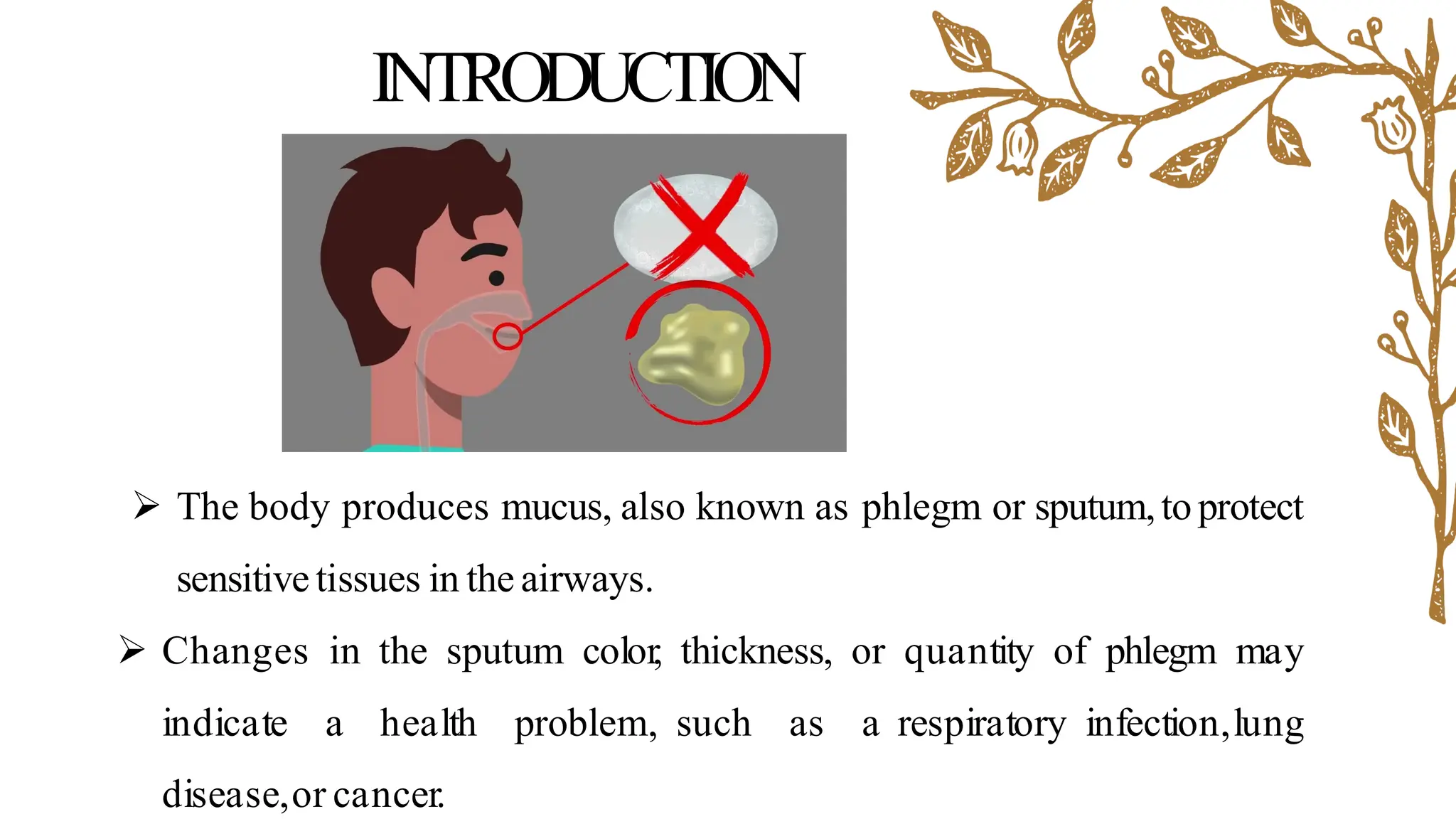
➢ The body produces mucus, also known as phlegm or sputum,to protect
sensitive tissues in the airways.
➢ Changes in the sputum color, thickness, or quantity of phlegm may
indicate a health problem, such as a respiratory infection,lung
disease,or cancer.
PROCEDURE
• The patients inhale and exhale through the
mouthpiece.
• An expectorate saliva into an emesis bowl and expectorate
sputum coughed up are collected into a sterile well-closed
container.
• The medical staff turns on the nebulizer device to allow the
patient to inhale the hypertonic mist for approximately five
minutes.
SPUTUMSAMPLE COLLECTION
❖ The cup is very clean. Don't open it until you are ready to
use it.
❖ As soon as you wake up in the morning (before you eat or
drink anything), brush your teeth and rinse your mouth with
water. Do not use mouthwash.
❖ If possible, go outside or open a window before collecting
the sputum sample. This helps protect other people from TB
germs when you cough.
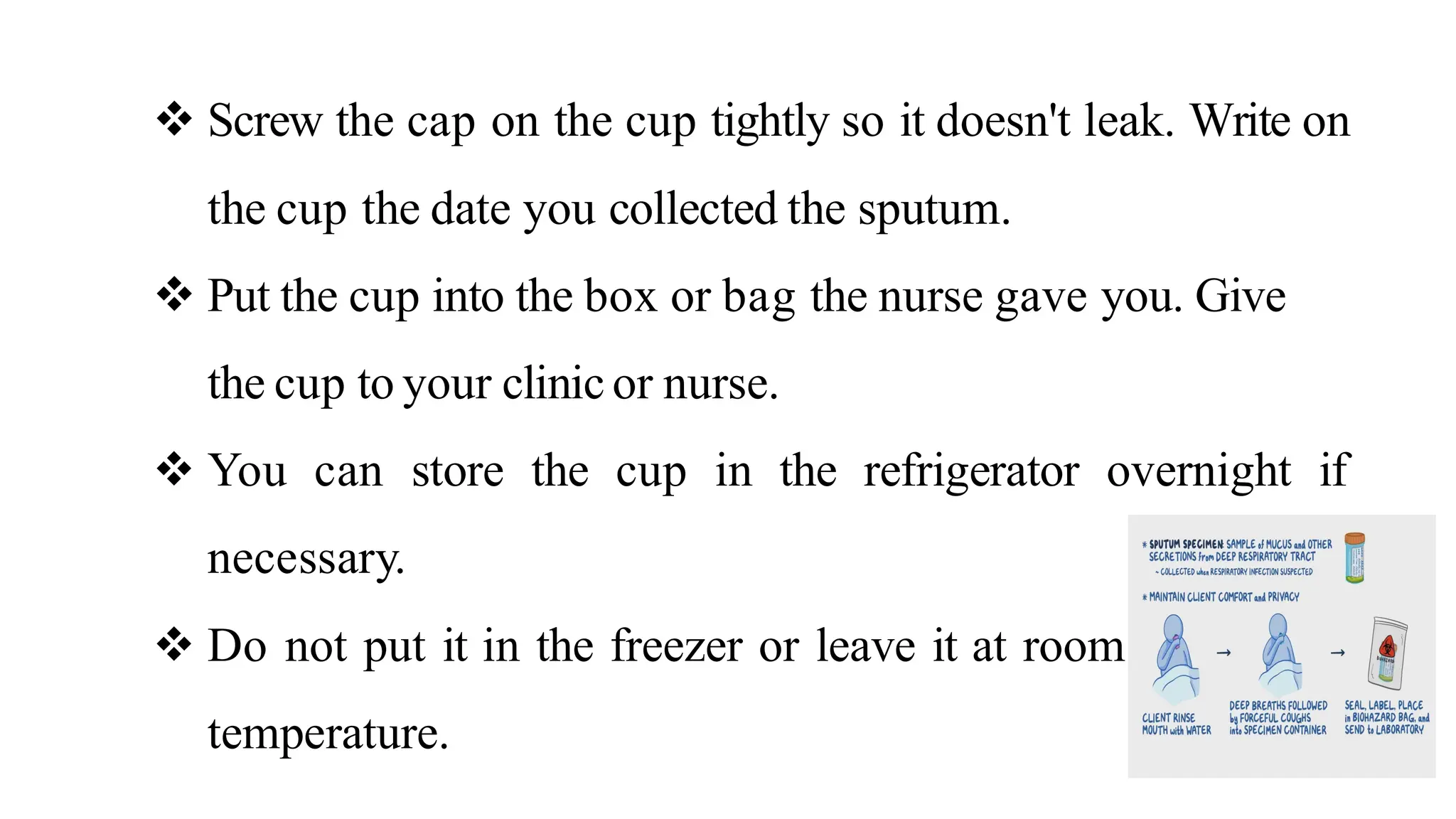
❖ Screw the cap on the cup tightly so it doesn't leak. Write on
the cup the date you collected the sputum.
❖ Put the cup into the box or bag the nurse gave you. Give
the cup to your clinic or nurse.
❖ You can store the cup in the refrigerator overnight if
necessary.
❖ Do not put it in the freezer or leave it at room
temperature.
HANDLINGANDTRANSPORT
• Replace lid after collection and close tightly to avoid
leakage.
• Bring container in the cooling box to the clinic as soon as
possible.
• Collect sputum in container provided. Avoid touching
inside or edge of specimen container or lid with finger.
Labeling
The sample should be labeled with the patient's name, hospital number, and
date of birth.Thelabel should also include the time and date of collection.
Documentation
The documentation should include the time and date of collection, the
amount and color of the sputum, and the procedure. Documentation is also required
for unsuccessful procedures.
Packaging
The sample should be placed in a specimen bag and transported to the
laboratory.Ifapplicable,alaboratory request formshould be attached to thebag.
PHYSICALEXAMINATION
Mucous sputum is clear or translucent and viscous,
containing only small numbers of microscopic
elements.Purulent sputumisoff- white,yelloworgreen,
and opaque.
MICROSCOPIC EXAMINATION
❑ Microscopic examination of sputum is used in identifying Paragonimus
westermani eggs, Strongyloides stercoralis larvae, Ascaris lumbricoides
larvae, hookworm larvae, and rarely Entamoeba histolytica.
❑ Sputum should be obtained from the lower respiratory passages rather than
a sample consisting mainlyof saliva.
QUALITY CONTROL CHECKS
✓ Followstandard guidelines.
✓ Everystep of theprocess,fromcollection to reporting,should be done
✓ accordingto standardguidelines.
✓ Performqualitycontrol tests.
✓ Duringdiagnostic tests,alaboratorytechnician should perform standardpositive,
sensitivityand negativecontrols.
✓ Don't report resultswithout qualitycontrol.
✓ No diagnosticresults should be reported if qualitycontrol measurementsarenot
authorized.
MOLECULAR TEST
▪ Polymerase chain reaction (PCR)
A test that looks for genetic material in a sputum sample.
It's often used to test for viral infections like influenza or
COVID-19.
▪ DNA mutation analysis
A rapid, low-cost, and sensitive technique for analyzing
sputum samples to diagnose lung cancer.
▪ DNA hypermethylation
A technique that involves adding a methyl group to
cytosines in DNA.
DOCUMENTATIONANDREPORTING
• Document all stepsof sputumcollection andprocessing in all
theLISor Laboratoryrecord.
• Report anydeviationsfrom expectedprocedures or results
promptlyto appropriatepersonnel.
REFERENCE
• https://en.m.wikipedia.org/wiki/Sputum
• https://www.medicalnewstoday.com/articles/3189 24
• https://www.physio-pedia.com/Sputum
THANKYOU

CLINICAL LABORATORY TECHNOLOGY-SPUTUM SAMPLE COLLECTION TECHNIQUES

  • 1.
    VIVEKANANDHA ARTS AND SCIENCECOLLEGE FOR WOMEN VEERACHIPALAYAM, SANGAKIRI - 6366007 TAMILNADU. DEPARTMENT OF MICROBIOLOGY SUBJECT : CLINICAL LABORATORY TECHNOLOGY TOPIC : SPUTUM SAMPLE COLLECTION TECHNIQUES SUBJECT INCHARGE PRESENTED BY Dr.V.BHARATHI,M.Sc.,M.Phil.,Ph.D. ASSISTANT PROFESSOR DEPARTMENT OF MICROBIOLOGY VIAAS, SANGAKIRI. AISWARYA R II B.Sc MICROBIOLOGY DEPARTMENT OF MICROBIOLOGY VIAAS, SANGAKIRI
  • 2.
    CONTENT ❖ INTRODUCTION ❖ PROCEDURE ❖SPUTUM SAMPLECOLLECTION ❖ HANDLINGAND TRANSPORT ❖ PHYSICALEXAMINATION ❖ MICROSCOPIC EXAMINATION ❖ QUALITYCONTROLCHECKS ❖ MOLECULARTEST ❖ DOCUMENTATIONANDREPORTING ❖ REFERENCE
  • 3.
  • 4.
    INTRODUCTION ➢ The bodyproduces mucus, also known as phlegm or sputum,to protect sensitive tissues in the airways. ➢ Changes in the sputum color, thickness, or quantity of phlegm may indicate a health problem, such as a respiratory infection,lung disease,or cancer.
  • 5.
    PROCEDURE • The patientsinhale and exhale through the mouthpiece. • An expectorate saliva into an emesis bowl and expectorate sputum coughed up are collected into a sterile well-closed container. • The medical staff turns on the nebulizer device to allow the patient to inhale the hypertonic mist for approximately five minutes.
  • 6.
    SPUTUMSAMPLE COLLECTION ❖ Thecup is very clean. Don't open it until you are ready to use it. ❖ As soon as you wake up in the morning (before you eat or drink anything), brush your teeth and rinse your mouth with water. Do not use mouthwash. ❖ If possible, go outside or open a window before collecting the sputum sample. This helps protect other people from TB germs when you cough.
  • 7.
    ❖ Screw thecap on the cup tightly so it doesn't leak. Write on the cup the date you collected the sputum. ❖ Put the cup into the box or bag the nurse gave you. Give the cup to your clinic or nurse. ❖ You can store the cup in the refrigerator overnight if necessary. ❖ Do not put it in the freezer or leave it at room temperature.
  • 8.
    HANDLINGANDTRANSPORT • Replace lidafter collection and close tightly to avoid leakage. • Bring container in the cooling box to the clinic as soon as possible. • Collect sputum in container provided. Avoid touching inside or edge of specimen container or lid with finger.
  • 9.
    Labeling The sample shouldbe labeled with the patient's name, hospital number, and date of birth.Thelabel should also include the time and date of collection. Documentation The documentation should include the time and date of collection, the amount and color of the sputum, and the procedure. Documentation is also required for unsuccessful procedures. Packaging The sample should be placed in a specimen bag and transported to the laboratory.Ifapplicable,alaboratory request formshould be attached to thebag.
  • 10.
    PHYSICALEXAMINATION Mucous sputum isclear or translucent and viscous, containing only small numbers of microscopic elements.Purulent sputumisoff- white,yelloworgreen, and opaque.
  • 11.
    MICROSCOPIC EXAMINATION ❑ Microscopicexamination of sputum is used in identifying Paragonimus westermani eggs, Strongyloides stercoralis larvae, Ascaris lumbricoides larvae, hookworm larvae, and rarely Entamoeba histolytica. ❑ Sputum should be obtained from the lower respiratory passages rather than a sample consisting mainlyof saliva.
  • 12.
    QUALITY CONTROL CHECKS ✓Followstandard guidelines. ✓ Everystep of theprocess,fromcollection to reporting,should be done ✓ accordingto standardguidelines. ✓ Performqualitycontrol tests. ✓ Duringdiagnostic tests,alaboratorytechnician should perform standardpositive, sensitivityand negativecontrols. ✓ Don't report resultswithout qualitycontrol. ✓ No diagnosticresults should be reported if qualitycontrol measurementsarenot authorized.
  • 13.
    MOLECULAR TEST ▪ Polymerasechain reaction (PCR) A test that looks for genetic material in a sputum sample. It's often used to test for viral infections like influenza or COVID-19. ▪ DNA mutation analysis A rapid, low-cost, and sensitive technique for analyzing sputum samples to diagnose lung cancer. ▪ DNA hypermethylation A technique that involves adding a methyl group to cytosines in DNA.
  • 14.
    DOCUMENTATIONANDREPORTING • Document allstepsof sputumcollection andprocessing in all theLISor Laboratoryrecord. • Report anydeviationsfrom expectedprocedures or results promptlyto appropriatepersonnel.
  • 15.
  • 16.