CLINICAL CHEMISTRY
By: Martha Tusabe
Jjuuko George William
•What are your expectations in this course?
•What do think clinical chemistry is?
Introduction to Clinical chemistry
• Clinical chemistry
• Biochemical analysis of body fluids to aid in disease diagnosis and treatment
• Testing utilizes chemical reactions to measure levels of chemical compounds
in body fluids
• Aims
• To provide students with knowledge, attitude and skills for
• Performing clinical chemistry investigations correctly
• Proper use and maintenance of equipment
• Providing sound advice to clinicians about the equipment used
Importance of clinical chemistry
• Provides the bases for diagnostic, prognostic, forensic and drug monitoring
• Points out special areas of interest in human health and indicators of
impending diseases
• Instrumentation made laboratory testing more efficient and productive
with reduced turn around time.
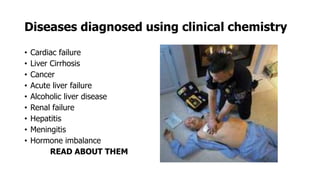
Diseases diagnosed using clinical chemistry
• Cardiac failure
• Liver Cirrhosis
• Cancer
• Acute liver failure
• Alcoholic liver disease
• Renal failure
• Hepatitis
• Meningitis
• Hormone imbalance
READ ABOUT THEM
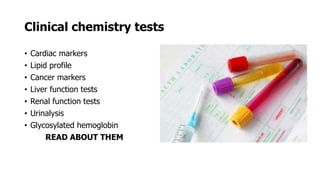
Clinical chemistry tests
• Cardiac markers
• Lipid profile
• Cancer markers
• Liver function tests
• Renal function tests
• Urinalysis
• Glycosylated hemoglobin
READ ABOUT THEM
Components identified in clinical chemistry
tests
• Most common specimens used
• Blood
• Urine
• Many different tests to detect and measure almost any type of chemical
component
• Blood glucose
• Electrolytes
• Enzymes
• Hormones
• lipids (fats)
• other metabolic substances and proteins
Components and their indications
• Blood glucose/ sugar
• Indicate how the body handles glucose
• Diagnose diabetes or hypoglycemia
• Electrolytes – sodium, potassium, chloride, bicarbonate, calcium,
phosphorus, and magnesium
• Indicate metabolic and kidney disorders
• Maintain electrical neutrality in cells and generate and conduct action
potentials in nerves and muscles
• Enzymes
• Released into the blood by organs that are damaged or diseased
• Type of enzyme released indicates which organ is affected
Methods of Clinical chemistry
• Clinical chemistry methods used in laboratories include:
• Electrophoresis
• Colorimetry
• Spectrophotometry
• Flame emission
• Atomic absorption and emission
• Test kits using ready-made reagents.
• Rapid solid phase (dry reagent) technologies, e.g. reagent strip tests.
• ELIZA – Enzyme Linked Immunosorbent Assay
• Direct read-out analyzers
The International System of Units/ Systeme
International (SI) d’Unites
• All measurements depend on units
• Serve as reference standards
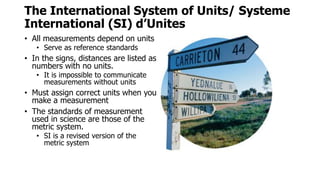
• In the signs, distances are listed as
numbers with no units.
• It is impossible to communicate
measurements without units
• Must assign correct units when you
make a measurement
• The standards of measurement
used in science are those of the
metric system.
• SI is a revised version of the
metric system
Measuring with SI Units
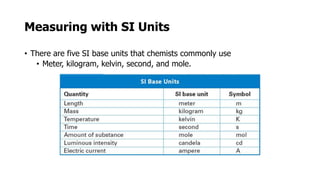
• There are five SI base units that chemists commonly use
• Meter, kilogram, kelvin, second, and mole.
Units and Quantities
What metric units are commonly used to measure length, volume,
mass, temperature and energy?
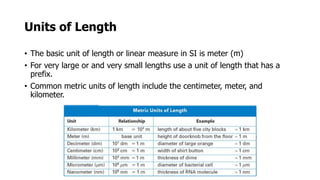
Units of Length
• The basic unit of length or linear measure in SI is meter (m)
• For very large or and very small lengths use a unit of length that has a
prefix.
• Common metric units of length include the centimeter, meter, and
kilometer.
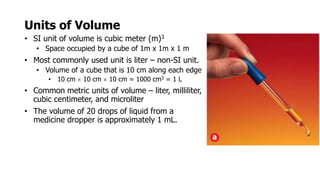
Units of Volume
• SI unit of volume is cubic meter (m)3
• Space occupied by a cube of 1m x 1m x 1 m
• Most commonly used unit is liter – non-SI unit.
• Volume of a cube that is 10 cm along each edge
• 10 cm  10 cm  10 cm = 1000 cm3 = 1 L
• Common metric units of volume – liter, milliliter,
cubic centimeter, and microliter
• The volume of 20 drops of liquid from a
medicine dropper is approximately 1 mL.
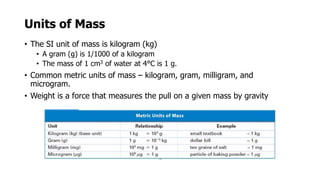
Units of Mass
• The SI unit of mass is kilogram (kg)
• A gram (g) is 1/1000 of a kilogram
• The mass of 1 cm3 of water at 4°C is 1 g.
• Common metric units of mass – kilogram, gram, milligram, and
microgram.
• Weight is a force that measures the pull on a given mass by gravity
Units of Temperature
• Temperature is a measure of how hot or cold an object is.
• Measured using thermometers
• Two equivalent units of temperature used by scientists are degree Celsius
and the kelvin.
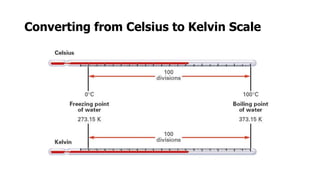
• The freezing and boiling points of water are 0°C and 100°C on the Celsius
scale
• They are 273.15k and 373.15 K on the Kelvin scale
• One degree on the Celsius scale is equivalent to one kelvin on the Kelvin scale
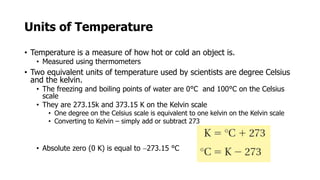
• Converting to Kelvin – simply add or subtract 273
• Absolute zero (0 K) is equal to 273.15 °C
Converting from Celsius to Kelvin Scale
Units of Energy
• Energy is the capacity to do work or to produce heat
• The SI unit for energy is joule (J)
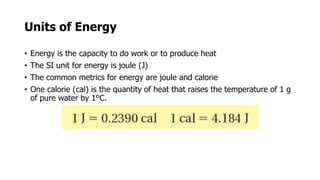
• The common metrics for energy are joule and calorie
• One calorie (cal) is the quantity of heat that raises the temperature of 1 g
of pure water by 1°C.
ANY QUESTIONS?

Clinical Chemistry_Lecture 1.pptx

  • 1.
    CLINICAL CHEMISTRY By: MarthaTusabe Jjuuko George William
  • 2.
    •What are yourexpectations in this course? •What do think clinical chemistry is?
  • 3.
    Introduction to Clinicalchemistry • Clinical chemistry • Biochemical analysis of body fluids to aid in disease diagnosis and treatment • Testing utilizes chemical reactions to measure levels of chemical compounds in body fluids • Aims • To provide students with knowledge, attitude and skills for • Performing clinical chemistry investigations correctly • Proper use and maintenance of equipment • Providing sound advice to clinicians about the equipment used
  • 4.
    Importance of clinicalchemistry • Provides the bases for diagnostic, prognostic, forensic and drug monitoring • Points out special areas of interest in human health and indicators of impending diseases • Instrumentation made laboratory testing more efficient and productive with reduced turn around time.
  • 5.
    Diseases diagnosed usingclinical chemistry • Cardiac failure • Liver Cirrhosis • Cancer • Acute liver failure • Alcoholic liver disease • Renal failure • Hepatitis • Meningitis • Hormone imbalance READ ABOUT THEM
  • 6.
    Clinical chemistry tests •Cardiac markers • Lipid profile • Cancer markers • Liver function tests • Renal function tests • Urinalysis • Glycosylated hemoglobin READ ABOUT THEM
  • 7.
    Components identified inclinical chemistry tests • Most common specimens used • Blood • Urine • Many different tests to detect and measure almost any type of chemical component • Blood glucose • Electrolytes • Enzymes • Hormones • lipids (fats) • other metabolic substances and proteins
  • 8.
    Components and theirindications • Blood glucose/ sugar • Indicate how the body handles glucose • Diagnose diabetes or hypoglycemia • Electrolytes – sodium, potassium, chloride, bicarbonate, calcium, phosphorus, and magnesium • Indicate metabolic and kidney disorders • Maintain electrical neutrality in cells and generate and conduct action potentials in nerves and muscles • Enzymes • Released into the blood by organs that are damaged or diseased • Type of enzyme released indicates which organ is affected
  • 9.
    Methods of Clinicalchemistry • Clinical chemistry methods used in laboratories include: • Electrophoresis • Colorimetry • Spectrophotometry • Flame emission • Atomic absorption and emission • Test kits using ready-made reagents. • Rapid solid phase (dry reagent) technologies, e.g. reagent strip tests. • ELIZA – Enzyme Linked Immunosorbent Assay • Direct read-out analyzers
  • 10.
    The International Systemof Units/ Systeme International (SI) d’Unites • All measurements depend on units • Serve as reference standards • In the signs, distances are listed as numbers with no units. • It is impossible to communicate measurements without units • Must assign correct units when you make a measurement • The standards of measurement used in science are those of the metric system. • SI is a revised version of the metric system
  • 11.
    Measuring with SIUnits • There are five SI base units that chemists commonly use • Meter, kilogram, kelvin, second, and mole.
  • 12.
    Units and Quantities Whatmetric units are commonly used to measure length, volume, mass, temperature and energy?
  • 13.
    Units of Length •The basic unit of length or linear measure in SI is meter (m) • For very large or and very small lengths use a unit of length that has a prefix. • Common metric units of length include the centimeter, meter, and kilometer.
  • 14.
    Units of Volume •SI unit of volume is cubic meter (m)3 • Space occupied by a cube of 1m x 1m x 1 m • Most commonly used unit is liter – non-SI unit. • Volume of a cube that is 10 cm along each edge • 10 cm  10 cm  10 cm = 1000 cm3 = 1 L • Common metric units of volume – liter, milliliter, cubic centimeter, and microliter • The volume of 20 drops of liquid from a medicine dropper is approximately 1 mL.
  • 15.
    Units of Mass •The SI unit of mass is kilogram (kg) • A gram (g) is 1/1000 of a kilogram • The mass of 1 cm3 of water at 4°C is 1 g. • Common metric units of mass – kilogram, gram, milligram, and microgram. • Weight is a force that measures the pull on a given mass by gravity
  • 16.
    Units of Temperature •Temperature is a measure of how hot or cold an object is. • Measured using thermometers • Two equivalent units of temperature used by scientists are degree Celsius and the kelvin. • The freezing and boiling points of water are 0°C and 100°C on the Celsius scale • They are 273.15k and 373.15 K on the Kelvin scale • One degree on the Celsius scale is equivalent to one kelvin on the Kelvin scale • Converting to Kelvin – simply add or subtract 273 • Absolute zero (0 K) is equal to 273.15 °C
  • 17.
    Converting from Celsiusto Kelvin Scale
  • 18.
    Units of Energy •Energy is the capacity to do work or to produce heat • The SI unit for energy is joule (J) • The common metrics for energy are joule and calorie • One calorie (cal) is the quantity of heat that raises the temperature of 1 g of pure water by 1°C.
  • 19.