BRIEF SYMPTOM INVENTORY
INTRODUCTION
A 53-item self-report inventory
participants rate the extent to which they have been bothered on 5 point Likert scale (0 ="not at all" to
4="extremely") in the past week by various symptoms.
has nine subscales designed to assess individual symptom groups:
1. somatization (SOM)
2. obsessive-compulsive (OC)
3. interpersonal sensitivity (IS)
4. depression (DEP)
5. anxiety (ANX)
6. hostility (HOS)
7. phobic anxiety (PHB)
8. paranoid ideation (PAR)
9. psychoticism (PSY)
The BSI also includes three scales that capture global psychological
distress. three global indices of distress:
 Global Severity Index
 Positive Symptom Distress Index
 Positive Symptom Total
RATIONALE
BSI is typically to identify self-reported clinically relevant
psychological symptoms in adolescents and adults and to provide
an overview of a patient's symptoms and their intensity at a
specific point in time.
It is also useful to assess psychological symptoms in medical
patients, non-patients, and subjects for experimental studies. It can
be used in both cross-sectional and longitudinal studies, and it can
measure chronological sequences as well as pre- and post-ratings
HISTORY
BSI was developed from Symptom Checklist (SCL-90) in response to the
need for shorter evaluation tools that could be used in a variety of assessment
settings, including medical and industrial research studies.
SCI -90 itself was developed in 1973(Derogatis et al. 1973) and was based on
Hopkins Symptoms Checklist, whereas BSI was published in 1983 (Derogatis
& Melisaratos., 1983).
It was further revised in shorter from that is BSI-18 published in 2000
(Derogatis., 2000). and consist of three 6-item subscales: somatization,
depression, and anxiety. A GSI also can be calculated.
PSYCHOMETRIC PROPERTIES
1. RELIABILITY
Psychoticism has internal consistency and reliability.71, whereas Depression has
internal consistency reliability of .85, according to the authors. A number of
independent investigations have shown that the internal consistency reliability is
excellent. The three worldwide indexes have no alpha reliability stated. For each of
the nine symptom dimensions, the reliability obtained from test and retest ranges
from 0.68 (Somatization) to 0.91 (Phobic Anxiety) and from.87 (PSDI) to.90 (Global
Indices) for the three Global Indices (GSI). The level of internal consistency
(Cronbach's =0.96) is quite high (Derogatis, 1993).
PSYCHOMETRIC PROPERTIES
2. VALIDITY
The BSI has an excellent correlation with the following scales:
BSI Anxiety has a high correlation with the Anxiety subscale of the Depression
Anxiety Stress Scale (Pearson's r=0.61).
There is a strong correlation between the Depression Subscale of the BSI and the
depression subscale of Depression Anxiety Stress Scale (Pearson’s r =0.71)
(Derogatis, 1993).
Satisfaction with Life Scale (Spearman’s ρ=--0.64).
EQUIPMENT
BSI handbook and copyrighted forms are available for brief symptom inventory
(Derogatis, 1993).
ADMINISTRATION
 It can be self-reported as it is available in a self-report format and the professional
can administer it.
 Using a five-point scale having range of 0 (not at all) to 4, the responses of the
participants are rated (extremely).
 The responses of the participants indicate the level of distress during the last week.
 It may be given to anyone ages 13 years and older.
 Only Paper and a pencil are needed for administration.
CONTINUED…..
 It can also be administered through the computer.
 The administration time is 8-12 minutes.
 It can be self-administered or administered by a professional.
 The training required for the administration of this test is minimal.
LANGUAGE
Only reading knowledge that is equivalent to sixth-grade education is required
to understand this scale. This scale is available in English, French, and
Spanish.
TRAINING
BSI administration requires just minimal training. To get a handbook or
copyrighted form from a publisher, one must have a healthcare-related
specialist degree and an applicable certificate or license.
SCORING
Responses are ranked on five-point
scale, ranging from (Not at all) 0, (A
little bit) 1, (Moderately) 2, (Quite a
bit) 3and (extremely) which is
marked as 4. Each rank indicates the
intensity of distress experienced by
the respondent in past seven days.
Each dimension of nine primary symptoms contain specific items which are as
follows:
1. Somatization contains items 2, 7, 23, 29, 30, 33, and 37,
2. Obsession-Compulsion contains items 5, 15, 26, 27, 32, and 36,
3. Interpersonal sensitivity includes items 20, 21, 22, and 42,
4. Depression includes items 9, 16, 17, 18, 35, and 50,
5. Anxiety items 1, 12, 19, 38, 45, and 49,
6. Hostility includes items 6, 13, 40, 41, and 46,
7. Phobic Anxiety items 8, 28, 31, 43, and 47,
8. Paranoid Ideation items 4, 10, 24, 48, and 51,
9. Psychoticism items 3, 14, 34, 44, and 53.
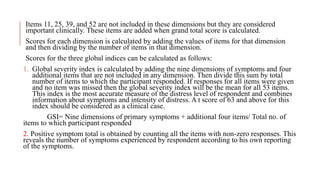
Items 11, 25, 39, and 52 are not included in these dimensions but they are considered
important clinically. These items are added when grand total score is calculated.
Scores for each dimension is calculated by adding the values of items for that dimension
and then dividing by the number of items in that dimension.
Scores for the three global indices can be calculated as follows:
1. Global severity index is calculated by adding the nine dimensions of symptoms and four
additional items that are not included in any dimension. Then divide this sum by total
number of items to which the participant responded. If responses for all items were given
and no item was missed then the global severity index will be the mean for all 53 items.
This index is the most accurate measure of the distress level of respondent and combines
information about symptoms and intensity of distress. A t score of 63 and above for this
index should be considered as a clinical case.
GSI= Nine dimensions of primary symptoms + additional four items/ Total no. of
items to which participant responded
2. Positive symptom total is obtained by counting all the items with non-zero responses. This
reveals the number of symptoms experienced by respondent according to his own reporting
of the symptoms.
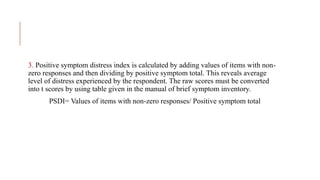
3. Positive symptom distress index is calculated by adding values of items with non-
zero responses and then dividing by positive symptom total. This reveals average
level of distress experienced by the respondent. The raw scores must be converted
into t scores by using table given in the manual of brief symptom inventory.
PSDI= Values of items with non-zero responses/ Positive symptom total
INTERPRETATION OF SCORES
Scoring is interpreted by comparison to age appropriate norms. Normative
data for four different samples including adult non-patients, adult psychiatric
out-patients and in-patients and adolescents non-patients is available in the
manual. A global severity index score of 63 or above is considered a clinical
case. From table 16 to 19 in the manual, the mean raw score for 9 dimensions
and three global is included, for each of four samples.
USES OF BSI
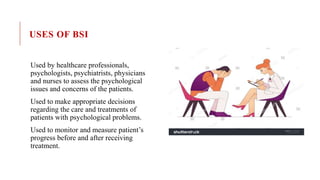
Used by healthcare professionals,
psychologists, psychiatrists, physicians
and nurses to assess the psychological
issues and concerns of the patients.
Used to make appropriate decisions
regarding the care and treatments of
patients with psychological problems.
Used to monitor and measure patient’s
progress before and after receiving
treatment.
Based on the patient’s available
information, BSI can be used to
calculate the outcomes of the treatment
plan.
A more recent version of this scale i.e
BSI-18 is used to reveal any psychiatric
disorder present in medical and
community population, if any.
A number of BSI translations are
available, including Spanish, Italian and
French etc. making it useable
worldwide.
REFERENCES
Derogatis, L. R., Lipman, R. S., & Covi, L. (1973). SCL-90: An outpatient
psychiatric rating scale: Preliminary report. Psychopharmacology Bulletin, 9, 13–28.
Derogatis, L. R., & Melisaratos, N. (1983). The Brief Symptom Inventory: An
introductory report. Psychological Medicine, 13, 595–605.
Derogatis, L. R. (1993). Brief Symptom Inventory (BSI): Administration, Scoring,
and Procedures Manual 4th edition. Minneapolis: NCS Pearson.
Derogatis, L. R. (2000). Brief Symptom Inventory-18 (BSI-18): Administration,
scoring, and procedures manual. Minneapolis: National Computer Systems

Clinical Assessment Final project (1).pptx

  • 1.
  • 2.
    INTRODUCTION A 53-item self-reportinventory participants rate the extent to which they have been bothered on 5 point Likert scale (0 ="not at all" to 4="extremely") in the past week by various symptoms. has nine subscales designed to assess individual symptom groups: 1. somatization (SOM) 2. obsessive-compulsive (OC) 3. interpersonal sensitivity (IS) 4. depression (DEP) 5. anxiety (ANX) 6. hostility (HOS) 7. phobic anxiety (PHB) 8. paranoid ideation (PAR) 9. psychoticism (PSY)
  • 3.
    The BSI alsoincludes three scales that capture global psychological distress. three global indices of distress:  Global Severity Index  Positive Symptom Distress Index  Positive Symptom Total
  • 4.
    RATIONALE BSI is typicallyto identify self-reported clinically relevant psychological symptoms in adolescents and adults and to provide an overview of a patient's symptoms and their intensity at a specific point in time. It is also useful to assess psychological symptoms in medical patients, non-patients, and subjects for experimental studies. It can be used in both cross-sectional and longitudinal studies, and it can measure chronological sequences as well as pre- and post-ratings
  • 5.
    HISTORY BSI was developedfrom Symptom Checklist (SCL-90) in response to the need for shorter evaluation tools that could be used in a variety of assessment settings, including medical and industrial research studies. SCI -90 itself was developed in 1973(Derogatis et al. 1973) and was based on Hopkins Symptoms Checklist, whereas BSI was published in 1983 (Derogatis & Melisaratos., 1983). It was further revised in shorter from that is BSI-18 published in 2000 (Derogatis., 2000). and consist of three 6-item subscales: somatization, depression, and anxiety. A GSI also can be calculated.
  • 6.
    PSYCHOMETRIC PROPERTIES 1. RELIABILITY Psychoticismhas internal consistency and reliability.71, whereas Depression has internal consistency reliability of .85, according to the authors. A number of independent investigations have shown that the internal consistency reliability is excellent. The three worldwide indexes have no alpha reliability stated. For each of the nine symptom dimensions, the reliability obtained from test and retest ranges from 0.68 (Somatization) to 0.91 (Phobic Anxiety) and from.87 (PSDI) to.90 (Global Indices) for the three Global Indices (GSI). The level of internal consistency (Cronbach's =0.96) is quite high (Derogatis, 1993).
  • 7.
    PSYCHOMETRIC PROPERTIES 2. VALIDITY TheBSI has an excellent correlation with the following scales: BSI Anxiety has a high correlation with the Anxiety subscale of the Depression Anxiety Stress Scale (Pearson's r=0.61). There is a strong correlation between the Depression Subscale of the BSI and the depression subscale of Depression Anxiety Stress Scale (Pearson’s r =0.71) (Derogatis, 1993). Satisfaction with Life Scale (Spearman’s ρ=--0.64).
  • 8.
    EQUIPMENT BSI handbook andcopyrighted forms are available for brief symptom inventory (Derogatis, 1993).
  • 9.
    ADMINISTRATION  It canbe self-reported as it is available in a self-report format and the professional can administer it.  Using a five-point scale having range of 0 (not at all) to 4, the responses of the participants are rated (extremely).  The responses of the participants indicate the level of distress during the last week.  It may be given to anyone ages 13 years and older.  Only Paper and a pencil are needed for administration.
  • 10.
    CONTINUED…..  It canalso be administered through the computer.  The administration time is 8-12 minutes.  It can be self-administered or administered by a professional.  The training required for the administration of this test is minimal.
  • 11.
    LANGUAGE Only reading knowledgethat is equivalent to sixth-grade education is required to understand this scale. This scale is available in English, French, and Spanish.
  • 12.
    TRAINING BSI administration requiresjust minimal training. To get a handbook or copyrighted form from a publisher, one must have a healthcare-related specialist degree and an applicable certificate or license.
  • 13.
    SCORING Responses are rankedon five-point scale, ranging from (Not at all) 0, (A little bit) 1, (Moderately) 2, (Quite a bit) 3and (extremely) which is marked as 4. Each rank indicates the intensity of distress experienced by the respondent in past seven days.
  • 14.
    Each dimension ofnine primary symptoms contain specific items which are as follows: 1. Somatization contains items 2, 7, 23, 29, 30, 33, and 37, 2. Obsession-Compulsion contains items 5, 15, 26, 27, 32, and 36, 3. Interpersonal sensitivity includes items 20, 21, 22, and 42, 4. Depression includes items 9, 16, 17, 18, 35, and 50, 5. Anxiety items 1, 12, 19, 38, 45, and 49, 6. Hostility includes items 6, 13, 40, 41, and 46, 7. Phobic Anxiety items 8, 28, 31, 43, and 47, 8. Paranoid Ideation items 4, 10, 24, 48, and 51, 9. Psychoticism items 3, 14, 34, 44, and 53.
  • 15.
    Items 11, 25,39, and 52 are not included in these dimensions but they are considered important clinically. These items are added when grand total score is calculated. Scores for each dimension is calculated by adding the values of items for that dimension and then dividing by the number of items in that dimension. Scores for the three global indices can be calculated as follows: 1. Global severity index is calculated by adding the nine dimensions of symptoms and four additional items that are not included in any dimension. Then divide this sum by total number of items to which the participant responded. If responses for all items were given and no item was missed then the global severity index will be the mean for all 53 items. This index is the most accurate measure of the distress level of respondent and combines information about symptoms and intensity of distress. A t score of 63 and above for this index should be considered as a clinical case. GSI= Nine dimensions of primary symptoms + additional four items/ Total no. of items to which participant responded 2. Positive symptom total is obtained by counting all the items with non-zero responses. This reveals the number of symptoms experienced by respondent according to his own reporting of the symptoms.
  • 16.
    3. Positive symptomdistress index is calculated by adding values of items with non- zero responses and then dividing by positive symptom total. This reveals average level of distress experienced by the respondent. The raw scores must be converted into t scores by using table given in the manual of brief symptom inventory. PSDI= Values of items with non-zero responses/ Positive symptom total
  • 17.
    INTERPRETATION OF SCORES Scoringis interpreted by comparison to age appropriate norms. Normative data for four different samples including adult non-patients, adult psychiatric out-patients and in-patients and adolescents non-patients is available in the manual. A global severity index score of 63 or above is considered a clinical case. From table 16 to 19 in the manual, the mean raw score for 9 dimensions and three global is included, for each of four samples.
  • 18.
    USES OF BSI Usedby healthcare professionals, psychologists, psychiatrists, physicians and nurses to assess the psychological issues and concerns of the patients. Used to make appropriate decisions regarding the care and treatments of patients with psychological problems. Used to monitor and measure patient’s progress before and after receiving treatment.
  • 19.
    Based on thepatient’s available information, BSI can be used to calculate the outcomes of the treatment plan. A more recent version of this scale i.e BSI-18 is used to reveal any psychiatric disorder present in medical and community population, if any. A number of BSI translations are available, including Spanish, Italian and French etc. making it useable worldwide.
  • 20.
    REFERENCES Derogatis, L. R.,Lipman, R. S., & Covi, L. (1973). SCL-90: An outpatient psychiatric rating scale: Preliminary report. Psychopharmacology Bulletin, 9, 13–28. Derogatis, L. R., & Melisaratos, N. (1983). The Brief Symptom Inventory: An introductory report. Psychological Medicine, 13, 595–605. Derogatis, L. R. (1993). Brief Symptom Inventory (BSI): Administration, Scoring, and Procedures Manual 4th edition. Minneapolis: NCS Pearson. Derogatis, L. R. (2000). Brief Symptom Inventory-18 (BSI-18): Administration, scoring, and procedures manual. Minneapolis: National Computer Systems