Climate
Change.
MITIGATION.
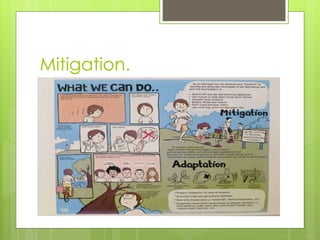
Mitigation.
What is Mitigation?
 Climate change mitigation consists of actions to limit
the magnitude or rate of long-term climate change.
Climate change mitigation generally involves
reductions in human emissions of greenhouse gases
(GHGs). Mitigation may also be achieved by increasing
the capacity of carbon sinks, e.g., through reforestation.
Mitigation policies can substantially reduce the risks
associated with human-induced global warming.
Mitigation strategies.
 Some of the mitigation strategies that would be discussed
during the lesson include;
--Avoided/reduced deforestation- “Avoided deforestation”
refers to reducing greenhouse gas emissions by not clearing
forests. This approach decreases the impact of climate
change while conserving biodiversity and protecting the 1.5
billion forest dependent peoples.
-Greenhouse gas emission reductions and limits.
-switching to low-carbon energy sources.
-Energy use in buildings for example reducing the cooling
load by
building shape and orientation.
-Renewable energy.
De Bono’s six thinking hats.
 To engage with the new content, I will use the De
Bono’s thinking hats. This method is an effective
way of teaching learners to view an issue from
different perspectives. Using this method forces
the learners to consider problems from different
perspectives, and so encourages better thinking.
 As teachers we tend to think about matters in a
particular way because of the knowledge we
already have, but some people are more
emotional thinkers, and others are more factual.
 In addition to the hats, open ended questions will
be used so that the conversation flows.
 Instead of placing the learners into
groups, the learners and teacher will
tackle one hat at a time.
Learner activity- engaging in discussion
according to hat color.
Teacher activity-making sure that the
discussion runs smoothly by making sure
that learners listen and respect when the
other is talking.
The six hats.
 White hat.
The white hat basically deals with facts. It is the
hat that deals with details, figures, information
etc.
What is your understanding of mitigation?
What will happen if mitigation does not
happen?
What example can you give of a mitigation
strategy?
 Yellow hat.
This hat requires learners to look at the good
points regarding the topic or a certain
situation.
What is positive about climate change
mitigation?
Why do you agree that mitigation is the
best option?
 Red hat.
This hat allows the learners to use their emotions
to lead their thinking. It allows the learners to
also use their intuition and general feelings.
How do you feel about the issue of climate
change mitigation?
How does this apply to everyday life?
What will happen if nothing is done?
 Black hat.
This hat has the most important aspect in
engaging with the content which is critical
thinking. It prevents ones emotions from
dominating the topic at hand.
What could have caused this?
How do you know that?
What will be the result of…?
 Green hat.
This hat requires learners to come up with
solutions, learners should be creative and
come up with innovative suggestions or
ideas.
What are some of the possible solutions to
climate change mitigation?
What strategies should we use?
 Blue hat.
This is the hat that requires an overview of a
learners thinking. It offers the opportunity of
self-analysis, evaluation and holistic thinking.
Why do you believe that mitigation will
help?
Why do you agree/disagree?
 The blue hat is the one that will some up
the lesson and give a conclusion.
Loughran, Mulhall and
Berry(2003).
7. Teaching procedures and particular reasons
for using these to engage with this idea?
 I used De Bonos thinking hats and included
open ended questions. I chose this strategy
because it will keep the discussion going and
allows all the learners to participate.
8. Specific ways of ascertaining students’
understanding or confusion around this idea.
o To ensure understanding I will ask questions
like, what is it that you don’t understand?
References
https://en.wikipedia.org/wiki/Avoided_
Deforestation_Partners
https://www.balancedview.org/en/wel
come/the-real-solution-to-climate-
change/?gclid=CPqS-
sq1rcgCFQKD2wodGf8OwQ
Becoming A Teacher(2010). L Conley, J
De Beer, H Dunbar-Krige, E du Plesis, S
Gravett, L Lomofsky, V Merckel, I
November, R Osman, N Peterson, M
Robinson, M van der Merve,

Climate change

  • 1.
  • 2.
  • 3.
    What is Mitigation? Climate change mitigation consists of actions to limit the magnitude or rate of long-term climate change. Climate change mitigation generally involves reductions in human emissions of greenhouse gases (GHGs). Mitigation may also be achieved by increasing the capacity of carbon sinks, e.g., through reforestation. Mitigation policies can substantially reduce the risks associated with human-induced global warming.
  • 4.
    Mitigation strategies.  Someof the mitigation strategies that would be discussed during the lesson include; --Avoided/reduced deforestation- “Avoided deforestation” refers to reducing greenhouse gas emissions by not clearing forests. This approach decreases the impact of climate change while conserving biodiversity and protecting the 1.5 billion forest dependent peoples. -Greenhouse gas emission reductions and limits. -switching to low-carbon energy sources. -Energy use in buildings for example reducing the cooling load by building shape and orientation. -Renewable energy.
  • 5.
    De Bono’s sixthinking hats.  To engage with the new content, I will use the De Bono’s thinking hats. This method is an effective way of teaching learners to view an issue from different perspectives. Using this method forces the learners to consider problems from different perspectives, and so encourages better thinking.  As teachers we tend to think about matters in a particular way because of the knowledge we already have, but some people are more emotional thinkers, and others are more factual.  In addition to the hats, open ended questions will be used so that the conversation flows.
  • 6.
     Instead ofplacing the learners into groups, the learners and teacher will tackle one hat at a time. Learner activity- engaging in discussion according to hat color. Teacher activity-making sure that the discussion runs smoothly by making sure that learners listen and respect when the other is talking.
  • 7.
    The six hats. White hat. The white hat basically deals with facts. It is the hat that deals with details, figures, information etc. What is your understanding of mitigation? What will happen if mitigation does not happen? What example can you give of a mitigation strategy?
  • 8.
     Yellow hat. Thishat requires learners to look at the good points regarding the topic or a certain situation. What is positive about climate change mitigation? Why do you agree that mitigation is the best option?
  • 9.
     Red hat. Thishat allows the learners to use their emotions to lead their thinking. It allows the learners to also use their intuition and general feelings. How do you feel about the issue of climate change mitigation? How does this apply to everyday life? What will happen if nothing is done?
  • 10.
     Black hat. Thishat has the most important aspect in engaging with the content which is critical thinking. It prevents ones emotions from dominating the topic at hand. What could have caused this? How do you know that? What will be the result of…?
  • 11.
     Green hat. Thishat requires learners to come up with solutions, learners should be creative and come up with innovative suggestions or ideas. What are some of the possible solutions to climate change mitigation? What strategies should we use?
  • 12.
     Blue hat. Thisis the hat that requires an overview of a learners thinking. It offers the opportunity of self-analysis, evaluation and holistic thinking. Why do you believe that mitigation will help? Why do you agree/disagree?
  • 13.
     The bluehat is the one that will some up the lesson and give a conclusion.
  • 14.
    Loughran, Mulhall and Berry(2003). 7.Teaching procedures and particular reasons for using these to engage with this idea?  I used De Bonos thinking hats and included open ended questions. I chose this strategy because it will keep the discussion going and allows all the learners to participate. 8. Specific ways of ascertaining students’ understanding or confusion around this idea. o To ensure understanding I will ask questions like, what is it that you don’t understand?
  • 15.
    References https://en.wikipedia.org/wiki/Avoided_ Deforestation_Partners https://www.balancedview.org/en/wel come/the-real-solution-to-climate- change/?gclid=CPqS- sq1rcgCFQKD2wodGf8OwQ Becoming A Teacher(2010).L Conley, J De Beer, H Dunbar-Krige, E du Plesis, S Gravett, L Lomofsky, V Merckel, I November, R Osman, N Peterson, M Robinson, M van der Merve,