38
*Corresponding author: Tim Eaton, Sterile Manufacturing Specialist,
AstraZeneca, UK Operations, Silk Road Business Park, Macclesfield,
Cheshire, SK10 2NA; Email: tim.eaton@astrazeneca.com; Tel: +44(0)1625
514916.
European Journal of Parenteral & Pharmaceutical Sciences 2017; 22(2): 38-49
© 2017 Pharmaceutical and Healthcare Sciences Society
W Whyte1
and T Eaton2
1
James Watt Building South, University of Glasgow, Glasgow G12 8QQ
2
AstraZeneca, Macclesfield, Cheshire, SK10 2NA
Assessment of degree of risk from sources of
microbial contamination in cleanrooms; 3:
Overall application
Introduction
The European Commission and the Food and Drug
Administration in the USA suggest that risk management and
assessment methods should be used to identify and control
sources of microbial contamination1,2
. A risk management
method has been described by Whyte3,4
that is based on the
Hazard Analysis and Critical Control Point (HACCP) system
but reinterpreted for use in cleanrooms, and called Risk
Management of Contamination (RMC). This method is also
described in the PHSS Technical Monograph No 145
and has
the following steps.
1. Identify the sources and routes of contamination in the
cleanroom.
2. Assess the risks from these sources and routes and, where
appropriate, introduce or improve control methods to
reduce the risks.
3. Establish a monitoring programme using valid sampling
methods to monitor the hazards, or their control methods,
or both. Establish alert and action levels with measures to
be taken, when required, if these levels are exceeded.
4. Verify, on a continuing basis, that the contamination
control system is working well by reviewing product
contamination rates, environmental monitoring results,
risk assessment methods, control methods and monitoring
limits and, where appropriate, modify them accordingly.
5. Establish and maintain appropriate documentation.
6. Train the staff.
The second step in the above list is the assessment of the risks
from various sources and routes of contamination in a
cleanroom and the introduction, or improvement, of methods
used to control risk. This is the most difficult task and
discussed in a number of articles5–9
published by the authors
of this article. To assess risk, the sources that are transferred
through air, surface contact, and liquids have to be identified,
their routes of transfer to the product ascertained, and degree
of risk determined. Having obtained the degree of risk from
each source, it is necessary to consider whether the risk is
acceptable and, if not, what further contamination control
A method of calculating the degree of risk of sources of microbial contamination to products
manufactured in cleanrooms has been described in two previous articles. The degree of risk was
ascertained by calculating the number of microbes deposited (NMD) onto, or into, a product from
each source of contamination. The first article considered airborne sources, the second article
considered surface and liquid sources, and this final article considers all three sources. The NMD
method can be applied to various manufacturing methods and designs of cleanrooms but was
illustrated by a vial-filling process in a unidirectional airflow (UDAF) workstation located in a non-
UDAF cleanroom. The same example was used in this article to demonstrate how to control the
microbial risk, and included the use of a restricted access barrier system.
The risk to a patient is not only dependent on microbial contamination of pharmaceutical
products during manufacture in cleanrooms and controlled zones but the chance that any microbes
deposited in the product will survive and multiply during its shelf life, and this aspect of patient risk
is considered.
Key words: Risk assessment, risk management, degree of risk, sources of contamination, airborne
contamination, surface contact, liquid contamination, micro-organisms, microbe-carrying particles
(MCPs).
ASSESSMENT OF DEGREE OF RISK FROM SOURCES OF MICROBIAL CONTAMINATION IN CLEANROOMS; 3: OVERALL APPLICATION 39
methods should be utilised to reduce risk.
In addition to the risk of microbial contamination of
products manufactured in a cleanroom, the risk to patients
is dependent on the likelihood that microbes deposited in a
product will survive and multiply during shelf life. A
method for assessing this type of risk has been described
by Whyte and Eaton10
.
What does ‘risk’ mean in cleanrooms?
Risk is defined11
as ‘the combination of the severity of
harm and the probability of occurrence of that harm’, and
interpreted in a mathematical form by Equation 1.
Equation 1
Degree of risk = severity of harm × probability of harm
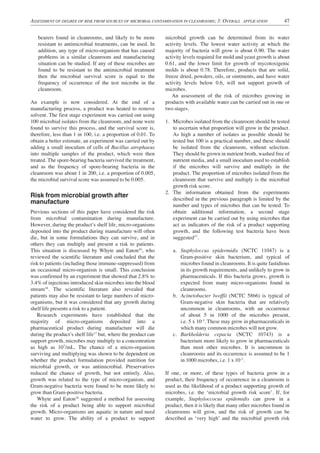
It follows that the degree of risk will increase from an
acceptable to an unacceptable level as the ‘severity’ and
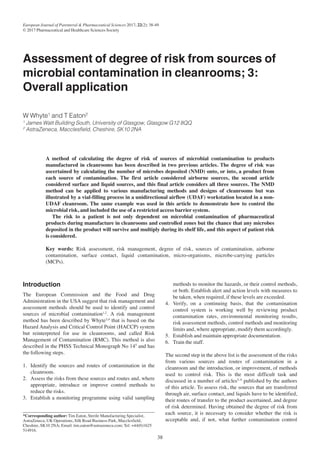
‘probability’ increases in the manner shown in Figure 1.
The same approach as above is advocated in the Failure
Mode and Effects Analysis (FMEA) in its Failure Mode
and Effects Criticality Analysis (FMECA) approach12
,
where a ‘criticality analysis’is used.
An alternative to criticality analysis is the use of the
Risk Priority Number (RPN), which includes ‘detection’
as a variable, and is calculated by the following equation.
Equation 2
Risk Priority Number (RPN) = severity x occurrence x
detection
The RPN approach is useful if risk can be detected before
it reaches the end user, and the effectiveness of the
detection method is variable. Detection of microbes can
be carried out in products by the sterility test but it is rare
to find microbes, and the method’s effectiveness does not
vary. Sampling of air, liquids and surfaces can be
considered to be detection methods, and their recovery
efficiency used as a measure of detection. However, the
recovery efficiency of sampling methods is often
unknown and the variation in the efficiency is generally
much smaller than severity and occurrence and of less
consequence. It is, therefore, considered that the detection
variable can be ignored and the criticality approach, as
given in Equation 1, should be used.
If the criticality analysis approach shown in Equation 1
is applied, the meaning of ‘severity’ and ‘occurrence’ in
cleanroom manufacturing needs to be established. This
has been obtained from the equations derived to determine
the number of microbes deposited into a product by means
of the different routes of transfer that are given in the
“Risk assessment by NMD method” section. These show
that the meaning of ‘severity of harm’ (also known as
‘criticality’), when applied to airborne or surface
microbial contamination of products manufactured in
cleanrooms, can be determined by the following risk
factors.
1. The concentration of microbes in, or on, the source of
contamination.
2. The ease by which microbes from a source are
dispersed, transferred and deposited into, or onto, a
product.
3. The area of product exposed to microbial deposition.
The second variable in Equation 1 is ‘frequency’ (also
known as ‘probability of harm’) and can be assessed in the
case of surface contamination from the number of contacts
with contaminated surfaces and, in the case of airborne
deposition, from the time the product is exposed to
airborne contamination. The risk factors of the two
variables in Equation 1 are assigned values, and the degree
of risk is obtained by multiplying these values together.
The degree of risk calculated by means of Equation 1
can be carried out by two methods, which are known as
the ‘descriptor’ and ‘number of microbes deposited’
(‘NMD’) methods. If limited information is available
about the risk factors, and actual values unknown, then the
‘descriptor’ method can be used. Descriptors, such as
‘high’, ‘medium’ and ‘low’, are chosen as a surrogate for
the actual numerical values, and allocated scores that are
multiplied together to give the degree of risk of a source.
This method has been described in the authors’ previous
publications5–9
but it has the following deficiencies.
• The allocation of descriptor values is subjective and
open to error.
• Descriptors are difficult to align with actual values of
the risk factors.
• The risk from different routes of contamination, i.e.
airborne, surface contact and liquid, have different
deposition mechanisms and the degree of risk cannot
be readily compared.
• Different manufacturing processes cannot be easily
compared, as the importance of the risk is likely to
reflect the type of manufacturing process, and different
descriptors and scores assigned to the same degree of
risk.
!
Figure 1. Increase in risk caused by an increase in the
frequency/probability and severity/criticality of an occurrence.
40 W WHYTE, T EATON
To overcome these drawbacks, Whyte and Eaton have
devised a more accurate method8,9
, in which actual values
of the risk factors are used to calculate the NMD from
each source into, or onto, a product.
Risk assessment by NMD method
The NMD method uses actual values for risk factors in the
three risk equations derived by Whyte and Eaton7–9
to
determine the NMD into, or onto, a product from a source
of microbial contamination through transfer by airborne,
surface contact and liquid. These equations are as follows.
Equation 3 –Airborne
NMDA = c*p*a*t*dv
Where, NMDA = number of airborne microbe-carrying
particles (MCPs) deposited onto a single product; c =
concentration of microbes in the airborne source; p =
proportion of MCPs transmitted from source to product; a
= area of product exposed to microbial deposition; t = time
of exposure to airborne deposition; and dv = deposition
velocity of MCPs through air.
The deposition velocity (dv) is the velocity of MCPs as
they fall through air and deposit onto a surface, such as a
product. The authors previously termed this the ‘settling
velocity’ but now consider that ‘deposition velocity’ is a
more precise and scientific term. Microbes do not
normally exist in room air as single cells, as they are
dispersed on skin particles by personnel, and have an
average aerodynamic diameter of about 12 µm13,14
. The
deposition velocity used in previous articles8,9
to calculate
the NMD was 0.46 cm/s. This is a reasonable value for use
in non-unidirectional airflow (non-UDAF) cleanrooms
and clean zones, or in non-UDAF isolators. However, the
exposure of products to airborne contamination often
occurs in UDAF systems, and recent research15
has shown
that as the concentration of airborne contamination
decreases, the deposition velocity increases. The
ventilation system of a cleanroom will remove smaller
sizes of airborne particles before they have time to deposit
on surfaces, but if more air is supplied to reduce the MCP
concentration, more of the larger sizes of particles will be
removed. The remaining particles will, therefore, have a
larger average size, and hence, a greater deposition
velocity. It is also possible that the greater velocity and
turbulent intensity of air associated with higher air supply
rates will increase the impaction of particles and hence the
deposition velocity. The deposition velocities reported for
different airborne concentrations in UDAF are given in
Table 1, and used to calculate the NMDA in this paper.
Equation 4 – Surface contact
NMDSC = c*p*a*n
Where, NMDSC = number of MCPs deposited onto a
single product by surface contact; c = concentration of
MCPs on the surface of a source; p = transfer coefficient
of MCPs from donating to receiving surface; a = area of
contact; and n = number of contacts.
Equation 4 is used to calculate the NMD onto a product by
contact with contaminated cleanroom and clean zone
surfaces, such as garments, gloves, etc. Most of the values
of the variables (risk factors) required to solve Equation 4
are likely to be known, or can be measured. However, the
proportion of microbes on the donating surface that are
transferred to a receiving surface, which is known as the
transfer coefficient, is not commonly known. Whyte and
Eaton16
carried out experiments and the following transfer
coefficients were obtained: gloves to stainless steel = 0.19,
stainless steel to stainless steel = 0.10, and clothing to
stainless steel = 0.06. These coefficients are similar and,
for simplification, a worst-case transfer coefficient of 0.2
is used in this article.
Equation 5 – Liquid
NMDL = c*p*v
Where, NMDL = number of liquid-borne microbes
deposited into a single product; c = concentration of
microbes in a liquid source; p = proportion of microbes
transferred from source to product; and v = volume of
liquid deposited into product.
Equation 5 is used to calculate the number of microbes
that are transferred from a source to a product by liquid.
The most accurate method of assessing the NMD onto
products is by using actual values of the risk factors.
Where it is not possible to obtain these values by
measurement, or from scientific literature, it will be
necessary to use the best estimate.
Description of cleanroom example
studied
The NMD method can be applied to any manufacturing
process in a cleanroom, if appropriate skills and
knowledge is available, but was previously illustrated by
an example of aseptic pharmaceutical manufacturing and
risk assessed from airborne sources8
, and surface contact
and liquid sources9
. However, owing to space limitations,
it was not possible to (a) compare all sources of microbial
contamination transferred by different routes, (b) apply
the NMD method to other designs of cleanrooms, or (c)
consider methods to control contamination risk. These are
considered in this article.
The cleanroom studied in the previous two articles was
similar to traditional designs of cleanrooms found in
pharmaceutical and medical device manufacturing, where
the manufacture of products is carried out in an open-
Table 1. Deposition velocities of MCPs in UDAF.
Airborne microbial concentration 0.1 0.5 1
(no./m3
)
Deposition velocity (cm/s) 3.55 2.04 1.61
ASSESSMENT OF DEGREE OF RISK FROM SOURCES OF MICROBIAL CONTAMINATION IN CLEANROOMS; 3: OVERALL APPLICATION 41
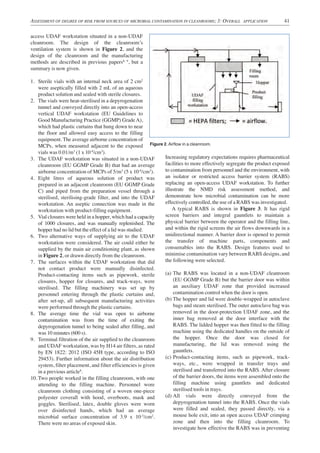
access UDAF workstation situated in a non-UDAF
cleanroom. The design of the cleanroom’s
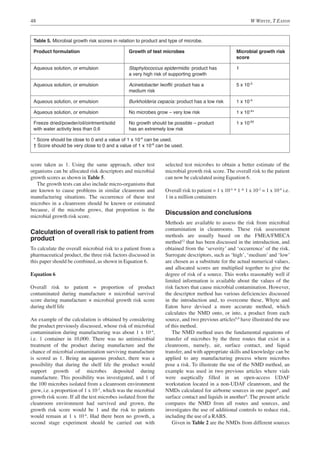
ventilation system is shown in Figure 2, and the
design of the cleanroom and the manufacturing
methods are described in previous papers8, 9
, but a
summary is now given.
1. Sterile vials with an internal neck area of 2 cm2
were aseptically filled with 2 mL of an aqueous
product solution and sealed with sterile closures.
2. The vials were heat-sterilised in a depyrogenation
tunnel and conveyed directly into an open-access
vertical UDAF workstation (EU Guidelines to
Good Manufacturing Practice (GGMP) GradeA),
which had plastic curtains that hung down to near
the floor and allowed easy access to the filling
equipment. The average airborne concentration of
MCPs, when measured adjacent to the exposed
vials was 0.01/m3
(1 x 10⁻⁸
/cm3
).
3. The UDAF workstation was situated in a non-UDAF
cleanroom (EU GGMP Grade B) that had an average
airborne concentration of MCPs of 5/m3
(5 x 10⁻⁶
/cm3
).
4. Eight litres of aqueous solution of product was
prepared in an adjacent cleanroom (EU GGMP Grade
C) and piped from the preparation vessel through a
sterilised, sterilising-grade filter, and into the UDAF
workstation. An aseptic connection was made in the
workstation with product-filling equipment.
5. Vial closures were held in a hopper, which had a capacity
of 1000 closures, and was manually replenished. The
hopper had no lid but the effect of a lid was studied.
6. Two alternative ways of supplying air to the UDAF
workstation were considered. The air could either be
supplied by the main air conditioning plant, as shown
in Figure 2, or drawn directly from the cleanroom.
7. The surfaces within the UDAF workstation that did
not contact product were manually disinfected.
Product-contacting items such as pipework, sterile
closures, hopper for closures, and track-ways, were
sterilised. The filling machinery was set up by
personnel entering through the plastic curtains and,
after set-up, all subsequent manufacturing activities
were performed through the plastic curtains.
8. The average time the vial was open to airborne
contamination was from the time of exiting the
depyrogenation tunnel to being sealed after filling, and
was 10 minutes (600 s).
9. Terminal filtration of the air supplied to the cleanroom
and UDAF workstation, was by H14 air filters, as rated
by EN 1822: 2012 (ISO 45H type, according to ISO
29453). Further information about the air distribution
system, filter placement, and filter efficiencies is given
in a previous article8
.
10. Two people worked in the filling cleanroom, with one
attending to the filling machine. Personnel wore
cleanroom clothing consisting of a woven one-piece
polyester coverall with hood, overboots, mask and
goggles. Sterilised, latex, double gloves were worn
over disinfected hands, which had an average
microbial surface concentration of 3.9 x 10⁻³
/cm2
.
There were no areas of exposed skin.
Increasing regulatory expectations requires pharmaceutical
facilities to more effectively segregate the product exposed
to contamination from personnel and the environment, with
an isolator or restricted access barrier system (RABS)
replacing an open-access UDAF workstation. To further
illustrate the NMD risk assessment method, and
demonstrate how microbial contamination can be more
effectively controlled, the use of a RABS was investigated.
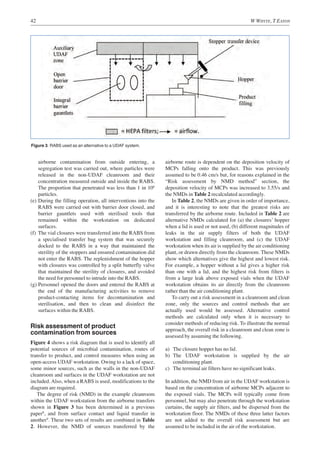
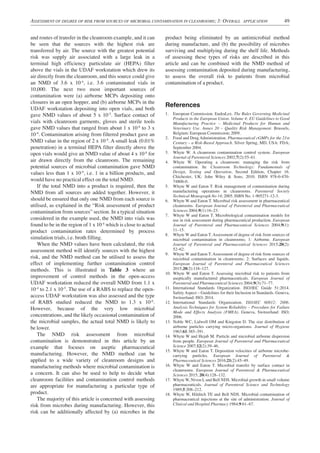
A typical RABS is shown in Figure 3. It has rigid
screen barriers and integral gauntlets to maintain a
physical barrier between the operator and the filling line,
and within the rigid screens the air flows downwards in a
unidirectional manner. A barrier door is opened to permit
the transfer of machine parts, components and
consumables into the RABS. Design features used to
minimise contamination vary between RABS designs, and
the following were selected.
(a) The RABS was located in a non-UDAF cleanroom
(EU GGMP Grade B) but the barrier door was within
an auxiliary UDAF zone that provided increased
contamination control when the door is open.
(b) The hopper and lid were double-wrapped in autoclave
bags and steam sterilised. The outer autoclave bag was
removed in the door-protection UDAF zone, and the
inner bag removed at the door interface with the
RABS. The lidded hopper was then fitted to the filling
machine using the dedicated handles on the outside of
the hopper. Once the door was closed for
manufacturing, the lid was removed using the
gauntlets.
(c) Product-contacting items, such as pipework, track-
ways, etc., were wrapped in transfer trays and
sterilised and transferred into the RABS. After closure
of the barrier doors, the items were assembled onto the
filling machine using gauntlets and dedicated
sterilised tools in trays.
(d) All vials were directly conveyed from the
depyrogenation tunnel into the RABS. Once the vials
were filled and sealed, they passed directly, via a
mouse hole exit, into an open access UDAF crimping
zone and then into the filling cleanroom. To
investigate how effective the RABS was in preventing
Figure 2. Airflow in a cleanroom.
42 W WHYTE, T EATON
airborne contamination from outside entering, a
segregation test was carried out, where particles were
released in the non-UDAF cleanroom and their
concentration measured outside and inside the RABS.
The proportion that penetrated was less than 1 in 106
particles.
(e) During the filling operation, all interventions into the
RABS were carried out with barrier door closed, and
barrier gauntlets used with sterilised tools that
remained within the workstation on dedicated
surfaces.
(f) The vial closures were transferred into the RABS from
a specialised transfer bag system that was securely
docked to the RABS in a way that maintained the
sterility of the stoppers and ensured contamination did
not enter the RABS. The replenishment of the hopper
with closures was controlled by a split butterfly valve
that maintained the sterility of closures, and avoided
the need for personnel to intrude into the RABS.
(g) Personnel opened the doors and entered the RABS at
the end of the manufacturing activities to remove
product-contacting items for decontamination and
sterilisation, and then to clean and disinfect the
surfaces within the RABS.
Risk assessment of product
contamination from sources
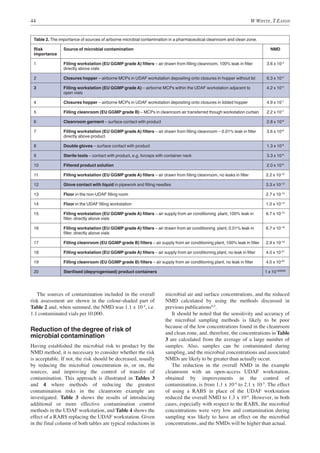
Figure 4 shows a risk diagram that is used to identify all
potential sources of microbial contamination, routes of
transfer to product, and control measures when using an
open-access UDAF workstation. Owing to a lack of space,
some minor sources, such as the walls in the non-UDAF
cleanroom and surfaces in the UDAF workstation are not
included. Also, when a RABS is used, modifications to the
diagram are required.
The degree of risk (NMD) in the example cleanroom
within the UDAF workstation from the airborne transfers
shown in Figure 3 has been determined in a previous
paper8
, and from surface contact and liquid transfer in
another9
. These two sets of results are combined in Table
2. However, the NMD of sources transferred by the
airborne route is dependent on the deposition velocity of
MCPs falling onto the product. This was previously
assumed to be 0.46 cm/s but, for reasons explained in the
“Risk assessment by NMD method” section, the
deposition velocity of MCPs was increased to 3.55/s and
the NMDs in Table 2 recalculated accordingly.
In Table 2, the NMDs are given in order of importance,
and it is interesting to note that the greatest risks are
transferred by the airborne route. Included in Table 2 are
alternative NMDs calculated for (a) the closures’ hopper
when a lid is used or not used, (b) different magnitudes of
leaks in the air supply filters of both the UDAF
workstation and filling cleanroom, and (c) the UDAF
workstation when its air is supplied by the air conditioning
plant, or drawn directly from the cleanroom. These NMDs
show which alternatives give the highest and lowest risk.
For example, a hopper without a lid gives a higher risk
than one with a lid, and the highest risk from filters is
from a large leak above exposed vials when the UDAF
workstation obtains its air directly from the cleanroom
rather than the air conditioning plant.
To carry out a risk assessment in a cleanroom and clean
zone, only the sources and control methods that are
actually used would be assessed. Alternative control
methods are calculated only when it is necessary to
consider methods of reducing risk. To illustrate the normal
approach, the overall risk in a cleanroom and clean zone is
assessed by assuming the following.
a) The closure hopper has no lid.
b) The UDAF workstation is supplied by the air
conditioning plant.
c) The terminal air filters have no significant leaks.
In addition, the NMD from air in the UDAF workstation is
based on the concentration of airborne MCPs adjacent to
the exposed vials. The MCPs will typically come from
personnel, but may also penetrate through the workstation
curtains, the supply air filters, and be dispersed from the
workstation floor. The NMDs of these three latter factors
are not added to the overall risk assessment but are
assumed to be included in the air of the workstation.
Figure 3. RABS used as an alternative to a UDAF system.
ASSESSMENT OF DEGREE OF RISK FROM SOURCES OF MICROBIAL CONTAMINATION IN CLEANROOMS; 3: OVERALL APPLICATION 43
Figure 4. Risk diagram showing sources of air, surface and liquid microbial contamination in a cleanroom with an open-access UDAF
system. Also included are the routes of transfer to product, and control methods. Air sources are shown in the top half of the figure, and
surface and liquid sources in the lower half.
44 W WHYTE, T EATON
The sources of contamination included in the overall
risk assessment are shown in the colour-shaded part of
Table 2 and, when summed, the NMD was 1.1 x 10⁻⁴
, i.e.
1.1 contaminated vials per 10,000.
Reduction of the degree of risk of
microbial contamination
Having established the microbial risk to product by the
NMD method, it is necessary to consider whether the risk
is acceptable. If not, the risk should be decreased, usually
by reducing the microbial concentration in, or on, the
sources, and improving the control of transfer of
contamination. This approach is illustrated in Tables 3
and 4 where methods of reducing the greatest
contamination risks in the cleanroom example are
investigated. Table 3 shows the results of introducing
additional or more effective contamination control
methods in the UDAF workstation, and Table 4 shows the
effect of a RABS replacing the UDAF workstation. Given
in the final column of both tables are typical reductions in
microbial air and surface concentrations, and the reduced
NMD calculated by using the methods discussed in
previous publications8,9
.
It should be noted that the sensitivity and accuracy of
the microbial sampling methods is likely to be poor
because of the low concentrations found in the cleanroom
and clean zone, and, therefore, the concentrations in Table
3 are calculated from the average of a large number of
samples. Also, samples can be contaminated during
sampling, and the microbial concentrations and associated
NMDs are likely to be greater than actually occur.
The reduction in the overall NMD in the example
cleanroom with an open-access UDAF workstation,
obtained by improvements in the control of
contamination, is from 1.1 x 10⁻⁴
to 2.1 x 10⁻⁵
. The effect
of using a RABS in place of the UDAF workstation
reduced the overall NMD to 1.3 x 10⁻⁶
. However, in both
cases, especially with respect to the RABS, the microbial
concentrations were very low and contamination during
sampling was likely to have an effect on the microbial
concentrations, and the NMDs will be higher than actual.
Table 2. The importance of sources of airborne microbial contamination in a pharmaceutical cleanroom and clean zone.
Risk Source of microbial contamination NMD
importance
1 Filling workstation (EU GGMP grade A) filters – air drawn from filling cleanroom, 100% leak in filter 3.6 x 10⁻⁴
directly above vials
2 Closures hopper – airborne MCPs in UDAF workstation depositing onto closures in hopper without lid 6.3 x 10⁻⁵
3 Filling workstation (EU GGMP grade A) – airborne MCPs within the UDAF workstation adjacent to 4.2 x 10⁻⁵
open vials
4 Closures hopper – airborne MCPs in UDAF workstation depositing onto closures in lidded hopper 4.9 x 10⁻⁷
5 Filling cleanroom (EU GGMP grade B) – MCPs in cleanroom air transferred though workstation curtain 2.2 x 10⁻⁷
6 Cleanroom garment – surface contact with product 2.8 x 10⁻⁸
7 Filling workstation (EU GGMP grade A) filters – air drawn from filling cleanroom – 0.01% leak in filter 3.6 x 10⁻⁸
directly above product
8 Double gloves – surface contact with product 1.3 x 10⁻⁸
9 Sterile tools – contact with product, e.g. forceps with container neck 3.3 x 10⁻⁹
10 Filtered product solution 2.0 x 10⁻⁹
11 Filling workstation (EU GGMP grade A) filters – air drawn from filling cleanroom, no leaks in filter 2.2 x 10⁻¹⁰
12 Glove contact with liquid in pipework and filling needles 3.3 x 10⁻¹²
13 Floor in the non-UDAF filling room 2.7 x 10⁻¹³
14 Floor in the UDAF filling workstation 1.0 x 10⁻¹³
15 Filling workstation (EU GGMP grade A) filters – air supply from air conditioning plant, 100% leak in 6.7 x 10⁻¹⁵
filter, directly above vials
16 Filling workstation (EU GGMP grade A) filters – air drawn from air conditioning plant, 0.01% leak in 6.7 x 10⁻¹⁹
filter, directly above vials
17 Filling cleanroom (EU GGMP grade B) filters – air supply from air conditioning plant, 100% leak in filter 2.9 x 10⁻¹⁹
18 Filling workstation (EU GGMP grade A) filters – air supply from air conditioning plant, no leak in filter 4.0 x 10⁻²¹
19 Filling cleanroom (EU GGMP grade B) filters – air supply from air conditioning plant, no leak in filter 4.0 x 10⁻²⁵
20 Sterilised (depyrogenised) product containers 1 x 10-300000
ASSESSMENT OF DEGREE OF RISK FROM SOURCES OF MICROBIAL CONTAMINATION IN CLEANROOMS; 3: OVERALL APPLICATION 45
Chance of microbial contamination
surviving manufacture
The number of MCPs that are likely to deposit into, or
onto, a single product manufactured in a cleanroom can be
calculated by the NMD method. However, there are
manufacturing methods, including sub-lethal heat
treatment, or the inclusion of chemicals in the product
formulation, which may kill microbes deposited into the
product. The proportion of microbes that survive this
antimicrobial action is called the ‘microbial survival
score’and can be obtained in one or two stages.
1. Microbes isolated from the cleanroom environment
Table 3. Reduction of risk (NMD) when using an open-access UDAF workstation.
Sources of Additional control methods Reduction of microbial concentration and NMD
microbial for reducing risk
contamination
Closures hopper The deposition of airborne (a) If a lid is fitted to the hopper, Table 2 shows the NMD can be
– MCPs MCPs onto closures can be reduced from 6.3 x 10⁻⁵
to 4.9 x10⁻⁷
depositing onto reduced by: (b) Reducing the airborne concentration of MCPs in the UDAF
closures in workstation is considered in the next section of this table,
hopper without (a) a lid on the hopper; where it is shown that the airborne concentration can be
a lid (b) reduction of airborne halved. The NMD will then be reduced from 4.9 x 10⁻⁷
to
MCPs in the UDAF 2.5 x 10⁻⁷
workstation; (c) If the hopper capacity is doubled, but the surface area
(c) reduction in the number remains the same, the number of replenishments would half,
of replenishments along with the NMD, which is finalised at 1.2 x 10⁻⁷
Filling The airborne concentration of (a) Highly-effective garments were already utilised, and no further
workstation – MCPs may be reduced by: improvements could be delivered
airborne MCPs (b) The floor’s NMD was very low at 10-13
and additional
within (a) more effective cleanroom cleaning would give no significant improvement
workstation garments; (c) The frequency of personnel working in the workstation was
(b) lowering the MCP halved and the NMD reduced from 4.2 x 10⁻⁵
to 2.1 x 10⁻⁵
concentration on the (d) The reduction in the penetration of MCPs from the non-UDAF
workstation floor; cleanroom and through the curtains is considered in the next
(c) reducing the frequency of section, where it is shown that the NMD can be reduced
personnel working in the from 2.1 x 10⁻⁷
to 5.3 x 10⁻⁸
. This will have no significant
workstation; effect on the NMD from airborne MCPs within the workstation
(d) reducing the concentration and the NMD is finalised at 2.1 x 10⁻⁵
of MCPs in the non-UDAF
cleanroom that pass
through the curtains
Non-UDAF The risk from MCPs in the (a) Highly-effective garments were already utilised, and no
filling non-UDAF cleanroom that further improvements could be delivered
cleanroom – pass through the curtain can (b) The MCPs on the UDAF workstation floor gives an
airborne MCPs be reduced as follows. insignificant NMD of 10-13
, and further cleaning would give
no significant improvement
(a) More effective garments (c) If the air supply rate is doubled from 3.33 m3
/s to 6.66 m3
/s,
worn in the cleanroom the airborne MCP concentration in the filling cleanroom can
(b) Lowering the concentration be halved from 5/m3
to 2.5/m3
of MCPs on the floor (d) The time the operator worked through the curtains was
(c) Greater air supply rate to halved. Using a proportion of MCPs that cross the curtain
the cleanroom of 1 x 10⁻⁴
, an MCP concentration in the cleanroom of 2.5/m3
,
(d) Reducing the frequency of and halving the time of working through the curtains, the
personnel working through calculation method previously used8
showed that the NMD
curtains was reduced from 2.1 x 10⁻⁷
to 5.3 x 10⁻⁸
Cleanroom The frequency of personnel If the possible frequency of contact of garment with product is
garment – attending to filling equipment halved, the NMD would be halved from 2.8 x 10⁻⁸
to 1.4 x 10⁻⁸
contact with could be reduced
product
Double gloves – The frequency of personnel If the possible frequency of contact of a glove with product is
contact with attending to filling equipment halved, the NMD would half from 1.3 x 10⁻⁸
to 6.6 x 10⁻⁹
product could be reduced
46 W WHYTE, T EATON
can be tested to ascertain the proportion that survives
antimicrobial treatment. These microbes should be
similar to the microflora in the cleanroom and sampled
without selection. The number of microbes tested
should be as high as practical, and 100 is a reasonable
number. Each micro-organism isolated should be
grown in nutrient broth, washed free of growth media,
and a small number of cells inoculated into the
product. Such a method is described by Whyte, Niven
and Bell17
. The antimicrobial treatment of the product
should be replicated, and the survival of the microbes
ascertained. The proportion of the microbial species
isolated from the cleanroom that survive the treatment
is the microbial survival score.
2. Additional information about the microbial survival
score can be obtained by using microbes that can be
found in cleanrooms that are more likely to survive
treatment of the product. For example, a mesophilic
spore bearer like Bacillus atrophaeus (ATCC 9372,
equivalent to NCIMB 8058), which is similar to spore-
Table 4. Reduction of risk (NMD) by use of a RABS.
Sources of RABS risk control methods Reduction of microbial concentration and NMD
microbial
contamination
Closures During set-up, a lid remains on the As discussed in the next section of this table, the airborne
hopper – MCPs hopper until the RABS door is closed concentration of MCPs in the RABS is 1.2 x 10⁻¹⁰
/cm3
. Using
depositing onto prior to start of manufacturing. It is the calculation method previously described8
, the NMD onto
closures in then removed using barrier gauntlets closures is shown to reduce from the 6.3 x 10⁻⁵
given in
hopper without Table 3, to 7.5 x 10⁻⁷
a lid Periodic replenishment of the
hopper is carried out using a split
butterfly transfer device that
maintains sterility of the closures.
There is no operator entry into the
RABS when closures are exposed
Filling During production, all There is no operator access into the RABS during production
workstation – manipulations in the RABS are and no dispersion of airborne MCPs. Also, by means of a
airborne MCPs by barrier gauntlets, with no separation test, where test particles were introduced into
within workstation operator entry the air outside the RABS, and the concentration measured
inside, the particle penetration was shown to be practically
zero. The MCP airborne concentration was found to be
1.2 x 10⁻¹⁰
/cm3
. Using the calculation method previously
described8
, the NMD was found to reduce from the
4.3 x 10⁻⁵
given in Table 3 to 5.1 x 10⁻⁷
Non-UDAF (a) The RABS has a rigid screen (a) The penetration of contamination into the RABS during
filling barrier, and the barrier door is production from the non-UDAF airflow cleanroom is
cleanroom closed during production. The considered to be practically zero, as is the NMD
effectiveness of the RABS in (b) The split-butterfly valve method is considered, for all
preventing an inflow of practical purposes, to ensure that no microbial
contamination from the non- contamination is introduced from the non-UDAF
UDAF cleanroom was cleanroom into the RABS
demonstrated by a segregation
test
(b) The RABS has a split-butterfly
valve that is used to introduce
closures aseptically
Cleanroom Contact with garments is eliminated As surface contact of garments with product is reduced to
garment – as personnel do not have access zero, so is the NMD
contact with into the RABS during production
product
Double gloves – The surface contamination on the The surface concentration on gauntlets in the RABS is
contact with barrier gauntlets within the RABS is reduced to 1.8 x 10⁻⁶
/cm2
. If there is a possible contact of
product reduced compared to gloves used gauntlets with product, then the previously-used calculation
by personnel in the UDAF method9
shows that the NMD reduces from 1.3 x 10⁻⁸
to
workstation 4.5 x 10⁻⁹
ASSESSMENT OF DEGREE OF RISK FROM SOURCES OF MICROBIAL CONTAMINATION IN CLEANROOMS; 3: OVERALL APPLICATION 47
bearers found in cleanrooms, and likely to be more
resistant to antimicrobial treatments, can be used. In
addition, any type of micro-organism that has caused
problems in a similar cleanroom and manufacturing
situation can be studied. If any of these microbes are
found to be resistant to the antimicrobial treatment
then the microbial survival score is equal to the
frequency of occurrence of the test microbe in the
cleanroom.
An example is now considered. At the end of a
manufacturing process, a product was heated to remove
solvent. The first stage experiment was carried out using
100 microbial isolates from the cleanroom, and none were
found to survive this process, and the survival score is,
therefore, less than 1 in 100, i.e. a proportion of 0.01. To
obtain a better estimate, an experiment was carried out by
adding a small inoculum of cells of Bacillus atrophaeus
into multiple samples of the product, which were then
treated. The spore-bearing bacteria survived the treatment,
and as the frequency of spore-bearing bacteria in the
cleanroom was about 1 in 200, i.e. a proportion of 0.005,
the microbial survival score was assumed to be 0.005.
Risk from microbial growth after
manufacture
Previous sections of this paper have considered the risk
from microbial contamination during manufacture.
However, during the product’s shelf life, micro-organisms
deposited into the product during manufacture will often
die, but in some formulations they can survive, and in
others they can multiply and present a risk to patients.
This situation is discussed by Whyte and Eaton10
, who
reviewed the scientific literature and concluded that the
risk to patients (including those immune-suppressed) from
an occasional micro-organism is small. This conclusion
was confirmed by an experiment that showed that 2.8% to
3.4% of injections introduced skin microbes into the blood
stream18
. The scientific literature also revealed that
patients may also be resistant to large numbers of micro-
organisms, but it was considered that any growth during
shelf life presents a risk to a patient.
Research experiments have established that the
majority of micro-organisms deposited into a
pharmaceutical product during manufacture will die
during the product’s shelf life17
but, where the product can
support growth, microbes may multiply to a concentration
as high as 107
/mL. The chance of a micro-organism
surviving and multiplying was shown to be dependent on
whether the product formulation provided nutrition for
microbial growth, or was antimicrobial. Preservatives
reduced the chance of growth, but not entirely. Also,
growth was related to the type of micro-organism, and
Gram-negative bacteria were found to be more likely to
grow than Gram-positive bacteria.
Whyte and Eaton10
suggested a method for assessing
the risk of a product being able to support microbial
growth. Micro-organisms are aquatic in nature and need
water to grow. The ability of a product to support
microbial growth can be determined from its water
activity levels. The lowest water activity at which the
majority of bacteria will grow is about 0.90. The water
activity levels required for mold and yeast growth is about
0.61, and the lower limit for growth of mycotoxigenic
molds is about 0.78. Therefore, products that are solid,
freeze dried, powders, oils, or ointments, and have water
activity levels below 0.6, will not support growth of
microbes.
An assessment of the risk of microbes growing in
products with available water can be carried out in one or
two stages.
1. Microbes isolated from the cleanroom should be tested
to ascertain what proportion will grow in the product.
As high a number of isolates as possible should be
tested but 100 is a practical number, and these should
be isolated from the cleanroom, without selection.
They should be grown in nutrient broth, washed free of
nutrient media, and a small inoculum used to establish
if the microbes will survive and multiply in the
product. The proportion of microbes isolated from the
cleanroom that survive and multiply is the microbial
growth risk score.
2. The information obtained from the experiments
described in the previous paragraph is limited by the
number and types of microbes that can be tested. To
obtain additional information, a second stage
experiment can be carried out by using microbes that
act as indicators of the risk of a product supporting
growth, and the following test bacteria have been
suggested17
.
a. Staphyloccus epidermidis (NCTC 11047) is a
Gram-positive skin bacterium, and typical of
microbes found in cleanrooms. It is quite fastidious
in its growth requirements, and unlikely to grow in
pharmaceuticals. If this bacteria grows, growth is
expected from many micro-organisms found in
cleanrooms.
b. Acinetobacter lwoffii (NCTC 5866) is typical of
Gram-negative skin bacteria that are relatively
uncommon in cleanrooms, with an occurrence
of about 5 in 1000 of the microbes present,
i.e. 5 x 10⁻³
. These may grow in pharmaceuticals in
which many common microbes will not grow.
c. Burkholderia cepacia (NCTC 10743) is a
bacterium more likely to grow in pharmaceuticals
than most other microbes. It is uncommon in
cleanrooms and its occurrence is assumed to be 1
in 1000 microbes, i.e. 1 x 10⁻³
.
If one, or more, of these types of bacteria grow in a
product, their frequency of occurrence in a cleanroom is
used as the likelihood of a product supporting growth of
microbes, i.e. the ‘microbial growth risk score’. If, for
example, Staphyloccocus epidemidis can grow in a
product, then it is likely that many other microbes found in
cleanrooms will grow, and the risk of growth can be
described as ‘very high’ and the microbial growth risk
48 W WHYTE, T EATON
score taken as 1. Using the same approach, other test
organisms can be allocated risk descriptors and microbial
growth scores as shown in Table 5.
The growth tests can also include micro-organisms that
are known to cause problems in similar cleanroom and
manufacturing situations. The occurrence of these test
microbes in a cleanroom should be known or estimated
because, if the microbe grows, that proportion is the
microbial growth risk score.
Calculation of overall risk to patient from
product
To calculate the overall microbial risk to a patient from a
pharmaceutical product, the three risk factors discussed in
this paper should be combined, as shown in Equation 6.
Equation 6
Overall risk to patient = proportion of product
contaminated during manufacture × microbial survival
score during manufacture × microbial growth risk score
during shelf life
An example of the calculation is obtained by considering
the product previously discussed, whose risk of microbial
contamination during manufacturing was about 1 x 10⁻⁴
,
i.e. 1 container in 10,000. There was no antimicrobial
treatment of the product during manufacture and the
chance of microbial contamination surviving manufacture
is scored as 1. Being an aqueous product, there was a
possibility that during the shelf life the product would
support growth of microbes deposited during
manufacture. This possibility was investigated, and 1 of
the 100 microbes isolated from a cleanroom environment
grew, i.e. a proportion of 1 x 10⁻²
, which was the microbial
growth risk score. If all the test microbes isolated from the
cleanroom environment had survived and grown, the
growth risk score would be 1 and the risk to patients
would remain at 1 x 10⁻⁴
. Had there been no growth, a
second stage experiment should be carried out with
selected test microbes to obtain a better estimate of the
microbial growth risk score. The overall risk to the patient
can now be calculated using Equation 6.
Overall risk to patient = 1 x 10-4
* 1 * 1 x 10-2
= 1 x 10⁻⁶
i.e.
1 in a million containers
Discussion and conclusions
Methods are available to assess the risk from microbial
contamination in cleanrooms. These risk assessment
methods are usually based on the FMEA/FMECA
method12
that has been discussed in the introduction, and
obtained from the ‘severity’ and ‘occurrence’ of the risk.
Surrogate descriptors, such as ‘high’, ‘medium’ and ‘low’
are chosen as a substitute for the actual numerical values,
and allocated scores are multiplied together to give the
degree of risk of a source. This works reasonably well if
limited information is available about the values of the
risk factors that cause microbial contamination. However,
the descriptor method has various deficiencies discussed
in the introduction and, to overcome these, Whyte and
Eaton have devised a more accurate method, which
calculates the NMD onto, or into, a product from each
source, and two previous articles8,9
have illustrated the use
of this method.
The NMD method uses the fundamental equations of
transfer of microbes by the three routes that exist in a
cleanroom, namely, air, surface contact, and liquid
transfer, and with appropriate skills and knowledge can be
applied to any manufacturing process where microbes
pose a risk. To illustrate the use of the NMD method, an
example was used in two previous articles where vials
were aseptically filled in an open-access UDAF
workstation located in a non-UDAF cleanroom, and the
NMDs calculated for airborne sources in one paper8
, and
surface contact and liquids in another9
. The present article
compares the NMD from all routes and sources, and
investigates the use of additional controls to reduce risk,
including the use of a RABS.
Given in Table 2 are the NMDs from different sources
Table 5. Microbial growth risk scores in relation to product and type of microbe.
Product formulation Growth of test microbes Microbial growth risk
score
Aqueous solution, or emulsion Staphylococcus epidermidis: product has 1
a very high risk of supporting growth
Aqueous solution, or emulsion Acinetobacter lwoffii: product has a 5 x 10⁻³
medium risk
Aqueous solution, or emulsion Burkholderia cepacia: product has a low risk 1 x 10⁻³
Aqueous solution, or emulsion No microbes grow – very low risk 1 x 10⁻⁴
*
Freeze dried/powder/oil/ointment/solid No growth should be possible – product 1 x 10⁻⁶†
with water activity less than 0.6 has an extremely low risk
* Score should be close to 0 and a value of 1 x 10⁻⁴
can be used.
† Score should be very close to 0 and a value of 1 x 10⁻⁶
can be used.
ASSESSMENT OF DEGREE OF RISK FROM SOURCES OF MICROBIAL CONTAMINATION IN CLEANROOMS; 3: OVERALL APPLICATION 49
and routes of transfer in the cleanroom example, and it can
be seen that the sources with the highest risk are
transferred by air. The source with the greatest potential
risk was supply air associated with a large leak in a
terminal high efficiency particulate air (HEPA) filter
above the vials in the UDAF workstation which drew its
air directly from the cleanroom, and this source could give
an NMD of 3.6 x 10⁻⁴
, i.e. 3.6 contaminated vials in
10,000. The next two most important sources of
contamination were (a) airborne MCPs depositing onto
closures in an open hopper, and (b) airborne MCPs in the
UDAF workstation depositing into open vials, and both
gave NMD values of about 5 x 10⁻⁵
. Surface contact of
vials with cleanroom garments, gloves and sterile tools
gave NMD values that ranged from about 1 x 10⁻⁸
to 3 x
10-9
. Contamination arising from filtered product gave an
NMD value in the region of 2 x 10⁻⁹
. A small leak (0.01%
penetration) in a terminal HEPA filter directly above the
open vials would give an NMD value of about 4 x 10⁻⁸
for
air drawn directly from the cleanroom. The remaining
potential sources of microbial contamination gave NMD
values less than 1 x 10⁻⁹
, i.e. 1 in a billion products, and
would have no practical effect on the total NMD.
If the total NMD into a product is required, then the
NMD from all sources are added together. However, it
should be ensured that only one NMD from each source is
utilised, as explained in the “Risk assessment of product
contamination from sources” section. In a typical situation
considered in the example used, the NMD into vials was
found to be in the region of 1 x 10⁻⁴
which is close to actual
product contamination rates determined by process
simulation trials, i.e. broth filling.
When the NMD values have been calculated, the risk
assessment method will identify sources with the highest
risk, and the NMD method can be utilised to assess the
effect of implementing further contamination control
methods. This is illustrated in Table 3 where an
improvement of control methods in the open-access
UDAF workstation reduced the overall NMD from 1.1 x
10-4
to 2.1 x 10⁻⁵
. The use of a RABS to replace the open-
access UDAF workstation was also assessed and the type
of RABS studied reduced the NMD to 1.3 x 10⁻⁶
.
However, because of the very low microbial
concentrations, and the likely occasional contamination of
the microbial samples, the actual total NMD is likely to
be lower.
The NMD risk assessment from microbial
contamination is demonstrated in this article by an
example that focuses on aseptic pharmaceutical
manufacturing. However, the NMD method can be
applied to a wide variety of cleanroom designs and
manufacturing methods where microbial contamination is
a concern. It can also be used to help to decide what
cleanroom facilities and contamination control methods
are appropriate for manufacturing a particular type of
product.
The majority of this article is concerned with assessing
risk from microbes during manufacturing. However, this
risk can be additionally affected by (a) microbes in the
product being eliminated by an antimicrobial method
during manufacture, and (b) the possibility of microbes
surviving and multiplying during the shelf life. Methods
of assessing these types of risks are described in this
article and can be combined with the NMD method of
assessing contamination deposited during manufacturing,
to assess the overall risk to patients from microbial
contamination of a product.
References
1. European Commission. EudraLex. The Rules Governing Medicinal
Products in the European Union. Volume 4: EU Guidelines to Good
Manufacturing Practice – Medicinal Products for Human and
Veterinary Use. Annex 20 – Quality Risk Management. Brussels,
Belgium: European Commission; 2009.
2. Food and Drug Administration. Pharmaceutical cGMPs for the 21st
Century – a Risk-Based Approach. Silver Spring, MD, USA: FDA;
September 2004.
3. Whyte W. A cleanroom contamination control system. European
Journal of Parenteral Sciences 2002;7(2):55–61.
4. Whyte W. Operating a cleanroom: managing the risk from
contamination. In: Cleanroom Technology: Fundamentals of
Design, Testing and Operation, Second Edition, Chapter 16.
Chichester, UK: John Wiley & Sons; 2010. ISBN 978-0-470-
74806-0.
5. Whyte W and Eaton T. Risk management of contamination during
manufacturing operations in cleanrooms. Parenteral Society
Technical Monograph No 14; 2005. ISBN No. 1-905271-12-3.
6. Whyte W and Eaton T. Microbial risk assessment in pharmaceutical
cleanrooms. European Journal of Parenteral and Pharmaceutical
Sciences 2004;9(1):16–23.
7. Whyte W and Eaton T. Microbiological contamination models for
use in risk assessment during pharmaceutical production. European
Journal of Parenteral and Pharmaceutical Sciences 2004;9(1):
11–15.
8. Whyte W and Eaton T. Assessment of degree of risk from sources of
microbial contamination in cleanrooms; 1: Airborne. European
Journal of Parenteral and Pharmaceutical Sciences 2015;20(2):
52–62.
9. Whyte W and Eaton T. Assessment of degree of risk from sources of
microbial contamination in cleanrooms; 2: Surfaces and liquids.
European Journal of Parenteral and Pharmaceutical Sciences
2015;20(2):118–127.
10. Whyte W and Eaton T. Assessing microbial risk to patients from
aseptically manufactured pharmaceuticals. European Journal of
Parenteral and Pharmaceutical Sciences 2004;9(3):71–77.
11. International Standards Organization. ISO/IEC Guide 51:2014.
Safety Aspect – Guidelines for their Inclusion in Standards. Geneva,
Switzerland: ISO; 2014.
12. International Standards Organization. ISO/IEC 60812: 2006.
Analysis Techniques for System Reliability – Procedure for Failure
Mode and Effects Analysis (FMEA). Geneva, Switzerland: ISO;
2006.
13. Noble WC, Lidwell OM and Kingston D. The size distribution of
airborne particles carrying micro-organisms. Journal of Hygiene
1963;61:385–391.
14. Whyte W and Hejab M. Particle and microbial airborne dispersion
from people. European Journal of Parenteral and Pharmaceutical
Science 2007;12(2):39–46.
15. Whyte W and Eaton T. Deposition velocities of airborne microbe-
carrying particles. European Journal of Parenteral &
Pharmaceutical Sciences 2016;21(2):45–49.
16. Whyte W and Eaton T. Microbial transfer by surface contact in
cleanrooms. European Journal of Parenteral & Pharmaceutical
Sciences 2015; 20(4):128–132.
17. Whyte W, Niven L and Bell NDS. Microbial growth in small volume
pharmaceuticals. Journal of Parenteral Science and Technology
1989;5:208–212.
18. Whyte W, Hilditch TE and Bell NDS. Microbial contamination of
pharmaceutical injections at the site of administration. Journal of
Clinical and Hospital Pharmacy 1984;9:61–67.

cleanroom contamination.pdf

  • 1.
    38 *Corresponding author: TimEaton, Sterile Manufacturing Specialist, AstraZeneca, UK Operations, Silk Road Business Park, Macclesfield, Cheshire, SK10 2NA; Email: tim.eaton@astrazeneca.com; Tel: +44(0)1625 514916. European Journal of Parenteral & Pharmaceutical Sciences 2017; 22(2): 38-49 © 2017 Pharmaceutical and Healthcare Sciences Society W Whyte1 and T Eaton2 1 James Watt Building South, University of Glasgow, Glasgow G12 8QQ 2 AstraZeneca, Macclesfield, Cheshire, SK10 2NA Assessment of degree of risk from sources of microbial contamination in cleanrooms; 3: Overall application Introduction The European Commission and the Food and Drug Administration in the USA suggest that risk management and assessment methods should be used to identify and control sources of microbial contamination1,2 . A risk management method has been described by Whyte3,4 that is based on the Hazard Analysis and Critical Control Point (HACCP) system but reinterpreted for use in cleanrooms, and called Risk Management of Contamination (RMC). This method is also described in the PHSS Technical Monograph No 145 and has the following steps. 1. Identify the sources and routes of contamination in the cleanroom. 2. Assess the risks from these sources and routes and, where appropriate, introduce or improve control methods to reduce the risks. 3. Establish a monitoring programme using valid sampling methods to monitor the hazards, or their control methods, or both. Establish alert and action levels with measures to be taken, when required, if these levels are exceeded. 4. Verify, on a continuing basis, that the contamination control system is working well by reviewing product contamination rates, environmental monitoring results, risk assessment methods, control methods and monitoring limits and, where appropriate, modify them accordingly. 5. Establish and maintain appropriate documentation. 6. Train the staff. The second step in the above list is the assessment of the risks from various sources and routes of contamination in a cleanroom and the introduction, or improvement, of methods used to control risk. This is the most difficult task and discussed in a number of articles5–9 published by the authors of this article. To assess risk, the sources that are transferred through air, surface contact, and liquids have to be identified, their routes of transfer to the product ascertained, and degree of risk determined. Having obtained the degree of risk from each source, it is necessary to consider whether the risk is acceptable and, if not, what further contamination control A method of calculating the degree of risk of sources of microbial contamination to products manufactured in cleanrooms has been described in two previous articles. The degree of risk was ascertained by calculating the number of microbes deposited (NMD) onto, or into, a product from each source of contamination. The first article considered airborne sources, the second article considered surface and liquid sources, and this final article considers all three sources. The NMD method can be applied to various manufacturing methods and designs of cleanrooms but was illustrated by a vial-filling process in a unidirectional airflow (UDAF) workstation located in a non- UDAF cleanroom. The same example was used in this article to demonstrate how to control the microbial risk, and included the use of a restricted access barrier system. The risk to a patient is not only dependent on microbial contamination of pharmaceutical products during manufacture in cleanrooms and controlled zones but the chance that any microbes deposited in the product will survive and multiply during its shelf life, and this aspect of patient risk is considered. Key words: Risk assessment, risk management, degree of risk, sources of contamination, airborne contamination, surface contact, liquid contamination, micro-organisms, microbe-carrying particles (MCPs).
  • 2.
    ASSESSMENT OF DEGREEOF RISK FROM SOURCES OF MICROBIAL CONTAMINATION IN CLEANROOMS; 3: OVERALL APPLICATION 39 methods should be utilised to reduce risk. In addition to the risk of microbial contamination of products manufactured in a cleanroom, the risk to patients is dependent on the likelihood that microbes deposited in a product will survive and multiply during shelf life. A method for assessing this type of risk has been described by Whyte and Eaton10 . What does ‘risk’ mean in cleanrooms? Risk is defined11 as ‘the combination of the severity of harm and the probability of occurrence of that harm’, and interpreted in a mathematical form by Equation 1. Equation 1 Degree of risk = severity of harm × probability of harm It follows that the degree of risk will increase from an acceptable to an unacceptable level as the ‘severity’ and ‘probability’ increases in the manner shown in Figure 1. The same approach as above is advocated in the Failure Mode and Effects Analysis (FMEA) in its Failure Mode and Effects Criticality Analysis (FMECA) approach12 , where a ‘criticality analysis’is used. An alternative to criticality analysis is the use of the Risk Priority Number (RPN), which includes ‘detection’ as a variable, and is calculated by the following equation. Equation 2 Risk Priority Number (RPN) = severity x occurrence x detection The RPN approach is useful if risk can be detected before it reaches the end user, and the effectiveness of the detection method is variable. Detection of microbes can be carried out in products by the sterility test but it is rare to find microbes, and the method’s effectiveness does not vary. Sampling of air, liquids and surfaces can be considered to be detection methods, and their recovery efficiency used as a measure of detection. However, the recovery efficiency of sampling methods is often unknown and the variation in the efficiency is generally much smaller than severity and occurrence and of less consequence. It is, therefore, considered that the detection variable can be ignored and the criticality approach, as given in Equation 1, should be used. If the criticality analysis approach shown in Equation 1 is applied, the meaning of ‘severity’ and ‘occurrence’ in cleanroom manufacturing needs to be established. This has been obtained from the equations derived to determine the number of microbes deposited into a product by means of the different routes of transfer that are given in the “Risk assessment by NMD method” section. These show that the meaning of ‘severity of harm’ (also known as ‘criticality’), when applied to airborne or surface microbial contamination of products manufactured in cleanrooms, can be determined by the following risk factors. 1. The concentration of microbes in, or on, the source of contamination. 2. The ease by which microbes from a source are dispersed, transferred and deposited into, or onto, a product. 3. The area of product exposed to microbial deposition. The second variable in Equation 1 is ‘frequency’ (also known as ‘probability of harm’) and can be assessed in the case of surface contamination from the number of contacts with contaminated surfaces and, in the case of airborne deposition, from the time the product is exposed to airborne contamination. The risk factors of the two variables in Equation 1 are assigned values, and the degree of risk is obtained by multiplying these values together. The degree of risk calculated by means of Equation 1 can be carried out by two methods, which are known as the ‘descriptor’ and ‘number of microbes deposited’ (‘NMD’) methods. If limited information is available about the risk factors, and actual values unknown, then the ‘descriptor’ method can be used. Descriptors, such as ‘high’, ‘medium’ and ‘low’, are chosen as a surrogate for the actual numerical values, and allocated scores that are multiplied together to give the degree of risk of a source. This method has been described in the authors’ previous publications5–9 but it has the following deficiencies. • The allocation of descriptor values is subjective and open to error. • Descriptors are difficult to align with actual values of the risk factors. • The risk from different routes of contamination, i.e. airborne, surface contact and liquid, have different deposition mechanisms and the degree of risk cannot be readily compared. • Different manufacturing processes cannot be easily compared, as the importance of the risk is likely to reflect the type of manufacturing process, and different descriptors and scores assigned to the same degree of risk. ! Figure 1. Increase in risk caused by an increase in the frequency/probability and severity/criticality of an occurrence.
  • 3.
    40 W WHYTE,T EATON To overcome these drawbacks, Whyte and Eaton have devised a more accurate method8,9 , in which actual values of the risk factors are used to calculate the NMD from each source into, or onto, a product. Risk assessment by NMD method The NMD method uses actual values for risk factors in the three risk equations derived by Whyte and Eaton7–9 to determine the NMD into, or onto, a product from a source of microbial contamination through transfer by airborne, surface contact and liquid. These equations are as follows. Equation 3 –Airborne NMDA = c*p*a*t*dv Where, NMDA = number of airborne microbe-carrying particles (MCPs) deposited onto a single product; c = concentration of microbes in the airborne source; p = proportion of MCPs transmitted from source to product; a = area of product exposed to microbial deposition; t = time of exposure to airborne deposition; and dv = deposition velocity of MCPs through air. The deposition velocity (dv) is the velocity of MCPs as they fall through air and deposit onto a surface, such as a product. The authors previously termed this the ‘settling velocity’ but now consider that ‘deposition velocity’ is a more precise and scientific term. Microbes do not normally exist in room air as single cells, as they are dispersed on skin particles by personnel, and have an average aerodynamic diameter of about 12 µm13,14 . The deposition velocity used in previous articles8,9 to calculate the NMD was 0.46 cm/s. This is a reasonable value for use in non-unidirectional airflow (non-UDAF) cleanrooms and clean zones, or in non-UDAF isolators. However, the exposure of products to airborne contamination often occurs in UDAF systems, and recent research15 has shown that as the concentration of airborne contamination decreases, the deposition velocity increases. The ventilation system of a cleanroom will remove smaller sizes of airborne particles before they have time to deposit on surfaces, but if more air is supplied to reduce the MCP concentration, more of the larger sizes of particles will be removed. The remaining particles will, therefore, have a larger average size, and hence, a greater deposition velocity. It is also possible that the greater velocity and turbulent intensity of air associated with higher air supply rates will increase the impaction of particles and hence the deposition velocity. The deposition velocities reported for different airborne concentrations in UDAF are given in Table 1, and used to calculate the NMDA in this paper. Equation 4 – Surface contact NMDSC = c*p*a*n Where, NMDSC = number of MCPs deposited onto a single product by surface contact; c = concentration of MCPs on the surface of a source; p = transfer coefficient of MCPs from donating to receiving surface; a = area of contact; and n = number of contacts. Equation 4 is used to calculate the NMD onto a product by contact with contaminated cleanroom and clean zone surfaces, such as garments, gloves, etc. Most of the values of the variables (risk factors) required to solve Equation 4 are likely to be known, or can be measured. However, the proportion of microbes on the donating surface that are transferred to a receiving surface, which is known as the transfer coefficient, is not commonly known. Whyte and Eaton16 carried out experiments and the following transfer coefficients were obtained: gloves to stainless steel = 0.19, stainless steel to stainless steel = 0.10, and clothing to stainless steel = 0.06. These coefficients are similar and, for simplification, a worst-case transfer coefficient of 0.2 is used in this article. Equation 5 – Liquid NMDL = c*p*v Where, NMDL = number of liquid-borne microbes deposited into a single product; c = concentration of microbes in a liquid source; p = proportion of microbes transferred from source to product; and v = volume of liquid deposited into product. Equation 5 is used to calculate the number of microbes that are transferred from a source to a product by liquid. The most accurate method of assessing the NMD onto products is by using actual values of the risk factors. Where it is not possible to obtain these values by measurement, or from scientific literature, it will be necessary to use the best estimate. Description of cleanroom example studied The NMD method can be applied to any manufacturing process in a cleanroom, if appropriate skills and knowledge is available, but was previously illustrated by an example of aseptic pharmaceutical manufacturing and risk assessed from airborne sources8 , and surface contact and liquid sources9 . However, owing to space limitations, it was not possible to (a) compare all sources of microbial contamination transferred by different routes, (b) apply the NMD method to other designs of cleanrooms, or (c) consider methods to control contamination risk. These are considered in this article. The cleanroom studied in the previous two articles was similar to traditional designs of cleanrooms found in pharmaceutical and medical device manufacturing, where the manufacture of products is carried out in an open- Table 1. Deposition velocities of MCPs in UDAF. Airborne microbial concentration 0.1 0.5 1 (no./m3 ) Deposition velocity (cm/s) 3.55 2.04 1.61
  • 4.
    ASSESSMENT OF DEGREEOF RISK FROM SOURCES OF MICROBIAL CONTAMINATION IN CLEANROOMS; 3: OVERALL APPLICATION 41 access UDAF workstation situated in a non-UDAF cleanroom. The design of the cleanroom’s ventilation system is shown in Figure 2, and the design of the cleanroom and the manufacturing methods are described in previous papers8, 9 , but a summary is now given. 1. Sterile vials with an internal neck area of 2 cm2 were aseptically filled with 2 mL of an aqueous product solution and sealed with sterile closures. 2. The vials were heat-sterilised in a depyrogenation tunnel and conveyed directly into an open-access vertical UDAF workstation (EU Guidelines to Good Manufacturing Practice (GGMP) GradeA), which had plastic curtains that hung down to near the floor and allowed easy access to the filling equipment. The average airborne concentration of MCPs, when measured adjacent to the exposed vials was 0.01/m3 (1 x 10⁻⁸ /cm3 ). 3. The UDAF workstation was situated in a non-UDAF cleanroom (EU GGMP Grade B) that had an average airborne concentration of MCPs of 5/m3 (5 x 10⁻⁶ /cm3 ). 4. Eight litres of aqueous solution of product was prepared in an adjacent cleanroom (EU GGMP Grade C) and piped from the preparation vessel through a sterilised, sterilising-grade filter, and into the UDAF workstation. An aseptic connection was made in the workstation with product-filling equipment. 5. Vial closures were held in a hopper, which had a capacity of 1000 closures, and was manually replenished. The hopper had no lid but the effect of a lid was studied. 6. Two alternative ways of supplying air to the UDAF workstation were considered. The air could either be supplied by the main air conditioning plant, as shown in Figure 2, or drawn directly from the cleanroom. 7. The surfaces within the UDAF workstation that did not contact product were manually disinfected. Product-contacting items such as pipework, sterile closures, hopper for closures, and track-ways, were sterilised. The filling machinery was set up by personnel entering through the plastic curtains and, after set-up, all subsequent manufacturing activities were performed through the plastic curtains. 8. The average time the vial was open to airborne contamination was from the time of exiting the depyrogenation tunnel to being sealed after filling, and was 10 minutes (600 s). 9. Terminal filtration of the air supplied to the cleanroom and UDAF workstation, was by H14 air filters, as rated by EN 1822: 2012 (ISO 45H type, according to ISO 29453). Further information about the air distribution system, filter placement, and filter efficiencies is given in a previous article8 . 10. Two people worked in the filling cleanroom, with one attending to the filling machine. Personnel wore cleanroom clothing consisting of a woven one-piece polyester coverall with hood, overboots, mask and goggles. Sterilised, latex, double gloves were worn over disinfected hands, which had an average microbial surface concentration of 3.9 x 10⁻³ /cm2 . There were no areas of exposed skin. Increasing regulatory expectations requires pharmaceutical facilities to more effectively segregate the product exposed to contamination from personnel and the environment, with an isolator or restricted access barrier system (RABS) replacing an open-access UDAF workstation. To further illustrate the NMD risk assessment method, and demonstrate how microbial contamination can be more effectively controlled, the use of a RABS was investigated. A typical RABS is shown in Figure 3. It has rigid screen barriers and integral gauntlets to maintain a physical barrier between the operator and the filling line, and within the rigid screens the air flows downwards in a unidirectional manner. A barrier door is opened to permit the transfer of machine parts, components and consumables into the RABS. Design features used to minimise contamination vary between RABS designs, and the following were selected. (a) The RABS was located in a non-UDAF cleanroom (EU GGMP Grade B) but the barrier door was within an auxiliary UDAF zone that provided increased contamination control when the door is open. (b) The hopper and lid were double-wrapped in autoclave bags and steam sterilised. The outer autoclave bag was removed in the door-protection UDAF zone, and the inner bag removed at the door interface with the RABS. The lidded hopper was then fitted to the filling machine using the dedicated handles on the outside of the hopper. Once the door was closed for manufacturing, the lid was removed using the gauntlets. (c) Product-contacting items, such as pipework, track- ways, etc., were wrapped in transfer trays and sterilised and transferred into the RABS. After closure of the barrier doors, the items were assembled onto the filling machine using gauntlets and dedicated sterilised tools in trays. (d) All vials were directly conveyed from the depyrogenation tunnel into the RABS. Once the vials were filled and sealed, they passed directly, via a mouse hole exit, into an open access UDAF crimping zone and then into the filling cleanroom. To investigate how effective the RABS was in preventing Figure 2. Airflow in a cleanroom.
  • 5.
    42 W WHYTE,T EATON airborne contamination from outside entering, a segregation test was carried out, where particles were released in the non-UDAF cleanroom and their concentration measured outside and inside the RABS. The proportion that penetrated was less than 1 in 106 particles. (e) During the filling operation, all interventions into the RABS were carried out with barrier door closed, and barrier gauntlets used with sterilised tools that remained within the workstation on dedicated surfaces. (f) The vial closures were transferred into the RABS from a specialised transfer bag system that was securely docked to the RABS in a way that maintained the sterility of the stoppers and ensured contamination did not enter the RABS. The replenishment of the hopper with closures was controlled by a split butterfly valve that maintained the sterility of closures, and avoided the need for personnel to intrude into the RABS. (g) Personnel opened the doors and entered the RABS at the end of the manufacturing activities to remove product-contacting items for decontamination and sterilisation, and then to clean and disinfect the surfaces within the RABS. Risk assessment of product contamination from sources Figure 4 shows a risk diagram that is used to identify all potential sources of microbial contamination, routes of transfer to product, and control measures when using an open-access UDAF workstation. Owing to a lack of space, some minor sources, such as the walls in the non-UDAF cleanroom and surfaces in the UDAF workstation are not included. Also, when a RABS is used, modifications to the diagram are required. The degree of risk (NMD) in the example cleanroom within the UDAF workstation from the airborne transfers shown in Figure 3 has been determined in a previous paper8 , and from surface contact and liquid transfer in another9 . These two sets of results are combined in Table 2. However, the NMD of sources transferred by the airborne route is dependent on the deposition velocity of MCPs falling onto the product. This was previously assumed to be 0.46 cm/s but, for reasons explained in the “Risk assessment by NMD method” section, the deposition velocity of MCPs was increased to 3.55/s and the NMDs in Table 2 recalculated accordingly. In Table 2, the NMDs are given in order of importance, and it is interesting to note that the greatest risks are transferred by the airborne route. Included in Table 2 are alternative NMDs calculated for (a) the closures’ hopper when a lid is used or not used, (b) different magnitudes of leaks in the air supply filters of both the UDAF workstation and filling cleanroom, and (c) the UDAF workstation when its air is supplied by the air conditioning plant, or drawn directly from the cleanroom. These NMDs show which alternatives give the highest and lowest risk. For example, a hopper without a lid gives a higher risk than one with a lid, and the highest risk from filters is from a large leak above exposed vials when the UDAF workstation obtains its air directly from the cleanroom rather than the air conditioning plant. To carry out a risk assessment in a cleanroom and clean zone, only the sources and control methods that are actually used would be assessed. Alternative control methods are calculated only when it is necessary to consider methods of reducing risk. To illustrate the normal approach, the overall risk in a cleanroom and clean zone is assessed by assuming the following. a) The closure hopper has no lid. b) The UDAF workstation is supplied by the air conditioning plant. c) The terminal air filters have no significant leaks. In addition, the NMD from air in the UDAF workstation is based on the concentration of airborne MCPs adjacent to the exposed vials. The MCPs will typically come from personnel, but may also penetrate through the workstation curtains, the supply air filters, and be dispersed from the workstation floor. The NMDs of these three latter factors are not added to the overall risk assessment but are assumed to be included in the air of the workstation. Figure 3. RABS used as an alternative to a UDAF system.
  • 6.
    ASSESSMENT OF DEGREEOF RISK FROM SOURCES OF MICROBIAL CONTAMINATION IN CLEANROOMS; 3: OVERALL APPLICATION 43 Figure 4. Risk diagram showing sources of air, surface and liquid microbial contamination in a cleanroom with an open-access UDAF system. Also included are the routes of transfer to product, and control methods. Air sources are shown in the top half of the figure, and surface and liquid sources in the lower half.
  • 7.
    44 W WHYTE,T EATON The sources of contamination included in the overall risk assessment are shown in the colour-shaded part of Table 2 and, when summed, the NMD was 1.1 x 10⁻⁴ , i.e. 1.1 contaminated vials per 10,000. Reduction of the degree of risk of microbial contamination Having established the microbial risk to product by the NMD method, it is necessary to consider whether the risk is acceptable. If not, the risk should be decreased, usually by reducing the microbial concentration in, or on, the sources, and improving the control of transfer of contamination. This approach is illustrated in Tables 3 and 4 where methods of reducing the greatest contamination risks in the cleanroom example are investigated. Table 3 shows the results of introducing additional or more effective contamination control methods in the UDAF workstation, and Table 4 shows the effect of a RABS replacing the UDAF workstation. Given in the final column of both tables are typical reductions in microbial air and surface concentrations, and the reduced NMD calculated by using the methods discussed in previous publications8,9 . It should be noted that the sensitivity and accuracy of the microbial sampling methods is likely to be poor because of the low concentrations found in the cleanroom and clean zone, and, therefore, the concentrations in Table 3 are calculated from the average of a large number of samples. Also, samples can be contaminated during sampling, and the microbial concentrations and associated NMDs are likely to be greater than actually occur. The reduction in the overall NMD in the example cleanroom with an open-access UDAF workstation, obtained by improvements in the control of contamination, is from 1.1 x 10⁻⁴ to 2.1 x 10⁻⁵ . The effect of using a RABS in place of the UDAF workstation reduced the overall NMD to 1.3 x 10⁻⁶ . However, in both cases, especially with respect to the RABS, the microbial concentrations were very low and contamination during sampling was likely to have an effect on the microbial concentrations, and the NMDs will be higher than actual. Table 2. The importance of sources of airborne microbial contamination in a pharmaceutical cleanroom and clean zone. Risk Source of microbial contamination NMD importance 1 Filling workstation (EU GGMP grade A) filters – air drawn from filling cleanroom, 100% leak in filter 3.6 x 10⁻⁴ directly above vials 2 Closures hopper – airborne MCPs in UDAF workstation depositing onto closures in hopper without lid 6.3 x 10⁻⁵ 3 Filling workstation (EU GGMP grade A) – airborne MCPs within the UDAF workstation adjacent to 4.2 x 10⁻⁵ open vials 4 Closures hopper – airborne MCPs in UDAF workstation depositing onto closures in lidded hopper 4.9 x 10⁻⁷ 5 Filling cleanroom (EU GGMP grade B) – MCPs in cleanroom air transferred though workstation curtain 2.2 x 10⁻⁷ 6 Cleanroom garment – surface contact with product 2.8 x 10⁻⁸ 7 Filling workstation (EU GGMP grade A) filters – air drawn from filling cleanroom – 0.01% leak in filter 3.6 x 10⁻⁸ directly above product 8 Double gloves – surface contact with product 1.3 x 10⁻⁸ 9 Sterile tools – contact with product, e.g. forceps with container neck 3.3 x 10⁻⁹ 10 Filtered product solution 2.0 x 10⁻⁹ 11 Filling workstation (EU GGMP grade A) filters – air drawn from filling cleanroom, no leaks in filter 2.2 x 10⁻¹⁰ 12 Glove contact with liquid in pipework and filling needles 3.3 x 10⁻¹² 13 Floor in the non-UDAF filling room 2.7 x 10⁻¹³ 14 Floor in the UDAF filling workstation 1.0 x 10⁻¹³ 15 Filling workstation (EU GGMP grade A) filters – air supply from air conditioning plant, 100% leak in 6.7 x 10⁻¹⁵ filter, directly above vials 16 Filling workstation (EU GGMP grade A) filters – air drawn from air conditioning plant, 0.01% leak in 6.7 x 10⁻¹⁹ filter, directly above vials 17 Filling cleanroom (EU GGMP grade B) filters – air supply from air conditioning plant, 100% leak in filter 2.9 x 10⁻¹⁹ 18 Filling workstation (EU GGMP grade A) filters – air supply from air conditioning plant, no leak in filter 4.0 x 10⁻²¹ 19 Filling cleanroom (EU GGMP grade B) filters – air supply from air conditioning plant, no leak in filter 4.0 x 10⁻²⁵ 20 Sterilised (depyrogenised) product containers 1 x 10-300000
  • 8.
    ASSESSMENT OF DEGREEOF RISK FROM SOURCES OF MICROBIAL CONTAMINATION IN CLEANROOMS; 3: OVERALL APPLICATION 45 Chance of microbial contamination surviving manufacture The number of MCPs that are likely to deposit into, or onto, a single product manufactured in a cleanroom can be calculated by the NMD method. However, there are manufacturing methods, including sub-lethal heat treatment, or the inclusion of chemicals in the product formulation, which may kill microbes deposited into the product. The proportion of microbes that survive this antimicrobial action is called the ‘microbial survival score’and can be obtained in one or two stages. 1. Microbes isolated from the cleanroom environment Table 3. Reduction of risk (NMD) when using an open-access UDAF workstation. Sources of Additional control methods Reduction of microbial concentration and NMD microbial for reducing risk contamination Closures hopper The deposition of airborne (a) If a lid is fitted to the hopper, Table 2 shows the NMD can be – MCPs MCPs onto closures can be reduced from 6.3 x 10⁻⁵ to 4.9 x10⁻⁷ depositing onto reduced by: (b) Reducing the airborne concentration of MCPs in the UDAF closures in workstation is considered in the next section of this table, hopper without (a) a lid on the hopper; where it is shown that the airborne concentration can be a lid (b) reduction of airborne halved. The NMD will then be reduced from 4.9 x 10⁻⁷ to MCPs in the UDAF 2.5 x 10⁻⁷ workstation; (c) If the hopper capacity is doubled, but the surface area (c) reduction in the number remains the same, the number of replenishments would half, of replenishments along with the NMD, which is finalised at 1.2 x 10⁻⁷ Filling The airborne concentration of (a) Highly-effective garments were already utilised, and no further workstation – MCPs may be reduced by: improvements could be delivered airborne MCPs (b) The floor’s NMD was very low at 10-13 and additional within (a) more effective cleanroom cleaning would give no significant improvement workstation garments; (c) The frequency of personnel working in the workstation was (b) lowering the MCP halved and the NMD reduced from 4.2 x 10⁻⁵ to 2.1 x 10⁻⁵ concentration on the (d) The reduction in the penetration of MCPs from the non-UDAF workstation floor; cleanroom and through the curtains is considered in the next (c) reducing the frequency of section, where it is shown that the NMD can be reduced personnel working in the from 2.1 x 10⁻⁷ to 5.3 x 10⁻⁸ . This will have no significant workstation; effect on the NMD from airborne MCPs within the workstation (d) reducing the concentration and the NMD is finalised at 2.1 x 10⁻⁵ of MCPs in the non-UDAF cleanroom that pass through the curtains Non-UDAF The risk from MCPs in the (a) Highly-effective garments were already utilised, and no filling non-UDAF cleanroom that further improvements could be delivered cleanroom – pass through the curtain can (b) The MCPs on the UDAF workstation floor gives an airborne MCPs be reduced as follows. insignificant NMD of 10-13 , and further cleaning would give no significant improvement (a) More effective garments (c) If the air supply rate is doubled from 3.33 m3 /s to 6.66 m3 /s, worn in the cleanroom the airborne MCP concentration in the filling cleanroom can (b) Lowering the concentration be halved from 5/m3 to 2.5/m3 of MCPs on the floor (d) The time the operator worked through the curtains was (c) Greater air supply rate to halved. Using a proportion of MCPs that cross the curtain the cleanroom of 1 x 10⁻⁴ , an MCP concentration in the cleanroom of 2.5/m3 , (d) Reducing the frequency of and halving the time of working through the curtains, the personnel working through calculation method previously used8 showed that the NMD curtains was reduced from 2.1 x 10⁻⁷ to 5.3 x 10⁻⁸ Cleanroom The frequency of personnel If the possible frequency of contact of garment with product is garment – attending to filling equipment halved, the NMD would be halved from 2.8 x 10⁻⁸ to 1.4 x 10⁻⁸ contact with could be reduced product Double gloves – The frequency of personnel If the possible frequency of contact of a glove with product is contact with attending to filling equipment halved, the NMD would half from 1.3 x 10⁻⁸ to 6.6 x 10⁻⁹ product could be reduced
  • 9.
    46 W WHYTE,T EATON can be tested to ascertain the proportion that survives antimicrobial treatment. These microbes should be similar to the microflora in the cleanroom and sampled without selection. The number of microbes tested should be as high as practical, and 100 is a reasonable number. Each micro-organism isolated should be grown in nutrient broth, washed free of growth media, and a small number of cells inoculated into the product. Such a method is described by Whyte, Niven and Bell17 . The antimicrobial treatment of the product should be replicated, and the survival of the microbes ascertained. The proportion of the microbial species isolated from the cleanroom that survive the treatment is the microbial survival score. 2. Additional information about the microbial survival score can be obtained by using microbes that can be found in cleanrooms that are more likely to survive treatment of the product. For example, a mesophilic spore bearer like Bacillus atrophaeus (ATCC 9372, equivalent to NCIMB 8058), which is similar to spore- Table 4. Reduction of risk (NMD) by use of a RABS. Sources of RABS risk control methods Reduction of microbial concentration and NMD microbial contamination Closures During set-up, a lid remains on the As discussed in the next section of this table, the airborne hopper – MCPs hopper until the RABS door is closed concentration of MCPs in the RABS is 1.2 x 10⁻¹⁰ /cm3 . Using depositing onto prior to start of manufacturing. It is the calculation method previously described8 , the NMD onto closures in then removed using barrier gauntlets closures is shown to reduce from the 6.3 x 10⁻⁵ given in hopper without Table 3, to 7.5 x 10⁻⁷ a lid Periodic replenishment of the hopper is carried out using a split butterfly transfer device that maintains sterility of the closures. There is no operator entry into the RABS when closures are exposed Filling During production, all There is no operator access into the RABS during production workstation – manipulations in the RABS are and no dispersion of airborne MCPs. Also, by means of a airborne MCPs by barrier gauntlets, with no separation test, where test particles were introduced into within workstation operator entry the air outside the RABS, and the concentration measured inside, the particle penetration was shown to be practically zero. The MCP airborne concentration was found to be 1.2 x 10⁻¹⁰ /cm3 . Using the calculation method previously described8 , the NMD was found to reduce from the 4.3 x 10⁻⁵ given in Table 3 to 5.1 x 10⁻⁷ Non-UDAF (a) The RABS has a rigid screen (a) The penetration of contamination into the RABS during filling barrier, and the barrier door is production from the non-UDAF airflow cleanroom is cleanroom closed during production. The considered to be practically zero, as is the NMD effectiveness of the RABS in (b) The split-butterfly valve method is considered, for all preventing an inflow of practical purposes, to ensure that no microbial contamination from the non- contamination is introduced from the non-UDAF UDAF cleanroom was cleanroom into the RABS demonstrated by a segregation test (b) The RABS has a split-butterfly valve that is used to introduce closures aseptically Cleanroom Contact with garments is eliminated As surface contact of garments with product is reduced to garment – as personnel do not have access zero, so is the NMD contact with into the RABS during production product Double gloves – The surface contamination on the The surface concentration on gauntlets in the RABS is contact with barrier gauntlets within the RABS is reduced to 1.8 x 10⁻⁶ /cm2 . If there is a possible contact of product reduced compared to gloves used gauntlets with product, then the previously-used calculation by personnel in the UDAF method9 shows that the NMD reduces from 1.3 x 10⁻⁸ to workstation 4.5 x 10⁻⁹
  • 10.
    ASSESSMENT OF DEGREEOF RISK FROM SOURCES OF MICROBIAL CONTAMINATION IN CLEANROOMS; 3: OVERALL APPLICATION 47 bearers found in cleanrooms, and likely to be more resistant to antimicrobial treatments, can be used. In addition, any type of micro-organism that has caused problems in a similar cleanroom and manufacturing situation can be studied. If any of these microbes are found to be resistant to the antimicrobial treatment then the microbial survival score is equal to the frequency of occurrence of the test microbe in the cleanroom. An example is now considered. At the end of a manufacturing process, a product was heated to remove solvent. The first stage experiment was carried out using 100 microbial isolates from the cleanroom, and none were found to survive this process, and the survival score is, therefore, less than 1 in 100, i.e. a proportion of 0.01. To obtain a better estimate, an experiment was carried out by adding a small inoculum of cells of Bacillus atrophaeus into multiple samples of the product, which were then treated. The spore-bearing bacteria survived the treatment, and as the frequency of spore-bearing bacteria in the cleanroom was about 1 in 200, i.e. a proportion of 0.005, the microbial survival score was assumed to be 0.005. Risk from microbial growth after manufacture Previous sections of this paper have considered the risk from microbial contamination during manufacture. However, during the product’s shelf life, micro-organisms deposited into the product during manufacture will often die, but in some formulations they can survive, and in others they can multiply and present a risk to patients. This situation is discussed by Whyte and Eaton10 , who reviewed the scientific literature and concluded that the risk to patients (including those immune-suppressed) from an occasional micro-organism is small. This conclusion was confirmed by an experiment that showed that 2.8% to 3.4% of injections introduced skin microbes into the blood stream18 . The scientific literature also revealed that patients may also be resistant to large numbers of micro- organisms, but it was considered that any growth during shelf life presents a risk to a patient. Research experiments have established that the majority of micro-organisms deposited into a pharmaceutical product during manufacture will die during the product’s shelf life17 but, where the product can support growth, microbes may multiply to a concentration as high as 107 /mL. The chance of a micro-organism surviving and multiplying was shown to be dependent on whether the product formulation provided nutrition for microbial growth, or was antimicrobial. Preservatives reduced the chance of growth, but not entirely. Also, growth was related to the type of micro-organism, and Gram-negative bacteria were found to be more likely to grow than Gram-positive bacteria. Whyte and Eaton10 suggested a method for assessing the risk of a product being able to support microbial growth. Micro-organisms are aquatic in nature and need water to grow. The ability of a product to support microbial growth can be determined from its water activity levels. The lowest water activity at which the majority of bacteria will grow is about 0.90. The water activity levels required for mold and yeast growth is about 0.61, and the lower limit for growth of mycotoxigenic molds is about 0.78. Therefore, products that are solid, freeze dried, powders, oils, or ointments, and have water activity levels below 0.6, will not support growth of microbes. An assessment of the risk of microbes growing in products with available water can be carried out in one or two stages. 1. Microbes isolated from the cleanroom should be tested to ascertain what proportion will grow in the product. As high a number of isolates as possible should be tested but 100 is a practical number, and these should be isolated from the cleanroom, without selection. They should be grown in nutrient broth, washed free of nutrient media, and a small inoculum used to establish if the microbes will survive and multiply in the product. The proportion of microbes isolated from the cleanroom that survive and multiply is the microbial growth risk score. 2. The information obtained from the experiments described in the previous paragraph is limited by the number and types of microbes that can be tested. To obtain additional information, a second stage experiment can be carried out by using microbes that act as indicators of the risk of a product supporting growth, and the following test bacteria have been suggested17 . a. Staphyloccus epidermidis (NCTC 11047) is a Gram-positive skin bacterium, and typical of microbes found in cleanrooms. It is quite fastidious in its growth requirements, and unlikely to grow in pharmaceuticals. If this bacteria grows, growth is expected from many micro-organisms found in cleanrooms. b. Acinetobacter lwoffii (NCTC 5866) is typical of Gram-negative skin bacteria that are relatively uncommon in cleanrooms, with an occurrence of about 5 in 1000 of the microbes present, i.e. 5 x 10⁻³ . These may grow in pharmaceuticals in which many common microbes will not grow. c. Burkholderia cepacia (NCTC 10743) is a bacterium more likely to grow in pharmaceuticals than most other microbes. It is uncommon in cleanrooms and its occurrence is assumed to be 1 in 1000 microbes, i.e. 1 x 10⁻³ . If one, or more, of these types of bacteria grow in a product, their frequency of occurrence in a cleanroom is used as the likelihood of a product supporting growth of microbes, i.e. the ‘microbial growth risk score’. If, for example, Staphyloccocus epidemidis can grow in a product, then it is likely that many other microbes found in cleanrooms will grow, and the risk of growth can be described as ‘very high’ and the microbial growth risk
  • 11.
    48 W WHYTE,T EATON score taken as 1. Using the same approach, other test organisms can be allocated risk descriptors and microbial growth scores as shown in Table 5. The growth tests can also include micro-organisms that are known to cause problems in similar cleanroom and manufacturing situations. The occurrence of these test microbes in a cleanroom should be known or estimated because, if the microbe grows, that proportion is the microbial growth risk score. Calculation of overall risk to patient from product To calculate the overall microbial risk to a patient from a pharmaceutical product, the three risk factors discussed in this paper should be combined, as shown in Equation 6. Equation 6 Overall risk to patient = proportion of product contaminated during manufacture × microbial survival score during manufacture × microbial growth risk score during shelf life An example of the calculation is obtained by considering the product previously discussed, whose risk of microbial contamination during manufacturing was about 1 x 10⁻⁴ , i.e. 1 container in 10,000. There was no antimicrobial treatment of the product during manufacture and the chance of microbial contamination surviving manufacture is scored as 1. Being an aqueous product, there was a possibility that during the shelf life the product would support growth of microbes deposited during manufacture. This possibility was investigated, and 1 of the 100 microbes isolated from a cleanroom environment grew, i.e. a proportion of 1 x 10⁻² , which was the microbial growth risk score. If all the test microbes isolated from the cleanroom environment had survived and grown, the growth risk score would be 1 and the risk to patients would remain at 1 x 10⁻⁴ . Had there been no growth, a second stage experiment should be carried out with selected test microbes to obtain a better estimate of the microbial growth risk score. The overall risk to the patient can now be calculated using Equation 6. Overall risk to patient = 1 x 10-4 * 1 * 1 x 10-2 = 1 x 10⁻⁶ i.e. 1 in a million containers Discussion and conclusions Methods are available to assess the risk from microbial contamination in cleanrooms. These risk assessment methods are usually based on the FMEA/FMECA method12 that has been discussed in the introduction, and obtained from the ‘severity’ and ‘occurrence’ of the risk. Surrogate descriptors, such as ‘high’, ‘medium’ and ‘low’ are chosen as a substitute for the actual numerical values, and allocated scores are multiplied together to give the degree of risk of a source. This works reasonably well if limited information is available about the values of the risk factors that cause microbial contamination. However, the descriptor method has various deficiencies discussed in the introduction and, to overcome these, Whyte and Eaton have devised a more accurate method, which calculates the NMD onto, or into, a product from each source, and two previous articles8,9 have illustrated the use of this method. The NMD method uses the fundamental equations of transfer of microbes by the three routes that exist in a cleanroom, namely, air, surface contact, and liquid transfer, and with appropriate skills and knowledge can be applied to any manufacturing process where microbes pose a risk. To illustrate the use of the NMD method, an example was used in two previous articles where vials were aseptically filled in an open-access UDAF workstation located in a non-UDAF cleanroom, and the NMDs calculated for airborne sources in one paper8 , and surface contact and liquids in another9 . The present article compares the NMD from all routes and sources, and investigates the use of additional controls to reduce risk, including the use of a RABS. Given in Table 2 are the NMDs from different sources Table 5. Microbial growth risk scores in relation to product and type of microbe. Product formulation Growth of test microbes Microbial growth risk score Aqueous solution, or emulsion Staphylococcus epidermidis: product has 1 a very high risk of supporting growth Aqueous solution, or emulsion Acinetobacter lwoffii: product has a 5 x 10⁻³ medium risk Aqueous solution, or emulsion Burkholderia cepacia: product has a low risk 1 x 10⁻³ Aqueous solution, or emulsion No microbes grow – very low risk 1 x 10⁻⁴ * Freeze dried/powder/oil/ointment/solid No growth should be possible – product 1 x 10⁻⁶† with water activity less than 0.6 has an extremely low risk * Score should be close to 0 and a value of 1 x 10⁻⁴ can be used. † Score should be very close to 0 and a value of 1 x 10⁻⁶ can be used.
  • 12.
    ASSESSMENT OF DEGREEOF RISK FROM SOURCES OF MICROBIAL CONTAMINATION IN CLEANROOMS; 3: OVERALL APPLICATION 49 and routes of transfer in the cleanroom example, and it can be seen that the sources with the highest risk are transferred by air. The source with the greatest potential risk was supply air associated with a large leak in a terminal high efficiency particulate air (HEPA) filter above the vials in the UDAF workstation which drew its air directly from the cleanroom, and this source could give an NMD of 3.6 x 10⁻⁴ , i.e. 3.6 contaminated vials in 10,000. The next two most important sources of contamination were (a) airborne MCPs depositing onto closures in an open hopper, and (b) airborne MCPs in the UDAF workstation depositing into open vials, and both gave NMD values of about 5 x 10⁻⁵ . Surface contact of vials with cleanroom garments, gloves and sterile tools gave NMD values that ranged from about 1 x 10⁻⁸ to 3 x 10⁻⁹ . Contamination arising from filtered product gave an NMD value in the region of 2 x 10⁻⁹ . A small leak (0.01% penetration) in a terminal HEPA filter directly above the open vials would give an NMD value of about 4 x 10⁻⁸ for air drawn directly from the cleanroom. The remaining potential sources of microbial contamination gave NMD values less than 1 x 10⁻⁹ , i.e. 1 in a billion products, and would have no practical effect on the total NMD. If the total NMD into a product is required, then the NMD from all sources are added together. However, it should be ensured that only one NMD from each source is utilised, as explained in the “Risk assessment of product contamination from sources” section. In a typical situation considered in the example used, the NMD into vials was found to be in the region of 1 x 10⁻⁴ which is close to actual product contamination rates determined by process simulation trials, i.e. broth filling. When the NMD values have been calculated, the risk assessment method will identify sources with the highest risk, and the NMD method can be utilised to assess the effect of implementing further contamination control methods. This is illustrated in Table 3 where an improvement of control methods in the open-access UDAF workstation reduced the overall NMD from 1.1 x 10⁻⁴ to 2.1 x 10⁻⁵ . The use of a RABS to replace the open- access UDAF workstation was also assessed and the type of RABS studied reduced the NMD to 1.3 x 10⁻⁶ . However, because of the very low microbial concentrations, and the likely occasional contamination of the microbial samples, the actual total NMD is likely to be lower. The NMD risk assessment from microbial contamination is demonstrated in this article by an example that focuses on aseptic pharmaceutical manufacturing. However, the NMD method can be applied to a wide variety of cleanroom designs and manufacturing methods where microbial contamination is a concern. It can also be used to help to decide what cleanroom facilities and contamination control methods are appropriate for manufacturing a particular type of product. The majority of this article is concerned with assessing risk from microbes during manufacturing. However, this risk can be additionally affected by (a) microbes in the product being eliminated by an antimicrobial method during manufacture, and (b) the possibility of microbes surviving and multiplying during the shelf life. Methods of assessing these types of risks are described in this article and can be combined with the NMD method of assessing contamination deposited during manufacturing, to assess the overall risk to patients from microbial contamination of a product. References 1. European Commission. EudraLex. The Rules Governing Medicinal Products in the European Union. Volume 4: EU Guidelines to Good Manufacturing Practice – Medicinal Products for Human and Veterinary Use. Annex 20 – Quality Risk Management. Brussels, Belgium: European Commission; 2009. 2. Food and Drug Administration. Pharmaceutical cGMPs for the 21st Century – a Risk-Based Approach. Silver Spring, MD, USA: FDA; September 2004. 3. Whyte W. A cleanroom contamination control system. European Journal of Parenteral Sciences 2002;7(2):55–61. 4. Whyte W. Operating a cleanroom: managing the risk from contamination. In: Cleanroom Technology: Fundamentals of Design, Testing and Operation, Second Edition, Chapter 16. Chichester, UK: John Wiley & Sons; 2010. ISBN 978-0-470- 74806-0. 5. Whyte W and Eaton T. Risk management of contamination during manufacturing operations in cleanrooms. Parenteral Society Technical Monograph No 14; 2005. ISBN No. 1-905271-12-3. 6. Whyte W and Eaton T. Microbial risk assessment in pharmaceutical cleanrooms. European Journal of Parenteral and Pharmaceutical Sciences 2004;9(1):16–23. 7. Whyte W and Eaton T. Microbiological contamination models for use in risk assessment during pharmaceutical production. European Journal of Parenteral and Pharmaceutical Sciences 2004;9(1): 11–15. 8. Whyte W and Eaton T. Assessment of degree of risk from sources of microbial contamination in cleanrooms; 1: Airborne. European Journal of Parenteral and Pharmaceutical Sciences 2015;20(2): 52–62. 9. Whyte W and Eaton T. Assessment of degree of risk from sources of microbial contamination in cleanrooms; 2: Surfaces and liquids. European Journal of Parenteral and Pharmaceutical Sciences 2015;20(2):118–127. 10. Whyte W and Eaton T. Assessing microbial risk to patients from aseptically manufactured pharmaceuticals. European Journal of Parenteral and Pharmaceutical Sciences 2004;9(3):71–77. 11. International Standards Organization. ISO/IEC Guide 51:2014. Safety Aspect – Guidelines for their Inclusion in Standards. Geneva, Switzerland: ISO; 2014. 12. International Standards Organization. ISO/IEC 60812: 2006. Analysis Techniques for System Reliability – Procedure for Failure Mode and Effects Analysis (FMEA). Geneva, Switzerland: ISO; 2006. 13. Noble WC, Lidwell OM and Kingston D. The size distribution of airborne particles carrying micro-organisms. Journal of Hygiene 1963;61:385–391. 14. Whyte W and Hejab M. Particle and microbial airborne dispersion from people. European Journal of Parenteral and Pharmaceutical Science 2007;12(2):39–46. 15. Whyte W and Eaton T. Deposition velocities of airborne microbe- carrying particles. European Journal of Parenteral & Pharmaceutical Sciences 2016;21(2):45–49. 16. Whyte W and Eaton T. Microbial transfer by surface contact in cleanrooms. European Journal of Parenteral & Pharmaceutical Sciences 2015; 20(4):128–132. 17. Whyte W, Niven L and Bell NDS. Microbial growth in small volume pharmaceuticals. Journal of Parenteral Science and Technology 1989;5:208–212. 18. Whyte W, Hilditch TE and Bell NDS. Microbial contamination of pharmaceutical injections at the site of administration. Journal of Clinical and Hospital Pharmacy 1984;9:61–67.