Universidad de Navarra
11.10.2013
Herman Melville's between literary
sophistication and politics in
Benito Cereno
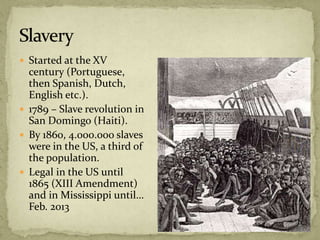
 Started at the XV
century (Portuguese,
then Spanish, Dutch,
English etc.).
 1789 – Slave revolution in
San Domingo (Haiti).
 By 1860, 4.000.000 slaves
were in the US, a third of
the population.
 Legal in the US until
1865 (XIII Amendment)
and in Mississippi until…
Feb. 2013
 Section 1. Neither slavery nor involuntary servitude,
except as a punishment for crime whereof the party
shall have been duly convicted, shall exist within the
United States, or any place subject to their jurisdiction.
 Section 2. Congress shall have power to enforce this
article by appropriate legislation.
 Born in NY in 1819.
 At the age of 22 he set sails
on a whaler for the South
Seas.
 3 years later he got back
and moved to NY where he
started writing (based on
experiences).
 A form of a “rarest literary
immortality”.
 “In fact, like most men of a good, blithe heart, Captain Delano
took to Negroes, not philanthropically, but genially, just as other
men to Newfoundland dogs.”
 “All this, with what preceded, and what followed, occurred with
such involutions of rapidity, that past, present, and future
seems one.”
 “Forget it. See, yon bright sun has forgotten it all, and the blue
sea, and the blue sky; these have turned over new leaves."
"Because they have no memory," he dejectedly replied; "because
they are not human.“ […]
 "You are saved, Don Benito," cried Captain Delano, more and
more astonished and pained; "you are saved; what has cast such a
shadow upon you?"
"The Negro."
 “Benito Cereno, borne on the bier, did, indeed, follow his
leader”
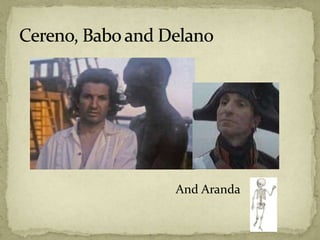
And Aranda
 Race –controversial issue in Melville’s writing.
 Slavery - Slavery under attack or a just reality under American XIX
century system.
 Friendship by compliance or by fear?
 The interaction of the three worlds - Americans, Europeans and
Africans interaction – Africans as slaves, Europeans as slave trade and
Americans as a good helping by stander that
 The end conversation - “In The Cultural Politics of Emotion, I explore
how emotions work to shape the 'surfaces' of individual and collective
bodies.”
 The Death of Don Alexandro Aranda – a “symbolic display of the
skeleton of a modern slaveholder in place of the image of Columbus”.
 The Hegelian Master and Slave
different perspectives of interrelations. - Delano/Cereno/Babo each one
in his context.
Analyze what is seen to the naked eye. Looking for the reason for the
phenomena (occurrence).
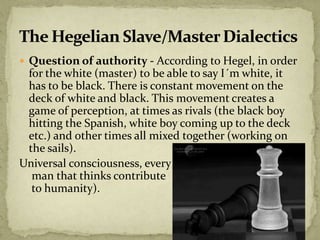
 Question of authority - According to Hegel, in order
for the white (master) to be able to say I´m white, it
has to be black. There is constant movement on the
deck of white and black. This movement creates a
game of perception, at times as rivals (the black boy
hitting the Spanish, white boy coming up to the deck
etc.) and other times all mixed together (working on
the sails).
Universal consciousness, every
man that thinks contribute
to humanity).
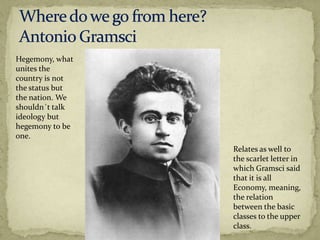
Relates as well to
the scarlet letter in
which Gramsci said
that it is all
Economy, meaning,
the relation
between the basic
classes to the upper
class.
Hegemony, what
unites the
country is not
the status but
the nation. We
shouldn´t talk
ideology but
hegemony to be
one.
 Alejandro Aranda´s skeleton – implicit imagery of
cannibalism.
 Colors – Black, White and Gray
Skin, Blood, Bones
“please, master, while I wipe this ugly stuff off the
razor, and strop it again.”
 Clothes – Delano judges the situation on the deck by
the clothes they wear.
 Grayness – The dominant color sense the beginning of the
story. Not only in the imagery but in the intrinsic
ambiance.
 Dehumanization – reciprocal brutality in order to keep
them from aspiring to natural freedom.
 The shaving scene – “The trope of the barbershop
violence” Yalon.
 Emotion, the narrative of fear – “emotions can be viewed
as a practical engagement with the world. Conceiving of
emotions as practices means understanding them as
emerging from bodily dispositions conditioned by a
social context, which always has cultural and historical
specificity.” (Scheer 2012: 193).
There is a great difference, whether the poet seeks the particular
for the sake of the general or sees the general in the
particular. From the former procedure there ensues allegory, in
which the particular serves only as illustration, as example of
the general. The latter procedure, however, is genuinely the nature
of poetry; it expresses something particular, without thinking of
the general or pointing to it.
Allegory transforms the phenomenon into a concept, the
concept into an image, but in such a way that the concept
always remains bounded in the image, and is entirely to be kept
and held in it, and to be expressed by it.
Symbolism . . . transforms the phenomenon into idea, the idea
into an image, and in such a way that the idea remains
always infinitely active and unapproachable in the image,
and even if expressed in all languages, still would remain
inexpressible.
--Goethe, Maxims and Reflections
 Write about one of the following:
- Do you know any other Barber scene in art. Compare
the two using Yadon’s article.
- Imagine a different ending. What would you have liked
it to be?
- Who is the villain? Analyze the characters in the story.
- Is the revolt justified? Explain. What would you have
done as one of the sailors, join the rebellion, oppose it,
risk your life to save others etc.
- What is the relation between the literary esthetic and
politics in Benito Cereno?
Did then the bold Slave rear at last the Sword
Of Vengeance? drench'd he deep its thirsty blade
In the cold bosom of his tyrant lord?
Oh! who shall blame him? thro' the midnight shade
Still o'er his tortur'd memory rush'd the thought
Of every past delight; his native grove,
Friendship's best joys, and Liberty and Love,
All lost for ever! then Remembrance wrought
His soul to madness; round his restless bed
Freedom's pale spectre stalk'd, with a stern smile
Pointing the wounds of slavery, the while
She shook her chains and hung her sullen head:
No more on Heaven he calls with fruitless breath,
But sweetens with revenge, the draught of death.
Next week
Colonialism and its aftermath. Daniel
Defoe's Robinson Crusoe
To read:
- Todorov, Tzvetan, La conquista de América, el
problema del otro (pages 195-212)

Classic characters, Benito Cereno

  • 1.
    Universidad de Navarra 11.10.2013 HermanMelville's between literary sophistication and politics in Benito Cereno
  • 3.
     Started atthe XV century (Portuguese, then Spanish, Dutch, English etc.).  1789 – Slave revolution in San Domingo (Haiti).  By 1860, 4.000.000 slaves were in the US, a third of the population.  Legal in the US until 1865 (XIII Amendment) and in Mississippi until… Feb. 2013
  • 4.
     Section 1.Neither slavery nor involuntary servitude, except as a punishment for crime whereof the party shall have been duly convicted, shall exist within the United States, or any place subject to their jurisdiction.  Section 2. Congress shall have power to enforce this article by appropriate legislation.
  • 5.
     Born inNY in 1819.  At the age of 22 he set sails on a whaler for the South Seas.  3 years later he got back and moved to NY where he started writing (based on experiences).  A form of a “rarest literary immortality”.
  • 6.
     “In fact,like most men of a good, blithe heart, Captain Delano took to Negroes, not philanthropically, but genially, just as other men to Newfoundland dogs.”  “All this, with what preceded, and what followed, occurred with such involutions of rapidity, that past, present, and future seems one.”  “Forget it. See, yon bright sun has forgotten it all, and the blue sea, and the blue sky; these have turned over new leaves." "Because they have no memory," he dejectedly replied; "because they are not human.“ […]  "You are saved, Don Benito," cried Captain Delano, more and more astonished and pained; "you are saved; what has cast such a shadow upon you?" "The Negro."  “Benito Cereno, borne on the bier, did, indeed, follow his leader”
  • 7.
  • 8.
     Race –controversialissue in Melville’s writing.  Slavery - Slavery under attack or a just reality under American XIX century system.  Friendship by compliance or by fear?  The interaction of the three worlds - Americans, Europeans and Africans interaction – Africans as slaves, Europeans as slave trade and Americans as a good helping by stander that  The end conversation - “In The Cultural Politics of Emotion, I explore how emotions work to shape the 'surfaces' of individual and collective bodies.”  The Death of Don Alexandro Aranda – a “symbolic display of the skeleton of a modern slaveholder in place of the image of Columbus”.  The Hegelian Master and Slave different perspectives of interrelations. - Delano/Cereno/Babo each one in his context. Analyze what is seen to the naked eye. Looking for the reason for the phenomena (occurrence).
  • 10.
     Question ofauthority - According to Hegel, in order for the white (master) to be able to say I´m white, it has to be black. There is constant movement on the deck of white and black. This movement creates a game of perception, at times as rivals (the black boy hitting the Spanish, white boy coming up to the deck etc.) and other times all mixed together (working on the sails). Universal consciousness, every man that thinks contribute to humanity).
  • 11.
    Relates as wellto the scarlet letter in which Gramsci said that it is all Economy, meaning, the relation between the basic classes to the upper class. Hegemony, what unites the country is not the status but the nation. We shouldn´t talk ideology but hegemony to be one.
  • 12.
     Alejandro Aranda´sskeleton – implicit imagery of cannibalism.  Colors – Black, White and Gray Skin, Blood, Bones “please, master, while I wipe this ugly stuff off the razor, and strop it again.”  Clothes – Delano judges the situation on the deck by the clothes they wear.
  • 13.
     Grayness –The dominant color sense the beginning of the story. Not only in the imagery but in the intrinsic ambiance.  Dehumanization – reciprocal brutality in order to keep them from aspiring to natural freedom.  The shaving scene – “The trope of the barbershop violence” Yalon.  Emotion, the narrative of fear – “emotions can be viewed as a practical engagement with the world. Conceiving of emotions as practices means understanding them as emerging from bodily dispositions conditioned by a social context, which always has cultural and historical specificity.” (Scheer 2012: 193).
  • 14.
    There is agreat difference, whether the poet seeks the particular for the sake of the general or sees the general in the particular. From the former procedure there ensues allegory, in which the particular serves only as illustration, as example of the general. The latter procedure, however, is genuinely the nature of poetry; it expresses something particular, without thinking of the general or pointing to it. Allegory transforms the phenomenon into a concept, the concept into an image, but in such a way that the concept always remains bounded in the image, and is entirely to be kept and held in it, and to be expressed by it. Symbolism . . . transforms the phenomenon into idea, the idea into an image, and in such a way that the idea remains always infinitely active and unapproachable in the image, and even if expressed in all languages, still would remain inexpressible. --Goethe, Maxims and Reflections
  • 15.
     Write aboutone of the following: - Do you know any other Barber scene in art. Compare the two using Yadon’s article. - Imagine a different ending. What would you have liked it to be? - Who is the villain? Analyze the characters in the story. - Is the revolt justified? Explain. What would you have done as one of the sailors, join the rebellion, oppose it, risk your life to save others etc. - What is the relation between the literary esthetic and politics in Benito Cereno?
  • 16.
    Did then thebold Slave rear at last the Sword Of Vengeance? drench'd he deep its thirsty blade In the cold bosom of his tyrant lord? Oh! who shall blame him? thro' the midnight shade Still o'er his tortur'd memory rush'd the thought Of every past delight; his native grove, Friendship's best joys, and Liberty and Love, All lost for ever! then Remembrance wrought His soul to madness; round his restless bed Freedom's pale spectre stalk'd, with a stern smile Pointing the wounds of slavery, the while She shook her chains and hung her sullen head: No more on Heaven he calls with fruitless breath, But sweetens with revenge, the draught of death.
  • 17.
    Next week Colonialism andits aftermath. Daniel Defoe's Robinson Crusoe To read: - Todorov, Tzvetan, La conquista de América, el problema del otro (pages 195-212)