JAVA CLASSES AND
OBJECT
Introduction
 Java is an object-oriented
programming language.
 Classes and objects are
fundamental concepts in Java.
What is a Class?
 A class is a blueprint for creating
objects.
 It defines a datatype by bundling data
and methods that operate on the data
into a single unit.
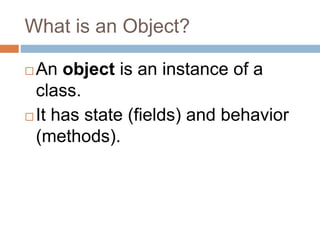
What is an Object?
 An object is an instance of a
class.
 It has state (fields) and behavior
(methods).
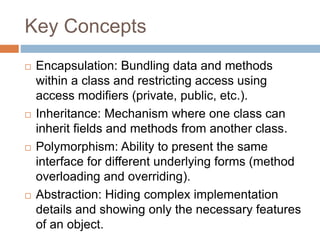
Key Concepts
 Encapsulation: Bundling data and methods
within a class and restricting access using
access modifiers (private, public, etc.).
 Inheritance: Mechanism where one class can
inherit fields and methods from another class.
 Polymorphism: Ability to present the same
interface for different underlying forms (method
overloading and overriding).
 Abstraction: Hiding complex implementation
details and showing only the necessary features
of an object.
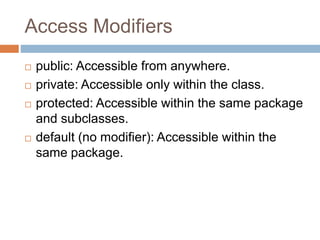
Access Modifiers
 public: Accessible from anywhere.
 private: Accessible only within the class.
 protected: Accessible within the same package
and subclasses.
 default (no modifier): Accessible within the
same package.
Conclusion
 Classes and objects are core components of
Java's object-oriented programming.
 Mastering these concepts is crucial for
effective Java programming.
CLASSES AND OBJECT SAMPLE USES A MODULE OF STUDENT.pptx

  • 1.
  • 2.
    Introduction  Java isan object-oriented programming language.  Classes and objects are fundamental concepts in Java.
  • 3.
    What is aClass?  A class is a blueprint for creating objects.  It defines a datatype by bundling data and methods that operate on the data into a single unit.
  • 4.
    What is anObject?  An object is an instance of a class.  It has state (fields) and behavior (methods).
  • 5.
    Key Concepts  Encapsulation:Bundling data and methods within a class and restricting access using access modifiers (private, public, etc.).  Inheritance: Mechanism where one class can inherit fields and methods from another class.  Polymorphism: Ability to present the same interface for different underlying forms (method overloading and overriding).  Abstraction: Hiding complex implementation details and showing only the necessary features of an object.
  • 6.
    Access Modifiers  public:Accessible from anywhere.  private: Accessible only within the class.  protected: Accessible within the same package and subclasses.  default (no modifier): Accessible within the same package.
  • 7.
    Conclusion  Classes andobjects are core components of Java's object-oriented programming.  Mastering these concepts is crucial for effective Java programming.