Noise
Noise may be defined, as an electrical sense, as any
unwanted form of energy tending to interfere with the proper
and easy reception and reproduction of wanted signals.
Effect of noise in Communication system:
Many disturbance of an electrical nature produce noise in
receivers, modifying the signal in an unwanted manner.
 In radio receivers, for example, noise may produce hiss
sound in loudspeaker output.
 In TV receiver, snow or confetti becomes superimposed
on the picture.
Noise Classification:
According to source, effect, or relation to the receiver noise
can be classified into two groups –
 External Noise: Noise whose sources are external to the
receiver.
Atmospheric noise
Extraterrestrial noise
Industrial noise
 Internal Noise: Noise created within the receiver itself.
Thermal Agitation Noise
Shot Noise
Transit-time Noise
 Miscellaneous Noise
Atmospheric Noise:
The atmospheric noise, generally called static. Static is
caused by lightning discharges in thunderstorms and other
natural electric disturbances occurring in the atmosphere.
Atmospheric noise becomes less severe at frequencies above
about 30 MHz because of two separate factors.
First, the higher frequencies are limited to line-of-sight
propagation i.e., less than 80 kilometers or so.
Second, the nature of the mechanism generating this noise is
such that very little of it is created in the VHF range and
above.
Extraterrestrial Noise:
Solar Noise: The sun radiates so many things our way that we should
not be too surprised to find that noise is noticeable among them, again
there arc two· types. under normal "quiet'' conditions, there is a constant
noise radiation from the sun, simply because it is a large body at a very
high temperature (over 6000°C on the
surface). It therefore radiates over a very broad frequency spectrum
which includes the frequencies we use for communication.
Cosmic Noise: Since distant stars are also suns and have high
temperatures, they radiate RF noise in the same manner as our sun and
what they lack in nearness they nearly make up in numbers which in
combination can become significant.
The noise received is called thermal (or black-body) noise and is
distributed fairly uniformly over the entire sky.
Industrial Noise:
Between the frequencies of l to 600 MHz (in Urban, suburban
and other industrial areas) the intensity of noise made by
humans easily outstrips that created by any other source,
internal or external to the receiver.
Under this heading, sources such as automobile and aircraft
ignition, electric motors and switching equipment; leakage from
high-voltage lines and a multitude of other heavy electric
machines are all included. Fluorescent lights are another
powerful source of such noise and therefore should not be used
where sensitive receiver reception or testing is being conducted.
INTERNAL NOISE:
Under the heading of internal noise, we discuss noise created
by any of the active or passive devices found in receivers.
Such noise is generally random, impossible to treat on an
individual voltage basis i.e., instantaneous value basis, but
easy to observe and describe statistically.
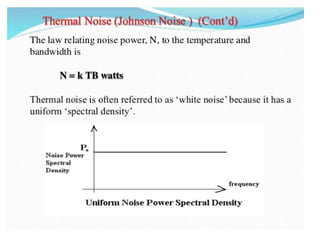
Because the noise is randomly distributed over the entire radio
spectrum there is, on the average, as much of it at one
frequency as at any other.
Random noise power is proportional to the bandwidth over
which it is measured.
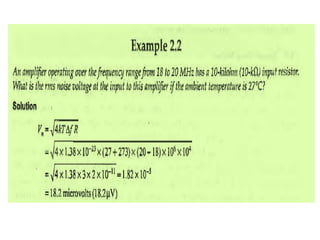
Thermal Agitation Noise:
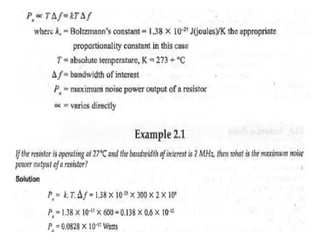
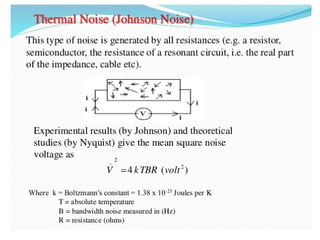
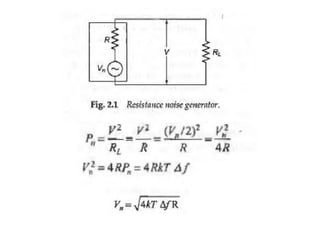
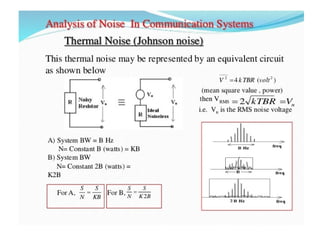
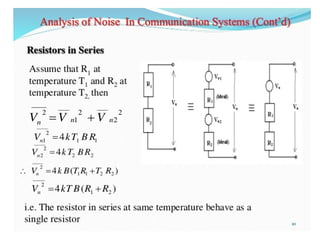
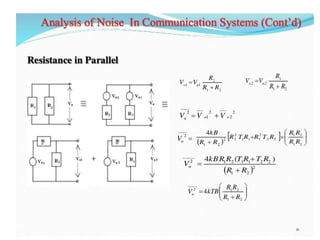
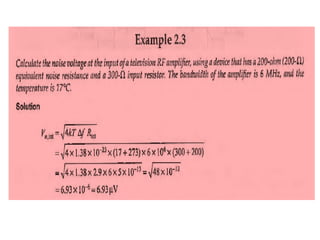
The noise generated in a resistance or the resistive component is
random and is referred to as thermal, agitation, white or Johnson
noise. It is due to the rapid and random motion of the molecules
(atoms and electrons) inside the component itself.
In thermodynamics, kinetic theory shows that the temperature of a
particle is a way of expressing its internal kinetic energy.
It becomes apparent that the noise generated by a resistor is
proportional to its absolute temperature, in addition to being
proportional to the bandwidth over which the noise is to be
measured.
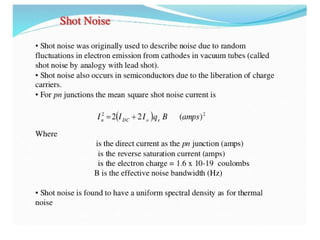
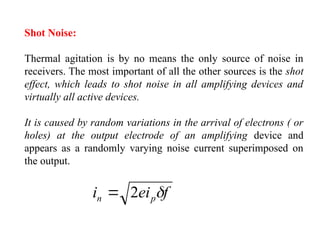
Shot Noise:
Thermal agitation is by no means the only source of noise in
receivers. The most important of all the other sources is the shot
effect, which leads to shot noise in all amplifying devices and
virtually all active devices.
It is caused by random variations in the arrival of electrons ( or
holes) at the output electrode of an amplifying device and
appears as a randomly varying noise current superimposed on
the output.
f
ei
i p
n 
2

Transit-Time Noise:
If the time taken by an electron to travel from the emitter to the
collector of a transistor becomes significant to the period of the
signal being amplified, i.e., at frequencies in the upper VHF
range and beyond, the so-called transit-time effect takes place,
and the noise input admittance of the transistor increases.
The minute currents induced in the input of the device by
random fluctuations in the output current become of great
importance at such frequencies and create random noise
(frequency distortion).
Miscellaneous Noise:
Flicker
Resistance
Noise in Mixer
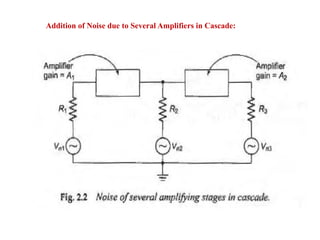
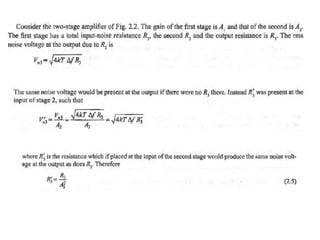
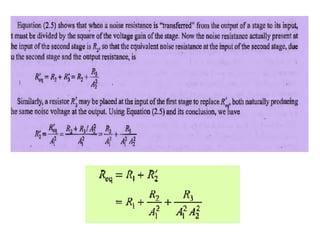
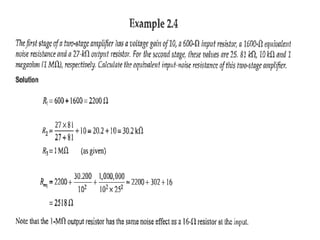
Addition of Noise due to Several Amplifiers in Cascade:
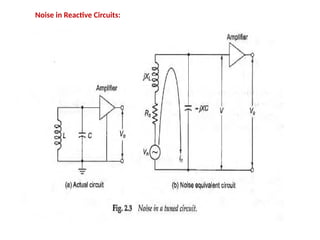
Noise in Reactive Circuits:
Class_6_Noise  description noise   .pptx

Class_6_Noise description noise .pptx

  • 2.
    Noise Noise may bedefined, as an electrical sense, as any unwanted form of energy tending to interfere with the proper and easy reception and reproduction of wanted signals. Effect of noise in Communication system: Many disturbance of an electrical nature produce noise in receivers, modifying the signal in an unwanted manner.  In radio receivers, for example, noise may produce hiss sound in loudspeaker output.  In TV receiver, snow or confetti becomes superimposed on the picture.
  • 3.
    Noise Classification: According tosource, effect, or relation to the receiver noise can be classified into two groups –  External Noise: Noise whose sources are external to the receiver. Atmospheric noise Extraterrestrial noise Industrial noise  Internal Noise: Noise created within the receiver itself. Thermal Agitation Noise Shot Noise Transit-time Noise  Miscellaneous Noise
  • 4.
    Atmospheric Noise: The atmosphericnoise, generally called static. Static is caused by lightning discharges in thunderstorms and other natural electric disturbances occurring in the atmosphere. Atmospheric noise becomes less severe at frequencies above about 30 MHz because of two separate factors. First, the higher frequencies are limited to line-of-sight propagation i.e., less than 80 kilometers or so. Second, the nature of the mechanism generating this noise is such that very little of it is created in the VHF range and above.
  • 5.
    Extraterrestrial Noise: Solar Noise:The sun radiates so many things our way that we should not be too surprised to find that noise is noticeable among them, again there arc two· types. under normal "quiet'' conditions, there is a constant noise radiation from the sun, simply because it is a large body at a very high temperature (over 6000°C on the surface). It therefore radiates over a very broad frequency spectrum which includes the frequencies we use for communication. Cosmic Noise: Since distant stars are also suns and have high temperatures, they radiate RF noise in the same manner as our sun and what they lack in nearness they nearly make up in numbers which in combination can become significant. The noise received is called thermal (or black-body) noise and is distributed fairly uniformly over the entire sky.
  • 6.
    Industrial Noise: Between thefrequencies of l to 600 MHz (in Urban, suburban and other industrial areas) the intensity of noise made by humans easily outstrips that created by any other source, internal or external to the receiver. Under this heading, sources such as automobile and aircraft ignition, electric motors and switching equipment; leakage from high-voltage lines and a multitude of other heavy electric machines are all included. Fluorescent lights are another powerful source of such noise and therefore should not be used where sensitive receiver reception or testing is being conducted.
  • 7.
    INTERNAL NOISE: Under theheading of internal noise, we discuss noise created by any of the active or passive devices found in receivers. Such noise is generally random, impossible to treat on an individual voltage basis i.e., instantaneous value basis, but easy to observe and describe statistically. Because the noise is randomly distributed over the entire radio spectrum there is, on the average, as much of it at one frequency as at any other. Random noise power is proportional to the bandwidth over which it is measured.
  • 8.
    Thermal Agitation Noise: Thenoise generated in a resistance or the resistive component is random and is referred to as thermal, agitation, white or Johnson noise. It is due to the rapid and random motion of the molecules (atoms and electrons) inside the component itself. In thermodynamics, kinetic theory shows that the temperature of a particle is a way of expressing its internal kinetic energy. It becomes apparent that the noise generated by a resistor is proportional to its absolute temperature, in addition to being proportional to the bandwidth over which the noise is to be measured.
  • 15.
    Shot Noise: Thermal agitationis by no means the only source of noise in receivers. The most important of all the other sources is the shot effect, which leads to shot noise in all amplifying devices and virtually all active devices. It is caused by random variations in the arrival of electrons ( or holes) at the output electrode of an amplifying device and appears as a randomly varying noise current superimposed on the output. f ei i p n  2 
  • 16.
    Transit-Time Noise: If thetime taken by an electron to travel from the emitter to the collector of a transistor becomes significant to the period of the signal being amplified, i.e., at frequencies in the upper VHF range and beyond, the so-called transit-time effect takes place, and the noise input admittance of the transistor increases. The minute currents induced in the input of the device by random fluctuations in the output current become of great importance at such frequencies and create random noise (frequency distortion).
  • 17.
  • 22.
    Addition of Noisedue to Several Amplifiers in Cascade:
  • 26.