ASTROVIDEO!
Direction. Watch the video!
Question:
“What do you call those phenomena that you
just watched in the video?”
ASTRONOMICAL PHENOMENA
KNOWN TO ASTRONOMERS
BEFORE THE ADVENT OF TELESCOPES
Harold N. Husayan
Special Science Teacher I
Astronomical Phenomena
Aggregates of
matter in outer
space, such as
stars, planets,
comets, etc. and the
properties and
processes they
undergo.
- U.S. National Library
of Medicine
4
SOLAR ECLIPSE
LUNAR ECLIPSE BOTH
Activity 2: Venn Diagram?
Direction. Listen to your teacher for the instruction.
Activity 2: Venn Diagram?
Direction. Listen to your teacher for the instruction.
LUNAR ECLIPSE SOLAR ECLIPSE
BOTH
Lunar Eclipse
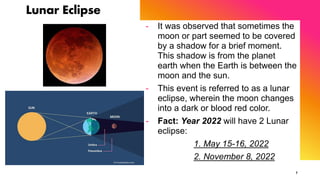
- It was observed that sometimes the
moon or part seemed to be covered
by a shadow for a brief moment.
This shadow is from the planet
earth when the Earth is between the
moon and the sun.
- This event is referred to as a lunar
eclipse, wherein the moon changes
into a dark or blood red color.
- Fact: Year 2022 will have 2 Lunar
eclipse:
1. May 15-16, 2022
2. November 8, 2022
7
Solar Eclipse
- Ancient astronomers also observed
the occurrence of a solar eclipse.
- A solar eclipse occurs when the
moon is in between the sun and the
Earth and the moon partially or
entirely blocks out the sun
- Fact: Year 2022 will have 2 Solar
eclipse:
1. April 30, 2022
2. October 25, 2022
8
Motion of the Stars
- The stars are observed to be
embedded in a heavenly sphere
that turns around an axis one day.
- This axis crosses the celestial
sphere at a particular mark in the
northern sky near the northern star,
Polaris.
- Also, the constellations' positions in
the night sky change depending on
the time of the year.
- 2 Types of Motion of the stars:
1. Diurnal motion- daily
2. Annual motion- yearly
9
Visibility of the Planets
- Mercury, Venus, Mars, Jupiter, and
Saturn, thought to be stars, were
discovered as planets called
"wanderers" or "planetes" in
Greek terms.
- Astronomers differentiated planets
from the stars because of their very
bright light and periodic change of
positions, which do not conform to
the stars' behavior belonging to a
constellation in a fixed position.
10
QUIZ TIME!
11
Question:
Share and identify other astronomical
phenomena that you might or have
experienced. How do you feel about these
experiences?
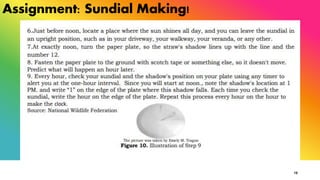
Assignment: Sundial Making!
13
Assignment: Sundial Making!
14
Assignment: Sundial Making!
15
Assignment: Sundial Making!
16
Assignment: Sundial Making!
17
THANK YOU!
KEEP CALM, WEAR YOUR
FACEMASK PROPERLY, &
MAINTAIN 1-METER
PHYSICAL DISTANCING

Class Observation.pptx

  • 1.
  • 2.
    Question: “What do youcall those phenomena that you just watched in the video?”
  • 3.
    ASTRONOMICAL PHENOMENA KNOWN TOASTRONOMERS BEFORE THE ADVENT OF TELESCOPES Harold N. Husayan Special Science Teacher I
  • 4.
    Astronomical Phenomena Aggregates of matterin outer space, such as stars, planets, comets, etc. and the properties and processes they undergo. - U.S. National Library of Medicine 4
  • 5.
    SOLAR ECLIPSE LUNAR ECLIPSEBOTH Activity 2: Venn Diagram? Direction. Listen to your teacher for the instruction.
  • 6.
    Activity 2: VennDiagram? Direction. Listen to your teacher for the instruction. LUNAR ECLIPSE SOLAR ECLIPSE BOTH
  • 7.
    Lunar Eclipse - Itwas observed that sometimes the moon or part seemed to be covered by a shadow for a brief moment. This shadow is from the planet earth when the Earth is between the moon and the sun. - This event is referred to as a lunar eclipse, wherein the moon changes into a dark or blood red color. - Fact: Year 2022 will have 2 Lunar eclipse: 1. May 15-16, 2022 2. November 8, 2022 7
  • 8.
    Solar Eclipse - Ancientastronomers also observed the occurrence of a solar eclipse. - A solar eclipse occurs when the moon is in between the sun and the Earth and the moon partially or entirely blocks out the sun - Fact: Year 2022 will have 2 Solar eclipse: 1. April 30, 2022 2. October 25, 2022 8
  • 9.
    Motion of theStars - The stars are observed to be embedded in a heavenly sphere that turns around an axis one day. - This axis crosses the celestial sphere at a particular mark in the northern sky near the northern star, Polaris. - Also, the constellations' positions in the night sky change depending on the time of the year. - 2 Types of Motion of the stars: 1. Diurnal motion- daily 2. Annual motion- yearly 9
  • 10.
    Visibility of thePlanets - Mercury, Venus, Mars, Jupiter, and Saturn, thought to be stars, were discovered as planets called "wanderers" or "planetes" in Greek terms. - Astronomers differentiated planets from the stars because of their very bright light and periodic change of positions, which do not conform to the stars' behavior belonging to a constellation in a fixed position. 10
  • 11.
  • 12.
    Question: Share and identifyother astronomical phenomena that you might or have experienced. How do you feel about these experiences?
  • 13.
  • 14.
  • 15.
  • 16.
  • 17.
  • 18.
    THANK YOU! KEEP CALM,WEAR YOUR FACEMASK PROPERLY, & MAINTAIN 1-METER PHYSICAL DISTANCING

Editor's Notes

  • #7 Give yourselves 5 overhead claps!