General Economic
Concepts
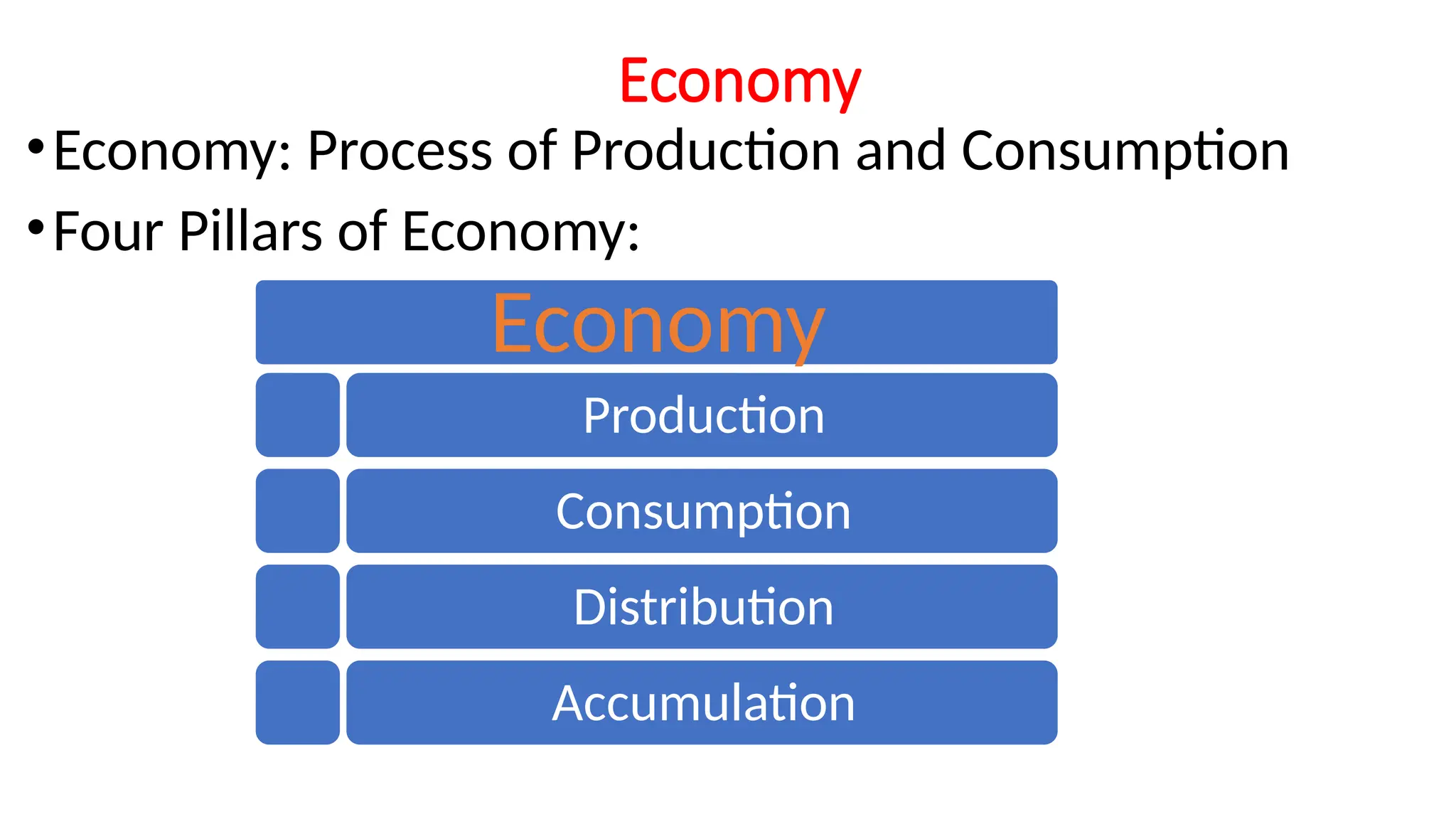
Economy
•Economy: Process of Production and Consumption
•Four Pillars of Economy:
Economy
Production
Consumption
Distribution
Accumulation
Economics
• Oikonomia: Household management
•Economics: ‘Economics is the science which studies human behaviour as a
relationship between ends and scarce means which have alternative use’
Robbins.
•The problem of allocation of scarce resource.
•Economics is the study of how societies use scarce resources to produce
valuable goods and services and distribute them among different
individuals.
•Efficiency: Economic efficiency requires that an economy produce the
highest combination of quantity and quality of goods and services given
its technology and scarce resources.
•Effective use of society’s resources in satisfying people’s wants and needs.
Two branches of Economics
•Microeconomics: Individual, Firm.
Studying Individual’s Utility, Firm’s production and cost
of production, Income of factors of production, etc
•Macroeconomics: Overall performance of the economy.
Learning about National Income, Aggregate Demand,
Economic Growth, etc.
Positive vs Normative Economics
•Positive Economics: What it is?? What has
happened?? What is happening??
•Normative Economics: How it should be??
TEN Principles of Economics
 Principle 1: People Face Trade-offs :
 To get something that we like, we usually have to give up
something else that we also like. Making decisions requires
trading off one goal against another.
 Principle 2: The Cost of Something Is What You Give Up to Get
it:
 Because people face trade-offs, making decisions requires
comparing the costs and benefits of alternative courses of
action. In many cases, however, the cost of an action is not as
obvious as it might first appear.
 Principle 3: Rational People Think at the Margin:
 Economists normally assume that people are
rational. Rational people systematically and
purposefully do the best they can to achieve their
objectives, given the available opportunities.
 Principle 4: People Respond to Incentives
 Incentives are crucial to analyzing how markets
work. A higher price in a market provides an
incentive for buyers to consume less and an
incentive for sellers to produce more. As we will see,
the influence of prices on the behavior of consumers
and producers is crucial for how a market economy
allocates scarce resources.
 Principle 5: Trade Can Make Everyone Better Off :
 Trade allows countries to specialize in what they do best and
to enjoy a greater variety of goods and services.
 Principle 6: Markets Are Usually a Good Way to Organize
Economic Activity
 market economy an economy that allocates resources through
the decentralized decisions of many firms and households as
they interact in markets for goods and services
 Principle 7: Governments Can Sometimes Improve Market
Outcomes
 Principle 8: A Country’s Standard of Living Depends on Its Ability to
Produce Goods and Services
 What explains these large differences in living standards among
countries and over time? The answer is surprisingly simple. Almost all
variation in living standards is attributable to differences in countries’
productivity—that is, the amount of goods and services produced by
each unit of labor input.
 Principle 9: Prices Rise When the Government Prints Too Much Money
 inflation an increase in the overall level of prices in the economy.
What causes inflation? In almost all cases of large or persistent
inflation, the culprit is growth in the quantity of money. When a
government creates large quantities of the nation’s money, the value
of the money falls.
Principle 10: Society Faces a Short-Run
Trade-off between Inflation and
Unemployment

Class 2 Ten Principles taken in class he

  • 1.
  • 2.
    Economy •Economy: Process ofProduction and Consumption •Four Pillars of Economy: Economy Production Consumption Distribution Accumulation
  • 3.
    Economics • Oikonomia: Householdmanagement •Economics: ‘Economics is the science which studies human behaviour as a relationship between ends and scarce means which have alternative use’ Robbins. •The problem of allocation of scarce resource. •Economics is the study of how societies use scarce resources to produce valuable goods and services and distribute them among different individuals. •Efficiency: Economic efficiency requires that an economy produce the highest combination of quantity and quality of goods and services given its technology and scarce resources. •Effective use of society’s resources in satisfying people’s wants and needs.
  • 4.
    Two branches ofEconomics •Microeconomics: Individual, Firm. Studying Individual’s Utility, Firm’s production and cost of production, Income of factors of production, etc •Macroeconomics: Overall performance of the economy. Learning about National Income, Aggregate Demand, Economic Growth, etc.
  • 5.
    Positive vs NormativeEconomics •Positive Economics: What it is?? What has happened?? What is happening?? •Normative Economics: How it should be??
  • 6.
    TEN Principles ofEconomics  Principle 1: People Face Trade-offs :  To get something that we like, we usually have to give up something else that we also like. Making decisions requires trading off one goal against another.  Principle 2: The Cost of Something Is What You Give Up to Get it:  Because people face trade-offs, making decisions requires comparing the costs and benefits of alternative courses of action. In many cases, however, the cost of an action is not as obvious as it might first appear.
  • 7.
     Principle 3:Rational People Think at the Margin:  Economists normally assume that people are rational. Rational people systematically and purposefully do the best they can to achieve their objectives, given the available opportunities.
  • 8.
     Principle 4:People Respond to Incentives  Incentives are crucial to analyzing how markets work. A higher price in a market provides an incentive for buyers to consume less and an incentive for sellers to produce more. As we will see, the influence of prices on the behavior of consumers and producers is crucial for how a market economy allocates scarce resources.
  • 9.
     Principle 5:Trade Can Make Everyone Better Off :  Trade allows countries to specialize in what they do best and to enjoy a greater variety of goods and services.  Principle 6: Markets Are Usually a Good Way to Organize Economic Activity  market economy an economy that allocates resources through the decentralized decisions of many firms and households as they interact in markets for goods and services  Principle 7: Governments Can Sometimes Improve Market Outcomes
  • 10.
     Principle 8:A Country’s Standard of Living Depends on Its Ability to Produce Goods and Services  What explains these large differences in living standards among countries and over time? The answer is surprisingly simple. Almost all variation in living standards is attributable to differences in countries’ productivity—that is, the amount of goods and services produced by each unit of labor input.  Principle 9: Prices Rise When the Government Prints Too Much Money  inflation an increase in the overall level of prices in the economy. What causes inflation? In almost all cases of large or persistent inflation, the culprit is growth in the quantity of money. When a government creates large quantities of the nation’s money, the value of the money falls.
  • 11.
    Principle 10: SocietyFaces a Short-Run Trade-off between Inflation and Unemployment

Editor's Notes

  • #7 why people use their cell phones as much as they do
  • #9 The first four principles discussed how individuals make decisions. As we go about our lives, many of our decisions affect not only ourselves but other people as well. The next three principles concern how people interact with one another.