Land Between TwoRivers
• Mesopotamia = 'land between rivers' (Tigris &
Euphrates)
• Located in the Fertile Crescent – Iraq, Syria, Kuwait,
Turkey
• Earliest urban civilization emerged around 3000
BCE
• Fertile soil supported agriculture and urban growth
• Frequent invasions due to lack of natural barriers
3.
A Cradle ofCivilization
• Birthplace of writing, law, and organized
government
• Epic of Gilgamesh – earliest surviving literary work
• Major achievements in astronomy, math, and
timekeeping
• Influenced later civilizations: Babylonians,
Assyrians, Hebrews
• Known for city life, temples, and scientific
curiosity
4.
Who Were theSumerians?
• Settled southern Mesopotamia around 4000 BCE
• Sumerian tradition tells the story of a long period
of prosperity and a well-developed, orderly society.
• There are : records of floods that destroyed cities
and accounts of the rebuilding of these cities.
• Built city-states: Ur, Uruk, Lagash, Nippur
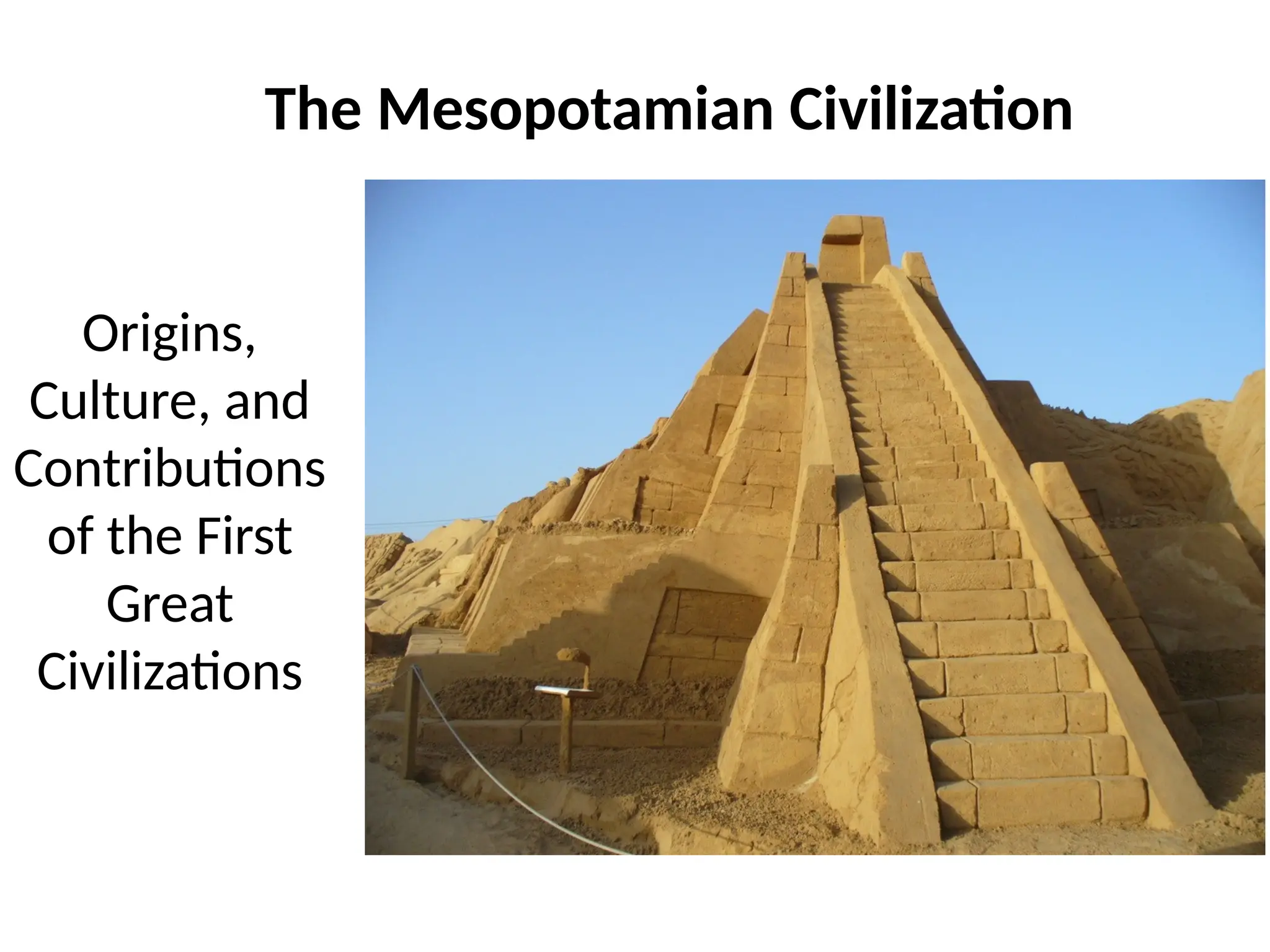
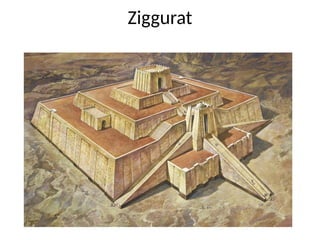
• Each city centered around a temple (ziggurat)
• Governed by patesi (priest-king)
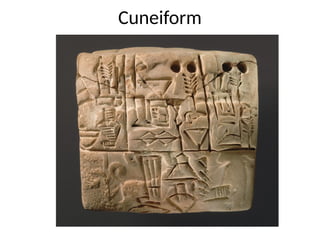
• Created cuneiform writing – wedge-shaped script
on clay tablets.
5.
Order and Religion
•Patesi: religious, military, and administrative leader. His
“lease” was renewed each year, during a great festival
held in honor of the god.
• City-states often fought over water and land
• Temples controlled economy – land, trade, workshops
• Priesthood held significant influence in
governance
• Society: priests, artisans, peasants, serfs, limited
slavery
6.
Innovations of theSumerians
• Cuneiform – record keeping, literature, trade
documents
• System of law – basis for later codes like
Hammurabi’s
• Mathematics based on 60 (sexagesimal
system)
• Lunar calendar and early astronomy
• Inventions: potter’s wheel, wheel,
sailboat,
arch, dome
A World Ruledby Gods
• Polytheistic – gods of sun, wind, fertility,
plague, etc.
• Ziggurats served as temples and religious
centers
• Believed in omens, dreams, and
astrology
• No heaven or hell – afterlife was a gloomy
underworld
• Stories influenced later Hebrew texts (e.g.
flood narrative)
End of anEra
• Conquered by Akkadians around 2000 BCE
under Sargon.
• Sumerians absorbed into later Mesopotamian
cultures.
• Language gradually replaced by Akkadian.
• Legacy lived on through laws, literature, and
innovations.
11.
Babylonian Civilization: Originsand
Geography
• Babylon located on the Euphrates River in
southern Mesopotamia.
• Rose to prominence under King Hammurabi in the
18th century BCE.
• City became a political, cultural, and economic
center of the region.
• Benefited from fertile land and strategic trade
routes.
• Babylonian empire eventually extended across
most of Mesopotamia.
12.
Hammurabi and HisLegal Code
• Hammurabi ruled from 1792–1750 BCE and unified Mesopotamia.
• His Code was one of the first comprehensive law codes in history.
• Included 282 laws addressing crime, property, trade, family, and labor.
• Based on the principle of retributive justice— 'an eye for an eye' and a tooth for a
tooth”.
• Laws engraved on a stele and publicly displayed for citizens to see.
• Women could own property, have equal rights in divorce, and bring
lawsuits.
• They could engage in business and become professional scribes.
• Justice to the widow and the orphan was assured.
• Heavier fines were imposed upon the rich than upon the poor,
because they could better afford to pay. The lower classes and even
slaves were protected by law.
• Slaves might own property, marry, and will their possessions to their
children. Freedom from bondage was obtained easily, and only
runaway slaves were branded.
13.
Babylonian Achievements in
Scienceand Culture
• Advanced mathematics using a base-60
(sexagesimal) system.
• Created early forms of algebra and geometric
calculations.
• Developed lunar calendars for agriculture and
festivals.
• Made astronomical observations—predicted
eclipses and planetary motion.
• Expanded and preserved the Epic of
Gilgamesh in written form.
14.
Babylonian Religion
• Marduk,god of Babylon, was generally recognized as
supreme, but he was not beyond challenge from others.
• Ishtar, the mother of the gods, who possessed control over
reproduction among plants, beasts, and human beings,
commanded almost universal attention.
• Associated with Ishtar was her husband Tammuz, the
vegetation god, who died each year and went to the lower
regions. Ishtar always went in search of him and, while they
were gone, vegetation died, but when they returned it
revived. An elaborate ritual developed around this practice,
which explained seasonal changes to the satisfaction of
Babylonians.
15.
Fall of Babylonia
•Babylonia was conquered by the Kassites
about 1700 B.c.
• They introduced the horse, which was of
great significance in later history.
• The Kassites destroyed much of the
civilization of the Babylonians and brought
to a close first epoch of the cultural history
of Mesopotamia.
16.
Assyrian Empire: Originsand
Expansion
• Originated in northern Mesopotamia, near
modern-day Iraq.
• Major cities: Ashur, Nineveh, Nimrud, and Kalhu.
• Reached imperial power after 1100 BCE—
expanded aggressively.
• At its peak, it controlled territory from Egypt to the
Persian Gulf.
• Used fear, military might, and deportation of
conquered peoples to maintain control.
17.
Assyrian Military Innovations
•Highly trained, professional standing army.
• Advanced siege tactics: battering rams,
ladders, tunnels, and sappers.
• Used cavalry and iron weapons effectively in
battle.
• Built extensive road systems for troop
movement and communication.
• Used psychological warfare—public
executions and deportations.
• Governed through appointed military
18.
Assyrian Culture, Art,and Legacy
• Built monumental palaces adorned with
intricate wall reliefs.
• Library of Ashurbanipal in Nineveh preserved
thousands of clay tablets.
• Art depicted royal hunts, military victories,
and religious rituals.
• Religion focused on Ashur, the supreme war
deity.
• Assyria fell in 612 BCE due to internal rebellion
and attacks by Babylonians and Medes.
19.
Chaldean Civilization: Neo-
BabylonianRevival
• Final phase of Mesopotamian civilization after
Assyrian collapse.
• Ruled by Nebuchadnezzar II and successors
who revived Babylon.
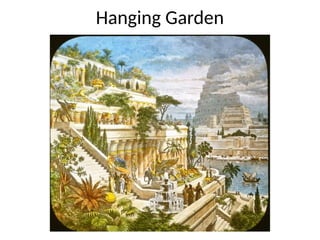
• Nebuchadnezzer built the famous hanging
garden.
• Attempted to restore Hammurabi-era culture,
laws, and governance.
• Partial success—Assyrian influence and
Chaldean traditions altered the revival.
Chaldean Religion: Riseof Astral
Worship
• Traditional gods reinterpreted as celestial
bodies—Marduk as Jupiter, Ishtar as Venus.
• Deities became transcendent and mechanistic
in their rule.
• Developed astral religion focusing on planets
as divine powers.
• Moved away from magic-based rituals toward
spiritual submission.
22.
Fatalism and theConcept of
Submission
• Humans were seen as powerless before the
gods’ inscrutable will.
• Piety meant submission without expectations
of reward or afterlife.
• Introduced fatalistic resignation as religious
devotion.
• Resignation reflected despair and humility
before divine mysteries.
23.
Penitential Literature andSpiritual
Thought
• Hymns expressed deep guilt and moral
anguish.
• Man viewed as inherently sinful and unworthy
of divine favor.
• Prayers emphasized justice, righteousness,
and divine judgment.
• Texts resembled later Hebrew religious
writings with shared moral themes.
24.
Chaldean Morality andDaily Life
• Despite gloomy religion, daily life remained
focused on material pleasures.
• Little evidence of asceticism—people sought
wealth, long life, family.
• Morality included kindness, reverence, and
purity, but also ritual cleanliness.
• Prayers often asked for physical blessings
rather than moral improvement.
25.
Chaldean Scientific Legacy:
Astronomy
•Best astronomers in Mesopotamian history.
• Mapped stars and planets, recorded eclipses
over 350 years.
• Invented the seven-day week and divided the
day into 12 double-hours.
• Astronomy primarily served religious and
astrological purposes.
26.
Other Aspects ofChaldean Culture
• Mathematics included understanding of zero
and early algebra.
• Medicine remained underdeveloped—similar
to Assyrian period.
• Art was more grand but not innovative.
• Literature preserved and reedited old
Babylonian texts with little originality.