CH1 INTRODUCTION
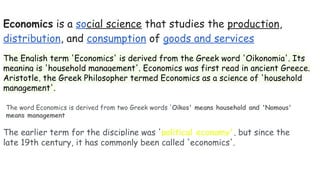
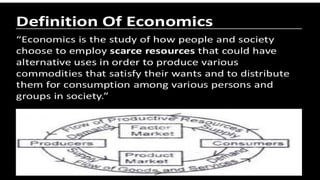
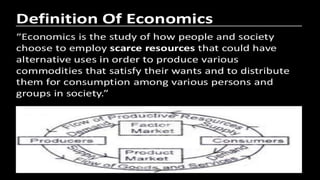
Economics is a social science that studies the production,
distribution, and consumption of goods and services
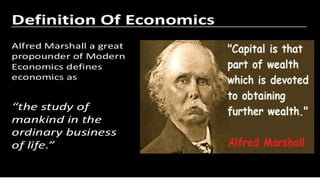
The English term 'Economics' is derived from the Greek word 'Oikonomia'. Its
meaning is 'household management'. Economics was first read in ancient Greece.
Aristotle, the Greek Philosopher termed Economics as a science of 'household
management'.
The earlier term for the discipline was 'political economy', but since the
late 19th century, it has commonly been called 'economics'.
The word Economics is derived from two Greek words 'Oikos' means household and 'Nomous'
means management
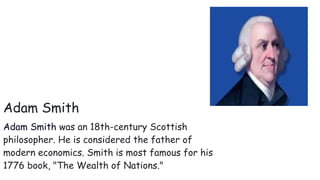
Adam Smith
Adam Smith was an 18th-century Scottish
philosopher. He is considered the father of
modern economics. Smith is most famous for his
1776 book, "The Wealth of Nations."
Q. "You have unlimited wants and limited resources to satisfy them." Explain by giving two examples.
answer :
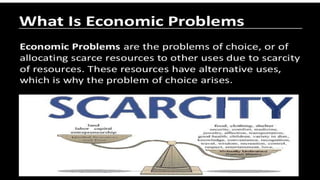
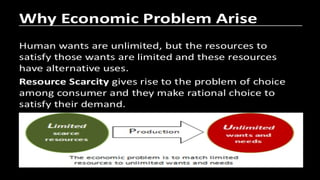
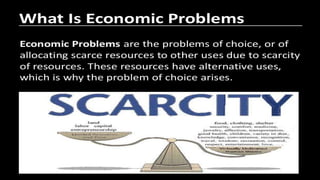
Every economy faces the problem of scarcity. 'Scarcity of resources' implies that there are unlimited
wants to be fulfilled by limited resources. The basic concern of an economy is to allocate the scarce
resources to the best possible use in the face of unlimited wants. Thus, the problem of scarcity forces
an economy to make a choice among various alternatives.
For example, an economy endowed with a given level of resources has to make a choice between
the production of guns and breads. The choice of the economy (i.e. either to produce guns or bread
and in what quantities) depends on the need and goal of the economy. While the production of bread
will make the economy devoid of the security level, whereas, the production of guns will not provide
sufficient food for the population. The same problem of scarcity can be felt at an individual level. For
example, with a given amount of money say, Rs 20,000, one cannot buy a TV and a sofa set
simultaneously. Thus, the individual needs to make a choice between the alternatives according to
his/her priority.
How will you choose the wants to be satisfied?
Answer :
An individual fulfills his/her wants according to his/her needs, satisfactions and
priority attached to different wants. Those wants will be fulfilled first that provides
the highest satisfaction to the individual and to which the individual has attached
the top most priority.
Further, the choice of want also depends on the need of the hour and availability of
the goods and also on the availability of means (money) to realise a particular want.
Thus, depending on all these conditions, we can say that an individual having
sufficient budget will fulfill a particular need that would fetch him/her the highest
possible satisfaction.
What are your reasons for studying Economics?
The need to study economics stems from the basic problem of
scarcity and choice. The basic concern of economics is to allocate
the scarce resources to the best possible use in the face of
unlimited wants. Consequent to the scarce availability of
resources, an
economy needs to make choice to allocate the scarce resources
to the areas with maximum possible and optimum returns.Thus,
the study of economics is very important. The following are the
reasons that make the study of economics inevitable.
1. To study the Theory of Consumption
The Theory of Consumption deals with the study of the behaviour
of the consumers in different types of market. The basic concern
of this theory is how a rational consumer makes his/her
preferences to get the maximum possible satisfaction in the facet
of fixed
level of income, given prices of the goods, etc.
2. To study the Theory of Production
The Theory of Production studies the production decisions of the
producers in different types of market. The theory investigates how a
producer takes production decisions. The theory highlights how a
producer combines different inputs (given their prices) in order to
minimise the cost of production and to maximise the profits.
3. To study the Theory of Distribution
The study of economics makes us aware about the distribution of
national income. In other words, how the income arising from the total
production of an economy is distributed in the form of wage, profit, rent
and interest to different factor owners (like, labour, entrepreneur, land,
capital).
4. To study the basic macroeconomic problems faced by an economy
Economics proves as the most powerful tool to understand and
analyse the root cause of basic macroeconomic problems faced by an
economy like, poverty, unemployment, income disparity, etc.
Economics helps us not only in understanding the interrelationship
among these problems (like the relationship between poverty and
unemployment) but also to take various corrective measures.
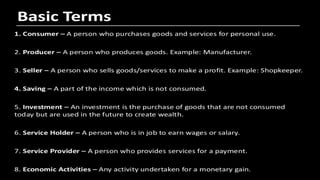
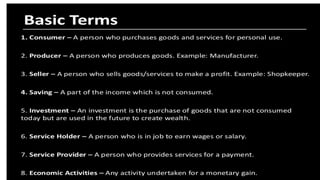
Consumer – A person who buys goods and services for the
satisfaction of human wants.
. Producer – A person who produces goods.
Service holder – A person who is working or in a job and
gets paid for it.
Service Provider – A person who gives services to others
for a payment.
Economic activity – Activities undertaken for monetary
gain or to earn income.
Economics is divided into three parts:
a] Consumption b] Production c] Distribution
Consumption: In consumption, we study wants, their origin, nature and
characteristics and
the laws governing them.
Production: It refers to all activities which are undertaken to produce
goods and services
for generation of income and satisfaction of wants.
. Distribution: Economic activity which studies how income generated
from the production process is distributed among the factors of
production.
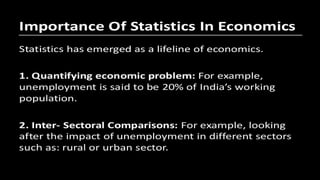
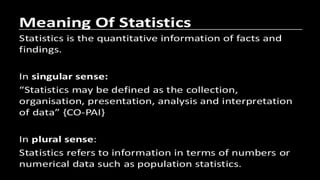
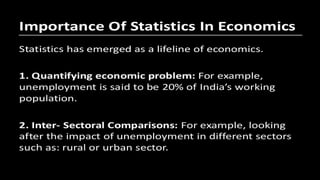
1. Meaning of Statistics in plural sense – It is a collection of numerical facts.
2. Meaning of Statistics in Plural Sense – It deals with the collection, presentation, analysis
and interpretation of quantitative information.
3. Definition of statistics in Plural Sense – It means aggregate of facts affected to a marked
extent of multiplicity of causes numerically expressed, enumerated or estimated according
to reasonable standard of accuracy, collected in a systematic manner for predetermined
purpose and placed in relation to each other.
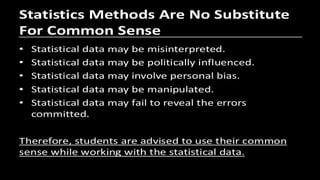
Data: Economic facts in terms of numbers.
Importance of Statistics:
Statistics is widely used in many fields.
a] Importance to the Government – Statistics is used in
administration and efficient
functioning of departments. It collects data to fulfill its welfare
objectives.
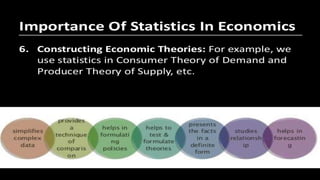
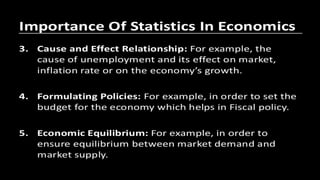
b] Importance of Statistics in Economics:
1] Statistics helps in making economic laws like law of demand and
concept of
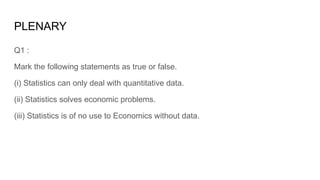
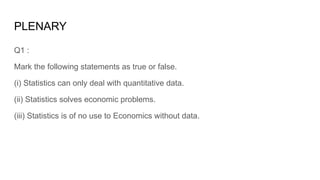
PLENARY
Q1 :
Mark the following statements as true or false.
(i) Statistics can only deal with quantitative data.
(ii) Statistics solves economic problems.
(iii) Statistics is of no use to Economics without data.
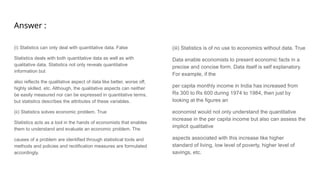
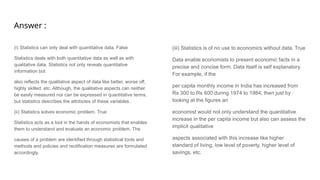
Answer :
(i) Statistics can only deal with quantitative data. False
Statistics deals with both quantitative data as well as with
qualitative data. Statistics not only reveals quantitative
information but
also reflects the qualitative aspect of data like better, worse off,
highly skilled, etc. Although, the qualitative aspects can neither
be easily measured nor can be expressed in quantitative terms,
but statistics describes the attributes of these variables.
(ii) Statistics solves economic problem. True
Statistics acts as a tool in the hands of economists that enables
them to understand and evaluate an economic problem. The
causes of a problem are identified through statistical tools and
methods and policies and rectification measures are formulated
accordingly.
(iii) Statistics is of no use to economics without data. True
Data enable economists to present economic facts in a
precise and concise form. Data itself is self explanatory.
For example, if the
per capita monthly income in India has increased from
Rs 300 to Rs 600 during 1974 to 1984, then just by
looking at the figures an
economist would not only understand the quantitative
increase in the per capita income but also can assess the
implicit qualitative
aspects associated with this increase like higher
standard of living, low level of poverty, higher level of
savings, etc.
ANSWER THE FOLLOWING
Make a list of activities that constitute the
ordinary business of life. Are these economic
activities?
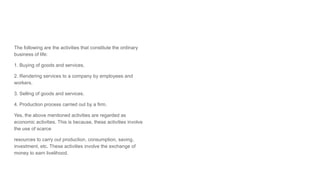
The following are the activities that constitute the ordinary
business of life:
1. Buying of goods and services.
2. Rendering services to a company by employees and
workers.
3. Selling of goods and services.
4. Production process carried out by a firm.
Yes, the above mentioned activities are regarded as
economic activities. This is because, these activities involve
the use of scarce
resources to carry out production, consumption, saving,
investment, etc. These activities involve the exchange of
money to earn livelihood.
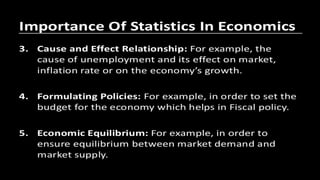
'The Government and policy makers use statistical data to formulate
suitable policies of economic development'. Illustrate
with two examples.
Answer :
The statistical data is of prime importance for the government and the
policy makers. The statistical data not only help them to analyse and
evaluate the outcomes of the past policies but also assist them to take
corrective measures and to formulate new policies accordingly.
Further, the statistical data also help the government to ascertain various
needs and priorities for the pursuit of the common goal of economic
development. For example, if Indian Government aims at encouraging
the production level, then it formulates its economic policy based on the
average production level of the past three years. Another example could
be the preparation of government budget. The previous data of
government expenditures and government revenues are taken
intoconsideration for estimating the allocation of funds among various
projects.
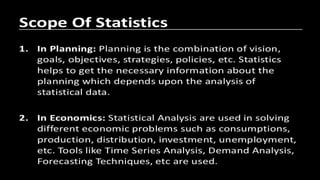
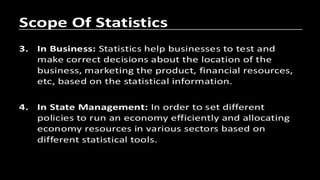
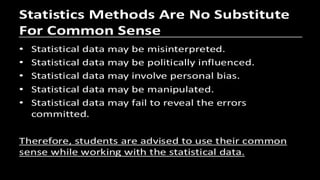
Statistics play an important role in Economics.
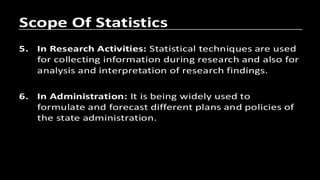
i. National income accounts are multipurpose indicators
for the economists and administrators.
ii. In Economics research statistical methods are used
for collecting and analysis the data and testing
hypothesis.
iii. The relationship between supply and demand is
studied by statistical methods, the imports and exports,
the inflation rate, the per capita income are the
problems which require a good knowledge of Statistics.
How is statistics important to the Government? The Government and policymakers use statistical data to formulate
suitable policies of economic development'. Illustrate with two examples.
The statistical data provide the base for the Government and the policy makers to formulate policies. The statistical data
not only help them to analyse and evaluate the outcomes of the past policies but also assist them to take corrective
measures and to formulate new policies.
Statistical data also help the Government to ascertain the relationship between economic variables and form policies
accordingly.
For example, if the Indian Government aims at increasing the national output, then it formulates its investment expenditure
policy based on the capital-output ratio in the past few years. Another example could be the preparation of monetary policy.
The previous data on inflation and economic growth are taken into consideration for estimating the money supply required
in the next period
Q. "You have unlimited wants and limited resources to satisfy them." Explain by giving two examples.
answer :
Every economy faces the problem of scarcity. 'Scarcity of resources' implies that there are unlimited
wants to be fulfilled by limited resources. The basic concern of an economy is to allocate the scarce
resources to the best possible use in the face of unlimited wants. Thus, the problem of scarcity forces
an economy to make a choice among various alternatives.
For example, an economy endowed with a given level of resources has to make a choice between
the production of guns and breads. The choice of the economy (i.e. either to produce guns or bread
and in what quantities) depends on the need and goal of the economy. While the production of bread
will make the economy devoid of the security level, whereas, the production of guns will not provide
sufficient food for the population. The same problem of scarcity can be felt at an individual level. For
example, with a given amount of money say, Rs 20,000, one cannot buy a TV and a sofa set
simultaneously. Thus, the individual needs to make a choice between the alternatives according to
his/her priority.
How will you choose the wants to be satisfied?
Answer :
An individual fulfills his/her wants according to his/her needs, satisfactions and
priority attached to different wants. Those wants will be fulfilled first that provides
the highest satisfaction to the individual and to which the individual has attached
the top most priority.
Further, the choice of want also depends on the need of the hour and availability of
the goods and also on the availability of means (money) to realise a particular want.
Thus, depending on all these conditions, we can say that an individual having
sufficient budget will fulfill a particular need that would fetch him/her the highest
possible satisfaction.
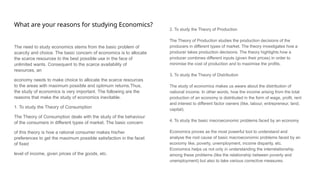
What are your reasons for studying Economics?
The need to study economics stems from the basic problem of
scarcity and choice. The basic concern of economics is to allocate
the scarce resources to the best possible use in the face of
unlimited wants. Consequent to the scarce availability of
resources, an
economy needs to make choice to allocate the scarce resources
to the areas with maximum possible and optimum returns.Thus,
the study of economics is very important. The following are the
reasons that make the study of economics inevitable.
1. To study the Theory of Consumption
The Theory of Consumption deals with the study of the behaviour
of the consumers in different types of market. The basic concern
of this theory is how a rational consumer makes his/her
preferences to get the maximum possible satisfaction in the facet
of fixed
level of income, given prices of the goods, etc.
2. To study the Theory of Production
The Theory of Production studies the production decisions of the
producers in different types of market. The theory investigates how a
producer takes production decisions. The theory highlights how a
producer combines different inputs (given their prices) in order to
minimise the cost of production and to maximise the profits.
3. To study the Theory of Distribution
The study of economics makes us aware about the distribution of
national income. In other words, how the income arising from the total
production of an economy is distributed in the form of wage, profit, rent
and interest to different factor owners (like, labour, entrepreneur, land,
capital).
4. To study the basic macroeconomic problems faced by an economy
Economics proves as the most powerful tool to understand and
analyse the root cause of basic macroeconomic problems faced by an
economy like, poverty, unemployment, income disparity, etc.
Economics helps us not only in understanding the interrelationship
among these problems (like the relationship between poverty and
unemployment) but also to take various corrective measures.
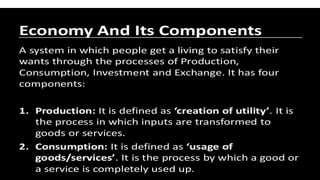
Consumer – A person who buys goods and services for the
satisfaction of human wants.
. Producer – A person who produces goods.
Service holder – A person who is working or in a job and
gets paid for it.
Service Provider – A person who gives services to others
for a payment.
Economic activity – Activities undertaken for monetary
gain or to earn income.
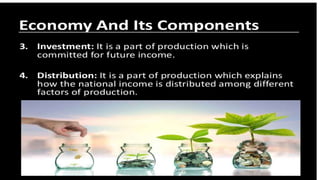
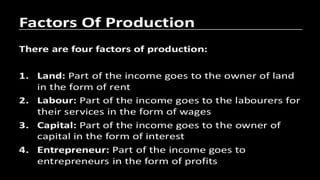
Economics is divided into three parts:
a] Consumption b] Production c] Distribution
Consumption: In consumption, we study wants, their origin, nature and
characteristics and
the laws governing them.
Production: It refers to all activities which are undertaken to produce
goods and services
for generation of income and satisfaction of wants.
. Distribution: Economic activity which studies how income generated
from the production process is distributed among the factors of
production.
1. Meaning of Statistics in plural sense – It is a collection of numerical facts.
2. Meaning of Statistics in Plural Sense – It deals with the collection, presentation, analysis
and interpretation of quantitative information.
3. Definition of statistics in Plural Sense – It means aggregate of facts affected to a marked
extent of multiplicity of causes numerically expressed, enumerated or estimated according
to reasonable standard of accuracy, collected in a systematic manner for predetermined
purpose and placed in relation to each other.
Data: Economic facts in terms of numbers.
Importance of Statistics:
Statistics is widely used in many fields.
a] Importance to the Government – Statistics is used in administration and efficient
functioning of departments. It collects data to fulfill its welfare objectives.
b] Importance of Statistics in Economics:
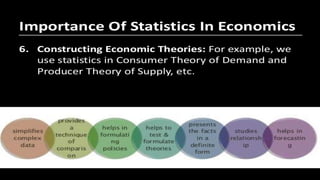
1] Statistics helps in making economic laws like law of demand and concept of
elasticity.
2] It helps in understanding and solving economic problem.
3] It helps in studying market structure.
4]It helps in finding mathematical relations between variables.
PLENARY
Q1 :
Mark the following statements as true or false.
(i) Statistics can only deal with quantitative data.
(ii) Statistics solves economic problems.
(iii) Statistics is of no use to Economics without data.
Answer :
(i) Statistics can only deal with quantitative data. False
Statistics deals with both quantitative data as well as with
qualitative data. Statistics not only reveals quantitative
information but
also reflects the qualitative aspect of data like better, worse off,
highly skilled, etc. Although, the qualitative aspects can neither
be easily measured nor can be expressed in quantitative terms,
but statistics describes the attributes of these variables.
(ii) Statistics solves economic problem. True
Statistics acts as a tool in the hands of economists that enables
them to understand and evaluate an economic problem. The
causes of a problem are identified through statistical tools and
methods and policies and rectification measures are formulated
accordingly.
(iii) Statistics is of no use to economics without data. True
Data enable economists to present economic facts in a
precise and concise form. Data itself is self explanatory.
For example, if the
per capita monthly income in India has increased from
Rs 300 to Rs 600 during 1974 to 1984, then just by
looking at the figures an
economist would not only understand the quantitative
increase in the per capita income but also can assess the
implicit qualitative
aspects associated with this increase like higher
standard of living, low level of poverty, higher level of
savings, etc.
ANSWER THE FOLLOWING
Make a list of activities that constitute the
ordinary business of life. Are these economic
activities?
The following are the activities that constitute the ordinary
business of life:
1. Buying of goods and services.
2. Rendering services to a company by employees and
workers.
3. Selling of goods and services.
4. Production process carried out by a firm.
Yes, the above mentioned activities are regarded as
economic activities. This is because, these activities involve
the use of scarce
resources to carry out production, consumption, saving,
investment, etc. These activities involve the exchange of
money to earn livelihood.
'The Government and policy makers use statistical data to formulate
suitable policies of economic development'. Illustrate
with two examples.
Answer :
The statistical data is of prime importance for the government and the
policy makers. The statistical data not only help them to analyse and
evaluate the outcomes of the past policies but also assist them to take
corrective measures and to formulate new policies accordingly.
Further, the statistical data also help the government to ascertain various
needs and priorities for the pursuit of the common goal of economic
development. For example, if Indian Government aims at encouraging
the production level, then it formulates its economic policy based on the
average production level of the past three years. Another example could
be the preparation of government budget. The previous data of
government expenditures and government revenues are taken
intoconsideration for estimating the allocation of funds among various
projects.
Statistics play an important role in Economics.
i. National income accounts are multipurpose indicators
for the economists and administrators.
ii. In Economics research statistical methods are used
for collecting and analysis the data and testing
hypothesis.
iii. The relationship between supply and demand is
studied by statistical methods, the imports and exports,
the inflation rate, the per capita income are the
problems which require a good knowledge of Statistics.
How is statistics important to the Government? The Government and policymakers use statistical data to formulate
suitable policies of economic development'. Illustrate with two examples.
The statistical data provide the base for the Government and the policy makers to formulate policies. The statistical data
not only help them to analyse and evaluate the outcomes of the past policies but also assist them to take corrective
measures and to formulate new policies.
Statistical data also help the Government to ascertain the relationship between economic variables and form policies
accordingly.
For example, if the Indian Government aims at increasing the national output, then it formulates its investment expenditure
policy based on the capital-output ratio in the past few years. Another example could be the preparation of monetary policy.
The previous data on inflation and economic growth are taken into consideration for estimating the money supply required
in the next period

Class 11 Eco Ch 1 - intro statastic ppt.pptx

  • 1.
  • 2.
    Economics is asocial science that studies the production, distribution, and consumption of goods and services The English term 'Economics' is derived from the Greek word 'Oikonomia'. Its meaning is 'household management'. Economics was first read in ancient Greece. Aristotle, the Greek Philosopher termed Economics as a science of 'household management'. The earlier term for the discipline was 'political economy', but since the late 19th century, it has commonly been called 'economics'. The word Economics is derived from two Greek words 'Oikos' means household and 'Nomous' means management
  • 3.
    Adam Smith Adam Smithwas an 18th-century Scottish philosopher. He is considered the father of modern economics. Smith is most famous for his 1776 book, "The Wealth of Nations."
  • 10.
    Q. "You haveunlimited wants and limited resources to satisfy them." Explain by giving two examples.
  • 11.
    answer : Every economyfaces the problem of scarcity. 'Scarcity of resources' implies that there are unlimited wants to be fulfilled by limited resources. The basic concern of an economy is to allocate the scarce resources to the best possible use in the face of unlimited wants. Thus, the problem of scarcity forces an economy to make a choice among various alternatives. For example, an economy endowed with a given level of resources has to make a choice between the production of guns and breads. The choice of the economy (i.e. either to produce guns or bread and in what quantities) depends on the need and goal of the economy. While the production of bread will make the economy devoid of the security level, whereas, the production of guns will not provide sufficient food for the population. The same problem of scarcity can be felt at an individual level. For example, with a given amount of money say, Rs 20,000, one cannot buy a TV and a sofa set simultaneously. Thus, the individual needs to make a choice between the alternatives according to his/her priority.
  • 12.
    How will youchoose the wants to be satisfied?
  • 13.
    Answer : An individualfulfills his/her wants according to his/her needs, satisfactions and priority attached to different wants. Those wants will be fulfilled first that provides the highest satisfaction to the individual and to which the individual has attached the top most priority. Further, the choice of want also depends on the need of the hour and availability of the goods and also on the availability of means (money) to realise a particular want. Thus, depending on all these conditions, we can say that an individual having sufficient budget will fulfill a particular need that would fetch him/her the highest possible satisfaction.
  • 16.
    What are yourreasons for studying Economics? The need to study economics stems from the basic problem of scarcity and choice. The basic concern of economics is to allocate the scarce resources to the best possible use in the face of unlimited wants. Consequent to the scarce availability of resources, an economy needs to make choice to allocate the scarce resources to the areas with maximum possible and optimum returns.Thus, the study of economics is very important. The following are the reasons that make the study of economics inevitable. 1. To study the Theory of Consumption The Theory of Consumption deals with the study of the behaviour of the consumers in different types of market. The basic concern of this theory is how a rational consumer makes his/her preferences to get the maximum possible satisfaction in the facet of fixed level of income, given prices of the goods, etc. 2. To study the Theory of Production The Theory of Production studies the production decisions of the producers in different types of market. The theory investigates how a producer takes production decisions. The theory highlights how a producer combines different inputs (given their prices) in order to minimise the cost of production and to maximise the profits. 3. To study the Theory of Distribution The study of economics makes us aware about the distribution of national income. In other words, how the income arising from the total production of an economy is distributed in the form of wage, profit, rent and interest to different factor owners (like, labour, entrepreneur, land, capital). 4. To study the basic macroeconomic problems faced by an economy Economics proves as the most powerful tool to understand and analyse the root cause of basic macroeconomic problems faced by an economy like, poverty, unemployment, income disparity, etc. Economics helps us not only in understanding the interrelationship among these problems (like the relationship between poverty and unemployment) but also to take various corrective measures.
  • 18.
    Consumer – Aperson who buys goods and services for the satisfaction of human wants. . Producer – A person who produces goods. Service holder – A person who is working or in a job and gets paid for it. Service Provider – A person who gives services to others for a payment. Economic activity – Activities undertaken for monetary gain or to earn income. Economics is divided into three parts: a] Consumption b] Production c] Distribution Consumption: In consumption, we study wants, their origin, nature and characteristics and the laws governing them. Production: It refers to all activities which are undertaken to produce goods and services for generation of income and satisfaction of wants. . Distribution: Economic activity which studies how income generated from the production process is distributed among the factors of production.
  • 20.
    1. Meaning ofStatistics in plural sense – It is a collection of numerical facts. 2. Meaning of Statistics in Plural Sense – It deals with the collection, presentation, analysis and interpretation of quantitative information. 3. Definition of statistics in Plural Sense – It means aggregate of facts affected to a marked extent of multiplicity of causes numerically expressed, enumerated or estimated according to reasonable standard of accuracy, collected in a systematic manner for predetermined purpose and placed in relation to each other.
  • 27.
    Data: Economic factsin terms of numbers. Importance of Statistics: Statistics is widely used in many fields. a] Importance to the Government – Statistics is used in administration and efficient functioning of departments. It collects data to fulfill its welfare objectives. b] Importance of Statistics in Economics: 1] Statistics helps in making economic laws like law of demand and concept of
  • 29.
    PLENARY Q1 : Mark thefollowing statements as true or false. (i) Statistics can only deal with quantitative data. (ii) Statistics solves economic problems. (iii) Statistics is of no use to Economics without data.
  • 30.
    Answer : (i) Statisticscan only deal with quantitative data. False Statistics deals with both quantitative data as well as with qualitative data. Statistics not only reveals quantitative information but also reflects the qualitative aspect of data like better, worse off, highly skilled, etc. Although, the qualitative aspects can neither be easily measured nor can be expressed in quantitative terms, but statistics describes the attributes of these variables. (ii) Statistics solves economic problem. True Statistics acts as a tool in the hands of economists that enables them to understand and evaluate an economic problem. The causes of a problem are identified through statistical tools and methods and policies and rectification measures are formulated accordingly. (iii) Statistics is of no use to economics without data. True Data enable economists to present economic facts in a precise and concise form. Data itself is self explanatory. For example, if the per capita monthly income in India has increased from Rs 300 to Rs 600 during 1974 to 1984, then just by looking at the figures an economist would not only understand the quantitative increase in the per capita income but also can assess the implicit qualitative aspects associated with this increase like higher standard of living, low level of poverty, higher level of savings, etc.
  • 31.
    ANSWER THE FOLLOWING Makea list of activities that constitute the ordinary business of life. Are these economic activities?
  • 32.
    The following arethe activities that constitute the ordinary business of life: 1. Buying of goods and services. 2. Rendering services to a company by employees and workers. 3. Selling of goods and services. 4. Production process carried out by a firm. Yes, the above mentioned activities are regarded as economic activities. This is because, these activities involve the use of scarce resources to carry out production, consumption, saving, investment, etc. These activities involve the exchange of money to earn livelihood.
  • 33.
    'The Government andpolicy makers use statistical data to formulate suitable policies of economic development'. Illustrate with two examples. Answer : The statistical data is of prime importance for the government and the policy makers. The statistical data not only help them to analyse and evaluate the outcomes of the past policies but also assist them to take corrective measures and to formulate new policies accordingly. Further, the statistical data also help the government to ascertain various needs and priorities for the pursuit of the common goal of economic development. For example, if Indian Government aims at encouraging the production level, then it formulates its economic policy based on the average production level of the past three years. Another example could be the preparation of government budget. The previous data of government expenditures and government revenues are taken intoconsideration for estimating the allocation of funds among various projects.
  • 34.
    Statistics play animportant role in Economics. i. National income accounts are multipurpose indicators for the economists and administrators. ii. In Economics research statistical methods are used for collecting and analysis the data and testing hypothesis. iii. The relationship between supply and demand is studied by statistical methods, the imports and exports, the inflation rate, the per capita income are the problems which require a good knowledge of Statistics.
  • 35.
    How is statisticsimportant to the Government? The Government and policymakers use statistical data to formulate suitable policies of economic development'. Illustrate with two examples. The statistical data provide the base for the Government and the policy makers to formulate policies. The statistical data not only help them to analyse and evaluate the outcomes of the past policies but also assist them to take corrective measures and to formulate new policies. Statistical data also help the Government to ascertain the relationship between economic variables and form policies accordingly. For example, if the Indian Government aims at increasing the national output, then it formulates its investment expenditure policy based on the capital-output ratio in the past few years. Another example could be the preparation of monetary policy. The previous data on inflation and economic growth are taken into consideration for estimating the money supply required in the next period
  • 42.
    Q. "You haveunlimited wants and limited resources to satisfy them." Explain by giving two examples.
  • 43.
    answer : Every economyfaces the problem of scarcity. 'Scarcity of resources' implies that there are unlimited wants to be fulfilled by limited resources. The basic concern of an economy is to allocate the scarce resources to the best possible use in the face of unlimited wants. Thus, the problem of scarcity forces an economy to make a choice among various alternatives. For example, an economy endowed with a given level of resources has to make a choice between the production of guns and breads. The choice of the economy (i.e. either to produce guns or bread and in what quantities) depends on the need and goal of the economy. While the production of bread will make the economy devoid of the security level, whereas, the production of guns will not provide sufficient food for the population. The same problem of scarcity can be felt at an individual level. For example, with a given amount of money say, Rs 20,000, one cannot buy a TV and a sofa set simultaneously. Thus, the individual needs to make a choice between the alternatives according to his/her priority.
  • 44.
    How will youchoose the wants to be satisfied?
  • 45.
    Answer : An individualfulfills his/her wants according to his/her needs, satisfactions and priority attached to different wants. Those wants will be fulfilled first that provides the highest satisfaction to the individual and to which the individual has attached the top most priority. Further, the choice of want also depends on the need of the hour and availability of the goods and also on the availability of means (money) to realise a particular want. Thus, depending on all these conditions, we can say that an individual having sufficient budget will fulfill a particular need that would fetch him/her the highest possible satisfaction.
  • 48.
    What are yourreasons for studying Economics? The need to study economics stems from the basic problem of scarcity and choice. The basic concern of economics is to allocate the scarce resources to the best possible use in the face of unlimited wants. Consequent to the scarce availability of resources, an economy needs to make choice to allocate the scarce resources to the areas with maximum possible and optimum returns.Thus, the study of economics is very important. The following are the reasons that make the study of economics inevitable. 1. To study the Theory of Consumption The Theory of Consumption deals with the study of the behaviour of the consumers in different types of market. The basic concern of this theory is how a rational consumer makes his/her preferences to get the maximum possible satisfaction in the facet of fixed level of income, given prices of the goods, etc. 2. To study the Theory of Production The Theory of Production studies the production decisions of the producers in different types of market. The theory investigates how a producer takes production decisions. The theory highlights how a producer combines different inputs (given their prices) in order to minimise the cost of production and to maximise the profits. 3. To study the Theory of Distribution The study of economics makes us aware about the distribution of national income. In other words, how the income arising from the total production of an economy is distributed in the form of wage, profit, rent and interest to different factor owners (like, labour, entrepreneur, land, capital). 4. To study the basic macroeconomic problems faced by an economy Economics proves as the most powerful tool to understand and analyse the root cause of basic macroeconomic problems faced by an economy like, poverty, unemployment, income disparity, etc. Economics helps us not only in understanding the interrelationship among these problems (like the relationship between poverty and unemployment) but also to take various corrective measures.
  • 50.
    Consumer – Aperson who buys goods and services for the satisfaction of human wants. . Producer – A person who produces goods. Service holder – A person who is working or in a job and gets paid for it. Service Provider – A person who gives services to others for a payment. Economic activity – Activities undertaken for monetary gain or to earn income. Economics is divided into three parts: a] Consumption b] Production c] Distribution Consumption: In consumption, we study wants, their origin, nature and characteristics and the laws governing them. Production: It refers to all activities which are undertaken to produce goods and services for generation of income and satisfaction of wants. . Distribution: Economic activity which studies how income generated from the production process is distributed among the factors of production.
  • 52.
    1. Meaning ofStatistics in plural sense – It is a collection of numerical facts. 2. Meaning of Statistics in Plural Sense – It deals with the collection, presentation, analysis and interpretation of quantitative information. 3. Definition of statistics in Plural Sense – It means aggregate of facts affected to a marked extent of multiplicity of causes numerically expressed, enumerated or estimated according to reasonable standard of accuracy, collected in a systematic manner for predetermined purpose and placed in relation to each other.
  • 59.
    Data: Economic factsin terms of numbers. Importance of Statistics: Statistics is widely used in many fields. a] Importance to the Government – Statistics is used in administration and efficient functioning of departments. It collects data to fulfill its welfare objectives. b] Importance of Statistics in Economics: 1] Statistics helps in making economic laws like law of demand and concept of elasticity. 2] It helps in understanding and solving economic problem. 3] It helps in studying market structure. 4]It helps in finding mathematical relations between variables.
  • 61.
    PLENARY Q1 : Mark thefollowing statements as true or false. (i) Statistics can only deal with quantitative data. (ii) Statistics solves economic problems. (iii) Statistics is of no use to Economics without data.
  • 62.
    Answer : (i) Statisticscan only deal with quantitative data. False Statistics deals with both quantitative data as well as with qualitative data. Statistics not only reveals quantitative information but also reflects the qualitative aspect of data like better, worse off, highly skilled, etc. Although, the qualitative aspects can neither be easily measured nor can be expressed in quantitative terms, but statistics describes the attributes of these variables. (ii) Statistics solves economic problem. True Statistics acts as a tool in the hands of economists that enables them to understand and evaluate an economic problem. The causes of a problem are identified through statistical tools and methods and policies and rectification measures are formulated accordingly. (iii) Statistics is of no use to economics without data. True Data enable economists to present economic facts in a precise and concise form. Data itself is self explanatory. For example, if the per capita monthly income in India has increased from Rs 300 to Rs 600 during 1974 to 1984, then just by looking at the figures an economist would not only understand the quantitative increase in the per capita income but also can assess the implicit qualitative aspects associated with this increase like higher standard of living, low level of poverty, higher level of savings, etc.
  • 63.
    ANSWER THE FOLLOWING Makea list of activities that constitute the ordinary business of life. Are these economic activities?
  • 64.
    The following arethe activities that constitute the ordinary business of life: 1. Buying of goods and services. 2. Rendering services to a company by employees and workers. 3. Selling of goods and services. 4. Production process carried out by a firm. Yes, the above mentioned activities are regarded as economic activities. This is because, these activities involve the use of scarce resources to carry out production, consumption, saving, investment, etc. These activities involve the exchange of money to earn livelihood.
  • 65.
    'The Government andpolicy makers use statistical data to formulate suitable policies of economic development'. Illustrate with two examples. Answer : The statistical data is of prime importance for the government and the policy makers. The statistical data not only help them to analyse and evaluate the outcomes of the past policies but also assist them to take corrective measures and to formulate new policies accordingly. Further, the statistical data also help the government to ascertain various needs and priorities for the pursuit of the common goal of economic development. For example, if Indian Government aims at encouraging the production level, then it formulates its economic policy based on the average production level of the past three years. Another example could be the preparation of government budget. The previous data of government expenditures and government revenues are taken intoconsideration for estimating the allocation of funds among various projects.
  • 66.
    Statistics play animportant role in Economics. i. National income accounts are multipurpose indicators for the economists and administrators. ii. In Economics research statistical methods are used for collecting and analysis the data and testing hypothesis. iii. The relationship between supply and demand is studied by statistical methods, the imports and exports, the inflation rate, the per capita income are the problems which require a good knowledge of Statistics.
  • 67.
    How is statisticsimportant to the Government? The Government and policymakers use statistical data to formulate suitable policies of economic development'. Illustrate with two examples. The statistical data provide the base for the Government and the policy makers to formulate policies. The statistical data not only help them to analyse and evaluate the outcomes of the past policies but also assist them to take corrective measures and to formulate new policies. Statistical data also help the Government to ascertain the relationship between economic variables and form policies accordingly. For example, if the Indian Government aims at increasing the national output, then it formulates its investment expenditure policy based on the capital-output ratio in the past few years. Another example could be the preparation of monetary policy. The previous data on inflation and economic growth are taken into consideration for estimating the money supply required in the next period