What is waterpollution
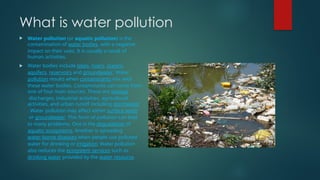
Water pollution (or aquatic pollution) is the
contamination of water bodies, with a negative
impact on their uses. It is usually a result of
human activities.
Water bodies include lakes, rivers, oceans,
aquifers, reservoirs and groundwater. Water
pollution results when contaminants mix with
these water bodies. Contaminants can come from
one of four main sources. These are sewage
discharges, industrial activities, agricultural
activities, and urban runoff including stormwater
. Water pollution may affect either surface water
or groundwater. This form of pollution can lead
to many problems. One is the degradation of
aquatic ecosystems. Another is spreading
water-borne diseases when people use polluted
water for drinking or irrigation.Water pollution
also reduces the ecosystem services such as
drinking water provided by the water resource.
3.
Sources of waterpollution
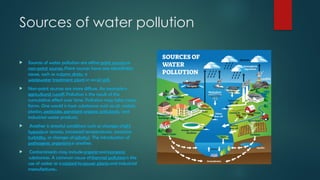
Sources of water pollution are eitherpoint sourcesor
non-point sources.Point sources have one identifiable
cause, such as astorm drain, a
wastewater treatment plantor anoil spill.
Non-point sources are more diffuse. An example is
agricultural runoff.Pollution is the result of the
cumulative effect over time. Pollution may take many
forms. One would is toxic substances such as oil, metals,
plastics,pesticides,persistent organic pollutants, and
industrial waste products.
Another is stressful conditions such as changes ofpH,
hypoxiaor anoxia, increased temperatures, excessive
turbidity, or changes ofsalinity). The introduction of
pathogenic organismsis another.
Contaminants may includeorganicandinorganic
substances. A common cause ofthermal pollutionis the
use of water as acoolantbypower plantsand industrial
manufacturers.
4.
What is thesolution for water
pollution
Control of water pollution requires
appropriate infrastructure and
management plans as well as
legislation. Technology solutions
can include improving sanitation,
sewage treatment,
industrial wastewater treatment,
agricultural wastewater treatment,
erosion control, sediment control
and control of urban runoff
(including stormwater
management).
5.
WATER POLLUTION INKERALA
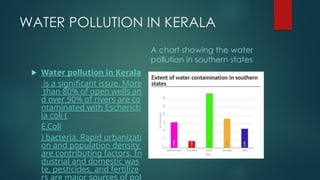
Water pollution in Kerala
is a significant issue. More
than 80% of open wells an
d over 90% of rivers are co
ntaminated with Escherich
ia coli (
E.Coli
) bacteria. Rapid urbanizati
on and population density
are contributing factors. In
dustrial and domestic was
te, pesticides, and fertilize
rs are major sources of pol
A chart showing the water
pollution in southern states
6.
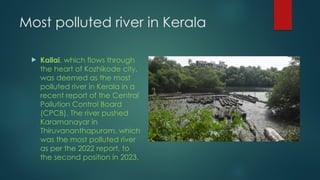
Most polluted riverin Kerala
Kallai, which flows through
the heart of Kozhikode city,
was deemed as the most
polluted river in Kerala in a
recent report of the Central
Pollution Control Board
(CPCB). The river pushed
Karamanayar in
Thiruvananthapuram, which
was the most polluted river
as per the 2022 report, to
the second position in 2023.
7.
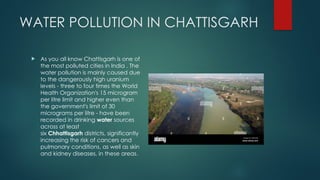
WATER POLLUTION INCHATTISGARH
As you all know Chattisgarh is one of
the most polluted cities in India . The
water pollution is mainly caused due
to the dangerously high uranium
levels - three to four times the World
Health Organization's 15 microgram
per litre limit and higher even than
the government's limit of 30
micrograms per litre - have been
recorded in drinking water sources
across at least
six Chhattisgarh districts, significantly
increasing the risk of cancers and
pulmonary conditions, as well as skin
and kidney diseases, in these areas.
8.
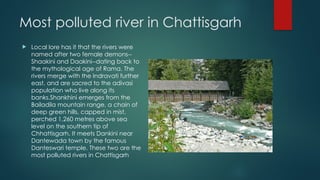
Most polluted riverin Chattisgarh
Local lore has it that the rivers were
named after two female demons--
Shaakini and Daakini--dating back to
the mythological age of Rama. The
rivers merge with the Indravati further
east, and are sacred to the adivasi
population who live along its
banks.Shankhini emerges from the
Bailadila mountain range, a chain of
deep green hills, capped in mist,
perched 1,260 metres above sea
level on the southern tip of
Chhattisgarh. It meets Dankini near
Dantewada town by the famous
Danteswari temple. These two are the
most polluted rivers in Chattisgarh




![Water_Pollution[1].pptx](https://cdn.slidesharecdn.com/ss_thumbnails/waterpollution1-231226162009-fa82de8a-thumbnail.jpg?width=640&height=640&fit=bounds)


