Introduction: Understanding the Need for Power Sharing
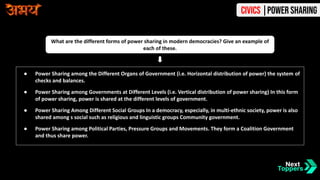
In any democratic country, power cannot be held by a single individual or group. It has to be shared among different groups, institutions, and levels of government to ensure that governance is fair, inclusive, and just. The concept of power sharing is deeply rooted in the principles of democracy, where every individual and community has the right to participate in the decision-making process. It is not only a method of governance but a necessity in diverse societies like India, Belgium, and Sri Lanka. The chapter “Power Sharing” introduces us to this idea by comparing real-world examples, analyzing models of governance, and understanding how power sharing maintains peace and unity in society.
Case Studies: Belgium and Sri Lanka – A Comparative Understanding
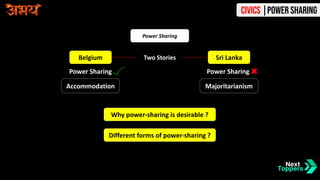
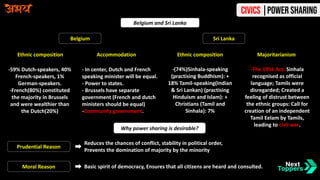
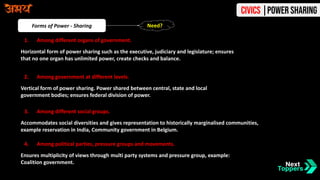
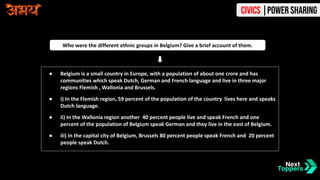
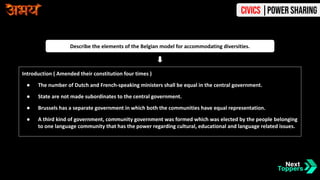
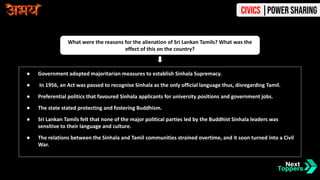
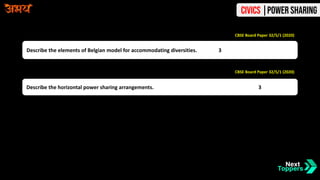
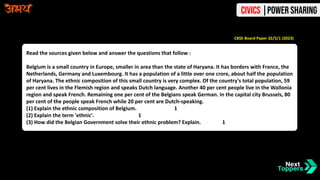
To understand the importance of power sharing, the chapter begins with two contrasting examples – Belgium and Sri Lanka. Belgium is a small European country with a complex population mix: 59% of the population lives in the Flemish region and speaks Dutch, 40% live in the Wallonia region and speak French, and about 1% speak German. In the capital city Brussels, the pattern is reversed, with French-speaking people forming the majority. The country recognized early that if peace was to be maintained, power needed to be distributed equitably among all these linguistic groups. Hence, they adopted a model that ensured every group had fair representation in governance. The Belgian model included constitutional amendments that resulted in equal representation of Dutch and French-speaking ministers in the central government, separate governments for each community, and a third level of government for Brussels, with equal powers for both groups.
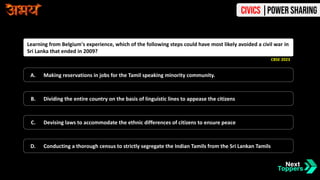
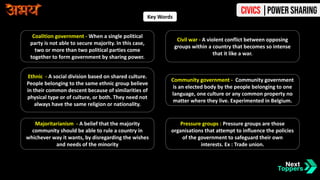
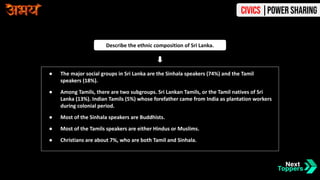
On the other hand, Sri Lanka followed a completely different path. The majority Sinhalese community, which constituted around 74% of the population, dominated the Tamil-speaking minority (around 18%) by adopting majoritarian policies. Sinhalese was declared the only official language, and Buddhism received special recognition, marginalizing the Tamil community both politically and culturally. Over time, this led to discontent, conflict, and eventually a civil war that lasted for decades. Unlike Belgium, where accommodation and power sharing prevented conflict, Sri Lanka’s majoritarianism led to deep divisions and violence.
The Moral and Prudential Reasons for Power Sharing
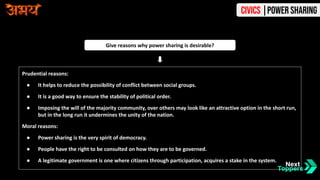
Power sharing is not just a matter of political strategy; it’s also a moral obligation in a democratic setup. Democracy stands for equality, freedom, and participation. If power is monopolized by one group, it can lead to injustice and alienation of minority communities. There are two broad reasons for power sharing: prudential and moral.
Prudential reasons stress that power sharing helps reduce the possibility of conflict between different social groups. It is a practical reason

![Compare the situation of Belgium and Sri Lanka considering their location, size and cultural aspects. 3
CBSE Board Paper 2019 - Set [32/1/1]
CBSE Board Paper 2019 - Set [32/1/1]
How is the idea of power sharing emerged? Explain different forms that have common arrangements of
power sharing. 3
CBSE Board Paper 2019 - Set [32/4/1]
Evaluate the power sharing system in India. 3
CBSE Board Paper 2019 - Set [32/3/1]
How is community government elected in Belgium? 3
CBSE Board Paper 2019 - Set [32/3/1]
How did the feeling of alienation develop among the Sri Lankan Tamils? 2
CBSE Board Paper 32/5/1 (2019)
Why power sharing good for democracies? Explain one reason. 2
Civics |Power Sharing](https://image.slidesharecdn.com/6750763b07e29powersharing-250406100800-2b57019b/85/Class-10-Civics-Chapter-1-Power-Sharing-15-320.jpg)
![Which one of the following is a major caste group of Sri Lanka :
A. Christian and Tamil
B. Buddhist and Hindu
C. Sinhali and Tamil
D. Sinhali and Christian
CBSE Board Paper 2020 - Set [32/1/1]
CBSE Board Paper 2020 - Set [32/2/1]
Identify the correct option of power sharing on the basis of different levels of government.
A. Among different pressure groups.
B. Among different social groups.
C. Legislature, Executive and Judiciary.
D. Union Government, State Government and Local bodies.
Civics |Power Sharing](https://image.slidesharecdn.com/6750763b07e29powersharing-250406100800-2b57019b/85/Class-10-Civics-Chapter-1-Power-Sharing-17-320.jpg)
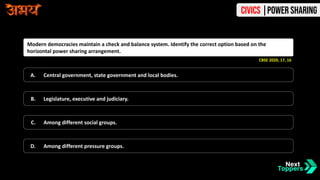
![Modern democracies maintain check and balance system. Identify the correct option based on the
horizontal power sharing arrangement.
A. Central government, state government, local bodies.
B. Legislature, executive, judiciary.
C. Among different social groups.
D. Among different pressure groups.
CBSE Board Paper 2020 - Set [32/1/1]
CBSE Board Paper 2021-22 - Set [32/1/4] [Term 1]
Identify 'Horizontal power sharing' arrangements among the following in modern democracies
A. Different organs of government
B. Governments at different levels
C. Different social groups
D. Different parties, pressure groups and movements
Civics |Power Sharing](https://image.slidesharecdn.com/6750763b07e29powersharing-250406100800-2b57019b/85/Class-10-Civics-Chapter-1-Power-Sharing-18-320.jpg)
![Identify the administrative system of Indian Government with the help of the following information.
● Power shared between Central and State Governments to Local Governments.
● It is called as a third tier of the Government.
● The State Governments are required to share some powers and revenue with them.
Select the appropriate option from the following.
A. Federal system
B. Unitary Federal system
C. Decentralised system
D. Unitary system
Sample Questions Paper 2021-22 [Term 1]
CBSE Board Paper 2021-22 - Set [32/1/4] [Term 1]
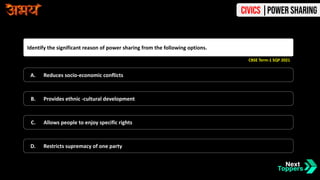
Assertion (A): Power sharing is good.
Reason (R): It help to reduce the possibility of conflicts between social groups.
A. Both Assertion (A) and Reason (R) are true and Reason (R) is the correct explanation of Assertion (A).
B. Both Assertion (A) and Reason (R) are true but Reason (R) is not the correct explanation of Assertion (A).
C. Assertion (A) is true but Reason (R) is false.
D. Assertion (A) is false but Reason (R) is true.
Civics |Power Sharing](https://image.slidesharecdn.com/6750763b07e29powersharing-250406100800-2b57019b/85/Class-10-Civics-Chapter-1-Power-Sharing-19-320.jpg)
![Consider the following statements on Power Sharing and choose the correct option :
(I) Majoritarianism is the real spirit of democracy.
(II) It creates balance and harmony in different groups.
(III) It reduces the possibility of conflict among social groups.
(IV) Power sharing is the essence of democracy.
Options :
(a) I, II and III
(b) II, III and IV
(c) I, III and IV
(d) I, II and IV
CBSE Board Paper 2023 - Set [32/4/1]
Civics |Power Sharing](https://image.slidesharecdn.com/6750763b07e29powersharing-250406100800-2b57019b/85/Class-10-Civics-Chapter-1-Power-Sharing-21-320.jpg)
![Identify the administrative level of Indian Government with the help of the information given in the box and
choose the correct option :
● Power shared between Central to Local Government.
● The State Governments are required to share some powers and revenue with them.
● It is called a three tier government.
Options :
A. Dictatorial System
B. Decentralized System
C. Unitary Federal System
D. Imperialistic System
CBSE Board Paper 2023 - Set [32/4/1]
Civics |Power Sharing](https://image.slidesharecdn.com/6750763b07e29powersharing-250406100800-2b57019b/85/Class-10-Civics-Chapter-1-Power-Sharing-22-320.jpg)
![Consider the following statements on Power sharing and choose the correct option.
● Imposing the will of majority community over others.
● It helps in reducing the possibility of conflict between the social groups.
● Power sharing is a good way to ensure the stability of political order.
● It brings socio-political opposition among parties.
Options:
(A) I and III
(C) I and IV
(B) II and III
(D) I and II
CBSE Board Paper 2023 - Set [32/6/1]
Civics |Power Sharing](https://image.slidesharecdn.com/6750763b07e29powersharing-250406100800-2b57019b/85/Class-10-Civics-Chapter-1-Power-Sharing-23-320.jpg)
![Consider the following statements on Power Sharing and choose the correct option:
I. It deepens democracy.
II. It helps to reduce conflicts among social groups.
III. It is a way to ensure political stability.
IV. It brings socio-economic struggles.
Options:
(A) I, II and III
(B) II, III and IV
(C) I, III and IV
(D) I, II and IV
CBSE Board Paper 2023 - Set [32/1/1]
In modern democracies, power sharing arrangements can take many forms." Explain the statement. 2
CBSE Board Paper 32/5/1 (2023)
Civics |Power Sharing](https://image.slidesharecdn.com/6750763b07e29powersharing-250406100800-2b57019b/85/Class-10-Civics-Chapter-1-Power-Sharing-24-320.jpg)
![What role do 'checks and balances' play in a democratic country ? 1
Choose the most suitable option from the following.
(a) To establish a direct form of government without representatives.
(b) To create a separation of powers to prevent from authoritarianism.
(c) To prevent any change to the Constitution.
(d) To ensure absolute power, for one branch of government.
CBSE Board Paper 2024 - Set [32/1/3]
Which of the following was the primary objective of Belgium to form the separate government in Brussels ? 1
(a) Promoting cultural events.
(b) Managing international relations.
(c) Enforcing local laws.
(d) Ensuring linguistic accommodation.
CBSE Board Paper 2024 - Set [32/1/3]
Explain the prudential reasons of power sharing. 2
CBSE Board Paper 2024 - Set [32/1/3]
Civics |Power Sharing](https://image.slidesharecdn.com/6750763b07e29powersharing-250406100800-2b57019b/85/Class-10-Civics-Chapter-1-Power-Sharing-25-320.jpg)
![Read the following statements about power-sharing arrangement in Belgium and choose the correct option. 1
I. Brussels has a separate Govt. with equal representation.
II. Dutch & French-speaking ministers are equal in Central Govt.
III. Community Govt. is elected by People belonging to one language.
IV. Series of majoritarian measures adopted in Belgium.
Options:
(A) I, II and IV
(B) I, III and IV
(C) II, III and IV
(D) I, II and III
CBSE Board Paper 2024 - Set [32/2/2]
Civics |Power Sharing](https://image.slidesharecdn.com/6750763b07e29powersharing-250406100800-2b57019b/85/Class-10-Civics-Chapter-1-Power-Sharing-26-320.jpg)
![How is horizontal power sharing different from vertical? Explain. 2
CBSE Board Paper 2024 - Set [32/2/2]
Identify the primary objective of power sharing arrangements in Belgium from the following options. 1
(A) Establishing a unitary form of government.
(B) Centralized political control of government.
(C) Establishing cultural and educational matters of Dutch.
(D) Accommodating linguistic and regional interest.
CBSE Board Paper 2024 - Set [32/3/3]
Civics |Power Sharing](https://image.slidesharecdn.com/6750763b07e29powersharing-250406100800-2b57019b/85/Class-10-Civics-Chapter-1-Power-Sharing-27-320.jpg)
![Read the arguments given in the favour of power sharing and choose the correct option. 1
I. Reduces the likelihood of bias.
II. Barricades the decision-making process.
III. Accommodates diversities.
IV. Increases the participation of people in power.
Options:
(A) Only I, II and III are correct.
(B) Only II, III and IV are correct.
(C) Only I, III and IV are correct.
(D) Only I, II and IV are correct.
CBSE Board Paper 2024 - Set [32/4/1]
Civics |Power Sharing](https://image.slidesharecdn.com/6750763b07e29powersharing-250406100800-2b57019b/85/Class-10-Civics-Chapter-1-Power-Sharing-28-320.jpg)
![Two statements, I and II are given below. 1
Read both the statements and choose the correct option.
Statement I : Division of power is good for democratic systems.
Statement II : It helps to reduce the possibility of conflict between social groups.
Options:
(A) Statement I is true, but II is false.
(B) Statement I is false, but II is true.
(C) Statements I and II are true and II is the correct explanation of I.
(D) Statements I and II are true, but II is not the correct explanation of I.
CBSE Board Paper 2024 - Set [32/5/2]
Civics |Power Sharing](https://image.slidesharecdn.com/6750763b07e29powersharing-250406100800-2b57019b/85/Class-10-Civics-Chapter-1-Power-Sharing-29-320.jpg)



![Democratic Politics Grade 10 chapter 1 Grade 10 CBSE [ Power sharing]](https://cdn.slidesharecdn.com/ss_thumbnails/finalchapter11-150513185027-lva1-app6892-thumbnail.jpg?width=640&height=640&fit=bounds)


