By Graeme Baird, Clyde & Co LLP, London.


Claims Handling Issues for
Contractors
The International Marine Contractors Association Conference
in Amsterdam 28 & 29 November 2012
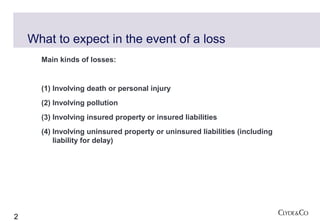
What to expect in the event of a loss
      Main kinds of losses:


      (1) Involving death or personal injury
      (2) Involving pollution
      (3) Involving insured property or insured liabilities
      (4) Involving uninsured property or uninsured liabilities (including
          liability for delay)


2
What to expect in the event of a loss
      Major Losses (i.e. categories 1 and 2)


      •   Licence holder (e.g. oil company) will usually implement their own
          disaster plan.
      •   Regulators may intervene in rescue, pollution control and/or wreck
          removal. [In England this will be the MCA and/or the SOSREP]
      •   Prosecuting Authorities may interview personnel and seize
          documents or computers. [In England this will be the Police and/or the
          HSE]
      •   Contracting Parties and their lawyers will assess exposures to civil
          liabilities, and indeed any criminal liability, on an urgent basis.
      •   Insurers and their lawyers will also want to assess their exposures.


3
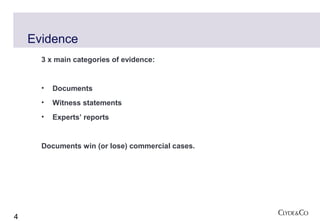
Evidence
      3 x main categories of evidence:


      •   Documents
      •   Witness statements
      •   Experts’ reports


      Documents win (or lose) commercial cases.


4
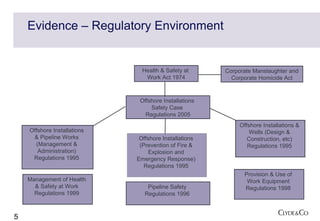
Evidence – Regulatory Environment


                               Health & Safety at      Corporate Manslaughter and
                                Work Act 1974            Corporate Homicide Act


                              Offshore Installations
                                  Safety Case
                                Regulations 2005
                                                            Offshore Installations &
    Offshore Installations                                      Wells (Design &
     & Pipeline Works         Offshore Installations           Construction, etc)
      (Management &           (Prevention of Fire &            Regulations 1995
       Administration)           Explosion and
     Regulations 1995        Emergency Response)
                                Regulations 1995
                                                              Provision & Use of
    Management of Health                                       Work Equipment
      & Safety at Work           Pipeline Safety              Regulations 1998
      Regulations 1999          Regulations 1996


5
Evidence
      Examples of key documents:


      1.   Oil company’s pre-approved emergency plan [In England this is an OPEP]. Was this
           followed correctly?
      2.   Compliance with regulator’s operational requirements [ In England a detailed “safety
           case” must have been agreed and approved by HSE highlighting potential dangers,
           consequences and methods of control]. Was this agreed operating procedure
           implemented correctly? Named individuals may have personal responsibility in the
           event of default [ In England the Safety Case Duty Holder or the Offshore Installation
           Manager].
      3.   Audit trail of regular testing and/or inspection of key safety equipment. [e.g. pursuant to
           the Design and Construction Regulations].
      4.   ISM and Classification Society records
      5.   Logs and/or daily reports
      6.   Original engineering certification of components
      7.   Drawings or charts supplied by one party to another and relied upon
      8.   Minutes of meetings, especially safety briefings and toolbox talks prior to the loss
      9.   Photographs or videos
      10. Correspondence, especially emails.

6
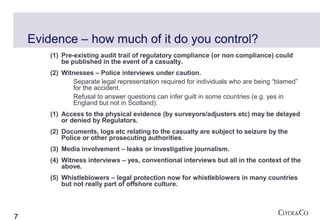
Evidence – how much of it do you control?
        (1) Pre-existing audit trail of regulatory compliance (or non compliance) could
            be published in the event of a casualty.
        (2) Witnesses – Police interviews under caution.
               Separate legal representation required for individuals who are being “blamed”
               for the accident.
               Refusal to answer questions can infer guilt in some countries (e.g. yes in
               England but not in Scotland).
        (1) Access to the physical evidence (by surveyors/adjusters etc) may be delayed
            or denied by Regulators.
        (2) Documents, logs etc relating to the casualty are subject to seizure by the
            Police or other prosecuting authorities.
        (3) Media involvement – leaks or investigative journalism.
        (4) Witness interviews – yes, conventional interviews but all in the context of the
            above.
        (5) Whistleblowers – legal protection now for whistleblowers in many countries
            but not really part of offshore culture.


7
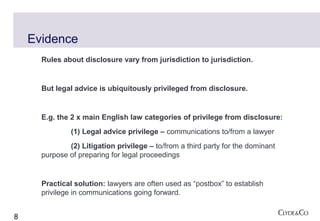
Evidence
      Rules about disclosure vary from jurisdiction to jurisdiction.


      But legal advice is ubiquitously privileged from disclosure.


      E.g. the 2 x main English law categories of privilege from disclosure:
               (1) Legal advice privilege – communications to/from a lawyer
              (2) Litigation privilege – to/from a third party for the dominant
      purpose of preparing for legal proceedings


      Practical solution: lawyers are often used as “postbox” to establish
      privilege in communications going forward.


8
Civil Claims

      Contractual claims


      and/or


      Tort claims (e.g. maritime collisions, product liability and defective design)


      [also: insurance claims and possible waivers of subrogation].


9
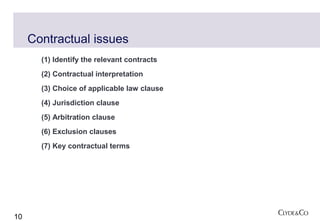
Contractual issues
       (1) Identify the relevant contracts
       (2) Contractual interpretation
       (3) Choice of applicable law clause
       (4) Jurisdiction clause
       (5) Arbitration clause
       (6) Exclusion clauses
       (7) Key contractual terms


10
Contractual issues (continued)
       (1) Identify the relevant contracts


          Signed contracts are usual in the offshore industry but there may be
          commercial pressure to start work before a written agreement is finalised.
          There can be an enforceable contract before this stage – just need sufficient
          consensus on key terms – but this usually leads to uncertainty in the event
          of a claim (e.g. are your exclusion clauses incorporated or not)


          Use of purchase orders or contracts agreed in correspondence: problem if
          purchaser and supplier both have written standard terms, unless it is made
          sufficiently clear which prevails.


          Course of dealing – an established pattern of trading on given terms.


11
Contractual issues (continued)
       (2) Contractual interpretation
          The concept in most jurisdictions is to give effect to the intention of
          the parties at the time they entered into the contract.
       BUT:
       (a) Witness evidence from the parties after a loss about what they
           actually meant is almost always inadmissible.
       (b) The presumed intention of the parties is derived from the words
           they have actually used and from the circumstances (factual matrix)
           in which the contract was formed.


12
Contractual issues (continued)
       (3) Choice of applicable law clause: [NB will have been chosen prior to any loss/claim].


           Law and jurisdiction need not be the same (e.g. can have New York law and London arbitration)


           The applicable law will usually determine:

            (a)   whether there is a contract
            (b)   whether the contract has been breached
            (c)   rights to terminate the contract
            (d)   what categories of loss can be claimed
            (e)   amount of damages


           The applicable law will not usually cover:
           (f) evidence/procedure
           (g) time limits
           These will usually be determined by the law of the forum


           Desire of contracting parties to use their own national law can lead to uncertainty on (a) to (e) above if
           that country’s legal rules are not sufficiently developed.


13
Contractual issues (continued)
       (4) Jurisdiction clause [NB will already have been chosen prior to any
           loss/claim].


       Factors as to choice of jurisdiction include:
       (a) expertise of Judges?
       (b) impartiality
       (c) cost
       (d) convenience (accessibility/time zones)
       (e) language issues
       (f) procedure/evidence
       (g) availability of lawyers or experts with relevant experience
       (h) speed/appeals
       (i) enforceability of judgments


14
Contractual issues (continued)
       (5) Arbitration clause
          [usually will have been agreed prior to claim/loss but can also be agreed
          afterwards]


          Factors relevant to arbitration:
          (a) confidentiality
          (b) speed
          (c) cost
          (d) flexible procedure but not suited to (i) multiple party situations or (ii)
              non-contract claims
          (e) wider enforceability: 1958 New York Convention


15
Contractual issues (continued)
       (6) Exclusion clauses


       Very important and often very useful BUT:
       (a) Many systems of law apply contra proferentem rule – exclusion
           clauses to be construed narrowly or against the person relying on
           them
       (b) Need to be incorporated into the contract when it was formed –
           printed on the reverse of an invoice may be too late.
       (c) The proper law of the contract may not allow complete freedom of
           contract in all situations [eg Unfair Contract Terms Act 1977 – can’t
           exclude liability for negligence giving rise to death or personal injury]


16
Contractual issues (continued)
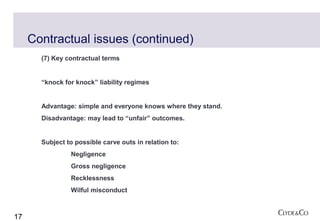
       (7) Key contractual terms


       “knock for knock” liability regimes


       Advantage: simple and everyone knows where they stand.
       Disadvantage: may lead to “unfair” outcomes.


       Subject to possible carve outs in relation to:
                Negligence
                Gross negligence
                Recklessness
                Wilful misconduct


17
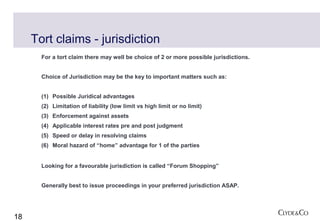
Tort claims - jurisdiction
       For a tort claim there may well be choice of 2 or more possible jurisdictions.


       Choice of Jurisdiction may be the key to important matters such as:


       (1) Possible Juridical advantages
       (2) Limitation of liability (low limit vs high limit or no limit)
       (3) Enforcement against assets
       (4) Applicable interest rates pre and post judgment
       (5) Speed or delay in resolving claims
       (6) Moral hazard of “home” advantage for 1 of the parties


       Looking for a favourable jurisdiction is called “Forum Shopping”


       Generally best to issue proceedings in your preferred jurisdiction ASAP.


18
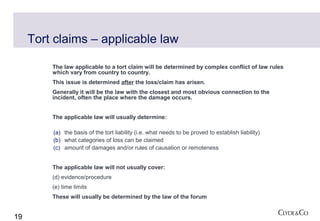
Tort claims – applicable law

         The law applicable to a tort claim will be determined by complex conflict of law rules
         which vary from country to country.
         This issue is determined after the loss/claim has arisen.
         Generally it will be the law with the closest and most obvious connection to the
         incident, often the place where the damage occurs.


         The applicable law will usually determine:

         (a) the basis of the tort liability (i.e. what needs to be proved to establish liability)
         (b) what categories of loss can be claimed
         (c) amount of damages and/or rules of causation or remoteness


         The applicable law will not usually cover:
         (d) evidence/procedure
         (e) time limits
         These will usually be determined by the law of the forum


19
Limitation of liability
        (a) One ship company or “SPV” – de facto limitation of liability unless
                                        the corporate veil can be pierced.


        (b) “Seagoing ships” can invoke Tonnage Limitation:


                 1957 Convention – low limits but easily broken


                Or


                 1976 Convention – higher limits but difficult to break


20
Limitation of Liability (continued)

       Article 4 of the 1976 Convention:


       “4. Conduct barring limitation
       A person liable shall not be entitled to limit his liability if it is proved that the
       loss resulted from his personal act or omission, committed with intent to
       cause such loss, or recklessly and with knowledge that such loss would
       probably result.”


       Issue:    Is a jack up rig or a MODU or an FPSO entitled to limit?
                 - Open question under English law.


21
Security/Enforcement
       Security
       (a) Arrest available for maritime claims – generally get a P&I Club letter of
       guarantee but the ultimate remedy is Judicial sale of the vessel
       (b) Freezing injunctions – all claims – ease or difficulty varies from jurisdiction
       to jurisdiction. May also be available in jurisdictions other than where the
       substantive claim is being litigated. Don’t usually get priority over other
       creditors.


       Enforcement
       OK, you get your judgment in court in country “A”.
       But where are the defendant’s assets?
       If assets are in country “B”, will the courts of country “B” recognize and give
       effect to the judgment from country “A”?
       A judgment from the courts of any EU member is enforceable throughout the
       EU. But can be very difficult elsewhere. Usually need a reciprocal enforcement
       treaty and there are fewer of them than is widely known.


22
Other ancillary orders
       Preservation orders.
       Orders to impose survey/inspection or to take samples.
       Delivery up of assets.
       General injunctions:
               prohibition
               mandatory or specific performance [hard to get]


23
Guarantees and bonds
         Claims or losses or delays may trigger additional liabilities, for example under guarantees or
         performance bonds.
         There has been lots of recent litigation in England on this subject. The terms “performance
         guarantee”, “completion bonds” and/or “on demand guarantee” are sometimes used interchangeably.


         There are fundamentally 2 different types of “guarantee”:


         (1)   A true guarantee, where the guarantor “G” guarantees the performance by “A” of his obligations to “B”.
               The guarantor’s liability to B is dependent on whether A is liable to B. If A is not liable to B then G is also
               not liable to B. G may rely on any defences A could have advanced as against B.
         (2)   An on demand bond where G undertakes to pay B on the happening of a specific event, which may be
               nothing more than the demand by B for payment. Even though this type of bond will typically be issued
               in consideration for B agreeing to do something for A’s benefit, the obligation of G is entirely
               independent of the liabilities as between A and B. Arguments that A may not be liable to B are irrelevant
               to G’s liability. These instruments are akin to letters of credit.

               Recent cases in England analyzing these categories include: Meritz Fire and Marine Ins Co vs Jan de
               Nul [2010] EWHC 3362 and [2011] EWCA 827; WS Tankships vs Kwangju Bank [2011] EWHC 3103;
               Wuhan vs Emporiki Bank [2012] 1715


24
Mediation

       Features of mediation:
       (a) Voluntary
       (b) Confidential
       (c) Usually non-evaluating mediator


       Key factors for successful mediation:
           (i) right mediator – especially if industry knowledge is relevant
           (ii) all parties must approach it with open mind
           (iii) timing:
                   too early – facts unclear
                   too late – costs already incurred; parties entrenched
           (iv) having the principals present
           (v) preparation


25
General tips for effective dispute resolution
       (a) Identify the legal basis of your claim(s) as early as possible.
       (b) Keep notes of important meetings.
       (c) Confirm all agreements in writing.
       (d) Photographs or videos can be very important.
       (e) Interview witnesses early – especially if they are not your
           employees.
       (f) Educate you opponents as well as attacking them.
       (g) Protect yourself on costs where possible.
       (h) Efficient document retention policy – including electronic media.
       (i) Control the creation of internal documents following an incident.
       (j) If there is doubt about the correct jurisdiction, be proactive and get
           in first.

26
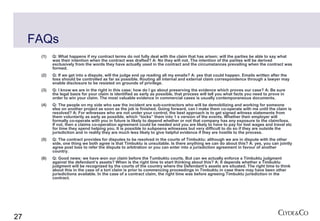
FAQs
      (1)   Q: What happens if my contract terms do not fully deal with the claim that has arisen; will the parties be able to say what
            was their intention when the contract was drafted? A: No they will not. The intention of the parties will be derived
            exclusively from the words they have actually used in the contract and the circumstances prevailing when the contract was
            formed.
      (2)   Q: If we get into a dispute, will the judge end up reading all my emails? A: yes that could happen. Emails written after the
            loss should be controlled as far as possible. Routing all internal and external claim correspondence through a lawyer may
            enable disclosure to be resisted on grounds of privilege.
      (3)   Q: I know we are in the right in this case; how do I go about preserving the evidence which proves our case? A: Be sure
            the legal basis for your claim is identified as early as possible, that process will tell you what facts you need to prove in
            order to win your claim. The most valuable evidence in commercial cases is usually contemporaneous documents.
      (4)   Q: The people on my side who saw the incident are sub-contractors who will be demobilizing and working for someone
            else on another project as soon as the job is finished. Going forward, can I make them co-operate with me until the claim is
            resolved? A: For witnesses who are not under your control, the best approach is to get signed witness statements from
            them voluntarily as early as possible, which “locks” them into 1 x version of the events. Whether their employer will
            formally co-operate with you in future is likely to depend whether or not that company has any exposure to the claim/loss.
            If not, then a claims co-operation agreement could be needed and you are likely to have to pay for lost wages and travel etc
            for time they spend helping you. It is possible to subpoena witnesses but very difficult to do so if they are outside the
            jurisdiction and in reality they are much less likely to give helpful evidence if they are hostile to the process.
      (5)   Q: The contract provides for disputes to be resolved in the courts of Timbuktu; although we are in dispute with the other
            side, one thing we both agree is that Timbuktu is unsuitable. Is there anything we can do about this? A: yes, you can jointly
            agree post loss to refer the dispute to arbitration or you can enter into a jurisdiction agreement in favour of another
            country.
      (6)   Q: Good news: we have won our claim before the Tumbuktu courts. But can we actually enforce a Timbuktu judgment
            against the defendant’s assets? When is the right time to start thinking about this? A: It depends whether a Timbuktu
            judgment will be recognized by the courts of the country where the Defendant’s assets are situated. The right time to think
            about this in the case of a tort claim is prior to commencing proceedings in Timbuktu in case there may have been other
            jurisdictions available. In the case of a contract claim, the right time was before agreeing Timbuktu jurisdiction in the
            contract.


27
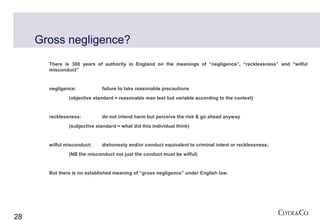
Gross negligence?
       There is 300 years of authority in England on the meanings of “negligence”, “recklessness” and “wilful
       misconduct”


       negligence:           failure to take reasonable precautions
               (objective standard = reasonable man test but variable according to the context)


       recklessness:         do not intend harm but perceive the risk & go ahead anyway
               (subjective standard = what did this individual think)


       wilful misconduct:    dishonesty and/or conduct equivalent to criminal intent or recklessness;
               (NB the misconduct not just the conduct must be wilful)


       But there is no established meaning of “gross negligence” under English law.


28
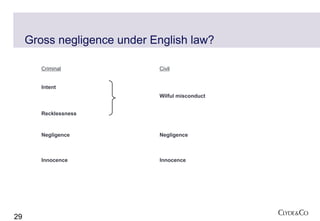
Gross negligence under English law?

        Criminal             Civil


        Intent
                             Wilful misconduct


        Recklessness


        Negligence           Negligence


        Innocence            Innocence


29
Gross negligence


       Bus crash:
       judged objectively this was certain to end badly; but viewed subjectively from the point of
       view of the bus driver (which is how the English law test for recklessness works) it was a
       totally inadvertent accident.
       = NEGLIGENT


       Golf shot:
       no intention to cause harm but full appreciation of the risks – that’s why they were so
       euphoric – but they went ahead and took the risk anyway.
       This is gambling with other people’s safety.
       = RECKLESS


30
Gross negligence
               Orthodox view under English law:


               Gross Negligence just means very negligent – which is still negligence.
               If negligence is equivalent to inadvertence; very inadvertent has no extra meaning.
               See judicial comments in the following cases:-


               Wilson v. Brett (1843) 11MFW 13.


               Per Lord Cranworth: "Gross negligence is ordinary negligence with a vituperative epithet".


               Tradigrain S.A. v. Intertek Testing Services [2007] GWCA civ 154.


               Per Moore-Bick LJ: "The term gross negligence, although often found in commercial documents, has never been accepted by English Civil
                      law as a concept distinct from civil negligence…".


               Sucden Financial v. Fluxocane [2010] EWHC 2133.


               Per Blair J: "I cannot see myself that the addition of the word "gross" to negligence adds much, if anything".


               Spread Trustee Co Limited v. Sarah Ann Hutcheson [2011] UKPC 13 dated 15 June 2011.


               Very complicated decision.
               Privy Council split 3:2.
               Whatever gross negligence means, it is something less than wilful misconduct.


31
Gross negligence
       Possible alternative views:
               Maybe it means objective recklessness: a risk not in fact appreciated by the individual concerned but it was so obvious or potentially
               dangerous that he should have realised.


       See for example this recent line of authorities:
       Red Sea Tankers v. Papachristidis ("The Ardent"). [1997] 2 Lloyd’s Rep 547
               Per Mance J: "…as a matter of ordinary language and general impression, the concept of gross negligence seems to be capable of
               embracing not only conduct undertaken with actual appreciation of the risks involved [subjective recklessness], but also serious
               disregard of or indifference to an obvious risk [objective recklessness]".
       Camarata Property Inc v. Credit Suisse Securities (Europe) Ltd [2011] EWHC 479 (Comm) 9 March 2011.
               Per Andrew Smith J: "The relevant question … is not whether generally gross negligence is a familiar concept in English civil law, but
               the meaning of the expression in [the exclusion clause in question]. I cannot accept that the parties intended it to connote mere
               negligence: in paragraph 1.2 and also in paragraph 1.3 both the expression "gross negligence" and the expression "negligence" were
               used, and some distinction between them was clearly intended". [He then goes on to quote with approval Mance J's comments in
               "The Ardent" as quoted above but N.B. this part of his decision was obiter dicta].
       Winnetka Trading Corporation v. Julius Baer International Limited [2011] EWHC 2030 (CH) dated 29 July 2011.
               Per Roth J: "Since the investment mandate uses both the expressions "negligence" and, separately, "gross negligence", I consider
               that the two cannot be intended to have the same meaning; and I think the language in the banking mandate should be construed
               consistently with the investment mandate. In that regard, I respectfully agree with the approach of Andrew Smith J in Camarata
               Property Inc v. Credit Suisse. As he there observed, the distinction between gross negligence and mere negligence is one of degree
               and not of kind, and therefore not easy to describe with precision. [He goes on to quote Mance J in "The Ardent"] However, it seems
               to me that "gross negligence" is not the same as subjective recklessness, although it may come close to it. [This part of the decision
               was obiter dicta as ultimately no negligence, still less gross negligence was in fact established in that case.


32
Further Information
       For further information please contact:-


               By email: graeme.baird@clydeco.com


               By mobile: +44 77 1161 4705


33
1,400                                                    1st                                                      285                                                      30
Lawyers and fee                                          Law Firm of the Year                                     Partners worldwide                                       Offices across Europe,
earners worldwide                                        Legal Business Awards                                                                                             Americas, Middle East,
                                                         2011                                                                                                              Africa and Asia.
Clyde & Co LLP accepts no responsibility for loss occasioned to any person acting or refraining from acting as a result of material contained in this summary. No part of this summary may be used, reproduced, stored in
a retrieval system or transmitted in any form or by any means, electronic, mechanical, photocopying, reading or otherwise without the prior permission of Clyde & Co LLP. © Clyde & Co LLP 2012

Claims Handling Issues for Contractors

  • 1.
    By Graeme Baird,Clyde & Co LLP, London. Claims Handling Issues for Contractors The International Marine Contractors Association Conference in Amsterdam 28 & 29 November 2012
  • 2.
    What to expectin the event of a loss Main kinds of losses: (1) Involving death or personal injury (2) Involving pollution (3) Involving insured property or insured liabilities (4) Involving uninsured property or uninsured liabilities (including liability for delay) 2
  • 3.
    What to expectin the event of a loss Major Losses (i.e. categories 1 and 2) • Licence holder (e.g. oil company) will usually implement their own disaster plan. • Regulators may intervene in rescue, pollution control and/or wreck removal. [In England this will be the MCA and/or the SOSREP] • Prosecuting Authorities may interview personnel and seize documents or computers. [In England this will be the Police and/or the HSE] • Contracting Parties and their lawyers will assess exposures to civil liabilities, and indeed any criminal liability, on an urgent basis. • Insurers and their lawyers will also want to assess their exposures. 3
  • 4.
    Evidence 3 x main categories of evidence: • Documents • Witness statements • Experts’ reports Documents win (or lose) commercial cases. 4
  • 5.
    Evidence – RegulatoryEnvironment Health & Safety at Corporate Manslaughter and Work Act 1974 Corporate Homicide Act Offshore Installations Safety Case Regulations 2005 Offshore Installations & Offshore Installations Wells (Design & & Pipeline Works Offshore Installations Construction, etc) (Management & (Prevention of Fire & Regulations 1995 Administration) Explosion and Regulations 1995 Emergency Response) Regulations 1995 Provision & Use of Management of Health Work Equipment & Safety at Work Pipeline Safety Regulations 1998 Regulations 1999 Regulations 1996 5
  • 6.
    Evidence Examples of key documents: 1. Oil company’s pre-approved emergency plan [In England this is an OPEP]. Was this followed correctly? 2. Compliance with regulator’s operational requirements [ In England a detailed “safety case” must have been agreed and approved by HSE highlighting potential dangers, consequences and methods of control]. Was this agreed operating procedure implemented correctly? Named individuals may have personal responsibility in the event of default [ In England the Safety Case Duty Holder or the Offshore Installation Manager]. 3. Audit trail of regular testing and/or inspection of key safety equipment. [e.g. pursuant to the Design and Construction Regulations]. 4. ISM and Classification Society records 5. Logs and/or daily reports 6. Original engineering certification of components 7. Drawings or charts supplied by one party to another and relied upon 8. Minutes of meetings, especially safety briefings and toolbox talks prior to the loss 9. Photographs or videos 10. Correspondence, especially emails. 6
  • 7.
    Evidence – howmuch of it do you control? (1) Pre-existing audit trail of regulatory compliance (or non compliance) could be published in the event of a casualty. (2) Witnesses – Police interviews under caution. Separate legal representation required for individuals who are being “blamed” for the accident. Refusal to answer questions can infer guilt in some countries (e.g. yes in England but not in Scotland). (1) Access to the physical evidence (by surveyors/adjusters etc) may be delayed or denied by Regulators. (2) Documents, logs etc relating to the casualty are subject to seizure by the Police or other prosecuting authorities. (3) Media involvement – leaks or investigative journalism. (4) Witness interviews – yes, conventional interviews but all in the context of the above. (5) Whistleblowers – legal protection now for whistleblowers in many countries but not really part of offshore culture. 7
  • 8.
    Evidence Rules about disclosure vary from jurisdiction to jurisdiction. But legal advice is ubiquitously privileged from disclosure. E.g. the 2 x main English law categories of privilege from disclosure: (1) Legal advice privilege – communications to/from a lawyer (2) Litigation privilege – to/from a third party for the dominant purpose of preparing for legal proceedings Practical solution: lawyers are often used as “postbox” to establish privilege in communications going forward. 8
  • 9.
    Civil Claims Contractual claims and/or Tort claims (e.g. maritime collisions, product liability and defective design) [also: insurance claims and possible waivers of subrogation]. 9
  • 10.
    Contractual issues (1) Identify the relevant contracts (2) Contractual interpretation (3) Choice of applicable law clause (4) Jurisdiction clause (5) Arbitration clause (6) Exclusion clauses (7) Key contractual terms 10
  • 11.
    Contractual issues (continued) (1) Identify the relevant contracts Signed contracts are usual in the offshore industry but there may be commercial pressure to start work before a written agreement is finalised. There can be an enforceable contract before this stage – just need sufficient consensus on key terms – but this usually leads to uncertainty in the event of a claim (e.g. are your exclusion clauses incorporated or not) Use of purchase orders or contracts agreed in correspondence: problem if purchaser and supplier both have written standard terms, unless it is made sufficiently clear which prevails. Course of dealing – an established pattern of trading on given terms. 11
  • 12.
    Contractual issues (continued) (2) Contractual interpretation The concept in most jurisdictions is to give effect to the intention of the parties at the time they entered into the contract. BUT: (a) Witness evidence from the parties after a loss about what they actually meant is almost always inadmissible. (b) The presumed intention of the parties is derived from the words they have actually used and from the circumstances (factual matrix) in which the contract was formed. 12
  • 13.
    Contractual issues (continued) (3) Choice of applicable law clause: [NB will have been chosen prior to any loss/claim]. Law and jurisdiction need not be the same (e.g. can have New York law and London arbitration) The applicable law will usually determine: (a) whether there is a contract (b) whether the contract has been breached (c) rights to terminate the contract (d) what categories of loss can be claimed (e) amount of damages The applicable law will not usually cover: (f) evidence/procedure (g) time limits These will usually be determined by the law of the forum Desire of contracting parties to use their own national law can lead to uncertainty on (a) to (e) above if that country’s legal rules are not sufficiently developed. 13
  • 14.
    Contractual issues (continued) (4) Jurisdiction clause [NB will already have been chosen prior to any loss/claim]. Factors as to choice of jurisdiction include: (a) expertise of Judges? (b) impartiality (c) cost (d) convenience (accessibility/time zones) (e) language issues (f) procedure/evidence (g) availability of lawyers or experts with relevant experience (h) speed/appeals (i) enforceability of judgments 14
  • 15.
    Contractual issues (continued) (5) Arbitration clause [usually will have been agreed prior to claim/loss but can also be agreed afterwards] Factors relevant to arbitration: (a) confidentiality (b) speed (c) cost (d) flexible procedure but not suited to (i) multiple party situations or (ii) non-contract claims (e) wider enforceability: 1958 New York Convention 15
  • 16.
    Contractual issues (continued) (6) Exclusion clauses Very important and often very useful BUT: (a) Many systems of law apply contra proferentem rule – exclusion clauses to be construed narrowly or against the person relying on them (b) Need to be incorporated into the contract when it was formed – printed on the reverse of an invoice may be too late. (c) The proper law of the contract may not allow complete freedom of contract in all situations [eg Unfair Contract Terms Act 1977 – can’t exclude liability for negligence giving rise to death or personal injury] 16
  • 17.
    Contractual issues (continued) (7) Key contractual terms “knock for knock” liability regimes Advantage: simple and everyone knows where they stand. Disadvantage: may lead to “unfair” outcomes. Subject to possible carve outs in relation to: Negligence Gross negligence Recklessness Wilful misconduct 17
  • 18.
    Tort claims -jurisdiction For a tort claim there may well be choice of 2 or more possible jurisdictions. Choice of Jurisdiction may be the key to important matters such as: (1) Possible Juridical advantages (2) Limitation of liability (low limit vs high limit or no limit) (3) Enforcement against assets (4) Applicable interest rates pre and post judgment (5) Speed or delay in resolving claims (6) Moral hazard of “home” advantage for 1 of the parties Looking for a favourable jurisdiction is called “Forum Shopping” Generally best to issue proceedings in your preferred jurisdiction ASAP. 18
  • 19.
    Tort claims –applicable law The law applicable to a tort claim will be determined by complex conflict of law rules which vary from country to country. This issue is determined after the loss/claim has arisen. Generally it will be the law with the closest and most obvious connection to the incident, often the place where the damage occurs. The applicable law will usually determine: (a) the basis of the tort liability (i.e. what needs to be proved to establish liability) (b) what categories of loss can be claimed (c) amount of damages and/or rules of causation or remoteness The applicable law will not usually cover: (d) evidence/procedure (e) time limits These will usually be determined by the law of the forum 19
  • 20.
    Limitation of liability (a) One ship company or “SPV” – de facto limitation of liability unless the corporate veil can be pierced. (b) “Seagoing ships” can invoke Tonnage Limitation: 1957 Convention – low limits but easily broken Or 1976 Convention – higher limits but difficult to break 20
  • 21.
    Limitation of Liability(continued) Article 4 of the 1976 Convention: “4. Conduct barring limitation A person liable shall not be entitled to limit his liability if it is proved that the loss resulted from his personal act or omission, committed with intent to cause such loss, or recklessly and with knowledge that such loss would probably result.” Issue: Is a jack up rig or a MODU or an FPSO entitled to limit? - Open question under English law. 21
  • 22.
    Security/Enforcement Security (a) Arrest available for maritime claims – generally get a P&I Club letter of guarantee but the ultimate remedy is Judicial sale of the vessel (b) Freezing injunctions – all claims – ease or difficulty varies from jurisdiction to jurisdiction. May also be available in jurisdictions other than where the substantive claim is being litigated. Don’t usually get priority over other creditors. Enforcement OK, you get your judgment in court in country “A”. But where are the defendant’s assets? If assets are in country “B”, will the courts of country “B” recognize and give effect to the judgment from country “A”? A judgment from the courts of any EU member is enforceable throughout the EU. But can be very difficult elsewhere. Usually need a reciprocal enforcement treaty and there are fewer of them than is widely known. 22
  • 23.
    Other ancillary orders Preservation orders. Orders to impose survey/inspection or to take samples. Delivery up of assets. General injunctions: prohibition mandatory or specific performance [hard to get] 23
  • 24.
    Guarantees and bonds Claims or losses or delays may trigger additional liabilities, for example under guarantees or performance bonds. There has been lots of recent litigation in England on this subject. The terms “performance guarantee”, “completion bonds” and/or “on demand guarantee” are sometimes used interchangeably. There are fundamentally 2 different types of “guarantee”: (1) A true guarantee, where the guarantor “G” guarantees the performance by “A” of his obligations to “B”. The guarantor’s liability to B is dependent on whether A is liable to B. If A is not liable to B then G is also not liable to B. G may rely on any defences A could have advanced as against B. (2) An on demand bond where G undertakes to pay B on the happening of a specific event, which may be nothing more than the demand by B for payment. Even though this type of bond will typically be issued in consideration for B agreeing to do something for A’s benefit, the obligation of G is entirely independent of the liabilities as between A and B. Arguments that A may not be liable to B are irrelevant to G’s liability. These instruments are akin to letters of credit. Recent cases in England analyzing these categories include: Meritz Fire and Marine Ins Co vs Jan de Nul [2010] EWHC 3362 and [2011] EWCA 827; WS Tankships vs Kwangju Bank [2011] EWHC 3103; Wuhan vs Emporiki Bank [2012] 1715 24
  • 25.
    Mediation Features of mediation: (a) Voluntary (b) Confidential (c) Usually non-evaluating mediator Key factors for successful mediation: (i) right mediator – especially if industry knowledge is relevant (ii) all parties must approach it with open mind (iii) timing: too early – facts unclear too late – costs already incurred; parties entrenched (iv) having the principals present (v) preparation 25
  • 26.
    General tips foreffective dispute resolution (a) Identify the legal basis of your claim(s) as early as possible. (b) Keep notes of important meetings. (c) Confirm all agreements in writing. (d) Photographs or videos can be very important. (e) Interview witnesses early – especially if they are not your employees. (f) Educate you opponents as well as attacking them. (g) Protect yourself on costs where possible. (h) Efficient document retention policy – including electronic media. (i) Control the creation of internal documents following an incident. (j) If there is doubt about the correct jurisdiction, be proactive and get in first. 26
  • 27.
    FAQs (1) Q: What happens if my contract terms do not fully deal with the claim that has arisen; will the parties be able to say what was their intention when the contract was drafted? A: No they will not. The intention of the parties will be derived exclusively from the words they have actually used in the contract and the circumstances prevailing when the contract was formed. (2) Q: If we get into a dispute, will the judge end up reading all my emails? A: yes that could happen. Emails written after the loss should be controlled as far as possible. Routing all internal and external claim correspondence through a lawyer may enable disclosure to be resisted on grounds of privilege. (3) Q: I know we are in the right in this case; how do I go about preserving the evidence which proves our case? A: Be sure the legal basis for your claim is identified as early as possible, that process will tell you what facts you need to prove in order to win your claim. The most valuable evidence in commercial cases is usually contemporaneous documents. (4) Q: The people on my side who saw the incident are sub-contractors who will be demobilizing and working for someone else on another project as soon as the job is finished. Going forward, can I make them co-operate with me until the claim is resolved? A: For witnesses who are not under your control, the best approach is to get signed witness statements from them voluntarily as early as possible, which “locks” them into 1 x version of the events. Whether their employer will formally co-operate with you in future is likely to depend whether or not that company has any exposure to the claim/loss. If not, then a claims co-operation agreement could be needed and you are likely to have to pay for lost wages and travel etc for time they spend helping you. It is possible to subpoena witnesses but very difficult to do so if they are outside the jurisdiction and in reality they are much less likely to give helpful evidence if they are hostile to the process. (5) Q: The contract provides for disputes to be resolved in the courts of Timbuktu; although we are in dispute with the other side, one thing we both agree is that Timbuktu is unsuitable. Is there anything we can do about this? A: yes, you can jointly agree post loss to refer the dispute to arbitration or you can enter into a jurisdiction agreement in favour of another country. (6) Q: Good news: we have won our claim before the Tumbuktu courts. But can we actually enforce a Timbuktu judgment against the defendant’s assets? When is the right time to start thinking about this? A: It depends whether a Timbuktu judgment will be recognized by the courts of the country where the Defendant’s assets are situated. The right time to think about this in the case of a tort claim is prior to commencing proceedings in Timbuktu in case there may have been other jurisdictions available. In the case of a contract claim, the right time was before agreeing Timbuktu jurisdiction in the contract. 27
  • 28.
    Gross negligence? There is 300 years of authority in England on the meanings of “negligence”, “recklessness” and “wilful misconduct” negligence: failure to take reasonable precautions (objective standard = reasonable man test but variable according to the context) recklessness: do not intend harm but perceive the risk & go ahead anyway (subjective standard = what did this individual think) wilful misconduct: dishonesty and/or conduct equivalent to criminal intent or recklessness; (NB the misconduct not just the conduct must be wilful) But there is no established meaning of “gross negligence” under English law. 28
  • 29.
    Gross negligence underEnglish law? Criminal Civil Intent Wilful misconduct Recklessness Negligence Negligence Innocence Innocence 29
  • 30.
    Gross negligence Bus crash: judged objectively this was certain to end badly; but viewed subjectively from the point of view of the bus driver (which is how the English law test for recklessness works) it was a totally inadvertent accident. = NEGLIGENT Golf shot: no intention to cause harm but full appreciation of the risks – that’s why they were so euphoric – but they went ahead and took the risk anyway. This is gambling with other people’s safety. = RECKLESS 30
  • 31.
    Gross negligence Orthodox view under English law: Gross Negligence just means very negligent – which is still negligence. If negligence is equivalent to inadvertence; very inadvertent has no extra meaning. See judicial comments in the following cases:- Wilson v. Brett (1843) 11MFW 13. Per Lord Cranworth: "Gross negligence is ordinary negligence with a vituperative epithet". Tradigrain S.A. v. Intertek Testing Services [2007] GWCA civ 154. Per Moore-Bick LJ: "The term gross negligence, although often found in commercial documents, has never been accepted by English Civil law as a concept distinct from civil negligence…". Sucden Financial v. Fluxocane [2010] EWHC 2133. Per Blair J: "I cannot see myself that the addition of the word "gross" to negligence adds much, if anything". Spread Trustee Co Limited v. Sarah Ann Hutcheson [2011] UKPC 13 dated 15 June 2011. Very complicated decision. Privy Council split 3:2. Whatever gross negligence means, it is something less than wilful misconduct. 31
  • 32.
    Gross negligence Possible alternative views: Maybe it means objective recklessness: a risk not in fact appreciated by the individual concerned but it was so obvious or potentially dangerous that he should have realised. See for example this recent line of authorities: Red Sea Tankers v. Papachristidis ("The Ardent"). [1997] 2 Lloyd’s Rep 547 Per Mance J: "…as a matter of ordinary language and general impression, the concept of gross negligence seems to be capable of embracing not only conduct undertaken with actual appreciation of the risks involved [subjective recklessness], but also serious disregard of or indifference to an obvious risk [objective recklessness]". Camarata Property Inc v. Credit Suisse Securities (Europe) Ltd [2011] EWHC 479 (Comm) 9 March 2011. Per Andrew Smith J: "The relevant question … is not whether generally gross negligence is a familiar concept in English civil law, but the meaning of the expression in [the exclusion clause in question]. I cannot accept that the parties intended it to connote mere negligence: in paragraph 1.2 and also in paragraph 1.3 both the expression "gross negligence" and the expression "negligence" were used, and some distinction between them was clearly intended". [He then goes on to quote with approval Mance J's comments in "The Ardent" as quoted above but N.B. this part of his decision was obiter dicta]. Winnetka Trading Corporation v. Julius Baer International Limited [2011] EWHC 2030 (CH) dated 29 July 2011. Per Roth J: "Since the investment mandate uses both the expressions "negligence" and, separately, "gross negligence", I consider that the two cannot be intended to have the same meaning; and I think the language in the banking mandate should be construed consistently with the investment mandate. In that regard, I respectfully agree with the approach of Andrew Smith J in Camarata Property Inc v. Credit Suisse. As he there observed, the distinction between gross negligence and mere negligence is one of degree and not of kind, and therefore not easy to describe with precision. [He goes on to quote Mance J in "The Ardent"] However, it seems to me that "gross negligence" is not the same as subjective recklessness, although it may come close to it. [This part of the decision was obiter dicta as ultimately no negligence, still less gross negligence was in fact established in that case. 32
  • 33.
    Further Information For further information please contact:- By email: graeme.baird@clydeco.com By mobile: +44 77 1161 4705 33
  • 34.
    1,400 1st 285 30 Lawyers and fee Law Firm of the Year Partners worldwide Offices across Europe, earners worldwide Legal Business Awards Americas, Middle East, 2011 Africa and Asia. Clyde & Co LLP accepts no responsibility for loss occasioned to any person acting or refraining from acting as a result of material contained in this summary. No part of this summary may be used, reproduced, stored in a retrieval system or transmitted in any form or by any means, electronic, mechanical, photocopying, reading or otherwise without the prior permission of Clyde & Co LLP. © Clyde & Co LLP 2012