Citing your Sources


Summer 2009   MSVU Library | library@msvu.ca
Challenges in Academic Writing
     Develop a topic based on what has already
      been said and written but write something
      new and original
     Rely on opinions of experts and authorities on
      a topic but improve upon and/or disagree
      with those same opinions
     Give credit to researchers who have come
      before you but make your own significant
      contribution
     Fit into the discourse by building upon what
      you hear and read but use your own words
      and your own voice
Summer 2009       MSVU Library | library@msvu.ca
Research & Scholarship
   in the University
     does not take place in a vacuum;
     is a “community” endeavor;
     is built upon: it evolves, morphs,
      (withers?)
     Built on the values of responsibility,
      integrity, academic freedom, respect,
      critical thinking, engagement,
      communication, community etc.

Summer 2009     MSVU Library | library@msvu.ca
What is citing?
     Citing means giving credit to the person whose idea
      you are using. This means providing information so
      someone else can locate the specific article, book, or
      web site that you used in your research.

     A citation usually includes: AUTHOR, TITLE,
      PUBLICATION information, DATE of publication and
      URL (if your source is electronic).

     Everything you use in research, (books, an article
      from a full text database or a page from the
      Internet) must be cited.


Summer 2009         MSVU Library | library@msvu.ca
What is Plagiarism?
     Taking and using as one’s own, the ideas, or
      the expression of the ideas (literary, artistic,
      musical, etc.) of another. (From the Oxford English
      Dictionary.)

     This means, either intentionally or
      unintentionally, using the words or ideas of
      someone else without giving credit.
     If you’re not citing your work you are
      plagiarizing.


Summer 2009          MSVU Library | library@msvu.ca
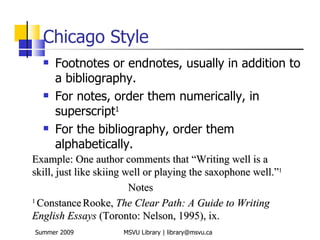
Chicago Style
     Footnotes or endnotes, usually in addition to
      a bibliography.
     For notes, order them numerically, in
      superscript1
     For the bibliography, order them
      alphabetically.
Example: One author comments that “Writing well is a
skill, just like skiing well or playing the saxophone well.”1
                         Notes
1
  Constance Rooke, The Clear Path: A Guide to Writing
English Essays (Toronto: Nelson, 1995), ix.
Summer 2009           MSVU Library | library@msvu.ca
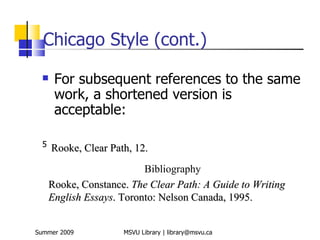
Chicago Style (cont.)
      For subsequent references to the same
       work, a shortened version is
       acceptable:

  5
      Rooke, Clear Path, 12.
                           Bibliography
      Rooke, Constance. The Clear Path: A Guide to Writing
      English Essays. Toronto: Nelson Canada, 1995.


Summer 2009           MSVU Library | library@msvu.ca
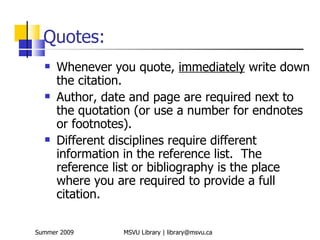
Quotes:
     Whenever you quote, immediately write down
      the citation.
     Author, date and page are required next to
      the quotation (or use a number for endnotes
      or footnotes).
     Different disciplines require different
      information in the reference list. The
      reference list or bibliography is the place
      where you are required to provide a full
      citation.

Summer 2009      MSVU Library | library@msvu.ca
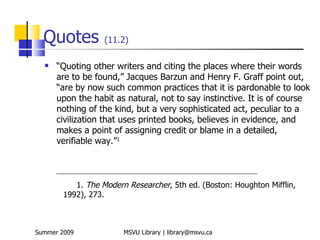
Quotes              (11.2)

     “Quoting other writers and citing the places where their words
      are to be found,” Jacques Barzun and Henry F. Graff point out,
      “are by now such common practices that it is pardonable to look
      upon the habit as natural, not to say instinctive. It is of course
      nothing of the kind, but a very sophisticated act, peculiar to a
      civilization that uses printed books, believes in evidence, and
      makes a point of assigning credit or blame in a detailed,
      verifiable way.”1


      _______________________________________________________________________

           1. The Modern Researcher, 5th ed. (Boston: Houghton Mifflin,
        1992), 273.


Summer 2009                  MSVU Library | library@msvu.ca
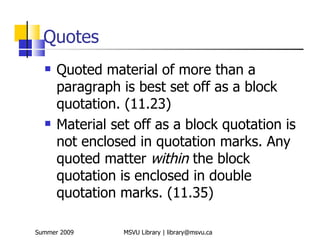
Quotes
     Quoted material of more than a
      paragraph is best set off as a block
      quotation. (11.23)
     Material set off as a block quotation is
      not enclosed in quotation marks. Any
      quoted matter within the block
      quotation is enclosed in double
      quotation marks. (11.35)

Summer 2009      MSVU Library | library@msvu.ca
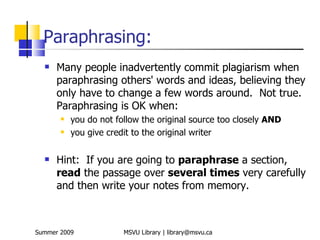
Paraphrasing:
     Many people inadvertently commit plagiarism when
      paraphrasing others' words and ideas, believing they
      only have to change a few words around. Not true.
      Paraphrasing is OK when:
          you do not follow the original source too closely AND
          you give credit to the original writer

     Hint: If you are going to paraphrase a section,
      read the passage over several times very carefully
      and then write your notes from memory.


Summer 2009             MSVU Library | library@msvu.ca
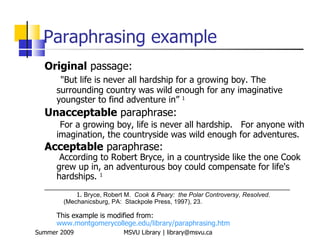
Paraphrasing example
  Original passage:
       "But life is never all hardship for a growing boy. The
      surrounding country was wild enough for any imaginative
      youngster to find adventure in” 1
  Unacceptable paraphrase:
       For a growing boy, life is never all hardship. For anyone with
      imagination, the countryside was wild enough for adventures.
  Acceptable paraphrase:
       According to Robert Bryce, in a countryside like the one Cook
      grew up in, an adventurous boy could compensate for life's
      hardships. 1
  _______________________________________________________________
            1. Bryce, Robert M. Cook & Peary: the Polar Controversy, Resolved.
        (Mechanicsburg, PA: Stackpole Press, 1997), 23.

      This example is modified from:
      www.montgomerycollege.edu/library/paraphrasing.htm
Summer 2009                 MSVU Library | library@msvu.ca
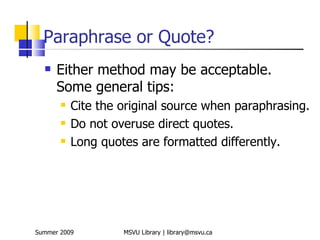
Paraphrase or Quote?
     Either method may be acceptable.
      Some general tips:
          Cite the original source when paraphrasing.
          Do not overuse direct quotes.
          Long quotes are formatted differently.


Summer 2009         MSVU Library | library@msvu.ca
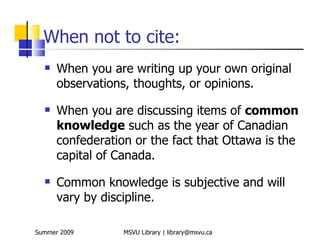
When not to cite:
     When you are writing up your own original
      observations, thoughts, or opinions.
     When you are discussing items of common
      knowledge such as the year of Canadian
      confederation or the fact that Ottawa is the
      capital of Canada.
     Common knowledge is subjective and will
      vary by discipline.

Summer 2009       MSVU Library | library@msvu.ca
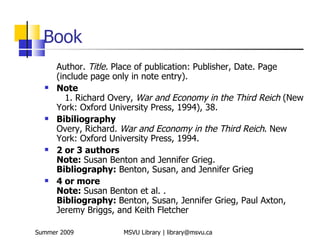
Book
      Author. Title. Place of publication: Publisher, Date. Page
      (include page only in note entry).
     Note
         1. Richard Overy, War and Economy in the Third Reich (New
      York: Oxford University Press, 1994), 38.
     Bibiliography
      Overy, Richard. War and Economy in the Third Reich. New
      York: Oxford University Press, 1994.
     2 or 3 authors
      Note: Susan Benton and Jennifer Grieg.
      Bibliography: Benton, Susan, and Jennifer Grieg
     4 or more
      Note: Susan Benton et al. .
      Bibliography: Benton, Susan, Jennifer Grieg, Paul Axton,
      Jeremy Briggs, and Keith Fletcher

Summer 2009           MSVU Library | library@msvu.ca
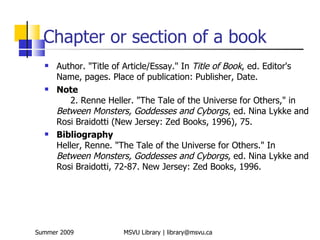
Chapter or section of a book
     Author. "Title of Article/Essay." In Title of Book, ed. Editor's
      Name, pages. Place of publication: Publisher, Date.
     Note
          2. Renne Heller. "The Tale of the Universe for Others," in
      Between Monsters, Goddesses and Cyborgs, ed. Nina Lykke and
      Rosi Braidotti (New Jersey: Zed Books, 1996), 75.
     Bibliography
      Heller, Renne. "The Tale of the Universe for Others." In
      Between Monsters, Goddesses and Cyborgs, ed. Nina Lykke and
      Rosi Braidotti, 72-87. New Jersey: Zed Books, 1996.


Summer 2009            MSVU Library | library@msvu.ca
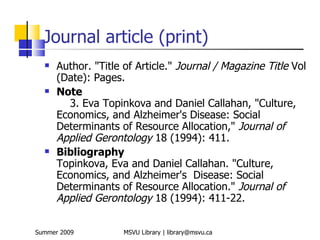
Journal article (print)
     Author. "Title of Article." Journal / Magazine Title Vol
      (Date): Pages.
     Note
        3. Eva Topinkova and Daniel Callahan, "Culture,
      Economics, and Alzheimer's Disease: Social
      Determinants of Resource Allocation," Journal of
      Applied Gerontology 18 (1994): 411.
     Bibliography
      Topinkova, Eva and Daniel Callahan. "Culture,
      Economics, and Alzheimer's Disease: Social
      Determinants of Resource Allocation." Journal of
      Applied Gerontology 18 (1994): 411-22.

Summer 2009          MSVU Library | library@msvu.ca
Journal article (online)
     Author. "Title of Article." Title of Journal / Magazine Vol
      (Date). Journal on-line. Available from url address,
      (accessed date).
     Note
          4. Rob Fairmichael, " Northern Ireland Chooses New
      Possibilities," Peace Magazine 14 (1998), [journal on-line];
      available from http://www.peacemagazine.org/archive/
      v14n4p23.htm (accessed 15 July 2005).
     Bibliography
      Fairmichael, Rob. "Northern Ireland Chooses New
      Possibilities." Peace Magazine 14 (1998). Journal on-line.
      Available from
      http://www.peacemagazine.org/archive/v14n4p23.htm
      (accessed 15 July 2005).

Summer 2009          MSVU Library | library@msvu.ca
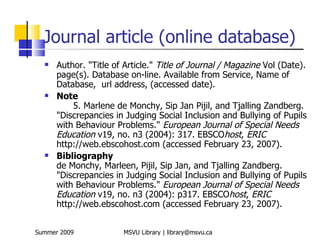
Journal article (online database)
     Author. "Title of Article." Title of Journal / Magazine Vol (Date).
      page(s). Database on-line. Available from Service, Name of
      Database, url address, (accessed date).
     Note
          5. Marlene de Monchy, Sip Jan Pijil, and Tjalling Zandberg.
      "Discrepancies in Judging Social Inclusion and Bullying of Pupils
      with Behaviour Problems." European Journal of Special Needs
      Education v19, no. n3 (2004): 317. EBSCOhost, ERIC
      http://web.ebscohost.com (accessed February 23, 2007).
     Bibliography
      de Monchy, Marleen, Pijil, Sip Jan, and Tjalling Zandberg.
      "Discrepancies in Judging Social Inclusion and Bullying of Pupils
      with Behaviour Problems." European Journal of Special Needs
      Education v19, no. n3 (2004): p317. EBSCOhost, ERIC
      http://web.ebscohost.com (accessed February 23, 2007).


Summer 2009            MSVU Library | library@msvu.ca
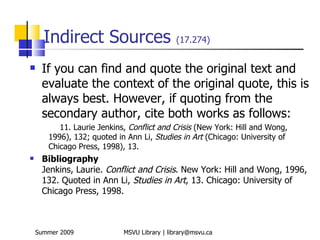
Indirect Sources                       (17.274)


    If you can find and quote the original text and
     evaluate the context of the original quote, this is
     always best. However, if quoting from the
     secondary author, cite both works as follows:
          11. Laurie Jenkins, Conflict and Crisis (New York: Hill and Wong,
       1996), 132; quoted in Ann Li, Studies in Art (Chicago: University of
       Chicago Press, 1998), 13.
    Bibliography
     Jenkins, Laurie. Conflict and Crisis. New York: Hill and Wong, 1996,
     132. Quoted in Ann Li, Studies in Art, 13. Chicago: University of
     Chicago Press, 1998.


    Summer 2009             MSVU Library | library@msvu.ca
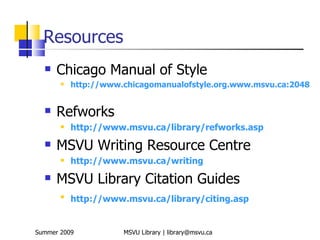
Resources
     Chicago Manual of Style
          http://www.chicagomanualofstyle.org.www.msvu.ca:2048


     Refworks
          http://www.msvu.ca/library/refworks.asp
     MSVU Writing Resource Centre
          http://www.msvu.ca/writing
     MSVU Library Citation Guides
       
           http://www.msvu.ca/library/citing.asp


Summer 2009           MSVU Library | library@msvu.ca

Citing with Chicago

  • 1.
    Citing your Sources Summer2009 MSVU Library | library@msvu.ca
  • 2.
    Challenges in AcademicWriting  Develop a topic based on what has already been said and written but write something new and original  Rely on opinions of experts and authorities on a topic but improve upon and/or disagree with those same opinions  Give credit to researchers who have come before you but make your own significant contribution  Fit into the discourse by building upon what you hear and read but use your own words and your own voice Summer 2009 MSVU Library | library@msvu.ca
  • 3.
    Research & Scholarship in the University  does not take place in a vacuum;  is a “community” endeavor;  is built upon: it evolves, morphs, (withers?)  Built on the values of responsibility, integrity, academic freedom, respect, critical thinking, engagement, communication, community etc. Summer 2009 MSVU Library | library@msvu.ca
  • 4.
    What is citing?  Citing means giving credit to the person whose idea you are using. This means providing information so someone else can locate the specific article, book, or web site that you used in your research.  A citation usually includes: AUTHOR, TITLE, PUBLICATION information, DATE of publication and URL (if your source is electronic).  Everything you use in research, (books, an article from a full text database or a page from the Internet) must be cited. Summer 2009 MSVU Library | library@msvu.ca
  • 5.
    What is Plagiarism?  Taking and using as one’s own, the ideas, or the expression of the ideas (literary, artistic, musical, etc.) of another. (From the Oxford English Dictionary.)  This means, either intentionally or unintentionally, using the words or ideas of someone else without giving credit.  If you’re not citing your work you are plagiarizing. Summer 2009 MSVU Library | library@msvu.ca
  • 6.
    Chicago Style  Footnotes or endnotes, usually in addition to a bibliography.  For notes, order them numerically, in superscript1  For the bibliography, order them alphabetically. Example: One author comments that “Writing well is a skill, just like skiing well or playing the saxophone well.”1 Notes 1 Constance Rooke, The Clear Path: A Guide to Writing English Essays (Toronto: Nelson, 1995), ix. Summer 2009 MSVU Library | library@msvu.ca
  • 7.
    Chicago Style (cont.)  For subsequent references to the same work, a shortened version is acceptable: 5 Rooke, Clear Path, 12. Bibliography Rooke, Constance. The Clear Path: A Guide to Writing English Essays. Toronto: Nelson Canada, 1995. Summer 2009 MSVU Library | library@msvu.ca
  • 8.
    Quotes:  Whenever you quote, immediately write down the citation.  Author, date and page are required next to the quotation (or use a number for endnotes or footnotes).  Different disciplines require different information in the reference list. The reference list or bibliography is the place where you are required to provide a full citation. Summer 2009 MSVU Library | library@msvu.ca
  • 9.
    Quotes (11.2)  “Quoting other writers and citing the places where their words are to be found,” Jacques Barzun and Henry F. Graff point out, “are by now such common practices that it is pardonable to look upon the habit as natural, not to say instinctive. It is of course nothing of the kind, but a very sophisticated act, peculiar to a civilization that uses printed books, believes in evidence, and makes a point of assigning credit or blame in a detailed, verifiable way.”1 _______________________________________________________________________ 1. The Modern Researcher, 5th ed. (Boston: Houghton Mifflin, 1992), 273. Summer 2009 MSVU Library | library@msvu.ca
  • 10.
    Quotes  Quoted material of more than a paragraph is best set off as a block quotation. (11.23)  Material set off as a block quotation is not enclosed in quotation marks. Any quoted matter within the block quotation is enclosed in double quotation marks. (11.35) Summer 2009 MSVU Library | library@msvu.ca
  • 11.
    Paraphrasing:  Many people inadvertently commit plagiarism when paraphrasing others' words and ideas, believing they only have to change a few words around. Not true. Paraphrasing is OK when:  you do not follow the original source too closely AND  you give credit to the original writer  Hint: If you are going to paraphrase a section, read the passage over several times very carefully and then write your notes from memory. Summer 2009 MSVU Library | library@msvu.ca
  • 12.
    Paraphrasing example Original passage: "But life is never all hardship for a growing boy. The surrounding country was wild enough for any imaginative youngster to find adventure in” 1 Unacceptable paraphrase: For a growing boy, life is never all hardship. For anyone with imagination, the countryside was wild enough for adventures. Acceptable paraphrase: According to Robert Bryce, in a countryside like the one Cook grew up in, an adventurous boy could compensate for life's hardships. 1 _______________________________________________________________ 1. Bryce, Robert M. Cook & Peary: the Polar Controversy, Resolved. (Mechanicsburg, PA: Stackpole Press, 1997), 23. This example is modified from: www.montgomerycollege.edu/library/paraphrasing.htm Summer 2009 MSVU Library | library@msvu.ca
  • 13.
    Paraphrase or Quote?  Either method may be acceptable. Some general tips:  Cite the original source when paraphrasing.  Do not overuse direct quotes.  Long quotes are formatted differently. Summer 2009 MSVU Library | library@msvu.ca
  • 14.
    When not tocite:  When you are writing up your own original observations, thoughts, or opinions.  When you are discussing items of common knowledge such as the year of Canadian confederation or the fact that Ottawa is the capital of Canada.  Common knowledge is subjective and will vary by discipline. Summer 2009 MSVU Library | library@msvu.ca
  • 15.
    Book Author. Title. Place of publication: Publisher, Date. Page (include page only in note entry).  Note 1. Richard Overy, War and Economy in the Third Reich (New York: Oxford University Press, 1994), 38.  Bibiliography Overy, Richard. War and Economy in the Third Reich. New York: Oxford University Press, 1994.  2 or 3 authors Note: Susan Benton and Jennifer Grieg. Bibliography: Benton, Susan, and Jennifer Grieg  4 or more Note: Susan Benton et al. . Bibliography: Benton, Susan, Jennifer Grieg, Paul Axton, Jeremy Briggs, and Keith Fletcher Summer 2009 MSVU Library | library@msvu.ca
  • 16.
    Chapter or sectionof a book  Author. "Title of Article/Essay." In Title of Book, ed. Editor's Name, pages. Place of publication: Publisher, Date.  Note 2. Renne Heller. "The Tale of the Universe for Others," in Between Monsters, Goddesses and Cyborgs, ed. Nina Lykke and Rosi Braidotti (New Jersey: Zed Books, 1996), 75.  Bibliography Heller, Renne. "The Tale of the Universe for Others." In Between Monsters, Goddesses and Cyborgs, ed. Nina Lykke and Rosi Braidotti, 72-87. New Jersey: Zed Books, 1996. Summer 2009 MSVU Library | library@msvu.ca
  • 17.
    Journal article (print)  Author. "Title of Article." Journal / Magazine Title Vol (Date): Pages.  Note 3. Eva Topinkova and Daniel Callahan, "Culture, Economics, and Alzheimer's Disease: Social Determinants of Resource Allocation," Journal of Applied Gerontology 18 (1994): 411.  Bibliography Topinkova, Eva and Daniel Callahan. "Culture, Economics, and Alzheimer's Disease: Social Determinants of Resource Allocation." Journal of Applied Gerontology 18 (1994): 411-22. Summer 2009 MSVU Library | library@msvu.ca
  • 18.
    Journal article (online)  Author. "Title of Article." Title of Journal / Magazine Vol (Date). Journal on-line. Available from url address, (accessed date).  Note 4. Rob Fairmichael, " Northern Ireland Chooses New Possibilities," Peace Magazine 14 (1998), [journal on-line]; available from http://www.peacemagazine.org/archive/ v14n4p23.htm (accessed 15 July 2005).  Bibliography Fairmichael, Rob. "Northern Ireland Chooses New Possibilities." Peace Magazine 14 (1998). Journal on-line. Available from http://www.peacemagazine.org/archive/v14n4p23.htm (accessed 15 July 2005). Summer 2009 MSVU Library | library@msvu.ca
  • 19.
    Journal article (onlinedatabase)  Author. "Title of Article." Title of Journal / Magazine Vol (Date). page(s). Database on-line. Available from Service, Name of Database, url address, (accessed date).  Note 5. Marlene de Monchy, Sip Jan Pijil, and Tjalling Zandberg. "Discrepancies in Judging Social Inclusion and Bullying of Pupils with Behaviour Problems." European Journal of Special Needs Education v19, no. n3 (2004): 317. EBSCOhost, ERIC http://web.ebscohost.com (accessed February 23, 2007).  Bibliography de Monchy, Marleen, Pijil, Sip Jan, and Tjalling Zandberg. "Discrepancies in Judging Social Inclusion and Bullying of Pupils with Behaviour Problems." European Journal of Special Needs Education v19, no. n3 (2004): p317. EBSCOhost, ERIC http://web.ebscohost.com (accessed February 23, 2007). Summer 2009 MSVU Library | library@msvu.ca
  • 20.
    Indirect Sources (17.274)  If you can find and quote the original text and evaluate the context of the original quote, this is always best. However, if quoting from the secondary author, cite both works as follows: 11. Laurie Jenkins, Conflict and Crisis (New York: Hill and Wong, 1996), 132; quoted in Ann Li, Studies in Art (Chicago: University of Chicago Press, 1998), 13.  Bibliography Jenkins, Laurie. Conflict and Crisis. New York: Hill and Wong, 1996, 132. Quoted in Ann Li, Studies in Art, 13. Chicago: University of Chicago Press, 1998. Summer 2009 MSVU Library | library@msvu.ca
  • 21.
    Resources  Chicago Manual of Style  http://www.chicagomanualofstyle.org.www.msvu.ca:2048  Refworks  http://www.msvu.ca/library/refworks.asp  MSVU Writing Resource Centre  http://www.msvu.ca/writing  MSVU Library Citation Guides  http://www.msvu.ca/library/citing.asp Summer 2009 MSVU Library | library@msvu.ca