Ashley Hennefer, M.A. candidate, Literacy Studies
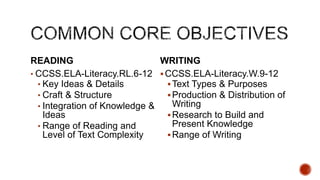
READING
WRITING
• CCSS.ELA-Literacy.RL.6-12  CCSS.ELA-Literacy.W.9-12
• Key Ideas & Details
 Text Types & Purposes
• Craft & Structure
 Production & Distribution of
Writing
• Integration of Knowledge &
Ideas
 Research to Build and
Present Knowledge
• Range of Reading and
Level of Text Complexity
 Range of Writing
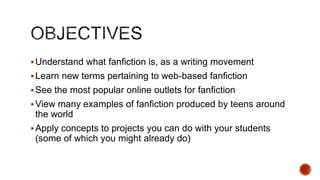
 Understand what fanfiction is, as a writing movement
 Learn new terms pertaining to web-based fanfiction
 See the most popular online outlets for fanfiction

 View many examples of fanfiction produced by teens around

the world
 Apply concepts to projects you can do with your students

(some of which you might already do)
Who are you?
What do you do? (Profession,

hobbies)
Who are your friends? Your enemies?
How much do you have to change to
be a part of this world?
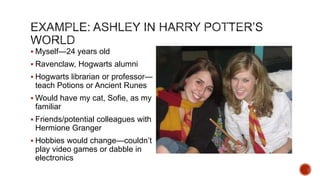
 Myself—24 years old
 Ravenclaw, Hogwarts alumni
 Hogwarts librarian or professor—

teach Potions or Ancient Runes
 Would have my cat, Sofie, as my

familiar
 Friends/potential colleagues with

Hermione Granger
 Hobbies would change—couldn’t

play video games or dabble in
electronics
Stories/artwork, created by fans, based on existing
works of original literature

―Fanfiction has been hailed as 'the
democratic genre' (Pugh, 2000), its
proponents celebrated as 'textual poachers'
(Jenkins, 1994) who radically disrupt but
also reinvigorate canonical texts.‖ (Thomas,
2007)
―Fanfiction is what literature might look like if it were
reinvented from scratch after a nuclear apocalypse by
a band of brilliant pop-culture junkies trapped in a
sealed bunker. They don't do it for money. That's not
what it's about. The writers write it and put it up online
just for the satisfaction. They're fans, but they're not
silent, couchbound consumers of media. The culture
talks to them, and they talk back to the culture in its
own language.‖
50 Shades of Grey - began as a

Twilight fanfic
Kirk/Spock – early fanfic communities
Harry Potter and the Methods of
Rationality
Highly technology-driven
Global/collaborative
Mixed-media
Can be a part of any fandom
Not divided by age/gender

Very popular with teenagers
Research
Writing
Peer-review

Editing
Interested in archetypes
Concerned/critical of character accuracy
Focus on plot and dialogue
Understanding of audience
―Bad writing‖ = less readers
 Great for English Language Learners (Black, 2007)
 Commercial texts become models (Jwa, 2012)
 Renews/revamps canonical texts (Thomas, 2007)

 Passive viewers  active writers, interpreters of texts and

media participants (Rust, 2003)
―Buffy [turned] the fans into authors and allow[ed] them to not only play
with any aspect of the show, but also to influence the direction of the
narrative itself.‖ (Rust, 2003)
 FF/fic - short for ―fanfiction‖

 Ship - a relationship

 Fandom - refers to a specific fan

 OTP - ―one true pairing‖--the relationship







universe. Popular fandoms include Harry a fan supports the most
Potter, Supernatural, Doctor Who, Star
 Slash - refers to a relationship pairing,
Trek, Percy Jackson
sometimes homosexual. Specifically
AU - alternate universe
refers to the ―/‖ between two characters’
names (Harry/Hermione, Kirk/Spock)
RP/RPG – role-playing game
 Meme - a concept created and shared
Face claim (FC) - using the appearance
rapidly on the internet
of an actor on which to base a character
 Tagging – adding a word/phrase to blog
Headcanon - an accepted belief that may post that helps others find your work
not be in the existing fiction
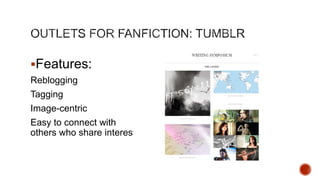
Features:
Reblogging
Tagging

Image-centric
Easy to connect with
others who share interests
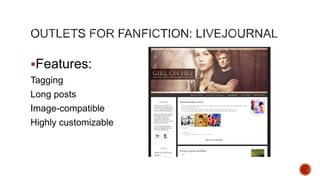
Features:
Tagging
Long posts

Image-compatible
Highly customizable
 Archive of Our Own (AO3)

Features: Tagging, long posts, ability to leave
author’s
notes, post in chapters, emphasis on
text, can
rate/review
 Fanfiction.net

Features: Long posts, chapters, tagged by
fandom, tagged by medium
Form is as important as function
Design serves as a motivator

Digital natives are highly visual
Customizing writing space is sacred
http://ashleyhwrites.tumblr.com
Have students make collages of images
Create a new character in an existing universe
Create a new universe for existing characters
Select a ―face claim‖ and create an origin story
Let students make a mixtape/playlist that

inspires their story
 Fanhand: A Tumblr-based literary journal that reviews fanart

http://fanhand.tumblr.com/
 Using Facebook & Tumblr to engage students

http://chronicle.com/blogs/profhacker/using-facebook-and-tumblr-toengage-students/47221
 Classroom Collective Tumblr http://classroomcollective.tumblr.com/
 Symposium Tumblr with examples http://ashleyhwrites.tumblr.com
 Authors on Tumblr: Neil Gaiman, Travis Beacham, John Green—all

active and very popular with their fans
 Alvermann, D. E. (2008). Why bother theorizing adolescents’ online literacies for classroom practice

and

research? Journal of Adolescent & Adult Literacy, 52(1), 8–19.

 Battis, J. (2009). Ryan is being beaten: incest, fanfiction and the OC. refractory, 15.
 Black, R. W. (2007). Fanfiction writing and the construction of space. ELearning, 4(4), 384–397.
 Black, R. W. (2006). Language, culture, and identity in online fanfiction. ELearning, 3(2), 170.
 Burns, E., & Webber, C. (2009). When Harry met Bella. Library, 55(8), 26–29.
 Chandler-Olcott, K., & Mahar, D. (2003). Adolescents’ anime-inspired ―fanfictions‖: an exploration of

multiliteracies. Journal of Adolescent Adult Literacy, 46(7), 556–566.

 Danforth, B. L. (2009). Games and writing. Library Journal, 134(17), 54.
 Lantagne, S. M. (2011). The better angels of our fanfiction: the need for true and logical precedent.

Hastings

Communications Entertainment Law Journal CommEnt, 33(2), 159–180.

 Moore, R. C. (2005). All shapes of hunger: teenagers and fanfiction. Voice of Youth Advocates, 28(1),

15–19.

 Rust, L. (2003). Welcome to the house of fun: Buffy fanfiction as a hall of mirrors. Refractory, 2.
 Viires, P. (2002). Literature in cyberspace 1. Folklore Tartu, 29, 153–174.

How Web-Based Fanfiction Fosters Narrative Writing

  • 1.
    Ashley Hennefer, M.A.candidate, Literacy Studies
  • 2.
    READING WRITING • CCSS.ELA-Literacy.RL.6-12 CCSS.ELA-Literacy.W.9-12 • Key Ideas & Details  Text Types & Purposes • Craft & Structure  Production & Distribution of Writing • Integration of Knowledge & Ideas  Research to Build and Present Knowledge • Range of Reading and Level of Text Complexity  Range of Writing
  • 3.
     Understand whatfanfiction is, as a writing movement  Learn new terms pertaining to web-based fanfiction  See the most popular online outlets for fanfiction  View many examples of fanfiction produced by teens around the world  Apply concepts to projects you can do with your students (some of which you might already do)
  • 4.
    Who are you? Whatdo you do? (Profession, hobbies) Who are your friends? Your enemies? How much do you have to change to be a part of this world?
  • 5.
     Myself—24 yearsold  Ravenclaw, Hogwarts alumni  Hogwarts librarian or professor— teach Potions or Ancient Runes  Would have my cat, Sofie, as my familiar  Friends/potential colleagues with Hermione Granger  Hobbies would change—couldn’t play video games or dabble in electronics
  • 6.
    Stories/artwork, created byfans, based on existing works of original literature ―Fanfiction has been hailed as 'the democratic genre' (Pugh, 2000), its proponents celebrated as 'textual poachers' (Jenkins, 1994) who radically disrupt but also reinvigorate canonical texts.‖ (Thomas, 2007)
  • 7.
    ―Fanfiction is whatliterature might look like if it were reinvented from scratch after a nuclear apocalypse by a band of brilliant pop-culture junkies trapped in a sealed bunker. They don't do it for money. That's not what it's about. The writers write it and put it up online just for the satisfaction. They're fans, but they're not silent, couchbound consumers of media. The culture talks to them, and they talk back to the culture in its own language.‖
  • 8.
    50 Shades ofGrey - began as a Twilight fanfic Kirk/Spock – early fanfic communities Harry Potter and the Methods of Rationality
  • 9.
    Highly technology-driven Global/collaborative Mixed-media Can bea part of any fandom Not divided by age/gender Very popular with teenagers
  • 10.
  • 11.
    Interested in archetypes Concerned/criticalof character accuracy Focus on plot and dialogue Understanding of audience ―Bad writing‖ = less readers
  • 12.
     Great forEnglish Language Learners (Black, 2007)  Commercial texts become models (Jwa, 2012)  Renews/revamps canonical texts (Thomas, 2007)  Passive viewers  active writers, interpreters of texts and media participants (Rust, 2003) ―Buffy [turned] the fans into authors and allow[ed] them to not only play with any aspect of the show, but also to influence the direction of the narrative itself.‖ (Rust, 2003)
  • 13.
     FF/fic -short for ―fanfiction‖  Ship - a relationship  Fandom - refers to a specific fan  OTP - ―one true pairing‖--the relationship     universe. Popular fandoms include Harry a fan supports the most Potter, Supernatural, Doctor Who, Star  Slash - refers to a relationship pairing, Trek, Percy Jackson sometimes homosexual. Specifically AU - alternate universe refers to the ―/‖ between two characters’ names (Harry/Hermione, Kirk/Spock) RP/RPG – role-playing game  Meme - a concept created and shared Face claim (FC) - using the appearance rapidly on the internet of an actor on which to base a character  Tagging – adding a word/phrase to blog Headcanon - an accepted belief that may post that helps others find your work not be in the existing fiction
  • 14.
  • 15.
  • 16.
     Archive ofOur Own (AO3) Features: Tagging, long posts, ability to leave author’s notes, post in chapters, emphasis on text, can rate/review  Fanfiction.net Features: Long posts, chapters, tagged by fandom, tagged by medium
  • 17.
    Form is asimportant as function Design serves as a motivator Digital natives are highly visual Customizing writing space is sacred
  • 18.
  • 19.
    Have students makecollages of images Create a new character in an existing universe Create a new universe for existing characters Select a ―face claim‖ and create an origin story Let students make a mixtape/playlist that inspires their story
  • 20.
     Fanhand: ATumblr-based literary journal that reviews fanart http://fanhand.tumblr.com/  Using Facebook & Tumblr to engage students http://chronicle.com/blogs/profhacker/using-facebook-and-tumblr-toengage-students/47221  Classroom Collective Tumblr http://classroomcollective.tumblr.com/  Symposium Tumblr with examples http://ashleyhwrites.tumblr.com  Authors on Tumblr: Neil Gaiman, Travis Beacham, John Green—all active and very popular with their fans
  • 21.
     Alvermann, D.E. (2008). Why bother theorizing adolescents’ online literacies for classroom practice and research? Journal of Adolescent & Adult Literacy, 52(1), 8–19.  Battis, J. (2009). Ryan is being beaten: incest, fanfiction and the OC. refractory, 15.  Black, R. W. (2007). Fanfiction writing and the construction of space. ELearning, 4(4), 384–397.  Black, R. W. (2006). Language, culture, and identity in online fanfiction. ELearning, 3(2), 170.  Burns, E., & Webber, C. (2009). When Harry met Bella. Library, 55(8), 26–29.  Chandler-Olcott, K., & Mahar, D. (2003). Adolescents’ anime-inspired ―fanfictions‖: an exploration of multiliteracies. Journal of Adolescent Adult Literacy, 46(7), 556–566.  Danforth, B. L. (2009). Games and writing. Library Journal, 134(17), 54.  Lantagne, S. M. (2011). The better angels of our fanfiction: the need for true and logical precedent. Hastings Communications Entertainment Law Journal CommEnt, 33(2), 159–180.  Moore, R. C. (2005). All shapes of hunger: teenagers and fanfiction. Voice of Youth Advocates, 28(1), 15–19.  Rust, L. (2003). Welcome to the house of fun: Buffy fanfiction as a hall of mirrors. Refractory, 2.  Viires, P. (2002). Literature in cyberspace 1. Folklore Tartu, 29, 153–174.