Identifying different types of citations in APA style.
Practice
Context
Read the following complimentary piece of text about citing in argumentative
texts using APA style.
Stage
5
English Citing in Argumentative Academic Texts
Academic Focus e-Task
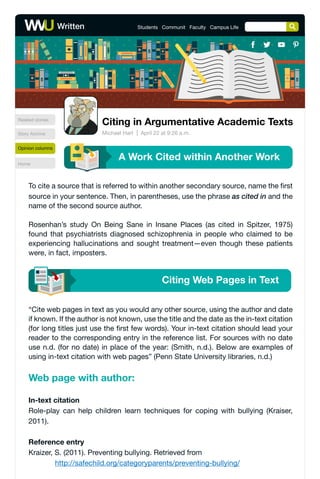
To cite a source that is referred to within another secondary source, name the first
source in your sentence. Then, in parentheses, use the phrase as cited in and the
name of the second source author.
Rosenhan’s study On Being Sane in Insane Places (as cited in Spitzer, 1975)
found that psychiatrists diagnosed schizophrenia in people who claimed to be
experiencing hallucinations and sought treatment—even though these patients
were, in fact, imposters.
Citing Web Pages in Text
“Cite web pages in text as you would any other source, using the author and date
if known. If the author is not known, use the title and the date as the in-text citation
(for long titles just use the first few words). Your in-text citation should lead your
reader to the corresponding entry in the reference list. For sources with no date
use n.d. (for no date) in place of the year: (Smith, n.d.). Below are examples of
using in-text citation with web pages” (Penn State University libraries, n.d.)
In-text citation
Role-play can help children learn techniques for coping with bullying (Kraiser,
2011).
Reference entry
Kraizer, S. (2011). Preventing bullying. Retrieved from
http://safechild.org/categoryparents/preventing-bullying/
Web page with author:
Related stories
Story Archive
Home
Opinion columns
Written Students Communit Faculty Campus Life
Citing in Argumentative Academic Texts
April 22 at 9:26 a.m.
Michael Hart
A Work Cited within Another Work
Formatting the References Section:
APA General Guidelines
APA
In-text citation
The term Nittany Lion was coined by Penn State football player Joe Mason in
1904 ("All things Nittany," 2006).
Reference entry
All things Nittany. (2006). Retrieved from
http://www.psu.edu/ur/about/nittanymascot.html
Web page with no author:
In-text citation
Establishing regular routines, such as exercise, can help survivors of disasters
recover from trauma (American Psychological Association [APA], n.d.).
Reference entry
American Psychological Association. (n.d.). Recovering emotionally from disaster.
Retrieved from http://www.apa.org/helpcenter/recovering-disasters.aspx
Web page with no date:
Include the heading References, centered at the top of the page. The
heading should not be boldfaced, italicized, or underlined.
Use double-spaced type throughout the references section, as in the
body of your paper.
1
2
Use hanging indentation for each entry. The first line should be flush
with the left margin, while any lines that follow should be indented five
spaces. Note that hanging indentation is the opposite of normal
indenting rules for paragraphs.
3
List entries in alphabetical order by the author’s last name. For a work
with multiple authors, use the last name of the first author listed.
For a work with no individual author(s), use the name of the
organization that published the work or, if this is unavailable, the title
of the work in place of the author’s name.
4
List authors’ names using this format: Smith, J. C.
5
6
Referencing Books
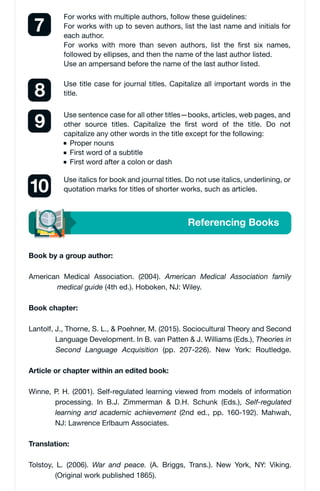
For works with multiple authors, follow these guidelines:
For works with up to seven authors, list the last name and initials for
each author.
For works with more than seven authors, list the first six names,
followed by ellipses, and then the name of the last author listed.
Use an ampersand before the name of the last author listed.
7
Use title case for journal titles. Capitalize all important words in the
title.
8
Use italics for book and journal titles. Do not use italics, underlining, or
quotation marks for titles of shorter works, such as articles.
10
Use sentence case for all other titles—books, articles, web pages, and
other source titles. Capitalize the first word of the title. Do not
capitalize any other words in the title except for the following:
Proper nouns
First word of a subtitle
First word after a colon or dash
9
Book by a group author:
American Medical Association. (2004). American Medical Association family
medical guide (4th ed.). Hoboken, NJ: Wiley.
Book chapter:
Lantolf, J., Thorne, S. L., & Poehner, M. (2015). Sociocultural Theory and Second
Language Development. In B. van Patten & J. Williams (Eds.), Theories in
Second Language Acquisition (pp. 207-226). New York: Routledge.
Article or chapter within an edited book:
Winne, P. H. (2001). Self-regulated learning viewed from models of information
processing. In B.J. Zimmerman & D.H. Schunk (Eds.), Self-regulated
learning and academic achievement (2nd ed., pp. 160-192). Mahwah,
NJ: Lawrence Erlbaum Associates.
Translation:
Tolstoy, L. (2006). War and peace. (A. Briggs, Trans.). New York, NY: Viking.
(Original work published 1865).
Electronic book:
Post, E. (1923). Etiquette in society, in business, in politics, and at home. New
York, NY: Funk & Wagnalls. Retrieved from http://www.bartleby.com/95/
Entry in an online reference work:
Rey, G. (2006). Behaviorism. In D. M. Borchert (Ed.), Encyclopedia of philosophy.
(2nd ed.). Retrieved from http://go.galegroup.com/
E-Reader book (such as Kindle):
Tetlock, P.E., & Gardner, D. (2015). Superforecasting: The art and science of
prediction [Kindle Paperwhite version]. Retrieved from Amazon.com
Dictionary entry:
Hipster. (n.d.) In Oxford English Dictionary. Retrieved from www.oed.com.
Like Comment Share
Taken and adapted from Penn State libraries (n.d.). APA Quick Citation Guide.

Citing in Argumentative Academic Texts.pdf

  • 1.
    Identifying different typesof citations in APA style. Practice Context Read the following complimentary piece of text about citing in argumentative texts using APA style. Stage 5 English Citing in Argumentative Academic Texts Academic Focus e-Task
  • 2.
    To cite asource that is referred to within another secondary source, name the first source in your sentence. Then, in parentheses, use the phrase as cited in and the name of the second source author. Rosenhan’s study On Being Sane in Insane Places (as cited in Spitzer, 1975) found that psychiatrists diagnosed schizophrenia in people who claimed to be experiencing hallucinations and sought treatment—even though these patients were, in fact, imposters. Citing Web Pages in Text “Cite web pages in text as you would any other source, using the author and date if known. If the author is not known, use the title and the date as the in-text citation (for long titles just use the first few words). Your in-text citation should lead your reader to the corresponding entry in the reference list. For sources with no date use n.d. (for no date) in place of the year: (Smith, n.d.). Below are examples of using in-text citation with web pages” (Penn State University libraries, n.d.) In-text citation Role-play can help children learn techniques for coping with bullying (Kraiser, 2011). Reference entry Kraizer, S. (2011). Preventing bullying. Retrieved from http://safechild.org/categoryparents/preventing-bullying/ Web page with author: Related stories Story Archive Home Opinion columns Written Students Communit Faculty Campus Life Citing in Argumentative Academic Texts April 22 at 9:26 a.m. Michael Hart A Work Cited within Another Work
  • 3.
    Formatting the ReferencesSection: APA General Guidelines APA In-text citation The term Nittany Lion was coined by Penn State football player Joe Mason in 1904 ("All things Nittany," 2006). Reference entry All things Nittany. (2006). Retrieved from http://www.psu.edu/ur/about/nittanymascot.html Web page with no author: In-text citation Establishing regular routines, such as exercise, can help survivors of disasters recover from trauma (American Psychological Association [APA], n.d.). Reference entry American Psychological Association. (n.d.). Recovering emotionally from disaster. Retrieved from http://www.apa.org/helpcenter/recovering-disasters.aspx Web page with no date: Include the heading References, centered at the top of the page. The heading should not be boldfaced, italicized, or underlined. Use double-spaced type throughout the references section, as in the body of your paper. 1 2 Use hanging indentation for each entry. The first line should be flush with the left margin, while any lines that follow should be indented five spaces. Note that hanging indentation is the opposite of normal indenting rules for paragraphs. 3 List entries in alphabetical order by the author’s last name. For a work with multiple authors, use the last name of the first author listed. For a work with no individual author(s), use the name of the organization that published the work or, if this is unavailable, the title of the work in place of the author’s name. 4 List authors’ names using this format: Smith, J. C. 5 6
  • 4.
    Referencing Books For workswith multiple authors, follow these guidelines: For works with up to seven authors, list the last name and initials for each author. For works with more than seven authors, list the first six names, followed by ellipses, and then the name of the last author listed. Use an ampersand before the name of the last author listed. 7 Use title case for journal titles. Capitalize all important words in the title. 8 Use italics for book and journal titles. Do not use italics, underlining, or quotation marks for titles of shorter works, such as articles. 10 Use sentence case for all other titles—books, articles, web pages, and other source titles. Capitalize the first word of the title. Do not capitalize any other words in the title except for the following: Proper nouns First word of a subtitle First word after a colon or dash 9 Book by a group author: American Medical Association. (2004). American Medical Association family medical guide (4th ed.). Hoboken, NJ: Wiley. Book chapter: Lantolf, J., Thorne, S. L., & Poehner, M. (2015). Sociocultural Theory and Second Language Development. In B. van Patten & J. Williams (Eds.), Theories in Second Language Acquisition (pp. 207-226). New York: Routledge. Article or chapter within an edited book: Winne, P. H. (2001). Self-regulated learning viewed from models of information processing. In B.J. Zimmerman & D.H. Schunk (Eds.), Self-regulated learning and academic achievement (2nd ed., pp. 160-192). Mahwah, NJ: Lawrence Erlbaum Associates. Translation: Tolstoy, L. (2006). War and peace. (A. Briggs, Trans.). New York, NY: Viking. (Original work published 1865).
  • 5.
    Electronic book: Post, E.(1923). Etiquette in society, in business, in politics, and at home. New York, NY: Funk & Wagnalls. Retrieved from http://www.bartleby.com/95/ Entry in an online reference work: Rey, G. (2006). Behaviorism. In D. M. Borchert (Ed.), Encyclopedia of philosophy. (2nd ed.). Retrieved from http://go.galegroup.com/ E-Reader book (such as Kindle): Tetlock, P.E., & Gardner, D. (2015). Superforecasting: The art and science of prediction [Kindle Paperwhite version]. Retrieved from Amazon.com Dictionary entry: Hipster. (n.d.) In Oxford English Dictionary. Retrieved from www.oed.com. Like Comment Share Taken and adapted from Penn State libraries (n.d.). APA Quick Citation Guide.