CitationWhat is it?Why does it matter?Sarah JonesZai Whitaker
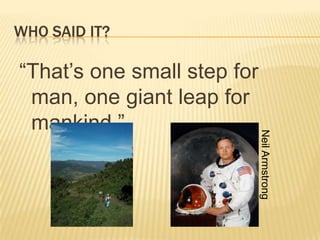
Who said it?“That’s one small step for man, one giant leap for mankind.”Neil Armstrong
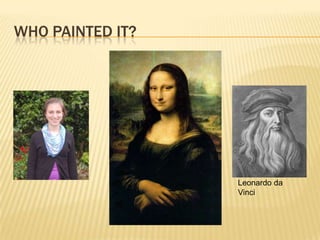
Who Painted it?Leonardo da Vinci
Using someone else’s words			      		thoughts						or ideasWITHOUT telling others where it came from		is not just confusing…It is Wrong
If you Don’t Give Credit to the Right Person, you could…Get a low grade
Fail the class
Get kicked out of school or college
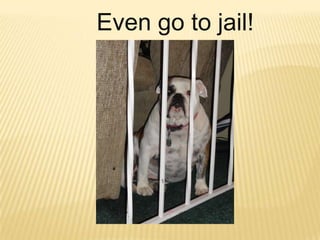
Have a court case against youEven go to jail!
If you want to get credit for the brilliant things YOU say,you must first give credit to other people for the brilliant things THEY say
?SO…WHAT DO we do?
Our hero		come to save the dayMLAModern Language Association
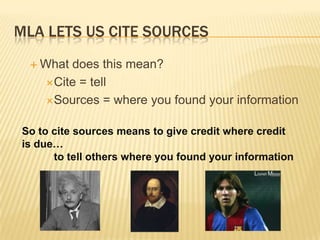
MLA lets us Cite SourcesWhat does this mean?Cite = tellSources = where you found your informationSo to cite sources means to give credit where credit is due…to tell others where you found your information
KIS has decided to use MLA citation for all student work.You’ll be using this until you graduate, and probably in college too.SO IT’S WORTH KNOWING HOW TO DO IT WELL.Let’s take a look at how to cite sources with MLA…
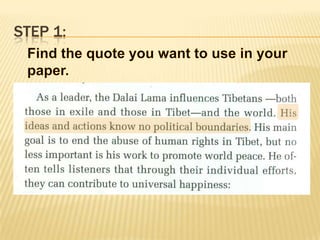
Step 1:Find the quote you want to use in your paper.
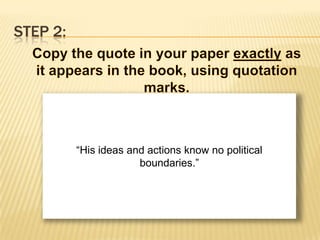
Step 2:Copy the quote in your paper exactly as it appears in the book, using quotation marks.“His ideas and actions know no political boundaries.”
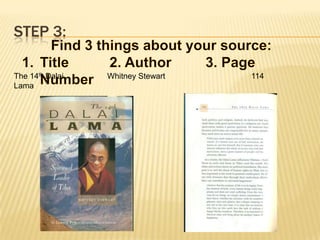
Step 3:Find 3 things about your source:Title	      2. Author	      3. Page NumberThe 14th Dalai LamaWhitney Stewart114
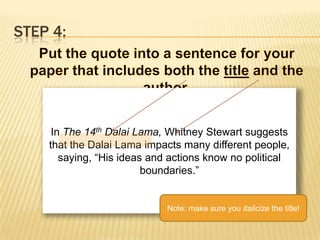
Step 4:Put the quote into a sentence for your paper that includes both the title and the author. In The 14th Dalai Lama, Whitney Stewart suggests that the Dalai Lama impacts many different people, saying, “His ideas and actions know no political boundaries.” Note: make sure you italicize the title!
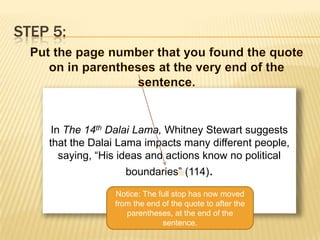
Step 5:Put the page number that you found the quote on in parentheses at the very end of the sentence. In The 14th Dalai Lama, Whitney Stewart suggests that the Dalai Lama impacts many different people, saying, “His ideas and actions know no political boundaries” (114).Notice: The full stop has now moved from the end of the quote to after the parentheses, at the end of the sentence.
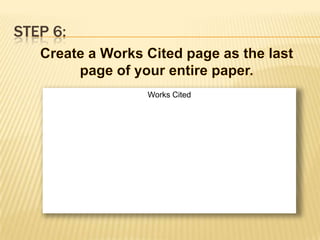
Step 6:Create a Works Cited page as the last page of your entire paper.Works Cited
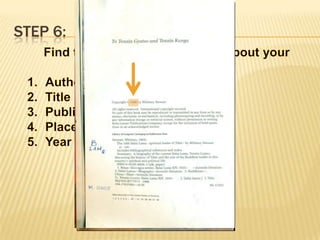
Step 6:Find the following information about your source:AuthorTitlePublishing CompanyPlace of Publication Year of PublicationWhitney StewartThe 14th Dalai LamaLearner PublicationsMinneapolis1996
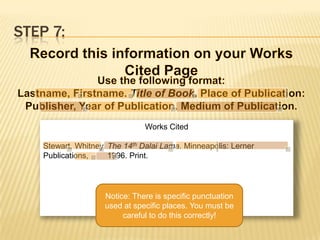
Step 7: Record this information on your Works Cited PageUse the following format:Lastname, Firstname. Title of Book. Place of Publication: Publisher, Year of Publication. Medium of Publication.Works CitedStewart, Whitney. The 14th Dalai Lama. Minneapolis: Lerner Publications, 	1996. Print.Notice: There is specific punctuation used at specific places. You must be careful to do this correctly!
So there you have the basics of MLA CitationBut one more thing…
What if you take an idea from a source and use it in your paper, BUT you don’t use the exact quote?Do you still have to Cite it?
YES!Here’s an example…
I want to include the IDEA that the what the Dalai Lama does impacts people of all political backgrounds. I did not come up with this IDEA myself; I read it in Whitney Stewart’s book.So, I need to say so in my paper. Here’s one way I could do that:According to Whitney Stewart in The 14th Dalai Lama, what the Dalai Lama does impacts people from all political backgrounds (114).  Even though I didn’t use a direct quote, I cited the information just the same, since I got this idea from someone else.
Any time you use someone else’s words, thoughts, or ideas, you must give them credit in your paper!

Citation PYPMYP

  • 1.
    CitationWhat is it?Whydoes it matter?Sarah JonesZai Whitaker
  • 2.
    Who said it?“That’sone small step for man, one giant leap for mankind.”Neil Armstrong
  • 3.
  • 4.
    Using someone else’swords thoughts or ideasWITHOUT telling others where it came from is not just confusing…It is Wrong
  • 5.
    If you Don’tGive Credit to the Right Person, you could…Get a low grade
  • 6.
  • 7.
    Get kicked outof school or college
  • 8.
    Have a courtcase against youEven go to jail!
  • 9.
    If you wantto get credit for the brilliant things YOU say,you must first give credit to other people for the brilliant things THEY say
  • 10.
  • 11.
    Our hero come tosave the dayMLAModern Language Association
  • 12.
    MLA lets usCite SourcesWhat does this mean?Cite = tellSources = where you found your informationSo to cite sources means to give credit where credit is due…to tell others where you found your information
  • 13.
    KIS has decidedto use MLA citation for all student work.You’ll be using this until you graduate, and probably in college too.SO IT’S WORTH KNOWING HOW TO DO IT WELL.Let’s take a look at how to cite sources with MLA…
  • 14.
    Step 1:Find thequote you want to use in your paper.
  • 15.
    Step 2:Copy thequote in your paper exactly as it appears in the book, using quotation marks.“His ideas and actions know no political boundaries.”
  • 16.
    Step 3:Find 3things about your source:Title 2. Author 3. Page NumberThe 14th Dalai LamaWhitney Stewart114
  • 17.
    Step 4:Put thequote into a sentence for your paper that includes both the title and the author. In The 14th Dalai Lama, Whitney Stewart suggests that the Dalai Lama impacts many different people, saying, “His ideas and actions know no political boundaries.” Note: make sure you italicize the title!
  • 18.
    Step 5:Put thepage number that you found the quote on in parentheses at the very end of the sentence. In The 14th Dalai Lama, Whitney Stewart suggests that the Dalai Lama impacts many different people, saying, “His ideas and actions know no political boundaries” (114).Notice: The full stop has now moved from the end of the quote to after the parentheses, at the end of the sentence.
  • 19.
    Step 6:Create aWorks Cited page as the last page of your entire paper.Works Cited
  • 20.
    Step 6:Find thefollowing information about your source:AuthorTitlePublishing CompanyPlace of Publication Year of PublicationWhitney StewartThe 14th Dalai LamaLearner PublicationsMinneapolis1996
  • 21.
    Step 7: Recordthis information on your Works Cited PageUse the following format:Lastname, Firstname. Title of Book. Place of Publication: Publisher, Year of Publication. Medium of Publication.Works CitedStewart, Whitney. The 14th Dalai Lama. Minneapolis: Lerner Publications, 1996. Print.Notice: There is specific punctuation used at specific places. You must be careful to do this correctly!
  • 22.
    So there youhave the basics of MLA CitationBut one more thing…
  • 23.
    What if youtake an idea from a source and use it in your paper, BUT you don’t use the exact quote?Do you still have to Cite it?
  • 24.
  • 25.
    I want toinclude the IDEA that the what the Dalai Lama does impacts people of all political backgrounds. I did not come up with this IDEA myself; I read it in Whitney Stewart’s book.So, I need to say so in my paper. Here’s one way I could do that:According to Whitney Stewart in The 14th Dalai Lama, what the Dalai Lama does impacts people from all political backgrounds (114). Even though I didn’t use a direct quote, I cited the information just the same, since I got this idea from someone else.
  • 26.
    Any time youuse someone else’s words, thoughts, or ideas, you must give them credit in your paper!