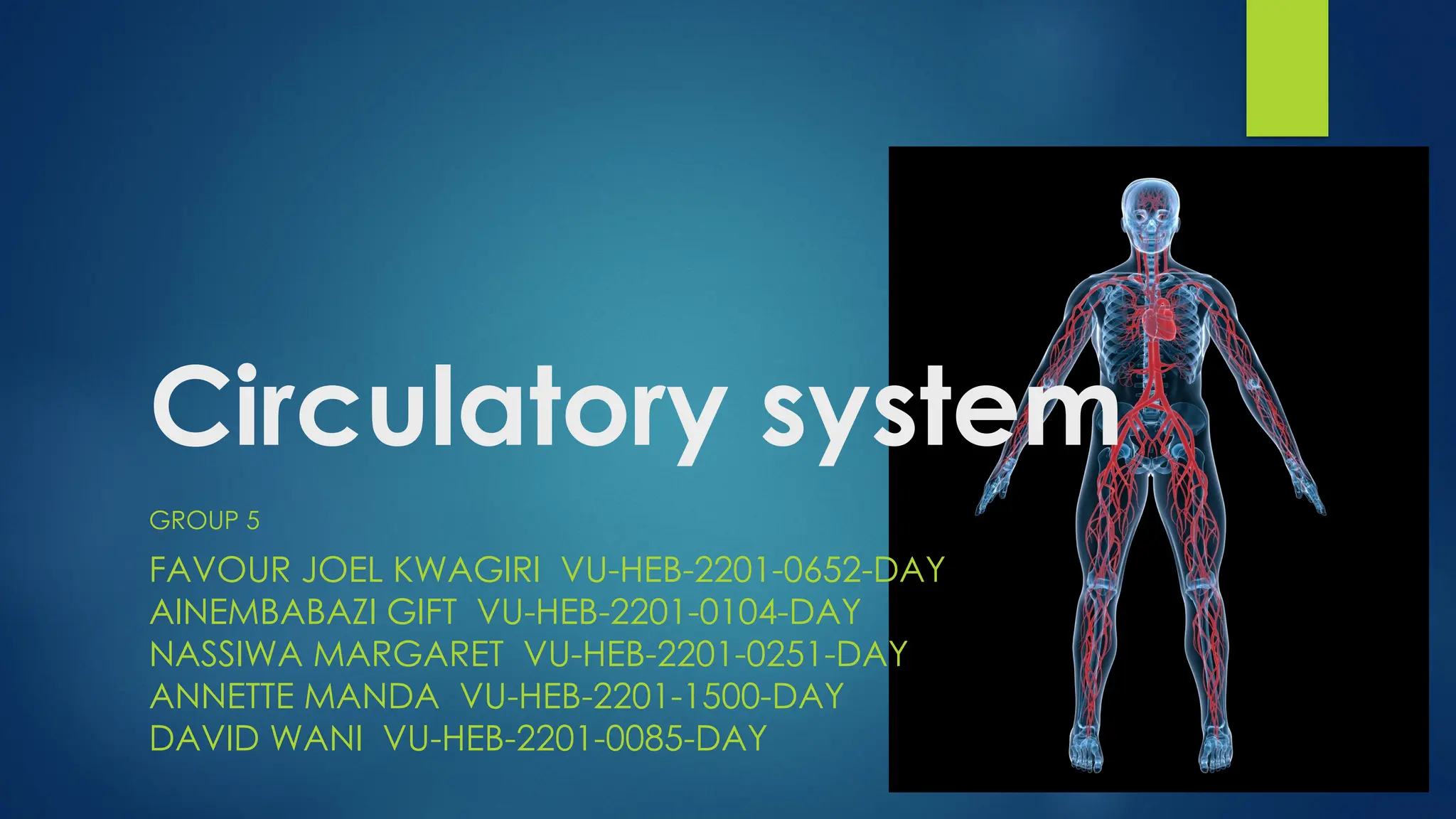
Circulatory system
GROUP 5
FAVOUR JOEL KWAGIRI VU-HEB-2201-0652-DAY
AINEMBABAZI GIFT VU-HEB-2201-0104-DAY
NASSIWA MARGARET VU-HEB-2201-0251-DAY
ANNETTE MANDA VU-HEB-2201-1500-DAY
DAVID WANI VU-HEB-2201-0085-DAY
INTRODUCTION
 The Human circulatory system is a system of organs that includes the
heart, blood vessels, and blood which is circulated throughout the
entire body of a human or other vertebrate.
 It includes the cardiovascular system, or vascular system, that
consists of the heart and blood vessels.
 The human circulatory system consists of a network of arteries, veins,
and capillaries, with the heart pumping blood through it. Its primary
role is to provide essential nutrients, minerals, and hormones to
various parts of the body.
 Alternatively, the circulatory system is also responsible for collecting
metabolic waste and toxins from the cells and tissues to be purified
or expelled from the body.
Organs of Circulatory System
include:
 Circulatory system is a closed system which circulate blood and
lymph throughout the body .
 The human circulatory system comprises 4 main organs that have
specific roles and functions.
 The vital circulatory system organs include:
 Heart
 Blood (technically, blood is considered a tissue and not an organ)
 Blood Vessels
 Lymphatic system.
The heart
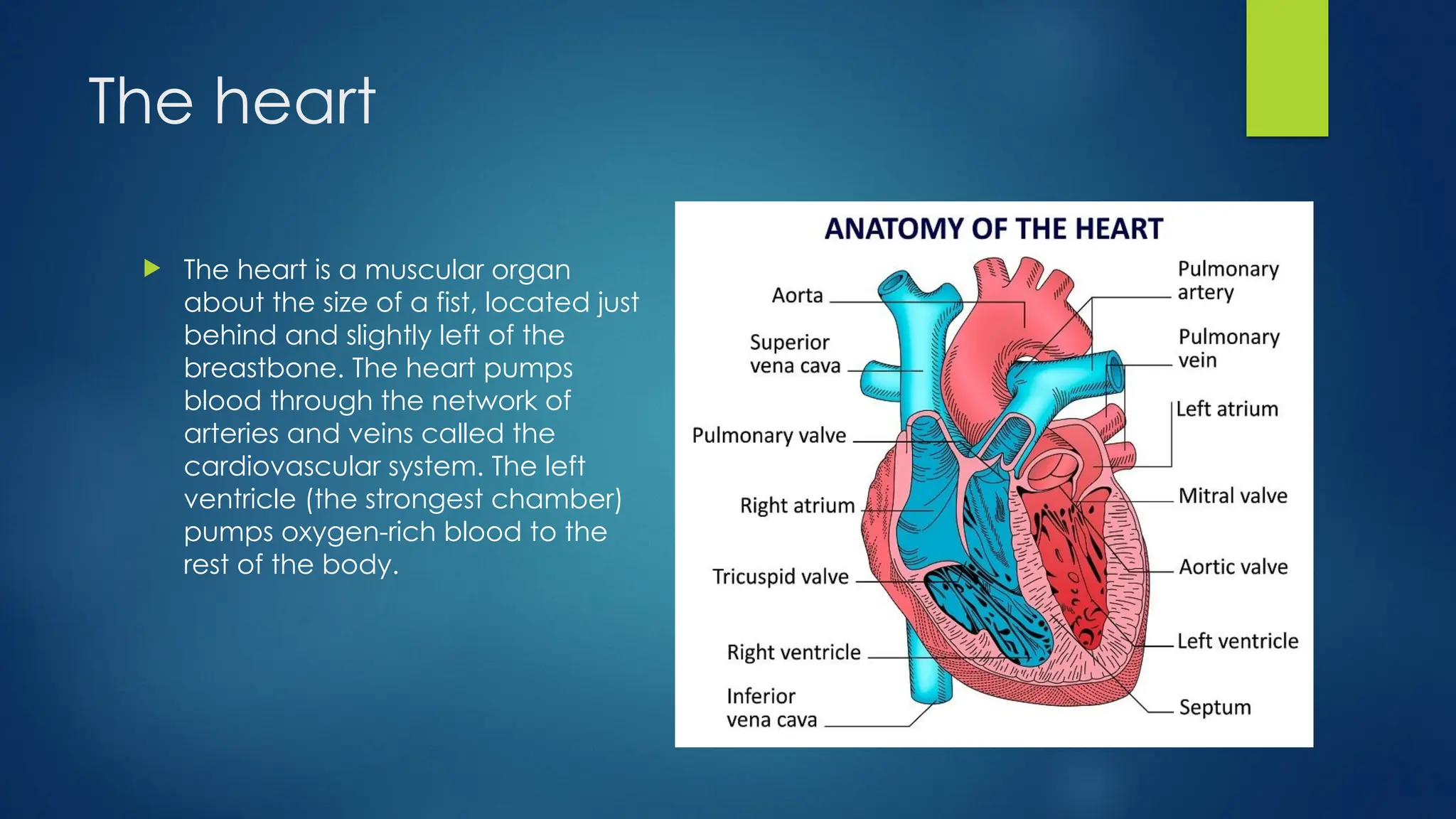
 The heart is a muscular organ
about the size of a fist, located just
behind and slightly left of the
breastbone. The heart pumps
blood through the network of
arteries and veins called the
cardiovascular system. The left
ventricle (the strongest chamber)
pumps oxygen-rich blood to the
rest of the body.
BLOOD
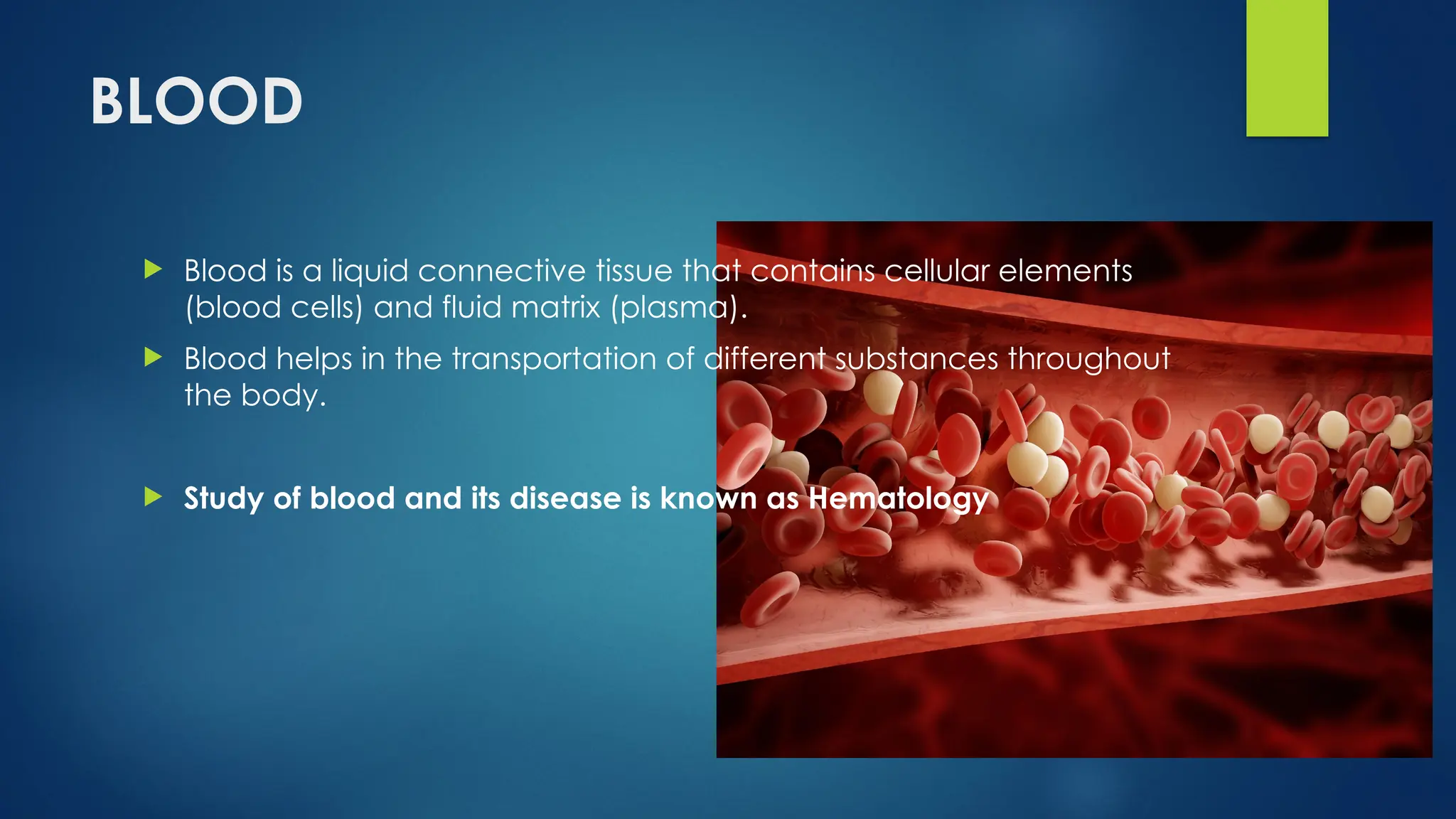
 Blood is a liquid connective tissue that contains cellular elements
(blood cells) and fluid matrix (plasma).
 Blood helps in the transportation of different substances throughout
the body.
 Study of blood and its disease is known as Hematology
Composition of Blood
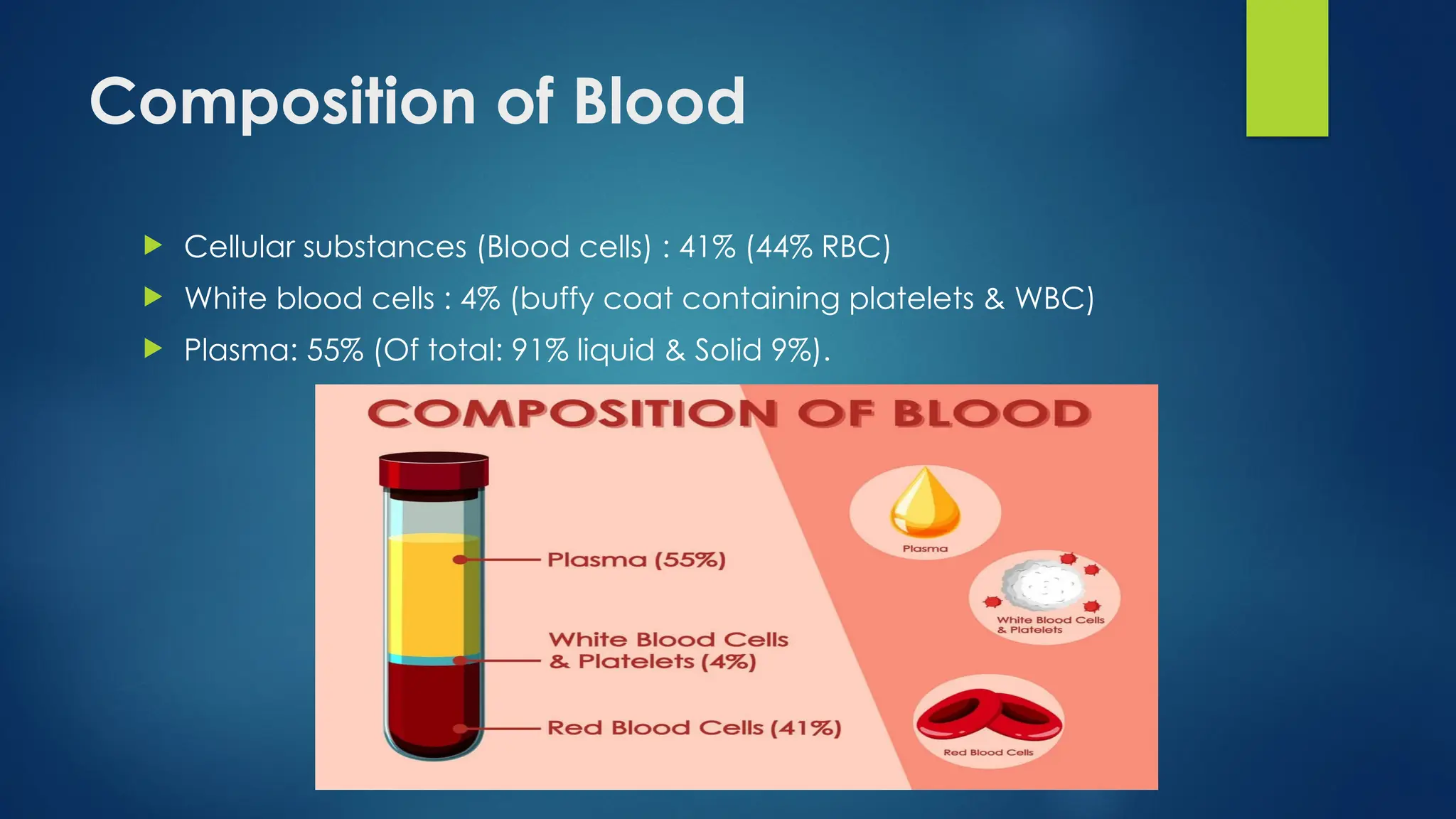
 Cellular substances (Blood cells) : 41% (44% RBC)
 White blood cells : 4% (buffy coat containing platelets & WBC)
 Plasma: 55% (Of total: 91% liquid & Solid 9%).
1) Erythrocytes or Red blood cells
(RBC)
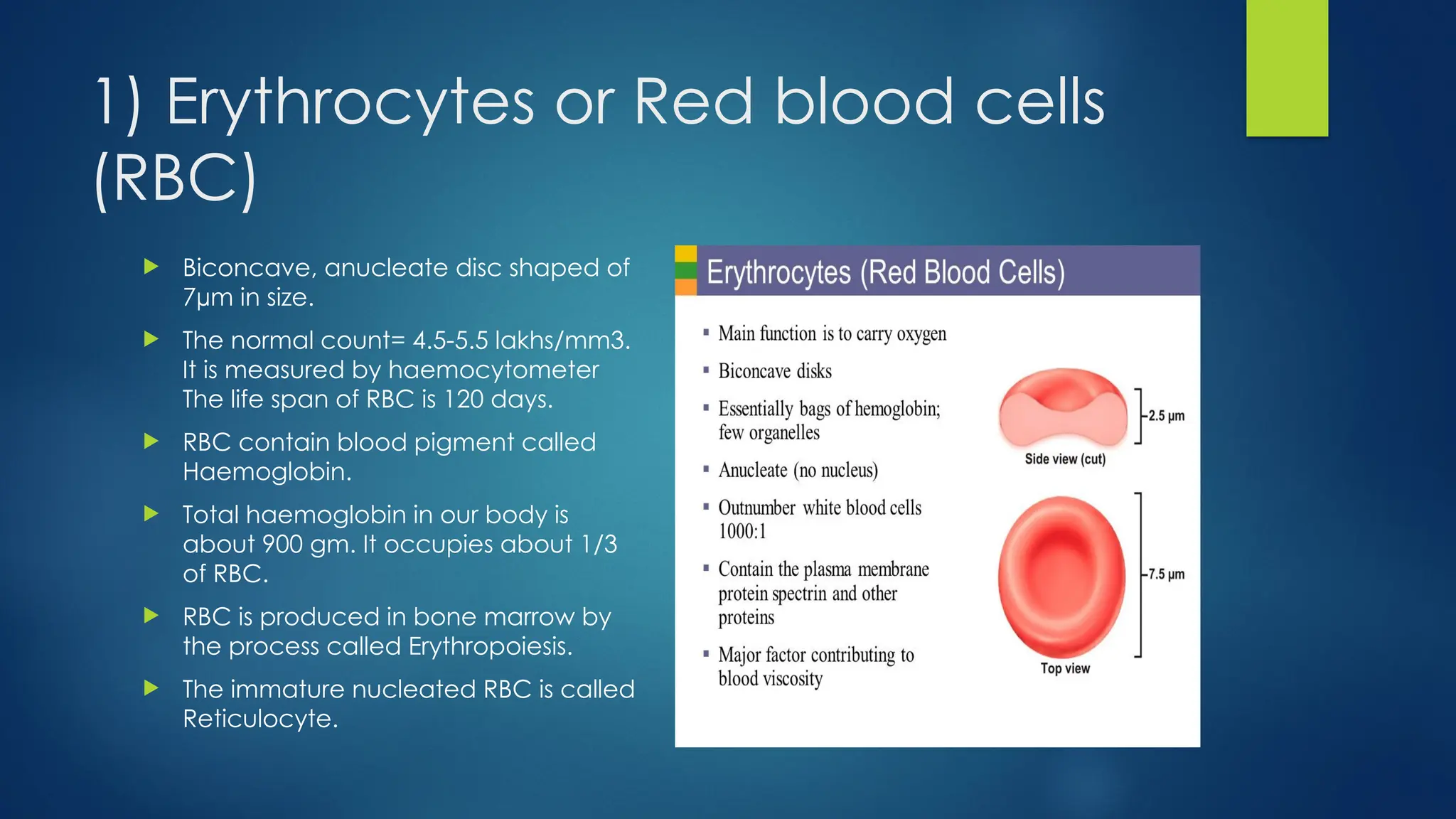
 Biconcave, anucleate disc shaped of
7µm in size.
 The normal count= 4.5-5.5 lakhs/mm3.
It is measured by haemocytometer
The life span of RBC is 120 days.
 RBC contain blood pigment called
Haemoglobin.
 Total haemoglobin in our body is
about 900 gm. It occupies about 1/3
of RBC.
 RBC is produced in bone marrow by
the process called Erythropoiesis.
 The immature nucleated RBC is called
Reticulocyte.
2) Leucocytes or White blood cells
(WBC)
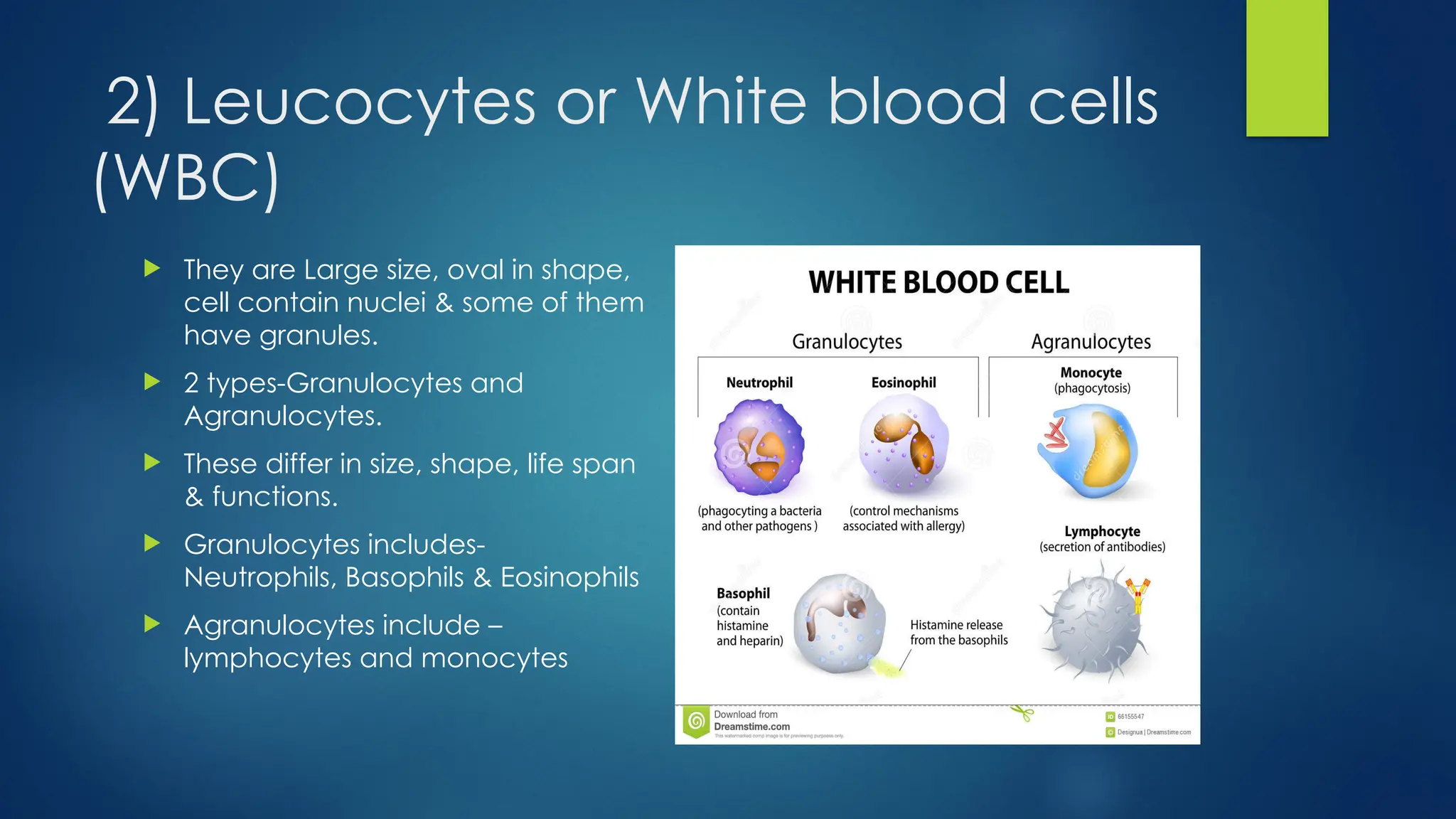
 They are Large size, oval in shape,
cell contain nuclei & some of them
have granules.
 2 types-Granulocytes and
Agranulocytes.
 These differ in size, shape, life span
& functions.
 Granulocytes includes-
Neutrophils, Basophils & Eosinophils
 Agranulocytes include –
lymphocytes and monocytes
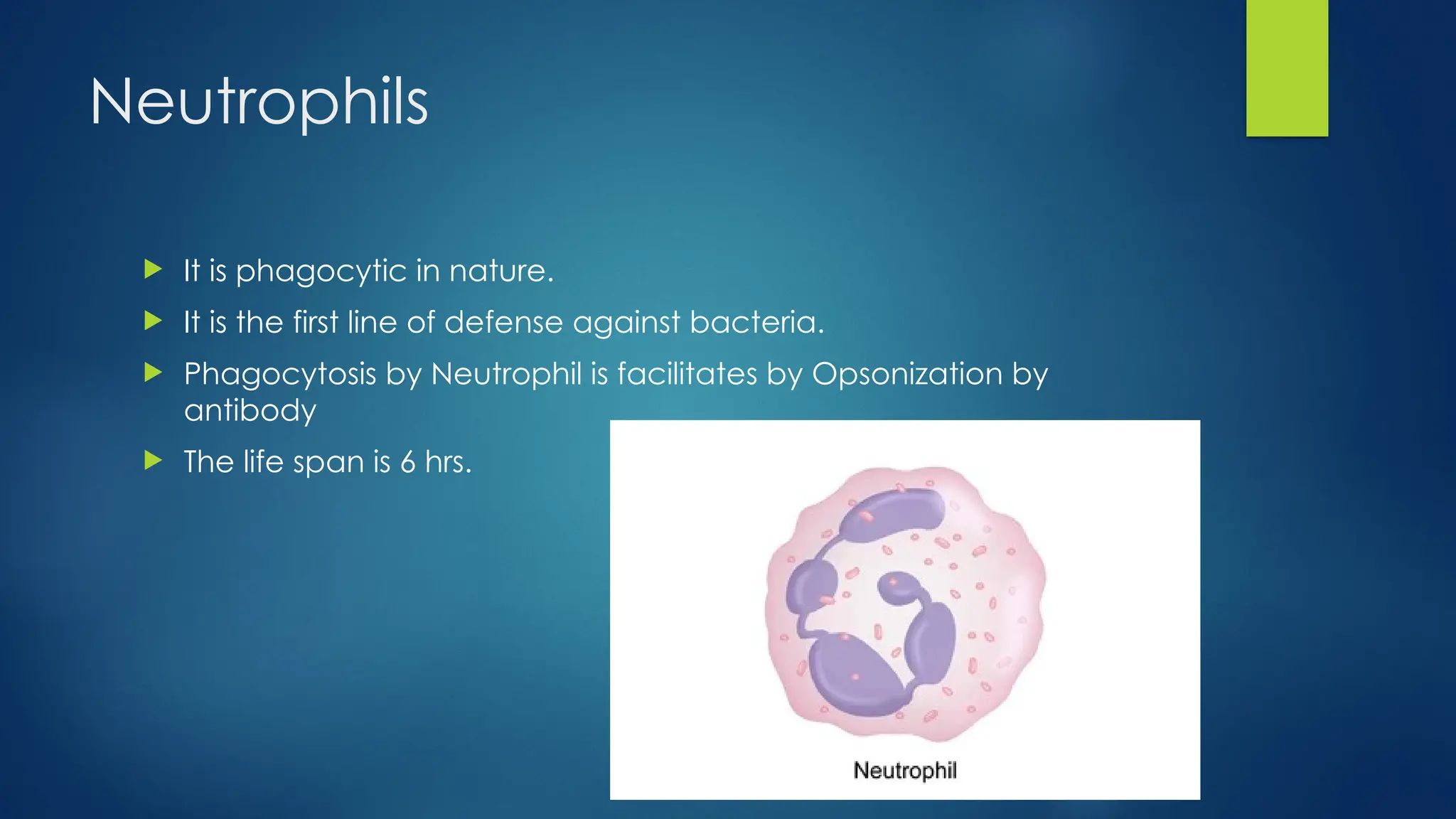
Neutrophils
 It is phagocytic in nature.
 It is the first line of defense against bacteria.
 Phagocytosis by Neutrophil is facilitates by Opsonization by
antibody
 The life span is 6 hrs.
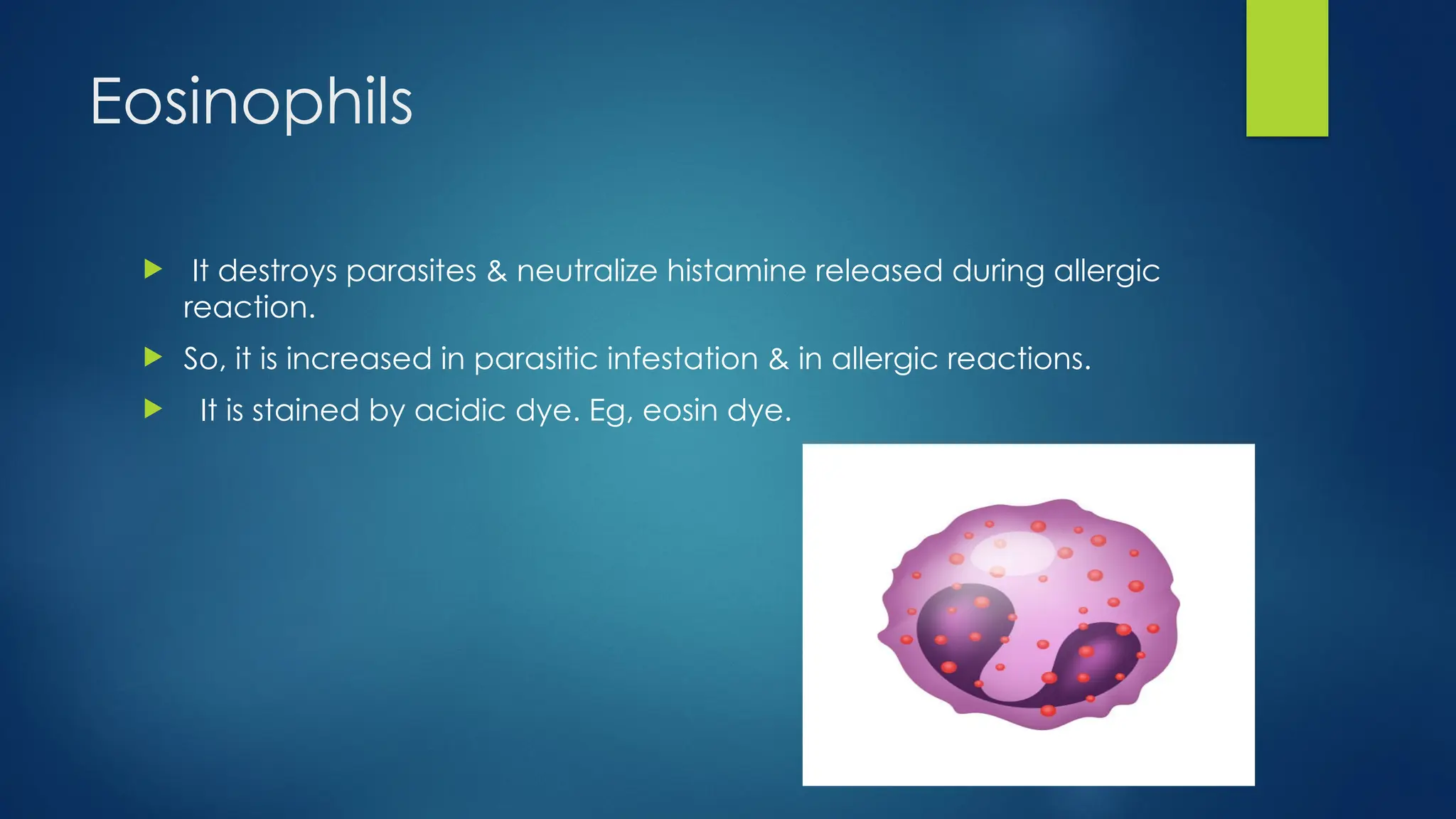
Eosinophils
 It destroys parasites & neutralize histamine released during allergic
reaction.
 So, it is increased in parasitic infestation & in allergic reactions.
 It is stained by acidic dye. Eg, eosin dye.
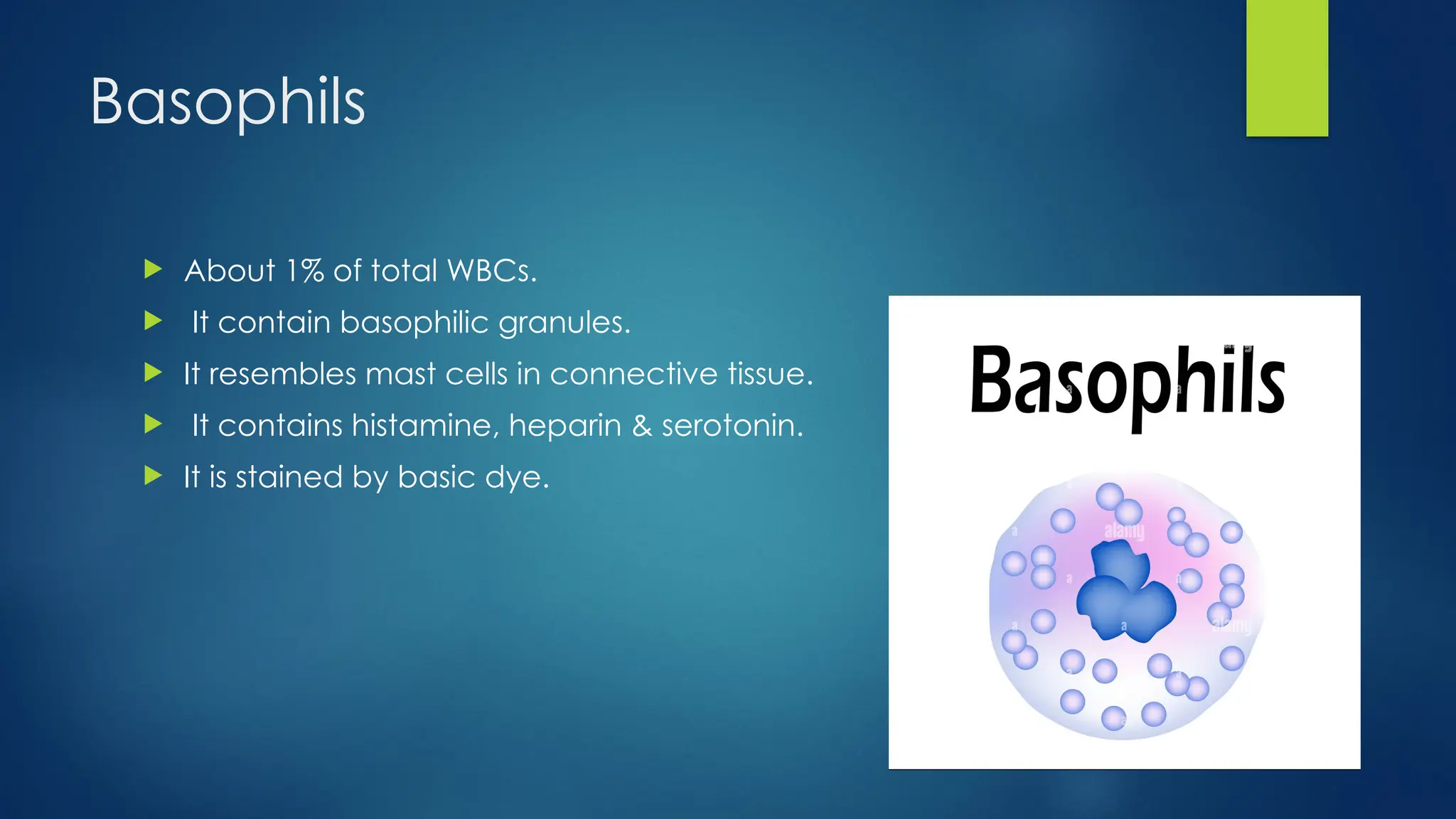
Basophils
 About 1% of total WBCs.
 It contain basophilic granules.
 It resembles mast cells in connective tissue.
 It contains histamine, heparin & serotonin.
 It is stained by basic dye.
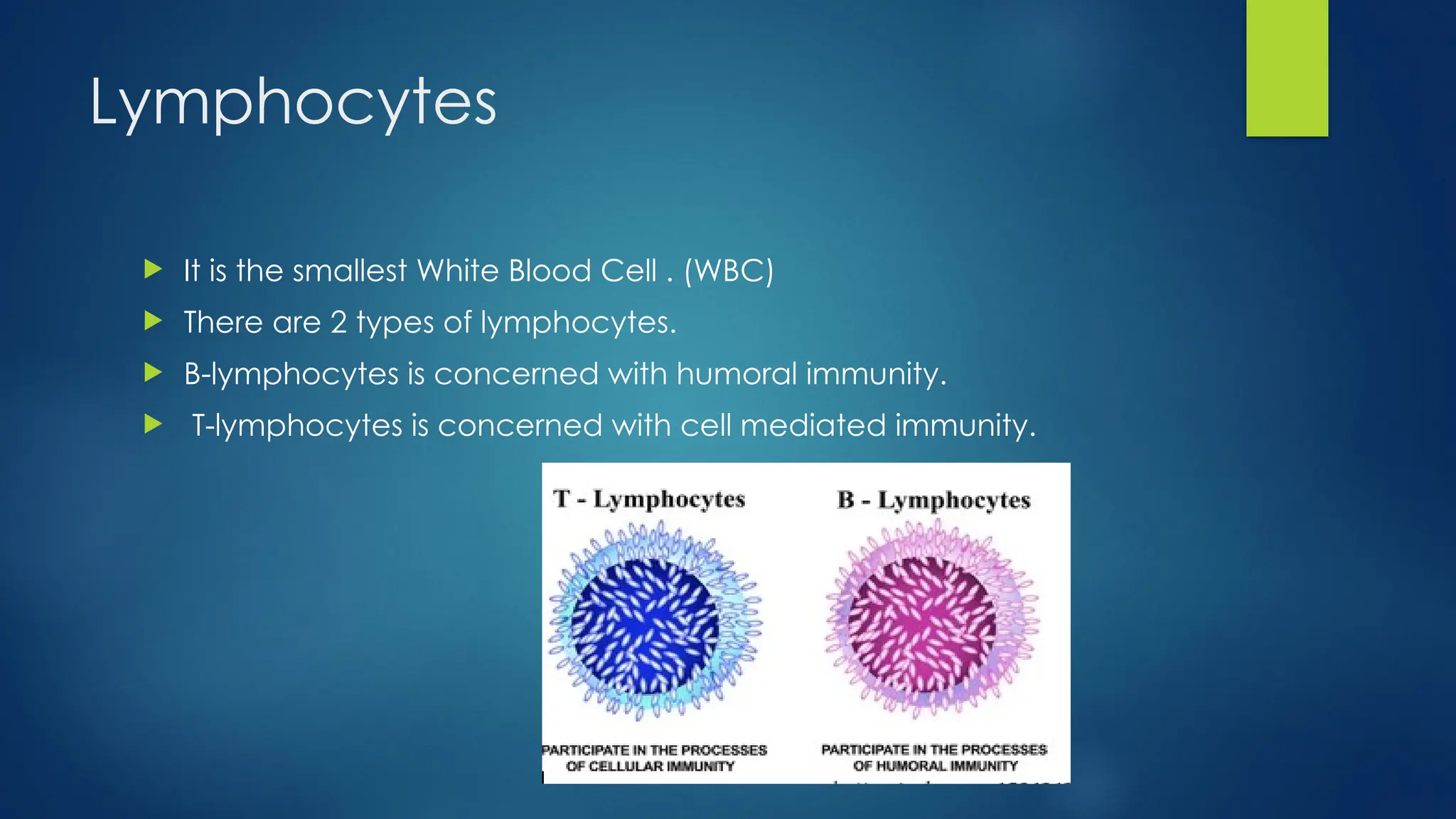
Lymphocytes
 It is the smallest White Blood Cell . (WBC)
 There are 2 types of lymphocytes.
 B-lymphocytes is concerned with humoral immunity.
 T-lymphocytes is concerned with cell mediated immunity.
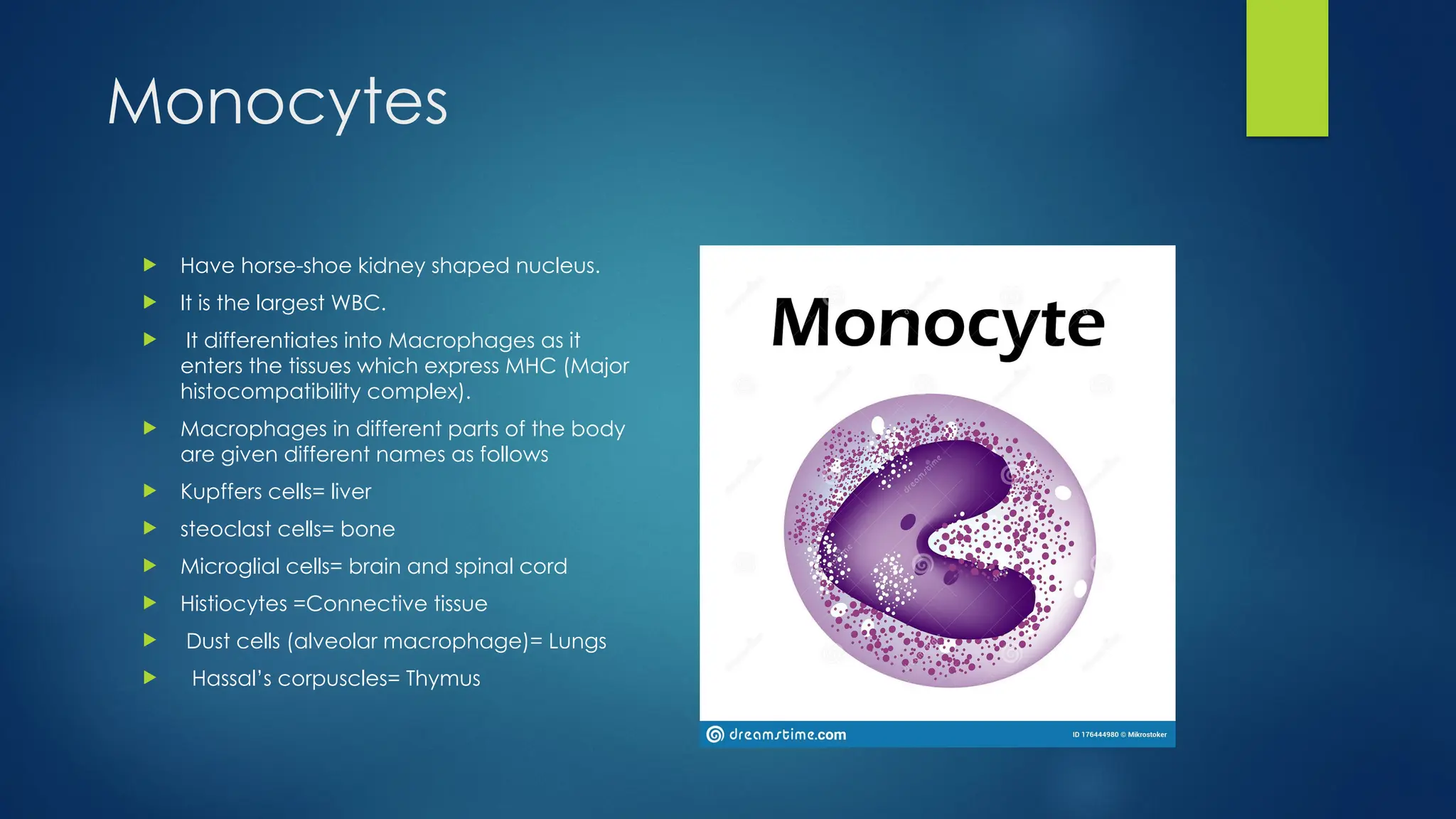
Monocytes
 Have horse-shoe kidney shaped nucleus.
 It is the largest WBC.
 It differentiates into Macrophages as it
enters the tissues which express MHC (Major
histocompatibility complex).
 Macrophages in different parts of the body
are given different names as follows
 Kupffers cells= liver
 steoclast cells= bone
 Microglial cells= brain and spinal cord
 Histiocytes =Connective tissue
 Dust cells (alveolar macrophage)= Lungs
 Hassal’s corpuscles= Thymus
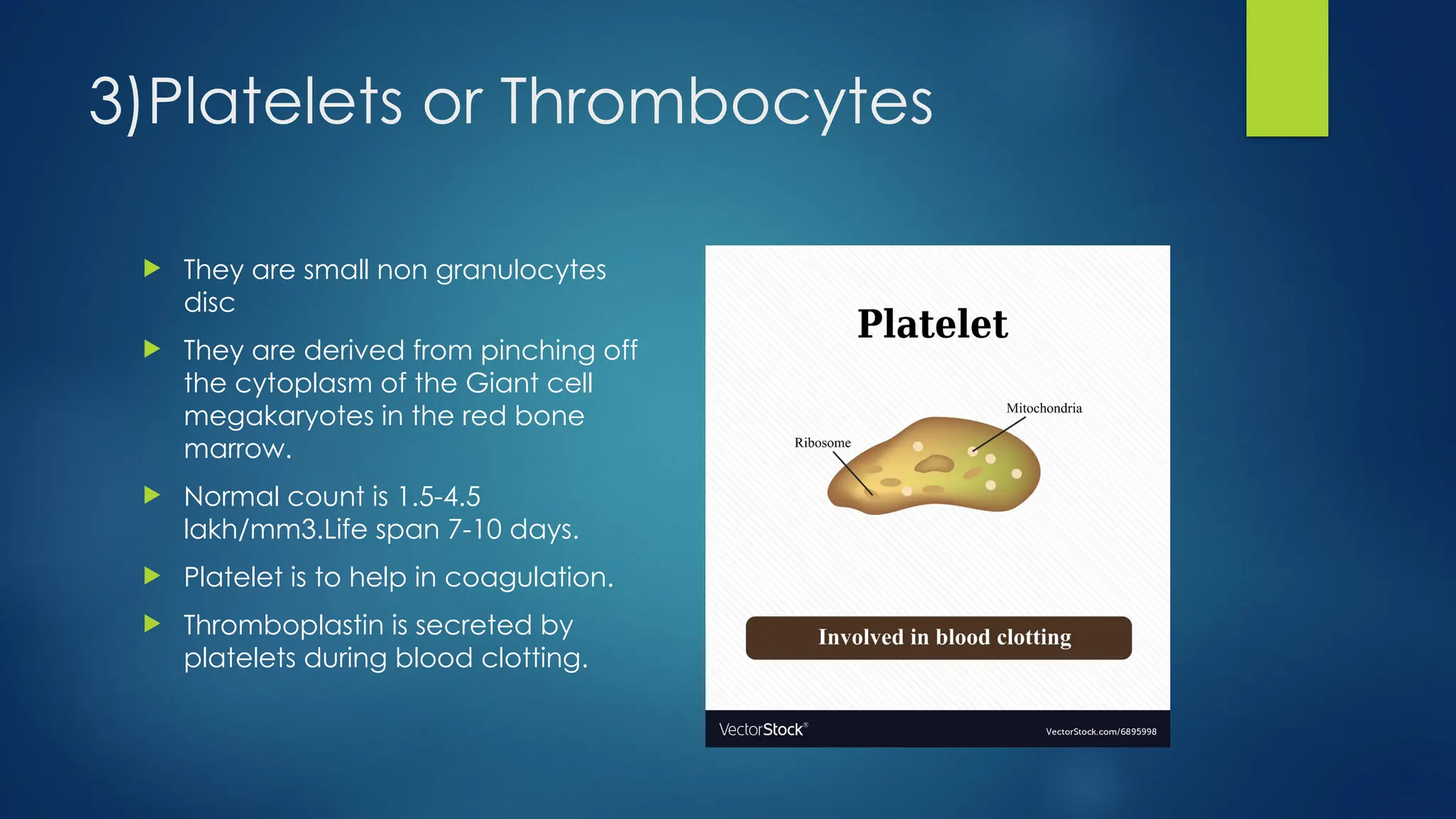
3)Platelets or Thrombocytes
 They are small non granulocytes
disc
 They are derived from pinching off
the cytoplasm of the Giant cell
megakaryotes in the red bone
marrow.
 Normal count is 1.5-4.5
lakh/mm3.Life span 7-10 days.
 Platelet is to help in coagulation.
 Thromboplastin is secreted by
platelets during blood clotting.
Plasma
 Plasma = (Blood- Blood cells)
 It is the liquid part of blood and is composed of 90-92 % water, 7-8 % plasma protein
and 1-2% other substances (glucose, amino acids, electrolytes, ammonia, enzymes,
hormones, vitamins, etc).
 Translucent, yellowish, little viscous when centrifuged.
 Normal range: 60-80 gm/dl of blood.
 Plasma proteins: Helps in maintaining osmotic pressure, coagulation of blood,
viscosity, blood pressure, defensive action, transport of gases.
 The solvent property of water helps in transport of nutrients as well as metabolic
wastes from one part of body to another part.
 Liver produces about 30gm of plasma protein each day.
con’t
 They are of three types:
 Albumin: (58-60%) most abundant, main function is to maintain is to
maintain plasma osmotic pressure (Oncotic pressure).
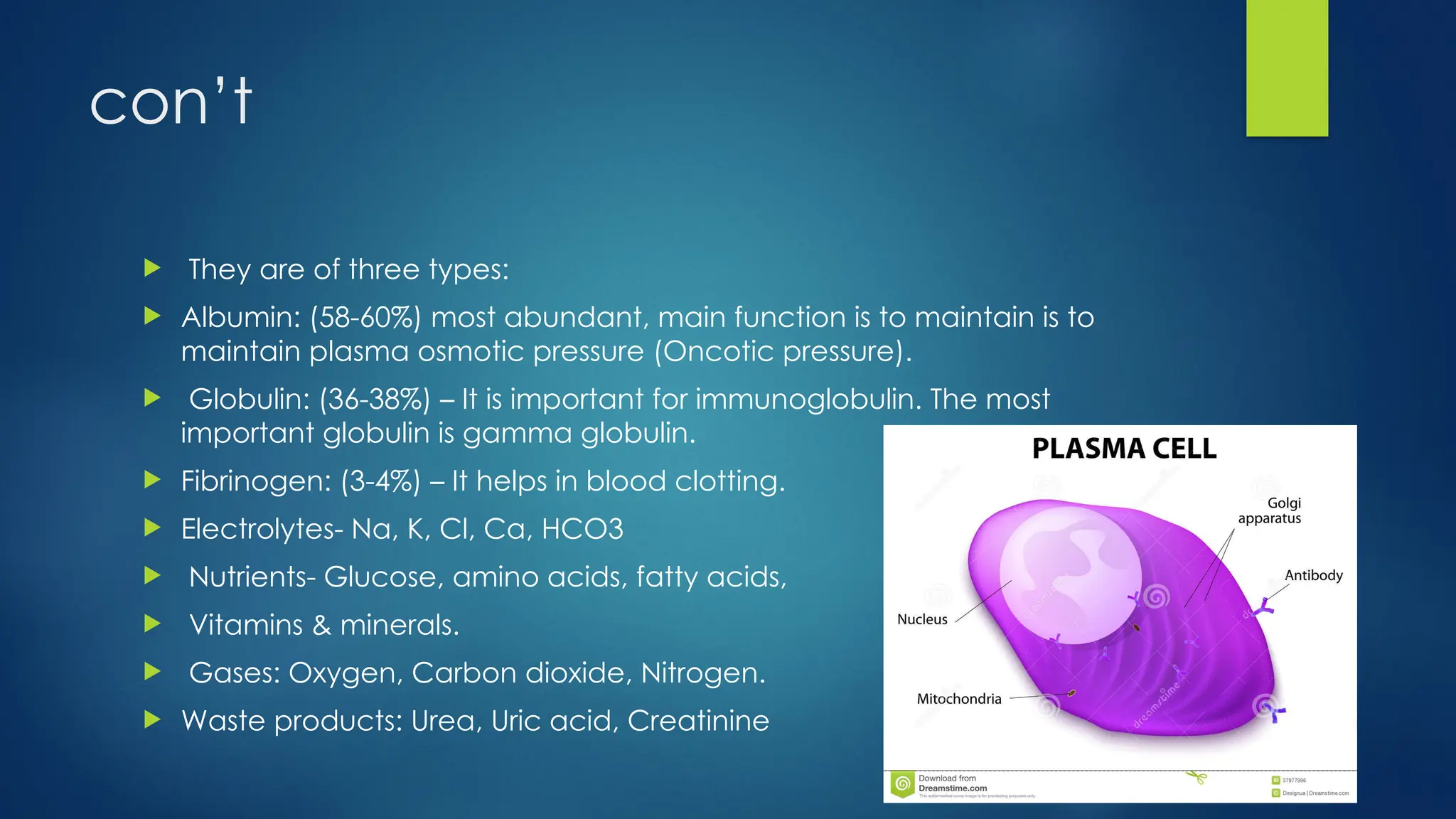
 Globulin: (36-38%) – It is important for immunoglobulin. The most
important globulin is gamma globulin.
 Fibrinogen: (3-4%) – It helps in blood clotting.
 Electrolytes- Na, K, Cl, Ca, HCO3
 Nutrients- Glucose, amino acids, fatty acids,
 Vitamins & minerals.
 Gases: Oxygen, Carbon dioxide, Nitrogen.
 Waste products: Urea, Uric acid, Creatinine
Functions of Blood:
(i) Transportation
 Transport of O2 from lungs to body tissue and CO2 from tissue to
lungs
 transport of wastes of cellular metabolism from body tissue to
kidney, liver or sweat gland and eventually removal out of body
 Transport of hormones, enzymes, other chemicals throughout the
body.
 Nutrients absorbed in the digestive tract, such as glucose, amino
acids, vitamins, minerals etc and are circulated to all body tissues.
 Waste products of the tissues, such as urea and creatinine, circulate
through the kidneys and are excreted in urine.
Con’t
(ii) Regulation (Homeostasis):
 Regulate body temperature.
 Distribution of heat throughout the body.
(iii) Balance
 Maintaining electrolyte balance
 Maintain acid base balance
(iv) Protection:
 protect body from harmful microorganisms, by WBCs, protein and antibody
 develop immune response (plasma protein).
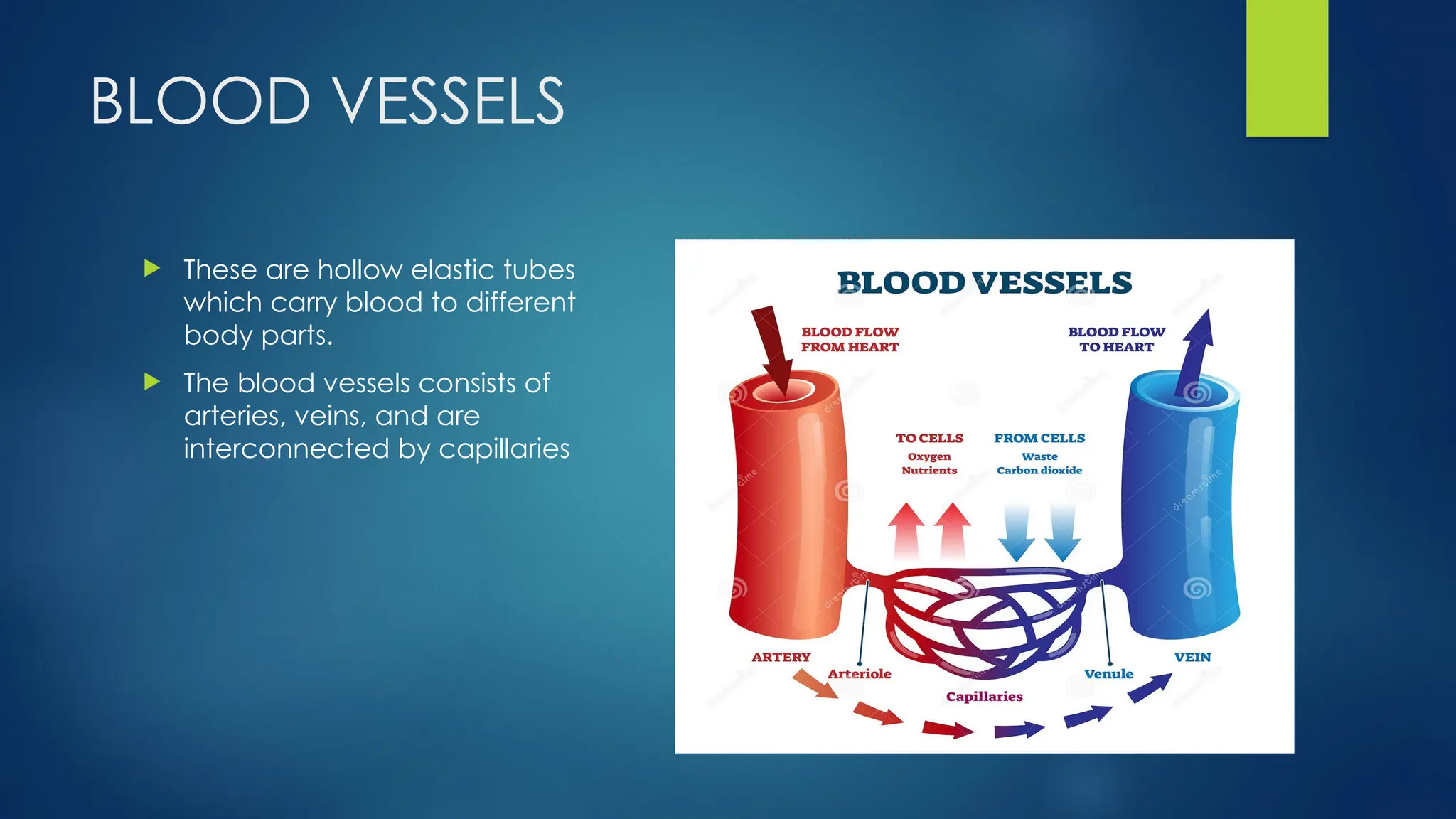
BLOOD VESSELS
 These are hollow elastic tubes
which carry blood to different
body parts.
 The blood vessels consists of
arteries, veins, and are
interconnected by capillaries
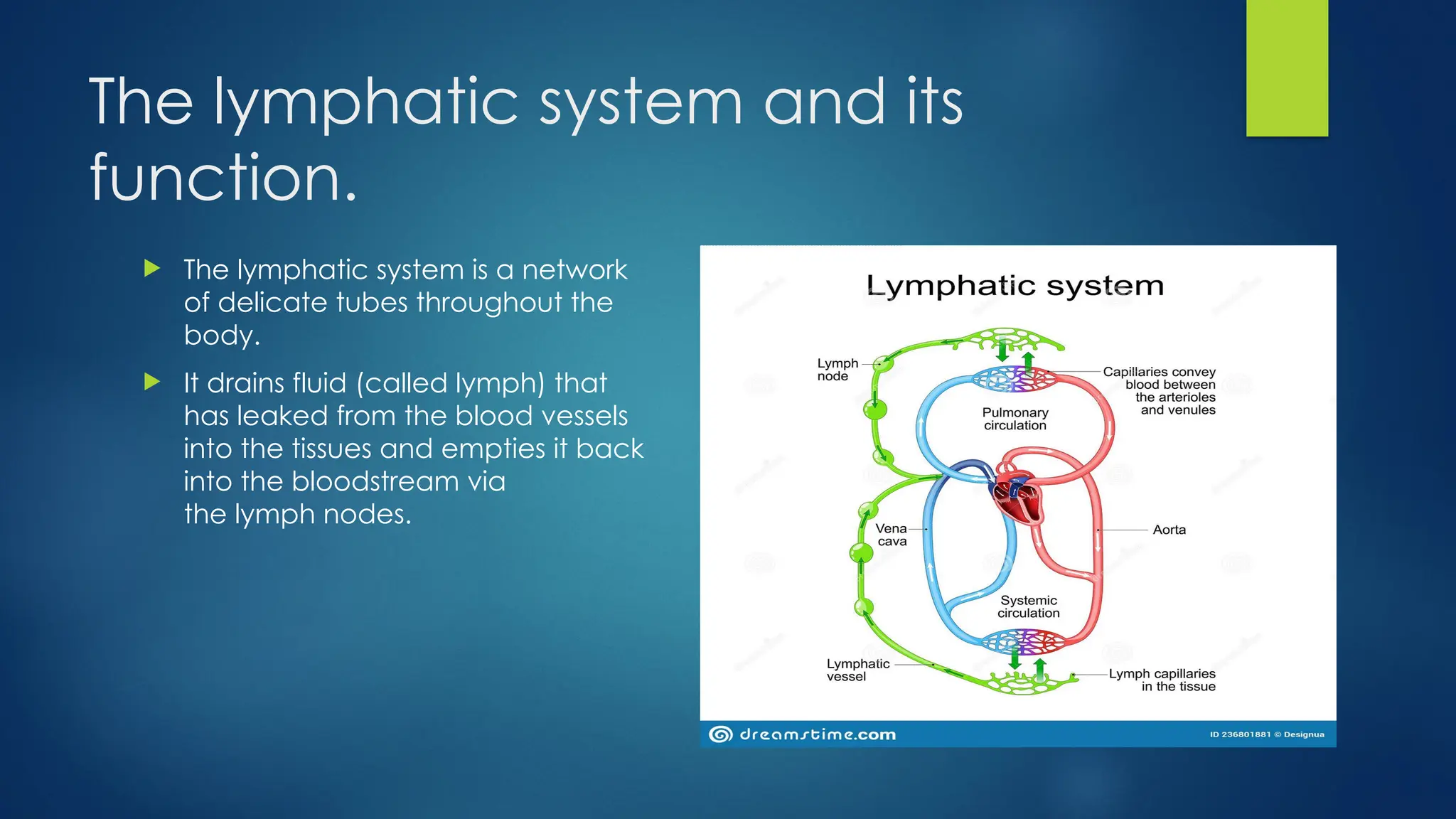
The lymphatic system and its
function.
 The lymphatic system is a network
of delicate tubes throughout the
body.
 It drains fluid (called lymph) that
has leaked from the blood vessels
into the tissues and empties it back
into the bloodstream via
the lymph nodes.
OVERVIEW OF CIRCULATORY
SYSTEM.
 The circulatory system (cardiovascular system) pumps blood from
the heart to the lungs to get oxygen.
 The heart then sends oxygenated blood through arteries to the rest
of the body.
 The veins carry oxygen-poor blood back to the heart to start the
circulation process over.
 The circulatory system is critical to healthy organs, muscles and
tissues.
Circulatory system in animals with detailed explanation

Circulatory system in animals with detailed explanation

  • 1.
    Circulatory system GROUP 5 FAVOURJOEL KWAGIRI VU-HEB-2201-0652-DAY AINEMBABAZI GIFT VU-HEB-2201-0104-DAY NASSIWA MARGARET VU-HEB-2201-0251-DAY ANNETTE MANDA VU-HEB-2201-1500-DAY DAVID WANI VU-HEB-2201-0085-DAY
  • 2.
    INTRODUCTION  The Humancirculatory system is a system of organs that includes the heart, blood vessels, and blood which is circulated throughout the entire body of a human or other vertebrate.  It includes the cardiovascular system, or vascular system, that consists of the heart and blood vessels.  The human circulatory system consists of a network of arteries, veins, and capillaries, with the heart pumping blood through it. Its primary role is to provide essential nutrients, minerals, and hormones to various parts of the body.  Alternatively, the circulatory system is also responsible for collecting metabolic waste and toxins from the cells and tissues to be purified or expelled from the body.
  • 3.
    Organs of CirculatorySystem include:  Circulatory system is a closed system which circulate blood and lymph throughout the body .  The human circulatory system comprises 4 main organs that have specific roles and functions.  The vital circulatory system organs include:  Heart  Blood (technically, blood is considered a tissue and not an organ)  Blood Vessels  Lymphatic system.
  • 4.
    The heart  Theheart is a muscular organ about the size of a fist, located just behind and slightly left of the breastbone. The heart pumps blood through the network of arteries and veins called the cardiovascular system. The left ventricle (the strongest chamber) pumps oxygen-rich blood to the rest of the body.
  • 5.
    BLOOD  Blood isa liquid connective tissue that contains cellular elements (blood cells) and fluid matrix (plasma).  Blood helps in the transportation of different substances throughout the body.  Study of blood and its disease is known as Hematology
  • 6.
    Composition of Blood Cellular substances (Blood cells) : 41% (44% RBC)  White blood cells : 4% (buffy coat containing platelets & WBC)  Plasma: 55% (Of total: 91% liquid & Solid 9%).
  • 7.
    1) Erythrocytes orRed blood cells (RBC)  Biconcave, anucleate disc shaped of 7µm in size.  The normal count= 4.5-5.5 lakhs/mm3. It is measured by haemocytometer The life span of RBC is 120 days.  RBC contain blood pigment called Haemoglobin.  Total haemoglobin in our body is about 900 gm. It occupies about 1/3 of RBC.  RBC is produced in bone marrow by the process called Erythropoiesis.  The immature nucleated RBC is called Reticulocyte.
  • 8.
    2) Leucocytes orWhite blood cells (WBC)  They are Large size, oval in shape, cell contain nuclei & some of them have granules.  2 types-Granulocytes and Agranulocytes.  These differ in size, shape, life span & functions.  Granulocytes includes- Neutrophils, Basophils & Eosinophils  Agranulocytes include – lymphocytes and monocytes
  • 9.
    Neutrophils  It isphagocytic in nature.  It is the first line of defense against bacteria.  Phagocytosis by Neutrophil is facilitates by Opsonization by antibody  The life span is 6 hrs.
  • 10.
    Eosinophils  It destroysparasites & neutralize histamine released during allergic reaction.  So, it is increased in parasitic infestation & in allergic reactions.  It is stained by acidic dye. Eg, eosin dye.
  • 11.
    Basophils  About 1%of total WBCs.  It contain basophilic granules.  It resembles mast cells in connective tissue.  It contains histamine, heparin & serotonin.  It is stained by basic dye.
  • 12.
    Lymphocytes  It isthe smallest White Blood Cell . (WBC)  There are 2 types of lymphocytes.  B-lymphocytes is concerned with humoral immunity.  T-lymphocytes is concerned with cell mediated immunity.
  • 13.
    Monocytes  Have horse-shoekidney shaped nucleus.  It is the largest WBC.  It differentiates into Macrophages as it enters the tissues which express MHC (Major histocompatibility complex).  Macrophages in different parts of the body are given different names as follows  Kupffers cells= liver  steoclast cells= bone  Microglial cells= brain and spinal cord  Histiocytes =Connective tissue  Dust cells (alveolar macrophage)= Lungs  Hassal’s corpuscles= Thymus
  • 14.
    3)Platelets or Thrombocytes They are small non granulocytes disc  They are derived from pinching off the cytoplasm of the Giant cell megakaryotes in the red bone marrow.  Normal count is 1.5-4.5 lakh/mm3.Life span 7-10 days.  Platelet is to help in coagulation.  Thromboplastin is secreted by platelets during blood clotting.
  • 15.
    Plasma  Plasma =(Blood- Blood cells)  It is the liquid part of blood and is composed of 90-92 % water, 7-8 % plasma protein and 1-2% other substances (glucose, amino acids, electrolytes, ammonia, enzymes, hormones, vitamins, etc).  Translucent, yellowish, little viscous when centrifuged.  Normal range: 60-80 gm/dl of blood.  Plasma proteins: Helps in maintaining osmotic pressure, coagulation of blood, viscosity, blood pressure, defensive action, transport of gases.  The solvent property of water helps in transport of nutrients as well as metabolic wastes from one part of body to another part.  Liver produces about 30gm of plasma protein each day.
  • 16.
    con’t  They areof three types:  Albumin: (58-60%) most abundant, main function is to maintain is to maintain plasma osmotic pressure (Oncotic pressure).  Globulin: (36-38%) – It is important for immunoglobulin. The most important globulin is gamma globulin.  Fibrinogen: (3-4%) – It helps in blood clotting.  Electrolytes- Na, K, Cl, Ca, HCO3  Nutrients- Glucose, amino acids, fatty acids,  Vitamins & minerals.  Gases: Oxygen, Carbon dioxide, Nitrogen.  Waste products: Urea, Uric acid, Creatinine
  • 17.
    Functions of Blood: (i)Transportation  Transport of O2 from lungs to body tissue and CO2 from tissue to lungs  transport of wastes of cellular metabolism from body tissue to kidney, liver or sweat gland and eventually removal out of body  Transport of hormones, enzymes, other chemicals throughout the body.  Nutrients absorbed in the digestive tract, such as glucose, amino acids, vitamins, minerals etc and are circulated to all body tissues.  Waste products of the tissues, such as urea and creatinine, circulate through the kidneys and are excreted in urine.
  • 18.
    Con’t (ii) Regulation (Homeostasis): Regulate body temperature.  Distribution of heat throughout the body. (iii) Balance  Maintaining electrolyte balance  Maintain acid base balance (iv) Protection:  protect body from harmful microorganisms, by WBCs, protein and antibody  develop immune response (plasma protein).
  • 19.
    BLOOD VESSELS  Theseare hollow elastic tubes which carry blood to different body parts.  The blood vessels consists of arteries, veins, and are interconnected by capillaries
  • 20.
    The lymphatic systemand its function.  The lymphatic system is a network of delicate tubes throughout the body.  It drains fluid (called lymph) that has leaked from the blood vessels into the tissues and empties it back into the bloodstream via the lymph nodes.
  • 21.
    OVERVIEW OF CIRCULATORY SYSTEM. The circulatory system (cardiovascular system) pumps blood from the heart to the lungs to get oxygen.  The heart then sends oxygenated blood through arteries to the rest of the body.  The veins carry oxygen-poor blood back to the heart to start the circulation process over.  The circulatory system is critical to healthy organs, muscles and tissues.