An article published exactly a year ago in CIO.
com titled ‘How the CIO Role Is Changing As
Business Needs Evolve’ made some interesting
observations about the role of the CIO and the
transformation it’s undergoing.
The piece, published on October 6, 2014 and
written by Jen A. Miller notes that “A decade ago,
the typical CIO was concerned mostly with IT
infrastructure” while “Today’s CIO faces a bevy
of additional challenges, namely user desires for
mobility and the cloud.”
“A recent survey from IT staffing firm Modis
reaffirms what we all know: The role of CIOs, and
the IT department they direct, is changing. Not
only do the vast majority of companies view their
CIOs as critical members of company structure,
they also expect that role to grow in the future,”
states Miller in her piece.
The survey, in which Modis interviewed 500
US-based CEOs and business leaders, found that
93 per cent trust their IT senior leader and said
that the CIO hires the right talent for the business.
Modis also found that 98 percent of business
leaders and CEOs think their CIOs adequately
articulate what the IT department does for those
companies, as well as what roles IT plays in
other departments. Only 7 percent of CEOs and
business owners involved the survey believed
that their IT departments don’t meet expectations
while half of the respondents in the survey
said they expect to increase their company’s IT
budgets in 2015.
“The role of the CIO has been more on the
forefront of public perception of a company, too,
for better or for worse. For better, more CIOs are
jumping into CEO roles. For worse, in the fallout of
the Target data breach, CIO Beth Jacobs resigned,
though CEO Gregg Steinhafel fell on his sword not
long after,” the article notes.
Jen Miller’s article provides key insights relating
to the CIO role and current trends from a global
context.
However, being East African in scope of coverage,
we always strive to offer our readers the best in
terms of content, ensuring that our readers keep
abreast of industry trends.
It’s in relation to this that we’ve decided to
introduce – from this edition of the magazine
– a new segment called ‘CIO Profile’. The
segment will focus on the CIO’s role within the
respective organization, how the CIO ensures that
expenditure on IT projects and solutions delivers
returns to the organization and also offer the
CIOs a platform to articulate their insights and
perspectives on key industry issues.
The new segment as well as our other regular
content in the magazine is meant to support
and enhance CIO East Africa’s objectives. These
include providing a platform for peer sharing
in an effort to help CIOs and other IT leaders
navigate their careers, a community platform
for networking as well as advice on current best
practices.
I hope you enjoy our inaugural CIO Profile feature
where we’ve interviewed Mr Raphael Hukai, the
CIO at Equity Group as he shares his insights as
well as overall vision as the CIO.
Our publisher, Harry Hare, recently stated that
“When we started publishing CIO in 2008, we
envisaged writing a magazine that will be useful
to CIOs in several ways.” It’s our hope that with
the introduction of the ‘CIO Profile’ segment, the
magazine has become even a more useful read to
you as a CIO.
EDITORIAL DIRECTOR
Harry Hare
EDITOR
Michael Ouma
TECHNICAL STAFF WRITERS
Lillian Mutegi
Baraka Jefwa
COLUMNISTS
Bobby Yawe
Sam Mwangi
HEAD OF SALES & MARKETING
Andrew Karanja
BUSINESS DEVELOPMENT MANAGER
Njambi Waruhiu
ACCOUNT MANAGERS
Amuyunzu Oscar
Vanessa Obura
Joseph Ooro
DIGITAL
Twahir Mohamed
DESIGN
Jean Bedell
Kenya
Tanzania
Uganda
Rwanda
michael.ouma@cio.co.ke
ALL RIGHTS RESERVED
The content of CIO East Africa is protected by copyright
law, full details of which are available from the publisher.
While great care has been taken in the receipt and handling
of material, production and accuracy of content in this
magazine, the publisher will not accept any responsility for
any errors, loss or ommisions which may occur.
Contacts
eDevelopment House : : 604 Limuru Road Old Muthaiga
: : P O Box 49475 00100 Nairobi : : Kenya
: : +254 20 404 16 46/7 : : +254 717 535 307
Email: info@cio.co.ke
Printed By:
Offset Printing Ltd.
Published By
Introducing the ‘CIO Profile’
segment
“The role of the CIO has
been more on the forefront
of public perception of a
company, too, for better or
for worse. For better, more
CIOs are jumping into CEO
roles. For worse, in the
fallout of the Target data
breach, CIO Beth Jacobs
resigned, though CEO Gregg
Steinhafel fell on his sword
not long after,” the article
notes.
2 CIO EAST AFRICA | OCTOBER 2015
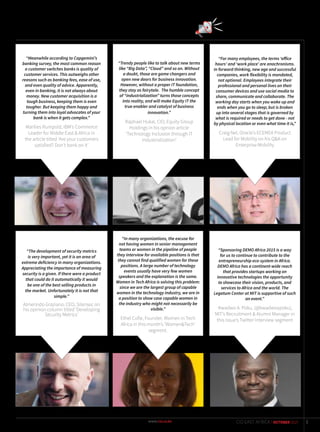
“For many employees, the terms ‘office
hours’ and ‘work place’ are anachronisms.
In forward thinking, new age and successful
companies, work flexibility is mandated,
not optional. Employees integrate their
professional and personal lives on their
consumer devices and use social media to
share, communicate and collaborate. The
working day starts when you wake up and
ends when you go to sleep; but is broken
up into several stages that is governed by
what is required or needs to get done - not
by physical location or even what time it is,”
Craig Nel, Oracle’s ECEMEA Product
Lead for Mobility on his Q&A on
Enterprise Mobility
“Trendy people like to talk about new terms
like “Big Data”, “Cloud” and so on. Without
a doubt, those are game changers and
open new doors for business innovation.
However, without a proper IT foundation,
they stay as fairytale. The humble concept
of “industrialization” turns those concepts
into reality, and will make Equity IT the
true enabler and catalyst of business
innovation.”
Raphael Hukai, CIO, Equity Group
Holdings in his opnion article
‘Technology Inclusion through IT
Industrialization’
“Meanwhile according to Capgemini’s
banking survey, the most common reason
a customer switches banks is quality of
customer services. This outweighs other
reasons such as banking fees, ease of use,
and even quality of advice. Apparently,
even in banking, it is not always about
money. New customer acquisition is a
tough business, keeping them is even
tougher. But keeping them happy and
turning them into loyal advocates of your
bank is when it gets complex.”
Marilies Rumpold, IBM’s Commerce
Leader for Middle East & Africa in
the article titled ‘Are your customers
satisfied? Don’t bank on it’
“The development of security metrics
is very important, yet it is an area of
extreme deficiency in many organizations.
Appreciating the importance of measuring
security is a given. If there were a product
that could do it automatically it would
be one of the best selling products in
the market. Unfortunately it is not that
simple.”
Almerindo Graziano, CEO, Silensec on
his opinion column titled ‘Developing
Security Metrics’
“In many organizations, the excuse for
not having women in senior management
teams or women in the pipeline of people
they interview for available positions is that
they cannot find qualified women for these
positions. A large number of technology
events usually have very few women
speakers and the explanation is the same.
Women in Tech Africa is solving this problem:
since we are the largest group of capable
women in the technology industry, we are in
a position to show case capable women in
the industry who might not necessarily be
visible.”
Ethel Cofie, Founder, Women in Tech
Africa in this month’s ‘Women&Tech’
segment.
“Sponsoring DEMO Africa 2015 is a way
for us to continue to contribute to the
entrepreneurship eco-system in Africa.
DEMO Africa has a continent-wide reach
that provides startups working on
innovative technologies the opportunity
to showcase their vision, products, and
services to Africa and the world. The
Legatum Center at MIT is supportive of such
an event.”
Kwadwo A. Poku, (@kwadwoapoku),
MIT’s Recruitment & Alumni Manager in
this issue’s Twitter Interview segment
3CIO EAST AFRICA | OCTOBER 2015
This may come as a surprise to many
but in the latest ranking of The Fastest
Growing Tech Companies in the World
in 2015, the number one slot is taken up
by LinkedIn closely followed by Apple
(www.forbes.com). LinkedIn is not as
socially in your face and dominant as
other social networking platforms but
does come across as the professional
network of choice across the business
community. Its stated objective is for its
members to create, manage and share
their professional identity online, build
and engage with their professional
network, access shared knowledge and
insights, and find business opportunities.
Its platform provides members with
solutions, including applications
and tools, to search, connect and
communicate with business contacts,
learn about career opportunities, join
industry groups, research organizations
and share information. In other words, it
helps its members to synchronize their
professional lives and profiles…all of a
sudden, easy.
Why surprising? Primarily because the
Fast Tech 25 then goes on to list a whole
slew of many new and hitherto unknown
companies that span the gamut from
cloud based healthcare to printing,
revenue collection and financial services.
The criteria set for measuring these
companies is quite strict and is pegged to
performance over the last 3 years which’s
not exactly your jack-in-the box type of
inertia.
My personal favorite on this year’s
list is a company called Synchronoss
(www.synchronoss.com), a provider
of automation software and cloud
technology solutions whose solutions
connect, synchronize and activate any
device or service across any channel or
network for Tier One Communications
Service Providers (CSPs) and Original
Equipment Manufacturers (OEMs) across
the globe. The demand driven market is
then beginning to reveal as it were the
future of technology in very fast growing
bits and pieces of entirely new ways
of doing things. If you didn’t know it
before, the Tech world as we know it has
changed.
This then brings us with a sudden
clanging, clashing, screeching halt to
our local East African market and what
tech companies have been able to
accomplish in growth terms in 2015 and
across which elements of our society.
Based on rudimentary analysis, it would
seem that the fastest areas of growth
closely map the Fast Tech 25 industry
verticals outside of LinkedIn and Apple,
essentially healthcare, revenue collection,
cloud services et al. There is little if any
My personal favorite
on this year’s list is
a company called
Synchronoss (www.
synchronoss.com), a
provider of automation
software and cloud
technology solutions
whose solutions
connect, synchronize
and activate any...
GuestEDITORIAL
Sudden
Synchronicity
similarity as far as the revenue growth is
concerned and that’s due primarily to a lack
of regional and global growth spread or
strategy for most of our companies. It’s going
to take a concerted effort from Government
and private sector to kick-start the harvest of
this newly emerging pasture of global markets
in Tech that is seemingly open to anyone
and anything that will help advance its main
cause which is to do things better, faster and
in a more simple and efficient way.
That notwithstanding, the opportunity now
presents itself for siloed companies and
industries to come together and discuss the
possibilities of sudden synchronicity that
would enable them to immediately access
a market that is 3 to 5 years away on a
traditional growth roadmap.
The benefits of working together to jointly
achieve new market momentum cannot be
overemphasized.
The story is told of Dashrath Manjhi, the man
who carved a road through a mountain in
India so that his people could reach a Doctor
in time following the injury and tragic loss of
his wife’s life (www.thebetterindia.com/18326/
the-man-who-moved-a-mountain-milaap-
dashrath-manjhi). Following even that
herculean effort it still took another 30 years
for government to tar the road that he had
built. The lesson we can learn today is that
we do not need to do it alone in order to
save time and achieve the impossible. Let’s
synchronize our efforts.
By Delano Longwe
(The writer is Director, Venture Consortium Africa)
4 CIO EAST AFRICA | OCTOBER 2015
October 2015
28
32
Women &
TECHNOLOGY
Start up
CORNER DEMO AFRICA
EDITORIAL
2 Introducing the ‘CIO Profile’
segment
TRENDLINES
8 Bank Populaire du Rwanda, USi
partner to re-implement the
bank’sT24 core banking system
10 Oracle’s Craig Neil on Enterprise
Mobility
12 StarTimes lucky subscribers win trip
to Germany to watch the Bundesliga
18 Five DEMO Africa Lions head to
Silicon Valley
OPINION
34Functional integration of IT into
business
35ERP Solutions deployment strategies
.
39Developing Security Metrics .
.
HARD TALK
40A time to let go It is interesting how
uncanny our personal lives emulate
our professional lives and lessons in
one are applicable in the other. Women in Tech Africa could fix
the gender gap in IT Sector
16
Kaka and Chui:
for a different way of teaching
children Kiswahili
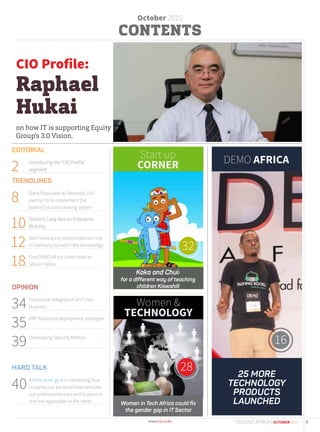
CIO Profile:
Raphael
Hukai
on how IT is supporting Equity
Group’s 3.0 Vision.
25 MORE
TECHNOLOGY
PRODUCTS
LAUNCHED
5CIO EAST AFRICA | OCTOBER 2015
InBRIEF
Fundamo founder joins
Nomanini’s advisory board
Fundamo founder, Hannes Van Rensburg,
generally considered the father of mobile
payments, has joined the advisory board of
Nomanini, a South African-based, enterprise
technology transactions platform provider,
saying the company is well placed to be
a market leader within a niche space.
The company’s platform facilitates cash
transactions in informal markets, allowing
enterprises to bolster their mobile airtime
and electricity distribution channels and
monitor micropayments in frontier markets
across Africa and beyond.
With Fundamo, Van Rensburg built one of the
world’s most advanced and sophisticated
mobile financial service platforms, deployed
in more than 34 countries across Africa,
Asia and the Middle East. Having sold
the company to Visa in 2011 for US $110
million, he will now be lending his expertise
to Nomanini as an advisor to the board of
directors. Van Rensburg said the quality
of Nomanini’s management team and
the company’s execution of its targeted
strategy puts it in a strong position to be a
market leader within the growing mobile
transactions space.
Oman Air, Accelya partner to streamline card payments
processes
Accelya, the global solutions provider of financial and business intelligence solutions
to the Airline industry, recently announced that Oman Air, the national airline of the
Sultanate of Oman, has selected Accelya’s VIVALDI card payments solutions to streamline
its card management process.
Oman Air will use the following from Accelya’s VIVALDI suite - VIVALDI CardClear, VIVALDI
Reconciliation and VIVALDI Chargeback. The scope of the agreement includes both
indirect and direct card sales.
Accelya’s VIVALDI solutions offer a number of benefits for Oman Air. They will enable the
airline to consolidate and present its card sales to select global acquirers, accept all card
types and facilitate transaction settlement in any desired currency. They will also allow
Oman Air to exercise greater control and compliance over acquirer agreements covering,
for example, missed service level agreements and discount rates. In addition, the
products will help Oman Air to protect its revenues by helping the company to reconcile
at transaction level and identify missing transactions payments. The chargeback process
will also be streamlined and accelerated.
Cornelius Ramatlhakwane
is the new CEO of
BotswanaPost
Cornelius Ramatlhakwane has been
appointed as the incoming CEO of
BotswanaPost from October 1. Mr has
been with BotswanaPost since 2009, as
Head of Business Development overseeing
BotswanaPost transition into the e-Commerce
space.
He started his career with Deloitte and
Touche, Cresta Hospitality Group and
Standard Chartered Bank before joining
BotswanaPost at Executive Management
Level responsible for commercial strategy,
ZTE Axon Elite now available for purchase via eBay
The ZTE Axon Elite is now available for purchase via eBay in a number of markets across
Europe and a number of other regions worldwide (not including the U.S and Canada).
The Axon Elite is on sale for 419.99 Euros (299.99 GBP or 469.99 USD) and for its first day
on sale only, will come with a free 64G memory card.
The ZTE Axon Elite was officially launched in Berlin earlier this month at IFA 2015.
During the show, Axon was awarded a ‘User Experience Gold Award’ by IDG and German
Industry and Commerce Ltd. ZTE’s Axon phones combine the right hardware and
software to offer the best sound quality, camera functionality, and all-round smooth
performance. This includes ‘dual track’ high fidelity sound recording and playback, as
well as dual rear-cameras that capture high resolution images and videos.
The Axon Elite sports a 5.5-inch full HD resolution display, Corning’s Antimicrobial
Gorilla Glass, a Qualcomm Snapdragon 810 processor and comes with 32GB of internal
storage, which can be expanded to an extra 128GB with a microSD card. The device can
be unlocked with three different biometric authentication options – fingerprint, voice
control and eye-scan. ZTE has partnered with eBay to sell a number of its innovative
devices in markets across the globe, including the ZTE Open, ZTE Open C and the Blade
S6 Plus.
business development, and product development. The new CEO holds a Master of Science
(MSc) degree in Strategic Management from the University of Derby, UK, as well Executive
Development Programmes from University of Stellenbosch Business School – South Africa, and
Management College of South Africa and other substantial training courses and programmes in
personal development, mentorship and motivation. He is married has two children, and he is
an avid amateur golfer.
6 CIO EAST AFRICA | OCTOBER 2015
Engineer from Diageo East Africa where he was
the Infrastructure and Communications Manager.
As a Cisco Engineer, he was involved in designing
and supporting large transformational projects
across the Africa region. In 2010, he transitioned
to a sales role taking the commercial business
lead for finance vertical, a position he held until
2012 when he took over as the Territory Business
Manager responsible for large enterprise accounts
across East Africa. At the beginning of 2013, Bunei
was tasked with the responsibility of leading the
Cisco’s Commercial Business in East Africa until
his appointment as the General Manager on
September 1, 2015.
In his role as the General Manager, David will be
responsible for leading the Sales Operation for
Cisco in East Africa to support customers with
their technology needs and challenges to enable
it to embrace the next wave of the internet, which
Cisco calls the Internet of Everything (IoE). He
holds a Bsc. Degree in Electrical and Electronics
Engineering from the University of Nairobi and
a Master’s in Business Administration from the
United States International University (USIU).
Bernard Muteti
Has been appointed to the position of
Enterprise and Wholesale Business Director
at Airtel Kenya from September 1. Until his
appointment, Mr Muteti was the General
Manager in charge of Airtel’s MVNO Business &
Multi-Brand Strategy and yuMobile Business.
He has spearheaded the launch of the first
ever MVNO in the Kenyan market and the
region, Equitel, and in April 2015 led Airtel
Kenya in winning the prestigious ‘Best
Wholesale Operator’ global award at the
MVNO World Congress in Nice, France.
Bernard joined Airtel Kenya from Airtel
Africa where he had been the Group Head
of Corporate Business, Global Accounts
and Strategic Partnerships across Airtel’s 17
operations in Sub Saharan Africa. Prior to
joining Airtel Africa, Bernard was a Brand &
Channels Manager at AccessKenya Group
- an Internet Solutions (SA) Company. In
his new and expanded role, Bernard will be
responsible for three business portfolios -
Enterprise Business Unit, MVNO Business
and yuMobile Business. A business leader
with over 13 years commercial experience
locally and Pan Africa in Telecoms, Bernard’s
specialties include Business Strategy, Sales
Strategies & Management, Marketing & Brand,
Strategic Partnerships and Customer Service
Operations with a strong background in
Business Markets.
He holds a degree in Marketing from
the University of Nairobi, Executive and
Leadership trainings from among others
University of Pretoria – SA and the prestigious
Indian Institute of Management, Ahmedabad -
IIMA, and is fluent in French.
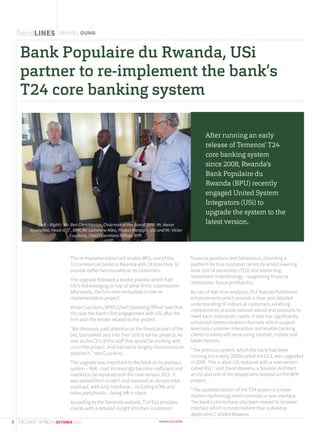
David Bunei
Is the new General Manager for East Africa in
charge of Kenya, Tanzania, Uganda, Rwanda
and Ethiopia at Cisco. In his new role, Mr
Bunei will report directly to David Meads, Vice
President for Cisco, Africa.
Bunei joined Cisco in 2006 as a Systems
NewAPPOINTMENTS
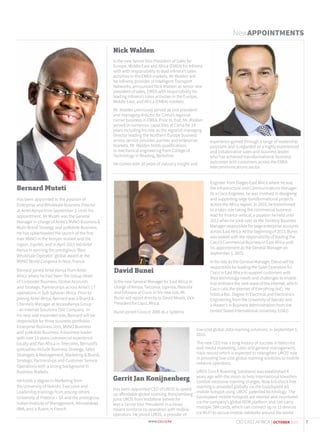
Nick Walden
Is the new Senior Vice President of Sales for
Europe, Middle East and Africa (EMEA) for Infinera
with with responsibility to lead Infinera’s sales
activities in the EMEA markets. Mr Walden will
be Infinera, provider of Intelligent Transport
Networks, announced Nick Walden as senior vice
president of sales, EMEA with responsibility for
leading Infinera’s sales activities in the Europe,
Middle East, and Africa (EMEA) markets.
Mr. Walden previously served as vice president
and managing director for Ciena’s regional
carrier business in EMEA. Prior to that, Mr. Walden
served in numerous capacities at Ciena for 14
years including his role as the regional managing
director leading the Northern Europe business
across service provider, partner and enterprise
markets. Mr. Walden holds qualifications
in mechanical engineering from College of
Technology in Reading, Berkshire.
He comes with 20 years of industry insight and
Gerrit Jan Konijnenberg
Has been appointed CEO of UROS to speed-
up affordable global roaming. Konijnenberg
joins UROS from Vodafone (where he
was a Senior Vice President) in a move
meant reinforce co-operation with mobile
operators. He joined UROS, a provider of
experience gained through a range of leadership
positions and is regarded as a highly experienced
and collaborative sales and business leader
who has achieved transformational business
outcomes with customers across the EMEA
telecommunications sector.
low-cost global data roaming solutions, in September 1,
2015.
The new CEO has a long history of success in telecoms
and media marketing, sales and general management,
track record which is expected to strengthen UROS’ role
in providing low-cost global roaming solutions to mobile
network operators.
UROS (Uni-fi Roaming Solutions) was established 4
years ago with the vision to help international travellers
combat excessive roaming charges. Now bill-shock free
roaming is provided globally via the Goodspeed 4G
mobile hotspot using UROS’ patented technology. The
Goodspeed mobile hotspots are steered and monitored
via the company’s global M2M platform and can carry
multiple SIM cards, which can connect up to 15 devices
via Wi-Fi to secure mobile networks around the world.
7CIO EAST AFRICA | OCTOBER 2015
TrendLINES
Bank Populaire du Rwanda, USi
partner to re-implement the bank’s
T24 core banking system
The re-implementation will enable BPU, one of the
13 commercial banks in Rwanda with 18 branches, to
provide better functionality to its customers.
The upgrade followed a tender process which had
USi’s bid emerging on top of other firms’ submissions.
Afterwards, the firm then embarked on the re-
implementation project.
Victor Cuyckens, BPR’s Chief Operating Officer said that
this was the bank’s first engagement with USi after the
firm won the tender related to the project.
“We obviously paid attention to the financial part of the
bid, but looked also into their (USI’s) earlier projects. As
well as the CV’s of the staff that would be working with
us on the project. And had some lengthy discussions on
approach,” said Cuyckens.
The upgrade was important to the bank as its previous
system – R08 – had increasingly become inefficient and
needed to be replaced with the new version, R12. It
was started from scratch and involved an almost total
overhaul, with only interfaces – including ATMs and
other peripherals – being left in place.
According to the Temenos website, T24 R12 provides
clients with a detailed insight into their customers’
financial positions and behaviours, providing a
platform for true customer centricity whilst lowering
total cost of ownership (TCO) and protecting
investment in technology – supporting financial
institutions’ future profitability.
By use of real-time analytics, R12 features functional
enhancements which provide a clear and detailed
understanding of individual customers, enabling
institutions to provide tailored advice and products to
meet each individual’s needs. It also has significantly
enhanced communication channels which support
seamless customer interaction and enable banking
clients to easily self-serve using internet, mobile and
tablet devices.
“The previous system, which the bank had been
running since early 2000s called the G13, was upgraded
in 2008. This is what USi replaced with a new version
called R12,” said David Waweru, a Solution Architect
at USi and one of the people who worked on the BPR
project.
“The updated version of the T24 system is a more
modern technology which provides a new interface.
The bank’s clients have also been moved to browser
interface which is more resilient than a desktop
application,” added Waweru.
MICHAEL OUMA
After running an early
release of Temenos’ T24
core banking system
since 2008, Rwanda’s
Bank Populaire du
Rwanda (BPU) recently
engaged United System
Integrators (USi) to
upgrade the system to the
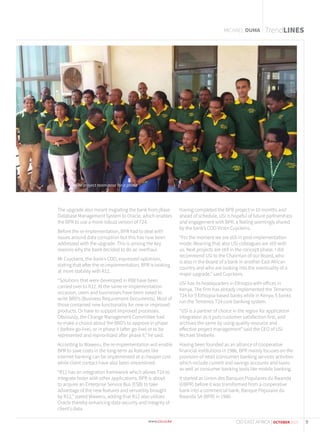
latest version.(Left – Right): Mr. Ben Christiaanse, Chairman of the Board ,BPR; Mr. Aaron
Niyonzima, Head of IT , BPR; Mr. Lamenew Nibo, Project Manager, USi and Mr. Victor
Cuyckens, Chief Operations Officer, BPR.
8 CIO EAST AFRICA | OCTOBER 2015
TrendLINESMICHAEL OUMA
The upgrade also meant migrating the bank from jBase
Database Management System to Oracle, which enables
the BPR to use a more robust version of T24.
Before the re-implementation, BPR had to deal with
issues around data corruption but this has now been
addressed with the upgrade. This is among the key
reasons why the bank decided to do an overhaul.
Mr Cuyckens, the bank’s COO, expressed optimism,
stating that after the re-implementation, BPR is looking
at more stability with R12.
“Solutions that were developed in R08 have been
carried over to R12. At the same re-implementation
occasion, users and businesses have been asked to
write BRD’s (Business Requirement Documents). Most of
those contained new functionality for new or improved
products. Or have to support improved processes.
Obviously, the Change Management Committee had
to make a choice about the BRD’s to approve in phase
I (before go-live), or in phase II (after go-live) or to be
represented and reprioritized after phase II,” he said.
According to Waweru, the re-implementation will enable
BPR to save costs in the long-term as features like
internet banking can be implemented at a cheaper cost
while client contact have also been streamlined.
“R12 has an integration framework which allows T24 to
integrate faster with other applications. BPR is about
to acquire an Enterprise Service Bus (ESB) to take
advantage of the new features and versatility brought
by R12,” stated Waweru, adding that R12 also utilizes
Oracle thereby enhancing data security and integrity of
client’s data.
Having completed the BPR project in 10 months and
ahead of schedule, USi is hopeful of future partnerships
and engagement with BPR, a feeling seemingly shared
by the bank’s COO Victor Cuyckens.
“For the moment we are still in post-implementation
mode. Meaning that also USi colleagues are still with
us. Next projects are still in the concept phase. I did
recommend USi to the Chairman of our Board, who
is also in the Board of a bank in another East African
country and who are looking into the eventuality of a
major upgrade,” said Cuyckens.
USi has its headquarters in Ethiopia with offices in
Kenya. The firm has already implemented the Temenos
T24 for 5 Ethiopia-based banks while in Kenya, 5 banks
run the Temenos T24 core banking system.
“USi is a partner of choice in the region for application
integration as it puts customer satisfaction first, and
archives the same by using quality resource and
effective project management” said the CEO of USi
Michael Shebelle.
Having been founded as an alliance of cooperative
financial institutions in 1986, BPR mainly focuses on the
provision of retail (consumer) banking services activities
which include current and savings accounts and loans
as well as consumer banking tools like mobile banking.
It started as Union des Banques Populaires du Rwanda
(UBPR) before it was transformed from a cooperative
bank into a commercial bank, Banque Populaire du
Rwanda SA (BPR) in 1986.
The project team pose for a photo.
9CIO EAST AFRICA | OCTOBER 2015
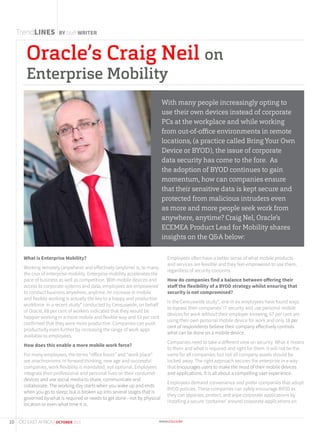
Oracle’s Craig Neil on
Enterprise Mobility
TrendLINES BY Staff WRITER
What is Enterprise Mobility?
Working remotely (anywhere) and effectively (anytime) is, to many,
the crux of enterprise mobility. Enterprise mobility accelerates the
pace of business as well as competition. With mobile devices and
access to corporate systems and data, employees are empowered
to conduct business anywhere, anytime. An increase in mobile
and flexible working is actually the key to a happy and productive
workforce. In a recent study* conducted by Censuswide, on behalf
of Oracle, 68 per cent of workers indicated that they would be
happier working in a more mobile and flexible way and 53 per cent
confirmed that they were more productive. Companies can push
productivity even further by increasing the range of work apps
available to employees.
How does this enable a more mobile work force?
For many employees, the terms “office hours” and “work place”
are anachronisms. In forward thinking, new age and successful
companies, work flexibility is mandated, not optional. Employees
integrate their professional and personal lives on their consumer
devices and use social media to share, communicate and
collaborate. The working day starts when you wake up and ends
when you go to sleep; but is broken up into several stages that is
governed by what is required or needs to get done - not by physical
location or even what time it is.
Employees often have a better sense of what mobile products
and services are feasible and they feel empowered to use them,
regardless of security concerns.
How do companies find a balance between offering their
staff the flexibility of a BYOD strategy whilst ensuring that
security is not compromised?
In the Cencuswide study*, one in six employees have found ways
to bypass their companies’ IT security and use personal mobile
devices for work without their employer knowing; 67 per cent are
using their own personal mobile device for work and only 18 per
cent of respondents believe their company effectively controls
what can be done on a mobile device.
Companies need to take a different view on security. What it means
to them and what is required and right for them. It will not be the
same for all companies; but not all company assets should be
locked away. The right approach secures the enterprise in a way
that encourages users to make the most of their mobile devices
and applications. It is all about a compelling user experience.
Employees demand convenience and prefer companies that adopt
BYOD policies. These companies can safely encourage BYOD as
they can separate, protect, and wipe corporate applications by
installing a secure ‘container’ around corporate applications on
With many people increasingly opting to
use their own devices instead of corporate
PCs at the workplace and while working
from out-of-office environments in remote
locations, (a practice called Bring Your Own
Device or BYOD), the issue of corporate
data security has come to the fore. As
the adoption of BYOD continues to gain
momentum, how can companies ensure
that their sensitive data is kept secure and
protected from malicious intruders even
as more and more people seek work from
anywhere, anytime? Craig Nel, Oracle’s
ECEMEA Product Lead for Mobility shares
insights on the Q&A below:
10 CIO EAST AFRICA | OCTOBER 2015
TrendLINESBY Staff WRITER
any mobile device. BYOD management also means users’ personal
applications and data can be kept separate from the enterprise
information – giving them the confidence they need to embrace
the use of their devices for corporate apps; another necessary
factor in driving forward the apps revolution within the enterprise.
Why do you think employers are still hesitant to encourage
mobile work?
I think that for most employers, it is about the perceived lack of
control over employees and their devices. The thinking is that if
I cannot see it, I cannot control it - and that applies to both the
employee and their mobile devices. It’s understandable that
companies have some concerns around enterprise mobility,
particularly when it comes to security and integration, but they
should by no means let their apprehension stifle innovation.
Of course security is a valid concern, but companies tend to
focus on this as a single overriding mobility issue. The problem
is that this desire to focus on a single issue can mask other,
sometimes more important issues and may result in unintended
consequences. For instance, the company may decide to minimise
risk by mandating that all BYOD devices access enterprise
resources using server-hosted virtual desktop (SHVD) technology
so that sensitive data is kept off the device. This decision may;
however, worsen user experience and as a result decrease
productivity.
How do work apps promote and boost productivity in the
mobile work force?
A mobile approach can transform the way a business operates at
its core. It allows employees to make the most of their connected
devices so they can collaborate more effectively and work in a
more flexible way. It also encourages innovation through the use
of pioneering apps and services, and perhaps most important
offers businesses a better way to engage with their customers, their
employees, and their partners.
Today, companies should not just offer employees mobile access
to services because they need it to do their work. A successful
mobile enterprise needs to understand that our connected
technologies have become instruments for real market innovation
and new business models. Companies such as Uber, Spotify, and
WhatsApp (among others) have achieved extraordinary levels of
success in the past few years because they recognized that mobile
isn’t just a nice-to-have; it can be the very essence of a company.
Looking at the apps that will boost productivity, businesses
must adopt a mobile-centric mind-set. This mind-set teaches
enterprises to think of mobile from the outset and with an outside-
in approach whenever coming up with a solution to a business
challenge. If enterprises adopt a long-term mobile-centric vision
they can translate this into crucial brainstorm sessions at the initial
product development stage to ensure mobile experiences are
integral to all their applications.
What are some of the benefits companies experience as a
result of enterprise mobility and remote work?
Enterprise mobility gives employees the ability to work from
anywhere. It therefore has the potential to dramatically speed up
transactions and the completion of projects. This speed, as well
as the ability to quickly deliver results for customers, is what gives
many companies a competitive advantage.
In addition to increased access to information, enterprise
mobility connects employees with each other regardless of their
location, improving overall communication and transparency. For
most companies, innovation will be a direct result of increased
productivity and improved collaboration. Enterprise mobility
allows opinions, ideas, advice and expertise to flow freely
throughout the company. Meetings, discussions and decisions
are no longer delayed because stakeholders are not at the same
physical location at the same time. Being constantly connected
means employees can instantly and securely share their innovative
ideas and receive instant feedback.
What are some of the essentials in order for this to work?
Companies will have to perfect front-end simplicity and
understand the mobile context if they are to gain productivity from
their existing workforce as well as attract the younger generation
of workers and customers. This younger generation inherently
understands mobility and brings with them a freshness that
businesses can ill-afford to miss. The ‘front-ends’ of enterprise
apps (which include the user interface) should be as intuitive and
attractive as the apps people enjoy in their personal lives – from
Angry Birds to Instagram. Simplicity is about content, context
and convenience. If an app is complex or difficult to use; it will be
deleted. If an app does not provide the right content at the right
time; it will not be useful and will be deleted.
Real time access to data is not always essential but would depend
on the type of work that needs to be performed. Often times data
can be collected offline and synced when back in online mode. In
some instances data can also be securely obtained from back-end
systems and securely stored on the device specifically for offline
use. This could include catalogue information but would exclude
stock levels, where real time data is more important.
An essential requirement is that enterprise systems are
underpinned by a complete and unified integration platform.
Leveraging SOA is key to successful enterprise mobility, enabling
organisations to easily integrate and connect applications across
their IT ecosystems on a single platform, helping them achieve
faster time-to-market and increased productivity with a low TCO.
The platform must be capable of abstracting apps from the
underlying OS. In today’s BYOD environment, this platform
should enable a ‘write-once, run-anywhere’ capability for mobile
devices that simplifies the integration of third-party apps into
the enterprise. This is critical, as mobility demands often arise
from business units other than IT, such as when the marketing
department hires an outside agency to build a mobile app for the
public app stores.
(*Censuswide carried out this research on behalf of Oracle in
August 2014, surveying 1,500 professionals working for global
organizations: 500 in North America, 500 in EMEA and 500 in
APAC)
11CIO EAST AFRICA | OCTOBER 2015
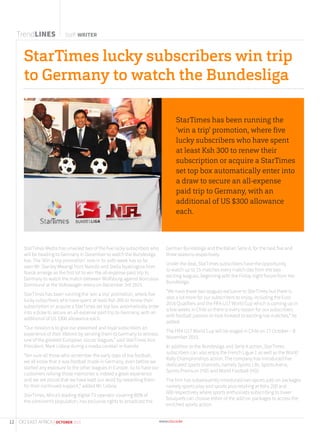
StarTimes lucky subscribers win trip
to Germany to watch the Bundesliga
TrendLINES Staff WRITER
StarTimes Media has unveiled two of the five lucky subscribers who
will be heading to Germany in December to watch the Bundesliga
live. The ‘Win a trip promotion’ now in its sixth week has so far
seen Mr. Stanley Mwangi from Nairobi and Stella Nyakiogora from
Narok emerge as the first lot to win the all-expense paid trip to
Germany to watch the match between Wolfsburg against Borrussia
Dortmund at the Volkswagen Arena on December 3rd 2015.
StarTimes has been running the ‘win a trip’ promotion, where five
lucky subscribers who have spent at least Ksh 300 to renew their
subscription or acquire a StarTimes set top box automatically enter
into a draw to secure an all-expense paid trip to Germany, with an
additional of US $300 allowance each.
“Our mission is to give our esteemed and loyal subscribers an
experience of their lifetime by sending them to Germany to witness
one of the greatest European soccer leagues,” said StarTimes Vice
President, Mark Lisboa during a media cocktail in Nairobi.
“Am sure all those who remember the early days of live football,
we all know that it was football made in Germany, even before we
started any exposure to the other leagues in Europe. So to have our
customers reliving those memories is indeed a great experience
and we are proud that we have kept our word by rewarding them
for their continued support,” added Mr. Lisboa.
StarTimes, Africa’s leading digital-TV operator covering 80% of
the continent’s population, has exclusive rights to broadcast the
German Bundesliga and the Italian Serie A, for the next five and
three seasons respectively.
Under the deal, StarTimes subscribers have the opportunity
to watch up to 15 matches every match day from the two
exciting leagues, beginning with the Friday night fixture from the
Bundesliga.
“We have these two leagues exclusive to StarTimes but there is
also a lot more for our subscribers to enjoy, including the Euro
2016 Qualifiers and the FIFA U17 World Cup which is coming up in
a few weeks in Chile so there is every reason for our subscribers
with football passion to look forward to exciting live matches,” he
added.
The FIFA U17 World Cup will be staged in Chile on 17 October – 8
November 2015.
In addition to the Bundesliga and Serie A action, StarTimes
subscribers can also enjoy the French Ligue 1 as well as the World
Rally Championships action. The company has introduced five
dedicated sports channels, namely Sports Life, Sports Arena,
Sports Premium (HD) and World Football (HD).
The firm has subsequently introduced two sports add-on packages
namely sports play and sports plus retailing at Kshs 200 and
600 respectively where sports enthusiasts subscribing to lower
bouquets can choose either of the add-on packages to access the
enriched sports action.
StarTimes has been running the
‘win a trip’ promotion, where five
lucky subscribers who have spent
at least Ksh 300 to renew their
subscription or acquire a StarTimes
set top box automatically enter into
a draw to secure an all-expense
paid trip to Germany, with an
additional of US $300 allowance
each.
12 CIO EAST AFRICA | OCTOBER 2015
Baraka JEFWA
Crowdsource Africa’s platform aiming
to combat unemployment
According to a report released by United Nations
Development Programme (UNDP), Kenya faces a significant
unemployment problem that affects young people
especially hard. Youth unemployment rates are several
times higher than the rates among adults and particularly
high in cities and among females. As young people grow up,
they stop depending on other people’s income and become
independent. During their transition from childhood to
adulthood, access to good jobs of acceptable quality is
essential for youth to acquire independence from their
parents, brighten their prospects in the job market and
enhance their prospects of forming a family.
To help solve this age-old problem of unemployment,
Crowdsource Africa is leveraging technology to promote
crowdsourcing in Kenya and the whole of Africa. Crowd
sourcing is the process of obtaining needed services, ideas,
or content by soliciting contributions from a large group of
people, and especially from an online community.
Crowdsource Africa thus brings together a pool of virtual
online human intelligence and scalable work force all over
Africa. The company creates a vast demand pool of online
workers that companies all over the world can tap into.
In an interview with CIO East Africa, Raphael Jerry, CEO,
Crowdsource Africa, said: “Crowd source Africa has been
up for two years now. Initially, we started as Crowdsource
Kenya but we have evolved because we see the demand has
been growing, so it is more of African brand now, so we are
forming what we call content distributers.”
The company is attempting to brand Africa all over the world
as a culture ready crowd sourcing destination. It provides a
platform for international clients all over the world to access
a ready scalable and flexible standby workforce from all
parts of Africa. There is a big pool of intellectual bandwidth
in Africa, with an already existing freelance culture and
affordable internet in most urban areas.
Young people aged between 16 and 35 represent more
than 60 per cent of the continent’s total population and
account for 45 per cent of the total labor force. Unlike other
developing regions, sub-Saharan Africa’s population is
becoming more youthful, with youth as a proportion of the
Crowdsourcing brings
together a pool of virtual
online human intelligence
and scalable work force all
over Africa.
TrendLINES
14 CIO EAST AFRICA | OCTOBER 2015
Baraka JEFWA
total population projected at over 75 per
cent by 2015, due to the high fertility rates
underlying the demographic momentum.
It is expected that this increase in the
number of young people - according to
the Africa Economic Outlook report 2012-
2015 - will not decline before 20 years or
more. In Kenya, according to the World
Bank, youth employment is currently at 17
per cent and 21 per cent employment rate
in Africa as a whole.
“As Crowdsource Africa we not only see
this as a gap but as a massive untapped
opportunity to empower youth all over
Africa with the necessary crowdsourcing
recourses that can grant them access to
the multi $billion crowdsourcing market,”
said Jerry.
“We are in low cost labor zones all over
the world. We have jobs for back office,
accounting jobs, production jobs and
people are even doing editing jobs for big
multinational media houses abroad and
you can imagine the same job in New York
would cost the employer fifteen dollars an
hour, so they are compelled to outsource.”
Another thing that Crowdsource Africa is
taking advantage of, according to Jerry,
is scale as under the crowdsourcing
platform, something that would take six
months could take as little as three weeks,
because the job is taken as a big chunk
and broken down into small tasks and
outsourced to people online.
This is so because crowdsourcing is
fragmented and distributed problem
solving process. From complex business
processes to concepts and data-related
problems that are broken down into micro
tasks distributed to a group of people
online and completed efficiently by an on-
demand scalable workforce.
Crowdsourcing is related to, but not
limited to, human-based computation,
which refers to the ways in which humans
and computers can work together to
solve problems. These two can be used
together to accomplish tasks. In Africa, the
unemployed might not be in a position
to either own or access expensive devices
with which to perform online tasks, a
problem which the company is doing its
bid to try and solve by partnering with
Intel.
“We are creating an ecosystem around
us of service enablers. For Intel, how
they come in is we are creating relevance
for their products to be acquired,” Jerry
explained.
CrowdSource Africa comes from a
BPO (Business Process Outsourcing)
background with crowdsourcing being
like a hybrid of BPO. Most of the firm’s
clients started from the brick and motor
environment where most of the jobs they
were offering were being outsourced to
vendors or Call Centres, but this method
of working with vendors had its own
limitations which can be detrimental to
task completion.
“You can imagine if there is a fiber cut to
the fiber that feeds Kenya with internet.
All ISPs go down so it does not matter
if you are using ten different ISP’s as
backup, they all go down. So what these
clients are looking for is redundancy; so
that means if someone in Cape town,
someone in Nairobi, someone in Abuja,
all of them working simultaneously for
this client, then they guarantee this client
the redundancy, so they have continuous
business continuity,” he stated.
CrowdSource Africa makes a difference
in trying to ensure that crowdsourcing is
seamless by playing the middle, in the
following ways; their clients provide the
work, Crowd Source Africa in turn analyzes
and formulates a customized deployment
plan, and finally they divide and distribute
the work to their scalable on demand
work force. Following this, the micro-tasks
are then handled by thousands of the
company’s online workers who are spread
all over Africa, giving the clients the much-
needed redundancy and fast delivery.
Crowd source Africa is designed to address
the lack of a secure, trustworthy, scalable
and reliable source of online jobs and
structured trained scalable workforce for
their global clients.
The reality on the ground is that about
95 per cent of the searched online jobs
available on ordinary search engines are
scams or potential scams and only 5 per
cent are legitimate. Out of 10 attempts,
only 1 may turn out to be legitimate.
Scammers are always requesting for
upfront payment or credit card details that
end up being misused once they fall into
the wrong hands.
A recent report by the FBI noted that the
industry loses up to $12milion annually,
a factor which led Crowdsource Africa
to step in a bid to protect users from
such incidences by providing access to
legitimate clients that have been vetted
and are looking to hire freelancers from
Africa.
The company is also ensuring that
the freelancers they provide are also
legitimate. One of the ways they do this
is through a partnership with Safaricom
which helps CrowdSource Africa in its
authentication process.
According to Jerry, it costs a lot of money
for the company to allocate cloud work
stations. So Crowd Source Africa needed
to create a way of killing spamming.
“During sign up, there is an activation
fee of Kshs 35. On paying that, Safaricom
will send us an API push which will now
trigger activation from our end, that
authenticates that you’re that user and
the number you have put on the system
belongs to you, thereby helping us to filter
and ensure we do not have spammers,”
Jerry added.
Crowdsource Africa is currently available
in Kenya and Ghana but plans are under
way to open up in Tanzania, South Africa
and Angola. Jerry explained that: “For
most of these countries for us to open
up, we need to have an exclusive content
distributer in that territory who will then
handle our business there on our behalf.”
At the end of the day, employment is
about making money. In regard to this,
Jerry explained that Crowdsource Africa
has a very direct mandate that they
defined for themselves, whereby they do
not handle payments; all they do is track
payments after which their clients pay
them a commission. The clients then pay
the freelancers directly either through wire
transfers or e-currency models.
“So if we talk about wire transfer of course
you have to have a dollar account or a
foreign currency account here locally, you
will give them the swift code they will be
wiring, the second option is e-currency,
things like; Paypal, Scroll, Money bookers,
so it depends on the client how do they
want to pay for you, so it is you to adapt to
them,” Jerry concluded.
TrendLINES
15CIO EAST AFRICA | OCTOBER 2015
DEMO Africa 2015: 25 more
technology products launched
The just ended 2015 DEMO Africa event has been described as the biggest in terms of
participation and quality of the products launched the since the debut event in 2012. This
year, 25 entrepreneurs graced the stage to introduce to the world new technology products.
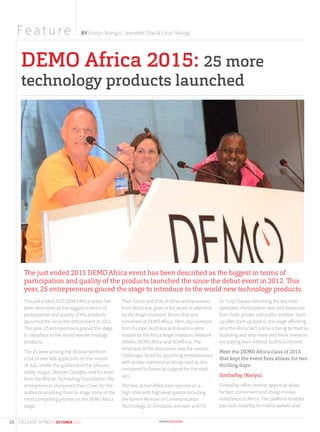
The just ended 2015 DEMO Africa event has
been described as the biggest in terms of
participation and quality of the products
launched the since the debut event in 2012.
This year, 25 entrepreneurs graced the stage
to introduce to the world new technology
products.
The 25 were among the 30 selected from
a list of over 600 applicants on the month
of July. Under the guidance of the Silicone
Valley mogul, Stephen Ozoigbo and his team
from the African Technology Foundation, the
entrepreneurs sharpened their claws for the
audience enabling them to stage some of the
most compelling pitches on the DEMO Africa
stage.
Their future and that of other entrepreneurs
from Africa was given a fair share of attention
by the Angel investors’ forum that was
convened at DEMO Africa. Here, top investors
from Europe, Australia and America were
hosted by the Africa Angel investors Network
(ABAN), DEMO Africa and VC4Africa. The
emphasis of the discussion was the various
challenges faced by upcoming entrepreneurs
with proper mentorship being cited as dire
compared to financial support for the start-
ups.
The two action-filled days opened on a
high note with high-level guests including
the former Minister of Communication
Technology, Dr Omobola Johnson and PS
Dr Tunji Olaopa delivering the key note
speeches. Participation was well balanced
from both private and public entities. Start-
up after start-up took to the stage affirming
why the Africa tech scene is being termed as
bubbling and why more and more investors
are paying keen interest to this continent.
Meet the DEMO Africa class of 2015
that kept the event fires ablaze for two
thrilling days:
SimbaPay (Kenya):
SimbaPay offers mobile apps that allow
for fast, convenient and cheap money
remittance to Africa. The platform enables
pay outs instantly to mobile wallets and
F ea tu r e BY Evelyn Wangui, Jeanette Oloo & Lilian Mutegi
16 CIO EAST AFRICA | OCTOBER 2015
BY Evelyn Wangui, Jeanette Oloo & Lilian Mutegi
many bank accounts. SimbaPay recently
launched the world’s first international
access to M-Pesa Pay Bill through the app
which allows Diaspora to pay merchants
directly from abroad.
Zuvaa (Nigeria):
A demo of a premier online marketplace for
African Inspired Fashion and Design. Using
community, content and social commerce
the Zuvaa is revolutionizing the way people
shop for African Fashion. Since the launch
in May, 2014, the company has gained
significant traction with over US $200,000
in revenue and over 1200 customers from
countries around the world. The company
has also connected 40+ vendors on
the platform and played an important
role in helping them grow their
business.
InsureAfrika.com (Kenya):
InsureAfrika.com is an online comparison
platform which enables users to compare
insurance quotes across insurance
categories like car insurance, health
insurance, travel insurance etc. from leading
insurance providers in Kenya.
CarPartsNigeria.com (Nigeria):
CarPartsNigeria.com approach to the auto
sector of the Nigerian economy was built
out of necessity to correct the challenges
of shopping for auto-parts in Nigeria.
Also out of the need to centralize parts
inventory across the nation, a place to
find difficult parts, reduce high prices and
ensure trustworthy vendors can compete,
while satisfied buyers can appreciate great
business. The platform is a search engine
aggregator, not just for auto parts but also
for finding the best auto service technicians
that is location specific in the country.
BambaPOS (Kenya):
BambaPOS allows retail merchants who
have been traditionally locked out of
automation due to the cost and complexity
of other solutions to access point of sale
and inventory management automation
with any android smart device. The
solution also aggregates multiple payment
channels i.e. card, mobile money and cash
for administration via a single interface.
Transactions happening at point of sale are
accessible in real time from anywhere in the
world. The solution also works offline.
Airshop (Ivory Coast):
Airshop unleashes the untapped potential
of duty-free stores by enabling passengers
to make special orders of high value
products in advance.
Bitsoko (Kenya):
Bitsoko is an Android mobile wallet that
removes the cost of transferring money
between two individuals and increasing
access to payment services.
Bozza Media (South Africa):
Bozza Media is a digital distribution
platform which enables artists to connect
with fans who want locally relevant content
via mobile and web.
Eco-mc2 Compressed Air Hydraulic Energy
Storage (LiGe eco-mc2) (South Africa).
Eco-mc2 Compressed Air Hydraulic Energy
Storage is an innovative air-compression
storage based products that ensures the
power stays on, without the disadvantages
of battery based systems.
Edge Books (South Africa):
Edge Books is a digital platform for
eBooks and other digital platforms such
as magazines, comics and journals. The
digital platform is integrated with owner
developed eReader App, known as Media+
eReader App already available on App Store
& Google Play. The EdgeBooks team hopes
to release the Windows version before the
end of the year.
ENT-Mobile (Kenya):
ENT-Mobile converts human conversation
on social media and mobile platforms
to actionable and quantifiable data for
business decision making.
Feem Wi-Fi (Cameroon):
Feem Wi-Fi is provides an easy way to
transfer music, videos, documents and
other files – and listen to music or play
videos when you are not transferring files.
FlippyCampus (Ghana):
Flippy Campus is a social application that
helps students get updated on what is
happening on their campuses.
iKon Tracker (Nigeria):
iKon Tracker is a conveniently sized
bluetooth tracking device paired with
a downloadable iKon smartphone
application. Utilizing iKon, people now
have an affordable and efficient way
of making sure their pets, children and
belongings are safe, accessible and where
they should be! iKon is perfect for any of
your precious items, ranging from your
keys, to your wallet, your bag, dog, child,
laptop, car, bus or even your private jet! It is
tiny and portable! Simply attach it to your
belongings, link it to your Android or iOS
device/s via the iKon mobile App.
IPC eProductivity (Zimbabwe):
Organizations collect a lot of data on
sales and customers, but do not use
it to full potential when it comes to
making decisions. eProductivity is an
on-line productivity calculator that helps
organizations determine their key drivers
of productivity, thus helping focus their
energies on the right factors to improve
overall profitability.
Koomzo (Cameroon):
Koomzo is a hosted (cloud based) SaaS
School ERP platform that automates
core school processes (academic and
administrative). It provides a scalable, off
site infrastructure accessible on demand
across the internet on a pay-per-student
per annum or pay-per-school package. The
business and operational model of koomzo,
waives institutions form steep upfront cost
Koomzo has been designed to be flexible
to comply with the education structure of
Secondary schools and universities across
Africa.
Minimal ICT skills are needed to use this
platform. With the mainstream adoption
of 3G/LTE data networks across African
countries, this platform presents a heavily
lucrative business model and addresses a
niche market overlooked by mainstream
ERP providers
Fea tu re
17CIO EAST AFRICA | OCTOBER 2015
LocName (Egypt):
“LocName” is an abbreviation of “Location Name’’ a web
and mobile application that creates an address for any
point on earth and gives a short, unique name, which
you can then share easily in just 2 seconds!
By avoiding reliance on government systems, LocName
helps people to determine their location details on their
own and, more importantly, to give it a unique name
with which they can be happy for years to come. Too
often governments assign location generic names – or
even no name at all. With LocName, the power is in the
hands of the people who are physically resident in a
location.
Mavis Computel Ltd (Nigeria):
Mavis Computel Ltd provides a Talking Books &
Talking Posters education solution. Talking Bookz was
developed in 2011 as an interactive, audio-visual tools
that make both teaching and learning very simple,
motivational and engaging by making quality content
prepared by experts easily available to learners.
ogaVenue (Nigeria):
This portal enables finding and booking venues online
through ogaVenue.com.ng. This solves the problem of
venue booking by aggregating variety of event venues,
making it easy to search, and check availability.
PoshRite (Nigeria):
PoshRite is an online beauty social network that aims
to encourage women to express their inner beauty by
offering a web platform.
Raye7 (Egypt):
Raye7 is a real-time community based ridesharing
mobile application. They connect people with those who
they trust to reach their destination together. It provides
a greener, cheaper, nicer, safer and time-efficient way of
transporting people aiming for a better tomorrow.
Shield Finance (Kenya):
Shield Finance is a FinTech company using proprietary
technology while leveraging on Mobile Money to offer
under-banked employees affordable salary advances
directly to their mobile phones.
MyToddler (Nigeria):
mytoddlr is built to make parenting easier. Using
mytoddlr, parents and guardians can easily track
a child’s development and daily activities, share
important, memorable moments of a child’s life, ensure
the child’s safety and easily communicate with the Pre-
school/Crèche.
Tango TV (Tanzania):
Tango TV is a Tanzanian technology company focusing
on integrated media streaming services, beginning with
African Movies, music videos and TV shows. Tango TV
aspires to become the leading provider of on-demand
Internet streaming media. It has developed customized
media streaming TV set-top boxes integrated with state
of the art content streaming technologies to enable
media distribution through various internet connected
devices and including regular Television Sets.
Zeepay Mobile Financial Services (Ghana):
Zeepay Mobile Financial Services is mobile payments
solution for both USSD and smart phones using NFC and
supporting international remittances onto Point of Sale.
Five DEMO
Africa Lions
head to Silicon
Valley
By Staff Writer
Over the years, Silicon Valley has been associated with
some of tech’s brightest minds, best tech practices, face-
to-face access to mentors, advisors, and VCs firms, all
within a short drive.
Five Start-ups from the DEMO Africa class of 2015 stand
to benefit from all these. The five Zuvaa (Nigeria),
CarpartsNigeria, Simbapay (Kenya), BambaPoS (Kenya)
and InsureAfrika (Kenya) were selected from among the
30 start-ups that pitched on the DEMO Africa stage this
year.
Besides the Silicon Valley experience, the five will also
have a chance to pitch to an international audience at
the DEMO event early next year. Here, they will be further
exposed to new markets and trends, opportunities
to build strategic business relationships, acquisition
opportunities and investment partnerships within a
global VC audience.
Continued from page 17 >>
18 CIO EAST AFRICA | OCTOBER 2015
PICTORIAL
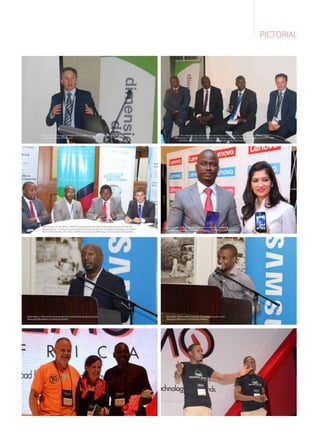
Adam Nyaga, VP-East Africa, , SOFGEN Group (second from right) fields media questions during the
Banking Forum. The others are (from left) David Wagacha, Director, TeamMate Consulting East & West
Africa; Tunde Oladele, CEO, Africa, SOFGEN Group and Joel Winteregg, CEO & Founder, NetGuardians.
Morgan Grant, Cloud GM for Middle East and Africa, Cloud, Dimension Data listen to a participant’s
question during the ITaaS launch.
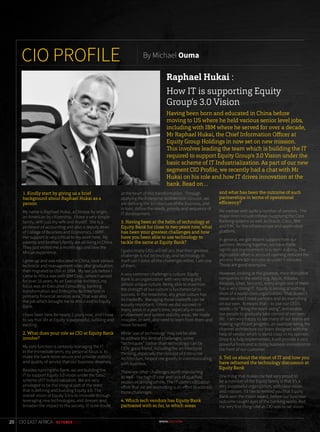
(L-R): Joseph Kairigo, MD, Dimension Data Kenya; David Bunei, GM, Cisco East Africa; Francis Thairo,
Manager, IT Advisory, PwC Kenya and Morgan Grant, Cloud GM for Middle East and Africa, Cloud,
Dimension Data listen to a participant’s question during the ITaaS launch.
Danish Oyugi, the Business Head, Lenovo East Africa and Shikha Monga ,
Regional Marketing Manager during the Lenovo Smartphones Launch in Kenya.
Ryan Mule, Tablet product manager, Samsung Electronics at the
SamsungCIOBreakfast on Enterprise Mobility
Robert Ngeru, COO and VP, Sumsang Electronics East Africa speaks during the
SamsungCIOBreakfast on Enterprise Mobility
1. Kindly start by giving us a brief
background about Raphael Hukai as a
person
My name is Raphael Hukai, a Chinese by origin,
an American by citizenship. I have a very simple
family, with just my wife and myself. She is a
professor of accounting and also a deputy dean
of College of Business and Economics, UWRF.
Her support is very critical to my work here. My
parents and brother’s family are all living in China.
They just visited me a month ago and love the
African experience.
I grew up and was educated in China, took various
technical and management roles after graduation,
then migrated to USA in 1994. My last job before I
came to Africa was with IBM Corp., where I served
for over 16 years. As an Executive Architect, my
focus was on Executive Consulting, banking
transformation and Enterprise Architecture in
primarily financial services area. That was also
the job which brought me to Africa and to Equity
Bank.
I have been here for nearly 2 years now, and I have
to say that life at Equity is purposeful, fulfilling and
exciting.
2. What does your role as CIO at Equity Bank
involve?
My core function is certainly managing the IT.
In the immediate term, my personal focus is to
make the bank more secure and provide stability
and quality of service that our business deserves.
Besides running the Bank, we are building the
IT to support Equity 3.0 vision under the basic
scheme of IT Industrialization. We are very
privileged to be the integral part of the team
that is defining and building Equity 3.0. The
overall vision of Equity 3.0 is to innovate through
leveraging new technologies, and deepen and
broaden the impact to the society. IT is no doubt
at the heart of this transformation. Through
applying the Enterprise Architecture concept, we
are defining the architecture of the business, and
in turn, define the needs, priority and sequence of
IT development.
3. Having been at the helm of technology at
Equity Bank for close to two years now, what
has been your greatest challenges and how
have you been able to use technology to
tackle the same at Equity Bank?
I guess many CIOs will tell you that their greatest
challenge is not technology and technology in
itself can’t solve all the challenges either. I am one
of them.
A very common challenge is culture. Equity
Bank is an organization with very strong and
almost unique culture. Being able to maximize
the strength of our culture is fundamental to
success. In the meantime, any great culture has
its tradeoffs. Managing those tradeoffs can be
equally important. I think we did succeed in
many areas in a year’s time, especially in team
enablement and system stability areas. We made
mistakes as well, and need to learn from them and
move forward.
While ‘use of technology’ may not be able
to address this kind of challenges, some
“techniques” (rather than technology) can be
CIOs’ good friend, including the architectural
thinking, especially the concept of Enterprise
Architecture, helped me greatly in communicating
with business.
There are other challenges worth mentioning
as well - like high IT cost and lack of qualified
resources among others. The IT commoditization
effort that we are promoting is an effort to address
those challenges.
4. Which tech vendors has Equity Bank
partnered with so far, in which areas
and what has been the outcome of such
partnerships in terms of operational
efficiency?
We partner with quite a number of vendors. The
major ones include Infosys (supplying the Core
Banking system) as well as Oracle, Cisco, IBM
and EMC for the infrastructure and application
platform.
In general, we got decent support from our
partners. Working together, we have made
significant improvement in system stability. The
digitization effort in account opening reduced the
process from 50+ minutes to under 5 minutes.
Those are good examples.
However, looking at the greatest, most disruptive
companies in the world (e.g. Apple, Alibaba,
Amazon, Uber, Tencent), every single one of them
has a very strong IT. Equity is aiming at nothing
short of a world class organization. That doesn’t
mean we don’t need partners and do everything
on our own. It means that – to use our CEO’s
words – to “Bring the team along”, and enable
our people to gradually take control of our own
life. I am very happy to see many of our teams are
making significant progress, an example being the
channel architecture our team designed with the
help of vendor which is world class in my opinion.
Once it is fully implemented, it will provide a very
powerful front-end to bring business innovation to
the front of our customer.
5. Tell us about the vision of IT and how you
have reframed the technology discussion at
Equity Bank
One thing that makes me feel very proud to
be a member of the Equity family is that it’s a
very purposeful organization, with clear vision
and mission. I’d like to remind you that Equity
Bank won the Vision award, before our business
outcome caught eyes of the banking world. And
the very first thing I did as CIO was to set vision
CIO PROFILE By Michael Ouma
Raphael Hukai :
How IT is supporting Equity
Group’s 3.0 Vision
Having been born and educated in China before
moving to US where he held various senior level jobs,
including with IBM where he served for over a decade,
Mr Raphael Hukai, the Chief Information Officer at
Equity Group Holdings in now set on new mission.
This involves leading the team which is building the IT
required to support Equity Group’s 3.0 Vision under the
basic scheme of IT Industrialization. As part of our new
segment CIO Profile, we recently had a chat with Mr
Hukai on his role and how IT drives innovation at the
bank. Read on…
20 CIO EAST AFRICA | OCTOBER 2015
CIO PROFILE
and mission for IT based on our organization’s
vision and mission, and make them actionable
and relevant to IT’s daily life.
Our vision is to be the champion of applied
technology in catalyzing business innovation,
building a world-class IT for the world-class bank.
Our mission is to be the enabler and catalyst of
business innovation with stable, secure, scalable
and agile information services, providing
inclusive services through IT industrialization.
This mission statement defines our priority
and maturity roadmap. You may feel the
century-old term of “industrialization” sounds
overly humbled, comparing with “digitization”
and other fancy terms. We believe it’s a
better representation of the spirit of financial
inclusion, which is at the heart of Equity Bank.
Consequently, Equity IT is not about showcasing
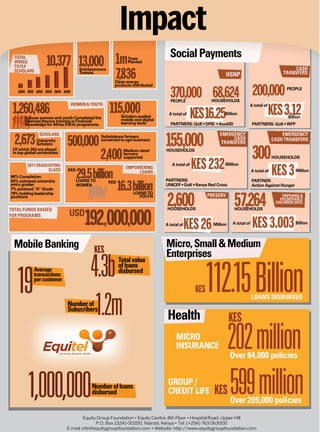
flashy buzz words, but to carefully adopt the right
technology, at the right time, to drive business
value.
6. How does innovation fit into your tech
strategy considering that Equity Bank has a
regional footprint?
Innovation is part of Equity Bank’s DNA. We
have a very tech-savvy CEO, who pays a lot of
attention to how technology can transform
life and livelihood; we have a dedicated Chief
Innovation Officer, who champions the Equitel
platform and many innovation initiatives,
especially in the payment space; our newly
appointed COO is driving the digitization of
the bank. This kind of executive level support
ensures that Equity is at the forefront of banking
innovation.
New technologies pose a significant challenge
to the banking industry today. Everyone - from
retailers to telcos – is eating banks’ lunch.
Companies like Apple, Tencent, Alibaba, and
Kenyan’s own Safaricom are perfect examples,
leaving the banks only two ways forward -
transforming ourselves, or being disrupted (or
destroyed). Innovation is no longer a luxury, but
matter of survival.
Equity recently launched Equitel successfully,
and became the first in the region to converge
Telco with Banking. Some people see this
move as another “mobile money” product,
my advice to them is to stay that way and
be ready for surprises. We see Equitel as the
foundation of our answer to the bigger quest
of “Bank of the Future”. This is based on our
own understanding of the history and trend of
technology development, at heart of which is
democratization of computing power, with the
latest front at the mobility space. The mobile
phone not only provides Africans the computing
power which they may not have otherwise (many
still don’t have PC and connectivity at home), but
also provide that power to you wherever you go.
The only challenge is whether people trust their
mobile phone for serious financial transactions.
That’s why mobile security is so important to us;
that’s also what forced us to take the MVNO route
after our efforts to access the secure element of
the phone was denied. With the secure mobile
channel in place, we now have a free hand
to expand our regional footprint, no longer
counting on building physical branches to reach
out to people.
Of course, Equitel is just a channel and the
channel alone will not bring the bank to the
future. The services provided through the
channels will. Our innovation will gradually shift
to the service area.
7. Within Equity Bank, are you
experimenting with innovative
technologies such as social networks?
There are two aspects of it. First of all, connecting
to people is fundamental to all business.
Since social media is the current trend of
communication, we are certainly into the game
beyond the “experimenting”. We consider social
media as a channel, which is part of our strategy
for Channel Convergence. However, the Big
Data which comes out of social media will play
a key role in the future, especially in the area of
understanding our customers and managing risk.
8. There’s been a debate that CIOs never get
a chance to assume the CEO role despite all
being members of the C-Suite. What’s your
comment on this?
I personally don’t have that ambition, probably
because I do have my own view of “success”. I
don’t think anyone will ask me “what’s your last
position in a company” when I leave this world.
My personal success is how fulfilling life is. Did I
accomplish something that changed the world,
change others’ life? I didn’t try to be a CIO before
I got this job, and now I do feel I am part of
something very big and purposeful. I am utilizing
my knowledge and experience to benefit that
purpose, my work is appreciated and making
an impact. If that could continue, I would have a
wonderful life.
As for if CIO is the right one for the CEO job, it
really depends on the type of business, rather
than self-confidence or leadership capability.
A consumer focused business needs a leader
that knows and understands the needs of the
customer well. As leader of IT today, my primary
customer still is LOB, even though, we have a lot
more chance to interact with our end-customer
now, it is still the banking business leaders who
know our customers the best. These are the
people who are better suited for the CEO job.
However, with that said, IT is an integral part
of the business and technology is becoming
increasingly important. Not only are businesses
becoming more and more reliant on technology,
but we (CIOs) are also getting closer and closer
to the customer. So if you asked me again in 5
years, I might have different answer… assuming
someone may have invented an anti-aging pill
by then
9. Looking at global technology trends,
what are the current major challenges
facing CIOs across all major industries and
how can the challenges be addressed?
Allow me to focus on East Africa specific
challenges where I believe the following three are
at the top:
2. Cost of technology – Let’s use a simple
example, assuming a genuine copy of Windows
for a home PC is US $99, which roughly equals 1-2
days of family income for an average American.
How long does it take an average Kenyan family
to earn that much? However, the software price
is about the same across the world regardless.
The situation is not much different in business.
In short, the business model of mainstream
software vendors is not built for Africa, and
doesn’t fit the African market. We need to find a
way to deal with it.
3. Resource shortage – If you live in a village
as a house builder, assuming a very professional
and successful one. Suddenly, there is an
opportunity to build a skyscraper, can you take
on the job? For a small developing country, and
business operating in such environment, to
find qualified, experienced resource to take on
complex, larger scale initiative is challenging by
default. Training will help, but has its limitations.
Businesses are poaching good resources from
each other, resulting in high resource cost and
difficulty in retention. We really need to create
a sizable enough marketplace to develop the
resource poll needed.
1. Security – as the result of the other two,
many problems were created, but one daunting
challenge stands out: information security. The
reason I single out the security problem is the
impact to business. Security failure can bring
down the business, and even worse than that,
those failures can damage the reputation for the
whole marketplace, the whole country. If your
credit card has ever been rejected online just
because it is issued from Africa, you understand
what I mean. However, let’s imagine making
Kenya a country like Germany of automobile,
Swiss of banking and watchmaking, Japan of
camera and cars!...
These are real challenges CIOs have to face, but
difficult to address on our own. One “possible”
solution is to join forces and tackle these
issues together. (It takes a united Europe to
build Airbus!) None of us wants to compete on
generators, why do we need to compete on Data
Centers, racks, operating system and databases?!
Thanks to the CIO East Africa team and
Strathmore University, with support from Kenya
Vision 2030, Kenya ICT Authority, a group of
CIOs from Government, Financial Services,
Transportation and Travel, Retailers, Education
sectors are working together under the umbrella
of the CIO Council of East Africa to commoditize
IT. That means we that we’ll jointly work on
deals, sharing human and physical resources.
This movement won’t solve all the problems
we are facing, but it is a good starting point.
If it succeeds, and we all believe it will, it will
transform East Africa. For the participating CIOs,
that will be our legacy!
21CIO EAST AFRICA | OCTOBER 2015
TrendLINES MARILIES RUMPOLD
Kenyan banking customers experience the
most problems when dealing with their
banks compared to their global peers, a new
survey shows. “Winning through customer
experience”: a 2014 Ernst & Young report
indicates that more than half of the customers
in Kenya reported a bad experience when
transacting, compared to a third of bank
customers globally.
Meanwhile according to Capgemini’s banking
survey, the most common reason a customer
switches banks is quality of customer services.
This outweighs other reasons such as banking
fees, ease of use, and even quality of advice.
Apparently, even in banking, it is not always
about money.
New customer acquisition is a tough
business, keeping them is even tougher. But
keeping them happy and turning them into
loyal advocates of your bank is when it gets
complex.
Now remove the option of being able to
physically serve a customer inside the
branch. Thanks to the digital shift customers
bank online. Many customers, like me, only
bank online. Where in the past face-to-face
customer service and social skills used to
play a dominant role, today the quality of the
website and the mobile banking application
drive how customers perceive a bank.
Customers don’t experience banking via
physical engagement with banking staff in
a nicely designed bank branch. To engage
customers via digital channels, banks must
provide their services online via a digital and
mobile platform in a seamless and attractive
way. They must be responsive to social media
channels, within minutes. Banks must provide
expert advice and consulting across a number
of platforms, mostly via phone or live chat.
However, if they retain a bank branch, the
branch staff needs to be made aware of the
digital interactions and challenges a customer
has been facing recently, so they can respond
accordingly when the customer approaches
them face to face.
The role of the traditional branch is
dramatically changing, and you can’t miss this
shift for your business. Accenture’s banking
report 2015 highlights that a staggering 81 per
cent of respondents won’t switch banks if their
local bank branch closed down. Still think your
branch is relevant to Milennials? Think again.
That does not render the branch obsolete
entirely. In fact, 52 per cent of respondents
wish to see interactive screens in their branch.
And they don’t remain unheard. Mashreq
bank in the UAE injected new features into
their branches recently such as interactive
screens and motion tables. However, today
customers want a digital experience when
banking, whether they come to the branch
or they use their mobile phone. Banks must
ramp up their digital offerings to the same or a
better level of services than what they offer in
the branches. Accenture suggests 33 per cent
of Milennials stay with their bank due to good
online services.
Some banks already go a step further. Citibank
earlier this year became the first bank to offer
an Apple watch app: “It is all about getting
even closer to your customers,” Andreas
Wolberg-Stok from Citibank says. “It is about
helping them to be in control of their money.
And customers expect evermore in that sense.
We have been on a journey for decades to
get closer to our customers and to bring our
accounts closer to them. So you no longer
need to go into a branch, you can just stop
into an ATM across the street. Then online
banking brought accounts into homes and
offices.” From there, Citibank took a next step
to bring their customer’s accounts to the
customer’s wrist.
Equity Bank:
Vendor Support article
Are your
customers
satisfied?
Don’t bank on it
22 CIO EAST AFRICA | OCTOBER 2015
Banking is merely following a trend that’s
sweeping throughout multiple industries. But
here is the defining point: banks provide a
service and experience that they can’t afford to
get wrong. They are dealing with investments,
trust, and people’s money.
At the beginning of last year, national news
reported a high number of customers
across the Middle East felt their banks didn’t
understand their needs. Being out of touch
with the requirement of your customers isn’t
an option in today’s market. If your customer
experience is broken - fix it.
As an example, my house bank in the UAE
invested in a nicely designed iPad app. When I
login, a graphical view of my account balance
and the outstanding balances and limits
on my credit cards are displayed. Tailored
advertisements pop up on my home screen,
so far so good. However, I struggled to find the
small icon to make an urgent payment the first
time I tried. I got really frustrated, despite the
nice look & feel of the app. My bank does not
know about this struggle because they don’t
track my interactions. They have no view as
to how many of their clients face the same
challenge.
Developing market-leading customer
engagement solutions has been a high priority
to IBM over the last few years. It’s been clear
to us that businesses are crying out for a
more simple, effective and attractive way
to serve their customers. They need tooling
that tells them what their customers are
experiencing, and provide the data needed to
improve customer experience. IBM Customer
Analytics does just that. It analyzes customer
interactions to aid customer retention, to
increase query response time, and improve
your call center’s efficiency. It allows banks
to get a more holistic picture of how their
customers interact, and where they struggle.
Most important of all: banks can increase the
conversion rate, for example for online loan
applications, by removing customer struggle
they otherwise might not even know about.
Improving customer experience will impact
bottom line revenue.
Understanding how your customer interacts
with the bank on multiple channels, at different
points in time, is critical to succeed in today’s
markets. It allows you to create this defining
moment, to create a moment of serendipity for
your customer. You want to offer a voucher for
your customer’s favorite restaurant the day a
salary increase hits their account, to celebrate
in style. Providing an experience which
speaks to the moment could be the difference
between keeping and losing that customer.
IBM deployed Tealeaf with a bank which was
having trouble giving customers the support
they needed to setup new accounts online.
When the bank rolled out IBM’s Tealeaf
solution, they could significantly increase the
cases the call center agents solved as ‘first
call resolution’ because they can now see the
steps the customer took on the website. If a
customer completes a loan application and
is stuck on a particular field, they can now
immediately respond and help to resolve it.
Tealeaf helped them to develop better user
interfaces and identify areas where they were
missing opportunity.
“Firstly, IBM Telaeaf CEM solutions allow us
to say to our online customer ‘yes, I can see
your problem,’ which gives us a tremendous
amount of credibility as a business,” stated
another bank’s SVP who is using Tealeaf.
Being able to deliver proactive and timely
responses to a customer is no longer a
privileged service, it should be the norm.
Today’s customers are expecting more than
ever, yet they’ve shown they are willing to be
loyal to their banks. It’s high time financial
institutions thrive for the best possible
customer experience to keep them happy.
(Marilies Rumpold-Preining is Commerce
Leader, IBM Middle East & Africa)
Monitoring
&Evaluation
EGF improves financial
access, financial capability and
consequently individual and
household financial security by
connecting low income people to
financial services and financial
literacy training.
Financial
Inclusion & Literacy
EGF increases access to and transition
through secondary and tertiary
education and provides leadership
and career development to poor
bright students from disadvantaged
backgrounds in order to break the
cycle of poverty and develop
the next generation of
leaders.
Education
& Leadership
Development
EGF increases access to
comprehensive private sector-
led, affordable, high-quality and
standardized health services and
health financing.
Health
EGF has a strong commitment
to innovation in order to promote
the uptake of new ideas, solutions
and technologies to achieve
greater impact
and scale for all of its work.
Innovation
EGF promotes the
conservation and smart use
of natural resources by
expanding forest cover,
improving water security and
promoting the use of
renewable energy and
energy efficient
technologies.
Environment
EGF helps enhance household
incomes, create jobs, improve
market access and expand
agricultural production by working in
partnership with small and medium-
sized farmers to increase their
production capabilities, business
acumen and access to
technology and financial
services.
Agriculture
EGF stimulates job creation
and economic growth by
providing micro and small
entrepreneurs with
entrepreneurship training
Entrepreneurship
and mentorship.
OurPrograms
HSNP
PEOPLE HOUSEHOLDS
370,000 68,624
PARTNERS: GoK • DFID • AusAID
A total of Billion
KES16.25
HOUSEHOLDS300
PARTNER:
Action Against Hunger
A total of Million
KES3
CASH
TRANSFERS
EMERGENCY
CASH TRANSFERS
HOUSEHOLDS
155,000
PARTNERS:
UNICEF • GoK • Kenya Red Cross
A total of Million
KES232
EMERGENCY
CASH
TRANSFERS
HOUSEHOLDS
57,264
A total of Billion
KES3.003
ORPHANS &
VULNERABLE
CHILDREN (OVC)
HOUSEHOLDS
2,600
A total of Million
KES26
PRESERV
PEOPLE
200,000
PARTNERS: GoK • WFP
A total of
Billion
KES3.12
SocialPayments
Subsistence farmers
converted to agri-business
500,000 Medium sized
farmers
supported2,400
Entrepreneurs
Trained.
13,000
Scholars availed
mobile and digital
learning tools
115,000
TOTAL FUNDS RAISED
FOR PROGRAMS
192,000,000USD
29.5billion
KES
EMPOWERING
LOANS
LOANS TO
WOMEN
16.3billion
KES
LOANS TO
YOUTH
2010 2011 2012 2013 2014 2015
TOTAL
WINGS
TOFLY
SCHOLARS
10,377
WOMEN&YOUTH
1,260,486Kenyan women and youth Completed the
financial literacy training in Financial
Knowledge for Africa (FiKA) programme.
Trees
Planted1m
Clean energy
products distributed
7,836
SCHOLARS
University
Scholars2,673Of which 263 are placed
in top global universities
2011GRADUATING
CLASS
98% Completion
93% achieved university
entry grades
7% achieved “A” Grade
79% holding leadership
positions
MobileBanking Micro,Small&Medium
Enterprises
112.15BillionLOANS DISBURSED
KES
KES
KES
KES
1.2mNumberof
Subscribers
19
Average
transactions
percustomer
4.3bTotalvalue
ofloans
disbursed
1,000,000Numberofloans
disbursed
MICRO
INSURANCE
Over 84,000 policies
202million
GROUP /
CREDIT LIFE
Over 209,000 policies
599million
Health
Equity Group Foundation • Equity Centre, 8th Floor • Hospital Road, Upper Hill
P.O. Box 13241-00200, Nairobi, Kenya • Tel: (+254) 763 063000
E-mail: info@equitygroupfoundation.com • Website: http://www.equitygroupfoundation.com
Samsung revolutionizes mobility with
thinnest and lightest tablets to date
Thinnest and lightest Galaxy
tablets combine advanced
super AMOLED visual
technology with unmatched
mobility
Samsung Electronics recently announced the local launch of
the Galaxy Tab S2, the thinnest, lightest and most immersive
Samsung tablet to-date. Samsung’s newest Galaxy tablet
continuously delivers a stunning Super AMOLED display
perfectly optimized for reading and viewing any type of
digital content. The Galaxy Tab S2 is stylishly designed with
the thinnest and lightest metal frame on the market and
packs powerful performance and features to offer enhanced
usability, empowering users with new and improved choices
in productivity and multitasking. The sleek and stylish tablet is
available in both 8” and 9.7” screen sizes
“The modern day tablet buyer is not only
looking for a product that delivers on
performance and connectivity to meet their
work/play needs, but also one that offers
advanced portability to complement their
on the move lifestyles. The Galaxy Tab S2 is
not only the slimmest and lightest tablet on
the market, it also gives users quick, easy
access to a wealth of superior multimedia
and productivity features,” said Ryan
Mule, tablet product manager, Samsung
Electronics East Africa. “We believe the
Samsung Galaxy Tab S2 is the most versatile
4G ready personal visual device designed
for consumers to carry and use anywhere.”
Newly Optimized Super AMOLED
Display for the best viewing
experience
When it comes to consuming content,
laptops can be too big and bulky.
Smartphones can be too small. Yet, at just
5.6mm thin and only 392g (9.7 inch) and
272g (8.0 inch) in weight, the Galaxy Tab
S2 is just right. As the thinnest and lightest
tablets on the market, toting around the
devices is easy. The Galaxy TabS2 tablet
fits effortlessly into a small bag, is easy
to handle with one hand and is ideal to
carry when on-the-go. The TabS2 also now
comes packaged in a metal frame adding to
its durability and sophisticated finish. The
sleek and stylish design is suitable for any
purpose or setting, so users can enjoy the
most sophisticated 4G tablet experience
anywhere, anytime.
The 4:3 aspect ratio of the Galaxy Tab S2
recreates the same viewing experience of
browsing through traditional print media,
making it comfortable to read digital
content, including e-books, magazines,
webpages and newsfeeds. This reading-
optimized ratio allows the user to enjoy
a seamless reading experience without
unnecessary scrolling.
With super AMOLED technology the Galaxy
TabS2 also presents images, videos, and
text in deeper contrast (100,000:1 contrast
ratio. 100 times better than LCD) and more
precise detail to provide the best-in-class,
high definition viewing experience. The
Super AMOLED display of the Galaxy TabS2
delivers 94 per cent of natural tones to
show true-to-life colors (Adobe RGB color
standard). In addition, the Galaxy Tab S2
is capable of continuously adapting its
advanced screen technology to provide
its user with a more comfortable viewing
experience. Adaptive Display intelligently
adjusts gamma, saturation, and sharpness
based on the application, the color
temperature of the viewing environment
and ambient lighting. Also, Reading Mode
modifies the screen’s brightness level to
allow users to read content for longer
periods of time without straining their eyes.
Ultimate Performanceand productivity
Features for Users On-The-Go
The Galaxy Tab S2 in both 8” and 9.7”
variations deliver unmatched mobility
coupled with next level performance.
Powered by a powerful 64bit Octa core
processor and 3GB of RAM, the Galaxy
R E V I E W BY STAFF WRITER
26 CIO EAST AFRICA | OCTOBER 2015
TabS2 is more than ready to handle the most intensive work and
play applications. Thanks to the powerful hardware, the Galaxy
Tab S2 offers effortless Multitasking, allowing users to view and
run two apps simultaneously with split view and the new Pop-Up
Window feature that lets users to navigate easily between multiple
apps at once.. Whether you want to watch videos while chatting
with friends, or scroll through a presentation while taking notes,
the tablets’ split view and pop up window features lets you do all
this at once. The Galaxy Tab S2 also provides an improved storage
structure that makes locating files simpler than ever.
To cater to high-efficiency users seeking maximized productivity,
the Tab S2comes fully equipped and preloaded with Microsoft
Office Solutions such as Word, Powerpoint, Excel, One Note, and
Skypefor ultimate productivity on the go. Users can freely create,
edit and view their office documents while also conveniently
storing up to 100GB of files on the cloud via Microsoft OneDrive
(free for 2 years)
For enhanced security, the Galaxy Tab S2 is built with a touch-
enabled Fingerprint Scanner for hassle-free authentication. A
built-in advanced security sensor now offers easy access to the
personal device with a simple press of a finger against the home
key. For the most streamlined device management options, the
Galaxy Tab S2 features the Smart Manager application which
displays the device’s settings automatically, including battery
power levels, storage and RAM availability for users to efficiently
manage their devices. The Tab S2 is also comes pre-installed with
McAfee mobile anti-virus software and Samsung KNOX defense
grade security architecture for an added layer of device protection.
The Samsung Galaxy Tab S2 8” & 9.7” come with 32GB internal
storage(Micro SD expandable to 128GB) and are 4G +Wi-Fi ready.
The Galaxy Tab S2 is available in black/white colors at Samsung
brand stores and authorized dealers countrywide.
R E V I E WBY STAFF WRITER
Huawei Ascend P8
PRODUCT REVIEW BY LILIAN MUTEGI
Today, Huawei is much more than some hardware manufacturer. Its
hands are in a multitude of telecommunication businesses. A decade
after it was established in 2003, Huawei Consumer Business Group
ranked third in global smartphone shipments in 2013 according to
IDC, SA, Gartner. In 2014, Huawei became the first mainland China
brand to rank in Interbrand’s Annual Top 100 Best Global Brands
Report.
The Huawei, P or rather “Platinum” or “Premium” series has recorded
a steady growth in shipments. Less than four months since its launch,
the Huawei P8 – the third in the ‘P’ series - has recorded up to 10,000
units sold daily in the China market.
The Huawei P8 is such an important smartphone as it has become
the first device from a Chinese company that has had mainstream
Western appeal.
Design
Huawei P8 seamlessly brings elegance and comfort together with
stunning pieces of technology and efficiency in mind.
The Huawei Ascend P8 comes with a 5.2-inch full HD display up front,
while the metal body design comes in at just 6.4mm thick - making
the P8 thinner than the iPhone 6 and Samsung Galaxy S6.
Picking up the P8, I found it to be well weighted, manageable in one
hand and indeed it does look and feel premium. If there is anything
that Huawei has been able to keep up with its Ascend P series, it is the
sleekness and ultra-thin design, which is commendable.
The edges are slightly curved, to provide a little extra grip, although
the completely flat rear and super slim 6.4mm profile means it’s not
the most comfortable to hold. It does however, slip effortlessly in a
pocket.
Compared to last year’s P7, the P8 looks a bit more squared, with the
curved edge along the bottom of the P7 now gone.
The square design is echoed in the interesting squared power button,
which can be found on the right side of the phone. The metal power
lock key is situated about half way down the right of the P8, in a
slightly recessed dip making it easier to find when you run a finger
along the edge.
While the Huawei P8 does spot a premium metal body, it feels like it
has borrowed much of its design from iPhone 5.
The volume rocker sits above it, while below are two trays - one for
your 4G nanoSIM and one for a microSD card (up to 128GB in size)
which also doubles as a second nanoSIM port.
The charging port also comes at the bottom part of the phone,
between two fairly loud speakers. The back part is stylish with the
word ‘Huawei’ and ‘Huawei’ logo encrypted at the top part. Huawei
has put some effort into making the P8 a decent audio player, and it
boasts an onboard Hi6402 DSP for improved audio quality.
You can pick the Huawei P8 up in four colours - mystic champagne,
carbon black, titanium grey and prestige gold. The champagne
and grey only feature on the 16GB model while black and gold are
reserved for 64GB. I got a chance to review the prestige gold, quite
pretty I must admit.
By pushing the limits of modern design, Huawei has created a
harmonious work of art that shines.
Operating System
The Huawei P8 comes with the latest iteration of Google’s operating
system, Android 5.0 Lollipop. As with all of its Android handsets,
Lollipop has been coated in Hauwei’s relatively heavy Emotion UI
which does away with the app tray for a slightly more iOS look and
feel.
In terms of power, Huawei has opted to stick to its own Kirin 930
processor inside the P8, and its 64-bit architecture and eight core
setup along with 3GB of RAM means it’s more than ready for the
demands of today’s applications and games.
P8 also comes with a few extras including an office solution and NQ
Anti-virus. There is no app drawer, which means every app is forced
on to the homescreen pages, much like an iPhone. The apps can be
placed in folders and the homescreens behave like standard Android
with moving wallpapers and widgets.
Camera
There is no better way to tell a story nowadays than through photos.
Huawei P8 truly completes a package of stunning photos through a
click of the button. The camera comes with a DSLR Level Image Signal
Processor, Optical Image Stabilization and a four colour RGBW
Seven years ago,
Huawei was
manufacturing
HSDPA modems
for Vodafone. It was
making smartphones
that other companies
could brand and
then sell. This was its
starting point in most
markets.
28 CIO EAST AFRICA | OCTOBER 2015
PRODUCT REVIEW
Sensor.
It seems the R&D department had a lot of
research done on the camera of the Huawei
P8, with a host of modes and features packed
inside this impossibly slender device.
Round the back you’ll find a 13MP camera
with dual-LED flash, while on the front you
get a decent 8MP snapper - perfect for selfie
lovers.
A party trick Huawei introduced with the
Ascend P7 and has carried over to the P8 is
Instant Shot. It allows you to snap a picture
while the handset is locked by double
clicking the down volume key.
It even shows up a timer on screen showing
you how quickly it snapped the photo -
usually 1.1 or 1.2 seconds for me - although
you can’t guarantee if your subject is in shot
or in focus.
Smartphone camera staples such as full HD
video recording and HDR are also present
on the Huawei P8, as is an iOS style filter
providing you with eight Instagram friendly
effects if you want to get arty.
Tap the menu in the top corner of the camera
app and you’ll get access to a few more
modes including All focus, Watermark and
Super night.
All focus is Huawei’s attempt at the now
common-place background defocus effect
we’re seeing on pretty much every top tier
smartphone these days.
Snap a picture with All focus enabled and
you can adjust the focus after taking the shot.
It’s easy to do, but the blur effect is relatively
minor which means the overall appearance
isn’t as striking as on some rival handsets.
Watermark allows you to add stickers to your
shots - be it your location, the weather or
something cheesy like a food related slogan.
It’s very reminiscent of the filters you get on
Snapchat. You have a limited level of control
over them - but I can’t see them getting used
all that often.
Super night is for those low-light situations.
The Huawei P8 encourages you to keep
the handset still, or use a tripod, as camera
shake is more apparent here. It doesn’t do
too bad a job, and I managed to get a couple
of clear night shots with the P8 picking out a
decent level of detail.
“Light painting” for four more options; Car
light trails, Light graffiti, Silky water and Star
track. These rather gimmicky modes are
mostly self-explanatory, with Car light trails
looking to give you the long exposure shots
you see of traffic with the lines of light.
It also comes with the beauty mode and
allows one to take panoramic photos.
Another interesting feature is the Director
mode which lets you capture the magic
of the moment from multiple angles.
Then combine footage into your very own
professional grade masterpiece.
Battery Life
The 2600mAh battery is locked inside the
aluminium body and can’t be swapped out,
but Huawei reckons the P8 will go for a day
and a half with normal usage.
With “normal usage” I found the Huawei P8
could see out a day pretty easily, usually
ending up in the low teens by the time
it came to plugging it in at night. There
certainly wasn’t enough left in the tank to get
another half a day of use though.
You can fine tune the settings to force
particular apps to either stay on or be
switched off when the phone is laying idle -
again helping you to get the most from the
P8’s battery.
There’s also an ultra-power saving mode
which strips down the Android OS to a basic
six tile, black and white affair, providing
access to basic applications only to help you
eke out the last drops of life.
The Huawei P8 does heat up a bit after using
it continuously for a while, but also cools off
immediately.
Media
The entry level Huawei P8 only comes with
16GB of internal storage, which is pretty low
for a flagship device these days. However,
there is a microSD card slot on the side
allowing you to build on the internal offering
by up to 128GB.
The 5.2-inch full HD display is handy for video
playback, and the P8 comes with a dedicated
video application allowing you to locate your
moving pictures easily.
Tap a video and you’ll get a basic player, with
play/pause, scrub and chapter skip control.
It’s all very simple, making it easy to use and
the P8 is generally comfortable to hold.
The placement of the speaker at the base
of the handset means your hand may be
covering it, requiring you to shift your grip of
the P8. While it can kick out a decent volume,
the quality still isn’t as good as a pair of
headphones.
Head over to the music app and it’s another
simple affair with songs organised by title,
artist and album - plus there’s the option to
create playlists.
Sound quality through a decent set of
headphones is pleasing, and the internal
speaker can fill a room with sound
New feature
A new feature Huawei has baked into its
interface is Speech Awareness. This allows
you to say a pre-determined phase for your
phone to recognise and then call out to tell
you where it is.
It’s not likely to be a feature that’s used all
that often, and the ringtone which actually
says “I’m here” is a bit odd coming from your
phone - but there’s a clear use case for it.
The default ‘name’ given to the Huawei P8 is
Emy - not exactly a common name, but you
can change it to anything. After setting the
name, you have to say the phrase three times
into the handset so it can learn your voice,
then you’re good to go. Early impressions
were positive, saying “Hello Emy” woke the
phone up and following that with “where are
you” triggered the ringtone and creepy “I’m
here” voice.
You can also have the Huawei P8 call
someone in your contact book using your
voice - but that’s it.
Knuckle Sense Technology
Basically what this means is the P8 can
detect whether you’re tapping the screen
with your fingertip or knuckle, and perform a
different action depending on which you’re
using. Double tap the screen with your
knuckle and the P8 snaps a screenshot, while
drawing a circle will see a crop tool appear
allowing you to select a part of the screen to
cut out and save for later.
Price:
The Huawei P8 comes in champagne or
grey, costing US $529, which translates to
Kshs 52,999 on the Jumia Kenya online shop
which is around US $200 less than most of
the competitors, including Samsung, LG,
Sony, HTC and Apple.
Verdict:
The Huawei P8’s beautiful design, proficient
hardware and a focus on relevant features
make it a worthy contender to better
recognised brands. Its packaging is also
worth noting. Its screen, power, camera and
battery life are just about on par with the
high-end competition. The Huawei P8 has
all the right ingredients for a top of the range
smartphone, but something’s not quite gone
to plan in the baking. As it is though, it feels
like a second tier device compared to Apple,
Samsung, Sony and HTC - a stigma the firm is
still struggling to shrug off.
BY LILIAN MUTEGI
29CIO EAST AFRICA | OCTOBER 2015
The percentage of computing
jobs held by women has
actually fallen over the past
23 years, according to a new
study.
In 2013, just 26 percent of computing jobs
in the U.S. were held by women, down from
35 percent in 1990, according to the study
released earlier in the year by American
Association of University Women, (AAUW), a
non-profit that promotes gender equality.
During that same period, the number of
women earning computing degrees also
declined.
The decline is striking but not entirely
surprising. A recent flurry of reports
from some of the most prominent tech
companies, ones that did not exist in 1990,
offer some depressing numbers.
For instance, at Google, women make up 30
percent of the company’s overall workforce,
but hold only 17 percent of the company’s
tech jobs. At Facebook, 15 percent of tech
roles are staffed by women. At Twitter,
women just make up to 10 percent of the
work force.
In the computing world, the stereotype of
male superiority has proved more stubborn.
The number one thing holding women back
is stereotypes. The stereotype is that girls
and women are not as good at math and
science as boys and men are.
Those prejudices tend to make their way
into the hiring process too. Both male and
female hiring managers often view women
as less competent in math or tech.
In Africa, maybe the decline could be worse.
Women & Tech
Women in Tech Africa
could fix the gender gap in IT Sector
By lilian
Mutegi
30 CIO EAST AFRICA | OCTOBER 2015
However, times are set to change with a new entrant
in the tech space, Women in Technology Africa,
which is the largest women in tech group in over 30
countries.
Women in Tech Africa focuses on two main goals
encouraging women and girls into Science,
Technology, careers and preventing women dropping
out of technology roles and careers through
education, provision of opportunities and by sharing
experiences and supporting the corporations that
hire them.
Women in Tech Group has created a database of
a cross section of its members and links to their
LinkedIn profiles and tags of their specialties to help
women in tech to be found.
The Database is searchable by skill set, country and
other details and is open to recruiters, chief executive
officers (CEOs) as well as event organizers in Africa
to find their next hire, next speaker or even their next
board member online.
There are over 250 women highlighted on the page
based on their preference to be highlighted. The
organisation is working steadily to grow the database
to over 5,000 women across all of Africa.
According to Ethel Cofie, Founder, of Women in
Tech Africa, “In many organizations, the excuse for
not having women in senior management teams
or women in the pipeline of people they interview
for available positions is that they cannot find
qualified women for these positions. A large number
of technology events usually have very few women
speakers and the explanation is the same. Women in
Tech Africa is solving this problem: since we are the
largest group of capable women in the technology
industry, we are in a position to show case capable
women in the industry who might not necessarily be
visible.”
Having more women take up roles in Tech related
careers will help bring diversity at workplace to give
them a broader range of ideas and insights to draw
on, in decision making and policy development.
According to a recent study by the Center for Talent
Innovation (CTI), diversity at work place draws
innovation in two ways: employees with inherent
diversity best understand markets and end-users that
companies today are most keen to reach; and leaders
with acquired diversity are best equipped to unlock
the insights of these employees.
At companies that harness both inherent diversity in
their workforce and acquired diversity in leadership
employees are 75 percent more likely to have had
a marketable idea implemented than employees at
companies that fail to harness these drivers.
Publicly traded companies with “two-dimensional
diversity” are 45 percent more likely than publicly
traded companies lacking it to have grown market
share in the last 12 months and 70 percent more likely
to have captured a new market.
The report also includes case studies that show how
companies use diversity to drive bottom-line results.
Companies like Cisco, EY and Time Warner have
leveraged the acquired diversity of their leaders to
extract innovation from functionally diverse teams.
These firms have realized significant revenues from
their diversity, as a result.
Women in Tech Africa has physical chapters in Ghana,
United Kingdom and Kenya and is looking to launch
in Nigeria and South Africa by the end of 2015.
“In many organizations, the excuse
for not having women in senior
management teams or women
in the pipeline of people they
interview for available positions
is that they cannot find qualified
women for these positions. A large
number of technology events
usually have very few women
speakers and the explanation is
the same. Women in Tech Africa
is solving this problem: since we
are the largest group of capable
women in the technology industry,
we are in a position to show case
capable women in the industry
who might not necessarily be
visible.”
Women&Tech. Lilian MUTEGI
31CIO EAST AFRICA | OCTOBER 2015
Most parents are relying on holiday tuition as
their way of turning lemons into lemonade.
While tried and tested over the years, holiday
tuition was in recent months banned by Prof
Jacob Kaimenyi, the CS for Education, Science
and Technology,.
“Holiday tuition denies children a chance to
learn basic skills like cooking, milking cows
or slaughtering a goat,” read Kaimenyi’s
statement on the issue.
While this could be a hindrance to most
people, Game 254 studios, through outside-of-
the-box thinking, came up with an innovation
that could help children between the ages
of 3-6 in Kenya and across the globe, learn
Kiswahili in a fun way.
Even though most people do not associate
learning with fun, this new innovation - an
application called Kaka and Chui - goes a long
way in trying to link the two, as the application
tries to make playing time learning time for
kids, by encouraging the use of gadgets such
as phones and tablets as learning tools.
Kaka and Chui provide toddlers with a
comprehensive introduction to the Swahili
language in a fun and interactive way. The
application is designed to take children
through the learning process with minimum
supervision.
To get more insight on the application, CIO
East Africa had an interview with Alex Kirui,
CEO and Animator at Kaka and Chui.
“Kaka is a young Maasai boy whose pet is
called Chui. Kaka and Chui are characters in
an upcoming kids animation we working on,”
Kirui said.
The two animated characters, Kaka and
Chui, take users of the application through
various tutorials whereby they are able to
learn about the following things in Kiswahili -
Vowels (Vokali), Numbers (Tarakimu), Shapes
(Maumbo) and Colors (Rangi).
Mr Kirui said that Kaka and Chui was inspired
by their own experiences growing up whereby
there was a clear lack of originally African
animated shows and games for them to enjoy.
“We grew up on only foreign stuff and we
thought it would be good to have our own
(African) games and animations based on our
stories and culture,” he added.
The app is currently only available on the
Google Play Store, but Kirui pointed out that
the application would be moving to other
stores in the near future. He pointed out lack
of certain personnel as the reason why the
application was still not available in more
online stores.
“We only have one Android developer in
the Team, Dennis Kawawa. We are currently
looking for an iOs developer to have the
current version in the apple store,” Kirui added.
The application has a few basic features. It
supports tablets, does not have Ads and does
not link to social media. This features show
how limited the application is, but this should
not deter anyone from indulging in it, as it is
still in its infancy stages. The game which was
uploaded to the Google Play Store in July this
year is currently on its first level. But Mr. Kirui
said it can “be downloaded by Kenyan parents
from anywhere in the world.”
Kirui expounded further on the application’s
no ads feature saying: “There are no ads in our
App. We are using a freemium model. The idea
is that we acquire users first and convert some
of the users to premium users by having video
and other content for sale and subscription.”
But for a game that is so young, so to speak, it
has a lot of benefits to the children. It allows
parents to play together with their children,
it helps children develop spatial recognition,
matching, tactile, and fine-motor skills and
last but not least, it helps the child to learn
Kiswahili in a fun way.
Kirui also noted that plans are underway to
upgrade the application so that it has more
content and more mechanics like jigsaw
puzzles, adding that this upgrade would take a
while because further animated content would
take them some time to come up with.
The game was recently featured in PIVOT
East 2015 under the ‘Mobile Entertainment
Category’, emerging as one of the semi-
finalists at the competition. This should be one
of the reasons, if not the main reason, to pay
attention to this start-up.
“HTC Zoodle is doing some great job for kid
apps and we want to be their equivalent in
Africa,” Kirui said about where he wants Kaka
and Chui to be in the years ahead.
Startups Corner Baraka Jefwa
Kaka and Chui:
for a different way of
teaching children Kiswahili
With the recent teachers strike
in Kenya disrupting learning for
children, parents and guardians
alike are now looking for various
alternatives to the traditional
learning. They are looking at
options that may help keep their
children busy during, what is
largely, an unplanned holiday.
32 CIO EAST AFRICA | OCTOBER 2015
OPINIONRaphael Hukai
Within the global business technologies application space, a paradigm shift is clearly
underway. This paradigm shift bug has already infected Equity Group Holdings, in its quest
to lay the foundation for its corporate mission.
As an organization dedicated to accelerating financial inclusivity in
Africa, Equity Group Holdings is undertaking a step change program.
This program is geared at facilitating technological inclusivity to meet
its corporate goals.
The organization-wide recognition that there’s no business growth
without technology inclusion, has fueled an urgency to integrate some
of the most advanced solutions with obvious positive results.
This has not been without some level of surmountable challenges
including the high cost of technology integration. To a large extent,
the high cost of technology in these shores is primarily inspired by the
small size of our combined economies in East Africa. Also, technology
vendors’ business models are generally designed for advanced
economy, putting Africa in disadvantage.
Beyond the cost elements, lack of suitably qualified human resource
capacity to handle advanced technologies caused an imbalanced
demand-supply, which also leads to inordinately high costs of
technology deployment in this region.
To tackle the cost challenge of technology adoption for Africa, we
may look into the history for a hint. In the first sentence of An Inquiry
into the Nature and Causes of the Wealth of Nations (1776), Adam
Smith foresaw the essence of industrialism by determining that
division of labour represents a qualitative increase in productivity.
Modern day industrialization is heavily centred on an organization
and a nation’s capacity to adopt technology and specialization of its
workforce. Technology adoption plays a key role in facilitating national
and organizational development. The specialization, which we call
“separation of concerns” in IT world, defines the productivity, quality,
agility and affordability that our customers require. That’s why in
Equity IT, we adopted the century old term of “industrialization” as our
mission to support our business vision and mission.
However, to reach the Promised Land, we will have to chart new
frontiers. This will principally call for the shedding of workshop models
for technology deployment in favour of the more organised factory/
conveyor belt model.
From a human capacity perspective, I have no doubt that IT
practitioners will need to transform from Superman to specialists
highly conversant with a particular discipline. General practitioners
in a technology deployment process are fast losing their shine as the
market prefers specialist talent.
This also presents an opportunity to adopt flexible sourcing models.
Turnkey solutions can replace in-house built solution whenever
appropriate; thereby allowing us to focus on innovations, rather than
commoditized components.
With the support of Kenya Vision 2030, Kenya ICT Authority, and
wonderful contribution of CIO East Africa magazine, Kenyan businesses
are getting together under the slogan of IT Commoditization. This
is a transformational, unprecedented effort to fighting for a more
affordable technology marketplace for the region. For the area we are
buying rather than competing, IT Commoditization initiative provides
one avenue to solve the technology inclusion challenge.
For the area we need to innovate and build, the transformation
entrenches the need for service oriented architecture (SOA). The key
architecture building blocks (ABBs) of SOA are matured today, allowing
us to build re-usable stand-alone (decoupled, in IT terms) services that
are closely mapped to business capability, interconnected through
Enterprise Service Bus (ESB), choreographed and managed through
Business Process Management (BPM)… all these building blocks alone
with many others, create an IT assembly line, allowing us to pump out
quality while delivering affordable services to our customer. Trendy
people like to talk about new terms like “Big Data”, “Cloud” and so on.
Without a doubt, those are game changers and open new doors for
business innovation. However, without a proper IT foundation, they
stay as fairytale. The humble concept of “industrialization” turns those
concepts into reality, and will make Equity IT the true enabler and
catalyst of business innovation.
With an Industrialized IT, Equity 3.0 will deliver innovative, quality,
affordable financial services to Africans, in the quest to transform
people’s lives and livelihoods.
(Mr. Raphael Hukai is the Chief Information Officer at Equity Group
Holdings)
Technology Inclusion
through IT Industrialization
With the support of Kenya Vision
2030, Kenya ICT Authority,
and wonderful contribution
of CIO East Africa magazine,
Kenyan businesses are getting
together under the slogan of IT
Commoditization.
33CIO EAST AFRICA | OCTOBER 2015
In the last couple of years, there has been clamor
for IT to be more responsive to business. One
illustration is that of a horse rider analogy. The
analogy depicts IT as the hind legs of the horse,
the torso and the front legs as the rest of business
and the rider as the owners of business. In a 3
dimensional view, view 1 illustrates a mismatch
between a focused business and a sluggish IT
that cannot enable the business jump over the
hurdles as the horse navigates towards the finish
line. In the view 2, the picture is of a sluggish
operation with an agile IT which causes chaos in
the kind of direction to follow. Finally in view 3,
both IT and business are aligned with the vision
and moving in tandem to execute.
The very organization of IT department / division
brings into sharp focus how well aligned IT is in
response to business. I have served in functional
units that were very technology centric. In
one instance, I was given the role of “Oracle
Applications Database Administrator”. The title
of that role looks very vendor product centric, yet
the responsbility involved operational support to
finance and vertical lines of business in service
delivery.
The responsibility spanned the three domains
of IT value chain i.e plan, build and run. In the
plan domain, there was expectation of input in
terms of investment requirements to enhance
application and data capabilities to deliver
efficient service for premium collection and
claims settlement as well as financial reporting
of the same for all lines of business. In the
build domain, there was an expectation of the
incumbent to work with third party solution
providers to deliver solutions that would actualize
the envisioned capabilities. On the run side, the
incumbent was expected to ensure availability
of the deployed capabilities in a usable state,
consistently.
The title of the role almost loses the real
contribution of the holder in the day to day
running of the enterprise. This is a case for
many a design of the functional units of an
IT department. Traditionally, the design has
been based on technology capability rather
than business capability. In other words, the
categorization of functional units takes a deep
technology centric approach rather than making
reference to the functional units of the business
for which IT supports. Largely the categorization
is based on software applications, hardware and
network infrastructure and projects. So you find
roles like Infrastructure, IT Support, PMO Office,
Analysis & Applications Development and the like.
To the horse rider, that demarcation loses the
business intent. In some instances, certain lines of
business demand a dedicated IT unit to support
them given the conundrum of overlapping roles
involved in resolving technology related business
issues. Take for example the effort involved in
activating user access in an ERP system. An
accountant calls the IT Service Desk, gets a ticket
and that ticket is assigned to an ERP support
analyst who, through some approval process
either manual or automated, creates this user in
the system and communicates back to the service
desk. Then service desk alerts the user of the
completion of the task and asks them to login.
The user attempts a login and is unable and does
a follow up call with the service desk. This time
round, the person who handled the ticket is not
the one who picks the call and the conversation
starts all over again. The ERP analyst finally
descends at the frustrated user’s desk and takes
him or her through a resolution of the login issue
until they have access. To the end user, the ERP
analyst is the go-to person on matters ERP, not
the service desk.
The effectiveness of service delivery therefore is
not so much how compliant the IT function is with
standards but how responsive it is to business. In
the case of the Accountant, let’s assume he or she
required access to be able to process commission
payment for brokers. Delayed settlement of
commissions means trouble for the business in
the context of insurance industry. IT service desk
doesn’t have this implication neither does the
ERP analyst understand that detail. Perhaps even
the Accountant only understands the implication
in part, not so the sales and marketing arm.
The question then becomes, “what if functional
organization was designed on the basis of
value rather than structure?” If for example
business is divided into Underwriting, Claims,
Operations, Customer Support etc, what if
the corresponding structures in IT and other
horizontal lines of business followed the same
path. In other words, rather than just having static
Applications Support, there is clear business
partnership framework within the verticals. So if
you have an underwriting function at the core,
you have a Finance and IT business partnership
for Underwriting. These partners not only are
skilled in their domain, but are trained and have
deep understanding of the implications of their
actions on the overall value of the vertical to the
business. Delayed configuration of tax rules for a
particular insurance product by a Configuration
Analyst means delays in product launch and
those are performance indicators upon which the
Configuration Analyst is held accountable.
What this means is that, business becomes
tightly coupled with each other holding each
functional unit accountable for the actions taken
because each action is a part of the whole. This
will accelerate the departure from the notion
that there is a business and there is IT. To have
that view is to decouple the technical capability
from business and in effect isolate from being
an integral part of the whole. This makes IT
appear like a third party entity that happens to
share a payroll with the rest of the business and
struggles to justify its existence. A re-look at how
IT is organized is important. This cannot be done
by IT department alone. It must be an enterprise
exercise that develops a clear cycle of value
identification->value planning->value creation->
value realization for all functional units. This
approach will more likely translate the view 3 of
the horse rider analogy into reality.
OPINION Peter Muya
Functional integration
of IT into business
34 CIO EAST AFRICA | OCTOBER 2015
OPINIONLameck Osinde
Are you considering implementing an ERP
solution for your business?
Over the years, organizations have tried
to strike a balance between ERP systems’
performance,versus the related costs, compexity
of implementation and flexibilty of customizable
features. There has been a constant and
increasing reliance on technology and therefore
there are dire consequences of choosing the
wrong software, and can spell imminent failure
and loss of business. Software implempletation
can be expensive, lengthy and fraught with
sigfinicant risks.
As a CIO or CEO,one of the most important
decisions you will be called upon to make is what
strategy and delivery platform to deploy. Why
is this important, you may ask?Because every
business is unique with its related processes, and
the decisions you finally make will have a huge
impact from a business perspective.
What are these strategies?
Previously, the prefered systems were On-
Premise ERP solutions and were wholly installed
locally on the organizations’ IT infrustructure.
Next came the hosted solutions, which were
managed off-site but the client software would
be installed and managed on the organization’s
computing infrastrucure. The latest option is the
colud-based ERP systems where both the data
and application is cloud-based and is sold as a
service, accessible via the clients’ web browser.
This deployment is centrally managed, both
data and application, by the Vendor and is “in
the Cloud”, also known as Software-as-a-Service
or SaaS based on this delivery method. It is fast
gaining traction as more and more technology
services have online offerings.
The evaluation framework
The evaluation framework should inlcude a
number of key important factors. These factors
must be thouroughly researched, examined
andanalyzed whilst consideringthe pros and cons
of each.
Flexibility, Scalability and Control
On-Premise ERP systems are known to be more
costly with massive risks, but CIOs and Executives
value their control over these systems.Cloud-
based solutions offer limited configuration
options, however,these have evolved rapidly to
meet the prevailing competetive envronment.
From a technology perspective, SaaS ERP
solutions are more flexible, can be easily
deployed, but lack the flexibilty of highly tailored
business processes.
Cost of ownership
Cloud-based ERP solutions cost less than the
traditional On-Premise ERP systems. What
companies save by not investing in in-house IT
infrastructure including servers, they pay for in
the form of annual subscription costs, which
cover the software, hosting charges and support
costs. The ERP Provider hosts and maintains the
IT infrastructure, rolls out enhancements and
updates, leaving the organization’s IT team free to
help elsewhere within the business. On-Premise
ERP systems usually require large upfront
financial investments, including the cost of IT
infrastructure, skilled workers, training, overall
maintenance and support costs.
Cloud-based ERP costs are significantly less since
the vendor implements the system based on
the organizations’ requirements and scales up
the features and licenses with the organization’s
evolving needs. For companies with cash-flow
issues, the cloud-based ERP solution is favored
due to the much less initial financial outlay and
the scalability based on ability to pay for the
licenses.
Speed of deployment
Successful deployment requires careful planning
to match the organization’s processes and
practices to the system. This takes anything
from months to years. Cloud-based ERP
deployment however has a clear advantage.
It offers a solution that meets the bare
minimum, albeit critical requirements of most
organizations. This, coupled with the fact that the
Organizations do not have to invest in software
and IT infrastructure, is a significant time saving
advantage. Additionally, cloud-based systems
allow rapid configurations, are more scalable,
with high levels of availability.
Implementation size
Cloud–based ERP systems tend to favor
small-to-medium sized companies due to
low implementation and support costs. Large
companies may find it more suitable for partial
implementation within the organization or a
solution to be integrated into an already existing
On-premise ERP platform. Such deployment is
more beneficial due to the scale gained by having
an On-premise deployment and ownership than
the potential saving offered by the cloud-based
option.
System Enhancements and updates
On-Premise ERP systems are easier to customize,
but are tied to the current version of the
deployment and are not easy to be upgraded
once the system is updated. In contrast, with
the cloud-based ERP solutions, Vendors are
responsible for maintaining both software and
hardware and this includes patches, upgrades,
and refreshes. The vendor is also responsible
for backups, routine upgrades, patches, system
monitoring and refreshes. This allows the IT
support resources to be deployed in other
areas within the organization. Since the Vendor
is continually upgrading their version of ERP
solution, the Organizations run the latest version
of the software and customizations are carried
forward whenever the solution is updated, at no
additional cost.
System Complexity
There are three factors that are considered when
assessing a systems’ complexity. These are size
of the deployment, extent of functionality and
level of integration. Large Corporates tend to
need basic functionality, minimal customization
and very limited integration and are best suited
for cloud-based ERP deployments. Due to these
matrices of complexity, some organizations have
been known to adopt what is now commonly
referred to as a hybrid system – retain a central
On-Premise ERP to run the core enterprise and
run other carefully chosen applications off the
cloud-based ERP.
In coclusion
Evaluate these deployment options with
due diligence and map them to the existing
processes while planning for the desired system.
Understandably, ensuring and considering all
the available ERP deployment options may
not be the “silver bullet” solution, but evaluate
each option with its trade-offs in order to fully
understand the intricacy inherent in how systems
work vis-a-vis how they should work, then
determine how they would work when the system
is fully implemented.
(Lameck Osinde is a PMI-certified ICT
Consultant currently based in Ontario,
Canada).
ERP Solutions
deployment strategies
35CIO EAST AFRICA | OCTOBER 2015
OPINION Joel Gachanja
Business Continuity
Management
With constant changes in the Business
Landscape, it has become a necessity to manage
the inherent risks that come with a business’
existence o ensure continued running.
Every Business by the very nature of its existence
in the environment makes it prone to disruptions
(Natural or Man-Made) which if not treated
could lead to a disaster. In this case, in order
for a business to ensure continued operation
under these unplanned outages or disruptions,
there is need to establish a Business Continuity
Management (BCM) programme.
Besides the obvious recovery of the ICT systems,
critical business processes also need to be
recovered and continued in order to service the
company’s customer base. In an ideal situation,
an alternate recovery site, fully equipped recovery
sitting facility, essential staff and services can
be moved at minimum notice. The recovery
site is pre-configured with all the necessary IT
infrastructure, network and voice connectivity,
office furniture and other amenities needed
to operate a production environment at short
notice.
BCM was and in some instances still remains
the domain of the ICT department whose
responsibility to recover any failure or technical
breakdown – is often known as Disaster Recovery.
When Business Continuity becomes part of
a business’ daily operations
As businesses progress and learn from the
mistakes of the past, BCM is now understood
to be a more holistic process that includes the
critical business processes, primarily those that
rely on the underlying technology to support it
and not visa-versa.
Business operations and day to day functional
continuity needs to be managed because a
company’s risk profile keeps changing, as do its
business processes and staff - all of these factors
need to be assessed regularly, the necessary
mitigation measures put in place, exercised and
tested. Within the organisation, managers need
to be able to identify critical staff, processes,
systems and what their impact on the business
would be in the event of a loss.
The BCM lifecycle
Business Continuity lifecycles are not only
about business impact assessments and risk
assessments, but also about plans, documents,
infrastructure, systems and processes.
There are 6 stages in the BCM lifecycle and they
can be described as follows:
Policy and Programme Management – this
focuses on BCM governance, policy and the
encompassing BCM programme.
Analysis – Business Impact Analysis and Risk
Assessments to understand the organization’s
priorities, impacts of non-delivery and its
environment.
Design – Determining BCM recovery strategies
which include ICT Disaster Recovery strategies
and strategies that include all the resources
needed to recover the business.
Implementation – Developing ICT Disaster
Recovery plan, Business Continuity Plans,
Emergency Response Plans; Crisis Management
Plan.
Validation – Testing conducted for implemented
plans and maintenance structures.
Embedding BCM – Initiatives and
documentation in place to support BCM training
and awareness activities aimed at organisational
BCM awareness.
A Business Impact and Continuity Requirement
Analysis helps you establish which components
of business are critical for the survival of the
company. This serves as the foundation on
which the whole BCM process is built. It identifies,
quantifies and qualifies the business impacts
of a loss, interruption or disruption of business
activities on an organization and provides the
data from which appropriate continuity strategies
can be determined.
The Business Impact Analysis (BIA) documents
the impacts over time that would result from
a business interruption, identifying both the
urgency of product and service delivery and the
activities which enable that delivery to allow
mitigation measures on the most urgent activities
within an organisation.
The BCM lifecycle methodology is represented in
the diagram (Extracted from the GPG2013)
The Cloud as a key driver of BCM
Whilst considering the resumption of normal
business operations and access to systems, it
is essential that all of the critical applications
are accessible and no matter what happens, if
you can’t run the front ends to get to the data, it
further beats the purpose of a BCM plan in the
first place.
Increasingly, as businesses continue to adopt
cloud-based technologies as a way of service
provision as and when needed whilst it is
also deliverable within specific pre-defined
operational parameters, the cloud avails a
platform to host and operate all the elements of
BCM.
For instance, in geographically segmented
disasters the cloud offers access to services and
applications without geographic limitations and
with most businesses migrating their operations
to the cloud, this makes BCM adaptable into
the day to day daily operations, strategies and
policies of any organisation. Other benefits
conferred by a cloud-based BCM include the
elimination of Capex (conversion of Capex to
Opex) and the fact that cloud can be scaled
without disruptions; the ability of a cloud
based BCM to be scaled up further without
interfering with normal business operations to
accommodate new risks to the business.
Overall, the operational and investment costs
required by any business to build, manage and
scale up BCMs are easily eliminated owing to the
fact that Cloud is an easily outsourced service.
Conclusively, it is only timely that businesses
start viewing the BCM process as not just an
ICT related function but a business critical
operation that must be embedded and adopted
by all functions of the business. In order for
organisations to achieve Continuity, there is a
need to put in place a systematic process to
prevent, predict and manage disruption and
incidents which have the potential to disrupt the
entire business.
(The writer, Joel Gachanja, is the CTO at
AccessKenya) Ends…//
36 CIO EAST AFRICA | OCTOBER 2015
The Legatum Center for Development
and Entrepreneurship catalyzes
entrepreneurship for broad-based
prosperity in low-income countries. The
Center was founded on the belief that
economic progress and good governance
in low-income countries emerge from, and
support, entrepreneurship and innovations
that empower ordinary citizens.
The Center administers a competitive
fellowship program for incoming and
current MIT students, from across all
academic and professional disciplines,
who have demonstrated the potential
and commitment to create innovative
and inclusive enterprises in low-income
countries.
This year, the Legatum Center for
Development and Entrepreneurship came
in as key participants at the 2015 edition
of DEMO Africa. @CIOEastAfrica caught up
with Kwadwo A. Poku, (@kwadwoapoku),
Recruitment & Alumni Manager at MIT
who is charged with the role of finding
innovative ways to attract exceptional
aspiring entrepreneurs to the fellowship. In
this role, he also serves as a liaison between
the center and its alumni, building an
enriching and engaging global community
of entrepreneurial change agents.
Here are some of the insights he shared in
regards to MIT and participation in DEMO
Africa 2015:
@CIOEastAfrica: What is MIT ?
@kwadwoapoku: MIT is the Massachusetts
Institute of Technology. It is a world-
class university based in Cambridge
Massachusetts, USA. The center I
represent at MIT is the Legatum Center for
Development and Entrepreneurship, and
the mission of the Legatum Center is to
promote entrepreneurship for broad-based
prosperity in low-income countries.
@kwadwoapoku: We do this through
various programs, including an on-campus
entrepreneurship fellowship program
for MIT students committed to pursuing
entrepreneurship in low-income countries,
and recently, through the Zambezi
Prize—a business competition for Africa-
based ventures that encourage financial
inclusion. The Zambezi Prize is presented
by the Legatum Center at MIT and the
MasterCard Foundation.
@CIOEastAfrica: What does your role as a
recruitment and alumni manager at MIT
entail?
@kwadwoapoku: As the recruitment and
alumni manager at the Legatum Center,
my role is to promote and coordinate the
application for the Legatum Fellowship
and build an engaged Legatum Fellowship
alumni community.
@CIOEastAfrica: From your perspective,
how are the STEM careers perceived by
students?
@kwadwoapoku: While MIT has other
academic disciplines, it is globally
recognized for its STEM courses and
degrees. MIT has had, and continues to
have, some of the leading minds of STEM
teaching at the institution. Because of its
leadership in the STEM fields, it attracts
students from all over the world who come
to study for their Bachelors, Masters, or
Doctorate degrees.
@CIOEastAfrica: How does MIT prepare
its students to be technology innovators?
@kwadwoapoku: From its founding to
present, MIT’s education philosophy is
guided by the motto ‘Mens et Manus’
(Mind and Hand). MIT, incorporated by the
Commonwealth of Massachusetts on April
10, 1861, was founded by William Barton
Rogers, who was himself a prominent
natural scientist.
@kwadwoapoku: He believed that an
effective education is when teaching and
research are combined while focusing
on solving real-world problems. This
philosophy continues to guide MIT and
its mission is to “advance knowledge and
educate students in science, technology,
and other areas of scholarship that will
best serve the nation and the world in the
21st century.”
Massachusetts Institute of Technology (MIT) is a
dedicated to advancing knowledge and educating
students in science, technology, and other areas
of scholarship that will best serve the world in
the 21st century. It is under MIT that the Legatum
Center for Development and Entrepreneurship was
founded in 2007 through a multi-million dollar gift
from Legatum Group, a global investment firm. The
Center administers programs and convenes events
that promote and shape discourse on bottom-up
development.
TWITTER INTERVIEW@CIOEastAfrica’s @MurugiMutegi
37CIO EAST AFRICA | OCTOBER 2015
@CIOEastAfrica: For many years now, IT related
courses have been taken up by people from other
continents as opposed to Africans. How is MIT
encouraging African students to take up these
courses?
@kwadwoapoku: In addition to recruiting African
students to pursue degrees and courses at MIT, MIT
continues to invest in MOOCs. Its MOOCs platforms—
OpenCourseWare (OCW) and MITx make several of its
courses, including IT related courses, accessible to
anybody in the world who has access to the internet.
@kwadwoapoku: To make sure that learners with
bandwidth constraints also have access to these
courses, over 200 copies of the OCW site’s materials
have been put on hard drives and sent to universities
primarily in sub-Saharan Africa.
@CIOEastAfrica: How successful have these efforts
been?
@kwadwoapoku: We’ve been quite successful. Many of
MIT’s alumni in Africa are having an impact in the STEM
fields and beyond.
@kwadwoapoku: MIT alumni are teachers and
professors, entrepreneurs who helped develop internet
technology in Africa, others are operating robotics
programs for youth, and government officials and
policy makers overseeing the advancement of science
and technology in their respective countries.
@kwadwoapoku: Additionally, over 50 million visitors
have accessed courses on OCW and many of them are
from Africa.
@CIOEastAfrica: Do you have a presence in Africa.
If yes, how is MIT ensuring that Africa hubs the next
“Silicon Valley”?
@kwadwoapoku: The Legatum Center or MIT does
not have an office or campus in Africa, but we have
organized programs in Africa. For instance, the Zambezi
Prize is an Africa-focused business competition that is
held in Africa for Africa-based ventures.
@kwadwoapoku: Other MIT centers and departments
have also organized programs throughout Africa. For
instance, the MIT Global Startup Labs, a technology
incubator organized in emerging regions of the world,
held its first incubator in Kenya in 2002. Since then,
it has had incubators in several African countries,
including Algeria, Ethiopia, Ghana, Nigeria, Senegal,
Rwanda, South Africa, and Zambia.
@CIOEastAfrica: As an institution that offers tech
related courses, I believe that MIT is credited with
some great tech innovations. How do you prepare
start-ups to come up with scalable products?
@kwadwoapoku: MIT has a very rich entrepreneurship
eco-system. Not only are there 40+ courses in
entrepreneurship offered to students, there are also
many centers, such as the Legatum Center, and
programs that promote and support entrepreneurship
of all kinds and in diverse fields.
@kwadwoapoku: To mention a few, there is the
Legatum Fellowship, MIT Clean Energy Prize, D-Lab,
Sloan Tech Club, MIT $100K Entrepreneurship
Competition, The Martin Trust Center for MIT
Entrepreneurship, MIT IDEAS Global Challenge, MIT
Global Startup Workshop, StartLabs, MIT Venture
Mentoring Service, and MIT Technology Licensing Office.
@kwadwoapoku: For instance, in addition to tuition
scholarships, the Legatum Fellowship provides its
fellows with mentorship and networking opportunities
with successful entrepreneurs and investors.
Opportunities such as these increase the scalability of
the startup.
@CIOEastAfrica: You are one of the key participants
at the 2015 edition of DEMO Africa. What informed
your support for this continental event?
@kwadwoapoku: The Legatum Center at MIT
is committed to promoting and supporting
entrepreneurship in Africa and other emerging regions.
And while our core program is the Legatum Fellowship
at MIT, we also sponsor events such as DEMO Africa.
@kwadwoapoku: Sponsoring DEMO Africa 2015 is a way
for us to continue to contribute to the entrepreneurship
eco-system in Africa. DEMO Africa has a continent-wide
reach that provides startups working on innovative
technologies the opportunity to showcase their vision,
products, and services to Africa and the world. The
Legatum Center at MIT is supportive of such an event.
@CIOEastAfrica: What is your expectation from this
year’s DEMO Africa event?
@kwadwoapoku: I am expecting to see amazing
startups and technologies that are second to none in
other regions of the world, and also have a positive,
productive, and creative impact on the lives of Africans
and the economies of the continent.
Continued from page37 >>
38 CIO EAST AFRICA | OCTOBER 2015
We have recently completed the development
of our latest training course on Security Metrics
Development and delivered it for the first time.
The development of security metrics is
very important, yet it is an area of extreme
deficiency in many organizations. Appreciating
the importance of measuring security is a
given. If there were a product that could do it
automatically it would be one of the best selling
products in the market. Unfortunately it is not
that simple.
Developing Security
Metrics
OPINIONAlmerindo Graziano
The first step in “cracking” the security metrics
nut it to define what a metric is. One would think
that being such an important issue in today’s
information security world, there would be plenty
of definitions out there. Unfortunately, that is part
of the problem. There is not a good definition
and in order to understand what a metric is, one
has to first digest quite a bit of reading. The first
and focal publication on the subject is the book
by Andrew Jaquith from 2007, titled “Security
Metrics: Replacing Fear, Uncertainty, and Doubt”.
As of today, the book is still the only book that
fully addresses the subject of security metrics in
all its facets, including data collection and analysis
techniques, information visualization and more.
What is a metric then? Paraphrasing the definition
of metric from Wikipedia, we can define a metric as
follows:
“A metric is a system of attributes or parameters
and documented methods of assigning values to
them (obtaining a measure) and interpreting them
so that they can provide meaningful and usable
information about an object of measurement.”
The best way to visualize a metric, based on the
above definition, is to use a metric template, i.e.
a sample empty metric, which can help us define
the specific object of measurement, the associated
attributes and other important element of a
metric. Let’s say we wish to measure the patch
management process. That is now our object of
measurement, i.e. the object we wish to measure.
What does it mean to develop a metric for such
process? The first questions we have to ask
ourselves are:
“What information are we trying to get out of
the measurement process? Specifically, what do
we want to learn about the patch management
process that we do not know and why do we need
that information? How would that information be
relevant to us?
In other words, the development of a metric begins
with the elements of meaningful and usable
information from the metric definition.
Meaning and usability are relative concepts,
which require defining a target audience to whom
the information will be meaningful and usable.
The information generated by a metric may be
meaningful and actionable for the administrator
of the patch management system but not by the
senior management of the organization.
39CIO EAST AFRICA | OCTOBER 2015
HardTALK Bobby YAWE
A time to let go
It is interesting how uncanny
our personal lives emulate our
professional lives and lessons in one
are applicable in the other.
In late August 2015, my eldest child got an admission
letter to join university, after which the burning question
became: “should he commute from home or move into
a hostel on campus?”
Note that none of my children has ever been to
boarding school and to the best of my knowledge, the
longest continuous period we have not all slept under
one roof is one week.
Now here I was running helter skelter looking for what I
would consider acceptable accommodation based on
the lifestyle we have accustomed them to.
I am sure by now you have looked back at the cover of
the magazine to make sure that you are not reading
some lifestyle magazine. Do not be alarmed and keep
reading, as at some point this content will become
more relevant.
Finally, we decided to let him go out and make the
decision on where he would be comfortable staying
but with the clear message from us that we had no
objection to him commuting. Off he went and as of
early August, he had moved into campus.
Every time we look at our children, we remember
them as helpless infants yet some are in their teens,
other past their teens and others have families of their
own. But we still see and treat them like they were still
dependent on us.
The same is the problem I think many ICT managers
are having and that then keeps them from truly
becoming CIOs as we see the systems we have put up
as still dependent on us. This is clearly visible from the
resistance to move our servers into co-location sites or
even virtualising systems.
While attending a presentation on Cloud Computing
recently, the issue of letting go kept nudging at the back
of my head and as we moved to the forum, it was clear
that I was not the only one with this reservation.
The presenters worked very hard to convince the
audience of the technological soundness of their
offering but that was not the resisting point. It was more
about our preparedness to let go of the infrastructure
or the applications that we have made accustomed to
having us physically around.
Life dictates that we must accept to let go of our
offspring, siblings, parents, friends, workmates and
many others and because of that, many of us look for
inanimate substitutes that cannot make the decision to
leave us such as cars, houses and server racks.
The resistance to let go is quite strong, this has become
clearer to us over the past few years as our business
moved towards the retrofitting of data centres to reduce
the need for physical access to the equipment. This
has meant that the ICT personnel need to develop
confidence in the information provided remotely, by for
example the environment monitoring system.
Even with most equipment that is sitting in our data
centres today, ranging from AC units to patch panels
having SNMP capability, we treat many of them like
3-month-old babies with regular forehead checks with
our hand for temperature changes or console logins to
monitor network activity.
In one of the cases, we were trying to convince a client
to install an IP-enabled KVM device that would allow
them to access their servers from a room immediately
next to the data centre. The resistance was palpable.
I was wondering what the reaction would be if I
proposed that they could do this from a different floor
within the same building. Now imagine asking them to
co-locate the servers, or the more radical proposal to
install their applications on a server that they did not
own or the blasphemous on the cloud.
I finally let go of my son with the conviction that I had
equipped him fully to take on the world on his own.
And this is the true test of a parent and so too is it to the
systems we have developed. Are they resilient enough
to stand on their own cloud feet?
Life dictates that we must accept to let
go of our offspring, siblings, parents,
friends, workmates and many others
and because of that, many of us look for
inanimate substitutes that cannot make
the decision to leave us such as cars,
houses and server racks.
40 CIO EAST AFRICA | OCTOBER 2015

CIO - October

  • 2.
    An article publishedexactly a year ago in CIO. com titled ‘How the CIO Role Is Changing As Business Needs Evolve’ made some interesting observations about the role of the CIO and the transformation it’s undergoing. The piece, published on October 6, 2014 and written by Jen A. Miller notes that “A decade ago, the typical CIO was concerned mostly with IT infrastructure” while “Today’s CIO faces a bevy of additional challenges, namely user desires for mobility and the cloud.” “A recent survey from IT staffing firm Modis reaffirms what we all know: The role of CIOs, and the IT department they direct, is changing. Not only do the vast majority of companies view their CIOs as critical members of company structure, they also expect that role to grow in the future,” states Miller in her piece. The survey, in which Modis interviewed 500 US-based CEOs and business leaders, found that 93 per cent trust their IT senior leader and said that the CIO hires the right talent for the business. Modis also found that 98 percent of business leaders and CEOs think their CIOs adequately articulate what the IT department does for those companies, as well as what roles IT plays in other departments. Only 7 percent of CEOs and business owners involved the survey believed that their IT departments don’t meet expectations while half of the respondents in the survey said they expect to increase their company’s IT budgets in 2015. “The role of the CIO has been more on the forefront of public perception of a company, too, for better or for worse. For better, more CIOs are jumping into CEO roles. For worse, in the fallout of the Target data breach, CIO Beth Jacobs resigned, though CEO Gregg Steinhafel fell on his sword not long after,” the article notes. Jen Miller’s article provides key insights relating to the CIO role and current trends from a global context. However, being East African in scope of coverage, we always strive to offer our readers the best in terms of content, ensuring that our readers keep abreast of industry trends. It’s in relation to this that we’ve decided to introduce – from this edition of the magazine – a new segment called ‘CIO Profile’. The segment will focus on the CIO’s role within the respective organization, how the CIO ensures that expenditure on IT projects and solutions delivers returns to the organization and also offer the CIOs a platform to articulate their insights and perspectives on key industry issues. The new segment as well as our other regular content in the magazine is meant to support and enhance CIO East Africa’s objectives. These include providing a platform for peer sharing in an effort to help CIOs and other IT leaders navigate their careers, a community platform for networking as well as advice on current best practices. I hope you enjoy our inaugural CIO Profile feature where we’ve interviewed Mr Raphael Hukai, the CIO at Equity Group as he shares his insights as well as overall vision as the CIO. Our publisher, Harry Hare, recently stated that “When we started publishing CIO in 2008, we envisaged writing a magazine that will be useful to CIOs in several ways.” It’s our hope that with the introduction of the ‘CIO Profile’ segment, the magazine has become even a more useful read to you as a CIO. EDITORIAL DIRECTOR Harry Hare EDITOR Michael Ouma TECHNICAL STAFF WRITERS Lillian Mutegi Baraka Jefwa COLUMNISTS Bobby Yawe Sam Mwangi HEAD OF SALES & MARKETING Andrew Karanja BUSINESS DEVELOPMENT MANAGER Njambi Waruhiu ACCOUNT MANAGERS Amuyunzu Oscar Vanessa Obura Joseph Ooro DIGITAL Twahir Mohamed DESIGN Jean Bedell Kenya Tanzania Uganda Rwanda michael.ouma@cio.co.ke ALL RIGHTS RESERVED The content of CIO East Africa is protected by copyright law, full details of which are available from the publisher. While great care has been taken in the receipt and handling of material, production and accuracy of content in this magazine, the publisher will not accept any responsility for any errors, loss or ommisions which may occur. Contacts eDevelopment House : : 604 Limuru Road Old Muthaiga : : P O Box 49475 00100 Nairobi : : Kenya : : +254 20 404 16 46/7 : : +254 717 535 307 Email: info@cio.co.ke Printed By: Offset Printing Ltd. Published By Introducing the ‘CIO Profile’ segment “The role of the CIO has been more on the forefront of public perception of a company, too, for better or for worse. For better, more CIOs are jumping into CEO roles. For worse, in the fallout of the Target data breach, CIO Beth Jacobs resigned, though CEO Gregg Steinhafel fell on his sword not long after,” the article notes. 2 CIO EAST AFRICA | OCTOBER 2015
  • 3.
    “For many employees,the terms ‘office hours’ and ‘work place’ are anachronisms. In forward thinking, new age and successful companies, work flexibility is mandated, not optional. Employees integrate their professional and personal lives on their consumer devices and use social media to share, communicate and collaborate. The working day starts when you wake up and ends when you go to sleep; but is broken up into several stages that is governed by what is required or needs to get done - not by physical location or even what time it is,” Craig Nel, Oracle’s ECEMEA Product Lead for Mobility on his Q&A on Enterprise Mobility “Trendy people like to talk about new terms like “Big Data”, “Cloud” and so on. Without a doubt, those are game changers and open new doors for business innovation. However, without a proper IT foundation, they stay as fairytale. The humble concept of “industrialization” turns those concepts into reality, and will make Equity IT the true enabler and catalyst of business innovation.” Raphael Hukai, CIO, Equity Group Holdings in his opnion article ‘Technology Inclusion through IT Industrialization’ “Meanwhile according to Capgemini’s banking survey, the most common reason a customer switches banks is quality of customer services. This outweighs other reasons such as banking fees, ease of use, and even quality of advice. Apparently, even in banking, it is not always about money. New customer acquisition is a tough business, keeping them is even tougher. But keeping them happy and turning them into loyal advocates of your bank is when it gets complex.” Marilies Rumpold, IBM’s Commerce Leader for Middle East & Africa in the article titled ‘Are your customers satisfied? Don’t bank on it’ “The development of security metrics is very important, yet it is an area of extreme deficiency in many organizations. Appreciating the importance of measuring security is a given. If there were a product that could do it automatically it would be one of the best selling products in the market. Unfortunately it is not that simple.” Almerindo Graziano, CEO, Silensec on his opinion column titled ‘Developing Security Metrics’ “In many organizations, the excuse for not having women in senior management teams or women in the pipeline of people they interview for available positions is that they cannot find qualified women for these positions. A large number of technology events usually have very few women speakers and the explanation is the same. Women in Tech Africa is solving this problem: since we are the largest group of capable women in the technology industry, we are in a position to show case capable women in the industry who might not necessarily be visible.” Ethel Cofie, Founder, Women in Tech Africa in this month’s ‘Women&Tech’ segment. “Sponsoring DEMO Africa 2015 is a way for us to continue to contribute to the entrepreneurship eco-system in Africa. DEMO Africa has a continent-wide reach that provides startups working on innovative technologies the opportunity to showcase their vision, products, and services to Africa and the world. The Legatum Center at MIT is supportive of such an event.” Kwadwo A. Poku, (@kwadwoapoku), MIT’s Recruitment & Alumni Manager in this issue’s Twitter Interview segment 3CIO EAST AFRICA | OCTOBER 2015
  • 4.
    This may comeas a surprise to many but in the latest ranking of The Fastest Growing Tech Companies in the World in 2015, the number one slot is taken up by LinkedIn closely followed by Apple (www.forbes.com). LinkedIn is not as socially in your face and dominant as other social networking platforms but does come across as the professional network of choice across the business community. Its stated objective is for its members to create, manage and share their professional identity online, build and engage with their professional network, access shared knowledge and insights, and find business opportunities. Its platform provides members with solutions, including applications and tools, to search, connect and communicate with business contacts, learn about career opportunities, join industry groups, research organizations and share information. In other words, it helps its members to synchronize their professional lives and profiles…all of a sudden, easy. Why surprising? Primarily because the Fast Tech 25 then goes on to list a whole slew of many new and hitherto unknown companies that span the gamut from cloud based healthcare to printing, revenue collection and financial services. The criteria set for measuring these companies is quite strict and is pegged to performance over the last 3 years which’s not exactly your jack-in-the box type of inertia. My personal favorite on this year’s list is a company called Synchronoss (www.synchronoss.com), a provider of automation software and cloud technology solutions whose solutions connect, synchronize and activate any device or service across any channel or network for Tier One Communications Service Providers (CSPs) and Original Equipment Manufacturers (OEMs) across the globe. The demand driven market is then beginning to reveal as it were the future of technology in very fast growing bits and pieces of entirely new ways of doing things. If you didn’t know it before, the Tech world as we know it has changed. This then brings us with a sudden clanging, clashing, screeching halt to our local East African market and what tech companies have been able to accomplish in growth terms in 2015 and across which elements of our society. Based on rudimentary analysis, it would seem that the fastest areas of growth closely map the Fast Tech 25 industry verticals outside of LinkedIn and Apple, essentially healthcare, revenue collection, cloud services et al. There is little if any My personal favorite on this year’s list is a company called Synchronoss (www. synchronoss.com), a provider of automation software and cloud technology solutions whose solutions connect, synchronize and activate any... GuestEDITORIAL Sudden Synchronicity similarity as far as the revenue growth is concerned and that’s due primarily to a lack of regional and global growth spread or strategy for most of our companies. It’s going to take a concerted effort from Government and private sector to kick-start the harvest of this newly emerging pasture of global markets in Tech that is seemingly open to anyone and anything that will help advance its main cause which is to do things better, faster and in a more simple and efficient way. That notwithstanding, the opportunity now presents itself for siloed companies and industries to come together and discuss the possibilities of sudden synchronicity that would enable them to immediately access a market that is 3 to 5 years away on a traditional growth roadmap. The benefits of working together to jointly achieve new market momentum cannot be overemphasized. The story is told of Dashrath Manjhi, the man who carved a road through a mountain in India so that his people could reach a Doctor in time following the injury and tragic loss of his wife’s life (www.thebetterindia.com/18326/ the-man-who-moved-a-mountain-milaap- dashrath-manjhi). Following even that herculean effort it still took another 30 years for government to tar the road that he had built. The lesson we can learn today is that we do not need to do it alone in order to save time and achieve the impossible. Let’s synchronize our efforts. By Delano Longwe (The writer is Director, Venture Consortium Africa) 4 CIO EAST AFRICA | OCTOBER 2015
  • 5.
    October 2015 28 32 Women & TECHNOLOGY Startup CORNER DEMO AFRICA EDITORIAL 2 Introducing the ‘CIO Profile’ segment TRENDLINES 8 Bank Populaire du Rwanda, USi partner to re-implement the bank’sT24 core banking system 10 Oracle’s Craig Neil on Enterprise Mobility 12 StarTimes lucky subscribers win trip to Germany to watch the Bundesliga 18 Five DEMO Africa Lions head to Silicon Valley OPINION 34Functional integration of IT into business 35ERP Solutions deployment strategies . 39Developing Security Metrics . . HARD TALK 40A time to let go It is interesting how uncanny our personal lives emulate our professional lives and lessons in one are applicable in the other. Women in Tech Africa could fix the gender gap in IT Sector 16 Kaka and Chui: for a different way of teaching children Kiswahili CIO Profile: Raphael Hukai on how IT is supporting Equity Group’s 3.0 Vision. 25 MORE TECHNOLOGY PRODUCTS LAUNCHED 5CIO EAST AFRICA | OCTOBER 2015
  • 6.
    InBRIEF Fundamo founder joins Nomanini’sadvisory board Fundamo founder, Hannes Van Rensburg, generally considered the father of mobile payments, has joined the advisory board of Nomanini, a South African-based, enterprise technology transactions platform provider, saying the company is well placed to be a market leader within a niche space. The company’s platform facilitates cash transactions in informal markets, allowing enterprises to bolster their mobile airtime and electricity distribution channels and monitor micropayments in frontier markets across Africa and beyond. With Fundamo, Van Rensburg built one of the world’s most advanced and sophisticated mobile financial service platforms, deployed in more than 34 countries across Africa, Asia and the Middle East. Having sold the company to Visa in 2011 for US $110 million, he will now be lending his expertise to Nomanini as an advisor to the board of directors. Van Rensburg said the quality of Nomanini’s management team and the company’s execution of its targeted strategy puts it in a strong position to be a market leader within the growing mobile transactions space. Oman Air, Accelya partner to streamline card payments processes Accelya, the global solutions provider of financial and business intelligence solutions to the Airline industry, recently announced that Oman Air, the national airline of the Sultanate of Oman, has selected Accelya’s VIVALDI card payments solutions to streamline its card management process. Oman Air will use the following from Accelya’s VIVALDI suite - VIVALDI CardClear, VIVALDI Reconciliation and VIVALDI Chargeback. The scope of the agreement includes both indirect and direct card sales. Accelya’s VIVALDI solutions offer a number of benefits for Oman Air. They will enable the airline to consolidate and present its card sales to select global acquirers, accept all card types and facilitate transaction settlement in any desired currency. They will also allow Oman Air to exercise greater control and compliance over acquirer agreements covering, for example, missed service level agreements and discount rates. In addition, the products will help Oman Air to protect its revenues by helping the company to reconcile at transaction level and identify missing transactions payments. The chargeback process will also be streamlined and accelerated. Cornelius Ramatlhakwane is the new CEO of BotswanaPost Cornelius Ramatlhakwane has been appointed as the incoming CEO of BotswanaPost from October 1. Mr has been with BotswanaPost since 2009, as Head of Business Development overseeing BotswanaPost transition into the e-Commerce space. He started his career with Deloitte and Touche, Cresta Hospitality Group and Standard Chartered Bank before joining BotswanaPost at Executive Management Level responsible for commercial strategy, ZTE Axon Elite now available for purchase via eBay The ZTE Axon Elite is now available for purchase via eBay in a number of markets across Europe and a number of other regions worldwide (not including the U.S and Canada). The Axon Elite is on sale for 419.99 Euros (299.99 GBP or 469.99 USD) and for its first day on sale only, will come with a free 64G memory card. The ZTE Axon Elite was officially launched in Berlin earlier this month at IFA 2015. During the show, Axon was awarded a ‘User Experience Gold Award’ by IDG and German Industry and Commerce Ltd. ZTE’s Axon phones combine the right hardware and software to offer the best sound quality, camera functionality, and all-round smooth performance. This includes ‘dual track’ high fidelity sound recording and playback, as well as dual rear-cameras that capture high resolution images and videos. The Axon Elite sports a 5.5-inch full HD resolution display, Corning’s Antimicrobial Gorilla Glass, a Qualcomm Snapdragon 810 processor and comes with 32GB of internal storage, which can be expanded to an extra 128GB with a microSD card. The device can be unlocked with three different biometric authentication options – fingerprint, voice control and eye-scan. ZTE has partnered with eBay to sell a number of its innovative devices in markets across the globe, including the ZTE Open, ZTE Open C and the Blade S6 Plus. business development, and product development. The new CEO holds a Master of Science (MSc) degree in Strategic Management from the University of Derby, UK, as well Executive Development Programmes from University of Stellenbosch Business School – South Africa, and Management College of South Africa and other substantial training courses and programmes in personal development, mentorship and motivation. He is married has two children, and he is an avid amateur golfer. 6 CIO EAST AFRICA | OCTOBER 2015
  • 7.
    Engineer from DiageoEast Africa where he was the Infrastructure and Communications Manager. As a Cisco Engineer, he was involved in designing and supporting large transformational projects across the Africa region. In 2010, he transitioned to a sales role taking the commercial business lead for finance vertical, a position he held until 2012 when he took over as the Territory Business Manager responsible for large enterprise accounts across East Africa. At the beginning of 2013, Bunei was tasked with the responsibility of leading the Cisco’s Commercial Business in East Africa until his appointment as the General Manager on September 1, 2015. In his role as the General Manager, David will be responsible for leading the Sales Operation for Cisco in East Africa to support customers with their technology needs and challenges to enable it to embrace the next wave of the internet, which Cisco calls the Internet of Everything (IoE). He holds a Bsc. Degree in Electrical and Electronics Engineering from the University of Nairobi and a Master’s in Business Administration from the United States International University (USIU). Bernard Muteti Has been appointed to the position of Enterprise and Wholesale Business Director at Airtel Kenya from September 1. Until his appointment, Mr Muteti was the General Manager in charge of Airtel’s MVNO Business & Multi-Brand Strategy and yuMobile Business. He has spearheaded the launch of the first ever MVNO in the Kenyan market and the region, Equitel, and in April 2015 led Airtel Kenya in winning the prestigious ‘Best Wholesale Operator’ global award at the MVNO World Congress in Nice, France. Bernard joined Airtel Kenya from Airtel Africa where he had been the Group Head of Corporate Business, Global Accounts and Strategic Partnerships across Airtel’s 17 operations in Sub Saharan Africa. Prior to joining Airtel Africa, Bernard was a Brand & Channels Manager at AccessKenya Group - an Internet Solutions (SA) Company. In his new and expanded role, Bernard will be responsible for three business portfolios - Enterprise Business Unit, MVNO Business and yuMobile Business. A business leader with over 13 years commercial experience locally and Pan Africa in Telecoms, Bernard’s specialties include Business Strategy, Sales Strategies & Management, Marketing & Brand, Strategic Partnerships and Customer Service Operations with a strong background in Business Markets. He holds a degree in Marketing from the University of Nairobi, Executive and Leadership trainings from among others University of Pretoria – SA and the prestigious Indian Institute of Management, Ahmedabad - IIMA, and is fluent in French. David Bunei Is the new General Manager for East Africa in charge of Kenya, Tanzania, Uganda, Rwanda and Ethiopia at Cisco. In his new role, Mr Bunei will report directly to David Meads, Vice President for Cisco, Africa. Bunei joined Cisco in 2006 as a Systems NewAPPOINTMENTS Nick Walden Is the new Senior Vice President of Sales for Europe, Middle East and Africa (EMEA) for Infinera with with responsibility to lead Infinera’s sales activities in the EMEA markets. Mr Walden will be Infinera, provider of Intelligent Transport Networks, announced Nick Walden as senior vice president of sales, EMEA with responsibility for leading Infinera’s sales activities in the Europe, Middle East, and Africa (EMEA) markets. Mr. Walden previously served as vice president and managing director for Ciena’s regional carrier business in EMEA. Prior to that, Mr. Walden served in numerous capacities at Ciena for 14 years including his role as the regional managing director leading the Northern Europe business across service provider, partner and enterprise markets. Mr. Walden holds qualifications in mechanical engineering from College of Technology in Reading, Berkshire. He comes with 20 years of industry insight and Gerrit Jan Konijnenberg Has been appointed CEO of UROS to speed- up affordable global roaming. Konijnenberg joins UROS from Vodafone (where he was a Senior Vice President) in a move meant reinforce co-operation with mobile operators. He joined UROS, a provider of experience gained through a range of leadership positions and is regarded as a highly experienced and collaborative sales and business leader who has achieved transformational business outcomes with customers across the EMEA telecommunications sector. low-cost global data roaming solutions, in September 1, 2015. The new CEO has a long history of success in telecoms and media marketing, sales and general management, track record which is expected to strengthen UROS’ role in providing low-cost global roaming solutions to mobile network operators. UROS (Uni-fi Roaming Solutions) was established 4 years ago with the vision to help international travellers combat excessive roaming charges. Now bill-shock free roaming is provided globally via the Goodspeed 4G mobile hotspot using UROS’ patented technology. The Goodspeed mobile hotspots are steered and monitored via the company’s global M2M platform and can carry multiple SIM cards, which can connect up to 15 devices via Wi-Fi to secure mobile networks around the world. 7CIO EAST AFRICA | OCTOBER 2015
  • 8.
    TrendLINES Bank Populaire duRwanda, USi partner to re-implement the bank’s T24 core banking system The re-implementation will enable BPU, one of the 13 commercial banks in Rwanda with 18 branches, to provide better functionality to its customers. The upgrade followed a tender process which had USi’s bid emerging on top of other firms’ submissions. Afterwards, the firm then embarked on the re- implementation project. Victor Cuyckens, BPR’s Chief Operating Officer said that this was the bank’s first engagement with USi after the firm won the tender related to the project. “We obviously paid attention to the financial part of the bid, but looked also into their (USI’s) earlier projects. As well as the CV’s of the staff that would be working with us on the project. And had some lengthy discussions on approach,” said Cuyckens. The upgrade was important to the bank as its previous system – R08 – had increasingly become inefficient and needed to be replaced with the new version, R12. It was started from scratch and involved an almost total overhaul, with only interfaces – including ATMs and other peripherals – being left in place. According to the Temenos website, T24 R12 provides clients with a detailed insight into their customers’ financial positions and behaviours, providing a platform for true customer centricity whilst lowering total cost of ownership (TCO) and protecting investment in technology – supporting financial institutions’ future profitability. By use of real-time analytics, R12 features functional enhancements which provide a clear and detailed understanding of individual customers, enabling institutions to provide tailored advice and products to meet each individual’s needs. It also has significantly enhanced communication channels which support seamless customer interaction and enable banking clients to easily self-serve using internet, mobile and tablet devices. “The previous system, which the bank had been running since early 2000s called the G13, was upgraded in 2008. This is what USi replaced with a new version called R12,” said David Waweru, a Solution Architect at USi and one of the people who worked on the BPR project. “The updated version of the T24 system is a more modern technology which provides a new interface. The bank’s clients have also been moved to browser interface which is more resilient than a desktop application,” added Waweru. MICHAEL OUMA After running an early release of Temenos’ T24 core banking system since 2008, Rwanda’s Bank Populaire du Rwanda (BPU) recently engaged United System Integrators (USi) to upgrade the system to the latest version.(Left – Right): Mr. Ben Christiaanse, Chairman of the Board ,BPR; Mr. Aaron Niyonzima, Head of IT , BPR; Mr. Lamenew Nibo, Project Manager, USi and Mr. Victor Cuyckens, Chief Operations Officer, BPR. 8 CIO EAST AFRICA | OCTOBER 2015
  • 9.
    TrendLINESMICHAEL OUMA The upgradealso meant migrating the bank from jBase Database Management System to Oracle, which enables the BPR to use a more robust version of T24. Before the re-implementation, BPR had to deal with issues around data corruption but this has now been addressed with the upgrade. This is among the key reasons why the bank decided to do an overhaul. Mr Cuyckens, the bank’s COO, expressed optimism, stating that after the re-implementation, BPR is looking at more stability with R12. “Solutions that were developed in R08 have been carried over to R12. At the same re-implementation occasion, users and businesses have been asked to write BRD’s (Business Requirement Documents). Most of those contained new functionality for new or improved products. Or have to support improved processes. Obviously, the Change Management Committee had to make a choice about the BRD’s to approve in phase I (before go-live), or in phase II (after go-live) or to be represented and reprioritized after phase II,” he said. According to Waweru, the re-implementation will enable BPR to save costs in the long-term as features like internet banking can be implemented at a cheaper cost while client contact have also been streamlined. “R12 has an integration framework which allows T24 to integrate faster with other applications. BPR is about to acquire an Enterprise Service Bus (ESB) to take advantage of the new features and versatility brought by R12,” stated Waweru, adding that R12 also utilizes Oracle thereby enhancing data security and integrity of client’s data. Having completed the BPR project in 10 months and ahead of schedule, USi is hopeful of future partnerships and engagement with BPR, a feeling seemingly shared by the bank’s COO Victor Cuyckens. “For the moment we are still in post-implementation mode. Meaning that also USi colleagues are still with us. Next projects are still in the concept phase. I did recommend USi to the Chairman of our Board, who is also in the Board of a bank in another East African country and who are looking into the eventuality of a major upgrade,” said Cuyckens. USi has its headquarters in Ethiopia with offices in Kenya. The firm has already implemented the Temenos T24 for 5 Ethiopia-based banks while in Kenya, 5 banks run the Temenos T24 core banking system. “USi is a partner of choice in the region for application integration as it puts customer satisfaction first, and archives the same by using quality resource and effective project management” said the CEO of USi Michael Shebelle. Having been founded as an alliance of cooperative financial institutions in 1986, BPR mainly focuses on the provision of retail (consumer) banking services activities which include current and savings accounts and loans as well as consumer banking tools like mobile banking. It started as Union des Banques Populaires du Rwanda (UBPR) before it was transformed from a cooperative bank into a commercial bank, Banque Populaire du Rwanda SA (BPR) in 1986. The project team pose for a photo. 9CIO EAST AFRICA | OCTOBER 2015
  • 10.
    Oracle’s Craig Neilon Enterprise Mobility TrendLINES BY Staff WRITER What is Enterprise Mobility? Working remotely (anywhere) and effectively (anytime) is, to many, the crux of enterprise mobility. Enterprise mobility accelerates the pace of business as well as competition. With mobile devices and access to corporate systems and data, employees are empowered to conduct business anywhere, anytime. An increase in mobile and flexible working is actually the key to a happy and productive workforce. In a recent study* conducted by Censuswide, on behalf of Oracle, 68 per cent of workers indicated that they would be happier working in a more mobile and flexible way and 53 per cent confirmed that they were more productive. Companies can push productivity even further by increasing the range of work apps available to employees. How does this enable a more mobile work force? For many employees, the terms “office hours” and “work place” are anachronisms. In forward thinking, new age and successful companies, work flexibility is mandated, not optional. Employees integrate their professional and personal lives on their consumer devices and use social media to share, communicate and collaborate. The working day starts when you wake up and ends when you go to sleep; but is broken up into several stages that is governed by what is required or needs to get done - not by physical location or even what time it is. Employees often have a better sense of what mobile products and services are feasible and they feel empowered to use them, regardless of security concerns. How do companies find a balance between offering their staff the flexibility of a BYOD strategy whilst ensuring that security is not compromised? In the Cencuswide study*, one in six employees have found ways to bypass their companies’ IT security and use personal mobile devices for work without their employer knowing; 67 per cent are using their own personal mobile device for work and only 18 per cent of respondents believe their company effectively controls what can be done on a mobile device. Companies need to take a different view on security. What it means to them and what is required and right for them. It will not be the same for all companies; but not all company assets should be locked away. The right approach secures the enterprise in a way that encourages users to make the most of their mobile devices and applications. It is all about a compelling user experience. Employees demand convenience and prefer companies that adopt BYOD policies. These companies can safely encourage BYOD as they can separate, protect, and wipe corporate applications by installing a secure ‘container’ around corporate applications on With many people increasingly opting to use their own devices instead of corporate PCs at the workplace and while working from out-of-office environments in remote locations, (a practice called Bring Your Own Device or BYOD), the issue of corporate data security has come to the fore. As the adoption of BYOD continues to gain momentum, how can companies ensure that their sensitive data is kept secure and protected from malicious intruders even as more and more people seek work from anywhere, anytime? Craig Nel, Oracle’s ECEMEA Product Lead for Mobility shares insights on the Q&A below: 10 CIO EAST AFRICA | OCTOBER 2015
  • 11.
    TrendLINESBY Staff WRITER anymobile device. BYOD management also means users’ personal applications and data can be kept separate from the enterprise information – giving them the confidence they need to embrace the use of their devices for corporate apps; another necessary factor in driving forward the apps revolution within the enterprise. Why do you think employers are still hesitant to encourage mobile work? I think that for most employers, it is about the perceived lack of control over employees and their devices. The thinking is that if I cannot see it, I cannot control it - and that applies to both the employee and their mobile devices. It’s understandable that companies have some concerns around enterprise mobility, particularly when it comes to security and integration, but they should by no means let their apprehension stifle innovation. Of course security is a valid concern, but companies tend to focus on this as a single overriding mobility issue. The problem is that this desire to focus on a single issue can mask other, sometimes more important issues and may result in unintended consequences. For instance, the company may decide to minimise risk by mandating that all BYOD devices access enterprise resources using server-hosted virtual desktop (SHVD) technology so that sensitive data is kept off the device. This decision may; however, worsen user experience and as a result decrease productivity. How do work apps promote and boost productivity in the mobile work force? A mobile approach can transform the way a business operates at its core. It allows employees to make the most of their connected devices so they can collaborate more effectively and work in a more flexible way. It also encourages innovation through the use of pioneering apps and services, and perhaps most important offers businesses a better way to engage with their customers, their employees, and their partners. Today, companies should not just offer employees mobile access to services because they need it to do their work. A successful mobile enterprise needs to understand that our connected technologies have become instruments for real market innovation and new business models. Companies such as Uber, Spotify, and WhatsApp (among others) have achieved extraordinary levels of success in the past few years because they recognized that mobile isn’t just a nice-to-have; it can be the very essence of a company. Looking at the apps that will boost productivity, businesses must adopt a mobile-centric mind-set. This mind-set teaches enterprises to think of mobile from the outset and with an outside- in approach whenever coming up with a solution to a business challenge. If enterprises adopt a long-term mobile-centric vision they can translate this into crucial brainstorm sessions at the initial product development stage to ensure mobile experiences are integral to all their applications. What are some of the benefits companies experience as a result of enterprise mobility and remote work? Enterprise mobility gives employees the ability to work from anywhere. It therefore has the potential to dramatically speed up transactions and the completion of projects. This speed, as well as the ability to quickly deliver results for customers, is what gives many companies a competitive advantage. In addition to increased access to information, enterprise mobility connects employees with each other regardless of their location, improving overall communication and transparency. For most companies, innovation will be a direct result of increased productivity and improved collaboration. Enterprise mobility allows opinions, ideas, advice and expertise to flow freely throughout the company. Meetings, discussions and decisions are no longer delayed because stakeholders are not at the same physical location at the same time. Being constantly connected means employees can instantly and securely share their innovative ideas and receive instant feedback. What are some of the essentials in order for this to work? Companies will have to perfect front-end simplicity and understand the mobile context if they are to gain productivity from their existing workforce as well as attract the younger generation of workers and customers. This younger generation inherently understands mobility and brings with them a freshness that businesses can ill-afford to miss. The ‘front-ends’ of enterprise apps (which include the user interface) should be as intuitive and attractive as the apps people enjoy in their personal lives – from Angry Birds to Instagram. Simplicity is about content, context and convenience. If an app is complex or difficult to use; it will be deleted. If an app does not provide the right content at the right time; it will not be useful and will be deleted. Real time access to data is not always essential but would depend on the type of work that needs to be performed. Often times data can be collected offline and synced when back in online mode. In some instances data can also be securely obtained from back-end systems and securely stored on the device specifically for offline use. This could include catalogue information but would exclude stock levels, where real time data is more important. An essential requirement is that enterprise systems are underpinned by a complete and unified integration platform. Leveraging SOA is key to successful enterprise mobility, enabling organisations to easily integrate and connect applications across their IT ecosystems on a single platform, helping them achieve faster time-to-market and increased productivity with a low TCO. The platform must be capable of abstracting apps from the underlying OS. In today’s BYOD environment, this platform should enable a ‘write-once, run-anywhere’ capability for mobile devices that simplifies the integration of third-party apps into the enterprise. This is critical, as mobility demands often arise from business units other than IT, such as when the marketing department hires an outside agency to build a mobile app for the public app stores. (*Censuswide carried out this research on behalf of Oracle in August 2014, surveying 1,500 professionals working for global organizations: 500 in North America, 500 in EMEA and 500 in APAC) 11CIO EAST AFRICA | OCTOBER 2015
  • 12.
    StarTimes lucky subscriberswin trip to Germany to watch the Bundesliga TrendLINES Staff WRITER StarTimes Media has unveiled two of the five lucky subscribers who will be heading to Germany in December to watch the Bundesliga live. The ‘Win a trip promotion’ now in its sixth week has so far seen Mr. Stanley Mwangi from Nairobi and Stella Nyakiogora from Narok emerge as the first lot to win the all-expense paid trip to Germany to watch the match between Wolfsburg against Borrussia Dortmund at the Volkswagen Arena on December 3rd 2015. StarTimes has been running the ‘win a trip’ promotion, where five lucky subscribers who have spent at least Ksh 300 to renew their subscription or acquire a StarTimes set top box automatically enter into a draw to secure an all-expense paid trip to Germany, with an additional of US $300 allowance each. “Our mission is to give our esteemed and loyal subscribers an experience of their lifetime by sending them to Germany to witness one of the greatest European soccer leagues,” said StarTimes Vice President, Mark Lisboa during a media cocktail in Nairobi. “Am sure all those who remember the early days of live football, we all know that it was football made in Germany, even before we started any exposure to the other leagues in Europe. So to have our customers reliving those memories is indeed a great experience and we are proud that we have kept our word by rewarding them for their continued support,” added Mr. Lisboa. StarTimes, Africa’s leading digital-TV operator covering 80% of the continent’s population, has exclusive rights to broadcast the German Bundesliga and the Italian Serie A, for the next five and three seasons respectively. Under the deal, StarTimes subscribers have the opportunity to watch up to 15 matches every match day from the two exciting leagues, beginning with the Friday night fixture from the Bundesliga. “We have these two leagues exclusive to StarTimes but there is also a lot more for our subscribers to enjoy, including the Euro 2016 Qualifiers and the FIFA U17 World Cup which is coming up in a few weeks in Chile so there is every reason for our subscribers with football passion to look forward to exciting live matches,” he added. The FIFA U17 World Cup will be staged in Chile on 17 October – 8 November 2015. In addition to the Bundesliga and Serie A action, StarTimes subscribers can also enjoy the French Ligue 1 as well as the World Rally Championships action. The company has introduced five dedicated sports channels, namely Sports Life, Sports Arena, Sports Premium (HD) and World Football (HD). The firm has subsequently introduced two sports add-on packages namely sports play and sports plus retailing at Kshs 200 and 600 respectively where sports enthusiasts subscribing to lower bouquets can choose either of the add-on packages to access the enriched sports action. StarTimes has been running the ‘win a trip’ promotion, where five lucky subscribers who have spent at least Ksh 300 to renew their subscription or acquire a StarTimes set top box automatically enter into a draw to secure an all-expense paid trip to Germany, with an additional of US $300 allowance each. 12 CIO EAST AFRICA | OCTOBER 2015
  • 14.
    Baraka JEFWA Crowdsource Africa’splatform aiming to combat unemployment According to a report released by United Nations Development Programme (UNDP), Kenya faces a significant unemployment problem that affects young people especially hard. Youth unemployment rates are several times higher than the rates among adults and particularly high in cities and among females. As young people grow up, they stop depending on other people’s income and become independent. During their transition from childhood to adulthood, access to good jobs of acceptable quality is essential for youth to acquire independence from their parents, brighten their prospects in the job market and enhance their prospects of forming a family. To help solve this age-old problem of unemployment, Crowdsource Africa is leveraging technology to promote crowdsourcing in Kenya and the whole of Africa. Crowd sourcing is the process of obtaining needed services, ideas, or content by soliciting contributions from a large group of people, and especially from an online community. Crowdsource Africa thus brings together a pool of virtual online human intelligence and scalable work force all over Africa. The company creates a vast demand pool of online workers that companies all over the world can tap into. In an interview with CIO East Africa, Raphael Jerry, CEO, Crowdsource Africa, said: “Crowd source Africa has been up for two years now. Initially, we started as Crowdsource Kenya but we have evolved because we see the demand has been growing, so it is more of African brand now, so we are forming what we call content distributers.” The company is attempting to brand Africa all over the world as a culture ready crowd sourcing destination. It provides a platform for international clients all over the world to access a ready scalable and flexible standby workforce from all parts of Africa. There is a big pool of intellectual bandwidth in Africa, with an already existing freelance culture and affordable internet in most urban areas. Young people aged between 16 and 35 represent more than 60 per cent of the continent’s total population and account for 45 per cent of the total labor force. Unlike other developing regions, sub-Saharan Africa’s population is becoming more youthful, with youth as a proportion of the Crowdsourcing brings together a pool of virtual online human intelligence and scalable work force all over Africa. TrendLINES 14 CIO EAST AFRICA | OCTOBER 2015
  • 15.
    Baraka JEFWA total populationprojected at over 75 per cent by 2015, due to the high fertility rates underlying the demographic momentum. It is expected that this increase in the number of young people - according to the Africa Economic Outlook report 2012- 2015 - will not decline before 20 years or more. In Kenya, according to the World Bank, youth employment is currently at 17 per cent and 21 per cent employment rate in Africa as a whole. “As Crowdsource Africa we not only see this as a gap but as a massive untapped opportunity to empower youth all over Africa with the necessary crowdsourcing recourses that can grant them access to the multi $billion crowdsourcing market,” said Jerry. “We are in low cost labor zones all over the world. We have jobs for back office, accounting jobs, production jobs and people are even doing editing jobs for big multinational media houses abroad and you can imagine the same job in New York would cost the employer fifteen dollars an hour, so they are compelled to outsource.” Another thing that Crowdsource Africa is taking advantage of, according to Jerry, is scale as under the crowdsourcing platform, something that would take six months could take as little as three weeks, because the job is taken as a big chunk and broken down into small tasks and outsourced to people online. This is so because crowdsourcing is fragmented and distributed problem solving process. From complex business processes to concepts and data-related problems that are broken down into micro tasks distributed to a group of people online and completed efficiently by an on- demand scalable workforce. Crowdsourcing is related to, but not limited to, human-based computation, which refers to the ways in which humans and computers can work together to solve problems. These two can be used together to accomplish tasks. In Africa, the unemployed might not be in a position to either own or access expensive devices with which to perform online tasks, a problem which the company is doing its bid to try and solve by partnering with Intel. “We are creating an ecosystem around us of service enablers. For Intel, how they come in is we are creating relevance for their products to be acquired,” Jerry explained. CrowdSource Africa comes from a BPO (Business Process Outsourcing) background with crowdsourcing being like a hybrid of BPO. Most of the firm’s clients started from the brick and motor environment where most of the jobs they were offering were being outsourced to vendors or Call Centres, but this method of working with vendors had its own limitations which can be detrimental to task completion. “You can imagine if there is a fiber cut to the fiber that feeds Kenya with internet. All ISPs go down so it does not matter if you are using ten different ISP’s as backup, they all go down. So what these clients are looking for is redundancy; so that means if someone in Cape town, someone in Nairobi, someone in Abuja, all of them working simultaneously for this client, then they guarantee this client the redundancy, so they have continuous business continuity,” he stated. CrowdSource Africa makes a difference in trying to ensure that crowdsourcing is seamless by playing the middle, in the following ways; their clients provide the work, Crowd Source Africa in turn analyzes and formulates a customized deployment plan, and finally they divide and distribute the work to their scalable on demand work force. Following this, the micro-tasks are then handled by thousands of the company’s online workers who are spread all over Africa, giving the clients the much- needed redundancy and fast delivery. Crowd source Africa is designed to address the lack of a secure, trustworthy, scalable and reliable source of online jobs and structured trained scalable workforce for their global clients. The reality on the ground is that about 95 per cent of the searched online jobs available on ordinary search engines are scams or potential scams and only 5 per cent are legitimate. Out of 10 attempts, only 1 may turn out to be legitimate. Scammers are always requesting for upfront payment or credit card details that end up being misused once they fall into the wrong hands. A recent report by the FBI noted that the industry loses up to $12milion annually, a factor which led Crowdsource Africa to step in a bid to protect users from such incidences by providing access to legitimate clients that have been vetted and are looking to hire freelancers from Africa. The company is also ensuring that the freelancers they provide are also legitimate. One of the ways they do this is through a partnership with Safaricom which helps CrowdSource Africa in its authentication process. According to Jerry, it costs a lot of money for the company to allocate cloud work stations. So Crowd Source Africa needed to create a way of killing spamming. “During sign up, there is an activation fee of Kshs 35. On paying that, Safaricom will send us an API push which will now trigger activation from our end, that authenticates that you’re that user and the number you have put on the system belongs to you, thereby helping us to filter and ensure we do not have spammers,” Jerry added. Crowdsource Africa is currently available in Kenya and Ghana but plans are under way to open up in Tanzania, South Africa and Angola. Jerry explained that: “For most of these countries for us to open up, we need to have an exclusive content distributer in that territory who will then handle our business there on our behalf.” At the end of the day, employment is about making money. In regard to this, Jerry explained that Crowdsource Africa has a very direct mandate that they defined for themselves, whereby they do not handle payments; all they do is track payments after which their clients pay them a commission. The clients then pay the freelancers directly either through wire transfers or e-currency models. “So if we talk about wire transfer of course you have to have a dollar account or a foreign currency account here locally, you will give them the swift code they will be wiring, the second option is e-currency, things like; Paypal, Scroll, Money bookers, so it depends on the client how do they want to pay for you, so it is you to adapt to them,” Jerry concluded. TrendLINES 15CIO EAST AFRICA | OCTOBER 2015
  • 16.
    DEMO Africa 2015:25 more technology products launched The just ended 2015 DEMO Africa event has been described as the biggest in terms of participation and quality of the products launched the since the debut event in 2012. This year, 25 entrepreneurs graced the stage to introduce to the world new technology products. The just ended 2015 DEMO Africa event has been described as the biggest in terms of participation and quality of the products launched the since the debut event in 2012. This year, 25 entrepreneurs graced the stage to introduce to the world new technology products. The 25 were among the 30 selected from a list of over 600 applicants on the month of July. Under the guidance of the Silicone Valley mogul, Stephen Ozoigbo and his team from the African Technology Foundation, the entrepreneurs sharpened their claws for the audience enabling them to stage some of the most compelling pitches on the DEMO Africa stage. Their future and that of other entrepreneurs from Africa was given a fair share of attention by the Angel investors’ forum that was convened at DEMO Africa. Here, top investors from Europe, Australia and America were hosted by the Africa Angel investors Network (ABAN), DEMO Africa and VC4Africa. The emphasis of the discussion was the various challenges faced by upcoming entrepreneurs with proper mentorship being cited as dire compared to financial support for the start- ups. The two action-filled days opened on a high note with high-level guests including the former Minister of Communication Technology, Dr Omobola Johnson and PS Dr Tunji Olaopa delivering the key note speeches. Participation was well balanced from both private and public entities. Start- up after start-up took to the stage affirming why the Africa tech scene is being termed as bubbling and why more and more investors are paying keen interest to this continent. Meet the DEMO Africa class of 2015 that kept the event fires ablaze for two thrilling days: SimbaPay (Kenya): SimbaPay offers mobile apps that allow for fast, convenient and cheap money remittance to Africa. The platform enables pay outs instantly to mobile wallets and F ea tu r e BY Evelyn Wangui, Jeanette Oloo & Lilian Mutegi 16 CIO EAST AFRICA | OCTOBER 2015
  • 17.
    BY Evelyn Wangui,Jeanette Oloo & Lilian Mutegi many bank accounts. SimbaPay recently launched the world’s first international access to M-Pesa Pay Bill through the app which allows Diaspora to pay merchants directly from abroad. Zuvaa (Nigeria): A demo of a premier online marketplace for African Inspired Fashion and Design. Using community, content and social commerce the Zuvaa is revolutionizing the way people shop for African Fashion. Since the launch in May, 2014, the company has gained significant traction with over US $200,000 in revenue and over 1200 customers from countries around the world. The company has also connected 40+ vendors on the platform and played an important role in helping them grow their business. InsureAfrika.com (Kenya): InsureAfrika.com is an online comparison platform which enables users to compare insurance quotes across insurance categories like car insurance, health insurance, travel insurance etc. from leading insurance providers in Kenya. CarPartsNigeria.com (Nigeria): CarPartsNigeria.com approach to the auto sector of the Nigerian economy was built out of necessity to correct the challenges of shopping for auto-parts in Nigeria. Also out of the need to centralize parts inventory across the nation, a place to find difficult parts, reduce high prices and ensure trustworthy vendors can compete, while satisfied buyers can appreciate great business. The platform is a search engine aggregator, not just for auto parts but also for finding the best auto service technicians that is location specific in the country. BambaPOS (Kenya): BambaPOS allows retail merchants who have been traditionally locked out of automation due to the cost and complexity of other solutions to access point of sale and inventory management automation with any android smart device. The solution also aggregates multiple payment channels i.e. card, mobile money and cash for administration via a single interface. Transactions happening at point of sale are accessible in real time from anywhere in the world. The solution also works offline. Airshop (Ivory Coast): Airshop unleashes the untapped potential of duty-free stores by enabling passengers to make special orders of high value products in advance. Bitsoko (Kenya): Bitsoko is an Android mobile wallet that removes the cost of transferring money between two individuals and increasing access to payment services. Bozza Media (South Africa): Bozza Media is a digital distribution platform which enables artists to connect with fans who want locally relevant content via mobile and web. Eco-mc2 Compressed Air Hydraulic Energy Storage (LiGe eco-mc2) (South Africa). Eco-mc2 Compressed Air Hydraulic Energy Storage is an innovative air-compression storage based products that ensures the power stays on, without the disadvantages of battery based systems. Edge Books (South Africa): Edge Books is a digital platform for eBooks and other digital platforms such as magazines, comics and journals. The digital platform is integrated with owner developed eReader App, known as Media+ eReader App already available on App Store & Google Play. The EdgeBooks team hopes to release the Windows version before the end of the year. ENT-Mobile (Kenya): ENT-Mobile converts human conversation on social media and mobile platforms to actionable and quantifiable data for business decision making. Feem Wi-Fi (Cameroon): Feem Wi-Fi is provides an easy way to transfer music, videos, documents and other files – and listen to music or play videos when you are not transferring files. FlippyCampus (Ghana): Flippy Campus is a social application that helps students get updated on what is happening on their campuses. iKon Tracker (Nigeria): iKon Tracker is a conveniently sized bluetooth tracking device paired with a downloadable iKon smartphone application. Utilizing iKon, people now have an affordable and efficient way of making sure their pets, children and belongings are safe, accessible and where they should be! iKon is perfect for any of your precious items, ranging from your keys, to your wallet, your bag, dog, child, laptop, car, bus or even your private jet! It is tiny and portable! Simply attach it to your belongings, link it to your Android or iOS device/s via the iKon mobile App. IPC eProductivity (Zimbabwe): Organizations collect a lot of data on sales and customers, but do not use it to full potential when it comes to making decisions. eProductivity is an on-line productivity calculator that helps organizations determine their key drivers of productivity, thus helping focus their energies on the right factors to improve overall profitability. Koomzo (Cameroon): Koomzo is a hosted (cloud based) SaaS School ERP platform that automates core school processes (academic and administrative). It provides a scalable, off site infrastructure accessible on demand across the internet on a pay-per-student per annum or pay-per-school package. The business and operational model of koomzo, waives institutions form steep upfront cost Koomzo has been designed to be flexible to comply with the education structure of Secondary schools and universities across Africa. Minimal ICT skills are needed to use this platform. With the mainstream adoption of 3G/LTE data networks across African countries, this platform presents a heavily lucrative business model and addresses a niche market overlooked by mainstream ERP providers Fea tu re 17CIO EAST AFRICA | OCTOBER 2015
  • 18.
    LocName (Egypt): “LocName” isan abbreviation of “Location Name’’ a web and mobile application that creates an address for any point on earth and gives a short, unique name, which you can then share easily in just 2 seconds! By avoiding reliance on government systems, LocName helps people to determine their location details on their own and, more importantly, to give it a unique name with which they can be happy for years to come. Too often governments assign location generic names – or even no name at all. With LocName, the power is in the hands of the people who are physically resident in a location. Mavis Computel Ltd (Nigeria): Mavis Computel Ltd provides a Talking Books & Talking Posters education solution. Talking Bookz was developed in 2011 as an interactive, audio-visual tools that make both teaching and learning very simple, motivational and engaging by making quality content prepared by experts easily available to learners. ogaVenue (Nigeria): This portal enables finding and booking venues online through ogaVenue.com.ng. This solves the problem of venue booking by aggregating variety of event venues, making it easy to search, and check availability. PoshRite (Nigeria): PoshRite is an online beauty social network that aims to encourage women to express their inner beauty by offering a web platform. Raye7 (Egypt): Raye7 is a real-time community based ridesharing mobile application. They connect people with those who they trust to reach their destination together. It provides a greener, cheaper, nicer, safer and time-efficient way of transporting people aiming for a better tomorrow. Shield Finance (Kenya): Shield Finance is a FinTech company using proprietary technology while leveraging on Mobile Money to offer under-banked employees affordable salary advances directly to their mobile phones. MyToddler (Nigeria): mytoddlr is built to make parenting easier. Using mytoddlr, parents and guardians can easily track a child’s development and daily activities, share important, memorable moments of a child’s life, ensure the child’s safety and easily communicate with the Pre- school/Crèche. Tango TV (Tanzania): Tango TV is a Tanzanian technology company focusing on integrated media streaming services, beginning with African Movies, music videos and TV shows. Tango TV aspires to become the leading provider of on-demand Internet streaming media. It has developed customized media streaming TV set-top boxes integrated with state of the art content streaming technologies to enable media distribution through various internet connected devices and including regular Television Sets. Zeepay Mobile Financial Services (Ghana): Zeepay Mobile Financial Services is mobile payments solution for both USSD and smart phones using NFC and supporting international remittances onto Point of Sale. Five DEMO Africa Lions head to Silicon Valley By Staff Writer Over the years, Silicon Valley has been associated with some of tech’s brightest minds, best tech practices, face- to-face access to mentors, advisors, and VCs firms, all within a short drive. Five Start-ups from the DEMO Africa class of 2015 stand to benefit from all these. The five Zuvaa (Nigeria), CarpartsNigeria, Simbapay (Kenya), BambaPoS (Kenya) and InsureAfrika (Kenya) were selected from among the 30 start-ups that pitched on the DEMO Africa stage this year. Besides the Silicon Valley experience, the five will also have a chance to pitch to an international audience at the DEMO event early next year. Here, they will be further exposed to new markets and trends, opportunities to build strategic business relationships, acquisition opportunities and investment partnerships within a global VC audience. Continued from page 17 >> 18 CIO EAST AFRICA | OCTOBER 2015
  • 19.
    PICTORIAL Adam Nyaga, VP-EastAfrica, , SOFGEN Group (second from right) fields media questions during the Banking Forum. The others are (from left) David Wagacha, Director, TeamMate Consulting East & West Africa; Tunde Oladele, CEO, Africa, SOFGEN Group and Joel Winteregg, CEO & Founder, NetGuardians. Morgan Grant, Cloud GM for Middle East and Africa, Cloud, Dimension Data listen to a participant’s question during the ITaaS launch. (L-R): Joseph Kairigo, MD, Dimension Data Kenya; David Bunei, GM, Cisco East Africa; Francis Thairo, Manager, IT Advisory, PwC Kenya and Morgan Grant, Cloud GM for Middle East and Africa, Cloud, Dimension Data listen to a participant’s question during the ITaaS launch. Danish Oyugi, the Business Head, Lenovo East Africa and Shikha Monga , Regional Marketing Manager during the Lenovo Smartphones Launch in Kenya. Ryan Mule, Tablet product manager, Samsung Electronics at the SamsungCIOBreakfast on Enterprise Mobility Robert Ngeru, COO and VP, Sumsang Electronics East Africa speaks during the SamsungCIOBreakfast on Enterprise Mobility
  • 20.
    1. Kindly startby giving us a brief background about Raphael Hukai as a person My name is Raphael Hukai, a Chinese by origin, an American by citizenship. I have a very simple family, with just my wife and myself. She is a professor of accounting and also a deputy dean of College of Business and Economics, UWRF. Her support is very critical to my work here. My parents and brother’s family are all living in China. They just visited me a month ago and love the African experience. I grew up and was educated in China, took various technical and management roles after graduation, then migrated to USA in 1994. My last job before I came to Africa was with IBM Corp., where I served for over 16 years. As an Executive Architect, my focus was on Executive Consulting, banking transformation and Enterprise Architecture in primarily financial services area. That was also the job which brought me to Africa and to Equity Bank. I have been here for nearly 2 years now, and I have to say that life at Equity is purposeful, fulfilling and exciting. 2. What does your role as CIO at Equity Bank involve? My core function is certainly managing the IT. In the immediate term, my personal focus is to make the bank more secure and provide stability and quality of service that our business deserves. Besides running the Bank, we are building the IT to support Equity 3.0 vision under the basic scheme of IT Industrialization. We are very privileged to be the integral part of the team that is defining and building Equity 3.0. The overall vision of Equity 3.0 is to innovate through leveraging new technologies, and deepen and broaden the impact to the society. IT is no doubt at the heart of this transformation. Through applying the Enterprise Architecture concept, we are defining the architecture of the business, and in turn, define the needs, priority and sequence of IT development. 3. Having been at the helm of technology at Equity Bank for close to two years now, what has been your greatest challenges and how have you been able to use technology to tackle the same at Equity Bank? I guess many CIOs will tell you that their greatest challenge is not technology and technology in itself can’t solve all the challenges either. I am one of them. A very common challenge is culture. Equity Bank is an organization with very strong and almost unique culture. Being able to maximize the strength of our culture is fundamental to success. In the meantime, any great culture has its tradeoffs. Managing those tradeoffs can be equally important. I think we did succeed in many areas in a year’s time, especially in team enablement and system stability areas. We made mistakes as well, and need to learn from them and move forward. While ‘use of technology’ may not be able to address this kind of challenges, some “techniques” (rather than technology) can be CIOs’ good friend, including the architectural thinking, especially the concept of Enterprise Architecture, helped me greatly in communicating with business. There are other challenges worth mentioning as well - like high IT cost and lack of qualified resources among others. The IT commoditization effort that we are promoting is an effort to address those challenges. 4. Which tech vendors has Equity Bank partnered with so far, in which areas and what has been the outcome of such partnerships in terms of operational efficiency? We partner with quite a number of vendors. The major ones include Infosys (supplying the Core Banking system) as well as Oracle, Cisco, IBM and EMC for the infrastructure and application platform. In general, we got decent support from our partners. Working together, we have made significant improvement in system stability. The digitization effort in account opening reduced the process from 50+ minutes to under 5 minutes. Those are good examples. However, looking at the greatest, most disruptive companies in the world (e.g. Apple, Alibaba, Amazon, Uber, Tencent), every single one of them has a very strong IT. Equity is aiming at nothing short of a world class organization. That doesn’t mean we don’t need partners and do everything on our own. It means that – to use our CEO’s words – to “Bring the team along”, and enable our people to gradually take control of our own life. I am very happy to see many of our teams are making significant progress, an example being the channel architecture our team designed with the help of vendor which is world class in my opinion. Once it is fully implemented, it will provide a very powerful front-end to bring business innovation to the front of our customer. 5. Tell us about the vision of IT and how you have reframed the technology discussion at Equity Bank One thing that makes me feel very proud to be a member of the Equity family is that it’s a very purposeful organization, with clear vision and mission. I’d like to remind you that Equity Bank won the Vision award, before our business outcome caught eyes of the banking world. And the very first thing I did as CIO was to set vision CIO PROFILE By Michael Ouma Raphael Hukai : How IT is supporting Equity Group’s 3.0 Vision Having been born and educated in China before moving to US where he held various senior level jobs, including with IBM where he served for over a decade, Mr Raphael Hukai, the Chief Information Officer at Equity Group Holdings in now set on new mission. This involves leading the team which is building the IT required to support Equity Group’s 3.0 Vision under the basic scheme of IT Industrialization. As part of our new segment CIO Profile, we recently had a chat with Mr Hukai on his role and how IT drives innovation at the bank. Read on… 20 CIO EAST AFRICA | OCTOBER 2015
  • 21.
    CIO PROFILE and missionfor IT based on our organization’s vision and mission, and make them actionable and relevant to IT’s daily life. Our vision is to be the champion of applied technology in catalyzing business innovation, building a world-class IT for the world-class bank. Our mission is to be the enabler and catalyst of business innovation with stable, secure, scalable and agile information services, providing inclusive services through IT industrialization. This mission statement defines our priority and maturity roadmap. You may feel the century-old term of “industrialization” sounds overly humbled, comparing with “digitization” and other fancy terms. We believe it’s a better representation of the spirit of financial inclusion, which is at the heart of Equity Bank. Consequently, Equity IT is not about showcasing flashy buzz words, but to carefully adopt the right technology, at the right time, to drive business value. 6. How does innovation fit into your tech strategy considering that Equity Bank has a regional footprint? Innovation is part of Equity Bank’s DNA. We have a very tech-savvy CEO, who pays a lot of attention to how technology can transform life and livelihood; we have a dedicated Chief Innovation Officer, who champions the Equitel platform and many innovation initiatives, especially in the payment space; our newly appointed COO is driving the digitization of the bank. This kind of executive level support ensures that Equity is at the forefront of banking innovation. New technologies pose a significant challenge to the banking industry today. Everyone - from retailers to telcos – is eating banks’ lunch. Companies like Apple, Tencent, Alibaba, and Kenyan’s own Safaricom are perfect examples, leaving the banks only two ways forward - transforming ourselves, or being disrupted (or destroyed). Innovation is no longer a luxury, but matter of survival. Equity recently launched Equitel successfully, and became the first in the region to converge Telco with Banking. Some people see this move as another “mobile money” product, my advice to them is to stay that way and be ready for surprises. We see Equitel as the foundation of our answer to the bigger quest of “Bank of the Future”. This is based on our own understanding of the history and trend of technology development, at heart of which is democratization of computing power, with the latest front at the mobility space. The mobile phone not only provides Africans the computing power which they may not have otherwise (many still don’t have PC and connectivity at home), but also provide that power to you wherever you go. The only challenge is whether people trust their mobile phone for serious financial transactions. That’s why mobile security is so important to us; that’s also what forced us to take the MVNO route after our efforts to access the secure element of the phone was denied. With the secure mobile channel in place, we now have a free hand to expand our regional footprint, no longer counting on building physical branches to reach out to people. Of course, Equitel is just a channel and the channel alone will not bring the bank to the future. The services provided through the channels will. Our innovation will gradually shift to the service area. 7. Within Equity Bank, are you experimenting with innovative technologies such as social networks? There are two aspects of it. First of all, connecting to people is fundamental to all business. Since social media is the current trend of communication, we are certainly into the game beyond the “experimenting”. We consider social media as a channel, which is part of our strategy for Channel Convergence. However, the Big Data which comes out of social media will play a key role in the future, especially in the area of understanding our customers and managing risk. 8. There’s been a debate that CIOs never get a chance to assume the CEO role despite all being members of the C-Suite. What’s your comment on this? I personally don’t have that ambition, probably because I do have my own view of “success”. I don’t think anyone will ask me “what’s your last position in a company” when I leave this world. My personal success is how fulfilling life is. Did I accomplish something that changed the world, change others’ life? I didn’t try to be a CIO before I got this job, and now I do feel I am part of something very big and purposeful. I am utilizing my knowledge and experience to benefit that purpose, my work is appreciated and making an impact. If that could continue, I would have a wonderful life. As for if CIO is the right one for the CEO job, it really depends on the type of business, rather than self-confidence or leadership capability. A consumer focused business needs a leader that knows and understands the needs of the customer well. As leader of IT today, my primary customer still is LOB, even though, we have a lot more chance to interact with our end-customer now, it is still the banking business leaders who know our customers the best. These are the people who are better suited for the CEO job. However, with that said, IT is an integral part of the business and technology is becoming increasingly important. Not only are businesses becoming more and more reliant on technology, but we (CIOs) are also getting closer and closer to the customer. So if you asked me again in 5 years, I might have different answer… assuming someone may have invented an anti-aging pill by then 9. Looking at global technology trends, what are the current major challenges facing CIOs across all major industries and how can the challenges be addressed? Allow me to focus on East Africa specific challenges where I believe the following three are at the top: 2. Cost of technology – Let’s use a simple example, assuming a genuine copy of Windows for a home PC is US $99, which roughly equals 1-2 days of family income for an average American. How long does it take an average Kenyan family to earn that much? However, the software price is about the same across the world regardless. The situation is not much different in business. In short, the business model of mainstream software vendors is not built for Africa, and doesn’t fit the African market. We need to find a way to deal with it. 3. Resource shortage – If you live in a village as a house builder, assuming a very professional and successful one. Suddenly, there is an opportunity to build a skyscraper, can you take on the job? For a small developing country, and business operating in such environment, to find qualified, experienced resource to take on complex, larger scale initiative is challenging by default. Training will help, but has its limitations. Businesses are poaching good resources from each other, resulting in high resource cost and difficulty in retention. We really need to create a sizable enough marketplace to develop the resource poll needed. 1. Security – as the result of the other two, many problems were created, but one daunting challenge stands out: information security. The reason I single out the security problem is the impact to business. Security failure can bring down the business, and even worse than that, those failures can damage the reputation for the whole marketplace, the whole country. If your credit card has ever been rejected online just because it is issued from Africa, you understand what I mean. However, let’s imagine making Kenya a country like Germany of automobile, Swiss of banking and watchmaking, Japan of camera and cars!... These are real challenges CIOs have to face, but difficult to address on our own. One “possible” solution is to join forces and tackle these issues together. (It takes a united Europe to build Airbus!) None of us wants to compete on generators, why do we need to compete on Data Centers, racks, operating system and databases?! Thanks to the CIO East Africa team and Strathmore University, with support from Kenya Vision 2030, Kenya ICT Authority, a group of CIOs from Government, Financial Services, Transportation and Travel, Retailers, Education sectors are working together under the umbrella of the CIO Council of East Africa to commoditize IT. That means we that we’ll jointly work on deals, sharing human and physical resources. This movement won’t solve all the problems we are facing, but it is a good starting point. If it succeeds, and we all believe it will, it will transform East Africa. For the participating CIOs, that will be our legacy! 21CIO EAST AFRICA | OCTOBER 2015
  • 22.
    TrendLINES MARILIES RUMPOLD Kenyanbanking customers experience the most problems when dealing with their banks compared to their global peers, a new survey shows. “Winning through customer experience”: a 2014 Ernst & Young report indicates that more than half of the customers in Kenya reported a bad experience when transacting, compared to a third of bank customers globally. Meanwhile according to Capgemini’s banking survey, the most common reason a customer switches banks is quality of customer services. This outweighs other reasons such as banking fees, ease of use, and even quality of advice. Apparently, even in banking, it is not always about money. New customer acquisition is a tough business, keeping them is even tougher. But keeping them happy and turning them into loyal advocates of your bank is when it gets complex. Now remove the option of being able to physically serve a customer inside the branch. Thanks to the digital shift customers bank online. Many customers, like me, only bank online. Where in the past face-to-face customer service and social skills used to play a dominant role, today the quality of the website and the mobile banking application drive how customers perceive a bank. Customers don’t experience banking via physical engagement with banking staff in a nicely designed bank branch. To engage customers via digital channels, banks must provide their services online via a digital and mobile platform in a seamless and attractive way. They must be responsive to social media channels, within minutes. Banks must provide expert advice and consulting across a number of platforms, mostly via phone or live chat. However, if they retain a bank branch, the branch staff needs to be made aware of the digital interactions and challenges a customer has been facing recently, so they can respond accordingly when the customer approaches them face to face. The role of the traditional branch is dramatically changing, and you can’t miss this shift for your business. Accenture’s banking report 2015 highlights that a staggering 81 per cent of respondents won’t switch banks if their local bank branch closed down. Still think your branch is relevant to Milennials? Think again. That does not render the branch obsolete entirely. In fact, 52 per cent of respondents wish to see interactive screens in their branch. And they don’t remain unheard. Mashreq bank in the UAE injected new features into their branches recently such as interactive screens and motion tables. However, today customers want a digital experience when banking, whether they come to the branch or they use their mobile phone. Banks must ramp up their digital offerings to the same or a better level of services than what they offer in the branches. Accenture suggests 33 per cent of Milennials stay with their bank due to good online services. Some banks already go a step further. Citibank earlier this year became the first bank to offer an Apple watch app: “It is all about getting even closer to your customers,” Andreas Wolberg-Stok from Citibank says. “It is about helping them to be in control of their money. And customers expect evermore in that sense. We have been on a journey for decades to get closer to our customers and to bring our accounts closer to them. So you no longer need to go into a branch, you can just stop into an ATM across the street. Then online banking brought accounts into homes and offices.” From there, Citibank took a next step to bring their customer’s accounts to the customer’s wrist. Equity Bank: Vendor Support article Are your customers satisfied? Don’t bank on it 22 CIO EAST AFRICA | OCTOBER 2015
  • 23.
    Banking is merelyfollowing a trend that’s sweeping throughout multiple industries. But here is the defining point: banks provide a service and experience that they can’t afford to get wrong. They are dealing with investments, trust, and people’s money. At the beginning of last year, national news reported a high number of customers across the Middle East felt their banks didn’t understand their needs. Being out of touch with the requirement of your customers isn’t an option in today’s market. If your customer experience is broken - fix it. As an example, my house bank in the UAE invested in a nicely designed iPad app. When I login, a graphical view of my account balance and the outstanding balances and limits on my credit cards are displayed. Tailored advertisements pop up on my home screen, so far so good. However, I struggled to find the small icon to make an urgent payment the first time I tried. I got really frustrated, despite the nice look & feel of the app. My bank does not know about this struggle because they don’t track my interactions. They have no view as to how many of their clients face the same challenge. Developing market-leading customer engagement solutions has been a high priority to IBM over the last few years. It’s been clear to us that businesses are crying out for a more simple, effective and attractive way to serve their customers. They need tooling that tells them what their customers are experiencing, and provide the data needed to improve customer experience. IBM Customer Analytics does just that. It analyzes customer interactions to aid customer retention, to increase query response time, and improve your call center’s efficiency. It allows banks to get a more holistic picture of how their customers interact, and where they struggle. Most important of all: banks can increase the conversion rate, for example for online loan applications, by removing customer struggle they otherwise might not even know about. Improving customer experience will impact bottom line revenue. Understanding how your customer interacts with the bank on multiple channels, at different points in time, is critical to succeed in today’s markets. It allows you to create this defining moment, to create a moment of serendipity for your customer. You want to offer a voucher for your customer’s favorite restaurant the day a salary increase hits their account, to celebrate in style. Providing an experience which speaks to the moment could be the difference between keeping and losing that customer. IBM deployed Tealeaf with a bank which was having trouble giving customers the support they needed to setup new accounts online. When the bank rolled out IBM’s Tealeaf solution, they could significantly increase the cases the call center agents solved as ‘first call resolution’ because they can now see the steps the customer took on the website. If a customer completes a loan application and is stuck on a particular field, they can now immediately respond and help to resolve it. Tealeaf helped them to develop better user interfaces and identify areas where they were missing opportunity. “Firstly, IBM Telaeaf CEM solutions allow us to say to our online customer ‘yes, I can see your problem,’ which gives us a tremendous amount of credibility as a business,” stated another bank’s SVP who is using Tealeaf. Being able to deliver proactive and timely responses to a customer is no longer a privileged service, it should be the norm. Today’s customers are expecting more than ever, yet they’ve shown they are willing to be loyal to their banks. It’s high time financial institutions thrive for the best possible customer experience to keep them happy. (Marilies Rumpold-Preining is Commerce Leader, IBM Middle East & Africa)
  • 24.
    Monitoring &Evaluation EGF improves financial access,financial capability and consequently individual and household financial security by connecting low income people to financial services and financial literacy training. Financial Inclusion & Literacy EGF increases access to and transition through secondary and tertiary education and provides leadership and career development to poor bright students from disadvantaged backgrounds in order to break the cycle of poverty and develop the next generation of leaders. Education & Leadership Development EGF increases access to comprehensive private sector- led, affordable, high-quality and standardized health services and health financing. Health EGF has a strong commitment to innovation in order to promote the uptake of new ideas, solutions and technologies to achieve greater impact and scale for all of its work. Innovation EGF promotes the conservation and smart use of natural resources by expanding forest cover, improving water security and promoting the use of renewable energy and energy efficient technologies. Environment EGF helps enhance household incomes, create jobs, improve market access and expand agricultural production by working in partnership with small and medium- sized farmers to increase their production capabilities, business acumen and access to technology and financial services. Agriculture EGF stimulates job creation and economic growth by providing micro and small entrepreneurs with entrepreneurship training Entrepreneurship and mentorship. OurPrograms
  • 25.
    HSNP PEOPLE HOUSEHOLDS 370,000 68,624 PARTNERS:GoK • DFID • AusAID A total of Billion KES16.25 HOUSEHOLDS300 PARTNER: Action Against Hunger A total of Million KES3 CASH TRANSFERS EMERGENCY CASH TRANSFERS HOUSEHOLDS 155,000 PARTNERS: UNICEF • GoK • Kenya Red Cross A total of Million KES232 EMERGENCY CASH TRANSFERS HOUSEHOLDS 57,264 A total of Billion KES3.003 ORPHANS & VULNERABLE CHILDREN (OVC) HOUSEHOLDS 2,600 A total of Million KES26 PRESERV PEOPLE 200,000 PARTNERS: GoK • WFP A total of Billion KES3.12 SocialPayments Subsistence farmers converted to agri-business 500,000 Medium sized farmers supported2,400 Entrepreneurs Trained. 13,000 Scholars availed mobile and digital learning tools 115,000 TOTAL FUNDS RAISED FOR PROGRAMS 192,000,000USD 29.5billion KES EMPOWERING LOANS LOANS TO WOMEN 16.3billion KES LOANS TO YOUTH 2010 2011 2012 2013 2014 2015 TOTAL WINGS TOFLY SCHOLARS 10,377 WOMEN&YOUTH 1,260,486Kenyan women and youth Completed the financial literacy training in Financial Knowledge for Africa (FiKA) programme. Trees Planted1m Clean energy products distributed 7,836 SCHOLARS University Scholars2,673Of which 263 are placed in top global universities 2011GRADUATING CLASS 98% Completion 93% achieved university entry grades 7% achieved “A” Grade 79% holding leadership positions MobileBanking Micro,Small&Medium Enterprises 112.15BillionLOANS DISBURSED KES KES KES KES 1.2mNumberof Subscribers 19 Average transactions percustomer 4.3bTotalvalue ofloans disbursed 1,000,000Numberofloans disbursed MICRO INSURANCE Over 84,000 policies 202million GROUP / CREDIT LIFE Over 209,000 policies 599million Health Equity Group Foundation • Equity Centre, 8th Floor • Hospital Road, Upper Hill P.O. Box 13241-00200, Nairobi, Kenya • Tel: (+254) 763 063000 E-mail: info@equitygroupfoundation.com • Website: http://www.equitygroupfoundation.com
  • 26.
    Samsung revolutionizes mobilitywith thinnest and lightest tablets to date Thinnest and lightest Galaxy tablets combine advanced super AMOLED visual technology with unmatched mobility Samsung Electronics recently announced the local launch of the Galaxy Tab S2, the thinnest, lightest and most immersive Samsung tablet to-date. Samsung’s newest Galaxy tablet continuously delivers a stunning Super AMOLED display perfectly optimized for reading and viewing any type of digital content. The Galaxy Tab S2 is stylishly designed with the thinnest and lightest metal frame on the market and packs powerful performance and features to offer enhanced usability, empowering users with new and improved choices in productivity and multitasking. The sleek and stylish tablet is available in both 8” and 9.7” screen sizes “The modern day tablet buyer is not only looking for a product that delivers on performance and connectivity to meet their work/play needs, but also one that offers advanced portability to complement their on the move lifestyles. The Galaxy Tab S2 is not only the slimmest and lightest tablet on the market, it also gives users quick, easy access to a wealth of superior multimedia and productivity features,” said Ryan Mule, tablet product manager, Samsung Electronics East Africa. “We believe the Samsung Galaxy Tab S2 is the most versatile 4G ready personal visual device designed for consumers to carry and use anywhere.” Newly Optimized Super AMOLED Display for the best viewing experience When it comes to consuming content, laptops can be too big and bulky. Smartphones can be too small. Yet, at just 5.6mm thin and only 392g (9.7 inch) and 272g (8.0 inch) in weight, the Galaxy Tab S2 is just right. As the thinnest and lightest tablets on the market, toting around the devices is easy. The Galaxy TabS2 tablet fits effortlessly into a small bag, is easy to handle with one hand and is ideal to carry when on-the-go. The TabS2 also now comes packaged in a metal frame adding to its durability and sophisticated finish. The sleek and stylish design is suitable for any purpose or setting, so users can enjoy the most sophisticated 4G tablet experience anywhere, anytime. The 4:3 aspect ratio of the Galaxy Tab S2 recreates the same viewing experience of browsing through traditional print media, making it comfortable to read digital content, including e-books, magazines, webpages and newsfeeds. This reading- optimized ratio allows the user to enjoy a seamless reading experience without unnecessary scrolling. With super AMOLED technology the Galaxy TabS2 also presents images, videos, and text in deeper contrast (100,000:1 contrast ratio. 100 times better than LCD) and more precise detail to provide the best-in-class, high definition viewing experience. The Super AMOLED display of the Galaxy TabS2 delivers 94 per cent of natural tones to show true-to-life colors (Adobe RGB color standard). In addition, the Galaxy Tab S2 is capable of continuously adapting its advanced screen technology to provide its user with a more comfortable viewing experience. Adaptive Display intelligently adjusts gamma, saturation, and sharpness based on the application, the color temperature of the viewing environment and ambient lighting. Also, Reading Mode modifies the screen’s brightness level to allow users to read content for longer periods of time without straining their eyes. Ultimate Performanceand productivity Features for Users On-The-Go The Galaxy Tab S2 in both 8” and 9.7” variations deliver unmatched mobility coupled with next level performance. Powered by a powerful 64bit Octa core processor and 3GB of RAM, the Galaxy R E V I E W BY STAFF WRITER 26 CIO EAST AFRICA | OCTOBER 2015
  • 27.
    TabS2 is morethan ready to handle the most intensive work and play applications. Thanks to the powerful hardware, the Galaxy Tab S2 offers effortless Multitasking, allowing users to view and run two apps simultaneously with split view and the new Pop-Up Window feature that lets users to navigate easily between multiple apps at once.. Whether you want to watch videos while chatting with friends, or scroll through a presentation while taking notes, the tablets’ split view and pop up window features lets you do all this at once. The Galaxy Tab S2 also provides an improved storage structure that makes locating files simpler than ever. To cater to high-efficiency users seeking maximized productivity, the Tab S2comes fully equipped and preloaded with Microsoft Office Solutions such as Word, Powerpoint, Excel, One Note, and Skypefor ultimate productivity on the go. Users can freely create, edit and view their office documents while also conveniently storing up to 100GB of files on the cloud via Microsoft OneDrive (free for 2 years) For enhanced security, the Galaxy Tab S2 is built with a touch- enabled Fingerprint Scanner for hassle-free authentication. A built-in advanced security sensor now offers easy access to the personal device with a simple press of a finger against the home key. For the most streamlined device management options, the Galaxy Tab S2 features the Smart Manager application which displays the device’s settings automatically, including battery power levels, storage and RAM availability for users to efficiently manage their devices. The Tab S2 is also comes pre-installed with McAfee mobile anti-virus software and Samsung KNOX defense grade security architecture for an added layer of device protection. The Samsung Galaxy Tab S2 8” & 9.7” come with 32GB internal storage(Micro SD expandable to 128GB) and are 4G +Wi-Fi ready. The Galaxy Tab S2 is available in black/white colors at Samsung brand stores and authorized dealers countrywide. R E V I E WBY STAFF WRITER
  • 28.
    Huawei Ascend P8 PRODUCTREVIEW BY LILIAN MUTEGI Today, Huawei is much more than some hardware manufacturer. Its hands are in a multitude of telecommunication businesses. A decade after it was established in 2003, Huawei Consumer Business Group ranked third in global smartphone shipments in 2013 according to IDC, SA, Gartner. In 2014, Huawei became the first mainland China brand to rank in Interbrand’s Annual Top 100 Best Global Brands Report. The Huawei, P or rather “Platinum” or “Premium” series has recorded a steady growth in shipments. Less than four months since its launch, the Huawei P8 – the third in the ‘P’ series - has recorded up to 10,000 units sold daily in the China market. The Huawei P8 is such an important smartphone as it has become the first device from a Chinese company that has had mainstream Western appeal. Design Huawei P8 seamlessly brings elegance and comfort together with stunning pieces of technology and efficiency in mind. The Huawei Ascend P8 comes with a 5.2-inch full HD display up front, while the metal body design comes in at just 6.4mm thick - making the P8 thinner than the iPhone 6 and Samsung Galaxy S6. Picking up the P8, I found it to be well weighted, manageable in one hand and indeed it does look and feel premium. If there is anything that Huawei has been able to keep up with its Ascend P series, it is the sleekness and ultra-thin design, which is commendable. The edges are slightly curved, to provide a little extra grip, although the completely flat rear and super slim 6.4mm profile means it’s not the most comfortable to hold. It does however, slip effortlessly in a pocket. Compared to last year’s P7, the P8 looks a bit more squared, with the curved edge along the bottom of the P7 now gone. The square design is echoed in the interesting squared power button, which can be found on the right side of the phone. The metal power lock key is situated about half way down the right of the P8, in a slightly recessed dip making it easier to find when you run a finger along the edge. While the Huawei P8 does spot a premium metal body, it feels like it has borrowed much of its design from iPhone 5. The volume rocker sits above it, while below are two trays - one for your 4G nanoSIM and one for a microSD card (up to 128GB in size) which also doubles as a second nanoSIM port. The charging port also comes at the bottom part of the phone, between two fairly loud speakers. The back part is stylish with the word ‘Huawei’ and ‘Huawei’ logo encrypted at the top part. Huawei has put some effort into making the P8 a decent audio player, and it boasts an onboard Hi6402 DSP for improved audio quality. You can pick the Huawei P8 up in four colours - mystic champagne, carbon black, titanium grey and prestige gold. The champagne and grey only feature on the 16GB model while black and gold are reserved for 64GB. I got a chance to review the prestige gold, quite pretty I must admit. By pushing the limits of modern design, Huawei has created a harmonious work of art that shines. Operating System The Huawei P8 comes with the latest iteration of Google’s operating system, Android 5.0 Lollipop. As with all of its Android handsets, Lollipop has been coated in Hauwei’s relatively heavy Emotion UI which does away with the app tray for a slightly more iOS look and feel. In terms of power, Huawei has opted to stick to its own Kirin 930 processor inside the P8, and its 64-bit architecture and eight core setup along with 3GB of RAM means it’s more than ready for the demands of today’s applications and games. P8 also comes with a few extras including an office solution and NQ Anti-virus. There is no app drawer, which means every app is forced on to the homescreen pages, much like an iPhone. The apps can be placed in folders and the homescreens behave like standard Android with moving wallpapers and widgets. Camera There is no better way to tell a story nowadays than through photos. Huawei P8 truly completes a package of stunning photos through a click of the button. The camera comes with a DSLR Level Image Signal Processor, Optical Image Stabilization and a four colour RGBW Seven years ago, Huawei was manufacturing HSDPA modems for Vodafone. It was making smartphones that other companies could brand and then sell. This was its starting point in most markets. 28 CIO EAST AFRICA | OCTOBER 2015
  • 29.
    PRODUCT REVIEW Sensor. It seemsthe R&D department had a lot of research done on the camera of the Huawei P8, with a host of modes and features packed inside this impossibly slender device. Round the back you’ll find a 13MP camera with dual-LED flash, while on the front you get a decent 8MP snapper - perfect for selfie lovers. A party trick Huawei introduced with the Ascend P7 and has carried over to the P8 is Instant Shot. It allows you to snap a picture while the handset is locked by double clicking the down volume key. It even shows up a timer on screen showing you how quickly it snapped the photo - usually 1.1 or 1.2 seconds for me - although you can’t guarantee if your subject is in shot or in focus. Smartphone camera staples such as full HD video recording and HDR are also present on the Huawei P8, as is an iOS style filter providing you with eight Instagram friendly effects if you want to get arty. Tap the menu in the top corner of the camera app and you’ll get access to a few more modes including All focus, Watermark and Super night. All focus is Huawei’s attempt at the now common-place background defocus effect we’re seeing on pretty much every top tier smartphone these days. Snap a picture with All focus enabled and you can adjust the focus after taking the shot. It’s easy to do, but the blur effect is relatively minor which means the overall appearance isn’t as striking as on some rival handsets. Watermark allows you to add stickers to your shots - be it your location, the weather or something cheesy like a food related slogan. It’s very reminiscent of the filters you get on Snapchat. You have a limited level of control over them - but I can’t see them getting used all that often. Super night is for those low-light situations. The Huawei P8 encourages you to keep the handset still, or use a tripod, as camera shake is more apparent here. It doesn’t do too bad a job, and I managed to get a couple of clear night shots with the P8 picking out a decent level of detail. “Light painting” for four more options; Car light trails, Light graffiti, Silky water and Star track. These rather gimmicky modes are mostly self-explanatory, with Car light trails looking to give you the long exposure shots you see of traffic with the lines of light. It also comes with the beauty mode and allows one to take panoramic photos. Another interesting feature is the Director mode which lets you capture the magic of the moment from multiple angles. Then combine footage into your very own professional grade masterpiece. Battery Life The 2600mAh battery is locked inside the aluminium body and can’t be swapped out, but Huawei reckons the P8 will go for a day and a half with normal usage. With “normal usage” I found the Huawei P8 could see out a day pretty easily, usually ending up in the low teens by the time it came to plugging it in at night. There certainly wasn’t enough left in the tank to get another half a day of use though. You can fine tune the settings to force particular apps to either stay on or be switched off when the phone is laying idle - again helping you to get the most from the P8’s battery. There’s also an ultra-power saving mode which strips down the Android OS to a basic six tile, black and white affair, providing access to basic applications only to help you eke out the last drops of life. The Huawei P8 does heat up a bit after using it continuously for a while, but also cools off immediately. Media The entry level Huawei P8 only comes with 16GB of internal storage, which is pretty low for a flagship device these days. However, there is a microSD card slot on the side allowing you to build on the internal offering by up to 128GB. The 5.2-inch full HD display is handy for video playback, and the P8 comes with a dedicated video application allowing you to locate your moving pictures easily. Tap a video and you’ll get a basic player, with play/pause, scrub and chapter skip control. It’s all very simple, making it easy to use and the P8 is generally comfortable to hold. The placement of the speaker at the base of the handset means your hand may be covering it, requiring you to shift your grip of the P8. While it can kick out a decent volume, the quality still isn’t as good as a pair of headphones. Head over to the music app and it’s another simple affair with songs organised by title, artist and album - plus there’s the option to create playlists. Sound quality through a decent set of headphones is pleasing, and the internal speaker can fill a room with sound New feature A new feature Huawei has baked into its interface is Speech Awareness. This allows you to say a pre-determined phase for your phone to recognise and then call out to tell you where it is. It’s not likely to be a feature that’s used all that often, and the ringtone which actually says “I’m here” is a bit odd coming from your phone - but there’s a clear use case for it. The default ‘name’ given to the Huawei P8 is Emy - not exactly a common name, but you can change it to anything. After setting the name, you have to say the phrase three times into the handset so it can learn your voice, then you’re good to go. Early impressions were positive, saying “Hello Emy” woke the phone up and following that with “where are you” triggered the ringtone and creepy “I’m here” voice. You can also have the Huawei P8 call someone in your contact book using your voice - but that’s it. Knuckle Sense Technology Basically what this means is the P8 can detect whether you’re tapping the screen with your fingertip or knuckle, and perform a different action depending on which you’re using. Double tap the screen with your knuckle and the P8 snaps a screenshot, while drawing a circle will see a crop tool appear allowing you to select a part of the screen to cut out and save for later. Price: The Huawei P8 comes in champagne or grey, costing US $529, which translates to Kshs 52,999 on the Jumia Kenya online shop which is around US $200 less than most of the competitors, including Samsung, LG, Sony, HTC and Apple. Verdict: The Huawei P8’s beautiful design, proficient hardware and a focus on relevant features make it a worthy contender to better recognised brands. Its packaging is also worth noting. Its screen, power, camera and battery life are just about on par with the high-end competition. The Huawei P8 has all the right ingredients for a top of the range smartphone, but something’s not quite gone to plan in the baking. As it is though, it feels like a second tier device compared to Apple, Samsung, Sony and HTC - a stigma the firm is still struggling to shrug off. BY LILIAN MUTEGI 29CIO EAST AFRICA | OCTOBER 2015
  • 30.
    The percentage ofcomputing jobs held by women has actually fallen over the past 23 years, according to a new study. In 2013, just 26 percent of computing jobs in the U.S. were held by women, down from 35 percent in 1990, according to the study released earlier in the year by American Association of University Women, (AAUW), a non-profit that promotes gender equality. During that same period, the number of women earning computing degrees also declined. The decline is striking but not entirely surprising. A recent flurry of reports from some of the most prominent tech companies, ones that did not exist in 1990, offer some depressing numbers. For instance, at Google, women make up 30 percent of the company’s overall workforce, but hold only 17 percent of the company’s tech jobs. At Facebook, 15 percent of tech roles are staffed by women. At Twitter, women just make up to 10 percent of the work force. In the computing world, the stereotype of male superiority has proved more stubborn. The number one thing holding women back is stereotypes. The stereotype is that girls and women are not as good at math and science as boys and men are. Those prejudices tend to make their way into the hiring process too. Both male and female hiring managers often view women as less competent in math or tech. In Africa, maybe the decline could be worse. Women & Tech Women in Tech Africa could fix the gender gap in IT Sector By lilian Mutegi 30 CIO EAST AFRICA | OCTOBER 2015
  • 31.
    However, times areset to change with a new entrant in the tech space, Women in Technology Africa, which is the largest women in tech group in over 30 countries. Women in Tech Africa focuses on two main goals encouraging women and girls into Science, Technology, careers and preventing women dropping out of technology roles and careers through education, provision of opportunities and by sharing experiences and supporting the corporations that hire them. Women in Tech Group has created a database of a cross section of its members and links to their LinkedIn profiles and tags of their specialties to help women in tech to be found. The Database is searchable by skill set, country and other details and is open to recruiters, chief executive officers (CEOs) as well as event organizers in Africa to find their next hire, next speaker or even their next board member online. There are over 250 women highlighted on the page based on their preference to be highlighted. The organisation is working steadily to grow the database to over 5,000 women across all of Africa. According to Ethel Cofie, Founder, of Women in Tech Africa, “In many organizations, the excuse for not having women in senior management teams or women in the pipeline of people they interview for available positions is that they cannot find qualified women for these positions. A large number of technology events usually have very few women speakers and the explanation is the same. Women in Tech Africa is solving this problem: since we are the largest group of capable women in the technology industry, we are in a position to show case capable women in the industry who might not necessarily be visible.” Having more women take up roles in Tech related careers will help bring diversity at workplace to give them a broader range of ideas and insights to draw on, in decision making and policy development. According to a recent study by the Center for Talent Innovation (CTI), diversity at work place draws innovation in two ways: employees with inherent diversity best understand markets and end-users that companies today are most keen to reach; and leaders with acquired diversity are best equipped to unlock the insights of these employees. At companies that harness both inherent diversity in their workforce and acquired diversity in leadership employees are 75 percent more likely to have had a marketable idea implemented than employees at companies that fail to harness these drivers. Publicly traded companies with “two-dimensional diversity” are 45 percent more likely than publicly traded companies lacking it to have grown market share in the last 12 months and 70 percent more likely to have captured a new market. The report also includes case studies that show how companies use diversity to drive bottom-line results. Companies like Cisco, EY and Time Warner have leveraged the acquired diversity of their leaders to extract innovation from functionally diverse teams. These firms have realized significant revenues from their diversity, as a result. Women in Tech Africa has physical chapters in Ghana, United Kingdom and Kenya and is looking to launch in Nigeria and South Africa by the end of 2015. “In many organizations, the excuse for not having women in senior management teams or women in the pipeline of people they interview for available positions is that they cannot find qualified women for these positions. A large number of technology events usually have very few women speakers and the explanation is the same. Women in Tech Africa is solving this problem: since we are the largest group of capable women in the technology industry, we are in a position to show case capable women in the industry who might not necessarily be visible.” Women&Tech. Lilian MUTEGI 31CIO EAST AFRICA | OCTOBER 2015
  • 32.
    Most parents arerelying on holiday tuition as their way of turning lemons into lemonade. While tried and tested over the years, holiday tuition was in recent months banned by Prof Jacob Kaimenyi, the CS for Education, Science and Technology,. “Holiday tuition denies children a chance to learn basic skills like cooking, milking cows or slaughtering a goat,” read Kaimenyi’s statement on the issue. While this could be a hindrance to most people, Game 254 studios, through outside-of- the-box thinking, came up with an innovation that could help children between the ages of 3-6 in Kenya and across the globe, learn Kiswahili in a fun way. Even though most people do not associate learning with fun, this new innovation - an application called Kaka and Chui - goes a long way in trying to link the two, as the application tries to make playing time learning time for kids, by encouraging the use of gadgets such as phones and tablets as learning tools. Kaka and Chui provide toddlers with a comprehensive introduction to the Swahili language in a fun and interactive way. The application is designed to take children through the learning process with minimum supervision. To get more insight on the application, CIO East Africa had an interview with Alex Kirui, CEO and Animator at Kaka and Chui. “Kaka is a young Maasai boy whose pet is called Chui. Kaka and Chui are characters in an upcoming kids animation we working on,” Kirui said. The two animated characters, Kaka and Chui, take users of the application through various tutorials whereby they are able to learn about the following things in Kiswahili - Vowels (Vokali), Numbers (Tarakimu), Shapes (Maumbo) and Colors (Rangi). Mr Kirui said that Kaka and Chui was inspired by their own experiences growing up whereby there was a clear lack of originally African animated shows and games for them to enjoy. “We grew up on only foreign stuff and we thought it would be good to have our own (African) games and animations based on our stories and culture,” he added. The app is currently only available on the Google Play Store, but Kirui pointed out that the application would be moving to other stores in the near future. He pointed out lack of certain personnel as the reason why the application was still not available in more online stores. “We only have one Android developer in the Team, Dennis Kawawa. We are currently looking for an iOs developer to have the current version in the apple store,” Kirui added. The application has a few basic features. It supports tablets, does not have Ads and does not link to social media. This features show how limited the application is, but this should not deter anyone from indulging in it, as it is still in its infancy stages. The game which was uploaded to the Google Play Store in July this year is currently on its first level. But Mr. Kirui said it can “be downloaded by Kenyan parents from anywhere in the world.” Kirui expounded further on the application’s no ads feature saying: “There are no ads in our App. We are using a freemium model. The idea is that we acquire users first and convert some of the users to premium users by having video and other content for sale and subscription.” But for a game that is so young, so to speak, it has a lot of benefits to the children. It allows parents to play together with their children, it helps children develop spatial recognition, matching, tactile, and fine-motor skills and last but not least, it helps the child to learn Kiswahili in a fun way. Kirui also noted that plans are underway to upgrade the application so that it has more content and more mechanics like jigsaw puzzles, adding that this upgrade would take a while because further animated content would take them some time to come up with. The game was recently featured in PIVOT East 2015 under the ‘Mobile Entertainment Category’, emerging as one of the semi- finalists at the competition. This should be one of the reasons, if not the main reason, to pay attention to this start-up. “HTC Zoodle is doing some great job for kid apps and we want to be their equivalent in Africa,” Kirui said about where he wants Kaka and Chui to be in the years ahead. Startups Corner Baraka Jefwa Kaka and Chui: for a different way of teaching children Kiswahili With the recent teachers strike in Kenya disrupting learning for children, parents and guardians alike are now looking for various alternatives to the traditional learning. They are looking at options that may help keep their children busy during, what is largely, an unplanned holiday. 32 CIO EAST AFRICA | OCTOBER 2015
  • 33.
    OPINIONRaphael Hukai Within theglobal business technologies application space, a paradigm shift is clearly underway. This paradigm shift bug has already infected Equity Group Holdings, in its quest to lay the foundation for its corporate mission. As an organization dedicated to accelerating financial inclusivity in Africa, Equity Group Holdings is undertaking a step change program. This program is geared at facilitating technological inclusivity to meet its corporate goals. The organization-wide recognition that there’s no business growth without technology inclusion, has fueled an urgency to integrate some of the most advanced solutions with obvious positive results. This has not been without some level of surmountable challenges including the high cost of technology integration. To a large extent, the high cost of technology in these shores is primarily inspired by the small size of our combined economies in East Africa. Also, technology vendors’ business models are generally designed for advanced economy, putting Africa in disadvantage. Beyond the cost elements, lack of suitably qualified human resource capacity to handle advanced technologies caused an imbalanced demand-supply, which also leads to inordinately high costs of technology deployment in this region. To tackle the cost challenge of technology adoption for Africa, we may look into the history for a hint. In the first sentence of An Inquiry into the Nature and Causes of the Wealth of Nations (1776), Adam Smith foresaw the essence of industrialism by determining that division of labour represents a qualitative increase in productivity. Modern day industrialization is heavily centred on an organization and a nation’s capacity to adopt technology and specialization of its workforce. Technology adoption plays a key role in facilitating national and organizational development. The specialization, which we call “separation of concerns” in IT world, defines the productivity, quality, agility and affordability that our customers require. That’s why in Equity IT, we adopted the century old term of “industrialization” as our mission to support our business vision and mission. However, to reach the Promised Land, we will have to chart new frontiers. This will principally call for the shedding of workshop models for technology deployment in favour of the more organised factory/ conveyor belt model. From a human capacity perspective, I have no doubt that IT practitioners will need to transform from Superman to specialists highly conversant with a particular discipline. General practitioners in a technology deployment process are fast losing their shine as the market prefers specialist talent. This also presents an opportunity to adopt flexible sourcing models. Turnkey solutions can replace in-house built solution whenever appropriate; thereby allowing us to focus on innovations, rather than commoditized components. With the support of Kenya Vision 2030, Kenya ICT Authority, and wonderful contribution of CIO East Africa magazine, Kenyan businesses are getting together under the slogan of IT Commoditization. This is a transformational, unprecedented effort to fighting for a more affordable technology marketplace for the region. For the area we are buying rather than competing, IT Commoditization initiative provides one avenue to solve the technology inclusion challenge. For the area we need to innovate and build, the transformation entrenches the need for service oriented architecture (SOA). The key architecture building blocks (ABBs) of SOA are matured today, allowing us to build re-usable stand-alone (decoupled, in IT terms) services that are closely mapped to business capability, interconnected through Enterprise Service Bus (ESB), choreographed and managed through Business Process Management (BPM)… all these building blocks alone with many others, create an IT assembly line, allowing us to pump out quality while delivering affordable services to our customer. Trendy people like to talk about new terms like “Big Data”, “Cloud” and so on. Without a doubt, those are game changers and open new doors for business innovation. However, without a proper IT foundation, they stay as fairytale. The humble concept of “industrialization” turns those concepts into reality, and will make Equity IT the true enabler and catalyst of business innovation. With an Industrialized IT, Equity 3.0 will deliver innovative, quality, affordable financial services to Africans, in the quest to transform people’s lives and livelihoods. (Mr. Raphael Hukai is the Chief Information Officer at Equity Group Holdings) Technology Inclusion through IT Industrialization With the support of Kenya Vision 2030, Kenya ICT Authority, and wonderful contribution of CIO East Africa magazine, Kenyan businesses are getting together under the slogan of IT Commoditization. 33CIO EAST AFRICA | OCTOBER 2015
  • 34.
    In the lastcouple of years, there has been clamor for IT to be more responsive to business. One illustration is that of a horse rider analogy. The analogy depicts IT as the hind legs of the horse, the torso and the front legs as the rest of business and the rider as the owners of business. In a 3 dimensional view, view 1 illustrates a mismatch between a focused business and a sluggish IT that cannot enable the business jump over the hurdles as the horse navigates towards the finish line. In the view 2, the picture is of a sluggish operation with an agile IT which causes chaos in the kind of direction to follow. Finally in view 3, both IT and business are aligned with the vision and moving in tandem to execute. The very organization of IT department / division brings into sharp focus how well aligned IT is in response to business. I have served in functional units that were very technology centric. In one instance, I was given the role of “Oracle Applications Database Administrator”. The title of that role looks very vendor product centric, yet the responsbility involved operational support to finance and vertical lines of business in service delivery. The responsibility spanned the three domains of IT value chain i.e plan, build and run. In the plan domain, there was expectation of input in terms of investment requirements to enhance application and data capabilities to deliver efficient service for premium collection and claims settlement as well as financial reporting of the same for all lines of business. In the build domain, there was an expectation of the incumbent to work with third party solution providers to deliver solutions that would actualize the envisioned capabilities. On the run side, the incumbent was expected to ensure availability of the deployed capabilities in a usable state, consistently. The title of the role almost loses the real contribution of the holder in the day to day running of the enterprise. This is a case for many a design of the functional units of an IT department. Traditionally, the design has been based on technology capability rather than business capability. In other words, the categorization of functional units takes a deep technology centric approach rather than making reference to the functional units of the business for which IT supports. Largely the categorization is based on software applications, hardware and network infrastructure and projects. So you find roles like Infrastructure, IT Support, PMO Office, Analysis & Applications Development and the like. To the horse rider, that demarcation loses the business intent. In some instances, certain lines of business demand a dedicated IT unit to support them given the conundrum of overlapping roles involved in resolving technology related business issues. Take for example the effort involved in activating user access in an ERP system. An accountant calls the IT Service Desk, gets a ticket and that ticket is assigned to an ERP support analyst who, through some approval process either manual or automated, creates this user in the system and communicates back to the service desk. Then service desk alerts the user of the completion of the task and asks them to login. The user attempts a login and is unable and does a follow up call with the service desk. This time round, the person who handled the ticket is not the one who picks the call and the conversation starts all over again. The ERP analyst finally descends at the frustrated user’s desk and takes him or her through a resolution of the login issue until they have access. To the end user, the ERP analyst is the go-to person on matters ERP, not the service desk. The effectiveness of service delivery therefore is not so much how compliant the IT function is with standards but how responsive it is to business. In the case of the Accountant, let’s assume he or she required access to be able to process commission payment for brokers. Delayed settlement of commissions means trouble for the business in the context of insurance industry. IT service desk doesn’t have this implication neither does the ERP analyst understand that detail. Perhaps even the Accountant only understands the implication in part, not so the sales and marketing arm. The question then becomes, “what if functional organization was designed on the basis of value rather than structure?” If for example business is divided into Underwriting, Claims, Operations, Customer Support etc, what if the corresponding structures in IT and other horizontal lines of business followed the same path. In other words, rather than just having static Applications Support, there is clear business partnership framework within the verticals. So if you have an underwriting function at the core, you have a Finance and IT business partnership for Underwriting. These partners not only are skilled in their domain, but are trained and have deep understanding of the implications of their actions on the overall value of the vertical to the business. Delayed configuration of tax rules for a particular insurance product by a Configuration Analyst means delays in product launch and those are performance indicators upon which the Configuration Analyst is held accountable. What this means is that, business becomes tightly coupled with each other holding each functional unit accountable for the actions taken because each action is a part of the whole. This will accelerate the departure from the notion that there is a business and there is IT. To have that view is to decouple the technical capability from business and in effect isolate from being an integral part of the whole. This makes IT appear like a third party entity that happens to share a payroll with the rest of the business and struggles to justify its existence. A re-look at how IT is organized is important. This cannot be done by IT department alone. It must be an enterprise exercise that develops a clear cycle of value identification->value planning->value creation-> value realization for all functional units. This approach will more likely translate the view 3 of the horse rider analogy into reality. OPINION Peter Muya Functional integration of IT into business 34 CIO EAST AFRICA | OCTOBER 2015
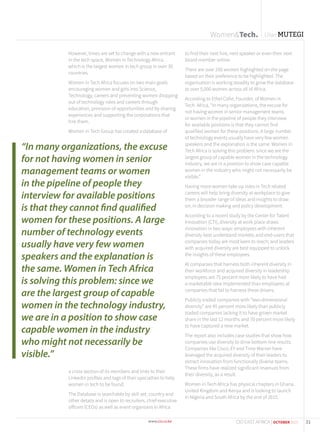
  • 35.
    OPINIONLameck Osinde Are youconsidering implementing an ERP solution for your business? Over the years, organizations have tried to strike a balance between ERP systems’ performance,versus the related costs, compexity of implementation and flexibilty of customizable features. There has been a constant and increasing reliance on technology and therefore there are dire consequences of choosing the wrong software, and can spell imminent failure and loss of business. Software implempletation can be expensive, lengthy and fraught with sigfinicant risks. As a CIO or CEO,one of the most important decisions you will be called upon to make is what strategy and delivery platform to deploy. Why is this important, you may ask?Because every business is unique with its related processes, and the decisions you finally make will have a huge impact from a business perspective. What are these strategies? Previously, the prefered systems were On- Premise ERP solutions and were wholly installed locally on the organizations’ IT infrustructure. Next came the hosted solutions, which were managed off-site but the client software would be installed and managed on the organization’s computing infrastrucure. The latest option is the colud-based ERP systems where both the data and application is cloud-based and is sold as a service, accessible via the clients’ web browser. This deployment is centrally managed, both data and application, by the Vendor and is “in the Cloud”, also known as Software-as-a-Service or SaaS based on this delivery method. It is fast gaining traction as more and more technology services have online offerings. The evaluation framework The evaluation framework should inlcude a number of key important factors. These factors must be thouroughly researched, examined andanalyzed whilst consideringthe pros and cons of each. Flexibility, Scalability and Control On-Premise ERP systems are known to be more costly with massive risks, but CIOs and Executives value their control over these systems.Cloud- based solutions offer limited configuration options, however,these have evolved rapidly to meet the prevailing competetive envronment. From a technology perspective, SaaS ERP solutions are more flexible, can be easily deployed, but lack the flexibilty of highly tailored business processes. Cost of ownership Cloud-based ERP solutions cost less than the traditional On-Premise ERP systems. What companies save by not investing in in-house IT infrastructure including servers, they pay for in the form of annual subscription costs, which cover the software, hosting charges and support costs. The ERP Provider hosts and maintains the IT infrastructure, rolls out enhancements and updates, leaving the organization’s IT team free to help elsewhere within the business. On-Premise ERP systems usually require large upfront financial investments, including the cost of IT infrastructure, skilled workers, training, overall maintenance and support costs. Cloud-based ERP costs are significantly less since the vendor implements the system based on the organizations’ requirements and scales up the features and licenses with the organization’s evolving needs. For companies with cash-flow issues, the cloud-based ERP solution is favored due to the much less initial financial outlay and the scalability based on ability to pay for the licenses. Speed of deployment Successful deployment requires careful planning to match the organization’s processes and practices to the system. This takes anything from months to years. Cloud-based ERP deployment however has a clear advantage. It offers a solution that meets the bare minimum, albeit critical requirements of most organizations. This, coupled with the fact that the Organizations do not have to invest in software and IT infrastructure, is a significant time saving advantage. Additionally, cloud-based systems allow rapid configurations, are more scalable, with high levels of availability. Implementation size Cloud–based ERP systems tend to favor small-to-medium sized companies due to low implementation and support costs. Large companies may find it more suitable for partial implementation within the organization or a solution to be integrated into an already existing On-premise ERP platform. Such deployment is more beneficial due to the scale gained by having an On-premise deployment and ownership than the potential saving offered by the cloud-based option. System Enhancements and updates On-Premise ERP systems are easier to customize, but are tied to the current version of the deployment and are not easy to be upgraded once the system is updated. In contrast, with the cloud-based ERP solutions, Vendors are responsible for maintaining both software and hardware and this includes patches, upgrades, and refreshes. The vendor is also responsible for backups, routine upgrades, patches, system monitoring and refreshes. This allows the IT support resources to be deployed in other areas within the organization. Since the Vendor is continually upgrading their version of ERP solution, the Organizations run the latest version of the software and customizations are carried forward whenever the solution is updated, at no additional cost. System Complexity There are three factors that are considered when assessing a systems’ complexity. These are size of the deployment, extent of functionality and level of integration. Large Corporates tend to need basic functionality, minimal customization and very limited integration and are best suited for cloud-based ERP deployments. Due to these matrices of complexity, some organizations have been known to adopt what is now commonly referred to as a hybrid system – retain a central On-Premise ERP to run the core enterprise and run other carefully chosen applications off the cloud-based ERP. In coclusion Evaluate these deployment options with due diligence and map them to the existing processes while planning for the desired system. Understandably, ensuring and considering all the available ERP deployment options may not be the “silver bullet” solution, but evaluate each option with its trade-offs in order to fully understand the intricacy inherent in how systems work vis-a-vis how they should work, then determine how they would work when the system is fully implemented. (Lameck Osinde is a PMI-certified ICT Consultant currently based in Ontario, Canada). ERP Solutions deployment strategies 35CIO EAST AFRICA | OCTOBER 2015
  • 36.
    OPINION Joel Gachanja BusinessContinuity Management With constant changes in the Business Landscape, it has become a necessity to manage the inherent risks that come with a business’ existence o ensure continued running. Every Business by the very nature of its existence in the environment makes it prone to disruptions (Natural or Man-Made) which if not treated could lead to a disaster. In this case, in order for a business to ensure continued operation under these unplanned outages or disruptions, there is need to establish a Business Continuity Management (BCM) programme. Besides the obvious recovery of the ICT systems, critical business processes also need to be recovered and continued in order to service the company’s customer base. In an ideal situation, an alternate recovery site, fully equipped recovery sitting facility, essential staff and services can be moved at minimum notice. The recovery site is pre-configured with all the necessary IT infrastructure, network and voice connectivity, office furniture and other amenities needed to operate a production environment at short notice. BCM was and in some instances still remains the domain of the ICT department whose responsibility to recover any failure or technical breakdown – is often known as Disaster Recovery. When Business Continuity becomes part of a business’ daily operations As businesses progress and learn from the mistakes of the past, BCM is now understood to be a more holistic process that includes the critical business processes, primarily those that rely on the underlying technology to support it and not visa-versa. Business operations and day to day functional continuity needs to be managed because a company’s risk profile keeps changing, as do its business processes and staff - all of these factors need to be assessed regularly, the necessary mitigation measures put in place, exercised and tested. Within the organisation, managers need to be able to identify critical staff, processes, systems and what their impact on the business would be in the event of a loss. The BCM lifecycle Business Continuity lifecycles are not only about business impact assessments and risk assessments, but also about plans, documents, infrastructure, systems and processes. There are 6 stages in the BCM lifecycle and they can be described as follows: Policy and Programme Management – this focuses on BCM governance, policy and the encompassing BCM programme. Analysis – Business Impact Analysis and Risk Assessments to understand the organization’s priorities, impacts of non-delivery and its environment. Design – Determining BCM recovery strategies which include ICT Disaster Recovery strategies and strategies that include all the resources needed to recover the business. Implementation – Developing ICT Disaster Recovery plan, Business Continuity Plans, Emergency Response Plans; Crisis Management Plan. Validation – Testing conducted for implemented plans and maintenance structures. Embedding BCM – Initiatives and documentation in place to support BCM training and awareness activities aimed at organisational BCM awareness. A Business Impact and Continuity Requirement Analysis helps you establish which components of business are critical for the survival of the company. This serves as the foundation on which the whole BCM process is built. It identifies, quantifies and qualifies the business impacts of a loss, interruption or disruption of business activities on an organization and provides the data from which appropriate continuity strategies can be determined. The Business Impact Analysis (BIA) documents the impacts over time that would result from a business interruption, identifying both the urgency of product and service delivery and the activities which enable that delivery to allow mitigation measures on the most urgent activities within an organisation. The BCM lifecycle methodology is represented in the diagram (Extracted from the GPG2013) The Cloud as a key driver of BCM Whilst considering the resumption of normal business operations and access to systems, it is essential that all of the critical applications are accessible and no matter what happens, if you can’t run the front ends to get to the data, it further beats the purpose of a BCM plan in the first place. Increasingly, as businesses continue to adopt cloud-based technologies as a way of service provision as and when needed whilst it is also deliverable within specific pre-defined operational parameters, the cloud avails a platform to host and operate all the elements of BCM. For instance, in geographically segmented disasters the cloud offers access to services and applications without geographic limitations and with most businesses migrating their operations to the cloud, this makes BCM adaptable into the day to day daily operations, strategies and policies of any organisation. Other benefits conferred by a cloud-based BCM include the elimination of Capex (conversion of Capex to Opex) and the fact that cloud can be scaled without disruptions; the ability of a cloud based BCM to be scaled up further without interfering with normal business operations to accommodate new risks to the business. Overall, the operational and investment costs required by any business to build, manage and scale up BCMs are easily eliminated owing to the fact that Cloud is an easily outsourced service. Conclusively, it is only timely that businesses start viewing the BCM process as not just an ICT related function but a business critical operation that must be embedded and adopted by all functions of the business. In order for organisations to achieve Continuity, there is a need to put in place a systematic process to prevent, predict and manage disruption and incidents which have the potential to disrupt the entire business. (The writer, Joel Gachanja, is the CTO at AccessKenya) Ends…// 36 CIO EAST AFRICA | OCTOBER 2015
  • 37.
    The Legatum Centerfor Development and Entrepreneurship catalyzes entrepreneurship for broad-based prosperity in low-income countries. The Center was founded on the belief that economic progress and good governance in low-income countries emerge from, and support, entrepreneurship and innovations that empower ordinary citizens. The Center administers a competitive fellowship program for incoming and current MIT students, from across all academic and professional disciplines, who have demonstrated the potential and commitment to create innovative and inclusive enterprises in low-income countries. This year, the Legatum Center for Development and Entrepreneurship came in as key participants at the 2015 edition of DEMO Africa. @CIOEastAfrica caught up with Kwadwo A. Poku, (@kwadwoapoku), Recruitment & Alumni Manager at MIT who is charged with the role of finding innovative ways to attract exceptional aspiring entrepreneurs to the fellowship. In this role, he also serves as a liaison between the center and its alumni, building an enriching and engaging global community of entrepreneurial change agents. Here are some of the insights he shared in regards to MIT and participation in DEMO Africa 2015: @CIOEastAfrica: What is MIT ? @kwadwoapoku: MIT is the Massachusetts Institute of Technology. It is a world- class university based in Cambridge Massachusetts, USA. The center I represent at MIT is the Legatum Center for Development and Entrepreneurship, and the mission of the Legatum Center is to promote entrepreneurship for broad-based prosperity in low-income countries. @kwadwoapoku: We do this through various programs, including an on-campus entrepreneurship fellowship program for MIT students committed to pursuing entrepreneurship in low-income countries, and recently, through the Zambezi Prize—a business competition for Africa- based ventures that encourage financial inclusion. The Zambezi Prize is presented by the Legatum Center at MIT and the MasterCard Foundation. @CIOEastAfrica: What does your role as a recruitment and alumni manager at MIT entail? @kwadwoapoku: As the recruitment and alumni manager at the Legatum Center, my role is to promote and coordinate the application for the Legatum Fellowship and build an engaged Legatum Fellowship alumni community. @CIOEastAfrica: From your perspective, how are the STEM careers perceived by students? @kwadwoapoku: While MIT has other academic disciplines, it is globally recognized for its STEM courses and degrees. MIT has had, and continues to have, some of the leading minds of STEM teaching at the institution. Because of its leadership in the STEM fields, it attracts students from all over the world who come to study for their Bachelors, Masters, or Doctorate degrees. @CIOEastAfrica: How does MIT prepare its students to be technology innovators? @kwadwoapoku: From its founding to present, MIT’s education philosophy is guided by the motto ‘Mens et Manus’ (Mind and Hand). MIT, incorporated by the Commonwealth of Massachusetts on April 10, 1861, was founded by William Barton Rogers, who was himself a prominent natural scientist. @kwadwoapoku: He believed that an effective education is when teaching and research are combined while focusing on solving real-world problems. This philosophy continues to guide MIT and its mission is to “advance knowledge and educate students in science, technology, and other areas of scholarship that will best serve the nation and the world in the 21st century.” Massachusetts Institute of Technology (MIT) is a dedicated to advancing knowledge and educating students in science, technology, and other areas of scholarship that will best serve the world in the 21st century. It is under MIT that the Legatum Center for Development and Entrepreneurship was founded in 2007 through a multi-million dollar gift from Legatum Group, a global investment firm. The Center administers programs and convenes events that promote and shape discourse on bottom-up development. TWITTER INTERVIEW@CIOEastAfrica’s @MurugiMutegi 37CIO EAST AFRICA | OCTOBER 2015
  • 38.
    @CIOEastAfrica: For manyyears now, IT related courses have been taken up by people from other continents as opposed to Africans. How is MIT encouraging African students to take up these courses? @kwadwoapoku: In addition to recruiting African students to pursue degrees and courses at MIT, MIT continues to invest in MOOCs. Its MOOCs platforms— OpenCourseWare (OCW) and MITx make several of its courses, including IT related courses, accessible to anybody in the world who has access to the internet. @kwadwoapoku: To make sure that learners with bandwidth constraints also have access to these courses, over 200 copies of the OCW site’s materials have been put on hard drives and sent to universities primarily in sub-Saharan Africa. @CIOEastAfrica: How successful have these efforts been? @kwadwoapoku: We’ve been quite successful. Many of MIT’s alumni in Africa are having an impact in the STEM fields and beyond. @kwadwoapoku: MIT alumni are teachers and professors, entrepreneurs who helped develop internet technology in Africa, others are operating robotics programs for youth, and government officials and policy makers overseeing the advancement of science and technology in their respective countries. @kwadwoapoku: Additionally, over 50 million visitors have accessed courses on OCW and many of them are from Africa. @CIOEastAfrica: Do you have a presence in Africa. If yes, how is MIT ensuring that Africa hubs the next “Silicon Valley”? @kwadwoapoku: The Legatum Center or MIT does not have an office or campus in Africa, but we have organized programs in Africa. For instance, the Zambezi Prize is an Africa-focused business competition that is held in Africa for Africa-based ventures. @kwadwoapoku: Other MIT centers and departments have also organized programs throughout Africa. For instance, the MIT Global Startup Labs, a technology incubator organized in emerging regions of the world, held its first incubator in Kenya in 2002. Since then, it has had incubators in several African countries, including Algeria, Ethiopia, Ghana, Nigeria, Senegal, Rwanda, South Africa, and Zambia. @CIOEastAfrica: As an institution that offers tech related courses, I believe that MIT is credited with some great tech innovations. How do you prepare start-ups to come up with scalable products? @kwadwoapoku: MIT has a very rich entrepreneurship eco-system. Not only are there 40+ courses in entrepreneurship offered to students, there are also many centers, such as the Legatum Center, and programs that promote and support entrepreneurship of all kinds and in diverse fields. @kwadwoapoku: To mention a few, there is the Legatum Fellowship, MIT Clean Energy Prize, D-Lab, Sloan Tech Club, MIT $100K Entrepreneurship Competition, The Martin Trust Center for MIT Entrepreneurship, MIT IDEAS Global Challenge, MIT Global Startup Workshop, StartLabs, MIT Venture Mentoring Service, and MIT Technology Licensing Office. @kwadwoapoku: For instance, in addition to tuition scholarships, the Legatum Fellowship provides its fellows with mentorship and networking opportunities with successful entrepreneurs and investors. Opportunities such as these increase the scalability of the startup. @CIOEastAfrica: You are one of the key participants at the 2015 edition of DEMO Africa. What informed your support for this continental event? @kwadwoapoku: The Legatum Center at MIT is committed to promoting and supporting entrepreneurship in Africa and other emerging regions. And while our core program is the Legatum Fellowship at MIT, we also sponsor events such as DEMO Africa. @kwadwoapoku: Sponsoring DEMO Africa 2015 is a way for us to continue to contribute to the entrepreneurship eco-system in Africa. DEMO Africa has a continent-wide reach that provides startups working on innovative technologies the opportunity to showcase their vision, products, and services to Africa and the world. The Legatum Center at MIT is supportive of such an event. @CIOEastAfrica: What is your expectation from this year’s DEMO Africa event? @kwadwoapoku: I am expecting to see amazing startups and technologies that are second to none in other regions of the world, and also have a positive, productive, and creative impact on the lives of Africans and the economies of the continent. Continued from page37 >> 38 CIO EAST AFRICA | OCTOBER 2015
  • 39.
    We have recentlycompleted the development of our latest training course on Security Metrics Development and delivered it for the first time. The development of security metrics is very important, yet it is an area of extreme deficiency in many organizations. Appreciating the importance of measuring security is a given. If there were a product that could do it automatically it would be one of the best selling products in the market. Unfortunately it is not that simple. Developing Security Metrics OPINIONAlmerindo Graziano The first step in “cracking” the security metrics nut it to define what a metric is. One would think that being such an important issue in today’s information security world, there would be plenty of definitions out there. Unfortunately, that is part of the problem. There is not a good definition and in order to understand what a metric is, one has to first digest quite a bit of reading. The first and focal publication on the subject is the book by Andrew Jaquith from 2007, titled “Security Metrics: Replacing Fear, Uncertainty, and Doubt”. As of today, the book is still the only book that fully addresses the subject of security metrics in all its facets, including data collection and analysis techniques, information visualization and more. What is a metric then? Paraphrasing the definition of metric from Wikipedia, we can define a metric as follows: “A metric is a system of attributes or parameters and documented methods of assigning values to them (obtaining a measure) and interpreting them so that they can provide meaningful and usable information about an object of measurement.” The best way to visualize a metric, based on the above definition, is to use a metric template, i.e. a sample empty metric, which can help us define the specific object of measurement, the associated attributes and other important element of a metric. Let’s say we wish to measure the patch management process. That is now our object of measurement, i.e. the object we wish to measure. What does it mean to develop a metric for such process? The first questions we have to ask ourselves are: “What information are we trying to get out of the measurement process? Specifically, what do we want to learn about the patch management process that we do not know and why do we need that information? How would that information be relevant to us? In other words, the development of a metric begins with the elements of meaningful and usable information from the metric definition. Meaning and usability are relative concepts, which require defining a target audience to whom the information will be meaningful and usable. The information generated by a metric may be meaningful and actionable for the administrator of the patch management system but not by the senior management of the organization. 39CIO EAST AFRICA | OCTOBER 2015
  • 40.
    HardTALK Bobby YAWE Atime to let go It is interesting how uncanny our personal lives emulate our professional lives and lessons in one are applicable in the other. In late August 2015, my eldest child got an admission letter to join university, after which the burning question became: “should he commute from home or move into a hostel on campus?” Note that none of my children has ever been to boarding school and to the best of my knowledge, the longest continuous period we have not all slept under one roof is one week. Now here I was running helter skelter looking for what I would consider acceptable accommodation based on the lifestyle we have accustomed them to. I am sure by now you have looked back at the cover of the magazine to make sure that you are not reading some lifestyle magazine. Do not be alarmed and keep reading, as at some point this content will become more relevant. Finally, we decided to let him go out and make the decision on where he would be comfortable staying but with the clear message from us that we had no objection to him commuting. Off he went and as of early August, he had moved into campus. Every time we look at our children, we remember them as helpless infants yet some are in their teens, other past their teens and others have families of their own. But we still see and treat them like they were still dependent on us. The same is the problem I think many ICT managers are having and that then keeps them from truly becoming CIOs as we see the systems we have put up as still dependent on us. This is clearly visible from the resistance to move our servers into co-location sites or even virtualising systems. While attending a presentation on Cloud Computing recently, the issue of letting go kept nudging at the back of my head and as we moved to the forum, it was clear that I was not the only one with this reservation. The presenters worked very hard to convince the audience of the technological soundness of their offering but that was not the resisting point. It was more about our preparedness to let go of the infrastructure or the applications that we have made accustomed to having us physically around. Life dictates that we must accept to let go of our offspring, siblings, parents, friends, workmates and many others and because of that, many of us look for inanimate substitutes that cannot make the decision to leave us such as cars, houses and server racks. The resistance to let go is quite strong, this has become clearer to us over the past few years as our business moved towards the retrofitting of data centres to reduce the need for physical access to the equipment. This has meant that the ICT personnel need to develop confidence in the information provided remotely, by for example the environment monitoring system. Even with most equipment that is sitting in our data centres today, ranging from AC units to patch panels having SNMP capability, we treat many of them like 3-month-old babies with regular forehead checks with our hand for temperature changes or console logins to monitor network activity. In one of the cases, we were trying to convince a client to install an IP-enabled KVM device that would allow them to access their servers from a room immediately next to the data centre. The resistance was palpable. I was wondering what the reaction would be if I proposed that they could do this from a different floor within the same building. Now imagine asking them to co-locate the servers, or the more radical proposal to install their applications on a server that they did not own or the blasphemous on the cloud. I finally let go of my son with the conviction that I had equipped him fully to take on the world on his own. And this is the true test of a parent and so too is it to the systems we have developed. Are they resilient enough to stand on their own cloud feet? Life dictates that we must accept to let go of our offspring, siblings, parents, friends, workmates and many others and because of that, many of us look for inanimate substitutes that cannot make the decision to leave us such as cars, houses and server racks. 40 CIO EAST AFRICA | OCTOBER 2015