Cinematography of
Psychological Horror’s over the
years.
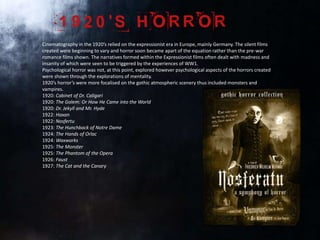
Cinematography in the 1920’s relied on the expressionist era in Europe, mainly Germany. The silent films
created were beginning to vary and horror soon became apart of the equation rather than the pre-war
romance films shown. The narratives formed within the Expressionist films often dealt with madness and
insanity of which were seen to be triggered by the experiences of WW1.
Psychological horror was not, at this point, explored however psychological aspects of the horrors created
were shown through the explorations of mentality.
1920’s horror’s were more focalised on the gothic atmospheric scenery thus included monsters and
vampires.
1920: Cabinet of Dr. Caligari
1920: The Golem: Or How He Came into the World
1920: Dr. Jekyll and Mr. Hyde
1922: Haxan
1922: Nosfertu
1923: The Hunchback of Notre Dame
1924: The Hands of Orlac
1924: Waxworks
1925: The Monster
1925: The Phantom of the Opera
1926: Faust
1927: The Cat and the Canary
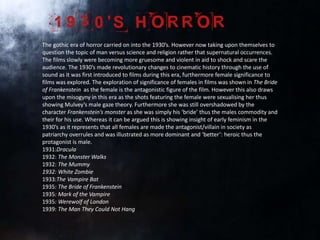
The gothic era of horror carried on into the 1930’s. However now taking upon themselves to
question the topic of man versus science and religion rather that supernatural occurrences.
The films slowly were becoming more gruesome and violent in aid to shock and scare the
audience. The 1930’s made revolutionary changes to cinematic history through the use of
sound as it was first introduced to films during this era, furthermore female significance to
films was explored. The exploration of significance of females in films was shown in The Bride
of Frankenstein as the female is the antagonistic figure of the film. However this also draws
upon the misogyny in this era as the shots featuring the female were sexualising her thus
showing Mulvey’s male gaze theory. Furthermore she was still overshadowed by the
character Frankenstein’s monster as she was simply his ‘bride’ thus the males commodity and
their for his use. Whereas it can be argued this is showing insight of early feminism in the
1930’s as it represents that all females are made the antagonist/villain in society as
patriarchy overrules and was illustrated as more dominant and ‘better’: heroic thus the
protagonist is male.
1931:Dracula
1932: The Monster Walks
1932: The Mummy
1932: White Zombie
1933:The Vampire Bat
1935: The Bride of Frankenstein
1935: Mark of the Vampire
1935: Werewolf of London
1939: The Man They Could Not Hang
The 1940’s was a controversial era for film, during the world war 2 period no
films could be shown in cinema theatres due to films centring around
propaganda being created and shown by the government to control society. After
the war horror films became scarce due to the fact people were frightened by
what had actually happened and thus wanted to find every escape they could
and would not want to further their trauma through watching horror films.
1941:The Black Cat
1942:. Cat people
1943: Leopard man
1944: Jungle Woman
1945: Isle of the dead
1946: Cat creeps
1946: She-wolf of London
1947: Scared to death
After the war period people had developed new fears and overcome their
previous fears pre-war. This was due to the trauma caused by war and the scenes
they had seen and experienced during. Thus people were no longer frightened as
easily, cinematography evolved with this societal change and began to look into
explorations of science, the unknown and evolving societies such as technological
change. All of these matters effecting a new audience: teenagers. The films began
including teenagers to fit their new target demographic; of which is done in
today’s films.
1957:Cat girl
1957: I was a teenage werewolf
1958: The giant from the unknown
1958: The Fly
1958: The Blob
1959: Teenage Zombies
Psychological horror properly made an appearance in this era. Psycho was the
most prominent psychological film and many followed after all exploring this new
sub-genre. Due to being post-war there were greater limitations on budget and
resources. Explorations of man being the monster was illustrated in Psycho and
Ghost paranormal/super-natural occurrences was explored in The haunting.
1960:Psycho
1960:. The Mask of Satan
1960: The village of the damned
1963: The birds
1963: The haunting
1964: Onibaba
1968: Night of the living dead
Psychological horror had now been explored and experimented with and had
become more popular. The 1970’s explored the fears of childbirth due to the
recent discovery of ‘the pill’ furthermore the nuclear family was becoming a
rarity, divorce rates rose and single motherhood became vast. The psychological
aspects of the family institution became a fear played upon in horrors seen in The
shining as the father sets out to kill his wife and son, furthermore the main
antagonists of many films at this time were children for example The exorcist.
1973: The exorcist
1975: Jaws
1976: The omen
1978: halloween
1979: Carrie
1979: Alien
The 1980’s was the years of which technological development occurred thus resulting in uses of SFX
becoming more common in horror. The 1980’s was filled with materialism, people wanted to keep improving
and wanted success in the way they were and what they did. This was shown in the horrors produced during
this era.
1980: The shining
1981: Evil dead
1981: American werewolf in London
1982: The thing
1982: Poltergeist
1984: The nightmare on elm street
1987: Evil dead 2
1987: Hellraiser
The SFX and blood and gore created during the 1980’s had become such a staple
for horror that it lost its shock factor and thus no longer scared the audience but
amused them in a comical way. The horror industry then began to find that their
new audience were scared of what was going on around them in their society
thus they focused the horror films of serial killers. The horrors became a mix of
sub-genre but primarily focusing on psychological as the films were centred
around the psychopathic murderer.
1991: Silence of the Lambs
1993: Trauma
1993: Kalifornia
1994: Natural born killers
1995: se7en
1995: Copycat
Horror films during this era played upon the subtexts of predications of future and also the
further unknown. This is a big era for psychological/supernatural film subgenre’s as the era
explores the fears associated with paranormal occurrences. Throughout the years people
have been scared of the unknown whether it be government, aliens or ghosts, the fear of not
knowing who or what is watching is extremely chilling as no one really knows. The thought of
possession especially in children was shown to be frightening and thus is a convention used
in many films. The use of SFX has improved with technological advances and also adds to the
realism of the films during the era and also combines the bloody gore aspects of splasher
and splatter films with the psychological narratives.
2000: Final destination
2002: The ring
2002: 28 days later
2002: The grudge
2004: Saw
2007: REC
2007: Paranormal activity
2009: Drag me to hell

Cinematography

  • 1.
  • 2.
    Cinematography in the1920’s relied on the expressionist era in Europe, mainly Germany. The silent films created were beginning to vary and horror soon became apart of the equation rather than the pre-war romance films shown. The narratives formed within the Expressionist films often dealt with madness and insanity of which were seen to be triggered by the experiences of WW1. Psychological horror was not, at this point, explored however psychological aspects of the horrors created were shown through the explorations of mentality. 1920’s horror’s were more focalised on the gothic atmospheric scenery thus included monsters and vampires. 1920: Cabinet of Dr. Caligari 1920: The Golem: Or How He Came into the World 1920: Dr. Jekyll and Mr. Hyde 1922: Haxan 1922: Nosfertu 1923: The Hunchback of Notre Dame 1924: The Hands of Orlac 1924: Waxworks 1925: The Monster 1925: The Phantom of the Opera 1926: Faust 1927: The Cat and the Canary
  • 3.
    The gothic eraof horror carried on into the 1930’s. However now taking upon themselves to question the topic of man versus science and religion rather that supernatural occurrences. The films slowly were becoming more gruesome and violent in aid to shock and scare the audience. The 1930’s made revolutionary changes to cinematic history through the use of sound as it was first introduced to films during this era, furthermore female significance to films was explored. The exploration of significance of females in films was shown in The Bride of Frankenstein as the female is the antagonistic figure of the film. However this also draws upon the misogyny in this era as the shots featuring the female were sexualising her thus showing Mulvey’s male gaze theory. Furthermore she was still overshadowed by the character Frankenstein’s monster as she was simply his ‘bride’ thus the males commodity and their for his use. Whereas it can be argued this is showing insight of early feminism in the 1930’s as it represents that all females are made the antagonist/villain in society as patriarchy overrules and was illustrated as more dominant and ‘better’: heroic thus the protagonist is male. 1931:Dracula 1932: The Monster Walks 1932: The Mummy 1932: White Zombie 1933:The Vampire Bat 1935: The Bride of Frankenstein 1935: Mark of the Vampire 1935: Werewolf of London 1939: The Man They Could Not Hang
  • 4.
    The 1940’s wasa controversial era for film, during the world war 2 period no films could be shown in cinema theatres due to films centring around propaganda being created and shown by the government to control society. After the war horror films became scarce due to the fact people were frightened by what had actually happened and thus wanted to find every escape they could and would not want to further their trauma through watching horror films. 1941:The Black Cat 1942:. Cat people 1943: Leopard man 1944: Jungle Woman 1945: Isle of the dead 1946: Cat creeps 1946: She-wolf of London 1947: Scared to death
  • 5.
    After the warperiod people had developed new fears and overcome their previous fears pre-war. This was due to the trauma caused by war and the scenes they had seen and experienced during. Thus people were no longer frightened as easily, cinematography evolved with this societal change and began to look into explorations of science, the unknown and evolving societies such as technological change. All of these matters effecting a new audience: teenagers. The films began including teenagers to fit their new target demographic; of which is done in today’s films. 1957:Cat girl 1957: I was a teenage werewolf 1958: The giant from the unknown 1958: The Fly 1958: The Blob 1959: Teenage Zombies
  • 6.
    Psychological horror properlymade an appearance in this era. Psycho was the most prominent psychological film and many followed after all exploring this new sub-genre. Due to being post-war there were greater limitations on budget and resources. Explorations of man being the monster was illustrated in Psycho and Ghost paranormal/super-natural occurrences was explored in The haunting. 1960:Psycho 1960:. The Mask of Satan 1960: The village of the damned 1963: The birds 1963: The haunting 1964: Onibaba 1968: Night of the living dead
  • 7.
    Psychological horror hadnow been explored and experimented with and had become more popular. The 1970’s explored the fears of childbirth due to the recent discovery of ‘the pill’ furthermore the nuclear family was becoming a rarity, divorce rates rose and single motherhood became vast. The psychological aspects of the family institution became a fear played upon in horrors seen in The shining as the father sets out to kill his wife and son, furthermore the main antagonists of many films at this time were children for example The exorcist. 1973: The exorcist 1975: Jaws 1976: The omen 1978: halloween 1979: Carrie 1979: Alien
  • 8.
    The 1980’s wasthe years of which technological development occurred thus resulting in uses of SFX becoming more common in horror. The 1980’s was filled with materialism, people wanted to keep improving and wanted success in the way they were and what they did. This was shown in the horrors produced during this era. 1980: The shining 1981: Evil dead 1981: American werewolf in London 1982: The thing 1982: Poltergeist 1984: The nightmare on elm street 1987: Evil dead 2 1987: Hellraiser
  • 9.
    The SFX andblood and gore created during the 1980’s had become such a staple for horror that it lost its shock factor and thus no longer scared the audience but amused them in a comical way. The horror industry then began to find that their new audience were scared of what was going on around them in their society thus they focused the horror films of serial killers. The horrors became a mix of sub-genre but primarily focusing on psychological as the films were centred around the psychopathic murderer. 1991: Silence of the Lambs 1993: Trauma 1993: Kalifornia 1994: Natural born killers 1995: se7en 1995: Copycat
  • 10.
    Horror films duringthis era played upon the subtexts of predications of future and also the further unknown. This is a big era for psychological/supernatural film subgenre’s as the era explores the fears associated with paranormal occurrences. Throughout the years people have been scared of the unknown whether it be government, aliens or ghosts, the fear of not knowing who or what is watching is extremely chilling as no one really knows. The thought of possession especially in children was shown to be frightening and thus is a convention used in many films. The use of SFX has improved with technological advances and also adds to the realism of the films during the era and also combines the bloody gore aspects of splasher and splatter films with the psychological narratives. 2000: Final destination 2002: The ring 2002: 28 days later 2002: The grudge 2004: Saw 2007: REC 2007: Paranormal activity 2009: Drag me to hell