1 2
3
EARLY ANIMATED FILM
I
n 1908 Fantasmagorie by Emile Cohl (1857–1938) mesmerized audiences,
showing the possibilities of animation. The German silhouette animator
Lotte Reiniger (1899–1981) had great success in 1926 with what is now
the world’s oldest surviving animated feature film, Die Abenteuer des Prinzen
Achmed (The Adventures of Prince Achmed, above). In 1928 animation’s most
famous son was born. He is an icon, recognizable the world over, having appeared
in hundreds of shorts and films. Mickey Mouse first appeared in 1928 and
the best known of the early Mickey cartoons is that year’s Steamboat Willie
(opposite above). The magic of Disney Studio’s animation is evident in this early
example, with catchy music and anthropomorphic characters. For decades, artists
have convinced viewers that, despite looking almost identical to Mickey, Minnie
is female, simply by putting her in a dress and placing a bow on her head.
In the golden age of Disney, Walt Disney and his ‘Nine Old Men’ (key
animators) worked tirelessly at producing animation for the masses and creating
what would become the template in Western cinema for animated feature films.
Between 1937 and 1942 they released Snow White and the Seven Dwarfs (1937,
see p.146), Pinocchio (1940), Fantasia (1940), Dumbo (1941) and Bambi (1942). Each
film is a cultural milestone and each is pioneering in its own way—Fantasia’s
combination of animation and stereophonic sound recording, for example, or
the balance of emotional peaks and grave darkness in Pinocchio and Bambi.
Concurrently, Fleischer Studios, MGM and Warner Brothers were crafting
world-class animation of their own. Fleischer created the legendary Betty Boop,
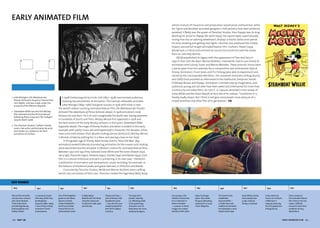
1 Lotte Reiniger’s Die Abenteuer des
Prinzen Achmed is based on stories from
1001 Nights, and was made under the
auspices of the Weimar Republic.
2 Steamboat Willie was the first Mickey
film released and the third produced
following Plane Crazy and The Gallopin’
Gaucho (both 1928).
3 The Fleischer Studios’ Gulliver’s Travels
used a live action performance by actor
Sam Parker as a reference for their
animation of Gulliver.
whose mixture of innocence and provocation would prove controversial, while
her figure and Brooklyn-accented gangster’s moll persona have been endlessly
parodied. If Betty was the queen of Fleischer Studios, then Popeye was its king.
Marking his arrival in Popeye the Sailor (1933), the squint-eyed, supernaturally
strong man has an adoring sweetheart, displays a macho tattoo and spends
his time smoking and getting into fights. Fleischer also produced the United
States’s second full-length animated feature film: Gulliver’s Travels (1939,
below) was a critical and commercial success but could not save the studio
from an untimely demise.
MGM established its legacy with the appearance of Tom and Jerry in
1940 in Puss Gets the Boot. Warner Brothers, meanwhile, had its own brand of
animation with Looney Tunes and Merrie Melodies. These anarchic shorts were
a world apart from the selective focus composition and sentimental style of
Disney. Animators Chuck Jones and Friz Freleng were able to experiment and,
voiced by the incomparable Mel Blanc, the screwball characters of Bugs Bunny
and Daffy Duck provided an alternative to the traditional, Everyman heroes
of Mickey Mouse and Popeye. Animation is limited only by imagination, and
audiences young and old alike have been awed and entertained for more than
a century by animated films. As critic C. A. Lejeune remarked in her review of
Snow White and the Seven Dwarfs at the time of its release: ‘Sometimes it is,
frankly, badly drawn. But I think it will give more people more pleasure of a
simple kind than any other film of its generation.’ SW
144 1930–39
Le roman de renard
(The Story of the Fox),
by Wladyslaw
Starevich (1882–1965),
is one of stop-motion
animation’s finest
achievements.
In Betty Boop’s
Bamboo Isle, the titular
character showcases
her blend of wide-eyed
promiscuity.
Flowers and Trees—
part of Disney’s Silly
Symphonies series
—wins the first ever
Academy Award for
Best Short Subject:
Cartoons.
The Hays Act is
passed, ‘cleaning
up’ offending media
and transforming
characters such as
Betty Boop into more
wholesome figures.
Warner Bros launches
Looney Tunes cartoons
into movie theatres.
These early shorts
precede Bugs Bunny,
featuring Bosko and
Buddy instead.
One of the forgotten
greats of animation,
Quirino Cristiani,
makes Peludopolis—
the first animated
feature film to use
synchronized sound.
1935 1935 1936 1937 1940 19411932 1932 1932 19351929 1930
key events
early animated film 145
Oskar Fischinger
(1900–67) creates
the groundbreaking
experiment in visual
music Allegretto.
Snow White and the
Seven Dwarfs (see
p.146), made by
Disney, is released.
In the midst of a
classic run of shorts,
A Wild Hare is
released, featuring
the first appearance
of Bugs Bunny.
China creates its
first animated feature
film, Princess Iron Fan,
made in difficult
economic and artistic
conditions during
World War II.
Len Lye (1901–80)
releases A Colour Box.
It is a milestone in
direct animation
—a process in which
images are created
directly on film stock.
The Soviet Union
established
Soyuzmultfilm—
a studio that used
traditional animation
but developed a more
experimental style.

Cinema sample 2

  • 1.
    1 2 3 EARLY ANIMATEDFILM I n 1908 Fantasmagorie by Emile Cohl (1857–1938) mesmerized audiences, showing the possibilities of animation. The German silhouette animator Lotte Reiniger (1899–1981) had great success in 1926 with what is now the world’s oldest surviving animated feature film, Die Abenteuer des Prinzen Achmed (The Adventures of Prince Achmed, above). In 1928 animation’s most famous son was born. He is an icon, recognizable the world over, having appeared in hundreds of shorts and films. Mickey Mouse first appeared in 1928 and the best known of the early Mickey cartoons is that year’s Steamboat Willie (opposite above). The magic of Disney Studio’s animation is evident in this early example, with catchy music and anthropomorphic characters. For decades, artists have convinced viewers that, despite looking almost identical to Mickey, Minnie is female, simply by putting her in a dress and placing a bow on her head. In the golden age of Disney, Walt Disney and his ‘Nine Old Men’ (key animators) worked tirelessly at producing animation for the masses and creating what would become the template in Western cinema for animated feature films. Between 1937 and 1942 they released Snow White and the Seven Dwarfs (1937, see p.146), Pinocchio (1940), Fantasia (1940), Dumbo (1941) and Bambi (1942). Each film is a cultural milestone and each is pioneering in its own way—Fantasia’s combination of animation and stereophonic sound recording, for example, or the balance of emotional peaks and grave darkness in Pinocchio and Bambi. Concurrently, Fleischer Studios, MGM and Warner Brothers were crafting world-class animation of their own. Fleischer created the legendary Betty Boop, 1 Lotte Reiniger’s Die Abenteuer des Prinzen Achmed is based on stories from 1001 Nights, and was made under the auspices of the Weimar Republic. 2 Steamboat Willie was the first Mickey film released and the third produced following Plane Crazy and The Gallopin’ Gaucho (both 1928). 3 The Fleischer Studios’ Gulliver’s Travels used a live action performance by actor Sam Parker as a reference for their animation of Gulliver. whose mixture of innocence and provocation would prove controversial, while her figure and Brooklyn-accented gangster’s moll persona have been endlessly parodied. If Betty was the queen of Fleischer Studios, then Popeye was its king. Marking his arrival in Popeye the Sailor (1933), the squint-eyed, supernaturally strong man has an adoring sweetheart, displays a macho tattoo and spends his time smoking and getting into fights. Fleischer also produced the United States’s second full-length animated feature film: Gulliver’s Travels (1939, below) was a critical and commercial success but could not save the studio from an untimely demise. MGM established its legacy with the appearance of Tom and Jerry in 1940 in Puss Gets the Boot. Warner Brothers, meanwhile, had its own brand of animation with Looney Tunes and Merrie Melodies. These anarchic shorts were a world apart from the selective focus composition and sentimental style of Disney. Animators Chuck Jones and Friz Freleng were able to experiment and, voiced by the incomparable Mel Blanc, the screwball characters of Bugs Bunny and Daffy Duck provided an alternative to the traditional, Everyman heroes of Mickey Mouse and Popeye. Animation is limited only by imagination, and audiences young and old alike have been awed and entertained for more than a century by animated films. As critic C. A. Lejeune remarked in her review of Snow White and the Seven Dwarfs at the time of its release: ‘Sometimes it is, frankly, badly drawn. But I think it will give more people more pleasure of a simple kind than any other film of its generation.’ SW 144 1930–39 Le roman de renard (The Story of the Fox), by Wladyslaw Starevich (1882–1965), is one of stop-motion animation’s finest achievements. In Betty Boop’s Bamboo Isle, the titular character showcases her blend of wide-eyed promiscuity. Flowers and Trees— part of Disney’s Silly Symphonies series —wins the first ever Academy Award for Best Short Subject: Cartoons. The Hays Act is passed, ‘cleaning up’ offending media and transforming characters such as Betty Boop into more wholesome figures. Warner Bros launches Looney Tunes cartoons into movie theatres. These early shorts precede Bugs Bunny, featuring Bosko and Buddy instead. One of the forgotten greats of animation, Quirino Cristiani, makes Peludopolis— the first animated feature film to use synchronized sound. 1935 1935 1936 1937 1940 19411932 1932 1932 19351929 1930 key events early animated film 145 Oskar Fischinger (1900–67) creates the groundbreaking experiment in visual music Allegretto. Snow White and the Seven Dwarfs (see p.146), made by Disney, is released. In the midst of a classic run of shorts, A Wild Hare is released, featuring the first appearance of Bugs Bunny. China creates its first animated feature film, Princess Iron Fan, made in difficult economic and artistic conditions during World War II. Len Lye (1901–80) releases A Colour Box. It is a milestone in direct animation —a process in which images are created directly on film stock. The Soviet Union established Soyuzmultfilm— a studio that used traditional animation but developed a more experimental style.