Keramoti
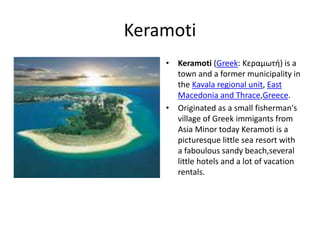
• Keramoti (Greek: Κεραμωτή) is a
town and a former municipality in
the Kavala regional unit, East
Macedonia and Thrace,Greece.
• Originated as a small fisherman's
village of Greek immigants from
Asia Minor today Keramoti is a
picturesque little sea resort with
a faboulous sandy beach,several
little hotels and a lot of vacation
rentals.
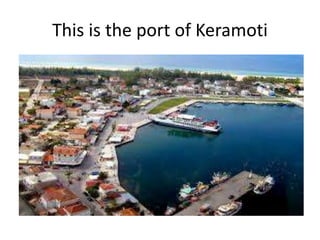
This is the port of Keramoti
Thassos island
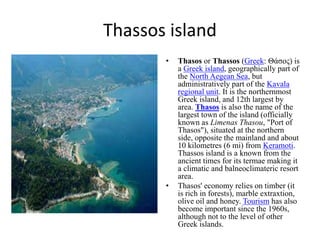
• Thasos or Thassos (Greek: Θάσος) is
a Greek island, geographically part of
the North Aegean Sea, but
administratively part of the Kavala
regional unit. It is the northernmost
Greek island, and 12th largest by
area. Thasos is also the name of the
largest town of the island (officially
known as Limenas Thasou, "Port of
Thasos"), situated at the northern
side, opposite the mainland and about
10 kilometres (6 mi) from Keramoti.
Thassos island is a known from the
ancient times for its termae making it
a climatic and balneoclimateric resort
area.
• Thasos' economy relies on timber (it
is rich in forests), marble extraxtion,
olive oil and honey. Tourism has also
become important since the 1960s,
although not to the level of other
Greek islands.
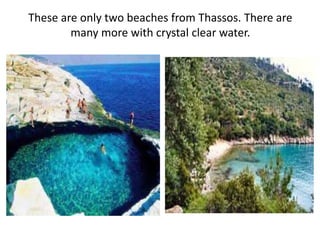
These are only two beaches from Thassos. There are
many more with crystal clear water.
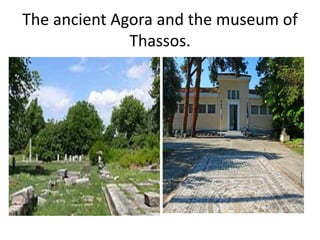
The ancient Agora and the museum of
Thassos.
The Nestos river
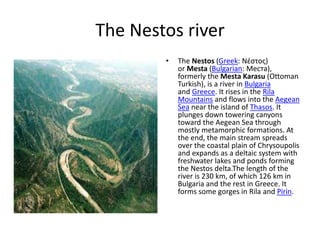
• The Nestos (Greek: Νέστος)
or Mesta (Bulgarian: Места),
formerly the Mesta Karasu (Ottoman
Turkish), is a river in Bulgaria
and Greece. It rises in the Rila
Mountains and flows into the Aegean
Sea near the island of Thasos. It
plunges down towering canyons
toward the Aegean Sea through
mostly metamorphic formations. At
the end, the main stream spreads
over the coastal plain of Chrysoupolis
and expands as a deltaic system with
freshwater lakes and ponds forming
the Nestos delta.The length of the
river is 230 km, of which 126 km in
Bulgaria and the rest in Greece. It
forms some gorges in Rila and Pirin.
The Nestos
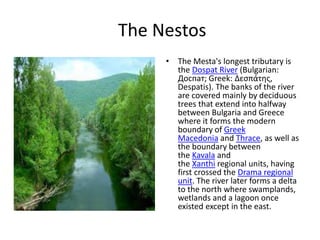
• The Mesta's longest tributary is
the Dospat River (Bulgarian:
Доспат; Greek: Δεσπάτης,
Despatis). The banks of the river
are covered mainly by deciduous
trees that extend into halfway
between Bulgaria and Greece
where it forms the modern
boundary of Greek
Macedonia and Thrace, as well as
the boundary between
the Kavala and
the Xanthi regional units, having
first crossed the Drama regional
unit. The river later forms a delta
to the north where swamplands,
wetlands and a lagoon once
existed except in the east.
The Nestos
• Nestos River is one of
the five longest rivers in
Greece.It creates an
environment of special
interest, unique value
and rare beauty, where
rare plants and
endangered animals
find shelter.
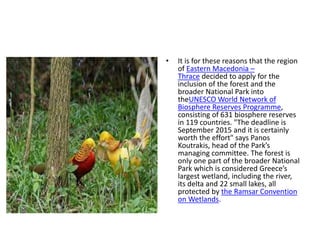
• It is for these reasons that the region
of Eastern Macedonia –
Thrace decided to apply for the
inclusion of the forest and the
broader National Park into
theUNESCO World Network of
Biosphere Reserves Programme,
consisting of 631 biosphere reserves
in 119 countries. "The deadline is
September 2015 and it is certainly
worth the effort" says Panos
Koutrakis, head of the Park’s
managing committee. The forest is
only one part of the broader National
Park which is considered Greece’s
largest wetland, including the river,
its delta and 22 small lakes, all
protected by the Ramsar Convention
on Wetlands.
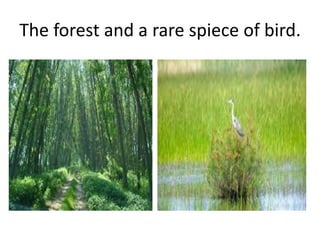
The forest and a rare spiece of bird.
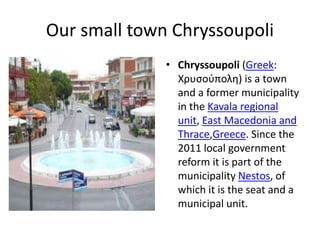
Our small town Chryssoupoli
• Chryssoupoli (Greek:
Χρυσούπολη) is a town
and a former municipality
in the Kavala regional
unit, East Macedonia and
Thrace,Greece. Since the
2011 local government
reform it is part of the
municipality Nestos, of
which it is the seat and a
municipal unit.
Chryssoupoli
• It was known as
"Sarışaban" during
Ottoman rule. It was
a kaza centre in
the Sanjak of Drama, part
of the Salonica Vilayet,
before the Balkan Wars.
• Its old name was Sapaioi
between 1913-1929.[3]
• The Nestos Nature
Museum is situated in
Chryssoupoli.

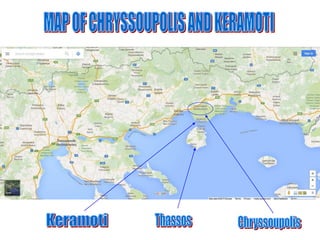
Chryssoupolis and keramoti

  • 2.
    Keramoti • Keramoti (Greek:Κεραμωτή) is a town and a former municipality in the Kavala regional unit, East Macedonia and Thrace,Greece. • Originated as a small fisherman's village of Greek immigants from Asia Minor today Keramoti is a picturesque little sea resort with a faboulous sandy beach,several little hotels and a lot of vacation rentals.
  • 3.
    This is theport of Keramoti
  • 4.
    Thassos island • Thasosor Thassos (Greek: Θάσος) is a Greek island, geographically part of the North Aegean Sea, but administratively part of the Kavala regional unit. It is the northernmost Greek island, and 12th largest by area. Thasos is also the name of the largest town of the island (officially known as Limenas Thasou, "Port of Thasos"), situated at the northern side, opposite the mainland and about 10 kilometres (6 mi) from Keramoti. Thassos island is a known from the ancient times for its termae making it a climatic and balneoclimateric resort area. • Thasos' economy relies on timber (it is rich in forests), marble extraxtion, olive oil and honey. Tourism has also become important since the 1960s, although not to the level of other Greek islands.
  • 5.
    These are onlytwo beaches from Thassos. There are many more with crystal clear water.
  • 6.
    The ancient Agoraand the museum of Thassos.
  • 7.
    The Nestos river •The Nestos (Greek: Νέστος) or Mesta (Bulgarian: Места), formerly the Mesta Karasu (Ottoman Turkish), is a river in Bulgaria and Greece. It rises in the Rila Mountains and flows into the Aegean Sea near the island of Thasos. It plunges down towering canyons toward the Aegean Sea through mostly metamorphic formations. At the end, the main stream spreads over the coastal plain of Chrysoupolis and expands as a deltaic system with freshwater lakes and ponds forming the Nestos delta.The length of the river is 230 km, of which 126 km in Bulgaria and the rest in Greece. It forms some gorges in Rila and Pirin.
  • 8.
    The Nestos • TheMesta's longest tributary is the Dospat River (Bulgarian: Доспат; Greek: Δεσπάτης, Despatis). The banks of the river are covered mainly by deciduous trees that extend into halfway between Bulgaria and Greece where it forms the modern boundary of Greek Macedonia and Thrace, as well as the boundary between the Kavala and the Xanthi regional units, having first crossed the Drama regional unit. The river later forms a delta to the north where swamplands, wetlands and a lagoon once existed except in the east.
  • 9.
    The Nestos • NestosRiver is one of the five longest rivers in Greece.It creates an environment of special interest, unique value and rare beauty, where rare plants and endangered animals find shelter.
  • 10.
    • It isfor these reasons that the region of Eastern Macedonia – Thrace decided to apply for the inclusion of the forest and the broader National Park into theUNESCO World Network of Biosphere Reserves Programme, consisting of 631 biosphere reserves in 119 countries. "The deadline is September 2015 and it is certainly worth the effort" says Panos Koutrakis, head of the Park’s managing committee. The forest is only one part of the broader National Park which is considered Greece’s largest wetland, including the river, its delta and 22 small lakes, all protected by the Ramsar Convention on Wetlands.
  • 11.
    The forest anda rare spiece of bird.
  • 12.
    Our small townChryssoupoli • Chryssoupoli (Greek: Χρυσούπολη) is a town and a former municipality in the Kavala regional unit, East Macedonia and Thrace,Greece. Since the 2011 local government reform it is part of the municipality Nestos, of which it is the seat and a municipal unit.
  • 13.
    Chryssoupoli • It wasknown as "Sarışaban" during Ottoman rule. It was a kaza centre in the Sanjak of Drama, part of the Salonica Vilayet, before the Balkan Wars. • Its old name was Sapaioi between 1913-1929.[3] • The Nestos Nature Museum is situated in Chryssoupoli.