THE CHRONICLES OF GARBAGE COLLECTION
BY
Rupreet Singh Gujral (rupreetg@outlook.com)
Product Development / Architect / Entrepreneur
AGENDA
• Memory Concepts
• Basic Principles
• Advantages and Disadvantages of using GC
• GC Algorithm
• Setting the context
• CLR implementation of GC
• Best practices related to memory management in .NET
MEMORY CONCEPTS
• Physical Memory: This is the physical RAM on the machine/device. This is mainly used by kernel
drivers.
• Virtual Memory: It’s the memory emulation Operating System does for user to store and access data.
Its not related to physical memory. Virtual Memory is used at system level.
• Address space: This is specific to the memory allocated/used by a process. Threads in a process use
address space for their stack, etc. Address space is used at process level.
• Private bytes: Private Bytes is the current size, in bytes, of memory that this process has allocated
that cannot be shared with other processes.
• Working Set: The Working Set is the set of memory pages touched recently by the threads in the
process.
ARE YOU GUYS AWAKE?
• Suppose user is running an application on a x64 bit machine.
• The machine has 4GB RAM installed.
• Task Manager shows 2GB of total RAM is used and rest is free
• After running application, it throws “Out Of Memory” (OOM) exception.
How?
OK, LET ME HELP YOU!
• Application always allocate memory in its “address space”. If the
allocated “address space” is exhausted, only then you’ll get OOM
exception even if Virtual Memory is available
BASIC PRINCIPLES!
• Find objects that cannot be accessed in the future
• Reclaim/Release the resources used by those objects
HISTORY
Garbage collection was invented by John McCarthy around 1959 to
solve problems in Lisp
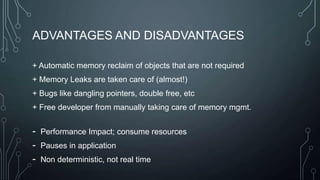
ADVANTAGES AND DISADVANTAGES
+ Automatic memory reclaim of objects that are not required
+ Memory Leaks are taken care of (almost!)
+ Bugs like dangling pointers, double free, etc
+ Free developer from manually taking care of memory mgmt.
- Performance Impact; consume resources
- Pauses in application
- Non deterministic, not real time
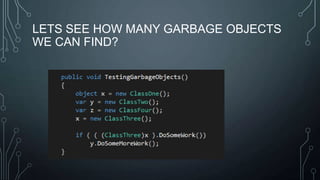
LETS SEE HOW MANY GARBAGE OBJECTS
WE CAN FIND?
GC ALGORITHM
• Reference Counting: Each object has a flag telling if it is referenced or not.
• Mark and Sweep: Two round collection cycle. First round it marks objects which are live
and in second round it clears the unused objects
• Copying Collectors: Create two heaps of same size. Use one for allocations; when
filled, pause the system and copy objects to other.
• Mark Compact Collector: Extended version of Mark and Sweep. In the second phase,
it compacts the heap to avoid fragmentation.
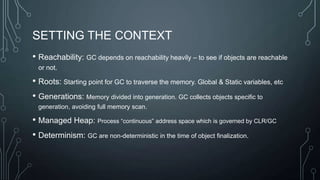
SETTING THE CONTEXT
• Reachability: GC depends on reachability heavily – to see if objects are reachable
or not.
• Roots: Starting point for GC to traverse the memory. Global & Static variables, etc
• Generations: Memory divided into generation. GC collects objects specific to
generation, avoiding full memory scan.
• Managed Heap: Process “continuous” address space which is governed by CLR/GC
• Determinism: GC are non-deterministic in the time of object finalization.
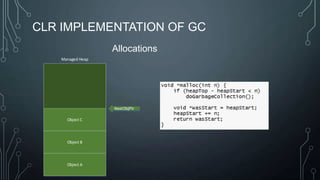
CLR IMPLEMENTATION OF GC
Object A
Object B
Object C
Managed Heap
NextObjPtr
Allocations
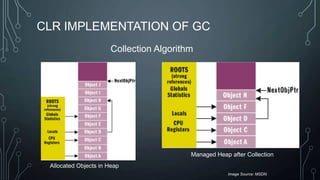
CLR IMPLEMENTATION OF GC
Image Source: MSDN
Allocated Objects in Heap
Managed Heap after Collection
Collection Algorithm
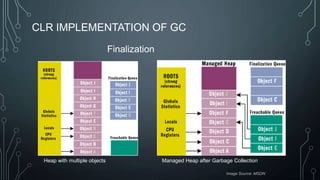
CLR IMPLEMENTATION OF GC
Image Source: MSDN
Finalization
Heap with multiple objects Managed Heap after Garbage Collection
CLR IMPLEMENTATION OF GC
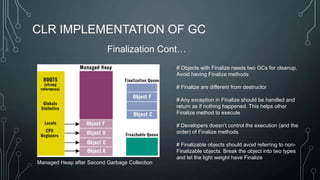
Finalization Cont…
Managed Heap after Second Garbage Collection
# Objects with Finalize needs two GCs for cleanup.
Avoid having Finalize methods
# Finalize are different from destructor
# Any exception in Finalize should be handled and
return as if nothing happened. This helps other
Finalize method to execute
# Developers doesn’t control the execution (and the
order) of Finalize methods
# Finalizable objects should avoid referring to non-
Finalizable objects. Break the object into two types
and let the light weight have Finalize
BEST PRACTICES RELATED TO MEMORY
MANAGEMENT IN .NET
• Assigning NULL to an object when its not needed doesn’t collect the object instantly.
• While designing classes, if it has some unmanaged resources, do implement Dispose
Pattern and Finalize method
• In Dispose implementation, do call GC.SuppressFinalize method.
• If the class has Close/Dispose method, it’s the responsibility of the caller to call them.
Finalize methods are implemented here in case caller forgets to call them
• Avoid calling GC.Collect(..);
Q&A
Aim and shoot your questions!
Image source: http://egamer.co.za/2011/07/review-shadows-of-the-damned/
THANK YOU!
Image Source: http://www.comicvine.com/forums/battles-7/spiderman-vs-wesker-670859/

Chronicles Of Garbage Collection (GC)

  • 1.
    THE CHRONICLES OFGARBAGE COLLECTION BY Rupreet Singh Gujral (rupreetg@outlook.com) Product Development / Architect / Entrepreneur
  • 2.
    AGENDA • Memory Concepts •Basic Principles • Advantages and Disadvantages of using GC • GC Algorithm • Setting the context • CLR implementation of GC • Best practices related to memory management in .NET
  • 3.
    MEMORY CONCEPTS • PhysicalMemory: This is the physical RAM on the machine/device. This is mainly used by kernel drivers. • Virtual Memory: It’s the memory emulation Operating System does for user to store and access data. Its not related to physical memory. Virtual Memory is used at system level. • Address space: This is specific to the memory allocated/used by a process. Threads in a process use address space for their stack, etc. Address space is used at process level. • Private bytes: Private Bytes is the current size, in bytes, of memory that this process has allocated that cannot be shared with other processes. • Working Set: The Working Set is the set of memory pages touched recently by the threads in the process.
  • 4.
    ARE YOU GUYSAWAKE? • Suppose user is running an application on a x64 bit machine. • The machine has 4GB RAM installed. • Task Manager shows 2GB of total RAM is used and rest is free • After running application, it throws “Out Of Memory” (OOM) exception. How?
  • 5.
    OK, LET MEHELP YOU! • Application always allocate memory in its “address space”. If the allocated “address space” is exhausted, only then you’ll get OOM exception even if Virtual Memory is available
  • 6.
    BASIC PRINCIPLES! • Findobjects that cannot be accessed in the future • Reclaim/Release the resources used by those objects HISTORY Garbage collection was invented by John McCarthy around 1959 to solve problems in Lisp
  • 7.
    ADVANTAGES AND DISADVANTAGES +Automatic memory reclaim of objects that are not required + Memory Leaks are taken care of (almost!) + Bugs like dangling pointers, double free, etc + Free developer from manually taking care of memory mgmt. - Performance Impact; consume resources - Pauses in application - Non deterministic, not real time
  • 8.
    LETS SEE HOWMANY GARBAGE OBJECTS WE CAN FIND?
  • 9.
    GC ALGORITHM • ReferenceCounting: Each object has a flag telling if it is referenced or not. • Mark and Sweep: Two round collection cycle. First round it marks objects which are live and in second round it clears the unused objects • Copying Collectors: Create two heaps of same size. Use one for allocations; when filled, pause the system and copy objects to other. • Mark Compact Collector: Extended version of Mark and Sweep. In the second phase, it compacts the heap to avoid fragmentation.
  • 10.
    SETTING THE CONTEXT •Reachability: GC depends on reachability heavily – to see if objects are reachable or not. • Roots: Starting point for GC to traverse the memory. Global & Static variables, etc • Generations: Memory divided into generation. GC collects objects specific to generation, avoiding full memory scan. • Managed Heap: Process “continuous” address space which is governed by CLR/GC • Determinism: GC are non-deterministic in the time of object finalization.
  • 11.
    CLR IMPLEMENTATION OFGC Object A Object B Object C Managed Heap NextObjPtr Allocations
  • 12.
    CLR IMPLEMENTATION OFGC Image Source: MSDN Allocated Objects in Heap Managed Heap after Collection Collection Algorithm
  • 13.
    CLR IMPLEMENTATION OFGC Image Source: MSDN Finalization Heap with multiple objects Managed Heap after Garbage Collection
  • 14.
    CLR IMPLEMENTATION OFGC Finalization Cont… Managed Heap after Second Garbage Collection # Objects with Finalize needs two GCs for cleanup. Avoid having Finalize methods # Finalize are different from destructor # Any exception in Finalize should be handled and return as if nothing happened. This helps other Finalize method to execute # Developers doesn’t control the execution (and the order) of Finalize methods # Finalizable objects should avoid referring to non- Finalizable objects. Break the object into two types and let the light weight have Finalize
  • 15.
    BEST PRACTICES RELATEDTO MEMORY MANAGEMENT IN .NET • Assigning NULL to an object when its not needed doesn’t collect the object instantly. • While designing classes, if it has some unmanaged resources, do implement Dispose Pattern and Finalize method • In Dispose implementation, do call GC.SuppressFinalize method. • If the class has Close/Dispose method, it’s the responsibility of the caller to call them. Finalize methods are implemented here in case caller forgets to call them • Avoid calling GC.Collect(..);
  • 16.
    Q&A Aim and shootyour questions! Image source: http://egamer.co.za/2011/07/review-shadows-of-the-damned/
  • 17.
    THANK YOU! Image Source:http://www.comicvine.com/forums/battles-7/spiderman-vs-wesker-670859/