z
Chronic Mesenteric
Ischemia
z
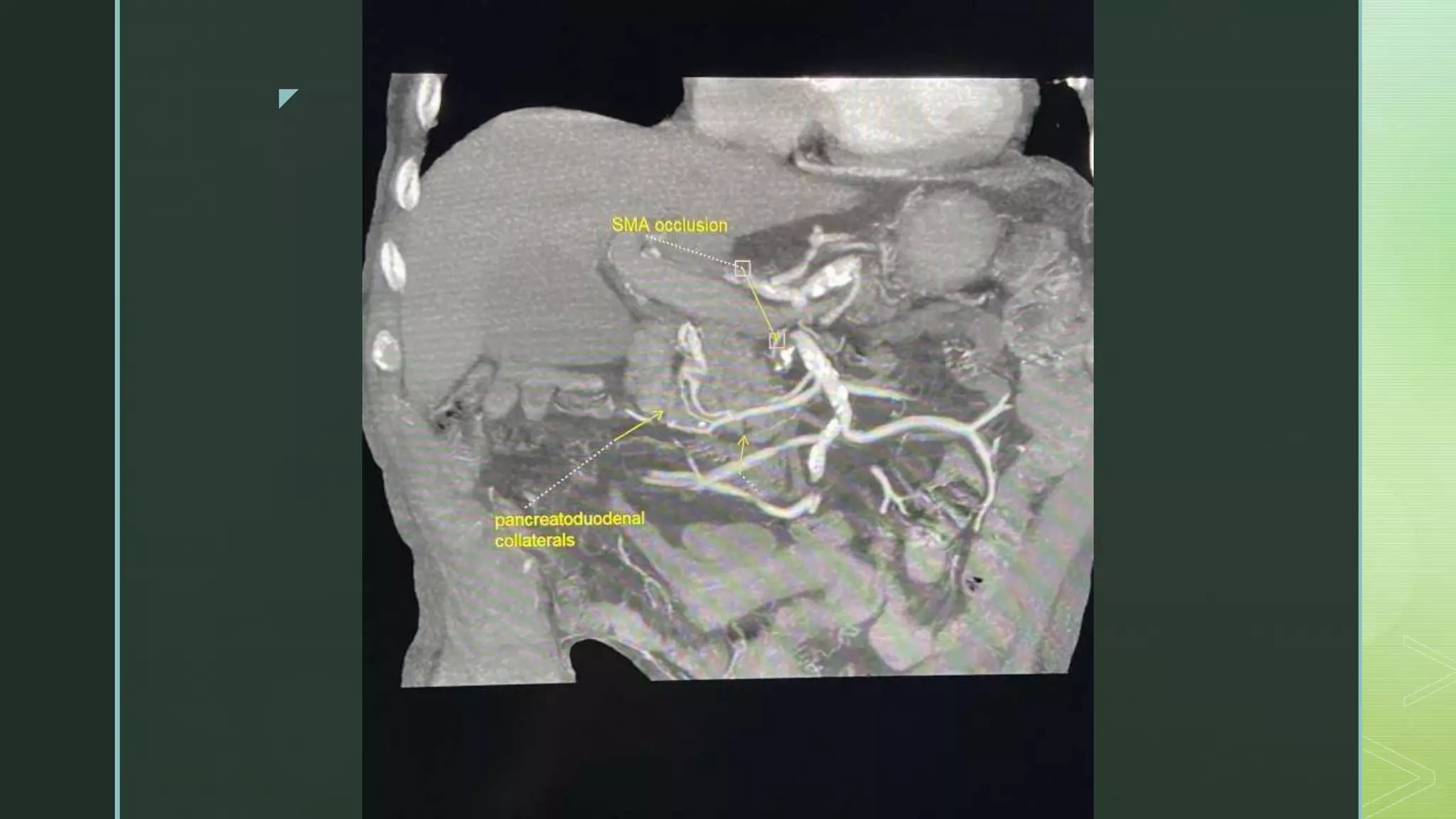
HPI
 A 78 yo male with PMH of DM, HTN, COPD, GERD, cerebral
vascular accident, and carotid artery stenosis presented from
nursing home due to abnormal labs which shows severe
anemia. Iron studies only revealed mild iron deficiency. Patient
had EGD and colonoscopy which noted esophagitis and mild
hemorrhagic gastritis as well as scattered diverticular disease.
z
z
z
z
z
INTRODUCTION
 Mesenteric ischemia is caused by a reduction in intestinal blood
flow and is classified as acute (sudden onset of intestinal
hypoperfusion) or chronic depending on the time course of
symptoms. Chronic mesenteric ischemia, also called intestinal
angina, refers to episodic or continuous hypoperfusion of the
small intestine that typically occurs in patients with multivessel
mesenteric artery stenosis or occlusion.
z
ETIOLOGY AND ASSOCIATIONS
 Atherosclerosis: The majority of cases of chronic mesenteric
ischemia are caused by atherosclerotic narrowing of the origins
of the celiac or superior mesenteric arteries
 Other: Rare causes of chronic mesenteric ischemia include
fibromuscular dysplasia, aortic or mesenteric artery dissection,
vasculitis (polyarteritis nodosum, Takayasu disease [8]), and
retroperitoneal fibrosis
z
z
CLINICAL PRESENTATIONS
 Asymptomatic: Most patients with chronic mesenteric ischemia due to
atherosclerotic disease do not exhibit symptoms because of the extensive
collateral network within the mesenteric vasculature that can form to
compensate for reduced flow
 Symptomatic: Pt who manifest symptoms of chronic mesenteric ischemia
are typically over 60 years of age and are 3 times more likely to be female
rather than male.
 Intestinal angina: Recurrent episodes of acute abdominal pain after eating.
 Adapted eating pattern: Results in patients avoiding eating due to the
anticipation of postprandial pain and other symptoms, resulting in weight
loss.
 Acute abdominal pain: Thrombus formation in the narrowed mesenteric
arterial segment can lead to acute, severe abdominal symptoms.
z
DIAGNOSIS
 Vascular imaging: CT angiography of the abdomen and pelvis as
the best imaging study
 Angiography: CT angiography has sensitivities and specificities
exceeding 90 percent for the diagnosis of chronic mesenteric
ischemia due to atherosclerosis.
MR angiography is also highly sensitive for detecting stenoses at
the origins of the celiac or mesenteric arteries; however, the
technique is much less reliable for detecting more distal lesions.
 Duplex ultrasonography of the mesenteric vessels: for the detection
of high-grade celiac and superior mesenteric artery stenosis
 Functional studies — A possible role for tonometry, spectroscopic
oximetry, and MR flow for the diagnosis of chronic mesenteric
ischemia has been suggested, but the clinical usefulness of these
studies, which are still under investigatio
z
Validated criteria for stenosis in visceral
vessels

Chronic Mesenteric Ischemia

  • 1.
  • 2.
    z HPI  A 78yo male with PMH of DM, HTN, COPD, GERD, cerebral vascular accident, and carotid artery stenosis presented from nursing home due to abnormal labs which shows severe anemia. Iron studies only revealed mild iron deficiency. Patient had EGD and colonoscopy which noted esophagitis and mild hemorrhagic gastritis as well as scattered diverticular disease.
  • 3.
  • 4.
  • 5.
  • 6.
  • 7.
    z INTRODUCTION  Mesenteric ischemiais caused by a reduction in intestinal blood flow and is classified as acute (sudden onset of intestinal hypoperfusion) or chronic depending on the time course of symptoms. Chronic mesenteric ischemia, also called intestinal angina, refers to episodic or continuous hypoperfusion of the small intestine that typically occurs in patients with multivessel mesenteric artery stenosis or occlusion.
  • 8.
    z ETIOLOGY AND ASSOCIATIONS Atherosclerosis: The majority of cases of chronic mesenteric ischemia are caused by atherosclerotic narrowing of the origins of the celiac or superior mesenteric arteries  Other: Rare causes of chronic mesenteric ischemia include fibromuscular dysplasia, aortic or mesenteric artery dissection, vasculitis (polyarteritis nodosum, Takayasu disease [8]), and retroperitoneal fibrosis
  • 9.
  • 10.
    z CLINICAL PRESENTATIONS  Asymptomatic:Most patients with chronic mesenteric ischemia due to atherosclerotic disease do not exhibit symptoms because of the extensive collateral network within the mesenteric vasculature that can form to compensate for reduced flow  Symptomatic: Pt who manifest symptoms of chronic mesenteric ischemia are typically over 60 years of age and are 3 times more likely to be female rather than male.  Intestinal angina: Recurrent episodes of acute abdominal pain after eating.  Adapted eating pattern: Results in patients avoiding eating due to the anticipation of postprandial pain and other symptoms, resulting in weight loss.  Acute abdominal pain: Thrombus formation in the narrowed mesenteric arterial segment can lead to acute, severe abdominal symptoms.
  • 11.
    z DIAGNOSIS  Vascular imaging:CT angiography of the abdomen and pelvis as the best imaging study  Angiography: CT angiography has sensitivities and specificities exceeding 90 percent for the diagnosis of chronic mesenteric ischemia due to atherosclerosis. MR angiography is also highly sensitive for detecting stenoses at the origins of the celiac or mesenteric arteries; however, the technique is much less reliable for detecting more distal lesions.  Duplex ultrasonography of the mesenteric vessels: for the detection of high-grade celiac and superior mesenteric artery stenosis  Functional studies — A possible role for tonometry, spectroscopic oximetry, and MR flow for the diagnosis of chronic mesenteric ischemia has been suggested, but the clinical usefulness of these studies, which are still under investigatio
  • 12.
    z Validated criteria forstenosis in visceral vessels