
War
…and some thoughts on
violence in general
When is it right to go to war?
Is there a proper way to fight a
war?
Are there things that are
unacceptable to do in war?
Who can you kill in a war
situation?
Preston Sprinkle brings a Christian
perspective to the issues:	

Should Christians participate in national
war?
Should Christians ever think positively
about the use of violence to accomplish
justice?
Should Christians support a national war?
Can a Christian use violence on an
individual level?
http://facultyblog.eternitybiblecollege.com/series/christians-and-violence-series/
What does the Bible teach about
war?
What does the Bible teach about
war?
Is there a difference in what the Old
Testament and New Testament teach?
What does the Bible teach about
war?
Is there a difference in what the Old
Testament and New Testament teach?
Does the NT ever support the use of
violence to resolve a problem?
38 “You have heard that it was said,‘Eye for eye,
and tooth for tooth.’[a] 39 But I tell you, do not
resist an evil person. If anyone slaps you on the
right cheek, turn to them the other cheek also…
But I tell you, love your enemies and pray for
those who persecute you, 45 that you may be
children of your Father in heaven. He causes his
sun to rise on the evil and the good, and sends
rain on the righteous and the unrighteous.
Some verses from the NT…
38 “You have heard that it was said,‘Eye for eye,
and tooth for tooth.’[a] 39 But I tell you, do not
resist an evil person. If anyone slaps you on the
right cheek, turn to them the other cheek also…
But I tell you, love your enemies and pray for
those who persecute you, 45 that you may be
children of your Father in heaven. He causes his
sun to rise on the evil and the good, and sends
rain on the righteous and the unrighteous.
This verse is about retaliation (the act
of returning an attack) - so if retaliation
is prohibited what form of violence
might be allowed by Jesus?
Is non-violent love something that
should be shown to all our enemies?
Some verses from the NT…
Matt 26 - Then the men stepped forward, seized
Jesus and arrested him. 51With that, one of
Jesus’ companions reached for his sword, drew it
out and struck the servant of the high priest,
cutting off his ear.	

52 “Put your sword back in its place,” Jesus said
to him, “for all who draw the sword will die
by the sword.
Jesus never used violence against those who
attacked him or other people.
Rom 12:17-21 Do not repay anyone evil for evil. Be
careful to do what is right in the eyes of everyone. 18
If it is possible, as far as it depends on you, live at
peace with everyone. 19 Do not take revenge, my dear
friends, but leave room for God’s wrath, for it is written:
“It is mine to avenge; I will repay,”[d] says the Lord. 20
On the contrary:	

“If your enemy is hungry, feed him;	

if he is thirsty, give him something to drink.	

In doing this, you will heap burning coals on his head.” 	

Do not be overcome by evil, but overcome evil
with good.
1Peter 2 - Slaves, in reverent fear of God submit yourselves to
your masters, not only to those who are good and considerate,
but also to those who are harsh. 19 For it is commendable if
someone bears up under the pain of unjust suffering because
they are conscious of God. 20 But how is it to your credit if you
receive a beating for doing wrong and endure it? But if you
suffer for doing good and you endure it, this is commendable
before God. 21 To this you were called, because Christ suffered
for you, leaving you an example, that you should follow in his
steps.	

22 “He committed no sin, and no deceit was found in his
mouth.”	

23 When they hurled their insults at him, he did not retaliate;
when he suffered, he made no threats. Instead, he entrusted
himself to him who judges justly.
Preston Sprinkle summarises the non-violent
argument like this…	

(1) Jesus acted non-violently, which lays down
a pattern for his followers, 	

(2) violence is everywhere prohibited and
never commanded for the church in the New
Testament.All arguments that support the
use of violence by Christians must wiggle it
out of indirect implications from the text in
the face of clear, direct commands of the
text.
BUT…
what about these three
passages often used in favour of
Christian involvement in a just
war?
Luke 22 - 35Then Jesus asked them,“When I sent you
without purse, bag or sandals, did you lack anything?”	

“Nothing,” they answered.	

36 He said to them,“But now if you have a purse, take it,
and also a bag; and if you don’t have a sword, sell your
cloak and buy one. 37 It is written:‘And he was numbered
with the transgressors’[b]; and I tell you that this must be
fulfilled in me.Yes, what is written about me is reaching its
fulfillment.”	

38The disciples said,“See, Lord, here are two swords.”	

“That’s enough!” he replied.
Luke 22 - 35Then Jesus asked them,“When I sent you
without purse, bag or sandals, did you lack anything?”	

“Nothing,” they answered.	

36 He said to them,“But now if you have a purse, take it,
and also a bag; and if you don’t have a sword, sell your
cloak and buy one. 37 It is written:‘And he was numbered
with the transgressors’[b]; and I tell you that this must be
fulfilled in me.Yes, what is written about me is reaching its
fulfillment.”	

38The disciples said,“See, Lord, here are two swords.”	

“That’s enough!” he replied.
Does Jesus support the use of violence?	

What of Luke 22:51?	

Does quoting Isa 53:12 mean Jesus was doing it
to fulfil OT prophecy, and so the Romans might
view him as a revolutionary?
Romans 13 - Let everyone be subject to the governing
authorities, for there is no authority except that which
God has established. The authorities that exist have been
established by God. 2 Consequently, whoever rebels
against the authority is rebelling against what God has
instituted, and those who do so will bring judgment on
themselves. 3 For rulers hold no terror for those who do
right, but for those who do wrong. Do you want to be free
from fear of the one in authority? Then do what is right
and you will be commended. 4 For the one in authority is
God’s servant for your good. But if you do wrong, be
afraid, for rulers do not bear the sword for no reason.
They are God’s servants, agents of wrath to bring
punishment on the wrongdoer. 5 Therefore, it is necessary
to submit to the authorities, not only because of possible
punishment but also as a matter of conscience.
Romans 13 - Let everyone be subject to the governing
authorities, for there is no authority except that which
God has established. The authorities that exist have been
established by God. 2 Consequently, whoever rebels
against the authority is rebelling against what God has
instituted, and those who do so will bring judgment on
themselves. 3 For rulers hold no terror for those who do
right, but for those who do wrong. Do you want to be free
from fear of the one in authority? Then do what is right
and you will be commended. 4 For the one in authority is
God’s servant for your good. But if you do wrong, be
afraid, for rulers do not bear the sword for no reason.
They are God’s servants, agents of wrath to bring
punishment on the wrongdoer. 5 Therefore, it is necessary
to submit to the authorities, not only because of possible
punishment but also as a matter of conscience.
Is Paul (God) saying to submit and do whatever
ungodly authorities command you to? 	

Is Paul saying that God is in charge - he is
sovereign - and so we need to live our lives in
obedience remembering that fact?	

Often in the OT we see God using evil powers
to accomplish his will - but HE is still in charge,
and ultimately he will judge them for what they
do.
Mark 11 - 15 On reaching Jerusalem, Jesus entered the
temple courts and began driving out those who were
buying and selling there. He overturned the tables of the
money changers and the benches of those selling doves,
16 and would not allow anyone to carry merchandise
through the temple courts. 17 And as he taught them, he
said,“Is it not written:‘My house will be called a house of
prayer for all nations’? But you have made it ‘a den of
robbers.’”	

18 The chief priests and the teachers of the law heard
this and began looking for a way to kill him, for they
feared him, because the whole crowd was amazed at his
teaching.
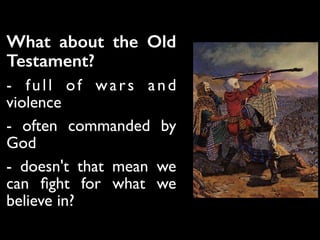
What about the Old
Testament?
- full of wars and
violence	

- often commanded by
God	

- doesn't that mean we
can fight for what we
believe in?
1. In the OT Israel was a theocracy - state
ruled by God, religion and state were one
under the rulership of God. Nowadays there
is no “Christian” country	

2. Much OT war is about the land God had
promised to the Israelites - no such promise
exists for the widespread people of God in
the NT
3. The Bible reveals a story of salvation
that culminates in Jesus - at times war is
commanded by God but the ultimate
goal is peace, the OT shows the prophets
pointing to Jesus and aiming for eventual
peace (Micah 4:3)
“Violence was allowed and even commanded in
the Old Testament, as was polygamy, divorce,
slavery, stoning of children, and killing people for
gathering sticks on the Sabbath. But this was not
the goal of redemptive history; rather, it was part
of God’s dynamic (not static) story of salvation,
which climaxes in Jesus who bore a plowshare and
not a sword. Jesus inaugurated that promised
period of peace and healing, and therefore
violence is allowed in the OldTestament but not in
the New.”	

Preston Sprinkle
Genesis 9	

5 And for your lifeblood I will surely demand an
accounting. I will demand an accounting from
every animal. And from each human being, too, I
will demand an accounting for the life of another
human being.	

6 “Whoever sheds human blood,	

by humans shall their blood be shed;	

for in the image of God	

has God made mankind.
We have looked very briefly what the NT
says about violence.	

Preston Sprinkle (who argues strongly for a
pacifist approach) poses the question, “What
do I do if someone is pointing a gun at my
family and threatening their lives, do I shoot
them?”	

What would you do - why?
We have looked very briefly what the NT
says about violence.	

Preston Sprinkle (who argues strongly for a
pacifist approach) poses the question, “What
do I do if someone is pointing a gun at my
family and threatening their lives, do I shoot
them?”	

What would you do - why?
“I would shoot
them”
Why?
Two different decisions have to be faced - both
are, according to Sprinkle, evil
Two different decisions have to be faced - both
are, according to Sprinkle, evil
- shooting the man is preemptive violence,
taking life, not loving him, he might go to hell
Two different decisions have to be faced - both
are, according to Sprinkle, evil
- shooting the man is preemptive violence,
taking life, not loving him, he might go to hell
- not shooting him means not loving his family,
not protecting his own household
Two different decisions have to be faced - both
are, according to Sprinkle, evil
- shooting the man is preemptive violence,
taking life, not loving him, he might go to hell
- not shooting him means not loving his family,
not protecting his own household
Sprinkle says he is choosing the lesser of two
evils (this is called graded absolutism which is
based on the idea of higher and lower laws -
therefore we obey the higher law here whilst
disobeying the lower)
Preston Sprinkle summarises the following 4
Christian positions on violence and warfare:	

!
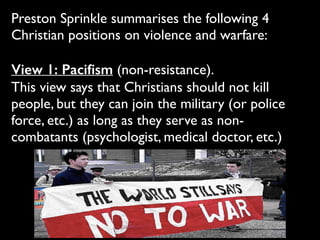
View 1: Pacifism (non-resistance). 	

This view says that Christians should not kill
people, but they can join the military (or police
force, etc.) as long as they serve as non-
combatants (psychologist, medical doctor, etc.)
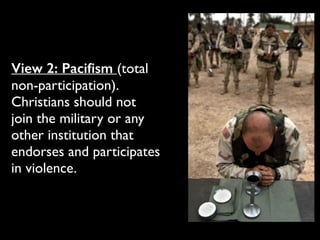
View 2: Pacifism (total
non-participation).
Christians should not
join the military or any
other institution that
endorses and participates
in violence.
View 3: Just War.
Christians can participate in a war that is waged
on a “just” basis.The seven-fold criteria for a “just”
war include: 	

(1) Just cause, 	

(2) Just intention, 	

(3) Last resort, 	

(4) Formal declaration, 	

(5) Limited objectives, 	

(6) Proportionate means, 	

(7) Noncombatant immunity.
View 4: Self-defence and Justice.
This view focuses on the individual’s encounter
with evil, as opposed to his/her participation in
national warfare.The view says that a Christian
may use violence when defending oneself against
evil (i.e. being attacked in a dark alley, etc.) or to
achieve justice for someone being oppressed (e.g.,
executing Hitler).
Christian
perspectives on
war
Adapted from Freiburg, Ethics for a Brave NewWorld
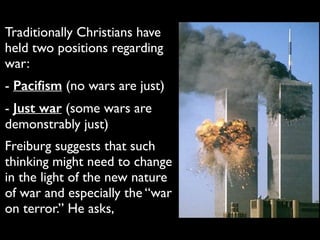
Traditionally Christians have
held two positions regarding
war:	

- Pacifism (no wars are just)	

- Just war (some wars are
demonstrably just)	

Freiburg suggests that such
thinking might need to change
in the light of the new nature
of war and especially the “war
on terror.” He asks,
Traditionally Christians have
held two positions regarding
war:	

- Pacifism (no wars are just)	

- Just war (some wars are
demonstrably just)	

Freiburg suggests that such
thinking might need to change
in the light of the new nature
of war and especially the “war
on terror.” He asks,
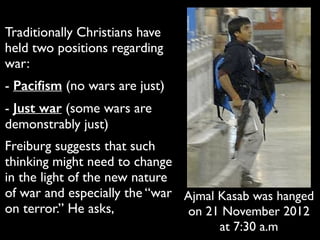
Ajmal Kasab was hanged
on 21 November 2012
at 7:30 a.m
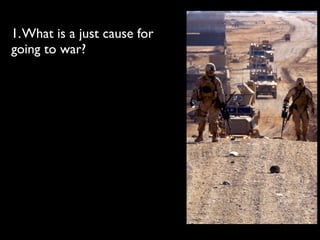
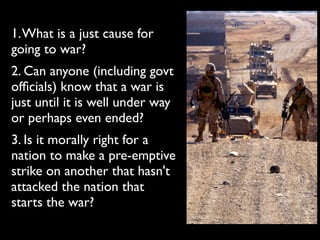
1.What is a just cause for
going to war?
1.What is a just cause for
going to war?
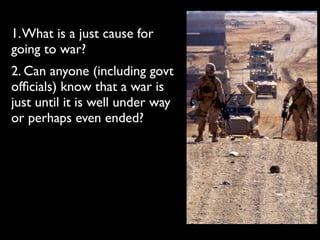
2. Can anyone (including govt
officials) know that a war is
just until it is well under way
or perhaps even ended?
1.What is a just cause for
going to war?
2. Can anyone (including govt
officials) know that a war is
just until it is well under way
or perhaps even ended?
3. Is it morally right for a
nation to make a pre-emptive
strike on another that hasn't
attacked the nation that
starts the war?
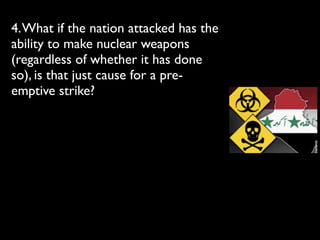
4.What if the nation attacked has the
ability to make nuclear weapons
(regardless of whether it has done
so), is that just cause for a pre-
emptive strike?
4.What if the nation attacked has the
ability to make nuclear weapons
(regardless of whether it has done
so), is that just cause for a pre-
emptive strike?
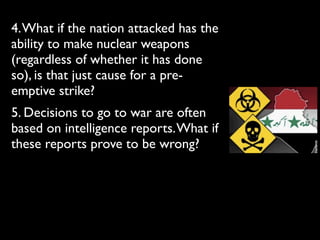
5. Decisions to go to war are often
based on intelligence reports.What if
these reports prove to be wrong?
4.What if the nation attacked has the
ability to make nuclear weapons
(regardless of whether it has done
so), is that just cause for a pre-
emptive strike?
5. Decisions to go to war are often
based on intelligence reports.What if
these reports prove to be wrong?
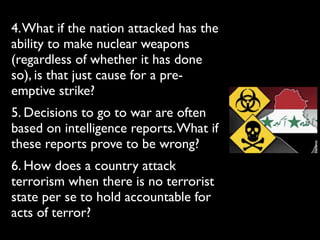
6. How does a country attack
terrorism when there is no terrorist
state per se to hold accountable for
acts of terror?
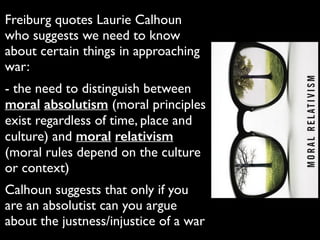
Freiburg quotes Laurie Calhoun
who suggests we need to know
about certain things in approaching
war:	

- the need to distinguish between
moral absolutism (moral principles
exist regardless of time, place and
culture) and moral relativism
(moral rules depend on the culture
or context)	

Calhoun suggests that only if you
are an absolutist can you argue
about the justness/injustice of a war
Calhoun also distinguishes between realists and
idealists,	

- realists believe that in the light of human nature
war cannot be avoided (so it is like floods, droughts,
earthquakes = cannot be avoided)	


 - relativists here believe that “anything goes”	


 - absolutists here believe that moral rules can be
applied in assessing the individual acts not the whole
war
- idealists believe that wars can be evaluated morally,
so we can have just and unjust wars	


 - here relativists would assess the morality of a
war (though at their position is relative agreement
might be hard to find)	


 - absolutists here would be able to argue whether
a war was just or not and so this leads to pacifism or
just war positions
We have said traditionally Christians have favoured
two positions regarding war - pacifism and just war.
Now we shall give greater definition to these and
discuss them.
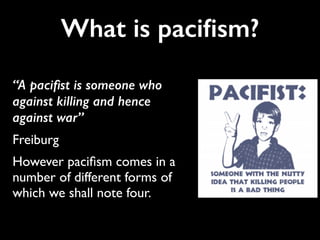
What is pacifism?
“A pacifist is someone who
against killing and hence
against war”
Freiburg	

However pacifism comes in a
number of different forms of
which we shall note four.
1. Universal pacifism	

Killing or violence is always wrong.
Violence of any kind is rejected -
personal, national, international.
Killing can never be justified	

- Gandhi, Schweitzer,Tolstoy
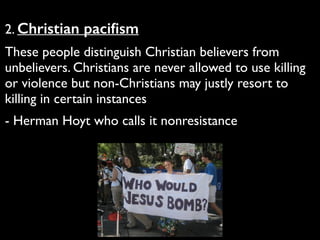
2. Christian pacifism	

These people distinguish Christian believers from
unbelievers. Christians are never allowed to use killing
or violence but non-Christians may justly resort to
killing in certain instances	

- Herman Hoyt who calls it nonresistance
3. Private pacifism	

Least common view - personal
violence is always wrong but a
nation may at times be justified
in using force in a just war	

- Augustine
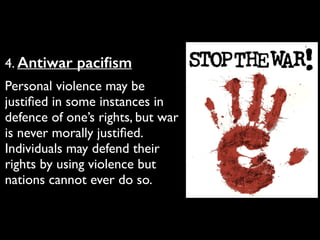
4. Antiwar pacifism	

Personal violence may be
justified in some instances in
defence of one’s rights, but war
is never morally justified.
Individuals may defend their
rights by using violence but
nations cannot ever do so.
Arguments for pacifism
Here we need to consider
the idea of whether war,
and participation in it, are
ever morally obligatory or
acceptable for Christians.
Non-biblical
arguments for pacifism
1. Historically many Christians
have been pacifists - they did
not serve in the Roman army
until Christianity was legalised
by Constantine - possibly
because they might have been
asked to do morally wrong
things (persecuting civilians,
stealing, worshipping the
emperor)
2. Some Christians were pacifists as life is
sacred - are we allowed to kill others, to kill
animals or plants?	

3. Killing is immoral as all humans have a right
to life - therefore taking life is always wrong
(even if killing is thought to bring about a good
result.
4. Kant put forth the idea that a mans life and
conduct should be a moral example -
therefore we cannot kill as the example is bad	

5.The example / philosophy of Gandhi (no
need to tell Indians about this!)
Biblical arguments for pacifism
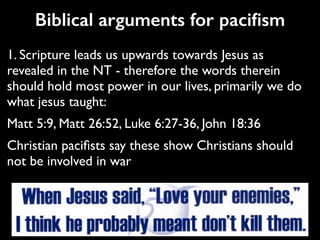
1. Scripture leads us upwards towards Jesus as
revealed in the NT - therefore the words therein
should hold most power in our lives, primarily we do
what jesus taught:	

Matt 5:9, Matt 26:52, Luke 6:27-36, John 18:36	

Christian pacifists say these show Christians should
not be involved in war
2. Matt 5: 38-48 	

This is not simply an attitude - but a rule of life
for the actions of all Christians	

3. In considering the OT we need to somehow
put ourselves in the position described and ask
what god was leading his people from. In doing
that we can see a total perspective on war and
violence (which is that God leads his people
away from them as well as false worship,
impurity etc.)
4.A Christian’s citizenship is in the
Kingdom of God. First loyalty to
Christ and his kingdom - which
crosses national and international
boundaries and therefore excludes
a Christian from nationalism! After
that we see our obligation to govts
etc.We MUST obey God and then
submit to authorities (which are
not always right!)	

We must add to this is the
possibility of killing a fellow
believer in war!
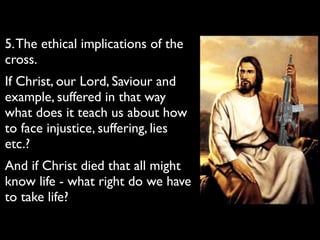
5.The ethical implications of the
cross.	

If Christ, our Lord, Saviour and
example, suffered in that way
what does it teach us about how
to face injustice, suffering, lies
etc.?	

And if Christ died that all might
know life - what right do we have
to take life?
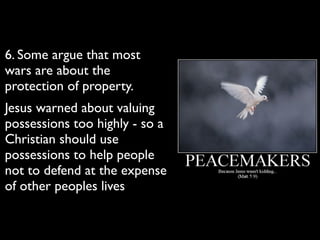
6. Some argue that most
wars are about the
protection of property. 	

Jesus warned about valuing
possessions too highly - so a
Christian should use
possessions to help people
not to defend at the expense
of other peoples lives
Objections to pacifism
The historical idea of Christian
being pacifists stretches back to the
Roman Empire when a compromise
of worship (emperor / false gods)
and reducing visibility (and therefore
evening potential persecution) would
have conflicted with faith.There is
nothing in the Bible which seems to
support Christians not enrolling in
the army
The historical idea of Christian
being pacifists stretches back to the
Roman Empire when a compromise
of worship (emperor / false gods)
and reducing visibility (and therefore
evening potential persecution) would
have conflicted with faith.There is
nothing in the Bible which seems to
support Christians not enrolling in
the army
Objections to non-biblical
arguments for pacifism
Sacredness of life - surely if life is sacred taking
it is immoral? However some question if this is
only when the killing is unnecessary - does that
mean that killing can at times be necessary (in
the army for example)?	

Does the principle that life is sacred mean that
nothing should ever be killed (pacifists), or does
it require us to preserve life as much as possible
(non-pacifists)?
The immorality of killing - if we have a right (God-
given) to life then surely there is a right to defend
that life? So what if you are attacked - surely you are
permitted to defend your life, even if that might
mean killing the other person whilst acting in self
defence?
The moral example argument -
“The world would be a better place
if everyone were a pacifist”	

We might agree - but does that make
it a moral imperative to be a pacifist?
Would “Use violence only in self
defence” be as valid a command?	

Part of the difficulty here is that we
live in a sinful world - the ideal might
be one of the commands, but in
reality we have to deal with violence
of many kinds.
Can we force obedience to the Bible
upon atheists, Jews or Muslims?	

1. Would biblical pacifism here be
universalizable?
However if the Bible is God’s Word
to us their disobedience is at their
own peril.The question is, in effect,
“What does God expect of us?”
Objections to biblical
arguments for pacifism
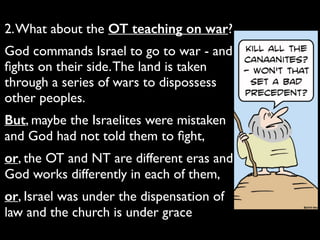
2.What about the OT teaching on war?	

God commands Israel to go to war - and
fights on their side.The land is taken
through a series of wars to dispossess
other peoples.	

But, maybe the Israelites were mistaken
and God had not told them to fight,	

or, the OT and NT are different eras and
God works differently in each of them,	

or, Israel was under the dispensation of
law and the church is under grace
The activity of Israel at war in the OT raises an
important question:	

How do the OT and NT relate on ethical matters? Is
there continuity or discontinuity?	

Freiburg suggests that, “Whatever is binding in the
OT continues to apply in the NT era, unless the NT
either explicitly or implicitly abrogates (does away
with) it.”	

In relation to war we then have to ask what the NT
teaches , is it prohibited (totally or in part), or is it
permitted (maybe only in some cases)?
3. So what of Jesus and the NT teaching on war?
- in reading the Sermon on the Mount is there a
difference in reading it with regard to private and
public duty? 	

As an individual I might turn the other cheek
when attacked. 	

If I have a public office I have a responsibility to
protect and defend the people, possibly by using
force. 	

What of my family, don’t I have a responsibility to
defend them if they are attacked?
- can pacifists suggest that we
take the Sermon on the
Mount literally?	

- have you plucked you eye
out recently Matt 5:29,30?	

- do you hate your relatives
Lk 14:26?	

- what of Jesus challenging
the legitimacy of his attack in
Jn 18:22,23? (and Paul in Acts
23:1-5)
4. Does being a citizen of the KOG rule out Christians
acting in war?	

We are also in this world - are the two mutually
exclusive? If God allows the state to use force when
reasonable, surely Christians should take part in this
as required?	

We have both benefits and responsibilities in the
world. Is the logical consequence here that we would
have to withdraw from all involvement with our govt.?
5. Does the ethical implications of the cross mean
as Christians we cannot fight?	

- the cross shows Gods patience in facing unjust
suffering, it reveals mercy	

- it also shows God’s righteousness and justice -
sin must be punished!	

To love your enemies does not mean you do not
exercise civil justice - a principle of love is found in
both OT and NT teaching (and laws)
6. What of war setting Christians
against Christians in favour of
national loyalty?
Freiburg argues that a Christian
would only fight on one side of a
“just war” for the other side
would obviously be unjust.	

But, what of nationalism which
does blinker Christian people to
the truth of what is just?

Christian Ethics (303) War Part 1

  • 1.
    War …and some thoughtson violence in general
  • 2.
    When is itright to go to war? Is there a proper way to fight a war? Are there things that are unacceptable to do in war? Who can you kill in a war situation?
  • 3.
    Preston Sprinkle bringsa Christian perspective to the issues: Should Christians participate in national war? Should Christians ever think positively about the use of violence to accomplish justice? Should Christians support a national war? Can a Christian use violence on an individual level? http://facultyblog.eternitybiblecollege.com/series/christians-and-violence-series/
  • 5.
    What does theBible teach about war?
  • 6.
    What does theBible teach about war? Is there a difference in what the Old Testament and New Testament teach?
  • 7.
    What does theBible teach about war? Is there a difference in what the Old Testament and New Testament teach? Does the NT ever support the use of violence to resolve a problem?
  • 8.
    38 “You haveheard that it was said,‘Eye for eye, and tooth for tooth.’[a] 39 But I tell you, do not resist an evil person. If anyone slaps you on the right cheek, turn to them the other cheek also… But I tell you, love your enemies and pray for those who persecute you, 45 that you may be children of your Father in heaven. He causes his sun to rise on the evil and the good, and sends rain on the righteous and the unrighteous. Some verses from the NT…
  • 9.
    38 “You haveheard that it was said,‘Eye for eye, and tooth for tooth.’[a] 39 But I tell you, do not resist an evil person. If anyone slaps you on the right cheek, turn to them the other cheek also… But I tell you, love your enemies and pray for those who persecute you, 45 that you may be children of your Father in heaven. He causes his sun to rise on the evil and the good, and sends rain on the righteous and the unrighteous. This verse is about retaliation (the act of returning an attack) - so if retaliation is prohibited what form of violence might be allowed by Jesus? Is non-violent love something that should be shown to all our enemies? Some verses from the NT…
  • 10.
    Matt 26 -Then the men stepped forward, seized Jesus and arrested him. 51With that, one of Jesus’ companions reached for his sword, drew it out and struck the servant of the high priest, cutting off his ear. 52 “Put your sword back in its place,” Jesus said to him, “for all who draw the sword will die by the sword. Jesus never used violence against those who attacked him or other people.
  • 11.
    Rom 12:17-21 Donot repay anyone evil for evil. Be careful to do what is right in the eyes of everyone. 18 If it is possible, as far as it depends on you, live at peace with everyone. 19 Do not take revenge, my dear friends, but leave room for God’s wrath, for it is written: “It is mine to avenge; I will repay,”[d] says the Lord. 20 On the contrary: “If your enemy is hungry, feed him; if he is thirsty, give him something to drink. In doing this, you will heap burning coals on his head.” Do not be overcome by evil, but overcome evil with good.
  • 12.
    1Peter 2 -Slaves, in reverent fear of God submit yourselves to your masters, not only to those who are good and considerate, but also to those who are harsh. 19 For it is commendable if someone bears up under the pain of unjust suffering because they are conscious of God. 20 But how is it to your credit if you receive a beating for doing wrong and endure it? But if you suffer for doing good and you endure it, this is commendable before God. 21 To this you were called, because Christ suffered for you, leaving you an example, that you should follow in his steps. 22 “He committed no sin, and no deceit was found in his mouth.” 23 When they hurled their insults at him, he did not retaliate; when he suffered, he made no threats. Instead, he entrusted himself to him who judges justly.
  • 13.
    Preston Sprinkle summarisesthe non-violent argument like this… (1) Jesus acted non-violently, which lays down a pattern for his followers, (2) violence is everywhere prohibited and never commanded for the church in the New Testament.All arguments that support the use of violence by Christians must wiggle it out of indirect implications from the text in the face of clear, direct commands of the text.
  • 14.
    BUT… what about thesethree passages often used in favour of Christian involvement in a just war?
  • 15.
    Luke 22 -35Then Jesus asked them,“When I sent you without purse, bag or sandals, did you lack anything?” “Nothing,” they answered. 36 He said to them,“But now if you have a purse, take it, and also a bag; and if you don’t have a sword, sell your cloak and buy one. 37 It is written:‘And he was numbered with the transgressors’[b]; and I tell you that this must be fulfilled in me.Yes, what is written about me is reaching its fulfillment.” 38The disciples said,“See, Lord, here are two swords.” “That’s enough!” he replied.
  • 16.
    Luke 22 -35Then Jesus asked them,“When I sent you without purse, bag or sandals, did you lack anything?” “Nothing,” they answered. 36 He said to them,“But now if you have a purse, take it, and also a bag; and if you don’t have a sword, sell your cloak and buy one. 37 It is written:‘And he was numbered with the transgressors’[b]; and I tell you that this must be fulfilled in me.Yes, what is written about me is reaching its fulfillment.” 38The disciples said,“See, Lord, here are two swords.” “That’s enough!” he replied. Does Jesus support the use of violence? What of Luke 22:51? Does quoting Isa 53:12 mean Jesus was doing it to fulfil OT prophecy, and so the Romans might view him as a revolutionary?
  • 17.
    Romans 13 -Let everyone be subject to the governing authorities, for there is no authority except that which God has established. The authorities that exist have been established by God. 2 Consequently, whoever rebels against the authority is rebelling against what God has instituted, and those who do so will bring judgment on themselves. 3 For rulers hold no terror for those who do right, but for those who do wrong. Do you want to be free from fear of the one in authority? Then do what is right and you will be commended. 4 For the one in authority is God’s servant for your good. But if you do wrong, be afraid, for rulers do not bear the sword for no reason. They are God’s servants, agents of wrath to bring punishment on the wrongdoer. 5 Therefore, it is necessary to submit to the authorities, not only because of possible punishment but also as a matter of conscience.
  • 18.
    Romans 13 -Let everyone be subject to the governing authorities, for there is no authority except that which God has established. The authorities that exist have been established by God. 2 Consequently, whoever rebels against the authority is rebelling against what God has instituted, and those who do so will bring judgment on themselves. 3 For rulers hold no terror for those who do right, but for those who do wrong. Do you want to be free from fear of the one in authority? Then do what is right and you will be commended. 4 For the one in authority is God’s servant for your good. But if you do wrong, be afraid, for rulers do not bear the sword for no reason. They are God’s servants, agents of wrath to bring punishment on the wrongdoer. 5 Therefore, it is necessary to submit to the authorities, not only because of possible punishment but also as a matter of conscience. Is Paul (God) saying to submit and do whatever ungodly authorities command you to? Is Paul saying that God is in charge - he is sovereign - and so we need to live our lives in obedience remembering that fact? Often in the OT we see God using evil powers to accomplish his will - but HE is still in charge, and ultimately he will judge them for what they do.
  • 19.
    Mark 11 -15 On reaching Jerusalem, Jesus entered the temple courts and began driving out those who were buying and selling there. He overturned the tables of the money changers and the benches of those selling doves, 16 and would not allow anyone to carry merchandise through the temple courts. 17 And as he taught them, he said,“Is it not written:‘My house will be called a house of prayer for all nations’? But you have made it ‘a den of robbers.’” 18 The chief priests and the teachers of the law heard this and began looking for a way to kill him, for they feared him, because the whole crowd was amazed at his teaching.
  • 20.
    What about theOld Testament? - full of wars and violence - often commanded by God - doesn't that mean we can fight for what we believe in?
  • 21.
    1. In theOT Israel was a theocracy - state ruled by God, religion and state were one under the rulership of God. Nowadays there is no “Christian” country 2. Much OT war is about the land God had promised to the Israelites - no such promise exists for the widespread people of God in the NT
  • 22.
    3. The Biblereveals a story of salvation that culminates in Jesus - at times war is commanded by God but the ultimate goal is peace, the OT shows the prophets pointing to Jesus and aiming for eventual peace (Micah 4:3)
  • 23.
    “Violence was allowedand even commanded in the Old Testament, as was polygamy, divorce, slavery, stoning of children, and killing people for gathering sticks on the Sabbath. But this was not the goal of redemptive history; rather, it was part of God’s dynamic (not static) story of salvation, which climaxes in Jesus who bore a plowshare and not a sword. Jesus inaugurated that promised period of peace and healing, and therefore violence is allowed in the OldTestament but not in the New.” Preston Sprinkle
  • 24.
    Genesis 9 5 Andfor your lifeblood I will surely demand an accounting. I will demand an accounting from every animal. And from each human being, too, I will demand an accounting for the life of another human being. 6 “Whoever sheds human blood, by humans shall their blood be shed; for in the image of God has God made mankind.
  • 26.
    We have lookedvery briefly what the NT says about violence. Preston Sprinkle (who argues strongly for a pacifist approach) poses the question, “What do I do if someone is pointing a gun at my family and threatening their lives, do I shoot them?” What would you do - why?
  • 27.
    We have lookedvery briefly what the NT says about violence. Preston Sprinkle (who argues strongly for a pacifist approach) poses the question, “What do I do if someone is pointing a gun at my family and threatening their lives, do I shoot them?” What would you do - why? “I would shoot them” Why?
  • 29.
    Two different decisionshave to be faced - both are, according to Sprinkle, evil
  • 30.
    Two different decisionshave to be faced - both are, according to Sprinkle, evil - shooting the man is preemptive violence, taking life, not loving him, he might go to hell
  • 31.
    Two different decisionshave to be faced - both are, according to Sprinkle, evil - shooting the man is preemptive violence, taking life, not loving him, he might go to hell - not shooting him means not loving his family, not protecting his own household
  • 32.
    Two different decisionshave to be faced - both are, according to Sprinkle, evil - shooting the man is preemptive violence, taking life, not loving him, he might go to hell - not shooting him means not loving his family, not protecting his own household Sprinkle says he is choosing the lesser of two evils (this is called graded absolutism which is based on the idea of higher and lower laws - therefore we obey the higher law here whilst disobeying the lower)
  • 33.
    Preston Sprinkle summarisesthe following 4 Christian positions on violence and warfare: ! View 1: Pacifism (non-resistance). This view says that Christians should not kill people, but they can join the military (or police force, etc.) as long as they serve as non- combatants (psychologist, medical doctor, etc.)
  • 34.
    View 2: Pacifism(total non-participation). Christians should not join the military or any other institution that endorses and participates in violence.
  • 35.
    View 3: JustWar. Christians can participate in a war that is waged on a “just” basis.The seven-fold criteria for a “just” war include: (1) Just cause, (2) Just intention, (3) Last resort, (4) Formal declaration, (5) Limited objectives, (6) Proportionate means, (7) Noncombatant immunity.
  • 36.
    View 4: Self-defenceand Justice. This view focuses on the individual’s encounter with evil, as opposed to his/her participation in national warfare.The view says that a Christian may use violence when defending oneself against evil (i.e. being attacked in a dark alley, etc.) or to achieve justice for someone being oppressed (e.g., executing Hitler).
  • 37.
    Christian perspectives on war Adapted fromFreiburg, Ethics for a Brave NewWorld
  • 38.
    Traditionally Christians have heldtwo positions regarding war: - Pacifism (no wars are just) - Just war (some wars are demonstrably just) Freiburg suggests that such thinking might need to change in the light of the new nature of war and especially the “war on terror.” He asks,
  • 39.
    Traditionally Christians have heldtwo positions regarding war: - Pacifism (no wars are just) - Just war (some wars are demonstrably just) Freiburg suggests that such thinking might need to change in the light of the new nature of war and especially the “war on terror.” He asks, Ajmal Kasab was hanged on 21 November 2012 at 7:30 a.m
  • 41.
    1.What is ajust cause for going to war?
  • 42.
    1.What is ajust cause for going to war? 2. Can anyone (including govt officials) know that a war is just until it is well under way or perhaps even ended?
  • 43.
    1.What is ajust cause for going to war? 2. Can anyone (including govt officials) know that a war is just until it is well under way or perhaps even ended? 3. Is it morally right for a nation to make a pre-emptive strike on another that hasn't attacked the nation that starts the war?
  • 45.
    4.What if thenation attacked has the ability to make nuclear weapons (regardless of whether it has done so), is that just cause for a pre- emptive strike?
  • 46.
    4.What if thenation attacked has the ability to make nuclear weapons (regardless of whether it has done so), is that just cause for a pre- emptive strike? 5. Decisions to go to war are often based on intelligence reports.What if these reports prove to be wrong?
  • 47.
    4.What if thenation attacked has the ability to make nuclear weapons (regardless of whether it has done so), is that just cause for a pre- emptive strike? 5. Decisions to go to war are often based on intelligence reports.What if these reports prove to be wrong? 6. How does a country attack terrorism when there is no terrorist state per se to hold accountable for acts of terror?
  • 48.
    Freiburg quotes LaurieCalhoun who suggests we need to know about certain things in approaching war: - the need to distinguish between moral absolutism (moral principles exist regardless of time, place and culture) and moral relativism (moral rules depend on the culture or context) Calhoun suggests that only if you are an absolutist can you argue about the justness/injustice of a war
  • 49.
    Calhoun also distinguishesbetween realists and idealists, - realists believe that in the light of human nature war cannot be avoided (so it is like floods, droughts, earthquakes = cannot be avoided) - relativists here believe that “anything goes” - absolutists here believe that moral rules can be applied in assessing the individual acts not the whole war
  • 50.
    - idealists believethat wars can be evaluated morally, so we can have just and unjust wars - here relativists would assess the morality of a war (though at their position is relative agreement might be hard to find) - absolutists here would be able to argue whether a war was just or not and so this leads to pacifism or just war positions
  • 51.
    We have saidtraditionally Christians have favoured two positions regarding war - pacifism and just war. Now we shall give greater definition to these and discuss them.
  • 52.
    What is pacifism? “Apacifist is someone who against killing and hence against war” Freiburg However pacifism comes in a number of different forms of which we shall note four.
  • 53.
    1. Universal pacifism Killingor violence is always wrong. Violence of any kind is rejected - personal, national, international. Killing can never be justified - Gandhi, Schweitzer,Tolstoy
  • 54.
    2. Christian pacifism Thesepeople distinguish Christian believers from unbelievers. Christians are never allowed to use killing or violence but non-Christians may justly resort to killing in certain instances - Herman Hoyt who calls it nonresistance
  • 55.
    3. Private pacifism Leastcommon view - personal violence is always wrong but a nation may at times be justified in using force in a just war - Augustine
  • 56.
    4. Antiwar pacifism Personalviolence may be justified in some instances in defence of one’s rights, but war is never morally justified. Individuals may defend their rights by using violence but nations cannot ever do so.
  • 57.
    Arguments for pacifism Herewe need to consider the idea of whether war, and participation in it, are ever morally obligatory or acceptable for Christians.
  • 58.
    Non-biblical arguments for pacifism 1.Historically many Christians have been pacifists - they did not serve in the Roman army until Christianity was legalised by Constantine - possibly because they might have been asked to do morally wrong things (persecuting civilians, stealing, worshipping the emperor)
  • 59.
    2. Some Christianswere pacifists as life is sacred - are we allowed to kill others, to kill animals or plants? 3. Killing is immoral as all humans have a right to life - therefore taking life is always wrong (even if killing is thought to bring about a good result.
  • 60.
    4. Kant putforth the idea that a mans life and conduct should be a moral example - therefore we cannot kill as the example is bad 5.The example / philosophy of Gandhi (no need to tell Indians about this!)
  • 61.
    Biblical arguments forpacifism 1. Scripture leads us upwards towards Jesus as revealed in the NT - therefore the words therein should hold most power in our lives, primarily we do what jesus taught: Matt 5:9, Matt 26:52, Luke 6:27-36, John 18:36 Christian pacifists say these show Christians should not be involved in war
  • 62.
    2. Matt 5:38-48 This is not simply an attitude - but a rule of life for the actions of all Christians 3. In considering the OT we need to somehow put ourselves in the position described and ask what god was leading his people from. In doing that we can see a total perspective on war and violence (which is that God leads his people away from them as well as false worship, impurity etc.)
  • 63.
    4.A Christian’s citizenshipis in the Kingdom of God. First loyalty to Christ and his kingdom - which crosses national and international boundaries and therefore excludes a Christian from nationalism! After that we see our obligation to govts etc.We MUST obey God and then submit to authorities (which are not always right!) We must add to this is the possibility of killing a fellow believer in war!
  • 64.
    5.The ethical implicationsof the cross. If Christ, our Lord, Saviour and example, suffered in that way what does it teach us about how to face injustice, suffering, lies etc.? And if Christ died that all might know life - what right do we have to take life?
  • 65.
    6. Some arguethat most wars are about the protection of property. Jesus warned about valuing possessions too highly - so a Christian should use possessions to help people not to defend at the expense of other peoples lives
  • 66.
    Objections to pacifism Thehistorical idea of Christian being pacifists stretches back to the Roman Empire when a compromise of worship (emperor / false gods) and reducing visibility (and therefore evening potential persecution) would have conflicted with faith.There is nothing in the Bible which seems to support Christians not enrolling in the army
  • 67.
    The historical ideaof Christian being pacifists stretches back to the Roman Empire when a compromise of worship (emperor / false gods) and reducing visibility (and therefore evening potential persecution) would have conflicted with faith.There is nothing in the Bible which seems to support Christians not enrolling in the army Objections to non-biblical arguments for pacifism
  • 68.
    Sacredness of life- surely if life is sacred taking it is immoral? However some question if this is only when the killing is unnecessary - does that mean that killing can at times be necessary (in the army for example)? Does the principle that life is sacred mean that nothing should ever be killed (pacifists), or does it require us to preserve life as much as possible (non-pacifists)?
  • 69.
    The immorality ofkilling - if we have a right (God- given) to life then surely there is a right to defend that life? So what if you are attacked - surely you are permitted to defend your life, even if that might mean killing the other person whilst acting in self defence?
  • 70.
    The moral exampleargument - “The world would be a better place if everyone were a pacifist” We might agree - but does that make it a moral imperative to be a pacifist? Would “Use violence only in self defence” be as valid a command? Part of the difficulty here is that we live in a sinful world - the ideal might be one of the commands, but in reality we have to deal with violence of many kinds.
  • 71.
    Can we forceobedience to the Bible upon atheists, Jews or Muslims? 1. Would biblical pacifism here be universalizable? However if the Bible is God’s Word to us their disobedience is at their own peril.The question is, in effect, “What does God expect of us?” Objections to biblical arguments for pacifism
  • 72.
    2.What about theOT teaching on war? God commands Israel to go to war - and fights on their side.The land is taken through a series of wars to dispossess other peoples. But, maybe the Israelites were mistaken and God had not told them to fight, or, the OT and NT are different eras and God works differently in each of them, or, Israel was under the dispensation of law and the church is under grace
  • 73.
    The activity ofIsrael at war in the OT raises an important question: How do the OT and NT relate on ethical matters? Is there continuity or discontinuity? Freiburg suggests that, “Whatever is binding in the OT continues to apply in the NT era, unless the NT either explicitly or implicitly abrogates (does away with) it.” In relation to war we then have to ask what the NT teaches , is it prohibited (totally or in part), or is it permitted (maybe only in some cases)?
  • 74.
    3. So whatof Jesus and the NT teaching on war? - in reading the Sermon on the Mount is there a difference in reading it with regard to private and public duty? As an individual I might turn the other cheek when attacked. If I have a public office I have a responsibility to protect and defend the people, possibly by using force. What of my family, don’t I have a responsibility to defend them if they are attacked?
  • 75.
    - can pacifistssuggest that we take the Sermon on the Mount literally? - have you plucked you eye out recently Matt 5:29,30? - do you hate your relatives Lk 14:26? - what of Jesus challenging the legitimacy of his attack in Jn 18:22,23? (and Paul in Acts 23:1-5)
  • 76.
    4. Does beinga citizen of the KOG rule out Christians acting in war? We are also in this world - are the two mutually exclusive? If God allows the state to use force when reasonable, surely Christians should take part in this as required? We have both benefits and responsibilities in the world. Is the logical consequence here that we would have to withdraw from all involvement with our govt.?
  • 77.
    5. Does theethical implications of the cross mean as Christians we cannot fight? - the cross shows Gods patience in facing unjust suffering, it reveals mercy - it also shows God’s righteousness and justice - sin must be punished! To love your enemies does not mean you do not exercise civil justice - a principle of love is found in both OT and NT teaching (and laws)
  • 78.
    6. What ofwar setting Christians against Christians in favour of national loyalty? Freiburg argues that a Christian would only fight on one side of a “just war” for the other side would obviously be unjust. But, what of nationalism which does blinker Christian people to the truth of what is just?