eAcademy.ps Internet of Things
Course: Internet of Things (IoT)
eAcademy.ps Internet of Things
Course: Internet of Things (IoT)
2
Notes:
• This course is heavily based on the Cisco Networking
Academy course: IoT Fundamentals: Connecting Things
version 2.01. It is recommended to enroll in this course
to gain full access to online materials.
• Parts of this content is copyrighted by Cisco.
• Main changes from original course:
• Removed the business canvas model
• Added a project instead of the hackathon.
eAcademy.ps Internet of Things
Session 2
What are Connections?
Course: Internet of Things (IoT)
eAcademy.ps Internet of Things
• 2.1 Models of Communication
• 2.2 Layers of Connections
• 2.3 Impact of Connections on Privacy and Security
• 2.4 Summary
4
Session Outline
What are Things?
eAcademy.ps Internet of Things
2.1 Models of Communication
5
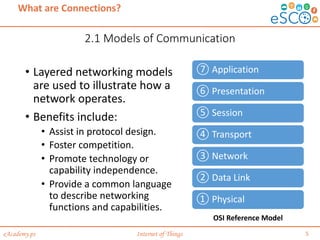
• Layered networking models
are used to illustrate how a
network operates.
• Benefits include:
• Assist in protocol design.
• Foster competition.
• Promote technology or
capability independence.
• Provide a common language
to describe networking
functions and capabilities.
What are Connections?
⑦ Application
⑥ Presentation
⑤ Session
④ Transport
③ Network
② Data Link
① Physical
OSI Reference Model
eAcademy.ps Internet of Things
TCP and OSI Models
6
What are Connections?
Models of Communication
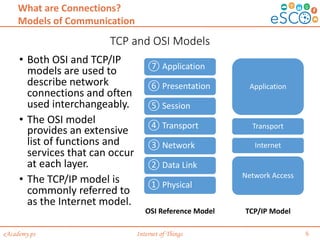
• Both OSI and TCP/IP
models are used to
describe network
connections and often
used interchangeably.
• The OSI model
provides an extensive
list of functions and
services that can occur
at each layer.
• The TCP/IP model is
commonly referred to
as the Internet model.
⑦ Application
⑥ Presentation
⑤ Session
④ Transport
③ Network
② Data Link
① Physical
OSI Reference Model
Application
Transport
Internet
Network Access
TCP/IP Model
eAcademy.ps Internet of Things
Class Activity: OSI Reference Model
• Group activity in 7 groups
• Each group works on one layer
• Duration: 15 minutes
• Output: 1 minute presentation containing:
• Short description of the layer
• Interactions with other layers
• Examples of devices and/or protocols in the layer
• Examples of standards in the layer
eAcademy.ps Internet of Things
Standardization
8
What are Connections?
Models of Communication
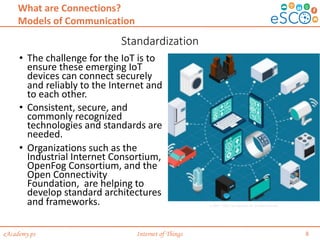
• The challenge for the IoT is to
ensure these emerging IoT
devices can connect securely
and reliably to the Internet and
to each other.
• Consistent, secure, and
commonly recognized
technologies and standards are
needed.
• Organizations such as the
Industrial Internet Consortium,
OpenFog Consortium, and the
Open Connectivity
Foundation, are helping to
develop standard architectures
and frameworks. © 2007 – 2010, Cisco Systems, Inc. All rights reserved.
eAcademy.ps Internet of Things
IoT World Forum Reference Model
9
What are Connections?
Models of Communication
© 2007 – 2010, Cisco Systems, Inc. All rights reserved.
eAcademy.ps Internet of Things
IoT World Forum Reference Model (Cont.)
10
What are Connections?
Models of Communication
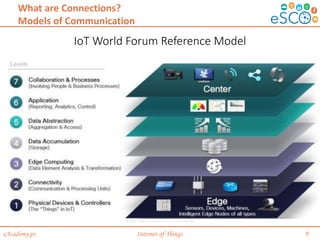
• Developed as a common framework to guide and to help accelerate IoT deployments.
• It’s intent is to provide common terminology and help clarify how information flows
and is processed for a unified IoT industry.
© 2007 – 2010, Cisco Systems, Inc. All rights reserved.
eAcademy.ps Internet of Things
Simplified IoT Architectures
11
What are Connections?
Models of Communication
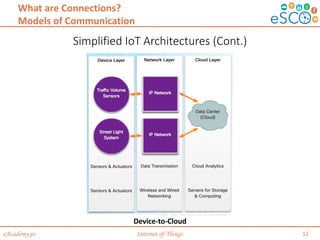
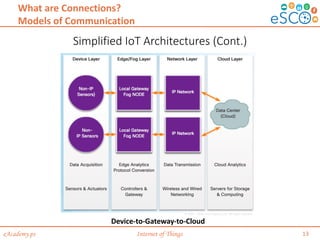
• Several architectures exist to help
facilitate the design and creation of
IoT systems.
• The OSI model, TCP/IP model, and
the IoT World Forum Reference
model have been presented as
examples.
• A simpler approach is based on
connection levels. The levels are:
• Device-to-Device
• Device-to-Cloud
• Device-to-Gateway-to-Cloud
• Device-to-Gateway-to-Cloud-to-
Application
Device-to-Device
© 2007 – 2010, Cisco Systems, Inc. All rights reserved.
eAcademy.ps Internet of Things
Simplified IoT Architectures (Cont.)
12
What are Connections?
Models of Communication
Device-to-Cloud
© 2007 – 2010, Cisco Systems, Inc. All rights reserved.
eAcademy.ps Internet of Things
Simplified IoT Architectures (Cont.)
13
What are Connections?
Models of Communication
Device-to-Gateway-to-Cloud
© 2007 – 2010, Cisco Systems, Inc. All rights reserved.
eAcademy.ps Internet of Things
Simplified IoT Architectures (Cont.)
14
What are Connections?
Models of Communication
Device-to-Gateway-to-Cloud-to-Application
© 2007 – 2010, Cisco Systems, Inc. All rights reserved.
eAcademy.ps Internet of Things
Cloud vs Fog
15
What are Connections?
Models of Communication
Cloud Fog
Architecture Centralized Distributed
Communication From distance Direct from Edge
Data Processing Far from source Close to source
Latency Higher Lower
Connectivity Internet Several Standards
Security Lower Higher
Computing Capabilities Higher Lower
eAcademy.ps Internet of Things
2.2 Layers of Connections
16
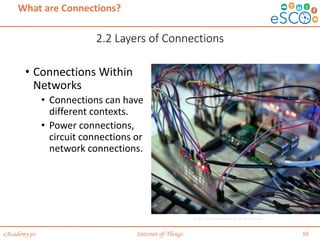
• Connections Within
Networks
• Connections can have
different contexts.
• Power connections,
circuit connections or
network connections.
What are Connections?
© 2007 – 2010, Cisco Systems, Inc. All rights reserved.
eAcademy.ps Internet of Things
Physical Connections
17
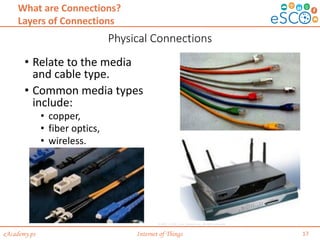
• Relate to the media
and cable type.
• Common media types
include:
• copper,
• fiber optics,
• wireless.
What are Connections?
Layers of Connections
© 2007 – 2010, Cisco Systems, Inc. All rights reserved.
eAcademy.ps Internet of Things
Data Link and Network Connections
18
• Network communication requires protocols to establish the
rules of communications. Data Link (OSI Layer 2) protocols:
• Allow the upper layers to access the media
• Prepare network data for the physical network
• Control how data is placed and received on the media
• Exchange frames between nodes over a physical network media,
such as copper or fiber-optic
• Receive and directing packets to an upper layer protocol
• Perform error detection
• The most popular data link layer connection used in wired
networks is Ethernet.
• Other data link protocols include wireless standards such as
IEEE 802.11 (Wi-Fi), IEEE 802.15 (Bluetooth), and cellular 3G
or 4G networks.
• LoRaWAN and NB-IoT are examples of emerging IoT
supporting technologies.
What are Connections?
Layers of Connections
eAcademy.ps Internet of Things
Application Connections
19
• The IoT supports many types of connections: Machine-to-
Machine (M2M), Machine-to-Gateway (M2G), Machine-to-
Cloud (M2C).
• Devices must use the same application layer protocols to
connect.
• The application will vary depending on the devices and type
of connection involved.
• MQTT and REST are newer application protocols, created to
support IoT devices that connect in the myriad of different
types of remote configurations.
• MQTT is a lightweight messaging protocol with minimal
overhead that provides high data integrity and security for
remote environments.
• REST or RESTful web services is a type of API designed to
make it easier for programs to interact over the Internet.
What are Connections?
Layers of Connections
eAcademy.ps Internet of Things
2.3 Impact of Connections on Privacy and Security
20
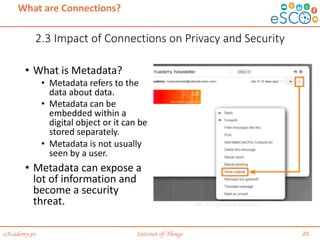
• What is Metadata?
• Metadata refers to the
data about data.
• Metadata can be
embedded within a
digital object or it can be
stored separately.
• Metadata is not usually
seen by a user.
• Metadata can expose a
lot of information and
become a security
threat.
What are Connections?
© 2007 – 2010, Cisco Systems, Inc. All rights reserved.
eAcademy.ps Internet of Things
Metadata –
Part of Metadata in email header
21
What are Connections?
Impact of Connections on Privacy and Security
eAcademy.ps Internet of Things
The Impact of IoT on Privacy
22
• Suggestions and
design
considerations
concerning privacy
include:
• Transparency
• Data Collection
• Data Usage
• Data Access
What are Connections?
Impact of Connections on Privacy and Security
© 2007 – 2010, Cisco Systems, Inc. All rights reserved.
eAcademy.ps Internet of Things
Challenges for Securing IoT Devices
23
• Some IoT network
security impacting
factors include:
• Increasing Number
of Devices
• Non-Traditional
Location of Devices
• Changing Type and
Quantity of
Gathered Data
• Lack of
Upgradeability
What are Connections?
Impact of Connections on Privacy and Security
© 2007 – 2010, Cisco Systems, Inc. All rights reserved.
eAcademy.ps Internet of Things
Activities
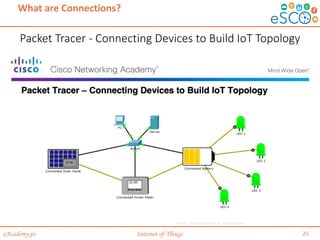
• Packet Tracer - Connecting Devices to Build IoT Topology
24
What are Connections?
eAcademy.ps Internet of Things
Packet Tracer - Connecting Devices to Build IoT Topology
25
What are Connections?
© 2007 – 2010, Cisco Systems, Inc. All rights reserved.
eAcademy.ps Internet of Things
Summary
- The main ideas of this session are:
• Layered networking models are used to illustrate and
model how devices communicate. Physical, data link and
network layers are concepts that are used to illustrate
how network communication operates.
• Security and privacy issues must be considered in all
phases of creation of an IoT system. Each level of
connectivity brings with it different requirements and
concerns.
- In the next session we will explore sensors,
actuators and microcontrollers.
26
What are Things?
eAcademy.ps Internet of Things
References
1. Cisco Networking Academy course: IoT Fundamentals:
Connecting Things version 2.01, Chapter 1.
2. IoT World Forum Reference Model
http://cdn.iotwf.com/resources/72/IoT_Reference_Model
_04_June_2014.pdf
27
What are Things?
eAcademy.ps Internet of Things
Thank you
28
What are Things?

ch2-What are Connections?

  • 1.
    eAcademy.ps Internet ofThings Course: Internet of Things (IoT)
  • 2.
    eAcademy.ps Internet ofThings Course: Internet of Things (IoT) 2 Notes: • This course is heavily based on the Cisco Networking Academy course: IoT Fundamentals: Connecting Things version 2.01. It is recommended to enroll in this course to gain full access to online materials. • Parts of this content is copyrighted by Cisco. • Main changes from original course: • Removed the business canvas model • Added a project instead of the hackathon.
  • 3.
    eAcademy.ps Internet ofThings Session 2 What are Connections? Course: Internet of Things (IoT)
  • 4.
    eAcademy.ps Internet ofThings • 2.1 Models of Communication • 2.2 Layers of Connections • 2.3 Impact of Connections on Privacy and Security • 2.4 Summary 4 Session Outline What are Things?
  • 5.
    eAcademy.ps Internet ofThings 2.1 Models of Communication 5 • Layered networking models are used to illustrate how a network operates. • Benefits include: • Assist in protocol design. • Foster competition. • Promote technology or capability independence. • Provide a common language to describe networking functions and capabilities. What are Connections? ⑦ Application ⑥ Presentation ⑤ Session ④ Transport ③ Network ② Data Link ① Physical OSI Reference Model
  • 6.
    eAcademy.ps Internet ofThings TCP and OSI Models 6 What are Connections? Models of Communication • Both OSI and TCP/IP models are used to describe network connections and often used interchangeably. • The OSI model provides an extensive list of functions and services that can occur at each layer. • The TCP/IP model is commonly referred to as the Internet model. ⑦ Application ⑥ Presentation ⑤ Session ④ Transport ③ Network ② Data Link ① Physical OSI Reference Model Application Transport Internet Network Access TCP/IP Model
  • 7.
    eAcademy.ps Internet ofThings Class Activity: OSI Reference Model • Group activity in 7 groups • Each group works on one layer • Duration: 15 minutes • Output: 1 minute presentation containing: • Short description of the layer • Interactions with other layers • Examples of devices and/or protocols in the layer • Examples of standards in the layer
  • 8.
    eAcademy.ps Internet ofThings Standardization 8 What are Connections? Models of Communication • The challenge for the IoT is to ensure these emerging IoT devices can connect securely and reliably to the Internet and to each other. • Consistent, secure, and commonly recognized technologies and standards are needed. • Organizations such as the Industrial Internet Consortium, OpenFog Consortium, and the Open Connectivity Foundation, are helping to develop standard architectures and frameworks. © 2007 – 2010, Cisco Systems, Inc. All rights reserved.
  • 9.
    eAcademy.ps Internet ofThings IoT World Forum Reference Model 9 What are Connections? Models of Communication © 2007 – 2010, Cisco Systems, Inc. All rights reserved.
  • 10.
    eAcademy.ps Internet ofThings IoT World Forum Reference Model (Cont.) 10 What are Connections? Models of Communication • Developed as a common framework to guide and to help accelerate IoT deployments. • It’s intent is to provide common terminology and help clarify how information flows and is processed for a unified IoT industry. © 2007 – 2010, Cisco Systems, Inc. All rights reserved.
  • 11.
    eAcademy.ps Internet ofThings Simplified IoT Architectures 11 What are Connections? Models of Communication • Several architectures exist to help facilitate the design and creation of IoT systems. • The OSI model, TCP/IP model, and the IoT World Forum Reference model have been presented as examples. • A simpler approach is based on connection levels. The levels are: • Device-to-Device • Device-to-Cloud • Device-to-Gateway-to-Cloud • Device-to-Gateway-to-Cloud-to- Application Device-to-Device © 2007 – 2010, Cisco Systems, Inc. All rights reserved.
  • 12.
    eAcademy.ps Internet ofThings Simplified IoT Architectures (Cont.) 12 What are Connections? Models of Communication Device-to-Cloud © 2007 – 2010, Cisco Systems, Inc. All rights reserved.
  • 13.
    eAcademy.ps Internet ofThings Simplified IoT Architectures (Cont.) 13 What are Connections? Models of Communication Device-to-Gateway-to-Cloud © 2007 – 2010, Cisco Systems, Inc. All rights reserved.
  • 14.
    eAcademy.ps Internet ofThings Simplified IoT Architectures (Cont.) 14 What are Connections? Models of Communication Device-to-Gateway-to-Cloud-to-Application © 2007 – 2010, Cisco Systems, Inc. All rights reserved.
  • 15.
    eAcademy.ps Internet ofThings Cloud vs Fog 15 What are Connections? Models of Communication Cloud Fog Architecture Centralized Distributed Communication From distance Direct from Edge Data Processing Far from source Close to source Latency Higher Lower Connectivity Internet Several Standards Security Lower Higher Computing Capabilities Higher Lower
  • 16.
    eAcademy.ps Internet ofThings 2.2 Layers of Connections 16 • Connections Within Networks • Connections can have different contexts. • Power connections, circuit connections or network connections. What are Connections? © 2007 – 2010, Cisco Systems, Inc. All rights reserved.
  • 17.
    eAcademy.ps Internet ofThings Physical Connections 17 • Relate to the media and cable type. • Common media types include: • copper, • fiber optics, • wireless. What are Connections? Layers of Connections © 2007 – 2010, Cisco Systems, Inc. All rights reserved.
  • 18.
    eAcademy.ps Internet ofThings Data Link and Network Connections 18 • Network communication requires protocols to establish the rules of communications. Data Link (OSI Layer 2) protocols: • Allow the upper layers to access the media • Prepare network data for the physical network • Control how data is placed and received on the media • Exchange frames between nodes over a physical network media, such as copper or fiber-optic • Receive and directing packets to an upper layer protocol • Perform error detection • The most popular data link layer connection used in wired networks is Ethernet. • Other data link protocols include wireless standards such as IEEE 802.11 (Wi-Fi), IEEE 802.15 (Bluetooth), and cellular 3G or 4G networks. • LoRaWAN and NB-IoT are examples of emerging IoT supporting technologies. What are Connections? Layers of Connections
  • 19.
    eAcademy.ps Internet ofThings Application Connections 19 • The IoT supports many types of connections: Machine-to- Machine (M2M), Machine-to-Gateway (M2G), Machine-to- Cloud (M2C). • Devices must use the same application layer protocols to connect. • The application will vary depending on the devices and type of connection involved. • MQTT and REST are newer application protocols, created to support IoT devices that connect in the myriad of different types of remote configurations. • MQTT is a lightweight messaging protocol with minimal overhead that provides high data integrity and security for remote environments. • REST or RESTful web services is a type of API designed to make it easier for programs to interact over the Internet. What are Connections? Layers of Connections
  • 20.
    eAcademy.ps Internet ofThings 2.3 Impact of Connections on Privacy and Security 20 • What is Metadata? • Metadata refers to the data about data. • Metadata can be embedded within a digital object or it can be stored separately. • Metadata is not usually seen by a user. • Metadata can expose a lot of information and become a security threat. What are Connections? © 2007 – 2010, Cisco Systems, Inc. All rights reserved.
  • 21.
    eAcademy.ps Internet ofThings Metadata – Part of Metadata in email header 21 What are Connections? Impact of Connections on Privacy and Security
  • 22.
    eAcademy.ps Internet ofThings The Impact of IoT on Privacy 22 • Suggestions and design considerations concerning privacy include: • Transparency • Data Collection • Data Usage • Data Access What are Connections? Impact of Connections on Privacy and Security © 2007 – 2010, Cisco Systems, Inc. All rights reserved.
  • 23.
    eAcademy.ps Internet ofThings Challenges for Securing IoT Devices 23 • Some IoT network security impacting factors include: • Increasing Number of Devices • Non-Traditional Location of Devices • Changing Type and Quantity of Gathered Data • Lack of Upgradeability What are Connections? Impact of Connections on Privacy and Security © 2007 – 2010, Cisco Systems, Inc. All rights reserved.
  • 24.
    eAcademy.ps Internet ofThings Activities • Packet Tracer - Connecting Devices to Build IoT Topology 24 What are Connections?
  • 25.
    eAcademy.ps Internet ofThings Packet Tracer - Connecting Devices to Build IoT Topology 25 What are Connections? © 2007 – 2010, Cisco Systems, Inc. All rights reserved.
  • 26.
    eAcademy.ps Internet ofThings Summary - The main ideas of this session are: • Layered networking models are used to illustrate and model how devices communicate. Physical, data link and network layers are concepts that are used to illustrate how network communication operates. • Security and privacy issues must be considered in all phases of creation of an IoT system. Each level of connectivity brings with it different requirements and concerns. - In the next session we will explore sensors, actuators and microcontrollers. 26 What are Things?
  • 27.
    eAcademy.ps Internet ofThings References 1. Cisco Networking Academy course: IoT Fundamentals: Connecting Things version 2.01, Chapter 1. 2. IoT World Forum Reference Model http://cdn.iotwf.com/resources/72/IoT_Reference_Model _04_June_2014.pdf 27 What are Things?
  • 28.
    eAcademy.ps Internet ofThings Thank you 28 What are Things?