Words Worth Reading Ltd
Proofreading services for undergraduates
http://www.wordsworthreading.co.uk/proofreading/student-proofreading-
services.php
What Information Should Students Take into Consideration when
Choosing a University?
If you’re looking to enhance your qualifications through Further Education, you will probably be
thinking about applying for a course at a university.
Besides being seen as a route to a decent professional career, university life has many other
attractions. Independence, social opportunities and the challenge of a new location are a few.
Here are some essentials you should have on your wish list when making your mind up about which
university is right for you.
Prioritising – the right course
The right course
• Research what is right for you
• Specialist courses have fewer locations accessible to you. A major subject, such as English or Law,
will have many more places on offer
• Be realistic – what are your entry level results likely to be and will they be good enough?
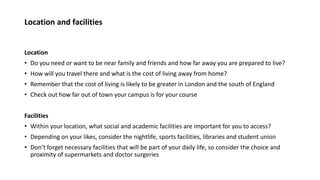
Location and facilities
Location
• Do you need or want to be near family and friends and how far away you are prepared to live?
• How will you travel there and what is the cost of living away from home?
• Remember that the cost of living is likely to be greater in London and the south of England
• Check out how far out of town your campus is for your course
Facilities
• Within your location, what social and academic facilities are important for you to access?
• Depending on your likes, consider the nightlife, sports facilities, libraries and student union
• Don’t forget necessary facilities that will be part of your daily life, so consider the choice and
proximity of supermarkets and doctor surgeries
Cost and quality
Cost
• What can you and your family afford? English universities are able to charge tuition fees that are
as much as £9,000 per academic year
• Bursaries and scholarships are available to help those from low-income families
• Check out student loans and how much you would need to repay and over what time period
Quality
• Look at university league tables to see how your potential university rates
• Weigh up the ratings with other factors such as quality of research, student feedback and
employment prospects
• Remember that universities appearing at the top of the table will demand higher grades, so again,
consider the likelihood of achieving these
Making the decision
• Do as much research as you can
• Think about the critical factors and these will help you to narrow down your course and location
• Look in prospectuses and visit university open days – it has to feel right!
• Don’t take the decision lightly. Most students drop out in the first year due to poor course choice
• Start with the right course for you and follow this up with your preferred location. All the other
things in your wish list may become a bonus.

Choosing your University

  • 1.
    Words Worth ReadingLtd Proofreading services for undergraduates http://www.wordsworthreading.co.uk/proofreading/student-proofreading- services.php
  • 2.
    What Information ShouldStudents Take into Consideration when Choosing a University? If you’re looking to enhance your qualifications through Further Education, you will probably be thinking about applying for a course at a university. Besides being seen as a route to a decent professional career, university life has many other attractions. Independence, social opportunities and the challenge of a new location are a few. Here are some essentials you should have on your wish list when making your mind up about which university is right for you.
  • 3.
    Prioritising – theright course The right course • Research what is right for you • Specialist courses have fewer locations accessible to you. A major subject, such as English or Law, will have many more places on offer • Be realistic – what are your entry level results likely to be and will they be good enough?
  • 4.
    Location and facilities Location •Do you need or want to be near family and friends and how far away you are prepared to live? • How will you travel there and what is the cost of living away from home? • Remember that the cost of living is likely to be greater in London and the south of England • Check out how far out of town your campus is for your course Facilities • Within your location, what social and academic facilities are important for you to access? • Depending on your likes, consider the nightlife, sports facilities, libraries and student union • Don’t forget necessary facilities that will be part of your daily life, so consider the choice and proximity of supermarkets and doctor surgeries
  • 5.
    Cost and quality Cost •What can you and your family afford? English universities are able to charge tuition fees that are as much as £9,000 per academic year • Bursaries and scholarships are available to help those from low-income families • Check out student loans and how much you would need to repay and over what time period Quality • Look at university league tables to see how your potential university rates • Weigh up the ratings with other factors such as quality of research, student feedback and employment prospects • Remember that universities appearing at the top of the table will demand higher grades, so again, consider the likelihood of achieving these
  • 6.
    Making the decision •Do as much research as you can • Think about the critical factors and these will help you to narrow down your course and location • Look in prospectuses and visit university open days – it has to feel right! • Don’t take the decision lightly. Most students drop out in the first year due to poor course choice • Start with the right course for you and follow this up with your preferred location. All the other things in your wish list may become a bonus.