CHOOSING A STUDY
DESIGN
Fruit
Examining, interpreting, and
making sense of data to
inform decision making
Leaves
The process of data collection
and the instruments used to
gather information
Trunk
Set of techniques and
procedures used to investigate a
particular field of research
Roots
Source of our knowledge; how
do we know what we know?
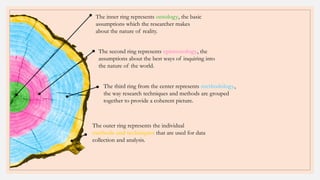
The inner ring represents ontology, the basic
assumptions which the researcher makes
about the nature of reality.
The second ring represents epistemology, the
assumptions about the best ways of inquiring into
the nature of the world.
The third ring from the center represents methodology,
the way research techniques and methods are grouped
together to provide a coherent picture.
The outer ring represents the individual
methods and techniques that are used for data
collection and analysis.
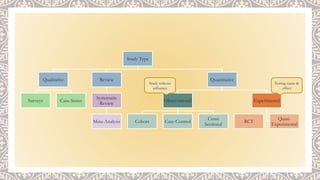
Study Type
Qualitative
Surveys Case-Series
Review
Systematic
Review
Meta-Analysis
Quantitative
Observational
Cohort Case-Control
Cross
Sectional
Experimental
RCT
Quasi-
Experimental
Testing cause &
effect
Study without
influence
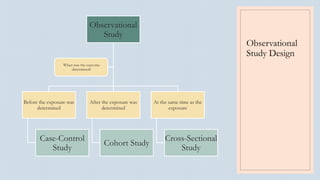
Observational
Study Design
Observational
Study
Before the exposure was
determined
Case-Control
Study
After the exposure was
determined
Cohort Study
At the same time as the
exposure
Cross-Sectional
Study
When was the outcome
determined?
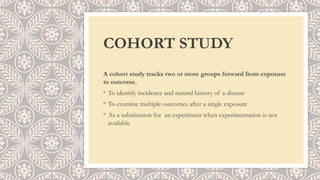
COHORT STUDY
A cohort study tracks two or more groups forward from exposure
to outcome.
◦ To identify incidence and natural history of a disease
◦ To examine multiple outcomes after a single exposure
◦ As a substitution for an experiment when experimentation is not
available
CASE-CONTROL STUDY
A study that compares patients who have a disease or outcome of
interest with patients who do not have the disease or outcome.
◦ Good for studying rare conditions or diseases
◦ Less time needed to conduct as the condition has already occurred
◦ Let's you simultaneously look at multiple risk factors
◦ Useful as initial studies to establish an association
RANDOMIZED
CONTROLLED TRIAL
A study design that randomly assigns participants into an
experimental group or a control group.
◦ To reduces bias.
◦ To approximate a controlled experiment.
◦ Statistically efficient
SYSTEMATIC REVIEW/
META ANALYSIS
A review of a formulated question that uses explicit methods to
identify, select, and appraise relevant research, and to collect and
assess data from the studies that are included in the review.
◦ To establish whether scientific findings are consistent and can be
generalized across populations, settings, and treatment variations, or
whether findings vary significantly by subsets.
◦ Meta-analyses can increase power of estimates of treatment effects
and exposure risks
Study Type
Qualitative
Surveys Case-Series
Review
Systematic
Review
Meta-Analysis
Quantitative
Observational
Cohort Case-Control
Cross
Sectional
Experimental
RCT
Quasi-
Experimental
Testing cause &
effect
Study without
influence

Choosing a Study Design Presentation.pptx

  • 1.
  • 2.
    Fruit Examining, interpreting, and makingsense of data to inform decision making Leaves The process of data collection and the instruments used to gather information Trunk Set of techniques and procedures used to investigate a particular field of research Roots Source of our knowledge; how do we know what we know?
  • 3.
    The inner ringrepresents ontology, the basic assumptions which the researcher makes about the nature of reality. The second ring represents epistemology, the assumptions about the best ways of inquiring into the nature of the world. The third ring from the center represents methodology, the way research techniques and methods are grouped together to provide a coherent picture. The outer ring represents the individual methods and techniques that are used for data collection and analysis.
  • 4.
    Study Type Qualitative Surveys Case-Series Review Systematic Review Meta-Analysis Quantitative Observational CohortCase-Control Cross Sectional Experimental RCT Quasi- Experimental Testing cause & effect Study without influence
  • 5.
    Observational Study Design Observational Study Before theexposure was determined Case-Control Study After the exposure was determined Cohort Study At the same time as the exposure Cross-Sectional Study When was the outcome determined?
  • 6.
    COHORT STUDY A cohortstudy tracks two or more groups forward from exposure to outcome. ◦ To identify incidence and natural history of a disease ◦ To examine multiple outcomes after a single exposure ◦ As a substitution for an experiment when experimentation is not available
  • 7.
    CASE-CONTROL STUDY A studythat compares patients who have a disease or outcome of interest with patients who do not have the disease or outcome. ◦ Good for studying rare conditions or diseases ◦ Less time needed to conduct as the condition has already occurred ◦ Let's you simultaneously look at multiple risk factors ◦ Useful as initial studies to establish an association
  • 8.
    RANDOMIZED CONTROLLED TRIAL A studydesign that randomly assigns participants into an experimental group or a control group. ◦ To reduces bias. ◦ To approximate a controlled experiment. ◦ Statistically efficient
  • 9.
    SYSTEMATIC REVIEW/ META ANALYSIS Areview of a formulated question that uses explicit methods to identify, select, and appraise relevant research, and to collect and assess data from the studies that are included in the review. ◦ To establish whether scientific findings are consistent and can be generalized across populations, settings, and treatment variations, or whether findings vary significantly by subsets. ◦ Meta-analyses can increase power of estimates of treatment effects and exposure risks
  • 10.
    Study Type Qualitative Surveys Case-Series Review Systematic Review Meta-Analysis Quantitative Observational CohortCase-Control Cross Sectional Experimental RCT Quasi- Experimental Testing cause & effect Study without influence

Editor's Notes

  • #4 Observational Studies themselves can be descriptive; A descriptive observational study focuses on systematically measuring variables without influencing them. i.e What proportion of students who scored in the 90th percentile attended online school? A correlational observational study tests whether variables are related to each other. i.e Does a rise in online teaching improve student test scores? Now what if you want to design the online curriculum? Experimental studies measure causation by an intervention/exposure that has been assigned through the study You develop an online math curriculum and want to determine its’ effect on student test scores. Takeaway: What is your most general, overarching question?