Healthy Relationships:
The Equality Wheel


                                             Important Note -- The Outer Circle of the Wheel

                                             Non-Violence: There is no place for violent acts or
                                             behaviors in a healthy relationship. Examples of violent acts
                                             or behaviors include yelling, name-calling, minimizing
                                             feelings, throwing things, unwanted touching, pushing,
                                             hitting, stalking.


WHAT IS THE EQUALITY WHEEL?

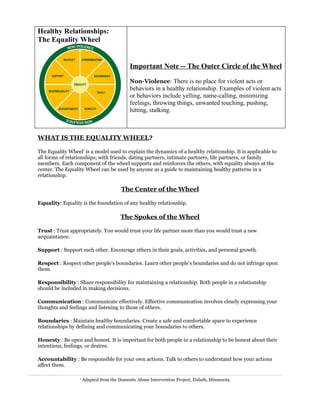
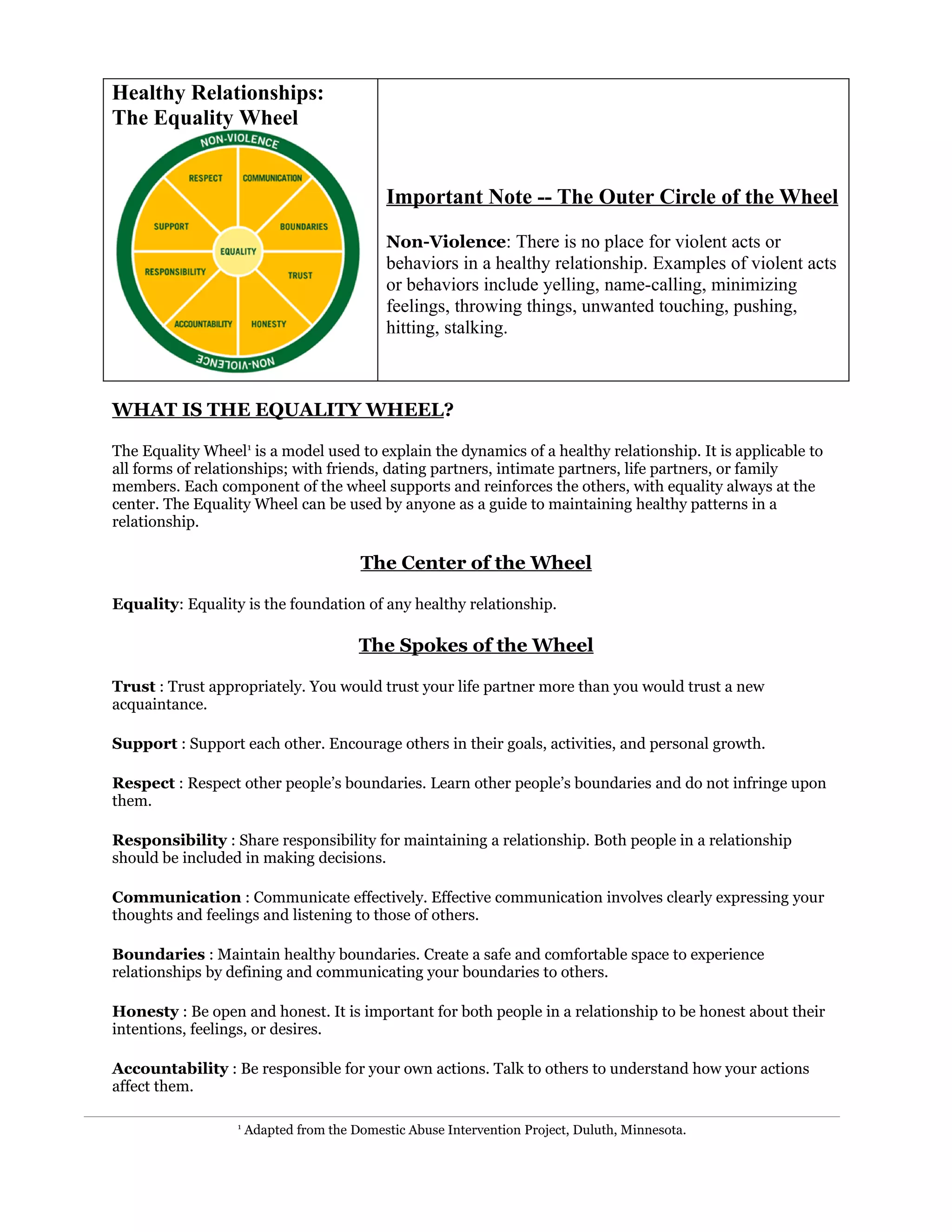
The Equality Wheel1 is a model used to explain the dynamics of a healthy relationship. It is applicable to
all forms of relationships; with friends, dating partners, intimate partners, life partners, or family
members. Each component of the wheel supports and reinforces the others, with equality always at the
center. The Equality Wheel can be used by anyone as a guide to maintaining healthy patterns in a
relationship.

                                        The Center of the Wheel

Equality: Equality is the foundation of any healthy relationship.

                                        The Spokes of the Wheel

Trust : Trust appropriately. You would trust your life partner more than you would trust a new
acquaintance.

Support : Support each other. Encourage others in their goals, activities, and personal growth.

Respect : Respect other people’s boundaries. Learn other people’s boundaries and do not infringe upon
them.

Responsibility : Share responsibility for maintaining a relationship. Both people in a relationship
should be included in making decisions.

Communication : Communicate effectively. Effective communication involves clearly expressing your
thoughts and feelings and listening to those of others.

Boundaries : Maintain healthy boundaries. Create a safe and comfortable space to experience
relationships by defining and communicating your boundaries to others.

Honesty : Be open and honest. It is important for both people in a relationship to be honest about their
intentions, feelings, or desires.

Accountability : Be responsible for your own actions. Talk to others to understand how your actions
affect them.

                  1
                      Adapted from the Domestic Abuse Intervention Project, Duluth, Minnesota.
SAFETY TIPS

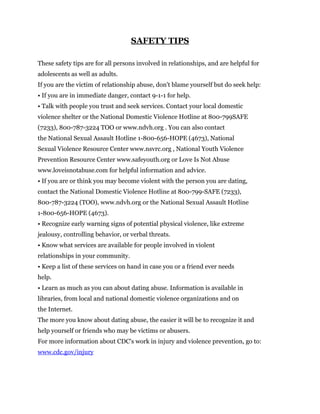
These safety tips are for all persons involved in relationships, and are helpful for
adolescents as well as adults.
If you are the victim of relationship abuse, don't blame yourself but do seek help:
• If you are in immediate danger, contact 9-1-1 for help.
• Talk with people you trust and seek services. Contact your local domestic
violence shelter or the National Domestic Violence Hotline at 800-799SAFE
(7233), 800-787-3224 TOO or www.ndvh.org . You can also contact
the National Sexual Assault Hotline 1-800-656-HOPE (4673), National
Sexual Violence Resource Center www.nsvrc.org , National Youth Violence
Prevention Resource Center www.safeyouth.org or Love Is Not Abuse
www.loveisnotabuse.com for helpful information and advice.
• If you are or think you may become violent with the person you are dating,
contact the National Domestic Violence Hotline at 800-799-SAFE (7233),
800-787-3224 (TOO), www.ndvh.org or the National Sexual Assault Hotline
1-800-656-HOPE (4673).
• Recognize early warning signs of potential physical violence, like extreme
jealousy, controlling behavior, or verbal threats.
• Know what services are available for people involved in violent
relationships in your community.
• Keep a list of these services on hand in case you or a friend ever needs
help.
• Learn as much as you can about dating abuse. Information is available in
libraries, from local and national domestic violence organizations and on
the Internet.
The more you know about dating abuse, the easier it will be to recognize it and
help yourself or friends who may be victims or abusers.
For more information about CDC's work in injury and violence prevention, go to:
www.cdc.gov/injury
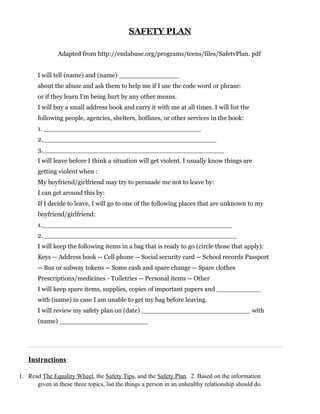
SAFETY PLAN

               Adapted from http://endabuse.org/programs/teens/files/SafetvPlan. pdf


       I will tell (name) and (name) _______________
       about the abuse and ask them to help me if I use the code word or phrase:
       or if they learn I'm being hurt by any other means.
       I will buy a small address book and carry it with me at all times. I will list the
       following people, agencies, shelters, hotlines, or other services in the book:
       1. _______________________________________
       2.___________________________________________
       3._____________________________________________
       I will leave before I think a situation will get violent. I usually know things are
       getting violent when :
       My boyfriend/girlfriend may try to persuade me not to leave by:
       I can get around this by:
       If I decide to leave, I will go to one of the following places that are unknown to my
       boyfriend/girlfriend:
       1._______________________________________________
       2.________________________________________________
       I will keep the following items in a bag that is ready to go (circle those that apply):
       Keys -- Address book -- Cell phone -- Social security card -- School records Passport
       -- Bus or subway tokens -- Some cash and spare change -- Spare clothes
       Prescriptions/medicines - Toiletries -- Personal items -- Other
       I will keep spare items, supplies, copies of important papers and ___________
       with (name) in case I am unable to get my bag before leaving.
       I will review my safety plan on (date) ___________________________ with
       (name) ______________________


   Instructions:

1. Read The Equality Wheel, the Safety Tips, and the Safety Plan. 2. Based on the information
      given in these three topics, list the things a person in an unhealthy relationship should do.

Choose Respect Equality Wheel

  • 1.
    Healthy Relationships: The EqualityWheel Important Note -- The Outer Circle of the Wheel Non-Violence: There is no place for violent acts or behaviors in a healthy relationship. Examples of violent acts or behaviors include yelling, name-calling, minimizing feelings, throwing things, unwanted touching, pushing, hitting, stalking. WHAT IS THE EQUALITY WHEEL? The Equality Wheel1 is a model used to explain the dynamics of a healthy relationship. It is applicable to all forms of relationships; with friends, dating partners, intimate partners, life partners, or family members. Each component of the wheel supports and reinforces the others, with equality always at the center. The Equality Wheel can be used by anyone as a guide to maintaining healthy patterns in a relationship. The Center of the Wheel Equality: Equality is the foundation of any healthy relationship. The Spokes of the Wheel Trust : Trust appropriately. You would trust your life partner more than you would trust a new acquaintance. Support : Support each other. Encourage others in their goals, activities, and personal growth. Respect : Respect other people’s boundaries. Learn other people’s boundaries and do not infringe upon them. Responsibility : Share responsibility for maintaining a relationship. Both people in a relationship should be included in making decisions. Communication : Communicate effectively. Effective communication involves clearly expressing your thoughts and feelings and listening to those of others. Boundaries : Maintain healthy boundaries. Create a safe and comfortable space to experience relationships by defining and communicating your boundaries to others. Honesty : Be open and honest. It is important for both people in a relationship to be honest about their intentions, feelings, or desires. Accountability : Be responsible for your own actions. Talk to others to understand how your actions affect them. 1 Adapted from the Domestic Abuse Intervention Project, Duluth, Minnesota.
  • 2.
    SAFETY TIPS These safetytips are for all persons involved in relationships, and are helpful for adolescents as well as adults. If you are the victim of relationship abuse, don't blame yourself but do seek help: • If you are in immediate danger, contact 9-1-1 for help. • Talk with people you trust and seek services. Contact your local domestic violence shelter or the National Domestic Violence Hotline at 800-799SAFE (7233), 800-787-3224 TOO or www.ndvh.org . You can also contact the National Sexual Assault Hotline 1-800-656-HOPE (4673), National Sexual Violence Resource Center www.nsvrc.org , National Youth Violence Prevention Resource Center www.safeyouth.org or Love Is Not Abuse www.loveisnotabuse.com for helpful information and advice. • If you are or think you may become violent with the person you are dating, contact the National Domestic Violence Hotline at 800-799-SAFE (7233), 800-787-3224 (TOO), www.ndvh.org or the National Sexual Assault Hotline 1-800-656-HOPE (4673). • Recognize early warning signs of potential physical violence, like extreme jealousy, controlling behavior, or verbal threats. • Know what services are available for people involved in violent relationships in your community. • Keep a list of these services on hand in case you or a friend ever needs help. • Learn as much as you can about dating abuse. Information is available in libraries, from local and national domestic violence organizations and on the Internet. The more you know about dating abuse, the easier it will be to recognize it and help yourself or friends who may be victims or abusers. For more information about CDC's work in injury and violence prevention, go to: www.cdc.gov/injury
  • 3.
    SAFETY PLAN Adapted from http://endabuse.org/programs/teens/files/SafetvPlan. pdf I will tell (name) and (name) _______________ about the abuse and ask them to help me if I use the code word or phrase: or if they learn I'm being hurt by any other means. I will buy a small address book and carry it with me at all times. I will list the following people, agencies, shelters, hotlines, or other services in the book: 1. _______________________________________ 2.___________________________________________ 3._____________________________________________ I will leave before I think a situation will get violent. I usually know things are getting violent when : My boyfriend/girlfriend may try to persuade me not to leave by: I can get around this by: If I decide to leave, I will go to one of the following places that are unknown to my boyfriend/girlfriend: 1._______________________________________________ 2.________________________________________________ I will keep the following items in a bag that is ready to go (circle those that apply): Keys -- Address book -- Cell phone -- Social security card -- School records Passport -- Bus or subway tokens -- Some cash and spare change -- Spare clothes Prescriptions/medicines - Toiletries -- Personal items -- Other I will keep spare items, supplies, copies of important papers and ___________ with (name) in case I am unable to get my bag before leaving. I will review my safety plan on (date) ___________________________ with (name) ______________________ Instructions: 1. Read The Equality Wheel, the Safety Tips, and the Safety Plan. 2. Based on the information given in these three topics, list the things a person in an unhealthy relationship should do.