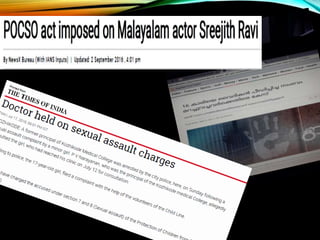
• The WHO defines Child Sexual Abuse (CSA) as
• “the involvement of a child in sexual activity
that he or she does not fully comprehend, is
unable to give informed consent to, or for
which the child is not developmentally
prepared and cannot give consent, or that
violates the laws or social taboos of society
INDIA
• 41 % of our population is under 18years ( around 56
crore)
• 35 % under 14 years
• Roughly one third are affected (males /females)
• (About 18 crore of indian children)
• Early identification and preventing repeat abuse helps
prevent complications
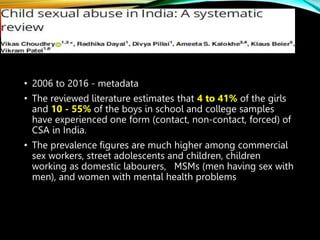
• 2006 to 2016 - metadata
• The reviewed literature estimates that 4 to 41% of the girls
and 10 - 55% of the boys in school and college samples
have experienced one form (contact, non-contact, forced) of
CSA in India.
• The prevalence figures are much higher among commercial
sex workers, street adolescents and children, children
working as domestic labourers, MSMs (men having sex with
men), and women with mental health problems
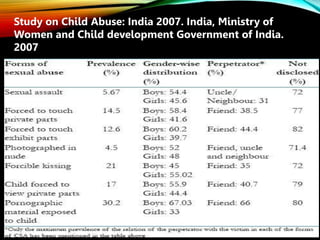
Study on Child Abuse: India 2007. India, Ministry of
Women and Child development Government of India.
2007
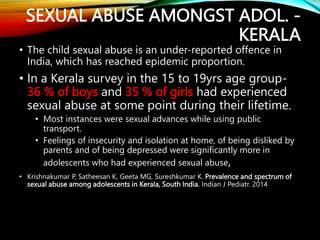
SEXUAL ABUSE AMONGST ADOL. -
KERALA
• The child sexual abuse is an under-reported offence in
India, which has reached epidemic proportion.
• In a Kerala survey in the 15 to 19yrs age group-
36 % of boys and 35 % of girls had experienced
sexual abuse at some point during their lifetime.
• Most instances were sexual advances while using public
transport.
• Feelings of insecurity and isolation at home, of being disliked by
parents and of being depressed were significantly more in
adolescents who had experienced sexual abuse,
• Krishnakumar P, Satheesan K, Geeta MG, Sureshkumar K. Prevalence and spectrum of
sexual abuse among adolescents in Kerala, South India. Indian J Pediatr. 2014
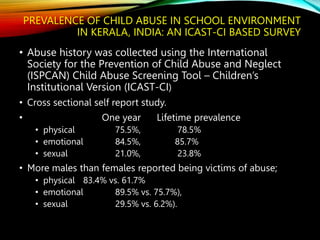
PREVALENCE OF CHILD ABUSE IN SCHOOL ENVIRONMENT
IN KERALA, INDIA: AN ICAST-CI BASED SURVEY
• Abuse history was collected using the International
Society for the Prevention of Child Abuse and Neglect
(ISPCAN) Child Abuse Screening Tool – Children’s
Institutional Version (ICAST-CI)
• Cross sectional self report study.
• One year Lifetime prevalence
• physical 75.5%, 78.5%
• emotional 84.5%, 85.7%
• sexual 21.0%, 23.8%
• More males than females reported being victims of abuse;
• physical 83.4% vs. 61.7%
• emotional 89.5% vs. 75.7%),
• sexual 29.5% vs. 6.2%).
TYPES
• Physical abuse. Physical child abuse occurs when a child is
purposely physically injured or put at risk of harm by another person.
• Sexual abuse. Sexual child abuse is any sexual activity with a child,
such as fondling, oral-genital contact, intercourse, exploitation or
exposure to child pornography.
• Emotional abuse. Emotional child abuse means injuring a child's self-
esteem or emotional well-being. It includes verbal and emotional assault
— such as continually belittling or berating a child — as well as isolating,
ignoring or rejecting a child.
• Medical abuse. Medical child abuse occurs when someone gives false
information about illness in a child that requires medical attention,
putting the child at risk of injury and unnecessary medical care.
• Neglect. Child neglect is failure to provide adequate food, shelter,
affection, supervision, education, or dental or medical care.
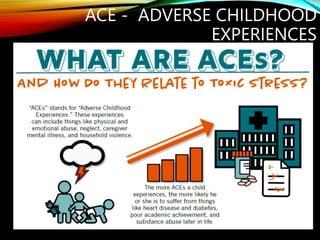
ACE - ADVERSE CHILDHOOD
EXPERIENCES
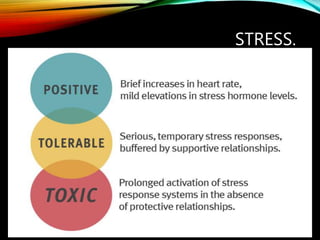
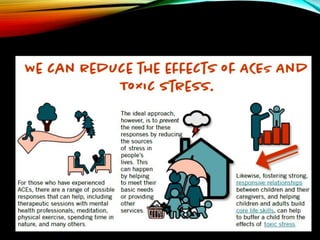
STRESS.
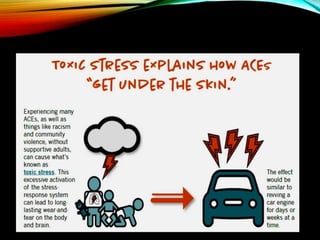
TOXIC STRESS
• an experience that overwhelms them,
sometimes making them feel like they are
in serious danger.
• It can leave - feeling powerless and
hopeless.
• And they may not have the coping skills
or support - would need to fully deal
with it.
• A child that had experienced at least four toxically stressful
events
• was 15 times more likely to attempt suicide,
• 3 times more likely to suffer from depression,
• and 4 times more likely to become an alcoholic or
intravenous drug user.
SYMPTOMS
SYMPTOMS
• A child who's being abused may feel guilty,
ashamed or confused.
• He or she may be afraid to tell anyone about
the abuse, especially if the abuser is a parent,
other relative or family friend.
WATCH FOR RED FLAGS
• Withdrawal from friends or usual activities
• Changes in behaviour — such as aggression, anger, hostility or
hyperactivity — or changes in school performance
• Depression, anxiety or unusual fears, or a sudden loss of self-
confidence
• Frequent absences from school
• Reluctance to leave school activities, as if he or she doesn't want to
go home
• Attempts at running away
• Rebellious or defiant behaviour
• Self-harm or attempts at suicide
PHYSICAL ABUSE SIGNS AND
SYMPTOMS
• Unexplained injuries, such as bruises, fractures
or burns
• Injuries that don't match the given explanation
SEXUAL ABUSE SIGNS AND SYMPTOMS
• Sexual behaviour or knowledge that's
inappropriate for the child's age
• Pregnancy or a sexually transmitted infection
• Blood in the child's underwear
• Statements that he or she was sexually abused
• Inappropriate sexual contact with other children
EMOTIONAL ABUSE
SIGNS AND SYMPTOMS
• Delayed or inappropriate emotional development
• Loss of self-confidence or self-esteem
• Social withdrawal or a loss of interest or enthusiasm
• Depression
• Avoidance of certain situations, such as refusing to go to
school or ride the bus
• Desperately seeks affection
• A decrease in school performance or loss of interest in
school
• Loss of previously acquired developmental skills
NEGLECT SIGNS AND SYMPTOMS
• Poor growth or weight gain or being overweight
• Poor hygiene
• Lack of clothing or supplies to meet physical needs
• Taking food or money without permission
• Hiding food for later
• Poor record of school attendance
• Lack of appropriate attention for medical, dental or
psychological problems or lack of necessary follow-up care
PARENTAL BEHAVIOUR
• Shows little concern for the child
• Appears unable to recognize physical or emotional distress in the
child
• Blames the child for the problems
• Consistently belittles the child, and describes the child with
negative terms, such as "worthless" or "evil"
• Expects the child to provide him or her with attention and care and
seems jealous of other family members getting attention from the
child
• Uses harsh physical discipline
• Demands an inappropriate level of physical or academic
performance
• Severely limits the child's contact with others
• Offers conflicting or unconvincing explanations for a child's injuries
or no explanation at all
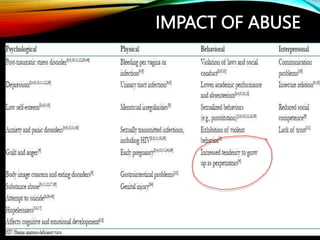
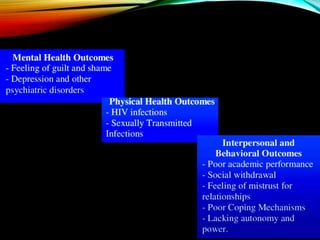
IMPACT OF ABUSE
IMPACT OF ABUSE
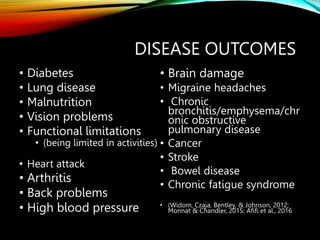
DISEASE OUTCOMES
• Diabetes
• Lung disease
• Malnutrition
• Vision problems
• Functional limitations
• (being limited in activities)
• Heart attack
• Arthritis
• Back problems
• High blood pressure
• Brain damage
• Migraine headaches
• Chronic
bronchitis/emphysema/chr
onic obstructive
pulmonary disease
• Cancer
• Stroke
• Bowel disease
• Chronic fatigue syndrome
• (Widom, Czaja, Bentley, & Johnson, 2012;
Monnat & Chandler, 2015; Afifi et al., 2016
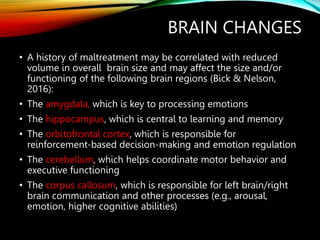
BRAIN CHANGES
• A history of maltreatment may be correlated with reduced
volume in overall brain size and may affect the size and/or
functioning of the following brain regions (Bick & Nelson,
2016):
• The amygdala, which is key to processing emotions
• The hippocampus, which is central to learning and memory
• The orbitofrontal cortex, which is responsible for
reinforcement-based decision-making and emotion regulation
• The cerebellum, which helps coordinate motor behavior and
executive functioning
• The corpus callosum, which is responsible for left brain/right
brain communication and other processes (e.g., arousal,
emotion, higher cognitive abilities)
EPIGENETICS
• Epigenetics refers to changes in how an individual’s genes are
expressed and used, which may be temporary or permanent
(National Scientific Council on the Developing Child, 2010).
• These changes can even be passed on to the person’s children.
• An epigenetic change can be caused by life experiences, such as
child maltreatment or substance exposure.
• One study found that children who had been maltreated exhibited
changes in genes associated with various physical and
psychological disorders, such as cancer, cardiovascular disease,
immune disorders, schizophrenia, bipolar disorder, and depression
(Cicchetti et al., 2016).
• The elevated and increased response of catecholamines and
CRF as discussed above can result in mechanisms that cause
accelerated neuronal loss, decreased neuronal size, reduced
number of synapses, abnormalities in developmentally
appropriate pruning, and inhibition of neurogenesis at vital
periods along with inadequate production and expression of
brain-derived neurotrophic factor.[62],[63],[64],[65],[66]
THE PREFRONTAL CORTEX
• Important brain area - constantly developing throughout
childhood and adolescence.
• serves the function of planning, thinking, attention,
concentration, working memory, and executive function.
• Has an inhibitory control over the amygdala and the limbic
system and has a neurotransmission system that is primarily
dopaminergic in nature.
• The stress-based release of catecholamines may lead to a
switching off of this control over the limbic system and
may exacerbate emotional and PTSD-related symptoms
in response to any trauma/CSA.
POCSO 2012
PROTECTION OF CHILDREN
FROM SEXUAL OFFENCES ACT,
2012.
• An Act to protect children from offences of sexual assault,
sexual harassment and pornography
• Establishment of Special Courts for trial of such offences.
• The Constitution, empowers the State to make special
provisions for children.
• “Child" means any person below the age
of EIGHTEEN years;
• Earlier, it was 16( but was amended- thru
POCSO 2012 and Criminal Law
(Amendment) Act, 2013 )
• Prohibition of Child Marriage Act states
that a girl in India can't marry before
the age of 18, and a boy before 21.
• CHAPTER I - PRELIMINARY
• CHAPTER II - SEXUAL OFFENCES AGAINST CHILDREN
• CHAPTER III - USING CHILD FOR PORNOGRAPHIC
PURPOSES AND PUNISHMENT THEREFOR
• CHAPTER IV - ABETMENT OF AND ATTEMPT TO COMMIT
AN OFFENCE
• CHAPTER V - PROCEDURE FOR REPORTING OF CASES
• CHAPTER VI - PROCEDURES FOR RECORDING STATEMENT
OF THE CHILD
• CHAPTER VII - SPECIAL COURTS
• CHAPTER VIII - PROCEDURE AND POWERS OF SPECIAL
COURTS AND RECORDING OF EVIDENCE
CONTENTS
SEC 3 - PENETRATIVE SEXUAL ASSAULT
•
• (a) he penetrates his penis, to any extent, into the vagina, mouth,
urethra or anus of a child or makes the child to do so with him
or any other person; or
• (b) he inserts, to any extent, any object or a part of the body, not
being the penis, into the vagina, the urethra or anus of the child
or makes the child to do so with him or any other person; or
• (c) he manipulates any part of the body of the child so as to
cause penetration into the vagina, urethra, anus or any part of
body of the child or makes the child to do so with him or any
other person or
• (d) he applies his mouth to the penis, vagina, anus, urethra of
the child or makes the child to do so to such person or any other
person.
SEC 5 - AGGRAVATED
PENETRATIVE SEXUAL
ASSAULT
Sec 3 if done by ….
• police officer, commits penetrative sexual assault on a child
• member of the armed forces or security forces
• public servant
• Person in management or on the staff of a jail, remand
home, protection home, observation home, or other place of
custody or care and protection established by or under any law
• whoever being on the management or staff of a hospital,
whether Government or private,
• management or staff of an educational institution or
religious institution,
SEC 5 - AGGRAVATED
PENETRATIVE SEXUAL
ASSAULT
• whoever commits gang penetrative sexual assault on a
child.
• using deadly weapons, fire, heated substance or corrosive
substance.
• causing grievous hurt or causing bodily harm and injury or
injury to the sexual organs of the child
• physically incapacitates the child or causes the child to
become mentally ill
SEC 5 - AGGRAVATED PENETRATIVE SEXUAL
ASSAULT
• makes the child pregnant as a consequence of sexual assault
• inflicts the child with HIV or any other life threatening disease
• taking advantage of a child's mental or physical disability, commits
penetrative sexual assault
• whoever commits penetrative sexual assault on the child more than
once or repeatedly; or
• penetrative sexual assault on a child below twelve years
• whoever being a relative of the child through blood or adoption or
marriage or guardianship or in foster care or having a domestic
relationship with a parent of the child or who is living in the same or
shared household with the child, commits penetrative sexual assault
on such child
• whoever being, in the ownership, or management, or staff, of any
institution providing services to the child, commits penetrative sexual
assault on the child;
• whoever being in a position of trust or authority of a child commits
penetrative sexual assault on the child in an institution or home of the
child or anywhere else; or
• knowing the child is pregnant
• attempts to murder the child
• assault on a child in the course of communal or sectarian violence
• If the offender has been previously convicted of having committed any
offence under this Act or any sexual offence punishable under any other
law for the time being in force
• penetrative sexual assault on a child and makes the child to strip or parade
naked in public, is said to commit aggravated penetrative sexual assault.
SEC 4 - PUNISHMENT FOR
SEC OFFENCE
• Not less than seven years which may extend to
imprisonment for life, and fine (Section 4)
AMENDMENT – AUG 2019
• The Bill increases the minimum punishment from seven years
to ten years.
• It further adds that if a person commits penetrative sexual
assault on a child below the age of 16 years, he will be
punishable with imprisonment between 20 years to life, with
a fine.
PUNISHMENT FOR
AGGRAVATED PENETRATIVE
SEXUAL ASSAULT :
•Rigorous imprisonment for a term
which shall not be less than ten
years but which may extend to
imprisonment for life and shall also
be liable to fine.
AMENDMENT -
• The Bill adds two more grounds to the definition of
aggravated penetrative sexual assault. These include: (i)
assault resulting in death of child, and (ii) assault committed
during a natural calamity, or in any similar situations of
violence.
• Currently, the punishment for aggravated penetrative sexual
assault is imprisonment between 10 years to life, and a fine.
• The Bill increases the minimum punishment from ten years
to 20 years, and the maximum punishment to death penalty.
SEC 7 - SEXUAL ASSAULT
• Sec 7 - Sexual assault : Whoever, with sexual intent touches
the vagina, penis, anus or breast of the child or makes the
child touch the vagina, penis, anus or breast of such person
or any other person, or does any other act with sexual intent
which involves physical contact without penetration is said to
commit sexual assault.
• Punishment for sexual assault : Imprisonment not less than
three years but which may extend to five years + fine.
• Sec 9- Aggravated sexual assault
SEC 9 AMENDMENT
• The Bill adds two more offences to the definition of
aggravated sexual assault.
• These include: (i) assault committed during a natural
calamity, and (ii) administrating or help in administering any
hormone or any chemical substance, to a child for the
purpose of attaining early sexual maturity.
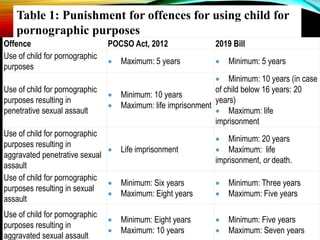
Table 1: Punishment for offences for using child for
pornographic purposes
Offence POCSO Act, 2012 2019 Bill
Use of child for pornographic
purposes
 Maximum: 5 years  Minimum: 5 years
Use of child for pornographic
purposes resulting in
penetrative sexual assault
 Minimum: 10 years
 Maximum: life imprisonment
 Minimum: 10 years (in case
of child below 16 years: 20
years)
 Maximum: life
imprisonment
Use of child for pornographic
purposes resulting in
aggravated penetrative sexual
assault
 Life imprisonment
 Minimum: 20 years
 Maximum: life
imprisonment, or death.
Use of child for pornographic
purposes resulting in sexual
assault
 Minimum: Six years
 Maximum: Eight years
 Minimum: Three years
 Maximum: Five years
Use of child for pornographic
purposes resulting in
aggravated sexual assault
 Minimum: Eight years
 Maximum: 10 years
 Minimum: Five years
 Maximum: Seven years
SEC 11 - SEXUAL HARASSMENT
• acts with sexual intent,-
• Utters any word or makes any sound, or makes any gesture or exhibits any object or part
of body with the intention that such word or sound shall be heard, or such gesture or
object or part of body shall be seen by the child; or
• (ii) makes a child exhibit his body or any part of his body so as it is seen by such person
or any other person; or
• (iii) shows any object to a child in any form or media for pornographic purposes; or
• (iv) repeatedly or constantly follows or watches or contacts a child either directly or
through electronic, digital or any other means; or
• (v) threatens to use, in any form of media, a real or fabricated depiction through
electronic, film or digital or any other mode, of any part of the body of the child or the
involvement of the child in a sexual act; or (vi) entices a child for pornographic purposes
or gives gratification therefor.
• Punishment - Imprisonment for upto 3 years and fine
SEC 13 -USE OF CHILD FOR
PORNOGRAPHIC
PURPOSES
• Punishment - imprisonment – up to 5 years + fine
• Repeat offenders – up to 7 years +fine
• If the person using the child for pornographic purposes
commits an offence, by directly participating in pornographic
acts, he shall be punished with rigorous imprisonment for life
and shall also be liable to fine.
STORAGE OF PORNOGRAPHIC
MATERIAL:
• The Act penalises storage of pornographic material for
commercial purposes with a punishment of up to three years,
or a fine, or both.
• The Bill amends this to provide that the punishment can be
imprisonment between three to five years, or a fine, or both.
• In addition, the Bill adds two other offences for storage of
pornographic material involving children. These include: (i)
failing to destroy, or delete, or report pornographic material
involving a child, and (ii) transmitting, displaying, distributing
such material except for the purpose of reporting it.
16. ABETMENT OF AN
OFFENCE.-
• A person abets an offence, who-
• First.- Instigates any person to do that offence; or
• Secondly.- Engages with one or more other person or persons in
any conspiracy for the doing of that offence, if an act or illegal
omission takes place in pursuance of that conspiracy, and in order
to the doing of that offence; or
• Thirdly.- Intentionally aids, by any act or illegal omission, the doing
of that offence.
• Explanation I.- A person who, by wilful misrepresentation, or by
wilful concealment of a material fact, which he is bound to disclose,
voluntarily causes or procures, or attempts to cause or procure a
thing to be done, is said to instigate the doing of that offence.
CHAPTER V - PROCEDURE FOR
REPORTING OF CASES
• Any person (including the child), who has apprehension that an
offence under this Act is likely to be committed or has
knowledge that such an offence has been committed, he shall
provide such information to.- the
• Special Juvenile Police Unit; or the local police.
• Every report should be given an entry number and recorded in
writing; be read over to the informant; shall be entered in a
book to be kept by the Police Unit.
• within a period of 24 hours, report the matter to the CWC
and the Special Court or to the Court of Session, including
need of the child for care and protection and steps taken in
this regard
REPORTING
• Any one can report
• Report to local police station
• Send Regd. letter with ack. due or e-mail to official email
id of the police station. ( No particular format for
intimation to police)
• You may also officially inform CWC members or chair
• Do not just inform over phone . Do record your call when
calling to inform police over phone( Follow up your call with
a proper written intimation)
WHEN TO REPORT
• As early as possible - do give it high priority
• (evidence on the victims body may be lost as time passes)
• Report to your superior officer too , if working in an
institution, in writing, - (mention – “Confidential
information”)
• Do not reveal the identity of the victim to anyone else
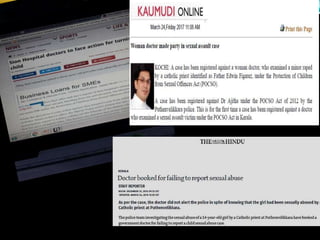
FAILURE TO REPORT
• Sec 20. Obligation of media, studio and photographic facilities to
report cases
• Punishment for failure to report or record a case : (1) Any person,
who fails to report the commission of an offence under sub-section
(1) of section 19 or section 20 or who fails to record such offence
under sub-section (2) of section 19 shall be punished with
imprisonment of either description which may extend to six
months or with fine or with both.
• (2) Any person, being in-charge of any company or an
institution (by whatever name called) who fails to report the
commission of an offence under sub-section (1) of section 19
in respect of a subordinate under his control, shall be punished
with imprisonment for a term which may extend to one year
and with fine.
EXEMPTION CLAUSE –
MEDICAL EXAMINATION
• Provisions of sections 3 to 13 not to apply in certain cases :
The provisions of sections 3 to 13 (both inclusive) shall not
apply in case of medical examination or medical treatment of
a child when such medical examination or medical treatment
is undertaken with the consent of his parents or guardian.
CHILD FRIENDLY
• 36. Child not to see accused at the time of testifying
• 37. Trials to be conducted in camera
• 38. Assistance of an interpreter or expert while recording
evidence of child
• If a child has a mental or physical disability, the Special Court
may take the assistance of a special educator or any person
familiar with the manner of communication of the child or an
expert in that field, having such qualifications, experience and
on payment of such fees as may be prescribed to record the
evidence of the child.
QUESTION OF AGE
• If any question arises in any proceeding before the Special
Court whether a person is a child or not, such question shall
be determined by the Special Court after satisfying itself
about the age of such person and it shall record in writing its
reasons for such determination
PRESUMPTION
• Sec 29 - Presumption as to certain offence : Where a
person is prosecuted for committing or abetting or
attempting to commit any offence under sections 3, 5, 7 and
section 9 of this Act, the Special Court shall presume, that
such person has committed or abetted or attempted to
commit the offence, as the case may be unless the contrary
is proved.
• Sec 30. Presumption of culpable mental state : the
Special Court shall presume the existence of such mental
state but it shall be a defence for the accused to prove the
fact that he had no such mental state with respect to the act
charged as an offence in that prosecution.
MEDICAL EXAMINATION
• 27. Medical examination of a child :
• (1) The medical examination of a child in respect of whom any
offence has been committed under this Act, shall, notwithstanding
that a First Information Report or complaint has not been
registered for the offences under this Act, be conducted in
accordance with section 164A of the Code of Criminal Procedure,
1973. 2 of 1973
• (2) In case the victim is a girl child, the medical examination shall
be conducted by a woman doctor.
• (3) The medical examination shall be conducted in the presence of
the parent of the child or any other person in whom the child
reposes trust or confidence.
• (4) Where, in case the parent of the child or other person referred
to in sub-section (3) cannot be present, for any woman nominated
by the head of the medical institution.
RECORDING OF
STATEMENT OF A CHILD :
• (1) The statement of the child shall be recorded at the residence of
the child
• or at a place where he usually resides or at the place of his choice
• (and as far as practicable) by a Woman police officer not below the
rank of S. I .
• (2) The police officer while recording the statement of the child
shall not be in uniform.
• (3) The police officer making the investigation, shall, while examining
the child, ensure that at no point of time the child come in the
contact in any way with the accused.
• (4) No child shall be detained in the police station in the night for
any reason.
• (5) The police officer shall ensure that the identity of the child is
protected from the public media
• 164 A. Medical examination of the victim of rape. –It is proposed to
get the person of the woman to be examined by a medical expert,
• shall be conducted by a registered medical practitioner employed in a
hospital run by the Government or a local authority,
• with the consent of such woman or of a person competent to give
such consent on her behalf
• within twenty-four hours from the time of receiving the information
relating to the commission of such offence.
• The registered medical practitioner, to whom such woman is sent
shall, without delay, examine her and prepare a report of his
examination giving the following particulars, namely:-
• (I) the name and address of the woman and of the person by whom
she was brought;
• (II) the age of the woman;
• (III) the description of material taken from the person of the woman
for DNA profiling;
• (IV) marks of injury, if any, on the person of the woman;
• (V) general mental condition of the woman; and
• (VI) other material particulars in reasonable detail.
164-A CONTDD.
• 3) The report shall state precisely the reasons for each
conclusion arrived at.
• (4) The report shall specifically record that the consent of the
woman or of the person competent.
• (5) The exact time of commencement and completion of the
examination shall also be noted in the report.
• (6) The registered medical practitioner shall, without delay
forward the report to the investigation officer
GUIDELINES FOR THE USE OF
PROFESSIONALS AND EXPERTS
UNDER THE POCSO ACT, 2012
MINISTRY OF WOMEN AND CHILD DEVELOPMENT-
Model guidelines under sec 39 – POCSO
TIPS FOR MEDICAL
PERSON
• Always identify yourself as a helping person and try to build
a rapport with the child.
• Make the child comfortable with the interview setting.
Gather preliminary information about the child’s verbal skills
and cognitive maturity.
• Convey that the goal of the interview is for the child to talk
and ask questions that invite the child to talk (e.g., “tell me
about your family”).
• Ask the child if he/she knows why they have come to see
you. Children are often confused about the purpose of the
interview or worried that they are in trouble.
TIPS
• Avoid touching the child and respect the child's personal
space. Do not stare at the child or sit uncomfortably close.
• Do not suggest feelings or responses to the child. For
example, do not say, “I know how difficult this must be for
you.”
• Do not make false promises. For example, do not say,
“Everything will be okay” or “You will never have to talk
about this again.”
TIPS
• Always begin with open-ended questions.
• Avoid asking the child a direct question, such as “Did
somebody touch your privates last week?”.
• Instead, try “I understand something has been bothering
you. Tell me about it.”
RULE 5 - EMERGENCY
MEDICAL CARE:
• (1) Where an officer of the SJPU, or the local police is
satisfied that the child against whom an offence has been
committed is in need of urgent medical care and protection,
he shall, as soon as possible, but not later than 24 hours of
receiving such information, arrange to take such child to the
nearest hospital or medical care facility OR centre for
emergency medical care:.
• Emergency medical care shall be rendered in such a
manner as to protect the privacy of the child, and in
• the presence of the parent or guardian or any other
person in whom the child has trust and confidence.
RULE 5 - EMERGENCY
MEDICAL CARE:
• The Medical Officer rendering emergency medical care shall attend to
the needs of the child, including --
• (i) treatment for cuts, bruises, and other injuries including genital
injuries, if any;
• (ii) treatment for exposure to sexually transmitted diseases (STDs)
including prophylaxis for identified STDs;
• (iii) treatment for exposure to Human Immunodeficiency Virus
(HIV), including prophylaxis for HIV after necessary consultation with
infectious disease experts;
• (iv) possible pregnancy and emergency contraceptives should be
discussed with the pubertal child and her parent or any other person
in whom the child has trust and confidence; and,
• (v) wherever necessary, a referral or consultation for mental or
psychological health or other counselling should be made.
• No medical practitioner, hospital or other medical facility
centre rendering emergency medical care to a child shall
demand any legal or magisterial requisition or other
documentation as a pre-requisite to rendering such care.
• Any forensic evidence collected in the course of rendering
emergency medical care must be collected in accordance
with section 27 of the Act.
ROLE OF MEDICAL PROFESSIONALS IN THE
CONTEXT OF THE POCSO ACT, 2012
• Doctors have a dual role to play in terms of the POCSO Act
2012.
• They are in a position to detect that a child has been or is
being abused (for example, if they come across a child with
an STD);
• they are also often the first point of reference in confirming
that a child has indeed been the victim of sexual abuse.
ROLE OF MEDICAL PROFESSIONALS IN THE
CONTEXT OF THE POCSO ACT, 2012 -CONTD
• The role of the doctor may include:
• i) Having an in-depth understanding of sexual victimization
• ii) Obtaining a medical history of the child‟s experience in a facilitating,
non-judgmental and empathetic manner
• iii) Meticulously documenting historical details
• iv) Conducting a detailed examination to diagnose acute and chronic
residual trauma and STDs, and to collect forensic evidence
• v) Considering a differential diagnosis of behavioural complaints and
physical signs that may mimic sexual abuse
• vi) Obtaining photographic/video documentation of all diagnostic findings
that appear to be residual to abuse
• vii) Formulating a complete and thorough medical report with diagnosis
and recommendations for treatment
• viii) Testifying in court when required
CONSENT
• Where a child is brought to a doctor for a medical examination
to confirm sexual abuse,
• the doctor must:
• i) Take the written consent of the child. The three main
elements of consent are information, comprehension and
voluntariness.
• The child and his/her family should be given information about
the medical examination process
• Where the child is too young or otherwise incapable of giving
consent, consent should be obtained from the child’s parent,
guardian or other person in whom the child has trust and
confidence
IF THE CHILD RESISTS THE
EXAMINATION
• i) If a child of any age refuses the genital-anal examination, it is a
clinical judgment of how to proceed. A rule of thumb is that the
physical exam should not cause any trauma to the child. It may
be wise to defer the examination under these
circumstances.
• ii) It may be possible to address some of the child's fears and
anxieties (e.g. a fear of needles) or potential sources of unease (e.g.
the sex of the examining health worker).
IF THE CHILD RESISTS…
• Further, utmost comfort and care for the child should be
provided e.g., examining very small children while on their
mother's (or caregiver's) lap or lying with her on a couch.
• iii) If the child still refuses, the examination may need to be
deferred or even abandoned.
• Never force the examination, especially if there are no
reported symptoms or injuries, because findings will be
minimal and this coercion may represent yet another assault to
the child.
• iv) The child should not be held down or restrained for the
examination
DOCUMENTATION
• Document who was present during the conversation with the
child.
• vi) Document questions asked and child's answers in the child's
own words.
• vii) Conduct the examination in a sensitive manner. It is
important that the exam is never painful. The exam should be
done in a manner that is least disturbing to the child.
• viii) Focus on asking simply worded, open-ended, non-leading
questions, such as the "what, when, where, and how"
questions, which are important to the medical evaluation of
suspected child sexual abuse.
• ix) Reliance should be placed as far as possible on such
questioning as "tell me more” followed by "and then what
happened?"
HEAD TO TOE EXAMN.
• When performing the head-to-toe examination of children, the
following points are particularly noteworthy:
• i) Record the height and weight of the child
(neglect may co-exist with sexual abuse).
• Note any bruises, burns, scars or rashes on the
skin.
• Carefully describe the size, location, pattern and
colour of any such injuries.
• ii) Check for any signs that force and/or restraints
were used, particularly around the neck and in the
extremities.
HEAD TO TOE EXAMN.
• (iii)Record the child's sexual development stage
and check the breasts for signs of injury.
• iv) If the survivor is menstruating at the time of
examination then a second examination is required
on a later date in order to record the injuries
clearly.
• v) Some amount of evidence is lost because of
menstruation. Hence it is important to record
whether the survivor was menstruating at the time of
assault/examination.
THE FOLLOWING PIECES OF INFORMATION ARE
ESSENTIAL TO THE MEDICAL HISTORY
• (i) Last occurrence of alleged abuse (younger children may
be unable to answer this precisely). When do you say this
happened?
• (ii) First time the alleged abuse occurred. When is the first
time you remember this happening?
• (iii) Threats that were made.
• (iv) Nature of the assault, e.g. anal, vaginal and/or oral
penetration. What area of your body did you say was
touched or hurt?
• (v) Whether or not the child noticed any injuries or
complained of pain.
CONTDD.
• (vi)Vaginal or anal pain, bleeding and/or discharge following the
event. Do you have any pain in your bottom or genital area? Is
there any blood in your panties or in the toilet?
• (vii) Any difficulty or pain with voiding or defecating. Does it hurt
when you go to the bathroom? (indication to examine both genital
and anal regions in all cases)
• (viii) Any urinary or faecal incontinence.
• (ix) Whether or not the child noticed any injuries or complained of
pain.
• (x) In case of children, illustrative books, body charts or a doll can
be used if available, to elicit the history of the assault.
THANK YOU

CHILDABUSE AND POCSO.pptx

  • 2.
    • The WHOdefines Child Sexual Abuse (CSA) as • “the involvement of a child in sexual activity that he or she does not fully comprehend, is unable to give informed consent to, or for which the child is not developmentally prepared and cannot give consent, or that violates the laws or social taboos of society
  • 4.
    INDIA • 41 %of our population is under 18years ( around 56 crore) • 35 % under 14 years • Roughly one third are affected (males /females) • (About 18 crore of indian children) • Early identification and preventing repeat abuse helps prevent complications
  • 5.
    • 2006 to2016 - metadata • The reviewed literature estimates that 4 to 41% of the girls and 10 - 55% of the boys in school and college samples have experienced one form (contact, non-contact, forced) of CSA in India. • The prevalence figures are much higher among commercial sex workers, street adolescents and children, children working as domestic labourers, MSMs (men having sex with men), and women with mental health problems
  • 6.
    Study on ChildAbuse: India 2007. India, Ministry of Women and Child development Government of India. 2007
  • 7.
    SEXUAL ABUSE AMONGSTADOL. - KERALA • The child sexual abuse is an under-reported offence in India, which has reached epidemic proportion. • In a Kerala survey in the 15 to 19yrs age group- 36 % of boys and 35 % of girls had experienced sexual abuse at some point during their lifetime. • Most instances were sexual advances while using public transport. • Feelings of insecurity and isolation at home, of being disliked by parents and of being depressed were significantly more in adolescents who had experienced sexual abuse, • Krishnakumar P, Satheesan K, Geeta MG, Sureshkumar K. Prevalence and spectrum of sexual abuse among adolescents in Kerala, South India. Indian J Pediatr. 2014
  • 8.
    PREVALENCE OF CHILDABUSE IN SCHOOL ENVIRONMENT IN KERALA, INDIA: AN ICAST-CI BASED SURVEY • Abuse history was collected using the International Society for the Prevention of Child Abuse and Neglect (ISPCAN) Child Abuse Screening Tool – Children’s Institutional Version (ICAST-CI) • Cross sectional self report study. • One year Lifetime prevalence • physical 75.5%, 78.5% • emotional 84.5%, 85.7% • sexual 21.0%, 23.8% • More males than females reported being victims of abuse; • physical 83.4% vs. 61.7% • emotional 89.5% vs. 75.7%), • sexual 29.5% vs. 6.2%).
  • 9.
    TYPES • Physical abuse.Physical child abuse occurs when a child is purposely physically injured or put at risk of harm by another person. • Sexual abuse. Sexual child abuse is any sexual activity with a child, such as fondling, oral-genital contact, intercourse, exploitation or exposure to child pornography. • Emotional abuse. Emotional child abuse means injuring a child's self- esteem or emotional well-being. It includes verbal and emotional assault — such as continually belittling or berating a child — as well as isolating, ignoring or rejecting a child. • Medical abuse. Medical child abuse occurs when someone gives false information about illness in a child that requires medical attention, putting the child at risk of injury and unnecessary medical care. • Neglect. Child neglect is failure to provide adequate food, shelter, affection, supervision, education, or dental or medical care.
  • 10.
    ACE - ADVERSECHILDHOOD EXPERIENCES
  • 11.
  • 13.
    TOXIC STRESS • anexperience that overwhelms them, sometimes making them feel like they are in serious danger. • It can leave - feeling powerless and hopeless. • And they may not have the coping skills or support - would need to fully deal with it.
  • 14.
    • A childthat had experienced at least four toxically stressful events • was 15 times more likely to attempt suicide, • 3 times more likely to suffer from depression, • and 4 times more likely to become an alcoholic or intravenous drug user.
  • 16.
  • 17.
    SYMPTOMS • A childwho's being abused may feel guilty, ashamed or confused. • He or she may be afraid to tell anyone about the abuse, especially if the abuser is a parent, other relative or family friend.
  • 18.
    WATCH FOR REDFLAGS • Withdrawal from friends or usual activities • Changes in behaviour — such as aggression, anger, hostility or hyperactivity — or changes in school performance • Depression, anxiety or unusual fears, or a sudden loss of self- confidence • Frequent absences from school • Reluctance to leave school activities, as if he or she doesn't want to go home • Attempts at running away • Rebellious or defiant behaviour • Self-harm or attempts at suicide
  • 19.
    PHYSICAL ABUSE SIGNSAND SYMPTOMS • Unexplained injuries, such as bruises, fractures or burns • Injuries that don't match the given explanation
  • 20.
    SEXUAL ABUSE SIGNSAND SYMPTOMS • Sexual behaviour or knowledge that's inappropriate for the child's age • Pregnancy or a sexually transmitted infection • Blood in the child's underwear • Statements that he or she was sexually abused • Inappropriate sexual contact with other children
  • 21.
    EMOTIONAL ABUSE SIGNS ANDSYMPTOMS • Delayed or inappropriate emotional development • Loss of self-confidence or self-esteem • Social withdrawal or a loss of interest or enthusiasm • Depression • Avoidance of certain situations, such as refusing to go to school or ride the bus • Desperately seeks affection • A decrease in school performance or loss of interest in school • Loss of previously acquired developmental skills
  • 22.
    NEGLECT SIGNS ANDSYMPTOMS • Poor growth or weight gain or being overweight • Poor hygiene • Lack of clothing or supplies to meet physical needs • Taking food or money without permission • Hiding food for later • Poor record of school attendance • Lack of appropriate attention for medical, dental or psychological problems or lack of necessary follow-up care
  • 23.
    PARENTAL BEHAVIOUR • Showslittle concern for the child • Appears unable to recognize physical or emotional distress in the child • Blames the child for the problems • Consistently belittles the child, and describes the child with negative terms, such as "worthless" or "evil" • Expects the child to provide him or her with attention and care and seems jealous of other family members getting attention from the child • Uses harsh physical discipline • Demands an inappropriate level of physical or academic performance • Severely limits the child's contact with others • Offers conflicting or unconvincing explanations for a child's injuries or no explanation at all
  • 24.
  • 25.
  • 27.
    DISEASE OUTCOMES • Diabetes •Lung disease • Malnutrition • Vision problems • Functional limitations • (being limited in activities) • Heart attack • Arthritis • Back problems • High blood pressure • Brain damage • Migraine headaches • Chronic bronchitis/emphysema/chr onic obstructive pulmonary disease • Cancer • Stroke • Bowel disease • Chronic fatigue syndrome • (Widom, Czaja, Bentley, & Johnson, 2012; Monnat & Chandler, 2015; Afifi et al., 2016
  • 28.
    BRAIN CHANGES • Ahistory of maltreatment may be correlated with reduced volume in overall brain size and may affect the size and/or functioning of the following brain regions (Bick & Nelson, 2016): • The amygdala, which is key to processing emotions • The hippocampus, which is central to learning and memory • The orbitofrontal cortex, which is responsible for reinforcement-based decision-making and emotion regulation • The cerebellum, which helps coordinate motor behavior and executive functioning • The corpus callosum, which is responsible for left brain/right brain communication and other processes (e.g., arousal, emotion, higher cognitive abilities)
  • 29.
    EPIGENETICS • Epigenetics refersto changes in how an individual’s genes are expressed and used, which may be temporary or permanent (National Scientific Council on the Developing Child, 2010). • These changes can even be passed on to the person’s children. • An epigenetic change can be caused by life experiences, such as child maltreatment or substance exposure. • One study found that children who had been maltreated exhibited changes in genes associated with various physical and psychological disorders, such as cancer, cardiovascular disease, immune disorders, schizophrenia, bipolar disorder, and depression (Cicchetti et al., 2016).
  • 30.
    • The elevatedand increased response of catecholamines and CRF as discussed above can result in mechanisms that cause accelerated neuronal loss, decreased neuronal size, reduced number of synapses, abnormalities in developmentally appropriate pruning, and inhibition of neurogenesis at vital periods along with inadequate production and expression of brain-derived neurotrophic factor.[62],[63],[64],[65],[66]
  • 31.
    THE PREFRONTAL CORTEX •Important brain area - constantly developing throughout childhood and adolescence. • serves the function of planning, thinking, attention, concentration, working memory, and executive function. • Has an inhibitory control over the amygdala and the limbic system and has a neurotransmission system that is primarily dopaminergic in nature. • The stress-based release of catecholamines may lead to a switching off of this control over the limbic system and may exacerbate emotional and PTSD-related symptoms in response to any trauma/CSA.
  • 32.
  • 33.
    PROTECTION OF CHILDREN FROMSEXUAL OFFENCES ACT, 2012. • An Act to protect children from offences of sexual assault, sexual harassment and pornography • Establishment of Special Courts for trial of such offences. • The Constitution, empowers the State to make special provisions for children.
  • 36.
    • “Child" meansany person below the age of EIGHTEEN years; • Earlier, it was 16( but was amended- thru POCSO 2012 and Criminal Law (Amendment) Act, 2013 ) • Prohibition of Child Marriage Act states that a girl in India can't marry before the age of 18, and a boy before 21.
  • 37.
    • CHAPTER I- PRELIMINARY • CHAPTER II - SEXUAL OFFENCES AGAINST CHILDREN • CHAPTER III - USING CHILD FOR PORNOGRAPHIC PURPOSES AND PUNISHMENT THEREFOR • CHAPTER IV - ABETMENT OF AND ATTEMPT TO COMMIT AN OFFENCE • CHAPTER V - PROCEDURE FOR REPORTING OF CASES • CHAPTER VI - PROCEDURES FOR RECORDING STATEMENT OF THE CHILD • CHAPTER VII - SPECIAL COURTS • CHAPTER VIII - PROCEDURE AND POWERS OF SPECIAL COURTS AND RECORDING OF EVIDENCE CONTENTS
  • 38.
    SEC 3 -PENETRATIVE SEXUAL ASSAULT • • (a) he penetrates his penis, to any extent, into the vagina, mouth, urethra or anus of a child or makes the child to do so with him or any other person; or • (b) he inserts, to any extent, any object or a part of the body, not being the penis, into the vagina, the urethra or anus of the child or makes the child to do so with him or any other person; or • (c) he manipulates any part of the body of the child so as to cause penetration into the vagina, urethra, anus or any part of body of the child or makes the child to do so with him or any other person or • (d) he applies his mouth to the penis, vagina, anus, urethra of the child or makes the child to do so to such person or any other person.
  • 39.
    SEC 5 -AGGRAVATED PENETRATIVE SEXUAL ASSAULT Sec 3 if done by …. • police officer, commits penetrative sexual assault on a child • member of the armed forces or security forces • public servant • Person in management or on the staff of a jail, remand home, protection home, observation home, or other place of custody or care and protection established by or under any law • whoever being on the management or staff of a hospital, whether Government or private, • management or staff of an educational institution or religious institution,
  • 40.
    SEC 5 -AGGRAVATED PENETRATIVE SEXUAL ASSAULT • whoever commits gang penetrative sexual assault on a child. • using deadly weapons, fire, heated substance or corrosive substance. • causing grievous hurt or causing bodily harm and injury or injury to the sexual organs of the child • physically incapacitates the child or causes the child to become mentally ill
  • 41.
    SEC 5 -AGGRAVATED PENETRATIVE SEXUAL ASSAULT • makes the child pregnant as a consequence of sexual assault • inflicts the child with HIV or any other life threatening disease • taking advantage of a child's mental or physical disability, commits penetrative sexual assault • whoever commits penetrative sexual assault on the child more than once or repeatedly; or • penetrative sexual assault on a child below twelve years • whoever being a relative of the child through blood or adoption or marriage or guardianship or in foster care or having a domestic relationship with a parent of the child or who is living in the same or shared household with the child, commits penetrative sexual assault on such child
  • 42.
    • whoever being,in the ownership, or management, or staff, of any institution providing services to the child, commits penetrative sexual assault on the child; • whoever being in a position of trust or authority of a child commits penetrative sexual assault on the child in an institution or home of the child or anywhere else; or • knowing the child is pregnant • attempts to murder the child • assault on a child in the course of communal or sectarian violence • If the offender has been previously convicted of having committed any offence under this Act or any sexual offence punishable under any other law for the time being in force • penetrative sexual assault on a child and makes the child to strip or parade naked in public, is said to commit aggravated penetrative sexual assault.
  • 43.
    SEC 4 -PUNISHMENT FOR SEC OFFENCE • Not less than seven years which may extend to imprisonment for life, and fine (Section 4)
  • 44.
    AMENDMENT – AUG2019 • The Bill increases the minimum punishment from seven years to ten years. • It further adds that if a person commits penetrative sexual assault on a child below the age of 16 years, he will be punishable with imprisonment between 20 years to life, with a fine.
  • 45.
    PUNISHMENT FOR AGGRAVATED PENETRATIVE SEXUALASSAULT : •Rigorous imprisonment for a term which shall not be less than ten years but which may extend to imprisonment for life and shall also be liable to fine.
  • 46.
    AMENDMENT - • TheBill adds two more grounds to the definition of aggravated penetrative sexual assault. These include: (i) assault resulting in death of child, and (ii) assault committed during a natural calamity, or in any similar situations of violence. • Currently, the punishment for aggravated penetrative sexual assault is imprisonment between 10 years to life, and a fine. • The Bill increases the minimum punishment from ten years to 20 years, and the maximum punishment to death penalty.
  • 47.
    SEC 7 -SEXUAL ASSAULT • Sec 7 - Sexual assault : Whoever, with sexual intent touches the vagina, penis, anus or breast of the child or makes the child touch the vagina, penis, anus or breast of such person or any other person, or does any other act with sexual intent which involves physical contact without penetration is said to commit sexual assault. • Punishment for sexual assault : Imprisonment not less than three years but which may extend to five years + fine. • Sec 9- Aggravated sexual assault
  • 48.
    SEC 9 AMENDMENT •The Bill adds two more offences to the definition of aggravated sexual assault. • These include: (i) assault committed during a natural calamity, and (ii) administrating or help in administering any hormone or any chemical substance, to a child for the purpose of attaining early sexual maturity.
  • 49.
    Table 1: Punishmentfor offences for using child for pornographic purposes Offence POCSO Act, 2012 2019 Bill Use of child for pornographic purposes  Maximum: 5 years  Minimum: 5 years Use of child for pornographic purposes resulting in penetrative sexual assault  Minimum: 10 years  Maximum: life imprisonment  Minimum: 10 years (in case of child below 16 years: 20 years)  Maximum: life imprisonment Use of child for pornographic purposes resulting in aggravated penetrative sexual assault  Life imprisonment  Minimum: 20 years  Maximum: life imprisonment, or death. Use of child for pornographic purposes resulting in sexual assault  Minimum: Six years  Maximum: Eight years  Minimum: Three years  Maximum: Five years Use of child for pornographic purposes resulting in aggravated sexual assault  Minimum: Eight years  Maximum: 10 years  Minimum: Five years  Maximum: Seven years
  • 50.
    SEC 11 -SEXUAL HARASSMENT • acts with sexual intent,- • Utters any word or makes any sound, or makes any gesture or exhibits any object or part of body with the intention that such word or sound shall be heard, or such gesture or object or part of body shall be seen by the child; or • (ii) makes a child exhibit his body or any part of his body so as it is seen by such person or any other person; or • (iii) shows any object to a child in any form or media for pornographic purposes; or • (iv) repeatedly or constantly follows or watches or contacts a child either directly or through electronic, digital or any other means; or • (v) threatens to use, in any form of media, a real or fabricated depiction through electronic, film or digital or any other mode, of any part of the body of the child or the involvement of the child in a sexual act; or (vi) entices a child for pornographic purposes or gives gratification therefor. • Punishment - Imprisonment for upto 3 years and fine
  • 51.
    SEC 13 -USEOF CHILD FOR PORNOGRAPHIC PURPOSES • Punishment - imprisonment – up to 5 years + fine • Repeat offenders – up to 7 years +fine • If the person using the child for pornographic purposes commits an offence, by directly participating in pornographic acts, he shall be punished with rigorous imprisonment for life and shall also be liable to fine.
  • 52.
    STORAGE OF PORNOGRAPHIC MATERIAL: •The Act penalises storage of pornographic material for commercial purposes with a punishment of up to three years, or a fine, or both. • The Bill amends this to provide that the punishment can be imprisonment between three to five years, or a fine, or both. • In addition, the Bill adds two other offences for storage of pornographic material involving children. These include: (i) failing to destroy, or delete, or report pornographic material involving a child, and (ii) transmitting, displaying, distributing such material except for the purpose of reporting it.
  • 53.
    16. ABETMENT OFAN OFFENCE.- • A person abets an offence, who- • First.- Instigates any person to do that offence; or • Secondly.- Engages with one or more other person or persons in any conspiracy for the doing of that offence, if an act or illegal omission takes place in pursuance of that conspiracy, and in order to the doing of that offence; or • Thirdly.- Intentionally aids, by any act or illegal omission, the doing of that offence. • Explanation I.- A person who, by wilful misrepresentation, or by wilful concealment of a material fact, which he is bound to disclose, voluntarily causes or procures, or attempts to cause or procure a thing to be done, is said to instigate the doing of that offence.
  • 54.
    CHAPTER V -PROCEDURE FOR REPORTING OF CASES • Any person (including the child), who has apprehension that an offence under this Act is likely to be committed or has knowledge that such an offence has been committed, he shall provide such information to.- the • Special Juvenile Police Unit; or the local police. • Every report should be given an entry number and recorded in writing; be read over to the informant; shall be entered in a book to be kept by the Police Unit. • within a period of 24 hours, report the matter to the CWC and the Special Court or to the Court of Session, including need of the child for care and protection and steps taken in this regard
  • 55.
    REPORTING • Any onecan report • Report to local police station • Send Regd. letter with ack. due or e-mail to official email id of the police station. ( No particular format for intimation to police) • You may also officially inform CWC members or chair • Do not just inform over phone . Do record your call when calling to inform police over phone( Follow up your call with a proper written intimation)
  • 56.
    WHEN TO REPORT •As early as possible - do give it high priority • (evidence on the victims body may be lost as time passes) • Report to your superior officer too , if working in an institution, in writing, - (mention – “Confidential information”) • Do not reveal the identity of the victim to anyone else
  • 57.
    FAILURE TO REPORT •Sec 20. Obligation of media, studio and photographic facilities to report cases • Punishment for failure to report or record a case : (1) Any person, who fails to report the commission of an offence under sub-section (1) of section 19 or section 20 or who fails to record such offence under sub-section (2) of section 19 shall be punished with imprisonment of either description which may extend to six months or with fine or with both. • (2) Any person, being in-charge of any company or an institution (by whatever name called) who fails to report the commission of an offence under sub-section (1) of section 19 in respect of a subordinate under his control, shall be punished with imprisonment for a term which may extend to one year and with fine.
  • 58.
    EXEMPTION CLAUSE – MEDICALEXAMINATION • Provisions of sections 3 to 13 not to apply in certain cases : The provisions of sections 3 to 13 (both inclusive) shall not apply in case of medical examination or medical treatment of a child when such medical examination or medical treatment is undertaken with the consent of his parents or guardian.
  • 59.
    CHILD FRIENDLY • 36.Child not to see accused at the time of testifying • 37. Trials to be conducted in camera • 38. Assistance of an interpreter or expert while recording evidence of child • If a child has a mental or physical disability, the Special Court may take the assistance of a special educator or any person familiar with the manner of communication of the child or an expert in that field, having such qualifications, experience and on payment of such fees as may be prescribed to record the evidence of the child.
  • 60.
    QUESTION OF AGE •If any question arises in any proceeding before the Special Court whether a person is a child or not, such question shall be determined by the Special Court after satisfying itself about the age of such person and it shall record in writing its reasons for such determination
  • 61.
    PRESUMPTION • Sec 29- Presumption as to certain offence : Where a person is prosecuted for committing or abetting or attempting to commit any offence under sections 3, 5, 7 and section 9 of this Act, the Special Court shall presume, that such person has committed or abetted or attempted to commit the offence, as the case may be unless the contrary is proved. • Sec 30. Presumption of culpable mental state : the Special Court shall presume the existence of such mental state but it shall be a defence for the accused to prove the fact that he had no such mental state with respect to the act charged as an offence in that prosecution.
  • 62.
    MEDICAL EXAMINATION • 27.Medical examination of a child : • (1) The medical examination of a child in respect of whom any offence has been committed under this Act, shall, notwithstanding that a First Information Report or complaint has not been registered for the offences under this Act, be conducted in accordance with section 164A of the Code of Criminal Procedure, 1973. 2 of 1973 • (2) In case the victim is a girl child, the medical examination shall be conducted by a woman doctor. • (3) The medical examination shall be conducted in the presence of the parent of the child or any other person in whom the child reposes trust or confidence. • (4) Where, in case the parent of the child or other person referred to in sub-section (3) cannot be present, for any woman nominated by the head of the medical institution.
  • 63.
    RECORDING OF STATEMENT OFA CHILD : • (1) The statement of the child shall be recorded at the residence of the child • or at a place where he usually resides or at the place of his choice • (and as far as practicable) by a Woman police officer not below the rank of S. I . • (2) The police officer while recording the statement of the child shall not be in uniform. • (3) The police officer making the investigation, shall, while examining the child, ensure that at no point of time the child come in the contact in any way with the accused. • (4) No child shall be detained in the police station in the night for any reason. • (5) The police officer shall ensure that the identity of the child is protected from the public media
  • 64.
    • 164 A.Medical examination of the victim of rape. –It is proposed to get the person of the woman to be examined by a medical expert, • shall be conducted by a registered medical practitioner employed in a hospital run by the Government or a local authority, • with the consent of such woman or of a person competent to give such consent on her behalf • within twenty-four hours from the time of receiving the information relating to the commission of such offence. • The registered medical practitioner, to whom such woman is sent shall, without delay, examine her and prepare a report of his examination giving the following particulars, namely:- • (I) the name and address of the woman and of the person by whom she was brought; • (II) the age of the woman; • (III) the description of material taken from the person of the woman for DNA profiling; • (IV) marks of injury, if any, on the person of the woman; • (V) general mental condition of the woman; and • (VI) other material particulars in reasonable detail.
  • 65.
    164-A CONTDD. • 3)The report shall state precisely the reasons for each conclusion arrived at. • (4) The report shall specifically record that the consent of the woman or of the person competent. • (5) The exact time of commencement and completion of the examination shall also be noted in the report. • (6) The registered medical practitioner shall, without delay forward the report to the investigation officer
  • 66.
    GUIDELINES FOR THEUSE OF PROFESSIONALS AND EXPERTS UNDER THE POCSO ACT, 2012 MINISTRY OF WOMEN AND CHILD DEVELOPMENT- Model guidelines under sec 39 – POCSO
  • 67.
    TIPS FOR MEDICAL PERSON •Always identify yourself as a helping person and try to build a rapport with the child. • Make the child comfortable with the interview setting. Gather preliminary information about the child’s verbal skills and cognitive maturity. • Convey that the goal of the interview is for the child to talk and ask questions that invite the child to talk (e.g., “tell me about your family”). • Ask the child if he/she knows why they have come to see you. Children are often confused about the purpose of the interview or worried that they are in trouble.
  • 68.
    TIPS • Avoid touchingthe child and respect the child's personal space. Do not stare at the child or sit uncomfortably close. • Do not suggest feelings or responses to the child. For example, do not say, “I know how difficult this must be for you.” • Do not make false promises. For example, do not say, “Everything will be okay” or “You will never have to talk about this again.”
  • 69.
    TIPS • Always beginwith open-ended questions. • Avoid asking the child a direct question, such as “Did somebody touch your privates last week?”. • Instead, try “I understand something has been bothering you. Tell me about it.”
  • 70.
    RULE 5 -EMERGENCY MEDICAL CARE: • (1) Where an officer of the SJPU, or the local police is satisfied that the child against whom an offence has been committed is in need of urgent medical care and protection, he shall, as soon as possible, but not later than 24 hours of receiving such information, arrange to take such child to the nearest hospital or medical care facility OR centre for emergency medical care:. • Emergency medical care shall be rendered in such a manner as to protect the privacy of the child, and in • the presence of the parent or guardian or any other person in whom the child has trust and confidence.
  • 71.
    RULE 5 -EMERGENCY MEDICAL CARE: • The Medical Officer rendering emergency medical care shall attend to the needs of the child, including -- • (i) treatment for cuts, bruises, and other injuries including genital injuries, if any; • (ii) treatment for exposure to sexually transmitted diseases (STDs) including prophylaxis for identified STDs; • (iii) treatment for exposure to Human Immunodeficiency Virus (HIV), including prophylaxis for HIV after necessary consultation with infectious disease experts; • (iv) possible pregnancy and emergency contraceptives should be discussed with the pubertal child and her parent or any other person in whom the child has trust and confidence; and, • (v) wherever necessary, a referral or consultation for mental or psychological health or other counselling should be made.
  • 72.
    • No medicalpractitioner, hospital or other medical facility centre rendering emergency medical care to a child shall demand any legal or magisterial requisition or other documentation as a pre-requisite to rendering such care. • Any forensic evidence collected in the course of rendering emergency medical care must be collected in accordance with section 27 of the Act.
  • 73.
    ROLE OF MEDICALPROFESSIONALS IN THE CONTEXT OF THE POCSO ACT, 2012 • Doctors have a dual role to play in terms of the POCSO Act 2012. • They are in a position to detect that a child has been or is being abused (for example, if they come across a child with an STD); • they are also often the first point of reference in confirming that a child has indeed been the victim of sexual abuse.
  • 74.
    ROLE OF MEDICALPROFESSIONALS IN THE CONTEXT OF THE POCSO ACT, 2012 -CONTD • The role of the doctor may include: • i) Having an in-depth understanding of sexual victimization • ii) Obtaining a medical history of the child‟s experience in a facilitating, non-judgmental and empathetic manner • iii) Meticulously documenting historical details • iv) Conducting a detailed examination to diagnose acute and chronic residual trauma and STDs, and to collect forensic evidence • v) Considering a differential diagnosis of behavioural complaints and physical signs that may mimic sexual abuse • vi) Obtaining photographic/video documentation of all diagnostic findings that appear to be residual to abuse • vii) Formulating a complete and thorough medical report with diagnosis and recommendations for treatment • viii) Testifying in court when required
  • 75.
    CONSENT • Where achild is brought to a doctor for a medical examination to confirm sexual abuse, • the doctor must: • i) Take the written consent of the child. The three main elements of consent are information, comprehension and voluntariness. • The child and his/her family should be given information about the medical examination process • Where the child is too young or otherwise incapable of giving consent, consent should be obtained from the child’s parent, guardian or other person in whom the child has trust and confidence
  • 76.
    IF THE CHILDRESISTS THE EXAMINATION • i) If a child of any age refuses the genital-anal examination, it is a clinical judgment of how to proceed. A rule of thumb is that the physical exam should not cause any trauma to the child. It may be wise to defer the examination under these circumstances. • ii) It may be possible to address some of the child's fears and anxieties (e.g. a fear of needles) or potential sources of unease (e.g. the sex of the examining health worker).
  • 77.
    IF THE CHILDRESISTS… • Further, utmost comfort and care for the child should be provided e.g., examining very small children while on their mother's (or caregiver's) lap or lying with her on a couch. • iii) If the child still refuses, the examination may need to be deferred or even abandoned. • Never force the examination, especially if there are no reported symptoms or injuries, because findings will be minimal and this coercion may represent yet another assault to the child. • iv) The child should not be held down or restrained for the examination
  • 78.
    DOCUMENTATION • Document whowas present during the conversation with the child. • vi) Document questions asked and child's answers in the child's own words. • vii) Conduct the examination in a sensitive manner. It is important that the exam is never painful. The exam should be done in a manner that is least disturbing to the child. • viii) Focus on asking simply worded, open-ended, non-leading questions, such as the "what, when, where, and how" questions, which are important to the medical evaluation of suspected child sexual abuse. • ix) Reliance should be placed as far as possible on such questioning as "tell me more” followed by "and then what happened?"
  • 79.
    HEAD TO TOEEXAMN. • When performing the head-to-toe examination of children, the following points are particularly noteworthy: • i) Record the height and weight of the child (neglect may co-exist with sexual abuse). • Note any bruises, burns, scars or rashes on the skin. • Carefully describe the size, location, pattern and colour of any such injuries. • ii) Check for any signs that force and/or restraints were used, particularly around the neck and in the extremities.
  • 80.
    HEAD TO TOEEXAMN. • (iii)Record the child's sexual development stage and check the breasts for signs of injury. • iv) If the survivor is menstruating at the time of examination then a second examination is required on a later date in order to record the injuries clearly. • v) Some amount of evidence is lost because of menstruation. Hence it is important to record whether the survivor was menstruating at the time of assault/examination.
  • 81.
    THE FOLLOWING PIECESOF INFORMATION ARE ESSENTIAL TO THE MEDICAL HISTORY • (i) Last occurrence of alleged abuse (younger children may be unable to answer this precisely). When do you say this happened? • (ii) First time the alleged abuse occurred. When is the first time you remember this happening? • (iii) Threats that were made. • (iv) Nature of the assault, e.g. anal, vaginal and/or oral penetration. What area of your body did you say was touched or hurt? • (v) Whether or not the child noticed any injuries or complained of pain.
  • 82.
    CONTDD. • (vi)Vaginal oranal pain, bleeding and/or discharge following the event. Do you have any pain in your bottom or genital area? Is there any blood in your panties or in the toilet? • (vii) Any difficulty or pain with voiding or defecating. Does it hurt when you go to the bathroom? (indication to examine both genital and anal regions in all cases) • (viii) Any urinary or faecal incontinence. • (ix) Whether or not the child noticed any injuries or complained of pain. • (x) In case of children, illustrative books, body charts or a doll can be used if available, to elicit the history of the assault.
  • 83.