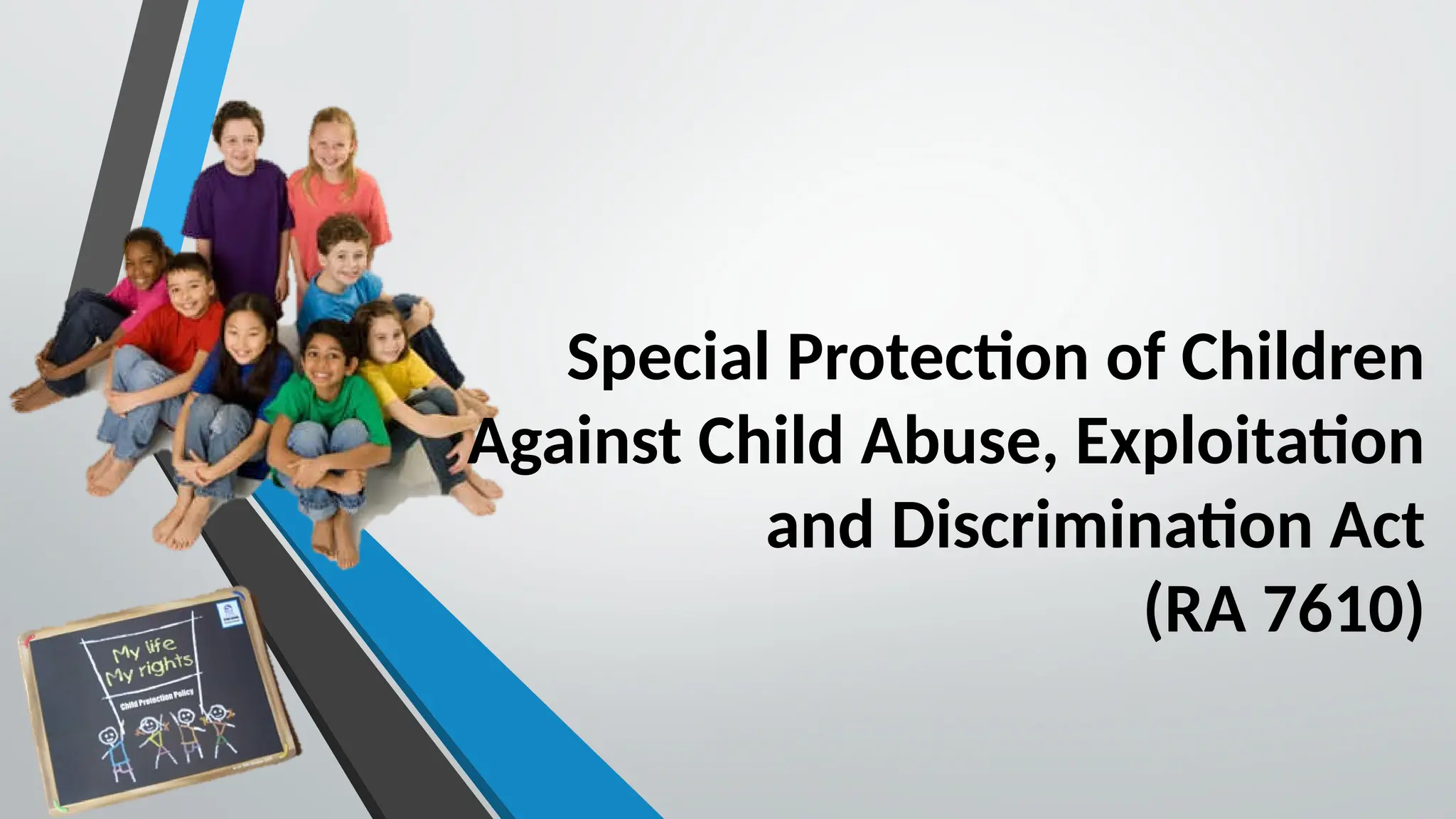
Special Protection of Children
Against Child Abuse, Exploitation
and Discrimination Act
(RA 7610)
When do Rights Begin?
‱ Philippine Constitution, Article II, Sec. 12 - “The
State recognizes the sanctity of family life and shall
protect and strengthen the family as a basic and
autonomous social institution. It shall equally protect
the life of the mother and the life of the unborn from
conception

.”
When do Rights Begin ?
‱ PD 603, Article 3, # 1:
“ A child is endowed with the dignity and worth of a
human being from the moment of conception, as
generally accepted in medical parlance, and is
therefore entitled with the right to be born well”.
Who are considered Children?
‱ Children - persons below 18 years of
age or those over but are unable to to
fully take care of themselves or protect
themselves from abuse, neglect,
cruelty, exploitation or discrimination
because of a physical or mental
disability or condition.
What is the Rationale of RA 7610?
To give protection to persons
below 18 years of age or those over
but are unable to fully take care of
themselves or protect themselves
from abuse, cruelty and
exploitation.
Offenses Against Children under RA 7610
1. Child Prostitution and other sexual abuse
2. Attempt to commit child prostitution
3. Child Trafficking
4. Attempt to commit child trafficking
5. Child pornography and indecent shows and publication
6. Other Acts of Neglect, Abuse, Cruelty or Exploitation and
Other Conditions Prejudicial to the Child’s Development
Other Acts of Abuse
‱ Any person who shall keep or have in his company a
minor, twelve (12) years or under or who is ten (10)
years or more his junior in any public or private place,
hotel, motel, beer joint, discotheque, cabaret, pension
house, sauna or massage parlor, beach and/or other
tourist resort or similar places.
Other Acts of Abuse
ïź Any person who shall use, coerce, force or
intimidate a street child or any other child to:
ïź beg or use begging as a means of living
ïź act as conduit or middleman in drug
trafficking or pushing
ïź conduct any illegal activities
Physical Abuse
The inflicting of physical injury upon a child. This may
include, burning, hitting, punching, shaking, kicking,
beating, or otherwise harming a child. The parent or
caretaker may not haven intended to hurt the child, the
injury is not an accident. It may, however, been the
result of over-discipline or physical punishment that is
inappropriate to the child’s age.
Psychological/Emotional Abuse
‱ also known as: verbal abuse, mental abuse, and
psychological maltreatment
‱ Includes acts or the failures to act by parents or
caretakers that have caused or could cause, serious
behavioral, cognitive, emotional, or mental disorders
‱ Constantly blaming or putting down a child;
excessive
yelling, shaming
Neglect
‱ the withdrawal of or failure to provide a child
with the basic necessities for physical growth and
development. This can include inappropriate
clothing for the weather, unhealthy food or no
food at all, lack of supervision, denial of medical
care to a sick or injured child or denial of love and
affection.
Duty of Government Workers to Report
‱ It shall be the duty of all teachers and
administrators in public schools, probation
officers, government lawyers, law enforcement
officers, barangay officials, corrections officers
and other government officials and employees
whose work involves dealing with children to
report all incidents of possible child abuse
to the Department.
CHILD PROTECTION POLICY
“Teacher’s Awareness and School
Responsiveness to the Child Protection
Policy”
DepEd Order No. 40, s.2012
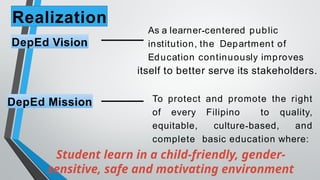
DepEd Vision
As a learner-centered public
institution, the Department of
Education continuously improves
itself to better serve its stakeholders.
Realization
DepEd Mission To protect and promote the right
of every Filipino to quality,
equitable, culture-based, and
complete basic education where:
Student learn in a child-friendly, gender-
sensitive, safe and motivating environment
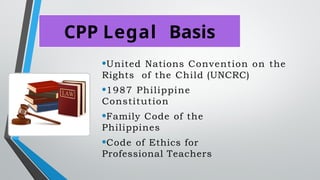
CPP Legal Basis
‱United Nations Convention on the
Rights of the Child (UNCRC)
‱1987 Philippine
Constitution
‱Family Code of the
Philippines
‱Code of Ethics for
Professional Teachers
‱ The Philippine Constitution
The State shall protect the right of children
to assistance, including proper care and
nutrition, and special protection from all
forms of neglect, abuse, cruelty, exploitation
and other conditions prejudicial to their
development (Art. XV. Sec. 3(b))
Legal Bases
‱ The Philippine Constitution
 All educational institutions shall
x x x

foster love of humanity, respect for human
rights
x x x
develop moral character and
personal discipline
 (Art XIV, Sec. 3 (b))
Article 218, 220, 233 of the Family
Code of the Philippines and PD 603
‱“gives the school, its administrator and teachers, or
the individual, entity or institution engaged in child
care the special parental authority and
responsibility over the minor child while under
their supervision, instruction or custody”

‱“Authority and responsibility shall apply to all
authorized activities whether inside or outside the
premises of the school, entity or institution
”
DepEd Order
No. 40, 2012
The Department of Education (“DepEd”) shall
ensure that schools are a safe place for the
education of children.
The best interest of the child shall be the
paramount consideration in all decisions and
actions involving children.
Child Protection Policy
DepEd Order
No. 40, 2012
‱ Child abuse
‱ Discrimination against children;
‱ Child exploitation;
‱ Violence against children in school;
‱ Corporal punishment;
‱ Any analogous or similar acts; and
‱ Bullying or peer abuse
Prohibited Acts:
Child Protection Policy
Some duties and responsibilities of Schools
‱ Ensure that the school adopts a CPP
‱ Ensure all pupils, students or learners, school
personnel, parents, guardians, or custodians,
and visitors & guests are made aware of the CPP
‱ Conduct the appropriate training & capability-
building activities on child protection measures
& protocols
‱ Adopt conflict resolution mechanisms that
respect IP rights
‱ Coordinate with the DSWD or appropriate
NGAs/NGOs on a Child Protection Hotline
The Child
Protection Committee
All public & private elementary and secondary schools
shall establish a Child Protection Committee (CPC)
‱ School Head / Administrator
‱ Guidance Counselor / Teacher
‱ Teacher Representative
‱ Parent Representative
‱ Student Representative
‱ Barangay Representative
CPC Members:
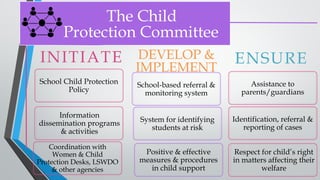
The Child
Protection Committee
INITIATE
School-based referral &
monitoring system
System for identifying
students at risk
ENSURE
Assistance to
parents/guardians
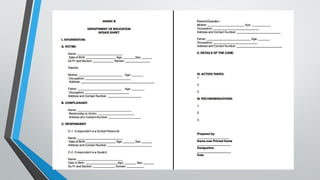
Identification, referral &
reporting of cases
Respect for child’s right
in matters affecting their
welfare
School Child Protection
Policy
Information
dissemination programs
& activities
Coordination with
Women & Child
Protection Desks, LSWDO
& other agencies
Positive & effective
measures & procedures
in child support
DEVELOP &
IMPLEMENT
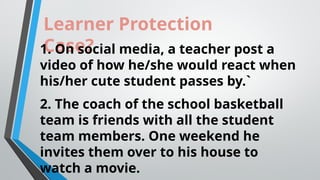
Learner Protection
Case?
1. On social media, a teacher post a
video of how he/she would react when
his/her cute student passes by.`
2. The coach of the school basketball
team is friends with all the student
team members. One weekend he
invites them over to his house to
watch a movie.
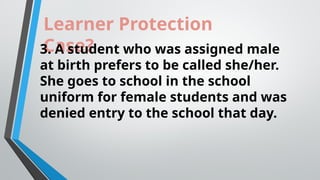
Learner Protection
Case?
3. A student who was assigned male
at birth prefers to be called she/her.
She goes to school in the school
uniform for female students and was
denied entry to the school that day.

CHILD-PROTECTION-POLICY-presentation for inset

  • 1.
    Special Protection ofChildren Against Child Abuse, Exploitation and Discrimination Act (RA 7610)
  • 2.
    When do RightsBegin? ‱ Philippine Constitution, Article II, Sec. 12 - “The State recognizes the sanctity of family life and shall protect and strengthen the family as a basic and autonomous social institution. It shall equally protect the life of the mother and the life of the unborn from conception

.”
  • 3.
    When do RightsBegin ? ‱ PD 603, Article 3, # 1: “ A child is endowed with the dignity and worth of a human being from the moment of conception, as generally accepted in medical parlance, and is therefore entitled with the right to be born well”.
  • 4.
    Who are consideredChildren? ‱ Children - persons below 18 years of age or those over but are unable to to fully take care of themselves or protect themselves from abuse, neglect, cruelty, exploitation or discrimination because of a physical or mental disability or condition.
  • 5.
    What is theRationale of RA 7610? To give protection to persons below 18 years of age or those over but are unable to fully take care of themselves or protect themselves from abuse, cruelty and exploitation.
  • 6.
    Offenses Against Childrenunder RA 7610 1. Child Prostitution and other sexual abuse 2. Attempt to commit child prostitution 3. Child Trafficking 4. Attempt to commit child trafficking 5. Child pornography and indecent shows and publication 6. Other Acts of Neglect, Abuse, Cruelty or Exploitation and Other Conditions Prejudicial to the Child’s Development
  • 7.
    Other Acts ofAbuse ‱ Any person who shall keep or have in his company a minor, twelve (12) years or under or who is ten (10) years or more his junior in any public or private place, hotel, motel, beer joint, discotheque, cabaret, pension house, sauna or massage parlor, beach and/or other tourist resort or similar places.
  • 8.
    Other Acts ofAbuse ïź Any person who shall use, coerce, force or intimidate a street child or any other child to: ïź beg or use begging as a means of living ïź act as conduit or middleman in drug trafficking or pushing ïź conduct any illegal activities
  • 9.
    Physical Abuse The inflictingof physical injury upon a child. This may include, burning, hitting, punching, shaking, kicking, beating, or otherwise harming a child. The parent or caretaker may not haven intended to hurt the child, the injury is not an accident. It may, however, been the result of over-discipline or physical punishment that is inappropriate to the child’s age.
  • 10.
    Psychological/Emotional Abuse ‱ alsoknown as: verbal abuse, mental abuse, and psychological maltreatment ‱ Includes acts or the failures to act by parents or caretakers that have caused or could cause, serious behavioral, cognitive, emotional, or mental disorders ‱ Constantly blaming or putting down a child; excessive yelling, shaming
  • 11.
    Neglect ‱ the withdrawalof or failure to provide a child with the basic necessities for physical growth and development. This can include inappropriate clothing for the weather, unhealthy food or no food at all, lack of supervision, denial of medical care to a sick or injured child or denial of love and affection.
  • 12.
    Duty of GovernmentWorkers to Report ‱ It shall be the duty of all teachers and administrators in public schools, probation officers, government lawyers, law enforcement officers, barangay officials, corrections officers and other government officials and employees whose work involves dealing with children to report all incidents of possible child abuse to the Department.
  • 14.
    CHILD PROTECTION POLICY “Teacher’sAwareness and School Responsiveness to the Child Protection Policy” DepEd Order No. 40, s.2012
  • 15.
    DepEd Vision As alearner-centered public institution, the Department of Education continuously improves itself to better serve its stakeholders. Realization DepEd Mission To protect and promote the right of every Filipino to quality, equitable, culture-based, and complete basic education where: Student learn in a child-friendly, gender- sensitive, safe and motivating environment
  • 16.
    CPP Legal Basis ‱UnitedNations Convention on the Rights of the Child (UNCRC) ‱1987 Philippine Constitution ‱Family Code of the Philippines ‱Code of Ethics for Professional Teachers
  • 17.
    ‱ The PhilippineConstitution The State shall protect the right of children to assistance, including proper care and nutrition, and special protection from all forms of neglect, abuse, cruelty, exploitation and other conditions prejudicial to their development (Art. XV. Sec. 3(b)) Legal Bases
  • 18.
    ‱ The PhilippineConstitution  All educational institutions shall
x x x
 foster love of humanity, respect for human rights
x x x
develop moral character and personal discipline
 (Art XIV, Sec. 3 (b))
  • 19.
    Article 218, 220,233 of the Family Code of the Philippines and PD 603 ‱“gives the school, its administrator and teachers, or the individual, entity or institution engaged in child care the special parental authority and responsibility over the minor child while under their supervision, instruction or custody”
 ‱“Authority and responsibility shall apply to all authorized activities whether inside or outside the premises of the school, entity or institution
”
  • 20.
    DepEd Order No. 40,2012 The Department of Education (“DepEd”) shall ensure that schools are a safe place for the education of children. The best interest of the child shall be the paramount consideration in all decisions and actions involving children. Child Protection Policy
  • 21.
    DepEd Order No. 40,2012 ‱ Child abuse ‱ Discrimination against children; ‱ Child exploitation; ‱ Violence against children in school; ‱ Corporal punishment; ‱ Any analogous or similar acts; and ‱ Bullying or peer abuse Prohibited Acts: Child Protection Policy
  • 22.
    Some duties andresponsibilities of Schools ‱ Ensure that the school adopts a CPP ‱ Ensure all pupils, students or learners, school personnel, parents, guardians, or custodians, and visitors & guests are made aware of the CPP ‱ Conduct the appropriate training & capability- building activities on child protection measures & protocols ‱ Adopt conflict resolution mechanisms that respect IP rights ‱ Coordinate with the DSWD or appropriate NGAs/NGOs on a Child Protection Hotline
  • 23.
    The Child Protection Committee Allpublic & private elementary and secondary schools shall establish a Child Protection Committee (CPC) ‱ School Head / Administrator ‱ Guidance Counselor / Teacher ‱ Teacher Representative ‱ Parent Representative ‱ Student Representative ‱ Barangay Representative CPC Members:
  • 24.
    The Child Protection Committee INITIATE School-basedreferral & monitoring system System for identifying students at risk ENSURE Assistance to parents/guardians Identification, referral & reporting of cases Respect for child’s right in matters affecting their welfare School Child Protection Policy Information dissemination programs & activities Coordination with Women & Child Protection Desks, LSWDO & other agencies Positive & effective measures & procedures in child support DEVELOP & IMPLEMENT
  • 26.
    Learner Protection Case? 1. Onsocial media, a teacher post a video of how he/she would react when his/her cute student passes by.` 2. The coach of the school basketball team is friends with all the student team members. One weekend he invites them over to his house to watch a movie.
  • 27.
    Learner Protection Case? 3. Astudent who was assigned male at birth prefers to be called she/her. She goes to school in the school uniform for female students and was denied entry to the school that day.