" Amino acids:
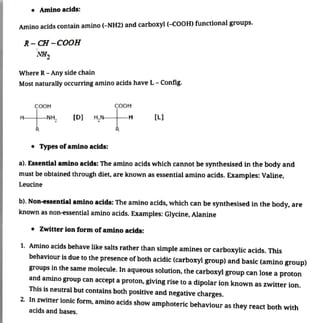
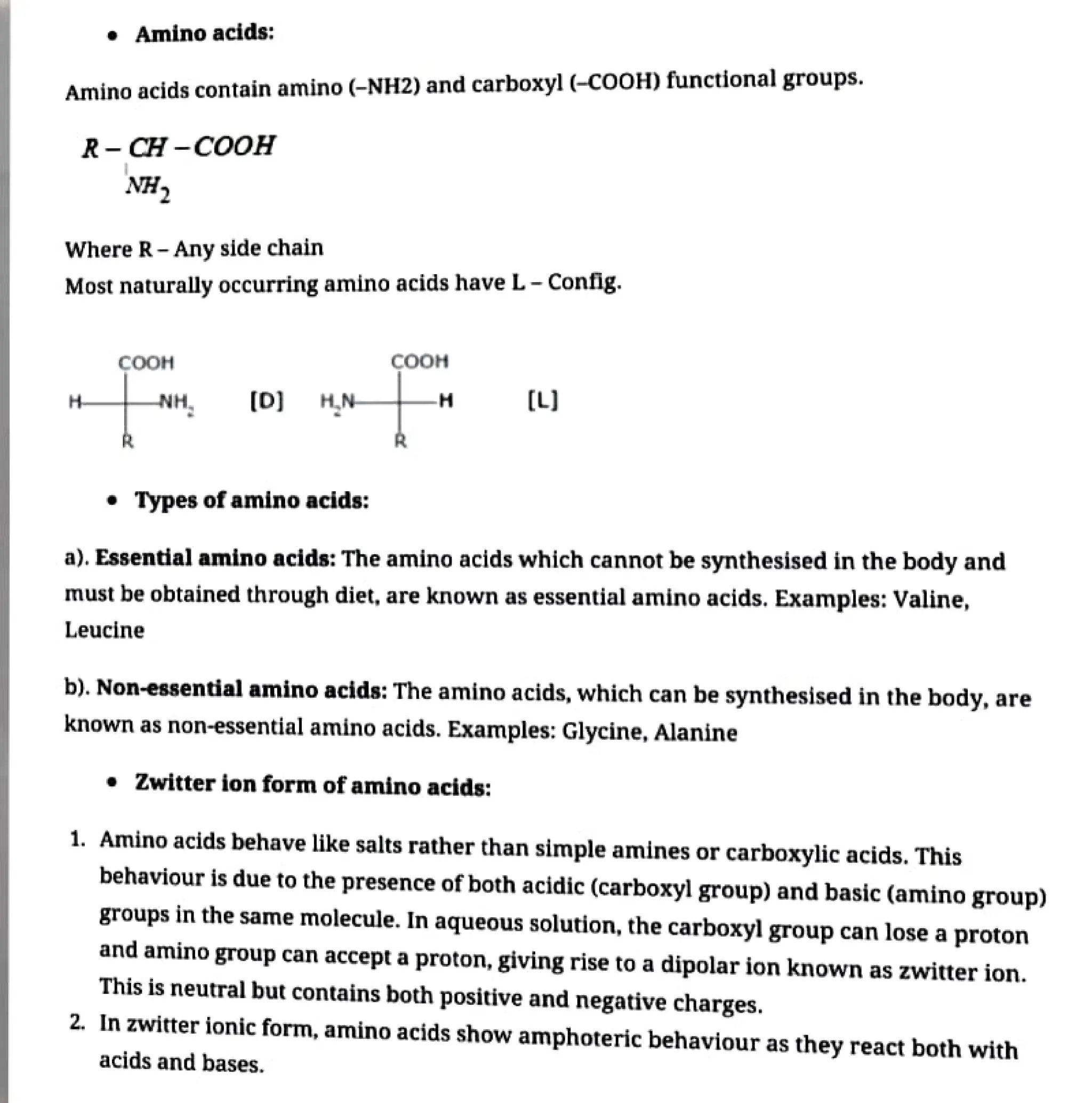
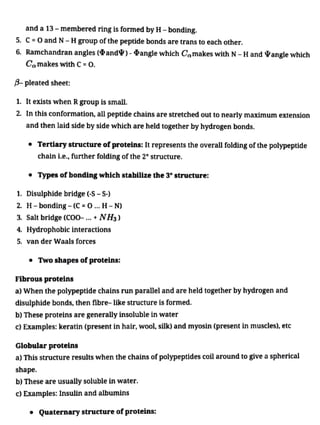
Amino acids contain amino(-NH2) and carboxyl (-CO0H) functional groups.
R-CH -COOH
NH,
Where R- Any side chain
Most naturally occurring amino acids have L - Config.
cOOH
NH,
" Types of amino acids:
Leucine
cOOH
a). Essential amino acids: The amino acids which cannot be synthesised in the body and
must be obtainedthrough diet, are known as essentialamino acids. Examples: Valine,
[L)
b). Non-essential amino acids: The amino acids, which can be synthesised in the body, are
known as non-essential amino acids. Examples: Glycine, Alanine
" Zwitter ion form of amino acids:
1. Amino acids behave like salts rather than simple amines or carboxylic acids. This
behaviour is due to the presence of both acidic (carboxyl group) and basic (amino group)
groups in thesame molecule. aqueous solution, the carboxyl group can lose a proton
and amino group can accept a proton, giving rise to a dipolar ion known as zwitter ion.
This is neutral but contains both positive and negative charges.
2. In zwitter ionic form, amino acids show amphoteric behaviour as they react both with
acids and bases.
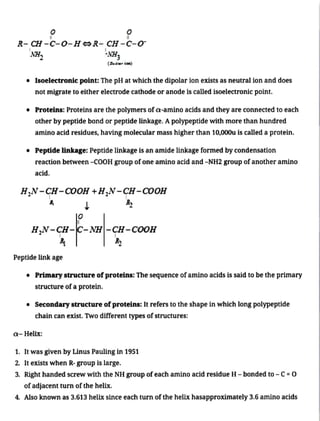
R- CH -C-0-HR- CH-C-0
'NH,
" Isoelectronic point: The pH at which the dipolar ion exists as neutral ion and does
not migrate to either electrode cathode or anode is called isoelectronic point.
NH,
(Zut ioa)
" Proteins: Proteins are the polymers ofa-amino acids and they are connected to each
other by peptide bond or peptide linkage. Apolypeptide with more than hundred
amino acid residues, having molecular mass higher than 10,000u is called a protein.
" Peptide linkage: Peptide linkage is an amide linkage formed by condensation
reaction between -cOOH group ofone amino acid and -NH2 group ofanother amino
acid.
HN-CH-COOH +H,N-CH-COOH
H,N-CH--NH-ÇH -cooH
Peptide link age
" Primarystructure ofproteins: The sequence ofamino acids is said to be the primary
structure of a protein.
" Secondary structureofproteins: It refersto the shape in which long polypeptide
chain can exist. Two different types of structures:
a- Helix:
1. It was given by Linus Pauling in 1951
2. It exists when R- group is large.
3. Right handed screwwith the NH group of each amino acid residue H- bonded to - C=0
ofadjacent turn of the helix.
4. Also known as 3.613 helix since each turn ofthe helix hasapproximately 3.6 amino acids
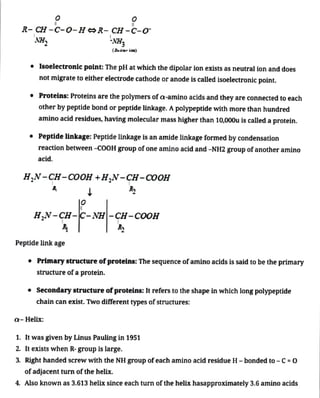
R- CH -C-0-HR- CH -C-0
NH, NH,
" Isoelectronic point: The pH at which the dipolar ion exists as neutral ion and does
not migrate to either electrode cathode or anode is called isoelectronic point.
(Zt ion)
" Proteins: Proteins are the polymers of a-amino acids and they are connected to each
other by peptide bond orpeptide linkage. Apolypeptidewith more than hundred
amino acid residues, having molecular mass higher than 10,000u is calleda protein.
" Peptide linkage: Peptide linkageis an amide linkage formed by condensation
reaction between -coOH group of one amino acid and -NH2 group of another amino
acid.
H,N-CH-COOH +H,N-CH-COOH
Peptide link age
HN-CH-C- NH-CH-COOH
" Primarystructure ofproteins: The sequence ofamino acids is said to be the primary
structure of a protein.
Q-Helix:
" Secondarystructureofproteins: It refers to the shape in which long polypeptide
chain can exist. Two different types ofstructures:
1. It was given by Linus Pauling in 1951
2. It exists when R-group is large.
3. Right handed screw with the NH group of eachamino acid residue H- bonded to - C=0
ofadjacent turn ofthe helix.
4. Also known as 3.613 helix since each turn ofthe helix hasapproximately3.6 amino acids
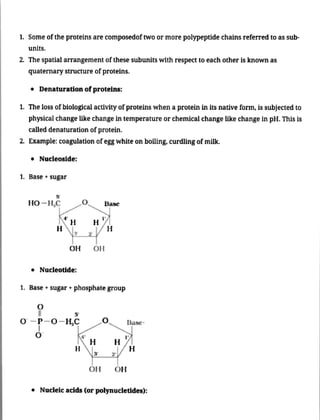
and a 13- membered ring is formed by H- bonding.
5. C=0 and N- Hgroup of the peptide bonds are transto each other.
6. Ramchandran angles (and V)- Õangle which Co makes with N-H and angle which
Camakes with C=0.
B- pleated sheet:
1. It exists when Rgroup is small.
2. In this conformation, all peptide chains are stretched out to nearly maximum extension
and then laid side by side which are held together by hydrogen bonds.
" Tertiarystructure ofproteins: It represents the overall folding of the polypeptide
chain i.e., further folding ofthe 2° structure.
" Types ofbondingwhich stabilize the 3° structure:
1. Disulphide bridge (-S - S-)
2. H- bonding - (C =0 ... H- N)
3. Salt bridge (C00-... *NH3 )
4. Hydrophobic interactions
5. van der Waals forces
" Twoshapes of proteins:
Fibrous proteins
a) When the polypeptide chains run parallel and are held together by hydrogen and
disulphide bonds, then fibre-like structure is formed.
b) These proteins are generally insoluble in water
c) Examples: keratin (present in hair, wool, silk) and myosin (present in muscles), etc
Globular proteins
a) This structure results when the chains ofpolypeptides coil around to give aspherical
shape.
b) These are usually soluble in water.
c) Examples: Insulin and albumins
" Quaternary structure of proteins:
1. Some of the proteins are composedof two or more polypeptide chains referred to as sub
units.
2. The spatial arrangement of these subunits with respect to each other is known as
quaternary structure ofproteins.
Denaturation ofproteins:
1. The loss ofbiological activity ofproteins when a protein in its native form, is subjected to
physical change like change in temperature or chemical change like change in pH. This is
called denaturation of protein.
2. Example: coagulation ofegg white on boiling, curdling of milk.
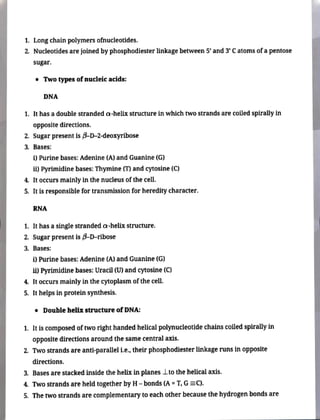
" Nucleoside:
1. Base +sugar
HO-H,C
H
H
OH
" Nucleotide:
0-p-o-HC
H
H.
OH
1. Base +sugar +phosphate group
Base
H
OH
H
H
OH
Base:
H
" Nucleic acids(or polynucletides):
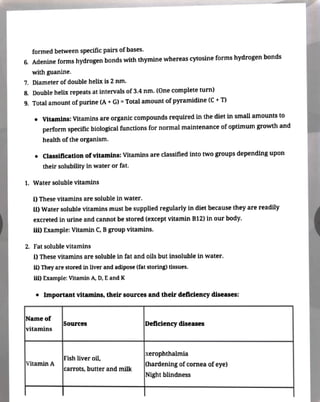
1. Long chain polymers ofnucleotides.
2. Nucleotides are joined by phosphodiester linkage between 5' and 3' Catoms ofa pentose
sugar.
" Two types of nucleic acids:
DNA
1. It has a double stranded a-helix structure in which two strands are coiled spirally in
opposite directions.
2. Sugar present is B-D-2-deoxyribose
3. Bases:
) Purine bases: Adenine (A) and Guanine (G)
i) Pyrimidine bases: Thymine (T) and eytosine (C)
4. It occurs mainly in the nucleus of the cell.
5. It is responsible for transmission for heredity character.
RNA
1, It has a single stranded a-helix structure.
2. Sugar present is B-D-ribose
3. Bases:
i) Purine bases: Adenine (A) and Guanine (G)
i) Pyrimidine bases: Uracil (U) and cytosine (C)
4. It occurs mainly in the cytoplasm of the cell.
5. It helps in protein synthesis.
" Double helix structure of DNA:
1. Itiscomposed oftworight handedhelical polynucleotidechainscoiledspirallyin
opposite directions around the same central axis.
2. Two strands are anti-parallel L.e. theirphosphodiesterlinkage runs in opposite
directions.
3. Bases are stacked inside the helix in planes Lto the helical axis.
4. Twostrands are held together by H- bonds (A =T, G=C).
5. The two strandsare complementary to each other because the hydrogen bonds are
formed between specific pairs of bases.
6. Adenine forms hydrogen bonds with thymine whereas cytosine forms hydrogen bonds
with guanine.
7. Diameter of double helix is 2 nm.
8. Double helix repeats at intervals of 3.4 nm. (One complete turn)
9. Total amount of purine (A +G) =Total amount of pyramidine (C +T)
Vitamins: Vitamins are organic compounds required in the diet in small amounts to
perform specific biological functions for normal maintenance of optimum growth and
health ofthe organism.
Classification of vitamins: Vitamins are classified into two groups depending upon
their solubility in water or fat.
1. Water soluble vitamins
i) These vitamins are soluble in water.
ii) Water soluble vitamins must be supplied regularly in diet because they are readily
excreted in urine and cannot be stored (except vitamin B12) in our body.
iii) Example: Vitamin C, Bgroup vitamins.
2. Fat soluble vitamins
i) These vitamins are soluble in fat and oils but insoluble in water.
i)They are stored in liver and adipose (fat storing) tissues.
ifi) Example: Vitamin A, D, Eand K
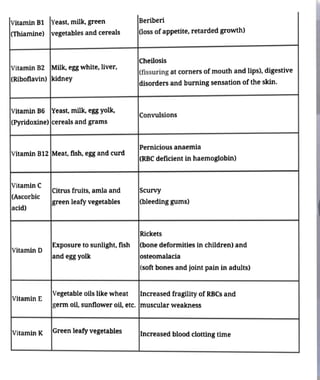
" Important vitamins, their sources and their deficiency diseases:
Name of
vitamins
Vitamin A
Sources
Fish liver oil,
carrots, butter and milk
Deficiencydiseases
xerophthalmia
Chardening of cornea of eye)
Night blindness
Vitamin B1 Yeast, milk, green
(Thiamine) vegetables and cereals
Vitamin B2 Milk, egg white, liver,
(Riboflavin) kidney
Vitamin B6 Yeast, milk, egg yolk,
(Pyridoxine)|cereals and grams
Vitamin B12 Meat, fish,egg and curd
|Vitamin C
(Ascorbic
acid)
Vitamin D
|Vitamin E
VitaminK
Citrus fruits, amla and
green leafyvegetables
Beriberi
loss of appetite, retarded growth)
Green leafy vegetables
Cheilosis
(fissuring at corners of mouth and lips), digestive
disorders and burning sensation of the skin.
Convulsions
Pernicious anaemia
(RBC deficient in haemoglobin)
Scurvy
(bleeding gums)
Rickets
Exposure to sunlight, fish (bonedeformities in children) and
Jand egg yolk osteomalacia
(soft bones and joint pain in adults)
Vegetable oils like wheat
germ oil, sunfloweroil,etc. muscular weakness
Increased fragility of RBCs and
Increased blood clotting time

Chemistry Notes on Amino acids class 12.pdf

  • 1.
    " Amino acids: Aminoacids contain amino(-NH2) and carboxyl (-CO0H) functional groups. R-CH -COOH NH, Where R- Any side chain Most naturally occurring amino acids have L - Config. cOOH NH, " Types of amino acids: Leucine cOOH a). Essential amino acids: The amino acids which cannot be synthesised in the body and must be obtainedthrough diet, are known as essentialamino acids. Examples: Valine, [L) b). Non-essential amino acids: The amino acids, which can be synthesised in the body, are known as non-essential amino acids. Examples: Glycine, Alanine " Zwitter ion form of amino acids: 1. Amino acids behave like salts rather than simple amines or carboxylic acids. This behaviour is due to the presence of both acidic (carboxyl group) and basic (amino group) groups in thesame molecule. aqueous solution, the carboxyl group can lose a proton and amino group can accept a proton, giving rise to a dipolar ion known as zwitter ion. This is neutral but contains both positive and negative charges. 2. In zwitter ionic form, amino acids show amphoteric behaviour as they react both with acids and bases.
  • 2.
    R- CH -C-0-HR-CH-C-0 'NH, " Isoelectronic point: The pH at which the dipolar ion exists as neutral ion and does not migrate to either electrode cathode or anode is called isoelectronic point. NH, (Zut ioa) " Proteins: Proteins are the polymers ofa-amino acids and they are connected to each other by peptide bond or peptide linkage. Apolypeptide with more than hundred amino acid residues, having molecular mass higher than 10,000u is called a protein. " Peptide linkage: Peptide linkage is an amide linkage formed by condensation reaction between -cOOH group ofone amino acid and -NH2 group ofanother amino acid. HN-CH-COOH +H,N-CH-COOH H,N-CH--NH-ÇH -cooH Peptide link age " Primarystructure ofproteins: The sequence ofamino acids is said to be the primary structure of a protein. " Secondary structureofproteins: It refersto the shape in which long polypeptide chain can exist. Two different types of structures: a- Helix: 1. It was given by Linus Pauling in 1951 2. It exists when R- group is large. 3. Right handed screwwith the NH group of each amino acid residue H- bonded to - C=0 ofadjacent turn of the helix. 4. Also known as 3.613 helix since each turn ofthe helix hasapproximately 3.6 amino acids
  • 3.
    R- CH -C-0-HR-CH -C-0 NH, NH, " Isoelectronic point: The pH at which the dipolar ion exists as neutral ion and does not migrate to either electrode cathode or anode is called isoelectronic point. (Zt ion) " Proteins: Proteins are the polymers of a-amino acids and they are connected to each other by peptide bond orpeptide linkage. Apolypeptidewith more than hundred amino acid residues, having molecular mass higher than 10,000u is calleda protein. " Peptide linkage: Peptide linkageis an amide linkage formed by condensation reaction between -coOH group of one amino acid and -NH2 group of another amino acid. H,N-CH-COOH +H,N-CH-COOH Peptide link age HN-CH-C- NH-CH-COOH " Primarystructure ofproteins: The sequence ofamino acids is said to be the primary structure of a protein. Q-Helix: " Secondarystructureofproteins: It refers to the shape in which long polypeptide chain can exist. Two different types ofstructures: 1. It was given by Linus Pauling in 1951 2. It exists when R-group is large. 3. Right handed screw with the NH group of eachamino acid residue H- bonded to - C=0 ofadjacent turn ofthe helix. 4. Also known as 3.613 helix since each turn ofthe helix hasapproximately3.6 amino acids
  • 4.
    and a 13-membered ring is formed by H- bonding. 5. C=0 and N- Hgroup of the peptide bonds are transto each other. 6. Ramchandran angles (and V)- Õangle which Co makes with N-H and angle which Camakes with C=0. B- pleated sheet: 1. It exists when Rgroup is small. 2. In this conformation, all peptide chains are stretched out to nearly maximum extension and then laid side by side which are held together by hydrogen bonds. " Tertiarystructure ofproteins: It represents the overall folding of the polypeptide chain i.e., further folding ofthe 2° structure. " Types ofbondingwhich stabilize the 3° structure: 1. Disulphide bridge (-S - S-) 2. H- bonding - (C =0 ... H- N) 3. Salt bridge (C00-... *NH3 ) 4. Hydrophobic interactions 5. van der Waals forces " Twoshapes of proteins: Fibrous proteins a) When the polypeptide chains run parallel and are held together by hydrogen and disulphide bonds, then fibre-like structure is formed. b) These proteins are generally insoluble in water c) Examples: keratin (present in hair, wool, silk) and myosin (present in muscles), etc Globular proteins a) This structure results when the chains ofpolypeptides coil around to give aspherical shape. b) These are usually soluble in water. c) Examples: Insulin and albumins " Quaternary structure of proteins:
  • 5.
    1. Some ofthe proteins are composedof two or more polypeptide chains referred to as sub units. 2. The spatial arrangement of these subunits with respect to each other is known as quaternary structure ofproteins. Denaturation ofproteins: 1. The loss ofbiological activity ofproteins when a protein in its native form, is subjected to physical change like change in temperature or chemical change like change in pH. This is called denaturation of protein. 2. Example: coagulation ofegg white on boiling, curdling of milk. " Nucleoside: 1. Base +sugar HO-H,C H H OH " Nucleotide: 0-p-o-HC H H. OH 1. Base +sugar +phosphate group Base H OH H H OH Base: H " Nucleic acids(or polynucletides):
  • 6.
    1. Long chainpolymers ofnucleotides. 2. Nucleotides are joined by phosphodiester linkage between 5' and 3' Catoms ofa pentose sugar. " Two types of nucleic acids: DNA 1. It has a double stranded a-helix structure in which two strands are coiled spirally in opposite directions. 2. Sugar present is B-D-2-deoxyribose 3. Bases: ) Purine bases: Adenine (A) and Guanine (G) i) Pyrimidine bases: Thymine (T) and eytosine (C) 4. It occurs mainly in the nucleus of the cell. 5. It is responsible for transmission for heredity character. RNA 1, It has a single stranded a-helix structure. 2. Sugar present is B-D-ribose 3. Bases: i) Purine bases: Adenine (A) and Guanine (G) i) Pyrimidine bases: Uracil (U) and cytosine (C) 4. It occurs mainly in the cytoplasm of the cell. 5. It helps in protein synthesis. " Double helix structure of DNA: 1. Itiscomposed oftworight handedhelical polynucleotidechainscoiledspirallyin opposite directions around the same central axis. 2. Two strands are anti-parallel L.e. theirphosphodiesterlinkage runs in opposite directions. 3. Bases are stacked inside the helix in planes Lto the helical axis. 4. Twostrands are held together by H- bonds (A =T, G=C). 5. The two strandsare complementary to each other because the hydrogen bonds are
  • 7.
    formed between specificpairs of bases. 6. Adenine forms hydrogen bonds with thymine whereas cytosine forms hydrogen bonds with guanine. 7. Diameter of double helix is 2 nm. 8. Double helix repeats at intervals of 3.4 nm. (One complete turn) 9. Total amount of purine (A +G) =Total amount of pyramidine (C +T) Vitamins: Vitamins are organic compounds required in the diet in small amounts to perform specific biological functions for normal maintenance of optimum growth and health ofthe organism. Classification of vitamins: Vitamins are classified into two groups depending upon their solubility in water or fat. 1. Water soluble vitamins i) These vitamins are soluble in water. ii) Water soluble vitamins must be supplied regularly in diet because they are readily excreted in urine and cannot be stored (except vitamin B12) in our body. iii) Example: Vitamin C, Bgroup vitamins. 2. Fat soluble vitamins i) These vitamins are soluble in fat and oils but insoluble in water. i)They are stored in liver and adipose (fat storing) tissues. ifi) Example: Vitamin A, D, Eand K " Important vitamins, their sources and their deficiency diseases: Name of vitamins Vitamin A Sources Fish liver oil, carrots, butter and milk Deficiencydiseases xerophthalmia Chardening of cornea of eye) Night blindness
  • 8.
    Vitamin B1 Yeast,milk, green (Thiamine) vegetables and cereals Vitamin B2 Milk, egg white, liver, (Riboflavin) kidney Vitamin B6 Yeast, milk, egg yolk, (Pyridoxine)|cereals and grams Vitamin B12 Meat, fish,egg and curd |Vitamin C (Ascorbic acid) Vitamin D |Vitamin E VitaminK Citrus fruits, amla and green leafyvegetables Beriberi loss of appetite, retarded growth) Green leafy vegetables Cheilosis (fissuring at corners of mouth and lips), digestive disorders and burning sensation of the skin. Convulsions Pernicious anaemia (RBC deficient in haemoglobin) Scurvy (bleeding gums) Rickets Exposure to sunlight, fish (bonedeformities in children) and Jand egg yolk osteomalacia (soft bones and joint pain in adults) Vegetable oils like wheat germ oil, sunfloweroil,etc. muscular weakness Increased fragility of RBCs and Increased blood clotting time