Chemical Bonding
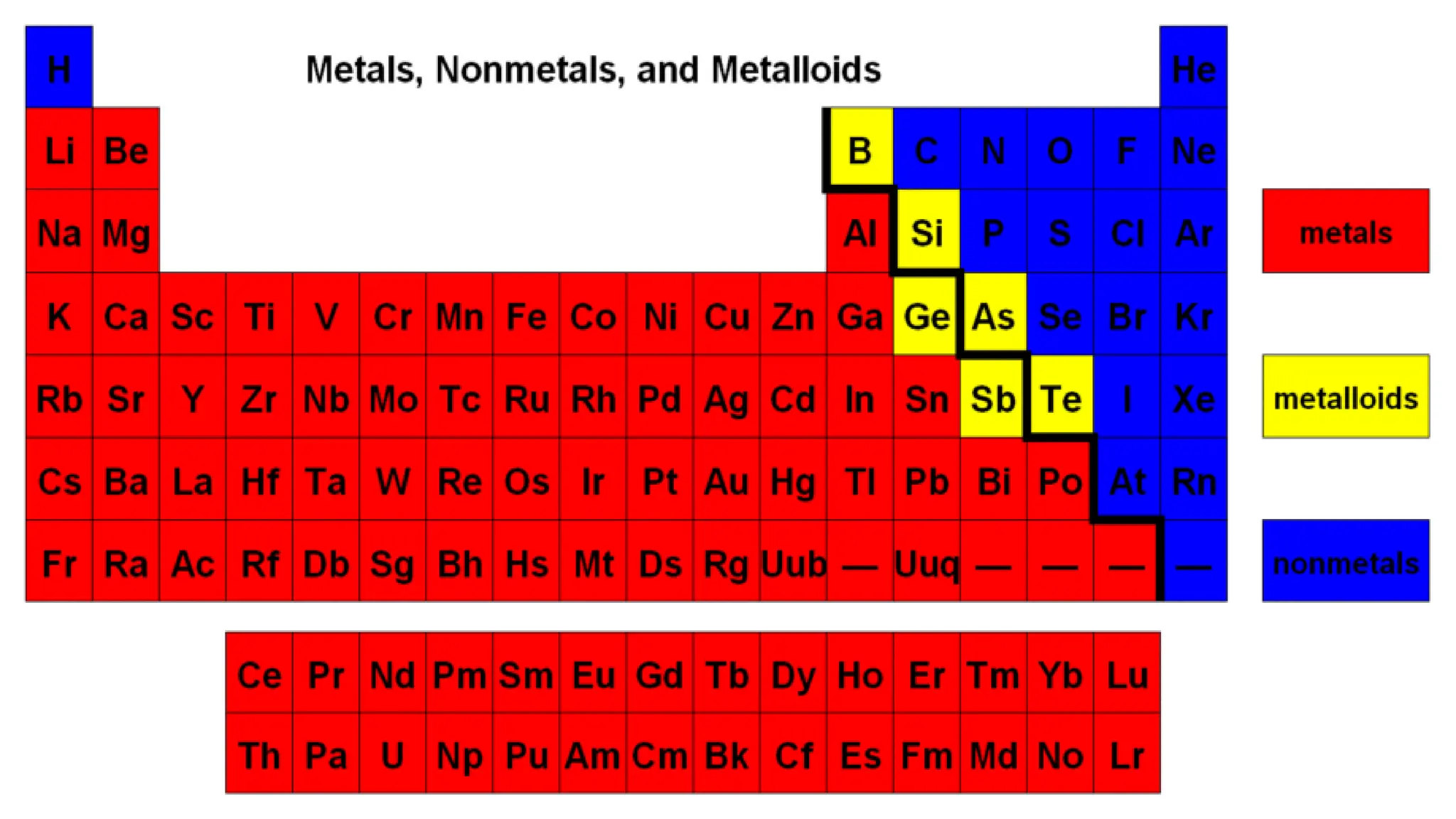
• The elements in the periodic table are
divided into three groups:
1. Metals
2. Non-metals
3. Metalloids
Research
• First research point
• Second research point
• Third research point
Chemical Compounds
•any substance composed of identical
molecules consisting of atoms of two
or more chemical elements.
• Ionic Compound
• Covalent Compound
Ionic Compound
•formed when metal (cation) transfers its
valence electron/s to a nonmetal (anion).
Example: Sodium chloride
Magnesium hydroxide
Electronegativity
Difference
Polarity
Greater than 1.9 Ionic
Equal to 0.5 and
lower than 1.9
Polar covalent
Less than 0.5
Nonpolar covalent
bond
Covalent Compound
•formed when nonmetals share their
valence electrons with another nonmetal.
Example: Carbon dioxide, Methane,
Nitrogen monoxide
Electronegativity
Difference
Polarity
Greater than 1.9 Ionic
Equal to 0.5 and
lower than 1.9
Polar covalent
Less than 0.5
Nonpolar covalent
bond
Activity
Compounds
Name of Elements
Involved
Type of Elements Ionic or Covalent?
1. Water (H2O) Hydrogen
Oxygen
Nonmetal
Nonmetal
Covalent
2. Sugar (C12H22O11)
3. Potassium chloride (KCl)
4. Carbon dioxide (CO2)
5. Sodium chloride (NaCl)
6. Methane (CH4)
7. Hydrochloric acid (HCl)
8. Barium hydroxide – Ba(OH)2
9. Potassium nitrate (KNO3)
10. Ammonium phosphate – (NH4)3PO4
Properties of Chemical Compounds
1. At normal atmospheric pressure
and temperature, covalent
compounds may exist in solid, liquid,
or a gas, while ionic compounds
exist only as crystalline solids.
2. Ionic compounds generally have
higher melting and boiling points
while covalent compounds have
lower melting and boiling points.
3. Ionic compounds are hard and
brittle, while covalent compounds
are soft and flexible.
4. Ionic compounds have high
polarity, while covalent compounds
have low polarity.
5. Ionic compounds are usually
soluble in water, while covalent
compounds tend to be less soluble
in water.
6. Ionic compounds tend to be less
flammable than covalent
compounds.
7. Ionic compounds conduct heat
and electricity compared to covalent
compounds.

Chemical Bonding, Electronegativity.pptx

Editor's Notes

  • #3 Summarize your research in three to five points.