INTRODUCTION:-
Soymilk (also called soya milk, soymilk, soybean milk, or soy juice)
is a beverage made from soybeans. soy milk is a lactose
free, vegan alternative to milk; it is often used by people who
have an allergy or intolerance for dairy. Soy milk has lower
calcium and vitamin B content but is richer in iron
compared with cow's milk.
Soy milk contains about the same proportion of protein as cow's milk:
around 3.5%; also 2% fat, 2.9% carbohydrate, and 0.5% ash.
The coagulated protein from soy milk can be made into Tofu, just as
dairy milk can be made into cheese.
According to popular tradition in China, soy milk was developed by
Liu An for medicinal purposes. This legend first appeared in the
12th century in Bunco Gangmu, where the development of tofu was
attributed to Liu with no mention of soy milk. Later writers in Asia
and the West additionally attributed development of soy milk to Liu
An, assuming that he could not have made tofu without making soy
milk. Soy milk contains little digestible calcium because calcium is
bound to the bean's pulp.
COMPERISON CHART OF SOY MILK AND
NATURAL MILK:-
MILK SOY MILK
Source
Mammal (usually cow or
buffalo)
Soy beans
Lactose Contains lactose Lactose-free
Vegetarian Yes Yes
Vegan No Yes
Protein 3.22 g 3.27 g
Carbohydrates 5.26 g 6.28 g
Polyunsaturated
fat
0.195 g 0.961 g
Calcium 113 mg (11%) 25 mg (3%)
Magnesium 10 mg (3%) 25 mg (7%)
Thiamine (vit.
B1)
0.044 mg (4%) 0.060 mg (5%)
Saturated fat 1.865 g 0.205 g
Riboflavin (vit.
B2)
0.183 mg (15%) 0.069 mg (6%)
Potassium 143 mg (3%) 118 mg (3%)
Sodium 43 mg (3%) 51 mg (3%)
Energy 60 kcal 54 kcal
CONTEMNTS: MILK VS SOY MILK :-
1.Nutrition
2.Health benefits
3.Ecological impact
1. Nutrition
A cup of cow’s milk contains lactose (a sugar found only in milk),
8.03 grams of protein and 11.49 grams of carbohydrates and 8
grams of fat.
In comparison, soy milk contains no lactose, half the fat (4.7
grams), slightly more protein (10.98 grams) and less carbohydrates
(12.8 grams ) per cup. Soy milk naturally contains much less
calcium and vitamin B.
2. Health benefits
Milk is an excellent source of calcium, vitamin A and vitamin D,
which is essential for strong bones. It also contains casein and
protein.
Soy milk has more vitamin B and iron, than cow’s milk. It also
contains 42 times manganese. Soy protein reduces LDL
cholesterol (“Bad” cholesterol) and raise HDL cholesterol
(“good” cholesterol). It contains more fiber than cow’s milk, and
flavones, which help to prevent cancer, heart disease.
3. Ecological impact
Using soybeans to make milk instead of raising cows may be
ecologically advantageous, because the amount of soy that could be
grown using the same amount of land would feed more people than if
used to raise cows. Cows require much more energy in order to produce
milk, since the farmer must feed the animal, which can consume up to
24 kilograms of food in dry matter (DM) basis and 90 to 180 liters (25
to 50 gallons) of water a day, producing an average of 40 kilograms of
milk a day.
ADVANTAGES
1. Improve Lipid Profile
The most important attribute of soy milk is its ability to improve your
blood lipid profile. Unlike dairy milk, which is high in saturated fat
and cholesterol, soy milk fat is mostly unsaturated with zero
cholesterol. The monounsaturated and polyunsaturated fatty acids
in soy can inhibit the transport of cholesterol into your blood
stream. Studies have shown that regular intake of soy can significantly
lower you blood concentrations of triglyceride and low density
lipoproteins (LDL) and raise the level of high density lipoproteins (HDL).
This combined effect makes soy milk an ideal drink if you have high
cholesterol or have a family history of coronary heart diseases.
2. Strengthen Blood Vessel Integrity
The omega-3 and omega-6 fatty acids as well as the powerful
antioxidants in soy can effectively protect your blood vessels from
lesions and hemorrhage. These compounds bind to the blood vessel lining
and defend your lining cells from free radical attacks and cholesterol
deposits. The binding of these nutrients also improve the fluidity and
flexibility of your blood vessels.
3. Promote Weight Loss
Soy milk is naturally lower in sugar content than regular milk. Cow's
milk has about 12 grams of sugar per cup as opposed to only 7
grams in soy milk. In addition, the monounsaturated fatty acid in soy
milk can inhibit your intestinal absorption of fat, which is another great
advantage for weight loss. Drinking soy milk also gives you an extra dose
of fiber, keeping your feeling fuller for longer time.
4. Prevent Postmenopausal Syndromes
During menopause, a woman’s natural production of estrogen drops to a
minimum. The sudden reduction of estrogen creates a number of health
problems for postmenopausal women. Postmenopausal women have higher
risks of heart disease, diabetes and obesity. The phytoestrogen in soy
is an effective estrogen replacement. Regular intake of soy is a great
way to prevent and alleviate these postmenopausal syndromes.
5. Prevent Osteoporosis
Osteoporosis is another age and hormone related disease. The
phytoestrogen in soy can help accelerate calcium absorption by your
body and prevent the loss of bone mass.
DISADVANTAGES
1. The University Of Maryland Medical Centre notes that soy foods are
safe for most people. The exceptions are those who have soy
allergies and recent breast cancer patients. Because soy products,
including soy milk, contain chemicals similar in structure to estrogen,
a diet rich in soy might pose a health risk if you've recently had
breast cancer, which is sometimes sensitive to estrogen. As a result,
further research is needed to determine soy's safety after breast
cancer.
2. However, some types of soy milk do have a major nutritional
disadvantage because of their added sugar content. Added sugars
boost your calories without offering nutritional value, and increase
your risk of cardiovascular disease. Select unsweetened soy milk to
minimize added sugar -- it contains just 1 gram of naturally occurring
sugars and no added sugar.
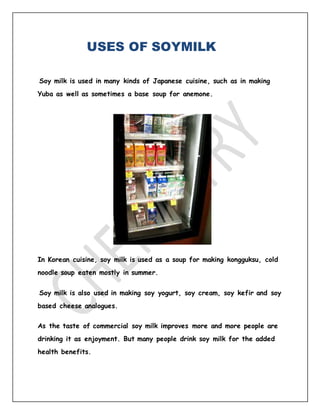
USES OF SOYMILK
Soy milk is used in many kinds of Japanese cuisine, such as in making
Yuba as well as sometimes a base soup for anemone.
In Korean cuisine, soy milk is used as a soup for making kongguksu, cold
noodle soup eaten mostly in summer.
Soy milk is also used in making soy yogurt, soy cream, soy kefir and soy
based cheese analogues.
As the taste of commercial soy milk improves more and more people are
drinking it as enjoyment. But many people drink soy milk for the added
health benefits.
PREPRATION
Soy milk can be made from whole soybeans or full-fat soy flour. The
dry beans are soaked in water overnight or for a minimum of 3 hours or
more depending on the temperature of the water. The rehydrated beans
then undergo wet grinding with enough added water to give the desired
solids content to the final product. The ratio of water to beans on a
weight basis should be about 10:1. The resulting slurry or purée is
brought to a boil in order to improve its nutritional value by heat
inactivating soybean inhibitor, improve its flavor and to sterilize the
product. Heating at or near the boiling point is continued for a period of
time, 15–20 minutes, followed by the removal of an insoluble residue
(soy pulp fiber or okara) by filtration.
There is a simple yet important difference between traditional Chinese
and Japanese soy milk processing: the Chinese method boils the
filtrate (soy milk) after a cold filtration, while the Japanese method
boils the slurry first, followed by hot filtration of the slurry.
The latter method results in a higher yield of soy milk but requires the
use of an anti-foaming agent or natural de-foamer during the boiling
step. Bringing filtered soy milk to a boil avoids the problem of foaming.
It is generally opaque, white or off-white in color, and approximately
the same consistency as cow's milk.
In 1967, experiments at Cornell University and the New York State
Agricultural Experiment Station at Geneva, NY led to the discovery that
paint-like, off-flavors of traditional soy milk can be prevented by a
rapid hydration and grinding process of dehulled beans at temperatures
above 80 °C. The quick moist heat treatment inactivates the LOX
(Lipoxygenase) enzyme before it can have a significant negative effect
on flavor. All modern soy milks have been heat treated in this manner to
destroy LOX.
Normal mature soybeans actually contain three LOX enzymes (SBL-1,
SBL-2, and SBL-3) that influence undesirable flavor development. One
or more of these enzymes have recently (1998) been removed genetically
from soybeans yielding soy milk with less cooked beany aroma and flavor
and less astringency.
SOY YOGURT
Soy yogurt, (Soya yoghurt in British English), is yogurt prepared using
soy milk, yogurt bacteria, mainly Lactobacillus and Streptococcus
thermopiles and sometimes additional sweetener, like fructose, glucose,
or raw sugar. It is suitable for vegans, as the bacteria for shop-bought
soy yogurt are usually not grown on a dairy base.
Soy yogurt can be prepared at home using the same method as dairy
yogurt . One tablespoon of sugar per 1 liter of unsweetened soy milk
may be added to promote bacterial fermentation. Soy milk on its own
lacks the lactose (milk sugar) that is the basic food for the yogurt
bacteria.
Soy yogurt may have a slight beany soy taste when made directly from
freshly prepared soymilk, but this is less pronounced in shop-bought soy
yogurt and in soy yogurt made from commercial soy milk.
Soy yogurt contains less fat than yogurt made with whole milk. This
amounts to about 2.7% (the same percentage as soy milk), versus
3.5% in dairy yogurt. However, dairy yogurt can be made with 2%,
1%, or fat-free milk, and these cases, it is lower in fat than soy
yogurt.
CURD
Buffalo/cow curd (in Hindi - "Dahi") is a traditional and nutritious dairy
product prepared by buffalo/cow milk and it is popular throughout the
south Asian countries such as India, Sri Lanka, Nepal, etc. Mostly clay
pots are used as packaging material for Buffalo curd.
Buffalo/cow curd is obtained by curdling (coagulating) buffalo milk using
microbial activities. In this process lactose in buffalo milk is converted
in to lactic acid using several micro-organisms. Several micro-organism
species are involved in the fermentation such as Streptococcus lactic,
Streptococcus diacetylactis, Streptococcus cremoris, Lactobacillus
bulgaricusand and Streptococcus thermopiles.
Buffalo curd has a higher nutritional value of protein, fat, lactose,
minerals and vitamins. It should have 7.5% of milk fat, 8.5% of milk
solids and 4.5% of Milk acid (lactic acid). Quality of the curd is totally
depend on the starter culture. Fermentation also develops the
characteristic flavor and color of the product.
EXPERIMENT
AIM:-
Preparation of soybean milk and its comparison with natural milk with
respect to curd formation, effect of temperature and taste.
APPARATUS:-
Pestle and mortar, beaker, measuring cylinder, tripod stand,
thermometer, tea spoon, muslin cloth.
CHEMICALS:-
Soybean milk and buffalo’s milk.
PROCEDURE:-
1. Prepare soymilk by above procedure.
2. Preparation of curd from soybean milk:- Take 20mL of soybean
milk in three beakers, labeled as A,B and C. Heat the beakers
30◦
C, 40◦
C and 50◦
C respectively. Add ¼ tea spoon full of curd to
each beaker. Mix the contents with a glass rod and allow the
beakers to stand undisturbed for 8 hours. Observe the changes
and record them.
3. Preparation of curd from buffalo’s milk:- Take 20mL of
buffalo’s milk in three beakers, labeled as D,E and F. Heat the
beakers 30◦
C, 40◦
C and 50◦
C respectively. Add ¼ tea spoon full
of curd to each beaker. Mix the contents with a glass rod and
allow the beakers to stand undisturbed for 8 hours. Observe the
changes and record them.
OBSERVATIONS:-
Volume of milk taken = 20mL
Time given for curd formation = 8 hours
Type of
milk
Beaker No. Temperature Quality of
curd
Taste of
curd
Soybean
milk
A
B
C
30◦
C
40◦
C
50◦
C
……………………
……………………
……………………
……………………….
……………………….
……………………….
Buffalo’s
milk
D
E
F
30◦
C
40◦
C
50◦
C
……………………
……………………
……………………
……………………….
……………………….
……………………….
RESULT:-
For soybean milk, the best temperature for the formation of good quality and
tasty cord = ………………………◦
C.
and for buffalo’s milk = …………………………◦
C.
CONCLUSION:-
1. In buffalo’s milk (natural milk), higher the temperature more rapid is
the fermentation of lactose into lactic acid which impart a sour taste to
the curd.
2. Higher the temperature, faster is the curd formation both in case of
buffalo’s milk as well as in soybean milk.
Topic:- “PREPARATION OF SOYABEAN MILK AND ITS
COMPARISON WITH THE NATURAL MILK RESPECT TO CURD
FORMATION, EFFECT OF TEMPERATURE ETC.”
IN PARTIAL FULFILLMENT OF CLASS 12th
CHEMISTRY AS
PER THE CIRCULAR OF 2015-16.
Submitted To:- Submitted By:-
Mam’ Pavitra savita Ravi sharma
12th
CONTENTS
TOPIC:-
1. Acknowledgement
2. Introduction
3. Comparison between soymilk and buffalo’s
milk
4. Advantages
5. Disadvantages
6. Use of soymilk
7. Preparation
8. Soy yogurt
9. Curd
10. Experiment

Chem

  • 1.
    INTRODUCTION:- Soymilk (also calledsoya milk, soymilk, soybean milk, or soy juice) is a beverage made from soybeans. soy milk is a lactose free, vegan alternative to milk; it is often used by people who have an allergy or intolerance for dairy. Soy milk has lower calcium and vitamin B content but is richer in iron compared with cow's milk. Soy milk contains about the same proportion of protein as cow's milk: around 3.5%; also 2% fat, 2.9% carbohydrate, and 0.5% ash. The coagulated protein from soy milk can be made into Tofu, just as dairy milk can be made into cheese. According to popular tradition in China, soy milk was developed by Liu An for medicinal purposes. This legend first appeared in the 12th century in Bunco Gangmu, where the development of tofu was attributed to Liu with no mention of soy milk. Later writers in Asia and the West additionally attributed development of soy milk to Liu An, assuming that he could not have made tofu without making soy milk. Soy milk contains little digestible calcium because calcium is bound to the bean's pulp.
  • 2.
    COMPERISON CHART OFSOY MILK AND NATURAL MILK:- MILK SOY MILK Source Mammal (usually cow or buffalo) Soy beans Lactose Contains lactose Lactose-free Vegetarian Yes Yes Vegan No Yes Protein 3.22 g 3.27 g Carbohydrates 5.26 g 6.28 g Polyunsaturated fat 0.195 g 0.961 g Calcium 113 mg (11%) 25 mg (3%) Magnesium 10 mg (3%) 25 mg (7%) Thiamine (vit. B1) 0.044 mg (4%) 0.060 mg (5%) Saturated fat 1.865 g 0.205 g Riboflavin (vit. B2) 0.183 mg (15%) 0.069 mg (6%) Potassium 143 mg (3%) 118 mg (3%) Sodium 43 mg (3%) 51 mg (3%) Energy 60 kcal 54 kcal
  • 3.
    CONTEMNTS: MILK VSSOY MILK :- 1.Nutrition 2.Health benefits 3.Ecological impact 1. Nutrition A cup of cow’s milk contains lactose (a sugar found only in milk), 8.03 grams of protein and 11.49 grams of carbohydrates and 8 grams of fat. In comparison, soy milk contains no lactose, half the fat (4.7 grams), slightly more protein (10.98 grams) and less carbohydrates (12.8 grams ) per cup. Soy milk naturally contains much less calcium and vitamin B. 2. Health benefits Milk is an excellent source of calcium, vitamin A and vitamin D, which is essential for strong bones. It also contains casein and protein. Soy milk has more vitamin B and iron, than cow’s milk. It also contains 42 times manganese. Soy protein reduces LDL cholesterol (“Bad” cholesterol) and raise HDL cholesterol
  • 4.
    (“good” cholesterol). Itcontains more fiber than cow’s milk, and flavones, which help to prevent cancer, heart disease. 3. Ecological impact Using soybeans to make milk instead of raising cows may be ecologically advantageous, because the amount of soy that could be grown using the same amount of land would feed more people than if used to raise cows. Cows require much more energy in order to produce milk, since the farmer must feed the animal, which can consume up to 24 kilograms of food in dry matter (DM) basis and 90 to 180 liters (25 to 50 gallons) of water a day, producing an average of 40 kilograms of milk a day.
  • 5.
    ADVANTAGES 1. Improve LipidProfile The most important attribute of soy milk is its ability to improve your blood lipid profile. Unlike dairy milk, which is high in saturated fat and cholesterol, soy milk fat is mostly unsaturated with zero cholesterol. The monounsaturated and polyunsaturated fatty acids in soy can inhibit the transport of cholesterol into your blood stream. Studies have shown that regular intake of soy can significantly lower you blood concentrations of triglyceride and low density lipoproteins (LDL) and raise the level of high density lipoproteins (HDL). This combined effect makes soy milk an ideal drink if you have high cholesterol or have a family history of coronary heart diseases. 2. Strengthen Blood Vessel Integrity The omega-3 and omega-6 fatty acids as well as the powerful antioxidants in soy can effectively protect your blood vessels from lesions and hemorrhage. These compounds bind to the blood vessel lining and defend your lining cells from free radical attacks and cholesterol deposits. The binding of these nutrients also improve the fluidity and flexibility of your blood vessels.
  • 6.
    3. Promote WeightLoss Soy milk is naturally lower in sugar content than regular milk. Cow's milk has about 12 grams of sugar per cup as opposed to only 7 grams in soy milk. In addition, the monounsaturated fatty acid in soy milk can inhibit your intestinal absorption of fat, which is another great advantage for weight loss. Drinking soy milk also gives you an extra dose of fiber, keeping your feeling fuller for longer time. 4. Prevent Postmenopausal Syndromes During menopause, a woman’s natural production of estrogen drops to a minimum. The sudden reduction of estrogen creates a number of health problems for postmenopausal women. Postmenopausal women have higher risks of heart disease, diabetes and obesity. The phytoestrogen in soy is an effective estrogen replacement. Regular intake of soy is a great way to prevent and alleviate these postmenopausal syndromes. 5. Prevent Osteoporosis Osteoporosis is another age and hormone related disease. The phytoestrogen in soy can help accelerate calcium absorption by your body and prevent the loss of bone mass.
  • 7.
    DISADVANTAGES 1. The UniversityOf Maryland Medical Centre notes that soy foods are safe for most people. The exceptions are those who have soy allergies and recent breast cancer patients. Because soy products, including soy milk, contain chemicals similar in structure to estrogen, a diet rich in soy might pose a health risk if you've recently had breast cancer, which is sometimes sensitive to estrogen. As a result, further research is needed to determine soy's safety after breast cancer. 2. However, some types of soy milk do have a major nutritional disadvantage because of their added sugar content. Added sugars boost your calories without offering nutritional value, and increase your risk of cardiovascular disease. Select unsweetened soy milk to minimize added sugar -- it contains just 1 gram of naturally occurring sugars and no added sugar.
  • 8.
    USES OF SOYMILK Soymilk is used in many kinds of Japanese cuisine, such as in making Yuba as well as sometimes a base soup for anemone. In Korean cuisine, soy milk is used as a soup for making kongguksu, cold noodle soup eaten mostly in summer. Soy milk is also used in making soy yogurt, soy cream, soy kefir and soy based cheese analogues. As the taste of commercial soy milk improves more and more people are drinking it as enjoyment. But many people drink soy milk for the added health benefits.
  • 9.
    PREPRATION Soy milk canbe made from whole soybeans or full-fat soy flour. The dry beans are soaked in water overnight or for a minimum of 3 hours or more depending on the temperature of the water. The rehydrated beans then undergo wet grinding with enough added water to give the desired solids content to the final product. The ratio of water to beans on a weight basis should be about 10:1. The resulting slurry or purée is brought to a boil in order to improve its nutritional value by heat inactivating soybean inhibitor, improve its flavor and to sterilize the product. Heating at or near the boiling point is continued for a period of time, 15–20 minutes, followed by the removal of an insoluble residue (soy pulp fiber or okara) by filtration. There is a simple yet important difference between traditional Chinese and Japanese soy milk processing: the Chinese method boils the filtrate (soy milk) after a cold filtration, while the Japanese method boils the slurry first, followed by hot filtration of the slurry. The latter method results in a higher yield of soy milk but requires the use of an anti-foaming agent or natural de-foamer during the boiling step. Bringing filtered soy milk to a boil avoids the problem of foaming.
  • 10.
    It is generallyopaque, white or off-white in color, and approximately the same consistency as cow's milk. In 1967, experiments at Cornell University and the New York State Agricultural Experiment Station at Geneva, NY led to the discovery that paint-like, off-flavors of traditional soy milk can be prevented by a rapid hydration and grinding process of dehulled beans at temperatures above 80 °C. The quick moist heat treatment inactivates the LOX (Lipoxygenase) enzyme before it can have a significant negative effect on flavor. All modern soy milks have been heat treated in this manner to destroy LOX. Normal mature soybeans actually contain three LOX enzymes (SBL-1, SBL-2, and SBL-3) that influence undesirable flavor development. One or more of these enzymes have recently (1998) been removed genetically from soybeans yielding soy milk with less cooked beany aroma and flavor and less astringency.
  • 11.
    SOY YOGURT Soy yogurt,(Soya yoghurt in British English), is yogurt prepared using soy milk, yogurt bacteria, mainly Lactobacillus and Streptococcus thermopiles and sometimes additional sweetener, like fructose, glucose, or raw sugar. It is suitable for vegans, as the bacteria for shop-bought soy yogurt are usually not grown on a dairy base. Soy yogurt can be prepared at home using the same method as dairy yogurt . One tablespoon of sugar per 1 liter of unsweetened soy milk may be added to promote bacterial fermentation. Soy milk on its own lacks the lactose (milk sugar) that is the basic food for the yogurt bacteria. Soy yogurt may have a slight beany soy taste when made directly from freshly prepared soymilk, but this is less pronounced in shop-bought soy yogurt and in soy yogurt made from commercial soy milk. Soy yogurt contains less fat than yogurt made with whole milk. This amounts to about 2.7% (the same percentage as soy milk), versus 3.5% in dairy yogurt. However, dairy yogurt can be made with 2%, 1%, or fat-free milk, and these cases, it is lower in fat than soy yogurt.
  • 12.
    CURD Buffalo/cow curd (inHindi - "Dahi") is a traditional and nutritious dairy product prepared by buffalo/cow milk and it is popular throughout the south Asian countries such as India, Sri Lanka, Nepal, etc. Mostly clay pots are used as packaging material for Buffalo curd. Buffalo/cow curd is obtained by curdling (coagulating) buffalo milk using microbial activities. In this process lactose in buffalo milk is converted in to lactic acid using several micro-organisms. Several micro-organism species are involved in the fermentation such as Streptococcus lactic, Streptococcus diacetylactis, Streptococcus cremoris, Lactobacillus bulgaricusand and Streptococcus thermopiles. Buffalo curd has a higher nutritional value of protein, fat, lactose, minerals and vitamins. It should have 7.5% of milk fat, 8.5% of milk solids and 4.5% of Milk acid (lactic acid). Quality of the curd is totally depend on the starter culture. Fermentation also develops the characteristic flavor and color of the product.
  • 13.
    EXPERIMENT AIM:- Preparation of soybeanmilk and its comparison with natural milk with respect to curd formation, effect of temperature and taste. APPARATUS:- Pestle and mortar, beaker, measuring cylinder, tripod stand, thermometer, tea spoon, muslin cloth. CHEMICALS:- Soybean milk and buffalo’s milk. PROCEDURE:- 1. Prepare soymilk by above procedure. 2. Preparation of curd from soybean milk:- Take 20mL of soybean milk in three beakers, labeled as A,B and C. Heat the beakers 30◦ C, 40◦ C and 50◦ C respectively. Add ¼ tea spoon full of curd to each beaker. Mix the contents with a glass rod and allow the beakers to stand undisturbed for 8 hours. Observe the changes and record them.
  • 14.
    3. Preparation ofcurd from buffalo’s milk:- Take 20mL of buffalo’s milk in three beakers, labeled as D,E and F. Heat the beakers 30◦ C, 40◦ C and 50◦ C respectively. Add ¼ tea spoon full of curd to each beaker. Mix the contents with a glass rod and allow the beakers to stand undisturbed for 8 hours. Observe the changes and record them. OBSERVATIONS:- Volume of milk taken = 20mL Time given for curd formation = 8 hours Type of milk Beaker No. Temperature Quality of curd Taste of curd Soybean milk A B C 30◦ C 40◦ C 50◦ C …………………… …………………… …………………… ………………………. ………………………. ………………………. Buffalo’s milk D E F 30◦ C 40◦ C 50◦ C …………………… …………………… …………………… ………………………. ………………………. ……………………….
  • 15.
    RESULT:- For soybean milk,the best temperature for the formation of good quality and tasty cord = ………………………◦ C. and for buffalo’s milk = …………………………◦ C. CONCLUSION:- 1. In buffalo’s milk (natural milk), higher the temperature more rapid is the fermentation of lactose into lactic acid which impart a sour taste to the curd. 2. Higher the temperature, faster is the curd formation both in case of buffalo’s milk as well as in soybean milk.
  • 16.
    Topic:- “PREPARATION OFSOYABEAN MILK AND ITS COMPARISON WITH THE NATURAL MILK RESPECT TO CURD FORMATION, EFFECT OF TEMPERATURE ETC.” IN PARTIAL FULFILLMENT OF CLASS 12th CHEMISTRY AS PER THE CIRCULAR OF 2015-16. Submitted To:- Submitted By:- Mam’ Pavitra savita Ravi sharma 12th
  • 17.
    CONTENTS TOPIC:- 1. Acknowledgement 2. Introduction 3.Comparison between soymilk and buffalo’s milk 4. Advantages 5. Disadvantages 6. Use of soymilk 7. Preparation 8. Soy yogurt 9. Curd 10. Experiment