Harnessing Opportunities to Transform the ASM
From Mining focus to Minerals for Development:
Akong Charles
Economic Affairs Officer
Linkages, Diversification and Investment
Present
• AMV and Minerals for Development
• Development Minerals
Examine
• Dimensions of Neglect
• Lessons for the ASM
Identify
• Transformative opportunities
Present
• Conclusions
Outline of Presentation
AMV Thinking Outside the ‘Mining Box’
‘’ Transparent, equitable and optimal
exploitation of mineral resources to underpin
broad-based sustainable growth and socio-
economic development’’
 Optimize knowledge and benefits of finite mineral
resources at all levels… for all minerals;
Incorporate both high value metals and lower value
industrial minerals at both commercial and small-
scale levels’’
 Harness the potential of small scale and artisanal
mining to improve livelihoods and integration into
the rural and national economy’’
But many past interventions in the ASM
remains ‘’mainly on mining gold and
gemstones and less on industrial minerals,
which have greater potential for integration
with other sectors of the local economy’’.
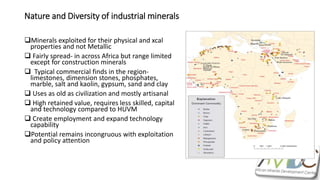
Nature and Diversity of industrial minerals
Minerals exploited for their physical and xcal
properties and not Metallic
 Fairly spread- in across Africa but range limited
except for construction minerals
 Typical commercial finds in the region-
limestones, dimension stones, phosphates,
marble, salt and kaolin, gypsum, sand and clay
 Uses as old as civilization and mostly artisanal
 High retained value, requires less skilled, capital
and technology compared to HUVM
 Create employment and expand technology
capability
Potential remains incongruous with exploitation
and policy attention
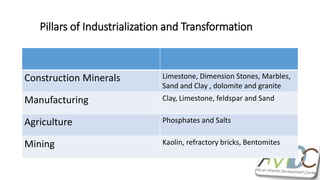
Pillars of Industrialization and Transformation
Construction Minerals Limestone, Dimension Stones, Marbles,
Sand and Clay , dolomite and granite
Manufacturing Clay, Limestone, feldspar and Sand
Agriculture Phosphates and Salts
Mining Kaolin, refractory bricks, Bentomites
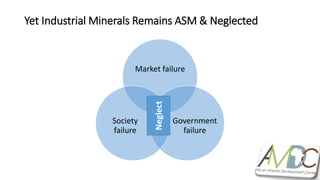
Yet Industrial Minerals Remains ASM & Neglected
Market failure
Government
failure
Society
failure
Neglect
BUT AFTER THE BOOM: NOT EVERY
UNGLITTERED MINERAL ISN’T GOLDEN
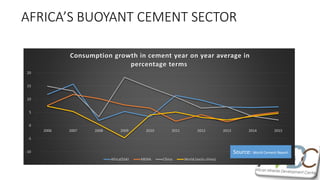
AFRICA’S BUOYANT CEMENT SECTOR
-10
-5
0
5
10
15
20
2006 2007 2008 2009 2010 2011 2012 2013 2014 2015
Consumption growth in cement year on year average in
percentage terms
Africa(SSA) MENA China World (exclu china)
Source: World Cement Report
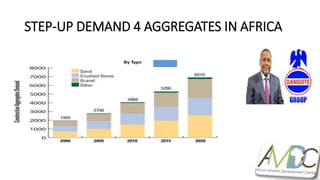
STEP-UP DEMAND 4 AGGREGATES IN AFRICA
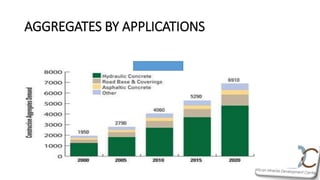
AGGREGATES BY APPLICATIONS
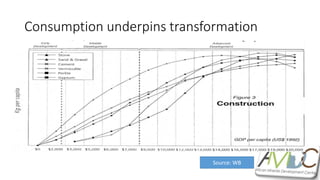
Consumption underpins transformation
Source: WB
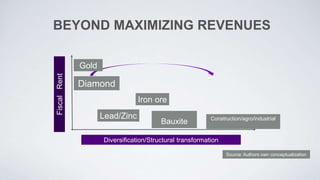
BEYOND MAXIMIZING REVENUES
Gold
FiscalRent
Diversification/Structural transformation
Lead/Zinc
Iron ore
Construction/agro/industrial
Diamond
Bauxite
Source: Authors own conceptualization
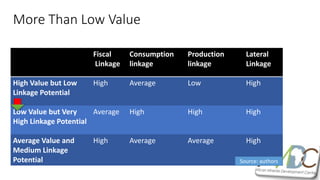
More Than Low Value
Fiscal
Linkage
Consumption
linkage
Production
linkage
Lateral
Linkage
High Value but Low
Linkage Potential
High Average Low High
Low Value but Very
High Linkage Potential
Average High High High
Average Value and
Medium Linkage
Potential
High Average Average High
Source: authors
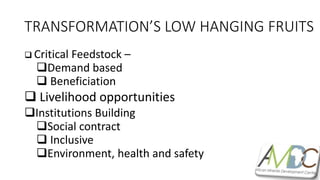
TRANSFORMATION’S LOW HANGING FRUITS
 Critical Feedstock –
Demand based
 Beneficiation
 Livelihood opportunities
Institutions Building
Social contract
 Inclusive
Environment, health and safety
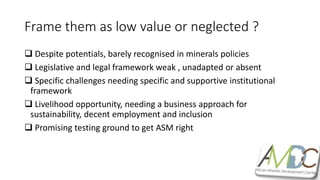
Frame them as low value or neglected ?
 Despite potentials, barely recognised in minerals policies
 Legislative and legal framework weak , unadapted or absent
 Specific challenges needing specific and supportive institutional
framework
 Livelihood opportunity, needing a business approach for
sustainability, decent employment and inclusion
 Promising testing ground to get ASM right
Conclusion
 Low hanging fruits for achieving the AMV
Towards a policy oriented focus of the sector
AMDC has decided to frame this class of minerals as
 NEGLECTED DEVELOPMENT MINERALS (NDM)
 Specific challenges in the sector requires clear and adapted legal and
institutional framework
 Strengthen capacity building in EHS, business management and
vocational training
 Research, geological and marketing information
Thank You!

Charles akong amdc asm workshop april 2016

  • 1.
    Harnessing Opportunities toTransform the ASM From Mining focus to Minerals for Development: Akong Charles Economic Affairs Officer Linkages, Diversification and Investment
  • 2.
    Present • AMV andMinerals for Development • Development Minerals Examine • Dimensions of Neglect • Lessons for the ASM Identify • Transformative opportunities Present • Conclusions Outline of Presentation
  • 3.
    AMV Thinking Outsidethe ‘Mining Box’ ‘’ Transparent, equitable and optimal exploitation of mineral resources to underpin broad-based sustainable growth and socio- economic development’’  Optimize knowledge and benefits of finite mineral resources at all levels… for all minerals; Incorporate both high value metals and lower value industrial minerals at both commercial and small- scale levels’’  Harness the potential of small scale and artisanal mining to improve livelihoods and integration into the rural and national economy’’
  • 4.
    But many pastinterventions in the ASM remains ‘’mainly on mining gold and gemstones and less on industrial minerals, which have greater potential for integration with other sectors of the local economy’’.
  • 5.
    Nature and Diversityof industrial minerals Minerals exploited for their physical and xcal properties and not Metallic  Fairly spread- in across Africa but range limited except for construction minerals  Typical commercial finds in the region- limestones, dimension stones, phosphates, marble, salt and kaolin, gypsum, sand and clay  Uses as old as civilization and mostly artisanal  High retained value, requires less skilled, capital and technology compared to HUVM  Create employment and expand technology capability Potential remains incongruous with exploitation and policy attention
  • 6.
    Pillars of Industrializationand Transformation Construction Minerals Limestone, Dimension Stones, Marbles, Sand and Clay , dolomite and granite Manufacturing Clay, Limestone, feldspar and Sand Agriculture Phosphates and Salts Mining Kaolin, refractory bricks, Bentomites
  • 7.
    Yet Industrial MineralsRemains ASM & Neglected Market failure Government failure Society failure Neglect
  • 8.
    BUT AFTER THEBOOM: NOT EVERY UNGLITTERED MINERAL ISN’T GOLDEN
  • 9.
    AFRICA’S BUOYANT CEMENTSECTOR -10 -5 0 5 10 15 20 2006 2007 2008 2009 2010 2011 2012 2013 2014 2015 Consumption growth in cement year on year average in percentage terms Africa(SSA) MENA China World (exclu china) Source: World Cement Report
  • 10.
    STEP-UP DEMAND 4AGGREGATES IN AFRICA
  • 11.
  • 12.
  • 13.
    BEYOND MAXIMIZING REVENUES Gold FiscalRent Diversification/Structuraltransformation Lead/Zinc Iron ore Construction/agro/industrial Diamond Bauxite Source: Authors own conceptualization
  • 14.
    More Than LowValue Fiscal Linkage Consumption linkage Production linkage Lateral Linkage High Value but Low Linkage Potential High Average Low High Low Value but Very High Linkage Potential Average High High High Average Value and Medium Linkage Potential High Average Average High Source: authors
  • 15.
    TRANSFORMATION’S LOW HANGINGFRUITS  Critical Feedstock – Demand based  Beneficiation  Livelihood opportunities Institutions Building Social contract  Inclusive Environment, health and safety
  • 16.
    Frame them aslow value or neglected ?  Despite potentials, barely recognised in minerals policies  Legislative and legal framework weak , unadapted or absent  Specific challenges needing specific and supportive institutional framework  Livelihood opportunity, needing a business approach for sustainability, decent employment and inclusion  Promising testing ground to get ASM right
  • 17.
    Conclusion  Low hangingfruits for achieving the AMV Towards a policy oriented focus of the sector AMDC has decided to frame this class of minerals as  NEGLECTED DEVELOPMENT MINERALS (NDM)  Specific challenges in the sector requires clear and adapted legal and institutional framework  Strengthen capacity building in EHS, business management and vocational training  Research, geological and marketing information
  • 18.

Editor's Notes

  • #6 Mali has economically viable deposits of salts, Ghana Cement, Senegal, Burkina faso and Togo phosphates Benin we can find marble as well as in Togo. Limestones in Nigeria, Guinea, Niger, Mali etc
  • #8 A combination of failures: market, government and society has to the neglect of the sector Often here description in report as vast, immense and inexhaustible to describe economic potential Where geological information is available it is patchy, unstructured and not systematic to be used for any viable market analysis for future demand projection Risks capital usually governed by the need to minimise opportunity cost and maximise short term profits which are readily provided by the high unit value minerals
  • #9 Vulnerable employment in Africa was estimated in 2012 to be 77.4% of all the jobs, the highest in all developing countries. A 10 percentage point increase in national income translate to 20 percentage point poverty reduction in Asia against only 7 percent for Africa Progressivity in mining tax regimes is rare in the continent with the exception of south Africa. Due to lack of progressive taxation during the boom, tax revenue growth stayed flat in most minerals rich countries while profits from mining companies quadruple. Illicit financial flows from the minerals sector also increased due to tax dodging practices of multinational companies
  • #11 Demand for construction aggregates in the Africa/Mideast region will expand 5.4%/year from 2010-2015 to 5.3 billion tonnes, the second fastest rate of growth behind the Asia/Pacific region but a deceleration from the 2005-2010 pace. United Nations Environment Programme, it has been understood that next to water, concrete is the second-most consumed substance on earth; on average, each person uses nearly three tons of concrete a year
  • #12 Africa/Mideast: Construction Aggregates Demand (million metric tons) by application