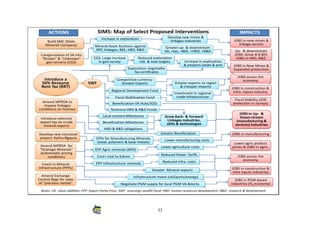
Maximising the Developmental Impact of the People’s Mineral Assets:
STATE INTERVENTION IN THE
MINERALS SECTOR (SIMS)
POLICY DISCUSSION DOCUMENT
March 2012
SIMS Summary
This summary consists of a Review and Discussion that covers a) the role of minerals sector in
our country; b) the critical issues around minerals/mining; and c) what other countries have
done to enhance the developmental impact of the extraction of mineral assets. This is
followed by proposals for South Africa to increase the developmental impact of mining. The
proposals   are   grouped   under   Ownership   and   Control;   Governance;   Economic   Linkages
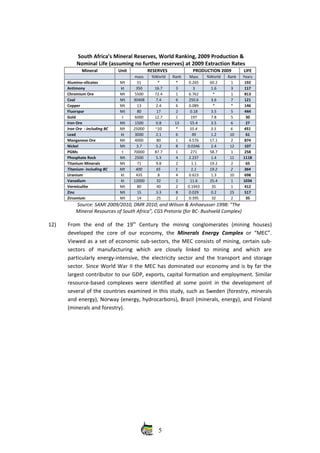
(Fiscal, Backward, Forward, Knowledge and Spatial); and the Regional Dimension.
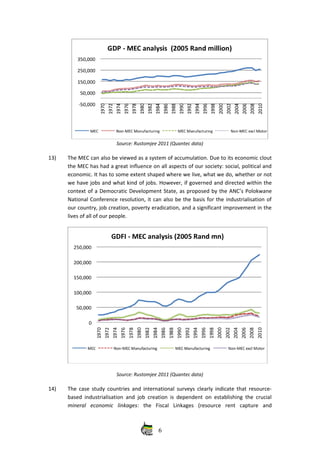
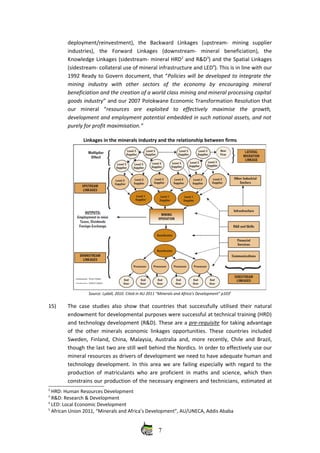
1 Review and Discussion
1) The 2010 meeting of the ANC’s National General Council took a resolution on the
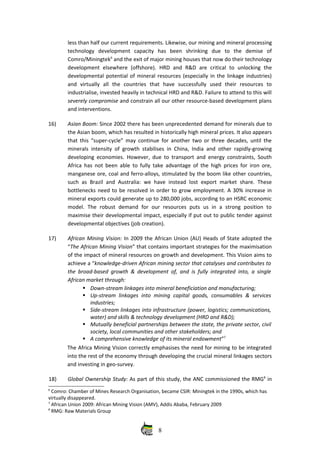
role of the state in the economy. This resolution was more encompassing than the
matter of nationalisation of the mines only. It was this viewpoint that informed
delegates to instruct the NEC to carry out an in‐depth study on how best to leverage
South Africa’s mineral wealth (and other natural resources) to achieve the key
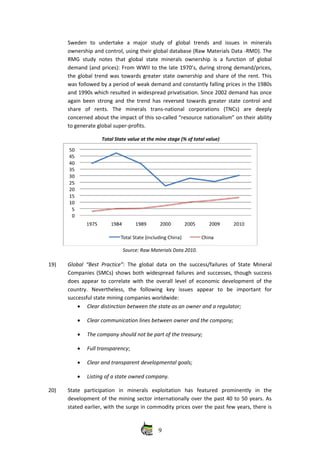
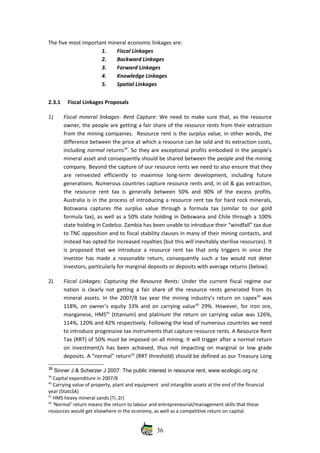
strategic goal of placing the economy on a new job‐creating and more equitable
growth path, in the context of the ANC’s Polokwane National Congress economic
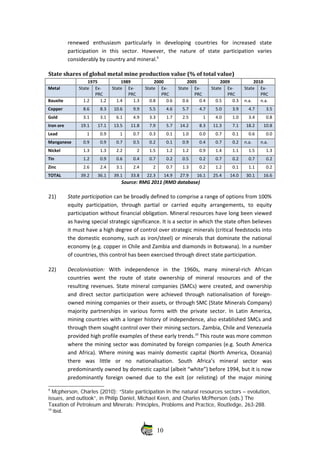
transformation resolution on creating a democratic developmental state that  “…
must ensure that our national resource endowments, including land, water, minerals
and marine resources are exploited to effectively maximise the growth, development
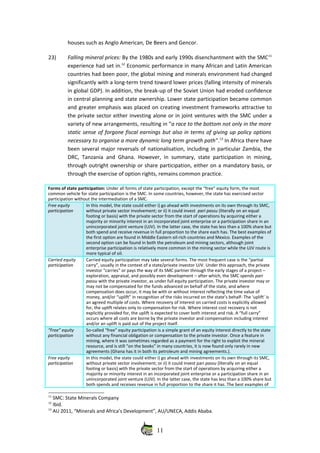
and employment potential embedded in such national assets, and not purely for
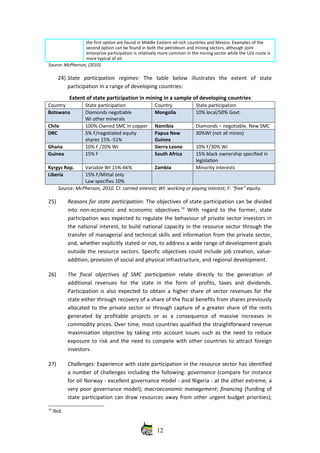
profit maximisation.”  
2) This study would enable the ANC to present a scientifically researched overview of
the minerals sector in particular, as well as international case studies so that any
political decision taken is based on an understanding of the real issues and other
country experiences. While the resolution further directs the ANC to look at other
sectors,   including   the   energy   and   financial   sectors,   this   research   project   was
required to focus on the minerals sector. The terms of reference called for a critical
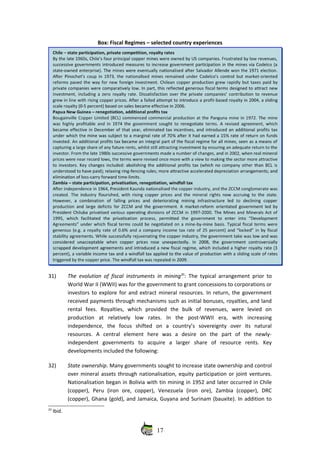
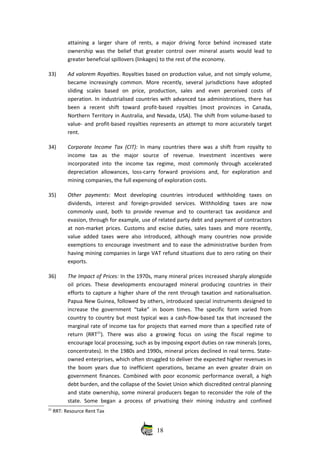
analysis of the existing mining sector, including potential and actual upstream and
downstream   sectors;   mineral‐related   logistics;   energy   and   environmental
sustainability   challenges   and   opportunities;   existing   state   assets   in   the   sector;
present   legislation   and   regulations   including   the   licensing   regulations,   and   the
Mining Charter. The project was also required to review a variety of international
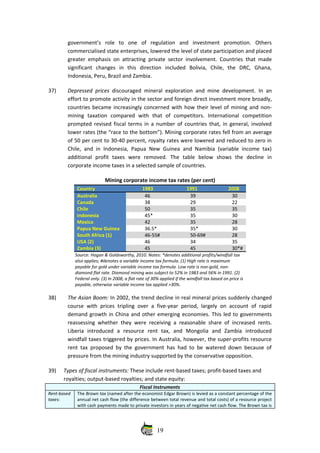
approaches to state intervention in the minerals sector, as well as the historical
perspective on the evolution of current mineral regimes. This will be achieved
through   evaluating  the   forms   of   state   interventions   by ‘developmental  states’,
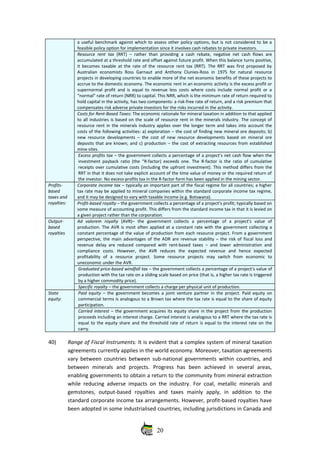
including  through  nationalisation,  and evaluating  other factors  influencing  such
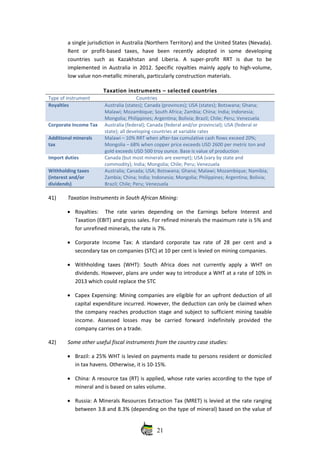
interventions   in   the   context   of   maximising     the   growth,   development   and
employment potential embedded in mineral assets.
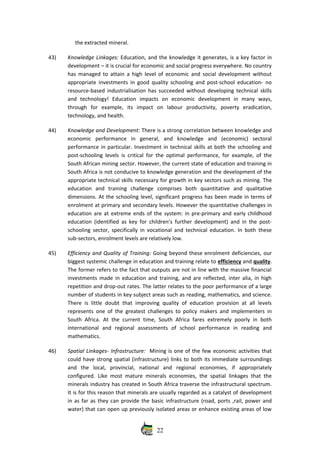
3)  The project team adopted the following methodology:
2
i. Commissioning studies/research on a number of critical topics – e.g. the South
African Minerals‐Energy (MEC) complex; international trends in state ownership
by the Raw Materials Group (RMG);
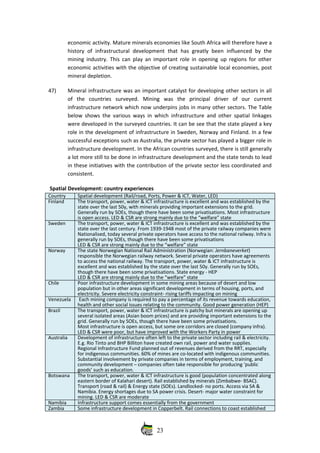
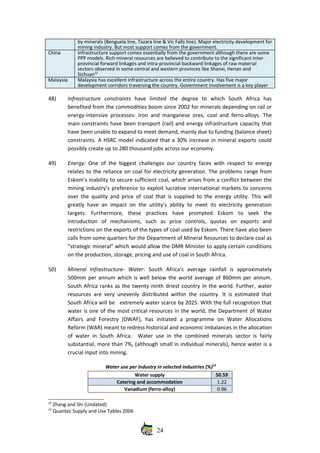
ii. Undertaking a series of international  visits to the following countries: 
• Latin America (Brazil, Chile and Venezuela);
• Africa (Botswana, Namibia and Zambia);
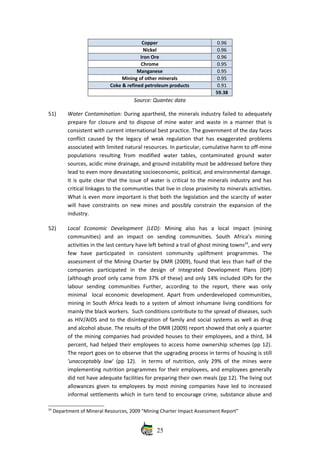
• Asia (China and Malaysia);
• OECD (Norway, Finland, Sweden and Australia)
iii. Hosting a series of stakeholder workshops with government; private sector;
research institutions; trade unions; and civil society organisations; and
iv. Undertaking own research.
4) The first point of departure for the study is the ANC’s policies & strategies on the
people’s mineral resources which have their roots in “The Freedom Charter” (1955),
the “Ready to Govern” (1992) document, the Reconstruction and Development
Programme   (RDP,   1994)   and   the   Polokwane   Conference   (2007)   Economic
Transformation resolution. In all of these documents the nation’s mineral assets are
seen as a resource to improve the lives of all of our people.
5) The Freedom Charter states clearly that “The national wealth of our country, the
heritage of South Africans, shall be restored to the people. The mineral wealth
beneath the soil ... shall be transferred to the ownership of the people as a whole.”
This was done when, under the MPRDA1
, all privately owned mineral resources were
transferred to the state. However, when we subsequently concessioned them, via a
Mining Right, we failed to ensure that their developmental impact was maximised.
This needs to be urgently remedied.
6) The   ANC’s   Polokwane   Economic   Transformation   resolution   states   that  “The
developmental state should maintain its strategic role in shaping the key sectors of
the economy, including the mineral and energy complex and the national transport
and logistics system” and goes on to say that we must “…ensure that our national
resource endowments, including land, water, minerals and marine resources are
exploited   to   effectively   maximise   the   growth,   development   and   employment
potential embedded in such national assets, and not purely for profit maximisation.”
This report attempts to develop policies, strategies and interventions that maximise
the growth, development and employment potential embedded in our mineral
resources.
1
 MPRDA: Minerals & Petroleum Resources Development Act of 2002
3
7) Our country has a long and innovative history of utilising mineral resources for our
people’s needs that pre‐dates European colonial conquest by thousands of years. In
fact  it  appears  that  the   earliest  evidence   of  mining   in  the  world  comes  from
southern Africa, by the San hunter‐gatherers.
8) Before the European colonial invasions minerals were generally mined for local uses,
such as clays for pottery, iron for hoes, arrow heads and assegais and copper and tin
for   ornamentation   and   vessels.   However,   although   gold   was   mined   for   local
ornamentation, it appears that southern Africa was a significant supplier to the
world economy between 600 and 1000 years ago, via the east African island city
states (such as Mocambique, Kilwa, and Zanzibar) and Dhow trading boats to the
Middle East and on to Asia.
9) The colonial “discovery” of our substantial and varied mineral resources led to a
ratcheting‐up   of   the   influx   of   Europeans   and   the   destruction   of   pre‐colonial
economic systems, due to the massive needs of the new mining companies for
abundant   cheap   labour.   The   migrant   labour   system   combined   with   land
appropriation, the reserves/Bantustans, pass laws and rigorous policing provided a
cheap supply of labour and huge profits to the mining companies.
10) But white Afrikaner capital was not in total alignment with English mining capital, so
the apartheid state made many interventions to increase the developmental impact
of   minerals   for   its   constituency   (the   “volk”)   including   policies   to   grow   white
Afrikaner mining capital (affirmative action, particularly in coal mining), policies to
grow   the   state   mineral‐based   sectors   (beneficiation)   through   State‐owned
Enterprises   (SOEs)   such   as   the   Industrial   Development   Corporation   (IDC‐
phosphates, aluminium, ferro‐alloys), Iscor (iron and steel), Sasol and Mossgas (coal/
gas to liquid fuels and petro‐chemicals), and Eskom (coal to energy). There are many
lessons from their interventions that we must assess dispassionately, to see if they
could serve our people.
11) South Africa is exceptionally well‐endowed with mineral resources and has been
called the country of “geological superlatives”. These include the largest reserves of
the   platinum   group   metals  (PGMs),   gold,  chromite,   manganese,   vanadium   and
refractory minerals (alumina‐silicates). We also have large resources of coal, iron
ore, titanium, zirconium, nickel, vermiculite, phosphate and many other minerals
(see Table below). At 2009 production rates our reserves for all minerals will last for
several hundred years (see Table), if no further resources are delineated, except for
gold (terminal decline), lead and zirconium (heavy mineral sands). However, the core
issue relates to how we use this exceptional but finite endowment to improve the
lives of our people, or how do we  maximise the developmental impact of our
substantial mineral assets whilst still extant!
4
South Africa’s Mineral Reserves, World Ranking, 2009 Production &
Nominal Life (assuming no further reserves) at 2009 Extraction Rates
Mineral Unit RESERVES PRODUCTION 2009 LIFE
mass %World Rank Mass %World Rank Years
Alumino‐silicates Mt 51 * * 0.265 60.2 1 192
Antimony kt 350 16.7 3 3 1.6 3 117
Chromium Ore Mt 5500 72.4 1 6.762 * 1 813
Coal Mt 30408 7.4 6 250.6 3.6 7 121
Copper Mt 13 2.4 6 0.089 * * 146
Fluorspar Mt 80 17 2 0.18 3.5 5 444
Gold t 6000 12.7 1 197 7.8 5 30
Iron Ore  Mt 1500 0.8 13 55.4 3.5 6 27
Iron Ore  ‐ including BC Mt 25000 ~10 * 55.4 3.5 6 451
Lead kt 3000 2.1 6 49 1.2 10 61
Manganese Ore Mt 4000 80 1 4.576 17.1 2 874
Nickel Mt 3.7 5.2 8 0.0346 2.4 12 107
PGMs t 70000 87.7 1 271 58.7 1 258
Phosphate Rock Mt 2500 5.3 4 2.237 1.4 11 1118
Titanium Minerals Mt 71 9.8 2 1.1 19.2 2 65
Titanium‐ including BC Mt 400 65 1 1.1 19.2 2 364
Uranium kt 435 8 4 0.623 1.3 10 698
Vanadium kt 12000 32 2 11.6 25.4 1 1034
Vermiculite Mt 80 40 2 0.1943 35 1 412
Zinc Mt 15 3.3 8 0.029 0.2 25 517
Zirconium Mt 14 25 2 0.395 32 2 35
Source: SAMI 2009/2010, DMR 2010; and Wilson & Anhaeusser 1998: “The
Mineral Resources of South Africa”, CGS Pretoria (for BC‐ Bushveld Complex)
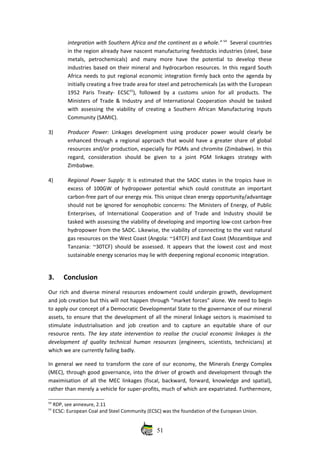
12) From   the   end   of   the   19th
  Century   the   mining   conglomerates   (mining   houses)
developed the core of our economy, the  Minerals Energy Complex  or “MEC”.
Viewed as a set of economic sub‐sectors, the MEC consists of mining, certain sub‐
sectors   of   manufacturing   which   are   closely   linked   to   mining   and   which   are
particularly energy‐intensive, the electricity sector and the transport and storage
sector. Since World War II the MEC has dominated our economy and is by far the
largest contributor to our GDP, exports, capital formation and employment. Similar
resource‐based complexes were identified at some point in the development of
several of the countries examined in this study, such as Sweden (forestry, minerals
and energy), Norway (energy, hydrocarbons), Brazil (minerals, energy), and Finland
(minerals and forestry).
5
Source: Rustomjee 2011 (Quantec data)
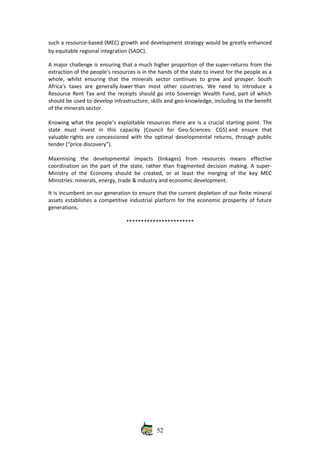
13) The MEC can also be viewed as a system of accumulation. Due to its economic clout
the MEC has had a great influence on all aspects of our society: social, political and
economic. It has to some extent shaped where we live, what we do, whether or not
we have jobs and what kind of jobs. However, if governed and directed within the
context of a Democratic Development State, as proposed by the ANC’s Polokwane
National Conference resolution, it can also be the basis for the industrialisation of
our country, job creation, poverty eradication, and a significant improvement in the
lives of all of our people.
Source: Rustomjee 2011 (Quantec data)
14) The case study countries and international surveys clearly indicate that resource‐
based industrialisation and job creation is dependent on establishing the crucial
mineral   economic   linkages:   the   Fiscal   Linkages   (resource   rent   capture   and
6
deployment/reinvestment),   the   Backward   Linkages   (upstream‐   mining   supplier
industries),   the   Forward   Linkages   (downstream‐   mineral   beneficiation),   the
Knowledge Linkages (sidestream‐ mineral HRD2
 and R&D3
) and the Spatial Linkages
(sidestream‐ collateral use of mineral infrastructure and LED4
). This is in line with our
1992 Ready to Govern document, that “Policies will be developed to integrate the
mining   industry   with   other   sectors   of   the   economy   by   encouraging   mineral
beneficiation and the creation of a world class mining and mineral processing capital
goods industry” and our 2007 Polokwane Economic Transformation Resolution that
our   mineral   “resources   are   exploited   to   effectively   maximise   the   growth,
development and employment potential embedded in such national assets, and not
purely for profit maximisation.”
Linkages in the minerals industry and the relationship between firms
Source: Lydall, 2010. Cited in AU 2011 “Minerals and Africa’s Development” p1035
15) The case studies also show that countries that successfully utilised their natural
endowment for developmental purposes were successful at technical training (HRD)
and technology development (R&D). These are a pre‐requisite for taking advantage
of the other minerals economic linkages opportunities. These countries included
Sweden, Finland, China, Malaysia, Australia and, more recently, Chile and Brazil,
though the last two are still well behind the Nordics. In order to effectively use our
mineral resources as drivers of development we need to have adequate human and
technology development. In this area we are failing especially with regard to the
production of matriculants who are proficient in maths and science, which then
constrains our production of the necessary engineers and technicians, estimated at
2
 HRD: Human Resources Development
3
 R&D: Research & Development
4
 LED: Local Economic Development
5
 African Union 2011, “Minerals and Africa’s Development”, AU/UNECA, Addis Ababa
7
less than half our current requirements. Likewise, our mining and mineral processing
technology   development   capacity   has   been   shrinking   due   to   the   demise   of
Comro/Miningtek6
 and the exit of major mining houses that now do their technology
development   elsewhere   (offshore).   HRD   and   R&D   are   critical   to   unlocking   the
developmental potential of mineral resources (especially in the linkage industries)
and   virtually   all   the   countries   that   have   successfully   used   their   resources   to
industrialise, invested heavily in technical HRD and R&D. Failure to attend to this will
severely compromise and constrain all our other resource‐based development plans
and interventions. 
16) Asian Boom: Since 2002 there has been unprecedented demand for minerals due to
the Asian boom, which has resulted in historically high mineral prices. It also appears
that this “super‐cycle” may continue for another two or three decades, until the
minerals intensity of growth stabilises in China, India and other rapidly‐growing
developing economies. However, due to transport and energy constraints, South
Africa has not been able to fully take advantage of the high prices for iron ore,
manganese ore, coal and ferro‐alloys, stimulated by the boom like other countries,
such as Brazil and Australia: we have instead lost export market share. These
bottlenecks need to be resolved in order to grow employment. A 30% increase in
mineral exports could generate up to 280,000 jobs, according to an HSRC economic
model.   The   robust   demand   for   our   resources   puts   us   in   a  strong   position   to
maximise their developmental impact, especially if put out to public tender against
developmental objectives (job creation).
17) African Mining Vision: In 2009 the African Union (AU) Heads of State adopted the
“The African Mining Vision” that contains important strategies for the maximisation
of the impact of mineral resources on growth and development. This Vision aims to
achieve a “knowledge‐driven African mining sector that catalyses and contributes to
the broad‐based growth & development of, and is fully integrated into, a single
African market through:
Down‐stream linkages into mineral beneficiation and manufacturing;
Up‐stream linkages  into mining capital goods, consumables & services
industries;
Side‐stream linkages into infrastructure (power, logistics; communications,
water) and skills & technology development (HRD and R&D);
Mutually beneficial partnerships between the state, the private sector, civil
society, local communities and other stakeholders; and
A comprehensive knowledge of its mineral endowment”7
The Africa Mining Vision correctly emphasises the need for mining to be integrated
into the rest of the economy through developing the crucial mineral linkages sectors
and investing in geo‐survey.
18) Global Ownership Study: As part of this study, the ANC commissioned the RMG8
 in
6
 Comro: Chamber of Mines Research Organisation, became CSIR: Miningtek in the 1990s, which has
virtually disappeared. 
7
 African Union 2009: African Mining Vision (AMV), Addis Ababa, February 2009
8
 RMG: Raw Materials Group
8
Sweden   to   undertake   a   major   study   of   global   trends   and   issues   in   minerals
ownership and control, using their global database (Raw Materials Data ‐RMD). The
RMG  study notes  that global state minerals  ownership  is  a function  of  global
demand (and prices): From WWII to the late 1970’s, during strong demand/prices,
the global trend was towards greater state ownership and share of the rent. This
was followed by a period of weak demand and constantly falling prices in the 1980s
and 1990s which resulted in widespread privatisation. Since 2002 demand has once
again been strong and the trend has reversed towards greater state control and
share   of   rents.   The   minerals   trans‐national   corporations   (TNCs)   are   deeply
concerned about the impact of this so‐called “resource nationalism” on their ability
to generate global super‐profits.
Total State value at the mine stage (% of total value)
Source: Raw Materials Data 2010.
19) Global “Best Practice”:  The global data on the success/failures of State Mineral
Companies (SMCs) shows both widespread failures and successes, though success
does appear to correlate with the overall level of economic development of the
country.   Nevertheless,   the   following   key   issues   appear   to   be   important   for
successful state mining companies worldwide:
• Clear distinction between the state as an owner and a regulator;
• Clear communication lines between owner and the company;
• The company should not be part of the treasury;
• Full transparency;
• Clear and transparent developmental goals; 
• Listing of a state owned company.
20) State   participation   in   minerals   exploitation   has   featured   prominently   in   the
development of the mining sector internationally over the past 40 to 50 years. As
stated earlier, with the surge in commodity prices over the past few years, there is
9
renewed   enthusiasm   particularly   in   developing   countries   for   increased   state
participation   in   this   sector.   However,   the   nature   of   state   participation   varies
considerably by country and mineral.9
State shares of global metal mine production value (% of total value)
1975 1989 2000 2005 2009 2010
Metal State Ex‐
PRC
State Ex‐
PRC
State Ex‐
PRC
State Ex‐
PRC
State Ex‐
PRC
State Ex‐
PRC
Bauxite 1.2 1.2 1.4 1.3 0.8 0.6 0.6 0.4 0.5 0.3 n.a. n.a.
Copper 8.6 8.3 10.6 9.9 5.5 4.6 5.7 4.7 5.0 3.9 4.7 3.5
Gold 3.1 3.1 6.1 4.9 3.3 1.7 2.5 1 4.0 1.0 3.4 0.8
Iron ore 19.1 17.1 13.5 11.8 7.9 5.7 14.2 8.3 11.3 7.1 18.2 10.8
Lead 1 0.9 1 0.7 0.3 0.1 1.0 0.0 0.7 0.1 0.6 0.0
Manganese 0.9 0.9 0.7 0.5 0.2 0.1 0.9 0.4 0.7 0.2 n.a. n.a.
Nickel 1.3 1.3 2.2 2 1.5 1.2 1.2 0.9 1.4 1.1 1.5 1.3
Tin 1.2 0.9 0.6 0.4 0.7 0.2 0.5 0.2 0.7 0.2 0.7 0.2
Zinc 2.6 2.4 3.1 2.4 2 0.7 1.3 0.2 1.2 0.1 1.1 0.2
TOTAL 39.2 36.1 39.1 33.8 22.3 14.9 27.9 16.1 25.4 14.0 30.1 16.6
Source: RMG 2011 (RMD database)
21) State participation can be broadly defined to comprise a range of options from 100%
equity   participation,   through   partial   or   carried   equity   arrangements,   to   equity
participation without financial obligation. Mineral resources have long been viewed
as having special strategic significance. It is a sector in which the state often believes
it must have a high degree of control over strategic minerals (critical feedstocks into
the domestic economy, such as iron/steel) or minerals that dominate the national
economy (e.g. copper in Chile and Zambia and diamonds in Botswana). In a number
of countries, this control has been exercised through direct state participation.
22) Decolonisation:  With   independence   in   the   1960s,   many   mineral‐rich   African
countries  went  the  route  of  state   ownership  of   mineral   resources  and  of  the
resulting revenues. State mineral companies (SMCs) were created, and ownership
and direct sector participation were achieved through nationalisation of foreign‐
owned mining companies or their assets, or through SMC (State Minerals Company)
majority partnerships in various forms with the private sector. In Latin America,
mining countries with a longer history of independence, also established SMCs and
through them sought control over their mining sectors. Zambia, Chile and Venezuela
provided high profile examples of these early trends.10
 This route was more common
where the mining sector was dominated by foreign companies (e.g. South America
and Africa). Where mining was mainly domestic capital (North America, Oceania)
there   was   little   or   no   nationalisation.   South   Africa’s   mineral   sector   was
predominantly owned by domestic capital (albeit “white”) before 1994, but it is now
predominantly foreign owned due to the exit (or relisting) of the major mining
9
Mcpherson, Charles (2010): “State participation in the natural resources sectors – evolution,
issues, and outlook”, in Philip Daniel, Michael Keen, and Charles McPherson (eds.) The
Taxation of Petroleum and Minerals: Principles, Problems and Practice, Routledge, 263-288.
10
 Ibid.
10
houses such as Anglo American, De Beers and Gencor.
23) Falling mineral prices: By the 1980s and early 1990s disenchantment with the SMC11
experience had set in.12
 Economic performance in many African and Latin American
countries had been poor, the global mining and minerals environment had changed
significantly with a long‐term trend toward lower prices (falling intensity of minerals
in global GDP). In addition, the break‐up of the Soviet Union had eroded confidence
in central planning and state ownership. Lower state participation became common
and greater emphasis was placed on creating investment frameworks attractive to
the private sector either investing alone or in joint ventures with the SMC under a
variety of new arrangements, resulting in “a race to the bottom not only in the more
static sense of forgone fiscal earnings but also in terms of giving up policy options
necessary to organise a more dynamic long term growth path”.13
 In Africa there have
been several major reversals of nationalisation, including in particular Zambia, the
DRC, Tanzania and Ghana. However, in summary, state participation in mining,
through outright ownership or share participation, either on a mandatory basis, or
through the exercise of option rights, remains common practice. 
Forms of state participation: Under all forms of state participation, except the “free” equity form, the most
common vehicle for state participation is the SMC. In some countries, however, the state has exercised sector
participation without the intermediation of a SMC.
Free equity
participation
In this model, the state could either i) go ahead with investments on its own through its SMC,
without private sector involvement; or ii) it could invest  pari passu (literally on an equal
footing or basis) with the private sector from the start of operations by acquiring either a
majority or minority interest in an incorporated joint enterprise or a participation share in an
unincorporated joint venture (UJV). In the latter case, the state has less than a 100% share but
both spend and receive revenue in full proportion to the share each has. The best examples of
the first option are found in Middle Eastern oil‐rich countries and Mexico. Examples of the
second option can be found in both the petroleum and mining sectors, although joint
enterprise participation is relatively more common in the mining sector while the UJV route is
more typical of oil.
Carried equity
participation
Carried equity participation may take several forms. The most frequent case is the “partial
carry”, usually in the context of a state/private investor UJV. Under this approach, the private
investor “carries” or pays the way of its SMC partner through the early stages of a project –
exploration, appraisal, and possibly even development – after which, the SMC spends pari
passu with the private investor, as under full equity participation. The private investor may or
may not be compensated for the funds advanced on behalf of the state, and where
compensation does occur, it may be with or without interest reflecting the time value of
money, and/or “uplift” in recognition of the risks incurred on the state’s behalf‐ The ‘uplift’ is
an agreed multiple of costs. Where recovery of interest on carried costs is explicitly allowed
for, the uplift relates only to compensation for risk. Where interest cost recovery is not
explicitly provided for, the uplift is expected to cover both interest and risk. A “full carry”
occurs where all costs are borne by the private investor and compensation including interest
and/or an uplift is paid out of the project itself. 
“Free” equity
participation
So‐called “free” equity participation is a simple grant of an equity interest directly to the state
without any financial obligation or compensation to the private investor. Once a feature in
mining, where it was sometimes regarded as a payment for the right to exploit the mineral
resource, and is still “on the books” in many countries, it is now found only rarely in new
agreements (Ghana has it in both its petroleum and mining agreements.).
Free equity
participation
In this model, the state could either i) go ahead with investments on its own through its SMC,
without private sector involvement; or ii) it could invest pari passu (literally on an equal
footing or basis) with the private sector from the start of operations by acquiring either a
majority or minority interest in an incorporated joint enterprise or a participation share in an
unincorporated joint venture (UJV). In the latter case, the state has less than a 100% share but
both spends and receives revenue in full proportion to the share it has. The best examples of
11
 SMC: State Minerals Company
12
 Ibid.
13
 AU 2011, “Minerals and Africa’s Development”, AU/UNECA, Addis Ababa.
11
the first option are found in Middle Eastern oil‐rich countries and Mexico. Examples of the
second option can be found in both the petroleum and mining sectors, although joint
enterprise participation is relatively more common in the mining sector while the UJV route is
more typical of oil.
Source: McPherson, (2010)
24) State   participation   regimes:  The   table   below   illustrates   the   extent   of   state
participation in a range of developing countries:
Extent of state participation in mining in a sample of developing countries
Country State participation Country State participation
Botswana Diamonds negotiable
WI other minerals
Mongolia 10% local/50% Govt.
Chile 100%‐Owned SMC in copper Namibia Diamonds – negotiable. New SMC
DRC 5% F/negotiated equity
shares 15% ‐51%
Papua New
Guinea
30%WI (not all mines)
Ghana 10% F /20% WI Sierra Leone 10% F/30% WI
Guinea 15% F South Africa 15% black ownership specified in
legislation
Kyrgyz Rep. Variable WI 15%‐66% Zambia Minority interests
Liberia 15% F/Mittal only
Law specifies 10%
Source: McPherson, 2010. CI: carried interest; WI: working or paying interest; F: “free” equity.
25) Reasons for state participation: The objectives of state participation can be divided
into non‐economic and economic objectives.14
  With regard to the former, state
participation was expected to regulate the behaviour of private sector investors in
the national interest, to build national capacity in the resource sector through the
transfer of managerial and technical skills and information from the private sector,
and, whether explicitly stated or not, to address a wide range of development goals
outside the resource sectors. Specific objectives could include job creation, value‐
addition, provision of social and physical infrastructure, and regional development.
26) The   fiscal   objectives   of   SMC   participation  relate   directly   to   the   generation   of
additional   revenues   for   the   state   in   the   form   of   profits,   taxes   and   dividends.
Participation is also expected to obtain a higher share of sector revenues for the
state either through recovery of a share of the fiscal benefits from shares previously
allocated to the private sector or through capture of a greater share of the rents
generated   by   profitable   projects   or  as   a  consequence   of   massive   increases   in
commodity prices. Over time, most countries qualified the straightforward revenue
maximisation objective by taking into account issues such as the need to reduce
exposure to risk and the need to compete with other countries to attract foreign
investors.
27) Challenges: Experience with state participation in the resource sector has identified
a number of challenges including the following: governance (compare for instance
for oil Norway ‐ excellent governance model ‐ and Nigeria ‐ at the other extreme, a
very poor governance model); macroeconomic management; financing (funding of
state participation can draw resources away from other urgent budget priorities);
14
 Ibid.
12
achieving commercial efficiency; and potential conflicts of interest (e.g. state partner
with private sector versus its regulator role).15
 Over the past few years, however, a
number   of   positive   policy   responses   to   the   specific   issues   raised   by   state
participation can be identified16
:
• A greater reliance on well structured laws and regulations (mineral regime) as
alternatives to direct participation. Ownership is no longer viewed as essential
to   protection   of   the   national  interest.   On   accountability   and   transparency
grounds appropriate legislation may well be a feasible alternative to ownership.
• Increased  clarity on roles and responsibilities  of government ministries and
agencies charged with sector oversight. The trends towards transferring non‐
commercial, quasi‐fiscal activities and regulatory or fiscal functions from SMCs
back   to   appropriate   ministries   or   independent   agencies,   thus   removing
obstacles to commercial efficiency and reducing or eliminating the potential for
conflicts of interest, has been particularly important in this regard. This re‐
assignment of roles is typically paralleled by efforts to build capacity in the
receiving ministries and agencies.
• A global movement in support of  greater transparency and accountability  of
SMC operations in natural resources sectors in which transparency of SMC
operations   and   finances   features   prominently.   Credible   audits   and   regular
public  reporting and  other assurances of integrity  are heavily emphasised.
Macroeconomic   management   concerns   have   increasingly   stressed   the
importance  of transparency   in the  resource sectors  and, in particular, the
explicit recognition in budgets and planning documents of the financial and
fiscal costs and risks associated with state participation. 
• An increased effort on the part of private sector investors to provide assurances
and  evidence of accountability  (e.g. adherence to EITI17
  and Equator Banking
principles)
• A more cautious approach towards the exercise of state participation options
and a trend towards lower levels of maximum participation. In some cases, the
state has wholly or partially withdrawn from sector participation. Elsewhere, an
increased emphasis on forms of participation which reduce state exposure to
funding   obligations,   e.g.   carried   interests,   non‐recourse   finance   and/or
production sharing, can be observed. At the same time, many countries have
provided more space for private sector participation and competition.
• Increased sophistication in resource tax design, and a growing recognition of the
advantages of efficient taxation over equity participation as a means of raising
revenue. 
State Participation in the Natural Resources Sector – selected country examples18
15
 Ibid.
16
 Ibid.
17
 EITI: Extractive Industries Transparency Initiative
13
1. Norway
(petroleum
sector)
State participation in the petroleum sector has been extensive with the creation of Statoil in
1972, with the state having majority ownership. Features of the Norwegian model of state
participation include the following: commitment to commercial efficiency; encouragement of
foreign private sector participation to benefit from technology and skills; appropriate
institutional mechanisms for excellent governance: e.g. sector ministry responsible for policy;
Norwegian Petroleum Directorate responsible for technical and regulatory oversight; Statoil
responsible for commercial operations. Partially privatised in 2001 but state still holds 80.8%.
2. Denmark
(petroleum)
Current arrangements in Denmark call for the state to hold a mandatory 20% working
interest (no carry) in all licences. The state interest is held by the Danish North Sea Fund.
Separately, DONG, the national oil company, can hold an interest in any licence, on the same
basis as a private investor. DONG itself was scheduled for partial privatisation. 
3. Zambia In the mid‐1990s, during depressed copper prices, Zambia moved away from its policy of
state‐ownership of the mining sector and launched with new legislation for a program of
privatisation. Various divisions of its SMC, Zambia Consolidated Copper Mines (ZCCM), were
sold to private investors over the period 1997‐2000 and ZCCM was converted from an
operating company to an investment holding company, ZCCM‐IH (87.6% State), with a
minority interest in most successor companies, typically in the 10‐20% range. This equity
interest, which was granted as part of the purchase price for the mines took two forms. The
first was a free carried interest, and the second, a carried interest repayable with interest out
of ZCCM‐IH’s income from the equity stake concerned. In addition to the equity interest,
Price Participation Agreements (PPAs) were signed which provided ZCCM‐IH with a share of
revenues earned above an agreed price threshold. Each of these mechanisms had an
approximate fiscal equivalent had they been paid to Government rather than ZCCM‐IH. The
free carried interest equates to a dividend withholding tax and the reimbursable carry
resembles a resource rent tax. The PPAs were similar to price‐related royalties. The approach
represented a classic use of participation to share in rents or windfalls without changing the
existing tax regime. Unfortunately, significant price increases in copper notwithstanding, the
detailed conditions of these equity participation formulas are such that the government has
seen only negligible revenues from them. This is attributable partly to the fact that payments
are triggered by the declaration of a dividend by the mining companies, which they have
successfully avoided by reinvesting earnings, and partly due to ZCCM‐IH’s costs and liabilities
which have limited any pass‐through to government. As a result of the failure of these
schemes to deliver an increased revenue share, the government announced its intent to
“explore the scope for raising the taxation of mining” and in fact, acted to increase taxes and
royalties. However, the subsequent collapse in prices proved these increases to be
unsustainable and they were withdrawn.
4. Chile Chile has a long mining history which was for years dominated by foreign firms mostly from
the USA. In the 1950s, the government began to assert more authority over the mines
through taxes and the creation of a Copper Department to oversee and participate in mining
operations. The process of “Chileanisation” began in earnest in 1966 when legislation was
passed to create mixed societies with foreign companies under which the state would own
51% of the deposit and take a direct role in the production and commercialisation of copper.
In 1971 a constitutional amendment nationalised all major mines “as demanded by the
national interest and in exercise of the sovereign and inalienable rights of the state to freely
use its wealth and natural resources”. The Corporation National de Cobre de Chile (Codelco)
was formed by decree in 1976 to take charge of the state’s mining interests. Codelco is the
world’s largest copper miner and is one of Chile’s largest companies accounting for 5% of
GDP, 25% of exports and 17% of the national budget. Codelco has benefited from the policies
applied in general to Chile’s state‐owned enterprises. These include limited government
interference and a high degree of transparency. Its operational flexibility at times is hindered
by the required transfer of close to all of its income to the state in the form of taxes,
royalties, and dividends. 10% of its export income is earmarked for Chile’s military, which has
limited its expansion into other countries. The tight rein on Codelco’s revenues facilitates
government control. More recently, Codelco’s future has become a matter of public debate.
Costs are rising, output is falling, and the resources required to make needed investments
are substantial. The company is increasingly challenged in global markets by smaller mining
companies’ mergers and growth. This has led to calls for Codelco’s privatisation. So far, the
government’s response has been draft legislation to improve Codelco’s governance and
make it more efficient and competitive. Codelco may in many ways be a model in adopting a
number of the elements of best practice in its own operations and in its relations with
Government. 
18
 Ibid.
14
5. Brazil The Brazilian mining company Vale, the largest in the world, is “officially” not a SMC. It was
“privatised” in 1999 but the state retained control through special class preferred shares (the
so‐called ‘Golden Shares’) and by using a combination of pyramids and ordinary (voting) and
preferential shares. State pension funds have an ultimate majority interest in Valepar which
holds a majority of the voting shares in Vale. This control has been used to get Vale to use its
producer power to encourage customers to locate value‐addition plants in Brazil. State
control of Vale is at extreme “arms length” and it successfully competes internationally. It
represents another “model” of SMC best‐practice in state ownership, but the form of
ownership gives control without a majority of earnings (dividends), but which are partly
captured through fiscal instruments (taxes).
6. Venezuela Unlike the petroleum sector, where there is a wholly‐owned state company, in the mining
sector, there is a variety of arrangements, ranging from 100 per cent equity but operations
managed by private companies; shared equity arrangements with the private sector; and
wholly privately owned and managed mines.
7. Namibia State participation manifests itself in many forms. In the diamond sector, there are two
forms of participation. Through NAMDEB, the state owns a 50% share in diamond mining
with De Beers and the Namibia Diamond Trading Company also jointly owned (50:50) with
De Beers, with the latter managing the entity. A new SMC, Epangelo, has been established
recently. It will be responsible for all future exploration and issuing of licences. The extent to
which it will operate as an owner of mines is not clear at this stage. Indications are that it will
operate on the basis of partnerships with the private sector. 
28) Fiscal Linkages‐ resource rents and risks: Minerals are an important source of export
earnings and taxation revenue in many countries. However, the fiscal regimes for
minerals tend to be different from those found in other sectors because of the
presence of so‐called ‘resource rents’ and the different set of risks prevailing in this
sector. Resource rents represent surplus revenues from a deposit after the payment
of all exploration, development, and extraction costs, including an investor’s risk‐
adjusted required return on investment. Since rent is pure surplus, it can be taxed
whilst upholding the core taxation principle of neutrality. Furthermore, governments
aim to capture the resource rent, not least because minerals are typically owned by
the state. The unusual and substantial risks inherent in the mining sector need to be
managed. These risks include, for example: a long exploration period with uncertain
geological outcomes; a large significant outlay of development capital that is not
transportable (‘sunk’ costs) once invested; uncertain future revenues due to very
volatile and unpredictable mineral prices; a long period of production to reach
break‐even point, which exposes the investor to political and policy instability;
potentially significant environmental impacts requiring large costs to be incurred
when   the   mine   closes;   and   often   during   production   support   to   affected   local
communities.   These   considerations   motivate   measures   such   as   accelerated
depreciation and extended loss‐carry forward limits, to hasten payback of initial
outlays.
29) Capture of Mineral Rents: While rents and risks are also present in other sectors,
their scale and characteristics have led to special tax treatment of the sector, using a
wide variety of fiscal instruments. These instruments include royalties, resource rent
taxes, windfall taxes, corporate income taxes and state ownership. Each has its
advantages and disadvantages with respect to the impact on investor behaviour, the
degree of progressivity (i.e. the extent to which the “government take” increases as
a project’s profitability increases), the sharing of risk between the government and
investor, and the administrative and compliance costs.
15
30) Mineral fiscal regimes vary widely between countries and minerals for a number of
reasons. For example, the level of taxation is likely to vary with country risk. This is
because investors base their decisions on risk‐adjusted rates of return, and the
lower the country risk the higher the level of taxation consistent with a given project
exceeding the minimum required return. The royalty rate and other instruments
most directly targeted at rent are also likely to vary with perceptions of the size of
the rent available. This explains why high value minerals like diamonds and gold
tend to attract a higher royalty rate. The optimal mix of fiscal instruments will also
vary depending on the country’s preferences and capabilities. Some governments
may prefer production‐based instruments as they are easier to administer and
provide earlier and more stable revenue. However, as this shifts more of the risk
onto   companies,   governments   will   most   likely   need   to   accept   a  lower   overall
expected   level   of   taxation.   Other   countries   might   therefore   prefer   a   more
progressive  regime   that  involves  the  government   assuming   more  risk  but   also
expecting a higher take from profits. In addition to variation between countries, a
number of global trends can be discerned over the past half century. These have
tended to be punctuated by external events that shifted the balance of power
between mineral producing countries and investors. This shift in power is analyzed
in the Box below with reference to three countries: Chile, Papua New Guinea, and
Zambia.19
 
19
 Hogan and Goldsworthy, 2010.
16
Box: Fiscal Regimes – selected country experiences
31) The evolution of fiscal instruments in mining20
: The typical arrangement prior to
World War II (WWII) was for the government to grant concessions to corporations or
investors to explore for and extract mineral resources. In return, the government
received payments through mechanisms such as initial bonuses, royalties, and land
rental   fees.   Royalties,   which   provided   the   bulk   of   revenues,   were   levied   on
production   at   relatively   low   rates.   In   the   post‐WWII   era,   with   increasing
independence,   the   focus   shifted   on   a   country’s   sovereignty   over   its   natural
resources.   A   central   element   here   was   a   desire   on   the   part   of   the   newly‐
independent   governments   to   acquire   a   larger   share   of   resource   rents.   Key
developments included the following:
32) State ownership. Many governments sought to increase state ownership and control
over mineral assets through nationalisation, equity participation or joint ventures.
Nationalisation began in Bolivia with tin mining in 1952 and later occurred in Chile
(copper),   Peru   (iron   ore,   copper),   Venezuela   (iron   ore),   Zambia   (copper),   DRC
(copper), Ghana (gold), and Jamaica, Guyana and Surinam (bauxite). In addition to
20
 Ibid.
17
attaining a larger share of rents, a major driving force behind increased state
ownership was the belief that greater control over mineral assets would lead to
greater beneficial spillovers (linkages) to the rest of the economy.
33) Ad valorem Royalties. Royalties based on production value, and not simply volume,
became increasingly common. More recently, several jurisdictions have adopted
sliding   scales   based   on   price,   production,   sales   and   even   perceived   costs   of
operation. In industrialised countries with advanced tax administrations, there has
been   a   recent   shift   toward   profit‐based   royalties   (most   provinces   in   Canada,
Northern Territory in Australia, and Nevada, USA). The shift from volume‐based to
value‐ and profit‐based royalties represents an attempt to more accurately target
rent.
34) Corporate Income Tax (CIT):  In many countries there was a shift from royalty to
income   tax   as   the   major   source   of   revenue.   Investment   incentives   were
incorporated into  the income tax regime, most commonly through accelerated
depreciation  allowances,   loss‐carry  forward  provisions   and, for  exploration  and
mining companies, the full expensing of exploration costs.
35) Other   payments:   Most   developing   countries   introduced   withholding   taxes   on
dividends,   interest   and   foreign‐provided   services.   Withholding   taxes   are   now
commonly used, both to provide revenue and to counteract tax avoidance and
evasion, through for example, use of related party debt and payment of contractors
at non‐market prices. Customs and excise duties, sales taxes and more recently,
value added taxes were also introduced, although many countries now provide
exemptions to encourage investment and to ease the administrative burden from
having mining companies in large VAT refund situations due to zero rating on their
exports.
36) The Impact of Prices: In the 1970s, many mineral prices increased sharply alongside
oil prices. These developments encouraged mineral producing countries in their
efforts to capture a higher share of the rent through taxation and nationalisation.
Papua New Guinea, followed by others, introduced special instruments designed to
increase the government “take” in boom times. The specific form varied from
country to country but most typical was a cash‐flow‐based tax that increased the
marginal rate of income tax for projects that earned more than a specified rate of
return   (RRT21
).   There   was   also   a   growing   focus   on   using   the   fiscal   regime   to
encourage local processing, such as by imposing export duties on raw minerals (ores,
concentrates). In the 1980s and 1990s, mineral prices declined in real terms. State‐
owned enterprises, which often struggled to deliver the expected higher revenues in
the boom years due to inefficient operations, became an even greater drain on
government finances. Combined with poor economic performance overall, a high
debt burden, and the collapse of the Soviet Union which discredited central planning
and state ownership, some mineral producers began to reconsider the role of the
state. Some began a process of privatising  their mining industry and confined
21
 RRT: Resource Rent Tax
18
government’s   role   to   one   of   regulation   and   investment   promotion.   Others
commercialised state enterprises, lowered the level of state participation and placed
greater emphasis on attracting private sector involvement. Countries that made
significant   changes   in   this   direction   included   Bolivia,   Chile,   the   DRC,   Ghana,
Indonesia, Peru, Brazil and Zambia. 
37) Depressed prices  discouraged mineral exploration and mine development. In an
effort to promote activity in the sector and foreign direct investment more broadly,
countries became increasingly concerned with how their level of mining and non‐
mining   taxation   compared   with   that   of   competitors.   International   competition
prompted revised fiscal terms in a number of countries that, in general, involved
lower rates (the “race to the bottom”). Mining corporate rates fell from an average
of 50 per cent to 30‐40 percent, royalty rates were lowered and reduced to zero in
Chile, and in Indonesia, Papua New Guinea and Namibia (variable income tax)
additional   profit   taxes   were   removed.   The   table   below   shows   the   decline   in
corporate income taxes in a selected sample of countries. 
Mining corporate income tax rates (per cent)
Country            1983                 1991              2008
Australia              46                    39                 30
Canada              38                    29                 22
Chile              50                    35                 35
Indonesia              45*                    35                 30
Mexico              42                    35                 28
Papua New Guinea              36.5*                    35*                 30
South Africa (1)              46‐55#                    50‐69#                 28
USA (2)              46                    34                 35
Zambia (3)              45                    45                 30*#
Source: Hogan & Goldsworthy, 2010. Notes: *denotes additional profits/windfall tax
also applies; #denotes a variable income tax formula. (1) High rate is maximum
payable for gold under variable income tax formula. Low rate is non‐gold, non‐
diamond flat rate. Diamond mining was subject to 52% in 1983 and 56% in 1991. (2)
Federal only. (3) In 2008, a flat rate of 30% applied if the windfall tax based on price is
payable, otherwise variable income tax applied >30%.
38) The Asian Boom: In 2002, the trend decline in real mineral prices suddenly changed
course with prices tripling over a five‐year period, largely on account of rapid
demand growth in China and other emerging economies. This led to governments
reassessing whether they were receiving a reasonable share of increased rents.
Liberia   introduced   a   resource   rent   tax,   and   Mongolia   and   Zambia   introduced
windfall taxes triggered by prices. In Australia, however, the super‐profits resource
rent tax proposed by the government has had to be watered down because of
pressure from the mining industry supported by the conservative opposition.
39) Types of fiscal instruments: These include rent‐based taxes; profit‐based taxes and
royalties; output‐based royalties; and state equity:
Fiscal Instruments
Rent‐based
taxes:
The Brown tax (named after the economist Edgar Brown) is levied as a constant percentage of the
annual net cash flow (the difference between total revenue and total costs) of a resource project
with cash payments made to private investors in years of negative net cash flow. The Brown tax is
19
a useful benchmark against which to assess other policy options, but is not considered to be a
feasible policy option for implementation since it involves cash rebates to private investors. 
Resource rent tax  (RRT) – rather than providing a cash rebate, negative net cash flows are
accumulated at a threshold rate and offset against future profit. When this balance turns positive,
it becomes taxable at the rate of the resource rent tax (RRT). The RRT was first proposed by
Australian economists Ross Garnaut  and Anthony  Clunies‐Ross in 1975  for  natural  resource
projects in developing countries to enable more of the net economic benefits of these projects to
accrue to the domestic economy. The economic rent in an economic activity is the excess profit or
supernormal profit and is equal to revenue less costs where costs include normal profit or a
“normal” rate of return (NRR) to capital. This NRR, which is the minimum rate of return required to
hold capital in the activity, has two components: a risk‐free rate of return, and a risk premium that
compensates risk adverse private investors for the risks incurred in the activity.
Costs for Rent‐Based Taxes: The economic rationale for mineral taxation in addition to that applied
to all industries is based on the scale of resource rent in the minerals industry. The concept of
resource rent in the minerals industry applies over the longer term and takes into account the
costs of the following activities: a) exploration – the cost of finding new mineral ore deposits; b)
new resource developments – the cost of new resource developments based on mineral ore
deposits that are known; and c) production – the cost of extracting resources from established
mine sites.
Excess profits tax – the government collects a percentage of a project’s net cash flow when the
investment payback ratio (the “R‐factor) exceeds one. The R‐factor is the ratio of cumulative
receipts over cumulative costs (including the upfront investment). This method differs from the
RRT in that it does not take explicit account of the time value of money or the required return of
the investor. No excess‐profits tax in the R‐factor form has been applied in the mining sector.
Profits‐
based
taxes and
royalties:
Corporate income tax – typically an important part of the fiscal regime for all countries; a higher
tax rate may be applied to mineral companies within the standard corporate income tax regime,
and it may be designed to vary with taxable income (e.g. Botswana).
Profit‐based royalty – the government collects a percentage of a project’s profit; typically based on
some measure of accounting profit. This differs from the standard income tax in that it is levied on
a given project rather than the corporation.
Output‐
based
royalties
Ad   valorem   royalty  (AVR)–   the   government   collects   a   percentage   of   a   project’s   value   of
production. The AVR is most often applied at a constant rate with the government collecting a
constant percentage of the value of production from each resource project. From a government
perspective, the main advantages of the ADR are revenue stability – the risk of fiscal loss and
revenue delay are reduced compared with rent‐based taxes – and lower administration and
compliance   costs.   However,   the   AVR   reduces   the   expected   revenue   and   hence   expected
profitability   of   a   resource   project.   Some   resource   projects   may   switch   from   economic   to
uneconomic under the AVR.
Graduated price‐based windfall tax – the government collects a percentage of a project’s value of
production with the tax rate on a sliding scale based on price (that is, a higher tax rate is triggered
by a higher commodity price).
Specific royalty – the government collects a charge per physical unit of production.
State
equity:
Paid equity  – the government becomes a joint venture partner in the project. Paid equity on
commercial terms is analogous to a Brown tax where the tax rate is equal to the share of equity
participation.
Carried interest – the government acquires its equity share in the project from the production
proceeds including an interest charge. Carried interest is analogous to a RRT where the tax rate is
equal to the equity share and the threshold rate of return is equal to the interest rate on the
carry.
40) Range of Fiscal Instruments: It is evident that a complex system of mineral taxation
agreements currently applies in the world economy. Moreover, taxation agreements
vary between countries between sub‐national governments within countries, and
between   minerals   and   projects.   Progress   has   been   achieved   in   several   areas,
enabling governments to obtain a return to the community from mineral extraction
while reducing adverse impacts on the industry. For coal, metallic minerals and
gemstones,   output‐based   royalties   and   taxes   mainly   apply,   in   addition   to   the
standard corporate income tax arrangements. However, profit‐based royalties have
been adopted in some industrialised countries, including jurisdictions in Canada and
20
a single jurisdiction in Australia (Northern Territory) and the United States (Nevada).
Rent   or   profit‐based   taxes,   have   been   recently   adopted   in   some   developing
countries   such   as   Kazakhstan   and   Liberia.   A   super‐profit   RRT   is   due   to   be
implemented in Australia in 2012. Specific royalties mainly apply to high‐volume,
low value non‐metallic minerals, particularly construction materials.
Taxation instruments – selected countries
Type of instrument                           Countries
Royalties Australia (states); Canada (provinces); USA (states); Botswana; Ghana;
Malawi; Mozambique; South Africa; Zambia; China; India; Indonesia;
Mongolia; Philippines; Argentina; Bolivia; Brazil; Chile; Peru; Venezuela
Corporate Income Tax Australia (federal); Canada (federal and/or provincial); USA (federal or
state); all developing countries at variable rates
Additional minerals
tax
Malawi – 10% RRT when after‐tax cumulative cash flows exceed 20%;
Mongolia – 68% when copper price exceeds USD 2600 per metric ton and
gold exceeds USD 500 troy ounce. Base is value of production
Import duties Canada (but most minerals are exempt); USA (vary by state and
commodity); India; Mongolia; Chile; Peru; Venezuela
Withholding taxes
(interest and/or
dividends)
Australia; Canada; USA; Botswana; Ghana; Malawi; Mozambique; Namibia;
Zambia; China; India; Indonesia; Mongolia; Philippines; Argentina; Bolivia;
Brazil; Chile; Peru; Venezuela
41) Taxation Instruments in South African Mining:
• Royalties:     The   rate   varies   depending   on   the   Earnings   before   Interest   and
Taxation (EBIT) and gross sales. For refined minerals the maximum rate is 5% and
for unrefined minerals, the rate is 7%. 
• Corporate Income Tax: A standard corporate tax rate of 28 per cent and a
secondary tax on companies (STC) at 10 per cent is levied on mining companies. 
• Withholding   taxes  (WHT):   South  Africa  does  not currently   apply  a  WHT  on
dividends. However, plans are under way to introduce a WHT at a rate of 10% in
2013 which could replace the STC
• Capex Expensing: Mining companies are eligible for an upfront deduction of all
capital expenditure incurred. However, the deduction can only be claimed when
the company reaches production stage and subject to sufficient mining taxable
income.   Assessed   losses   may   be   carried   forward   indefinitely   provided   the
company carries on a trade.
42) Some other useful fiscal instruments from the country case studies:
• Brazil: a 25% WHT is levied on payments made to persons resident or domiciled
in tax havens. Otherwise, it is 10‐15%.
• China: A resource tax (RT) is applied, whose rate varies according to the type of
mineral and is based on sales volume.
• Russia: A Minerals Resources Extraction Tax (MRET) is levied at the rate ranging
between 3.8 and 8.3% (depending on the type of mineral) based on the value of
21
the extracted mineral.
43) Knowledge Linkages: Education, and the knowledge it generates, is a key factor in
development – it is crucial for economic and social progress everywhere. No country
has managed to attain a high level of economic and social development without
appropriate investments in good quality schooling and post‐school education‐ no
resource‐based industrialisation has succeeded without developing technical skills
and   technology!   Education   impacts   on   economic   development   in   many   ways,
through   for   example,   its   impact   on   labour   productivity,   poverty   eradication,
technology, and health. 
44) Knowledge and Development: There is a strong correlation between knowledge and
economic   performance   in   general,   and   knowledge   and   (economic)   sectoral
performance in particular. Investment in technical skills at both the schooling and
post‐schooling levels is critical for the optimal performance, for example, of the
South African mining sector. However, the current state of education and training in
South Africa is not conducive to knowledge generation and the development of the
appropriate technical skills necessary for growth in key sectors such as mining. The
education   and   training   challenge   comprises   both   quantitative   and   qualitative
dimensions. At the schooling level, significant progress has been made in terms of
enrolment at primary and secondary levels. However the quantitative challenges in
education are at extreme ends of the system: in pre‐primary and early childhood
education (identified as key for children’s further development) and in the post‐
schooling sector, specifically in vocational and technical education. In both these
sub‐sectors, enrolment levels are relatively low. 
45) Efficiency and Quality of Training: Going beyond these enrolment deficiencies, our
biggest systemic challenge in education and training relate to efficiency and quality.
The former refers to the fact that outputs are not in line with the massive financial
investments made in education and training, and are reflected, inter alia, in high
repetition and drop‐out rates. The latter relates to the poor performance of a large
number of students in key subject areas such as reading, mathematics, and science.
There is little doubt that improving quality of education provision at all levels
represents one of the greatest challenges to policy makers and implementers in
South Africa. At the current time, South Africa fares extremely poorly in both
international   and   regional   assessments   of   school   performance   in   reading   and
mathematics. 
46) Spatial Linkages‐ Infrastructure:   Mining is one of the few economic activities that
could have strong spatial (infrastructure) links to both its immediate surroundings
and   the   local,   provincial,   national   and   regional   economies,   if   appropriately
configured. Like most mature minerals economies, the spatial linkages that the
minerals industry has created in South Africa traverse the infrastructural spectrum.
It is for this reason that minerals are usually regarded as a catalyst of development
in as far as they can provide the basic infrastructure (road, ports ,rail, power and
water) that can open up previously isolated areas or enhance existing areas of low
22
economic activity. Mature minerals economies like South Africa will therefore have a
history of infrastructural  development  that has greatly been influenced  by the
mining industry. This can play an important role in opening up regions for other
economic activities with the objective of creating sustainable local economies, post
mineral depletion.
47) Mineral infrastructure was an important catalyst for developing other sectors in all
of   the   countries   surveyed.   Mining   was   the   principal   driver   of   our   current
infrastructure network which now underpins jobs in many other sectors. The Table
below shows the various ways in which infrastructure and other spatial linkages
were developed in the surveyed countries. It can be see that the state played a key
role in the development of infrastructure in Sweden, Norway and Finland. In a few
successful exceptions such as Australia, the private sector has played a bigger role in
infrastructure development. In the African countries surveyed, there is still generally
a lot more still to be done in infrastructure development and the state tends to lead
in these initiatives with the contribution of the private sector less coordinated and
consistent. 
 Spatial Development: country experiences
Country Spatial development (Rail/road, Ports, Power & ICT, Water, LED)
Finland The transport, power, water & ICT infrastructure is excellent and was established by the
state over the last 50y, with minerals providing important extensions to the grid.
Generally run by SOEs, though there have been some privatisations. Most infrastructure
is open access. LED & CSR are strong mainly due to the “welfare” state
Sweden The transport, power, water & ICT infrastructure is excellent and was established by the
state over the last century. From 1939‐1948 most of the private railway companies were
Nationalised, today several private operators have access to the national railway. Infra is
generally run by SOEs, though there have been some privatisations
LED & CSR are strong mainly due to the “welfare” state
Norway The state Norwegian National Rail Administration (Norwegian: Jernbaneverket)
responsible the Norwegian railway network. Several private operators have agreements
to access the national railway. The transport, power, water & ICT infrastructure is
excellent and was established by the state over the last 50y. Generally run by SOEs,
though there have been some privatisations. State energy ‐ HEP 
LED & CSR are strong mainly due to the “welfare” state
Chile Poor infrastructure development in some mining areas because of desert and low
population but in other areas significant development in terms of housing, ports, and
electricity. Severe electricity constraint‐ rising tariffs impacting on mining
Venezuela  Each mining company is required to pay a percentage of its revenue towards education,
health and other social issues relating to the community. Good power generation (HEP)
Brazil The transport, power, water & ICT infrastructure is patchy but minerals are opening up
several isolated areas (Asian boom prices) and are providing important extensions to the
grid. Generally run by SOEs, though there have been some privatisations.
Most infrastructure is open access, but some ore corridors are closed (company infra).
LED & CSR were poor, but have improved with the Workers Party in power
Australia Development of infrastructure often left to the private sector including rail & electricity.
E.g. Rio Tinto and BHP Billiton have created own rail, power and water supplies. 
Regional Infrastructure Fund planned out of revenues derived from the RRT, especially
for indigenous communities. 60% of mines are co‐located with indigenous communities.
Substantial involvement by private companies in terms of employment, training, and
community development – companies often take responsible for producing ‘public
goods’ such as education.
Botswana The transport, power, water & ICT infrastructure is good (population concentrated along
eastern border of Kalahari desert). Rail established by minerals (Zimbabwe‐ BSAC).
Transport (road & rail) & Energy state (SOEs). Landlocked‐ no ports. Access via SA &
Namibia. Energy shortages due to SA power crisis. Desert‐ major water constraint for
mining. LED & CSR are moderate
Namibia Infrastructure support comes essentially from the government
Zambia Some infrastructure development in Copperbelt. Rail connections to coast established
23
by minerals (Benguela line, Tazara line & Vic Falls line). Major electricity development for
mining industry. But most support comes from the government.
China Infrastructure support comes essentially from the government although there are some
PPP models. Rich mineral resources are believed to contribute to the significant inter‐
provincial forward linkages and intra‐provincial backward linkages of raw material
sectors observed in some central and western provinces like Shanxi, Henan and
Sichuan22
Malaysia Malaysia has excellent infrastructure across the entire country. Has five major
development corridors traversing the country. Government involvement is a key player
48) Infrastructure   constraints  have   limited   the   degree   to   which   South   Africa   has
benefited from the commodities boom since 2002 for minerals depending on rail or
energy‐intensive processes: iron and manganese ores, coal and ferro‐alloys. The
main constraints have been transport (rail) and energy infrastructure capacity that
have been unable to expand to meet demand, mainly due to funding (balance sheet)
constraints. A HSRC model indicated that a 30% increase in mineral exports could
possibly create up to 280 thousand jobs across our economy.
49) Energy:  One of the biggest challenges our country faces with respect to energy
relates to the reliance on coal for electricity generation. The problems range from
Eskom’s inability to secure sufficient coal, which arises from a conflict between the
mining industry’s preference to exploit lucrative international markets to concerns
over the quality and price of coal that is supplied to the energy utility. This will
greatly have an impact on the utility’s ability to meet its electricity generation
targets.   Furthermore,   these   practices   have   prompted   Eskom   to   seek   the
introduction   of   mechanisms,   such   as   price   controls,   quotas   on   exports   and
restrictions on the exports of the types of coal used by Eskom. There have also been
calls from some quarters for the Department of Mineral Resources to declare coal as
“strategic mineral” which would allow the DMR Minister to apply certain conditions
on the production, storage, pricing and use of coal in South Africa. 
50) Mineral   Infrastructure‐   Water:   South   Africa's   average   rainfall   is   approximately
500mm per annum which is well below the world average of 860mm per annum.
South Africa ranks as the twenty ninth driest country in the world. Further, water
resources are very unevenly distributed within the country. It is estimated that
South Africa will be   extremely water scarce by 2025. With the full recognition that
water is one of the most critical resources in the world, the Department of Water
Affairs   and   Forestry   (DWAF),   has   initiated   a   programme   on   Water   Allocations
Reform (WAR) meant to redress historical and economic imbalances in the allocation
of water in South Africa.   Water use in the combined minerals sector is fairly
substantial, more than 7%, (although small in individual minerals), hence water is a
crucial input into mining.
Water use per industry in selected industries (%)23
Water supply 50.59
Catering and accommodation 1.22
Vanadium (ferro‐alloy) 0.96
22
 Zhang and Shi (Undated)
23
 Quantec Supply and Use Tables 2006
24
Copper 0.96
Nickel 0.96
Iron Ore 0.96
Chrome 0.95
Manganese 0.95
Mining of other minerals 0.95
Coke & refined petroleum products 0.91
59.38
Source: Quantec data
51) Water Contamination: During apartheid, the minerals industry failed to adequately
prepare for closure and to dispose of mine water and waste in a manner that is
consistent with current international best practice. The government of the day faces
conflict caused by the legacy of weak regulation that has exaggerated problems
associated with limited natural resources. In particular, cumulative harm to off‐mine
populations   resulting   from   modified   water   tables,   contaminated   ground   water
sources, acidic mine drainage, and ground instability must be addressed before they
lead to even more devastating socioeconomic, political, and environmental damage.
It is quite clear that the issue of water is critical to the minerals industry and has
critical linkages to the communities that live in close proximity to minerals activities.
What is even more important is that both the legislation and the scarcity of water
will have constraints on new mines and possibly constrain the expansion of the
industry.
52) Local   Economic   Development   (LED):  Mining   also   has   a   local   impact   (mining
communities)   and   an   impact   on   sending   communities.   South   Africa's   mining
activities in the last century have left behind a trail of ghost mining towns24
, and very
few   have   participated   in   consistent   community   upliftment   programmes.   The
assessment of the Mining Charter by DMR (2009), found that less than half of the
companies   participated   in   the   design   of   Integrated   Development   Plans   (IDP)
(although proof only came from 37% of these) and only 14% included IDPs for the
labour   sending   communities   Further,   according   to   the   report,   there   was   only
minimal   local economic development. Apart from underdeveloped communities,
mining in South Africa leads to a system of almost inhumane living conditions for
mainly the black workers.  Such conditions contribute to the spread of diseases, such
as HIV/AIDS and to the disintegration of family and social systems as well as drug
and alcohol abuse. The results of the DMR (2009) report showed that only a quarter
of the mining companies had provided houses to their employees, and a third, 34
percent, had helped their employees to access home ownership schemes (pp 12).
The report goes on to observe that the upgrading process in terms of housing is still
'unacceptably low' (pp 12).   In terms of nutrition, only 29% of the mines were
implementing nutrition programmes for their employees, and employees generally
did not have adequate facilities for preparing their own meals (pp 12). The living out
allowances given to employees by most mining companies have led to increased
informal settlements which in turn tend to encourage crime, substance abuse and
24
 Department of Mineral Resources, 2009 "Mining Charter Impact Assessment Report"
25
spread of diseases25
.
25
 ibid 2009.
26
2. State Intervention in the Minerals Sector: Proposals
Objectives: 
1) Our objective is to maximise the developmental impact of minerals through labour
absorbing growth and development, inter alia, to: capture the resource rents and
invest   in   long‐term   knowledge   and   physical   infrastructure;   and   industrialise,
diversify and create more jobs through maximising the mineral linkages (backward,
forward and knowledge). 
2) In order achieve this we need to locate the minerals sector (MEC) at the heart of our
National Development Strategy, as it is our strongest comparative advantage and
our only natural resource sector that could be regarded as  exceptional  in global
terms26
. The structure of our economy is best understood as a minerals and energy
complex (MEC). This must be harnessed in order to build our economic potential
domestically, and realise our competitive strengths globally in order to overcome
our massive unemployment time‐bomb. To do so it is essential that economic policy
development   and   implementation   are   aligned   to   the   actual   structure   of   the
economy. Better coordination between government departments responsible for
minerals, energy, industrial development and technology is essential. 
3) In addition, no country has successfully built a mature economy off its minerals base
without significant and sustained investment in technical knowledge, research and
development. A prerequisite for success is a dramatic enhancement of the quality of
our science and maths education and alignment with the needs of an expanded MEC
(increased production of engineers and technicians), that is fully integrated into our
economy through the realisation of all the economic linkages sectors. 
4) Finally, our aim must be to generate resource rents and capture these for social and
economic development. Generating resource rents requires significant investment
and risks in a partnership between the public and private sectors. The public sector
needs to deploy various instruments to facilitate the development of the sector in
order to capture an equitable share of the rents generated. In order to do this we
must establish certainty, predictability and transparency with respect to the terms
and   conditions   of   the   private   sector’s   participation   (particularly   the   regime   of
property rights that this entails). Hopefully, the proposals that follow will endure and
not require further major amendments over the next couple of decades.
2.1 Proposals on Ownership and Control 
1) Nationalisation of Mining Companies:  Section 25 of our Constitution  allows for
nationalisation   for   a   public   purpose   or   in   the   public   interest,   but   requires
compensation for expropriation at the market value of such property. It is estimated
26
 Our tourism potential could also possibly be classified as “exceptional” but is somewhat limited by
the long distances to the major markets (high travel costs to get to SA).
27
that the cost for the state to acquire 100% of listed mining companies only would be
just under one trillion Rand27
 and including non‐listed companies it would be well
over R1 trillion (the cost to acquire a 51% controlling share of listed companies
would thus be around R500 billion).  This exceeds the entire government budget,
which   is   expected   to   exceed   R1   trillion   rand   for   the   first   time   in   2012/1328
.
Consequently, either complete nationalisation or 51% would be totally unaffordable
and could put our country into a situation where we lose fiscal sovereignty and have
to   follow   the   dictates   of   the   Bretton   Woods   Institutions   under   a   Structural
Adjustment Programme (SAP), which would be untenable. Nationalisation without
compensation  would require a Constitutional change and would result in a near
collapse of foreign investment and access to finance, as well as widespread litigation
by   foreign   investors   domiciled   in   states   that   we   have   trade   and   investment
(protection) agreements with, which would ultimately likely result in the payment of
compensation, all the same. This route would clearly be an unmitigated economic
disaster   for   our   country   and   our   people.   This   study   proposes   that   we   rather
investigate the desired outcomes of state control, in terms of rent share, growth and
development, and make targeted interventions to achieve such outcomes. 
2) Targeted State  Interventions:  Nationalisation is but one instrument that we could
use to achieve our developmental objectives. The principal outcomes desired are a
much  greater  share of  the  resource  rents  (through  the introduction  of  a 50%
Resource   Rent   Tax   –   RRT   ‐   see   below   under   2.3.1   Fiscal   Linkages),   and   the
development of all the mineral economic linkages (backward, forward, knowledge
and spatial, see below) using a variety of instruments, for accelerated job creation.
Nationalisation of targeted mineral extraction is always an option, particularly for
strategic monopoly‐priced mineral feedstocks, if other instruments do not suffice.
However, the  ANC’s 1991 DEP document  “Forward to a Democratic Economy”
succinctly notes that although “...nationalisation might be an option, it could drain
the financial and managerial resources of a new government, and therefore might
not be manageable”.
3) Nationalisation of Mineral Assets: This was realised through the MPRDA of 2002, in
line   with   the   Freedom   Charter   (the   mineral   wealth   beneath   the   soil   shall   be
transferred to the ownership of the people as a whole), through the conversion of
“old order” private rights to “new order” state rights. However, there have been
challenges to this conversion on the basis that it is in effect a property expropriation
under Section 25 of the Constitution. Accordingly, we should amend Section 25 to
make it absolutely clear that mineral rights are not included in property rights.
4) State Minerals Company (SMC): Almost all the countries surveyed have, or have had,
state mining companies. However, there appears to be a clear trend to privatise or
corporatize these SOEs as the country becomes fully industrialised and the need for
27
 Gregory White & Gavin Keeton 2010, “Is the Nationalisation of the South African Mining Industry a
Good Idea?” Department of Economic History, Rhodes University.
28
 Treasury 2011: MTBPS, http://www.treasury.gov.za/documents/mtbps/2011/mtbps/
MTBPS%202011%20Full%20Document.pdf
28
an   SOE   diminishes   (e.g.   Nordic   States).   In   South   Africa,   the   apartheid   state
accelerated the privatisation of the Sasol (coal) and Iscor (iron/steel) SOEs in the
1980s   in   order   to   finance   the   increasing   apartheid   budget   deficit,   though   this
appears to have been premature given their monopoly pricing of several critical
industrial   feedstocks.   Most   middle   income  developing   countries   such   as   Brazil,
China, Malaysia and Chile, have state mining vehicles, but in general they  are
mineral specific (state copper mining companies, iron mining companies, etc.). We
have already taken the decision to build a State Minerals Company (SMC).
5) SMC Capitalisation and Governance: This should be done by transferring to the SMC
appropriate capacity and state holdings from the IDC (Sasol Mining29
, AMSA, Hernic,
Impala, Merafe, Wesiswe, Hillside Aluminium30
, etc.) and CEF (AEMFC31
).  This should
initially be capitalised, resourced and run by the IDC as a subsidiary, until legislation
to   establish   it   as   a  free‐standing   SOE   is   in   place.   Initially   its   Board  would   be
nominated by the IDC, in consultation with the Ministries of Mineral Resources, of
Energy, of Economic Development, of Public Enterprises and of Trade & Industry,
whilst its Act is being prepared and passed by Parliament. Once free standing, it
should come under the proposed (below) merged super‐Ministry of the Economy,
but if such a merger is not undertaken, it should come under the Ministry of Mineral
Resources and its Act should make provision for the nomination of Board Members
by the Ministries of Economic Development, of Public Enterprises, of Energy and of
Trade   &   Industry   to   ensure   alignment   with   national   economic   development,
industrial and energy strategies and policies through its annual corporate mandate. 
6) The SMC’s Mandate  should include the development of “strategic minerals”, in
partnership with other investors if necessary, in order to supply them into the
domestic market at competitive or utility prices. Accordingly, it should hold the
exploration rights to these minerals through a first‐sight of all new state financed
geo‐data (through the CGS ‐ Council for Geo‐Sciences). It should also be tasked with
developing   other   minerals,   with   Broad‐Based   Black   Economic   Empowerment
(BBBEE) enterprises, by taking a minority share and transferring skills. Finally, a
major element of its mandate should be to facilitate mineral knowledge linkages
through appropriate investments into technical HRD and R&D. 
7) SMC Ownership Models: Several countries use a combination of state and pension
schemes to control key mining companies, such as Brazil (Vale and Petrobras) and
Finland (Outokumpu Oy). In South Africa, in many instances, a combination of state
and Union (pension) holdings already represents a significant holding in many mining
companies, but the Union holding is generally managed by private sector fund
managers, giving little scope for direct influence by the Unions. The Unions should
pool their mineral holdings with the state in a SPV (Special Purpose Vehicle) that
would then have a major influence on the mining companies, which could be used to
29
 The conversion of the IDC holding in the parent company to a holding in the mining/refining
company should be considered in order to effect the supply of critical mineral feedstocks.
30
 Ditto
31
 AEMFC: African Exploration Mining and Finance Corporation
29
maximise the economic linkages. For strategic minerals, where majority state control
might be necessary, this holding could be increased to a controlling holding, but this
will   require   compensation   at   market   value.  Such   State/Union   SPVs   could   be
reinforced with the B‐B BEE holding, where appropriate. In this regard the ANC and
COSATU should develop a strategy to pool their holdings in order to promote
developmental outcomes in the company concerned. A combination of state and
pensions is used to implement national priorities in both Brazil and Finland. This
system also has the advantage of limiting inappropriate interventions in the running
of the company by either the state or the Unions.  
8) Align State and B‐B BEE Strategies in Mining Companies: We need to align State and
B‐B BEE influence in minerals companies to maximize the developmental impact of
the enterprise. This could be facilitated by increasing the combined B‐B BEE  and
state minimum holding to 30% of voting shares. The state holdings are ultimately
owned by the people and arguably constitute the most  Broad Based  BEE holding
possible. Accordingly we should amend the Mining Charter to include state holdings
(IDC, PIC, SMC, Eskom, etc.) in new B‐B BEE equity targets of 30%, to assist the BEE
companies in realising  comprehensive  broad‐based empowerment (job creation)
through the maximisation of mineral economic linkages and the creation of job
opportunities in the mining company concerned. Ideally, the BEE, state and Union
holdings should be consolidated into a SPV that would have a greater influence on
the company in balancing shareholder returns with developmental goals.
2.2 Mineral Resources Asset Management Proposals
1) Governance of Mineral Assets: Most of the states that have managed to realise their
mineral resources economic linkages, and consequently industrialised, combined the
governance of minerals and industry. Examples are Sweden (Ministry of Enterprise,
Energy and Communications), Finland (Ministry of Employment and Economy) and
Norway (the Ministry of Trade and Industry, which incorporates the Geological
Survey Department and the Directorate of Mines). Mineral resources governance in
South Africa is seriously compromised by the lack of coordination and strategy
alignment   between   the   Departments   of   Mineral   Resources   and   of   Trade   and
Industry which has probably been the main reason for the lack of progress in
realising the backward and forward linkages and their job creating potential. This
disarticulation has resulted in the widespread practice of monopoly pricing of critical
mineral feedstocks into our economy with the consequent enormous loss of job
opportunities.  Many countries have overcome this disarticulation  by combining
minerals governance with industry governance in order to maximise the national
industrial benefits and jobs, arising out of mineral assets. 
2) Best Practice‐ Coherent Minerals Governance:  In order to maximise the resource
linkages   with   the   rest   of   our   economy   we   need   much   greater   alignment   in
government which could be attained if we merged the Ministries of Trade and
Industry,   of   Mineral   Resources,   of   Energy,   of   Public   Enterprises,   of   Economic
Development and of Science and Technology. The creation of this Super Economic
30
Ministry   would   be   a   vital   first   step   in   tackling   South   Africa’s   enormous
unemployment challenge, through ensuring that the developmental impacts of our
resources are maximised into upstream and downstream industries, into energy,
into knowledge and into economic development. This could be done in two stages:
First we should appoint a coordinating Ministry immediately that will lead the
cluster and oversee the merger. Stage two would be the operational merged “super‐
ministry”. Failing a super‐Ministry, we should at a minimum merge the Ministries of
Mineral Resources, of Energy, of Economic Development and of Trade and Industry
(as with Norway, Angola, Finland and Sweden) to facilitate coherent governance of
the Minerals Energy Complex (MEC).  If this can’t done, then a MEC ministerial
“cluster” should be configured and the President should designate a cluster Chair
with powers to bring the other ministers into line to ensure coherent and integrated
strategies.
3) Granting of Mineral Rights: In most of the countries surveyed hydrocarbon rights are
generally granted through public tender, but not generally for solid minerals, except
for   a)   Finland,   where   the   geo‐survey   department   (GTK)   prepares   promising
properties   for   auction;   b)   Brazil,   where  all   relinquished   exploration   rights   are
auctioned (mineral right auctions have also been mooted for the new Brazilian
National Minerals Agency) and c) the State of Victoria (Australia), where they are
tendered against the mine development plan. In order to get the best possible deal
for our mineral assets, we should concession all “known” mineral deposits by public
tender, as with the disposal of other state assets, to maximise the developmental
impact. The bidders could push up the tax rate, linkages (backward & forward), and
investments, including knowledge investments. Unfortunately, although the MPRDA
transferred ownership of minerals to the nation, the known unexploited deposits
were subsequently given away for nothing (ostensibly, on a “first‐in‐first‐assessed”
FIFA basis), with no attempt  at maximising the developmental impact and job
creation. Exploration (prospecting) licenses should only be issued over areas where
the   Council   for  Geosciences   (CGS)   has   determined  that  there   are  no   biddable
mineral   assets   in   the   license   area.   Partly   known   mineralised   areas   should   be
reserved for the State Minerals Company and the CGS to develop for public tender
or for state mining. The Finnish Geological Survey (GTK) goes beyond geo‐mapping
by   developing   mineral   prospects   for   public   tender   through   further   resource
delineation.
4) Maximisation of the Developmental Impact of Mineral Rights Concessions: We need
to optimise the developmental impact of all new mineral concessions and the best
way to do this is to go to the market through the public tender (“price discovery”) of
all   known   un‐concessioned   mineral   assets   against   developmental   criteria.   To
implement this, South Africa must be categorised into three types of geological
terrains:
I. Areas with  “Known” resources‐ for public tender against developmental
outcomes, such as rent share (tax), infrastructure provision, backward and
forward value‐addition, knowledge (HRD and R&D) formation, and B‐B BEE.
31
II. Areas of “Unknown” mineral potential‐ allow FIFA32
 exploration (prospecting)
licences, but with a progressive tax (RRT) and “Mining Charter” conditions.
The private sector would be permitted to “discover” new assets for the
people and qualify for a mining concession (once all other conditions have
been met).
III. Areas with “Partly Known” resources where the resource data is insufficient
for  effective   auction  (public  tender).   These areas   should  become   “geo‐
reserves” for further work by the SMC (State Minerals Company) and the
CGS, following which it would be reclassified as “Known” or “Unknown”.
The categorisation  results should be put out for public comment for at least two
months to ensure that no known national assets are classified as unknown. The
Ministry of Mineral Resources should be given a maximum period of six months to
produce the classification. In the interim there should be a moratorium on the
granting of new prospecting rights. In this regard the Council for Geo‐Sciences (CGS)
needs to be mandated and adequately resourced to execute this seminal task, as
well as to effectively monitor all extant exploration (prospecting) licenses to ensure
that the concessionaires abide by their minimum work and investment programmes
(under the “use it or lose it” principle).
5) Oversight   of   Competitive   Concessions:  In   the   case   studies,   oversight   of   state
auctioning (public tender) processes is either undertaken by a sectoral agency (e.g.
the Brazilian National Agency of Petroleum, Natural Gas and Biofuels: ANP) or a
generic   national  (Public‐Private  Partnership  ‐ PPP)  agency. We should consider
expanding the brief and capacitating the existing PPP Unit in the National Treasury in
order   to   transform   it   into   a   dedicated   national   “Concessions   and   Compliance
Commission”   (CCC),   to   oversee   the   concessioning   of   all   state   assets,   not   just
minerals, under the Ministry of Finance, that would serve as the regulatory and
consulting body for concessions carried out by the line departments‐ in this case the
Ministry of Mineral Resources. Like Brazil, mineral concessions should come under
the proposed “Minerals Commission” with support from the CCC. The CCC would
assist the line department or agency that the asset came under (e.g. the proposed
“Minerals Commission” for mineral assets) to prepare the state asset for concession
(preparation of bid documents, etc.) and also carry out the ongoing monitoring and
evaluation (M&E) of the concession conditions (e.g. local content milestones). In this
regard the Ministry of Finance should be tasked with reconfiguring their PPP Unit
into a CCC to assist in the concessioning of our natural resources, but in the interim,
the current Treasury PPP Unit could be used to support the resources public tender
process.
6) Establish   a   professional   “Minerals   Commission”:  The   granting,   monitoring   and
evaluation of mineral concessions (licenses) has not been carried out in a manner
which maximised our development and job‐creation objectives. The process needs
to be resourced, capacitated and housed in a separate agency to ensure that the
exploitation of our minerals serves all the people and not just a select few. In this
32
 FIFA: First‐In‐First‐Assessed
32
regard we must consider the  creation of a “Minerals  Commission”  to manage
mineral rights under the Ministry of Mineral Resources (or the proposed merged
super Ministry of Economy) as a professional agency (along the lines of SARS under
the Ministry of Finance). The experience of other regions should inform such an
assessment, particularly Brazil33
, Ghana, Alaska and Botswana (their “Mineral Policy
Committee” incorporates some of the functions of a Minerals Commission). 
7) Minerals   Commission   Function   and   Governance:  The   primary   function   of   the
Minerals  Commission would  be  to regulate  the granting  and administration  of
mineral  rights  to  ensure  the maximisation  of their  developmental  impact.  The
governance of the Commission (Board) should include input from the Ministries of
Trade & Industry, of Energy and of Economic Development. The MPRDA could be
amended   to   reconfigure   the   Mining   Development   Board   into   an   independent
agency.  The   proposed   Minerals   Commission   would   also   be   tasked   with   the
assessment of which minerals should be designated as “strategic minerals” for final
classification as such by the Minister and Cabinet. This assessment must be in terms
of both critical feedstocks into our economy and minerals where South Africa has a
dominant   share   of   global   resources   that   could   be   leveraged   to   facilitate   the
establishment of backward and forward linkages. The Commission should ensure
that “strategic minerals” are exploited in an orderly and optimal manner to satisfy
national requirements, demand and pricing. In the interim, whilst the Minerals
Commission is being established, the Mining Development Board could be tasked
with the Commission’s functions. 
8) Amend the MPRDA to Maximise the Developmental Impacts: The “objectives” of the
MPRDA do not currently include the maximisation of the developmental impacts,
particularly job creation, through realisation of the linkages to the rest of our
economy. We need to urgently rectify this by amending the MPRDA “objectives”.
This would permit the state to impose the necessary conditions (backward, forward
and   knowledge/technology   linkages   milestones   at   year   5,   10,   15,   20   of   the
concession) on all prospecting or mining licenses/rights. We must also amend the
MPRDA and regulations to cater for “strategic minerals” (see below) such that it
would permit concessions/licenses to have sales/pricing and other conditionality;
and, for unexploited deposits, give first option for developing them to the state
(SMC34
). 
9) Mineral   Rights   Conversion:  None   of   the   states   surveyed   underwent   a   massive
conversion process from “old order rights” (private) to “new order rights” (state), so
there is no “best practice” to draw from. However, the old order unexploited
properties that were held privately by many apartheid era companies to keep out
competition (e.g. most of the Bushveld PGM35
  and chromium resources), were in
effect “private” exploration rights with well‐known resources. In Brazil, exploration
33
 New Brazilian National Mining Agency‐ “to ensure the exploitation of mineral resources is
consistent with the national development strategy”, http://www.mayerbrown.com
34
 SMC: State Minerals Company
35
 PGMs – Platinum Group Metals (Pt, Pd, Rh, Os, Ru, Ir)
33
rights are auctioned when they are abandoned or lapse (because they now generally
contain “known” prospective resources). This was not done when these properties
became state new order rights in South Africa. The wholesale handing out of our
nation’s known unexploited mineral assets (old order dormant rights), probably cost
South Africa several hundred thousand jobs. Even under the MPRDA, exploration
(prospecting) licenses should have been given on a “first‐in‐first‐assessed” basis
(FIFA: “free mining”), but the mineral rights conversion process was fraught with
irregularities. In order to reclaim at least some of the people’s mineral assets that
were recklessly given away, our President needs to establish a Presidential Mineral
Rights Audit Commission  to carry out a forensic audit on the granting of all New
Order Rights, to report to him within six months of establishment. Where such rights
were improperly awarded, they should be suspended, but where the concessionaire
had nevertheless made significant investments “in good faith”, they should be given
a commensurate free‐carry right in the consequent auction of the asset and, if a B‐B
BEE company, be given a first option on acquiring the outstanding portion of the
26% B‐B BEE holding;
10) Exploration Right Speculators: In order to discourage mineral right speculators we
must introduce an exploration (prospecting) right transfer capital gains tax of 50%,
payable   if   the   right   is   on‐sold   or   the   company   changes   hands   before   mining
commences. This will encourage genuine mineral property developers rather than
speculators (“flippers”). In addition, the MPRDA should be amended to stipulate that
the proposed Minerals Commission must approve the transfer of any exploration
right. Most of the countries surveyed require state approval for the transfer (sale) of
an exploration license or right. 
11) Investing  in State Geo‐knowledge:  In almost all of the  countries surveyed, the
geological survey departments were well‐resourced. Government expenditure in
2007 on geo‐survey per capita was roughly USD11 in Finland, USD2.4 in Sweden,
USD0.8 in Brazil, USD0.7 in China (including state companies) and only USD0.3 in
South Africa. Dramatically increased expenditure is required on basic geological
mapping,   to   uncover  the   nation’s  unknown   mineral  assets,   as   well   as   for  the
categorisation   of   the   whole   country   into   areas   of   “known”   resources   (for
competitive concessions), “unknown” (for “first‐in‐first‐assessed” FIFA exploration
licenses36
) and partially‐known (reserved for further work by the state to be able to
categorise into either “known” or “unknown” resource areas). 
12) Combat mineral asset “squatting”: We need to ensure that prospecting right holders
are carrying out genuine exploration and not merely holding on to the right in order
to cash in on it. We need to impose a tight “Use‐it‐or‐Lose‐it” regime by reinforcing
the prospecting license regulations to ensure that license holders undertake genuine
exploration (and do not “squat” on the people’s mineral assets), with appropriate
minimum work and minimum expenditure (per hectare) requirements, as is applied
in many other countries. Any default should trigger the suspension of the license.
36
 Under the MPRDA exploration licenses are termed “prospecting” licenses.
34
The work done should be monitored and evaluated by the CGS which must be
resourced to carry out prospecting license M&E37
.
13) Mining   Health   and   Safety:  The   South   African   mining   sector   has   a   regrettable
historical record of mining fatalities. Although fatalities have been declining during
the past decade, they remain at unacceptably high levels. More recently, the mining
inspectors of the DMR have been following a policy of temporarily closing a mine in
the event of any fatality or serious accident. This policy is at least partly responsible
for the improvement in the safety record because it puts a high cost on a fatality by
stopping production for an average of a week. SIMRAC (Safety in Mines Research
Advisory Committee) funding needs to be reinforced and its research areas need to
align with building the backward linkages cluster (see below) to supply goods and
services to enhance worker health and safety. 
14) Mining and the Environment‐ Monitoring and Compliance Agency:  The nature of
mining processes creates a potential negative impact on the environment both
during the mining operations and for years after the mine is closed. This impact has
led to many countries adopting regulations to moderate the negative effects of
mining operations. Environmental issues can include erosion, formation of sinkholes,
loss of biodiversity, and contamination of soil, groundwater and surface water by
chemicals from the mining process. We need codes and regulations that require the
necessary   steps   of   environmental   impact   assessment,   development   of
environmental   management   plans,   mine   closure   planning,   and   environmental
monitoring during operation and after closure. Monitoring and evaluation should be
done through a specialised state agency under the Ministries of Mineral Resources
and of Environmental Affairs and Tourism.
15) Minerals   and   Environmental   Impacts   Research:   In   South   Africa,   the   issue   of
environmental damage resulting from mining is particularly serious requiring urgent
attention by the government, particularly the Ministries of Mineral Resources, and
of the Environment. Two prominent issues in this regard are the potential long term
impact of coal mining on fresh‐water lakes (Mpumalanga), and acid mine drainage
(the release of acidic water). We need to tackle both of these problems through
research,   technology   development   and   training   that   reinforces   our   minerals
backward linkages cluster (see below) and mitigates environmental damage to the
absolute minimum.
2.3 Proposals for Developing the Mineral Economic Linkages
Best   Practice:  International   experience   indicates   that   the   growth,   development   and
employment potential of our mineral assets can only be realised through the maximisation
of the mineral economic linkages (e.g. Sweden, Finland, Brazil, China, etc.) as proposed by
the Africa Mining Vision. The mineral linkage industries can survive beyond the resource
exhaustion and provide the nurseries for more generalised industrialisation and job creation.
37
 Monitoring & Evaluation
35
The five most important mineral economic linkages are:
1. Fiscal Linkages
2. Backward Linkages
3. Forward Linkages
4. Knowledge Linkages
5. Spatial Linkages
2.3.1 Fiscal Linkages Proposals
1) Fiscal mineral linkages‐ Rent Capture:  We need to make sure that, as the resource
owner, the people are getting a fair share of the resource rents from their extraction
from the mining companies.  Resource rent is the surplus value, in other words, the
difference between the price at which a resource can be sold and its extraction costs,
including normal returns38
. So they are exceptional profits embodied in the people’s
mineral asset and consequently should be shared between the people and the mining
company. Beyond the capture of our resource rents we need to also ensure that they
are   reinvested   efficiently   to   maximise   long‐term   development,   including   future
generations. Numerous countries capture resource rents and, in oil & gas extraction,
the  resource rent tax is  generally  between  50% and 90%  of the excess  profits.
Australia is in the process of introducing a resource rent tax for hard rock minerals,
Botswana captures the surplus value through a formula tax (similar to our gold
formula tax), as well as a 50% state holding in Debswana and Chile through a 100%
state holding in Codelco. Zambia has been unable to introduce their “windfall” tax due
to TNC opposition and to fiscal stability clauses in many of their mining contacts, and
instead has opted for increased royalties (but this will inevitably sterilise resources). It
is proposed that we introduce a resource rent tax that only triggers in once the
investor has made a reasonable return, consequently such a tax would not deter
investors, particularly for marginal deposits or deposits with average returns (below).
2) Fiscal Linkages: Capturing the Resource Rents:  Under the current fiscal regime our
nation is clearly not getting a fair share of the resource rents generated from its
mineral assets. In the 2007/8 tax year the mining industry’s return on capex39
  was
118%, on owner’s equity 33% and on carrying value40
  29%. However, for iron ore,
manganese, HMS41
 (titanium) and platinum the return on carrying value was 126%,
114%, 120% and 42% respectively. Following the lead of numerous countries we need
to introduce progressive tax instruments that capture resource rents. A Resource Rent
Tax (RRT) of 50% must be imposed on all mining. It will trigger after a normal return
on investment/s has been achieved, thus not impacting on marginal or low grade
deposits. A “normal” return42
 (RRT threshold) should be defined as our Treasury Long
38
Sinner J & Scherzer J 2007: The public interest in resource rent, www.ecologic.org.nz
39
 Capital expenditure in 2007/8
40
 Carrying value of property, plant and equipment  and intangible assets at the end of the financial
year (StatsSA)
41
 HMS heavy mineral sands (Ti, Zr)
42
 ‘Normal’ return means the return to labour and entrepreneurial/management skills that these
resources would get elsewhere in the economy, as well as a competitive return on capital.
36
Bond Rate plus 7% (about 15% currently). A RRT of 50% would yield about R40 billion
per annum at current prices. The RRT proceeds should ideally be kept in an offshore
SWF (Sovereign Wealth Fund) to ameliorate the strengthening of our currency during
commodity booms (the “Dutch Disease”). We need to standardise the mineral fiscal
regime by replacing the current Gold mining formula tax with corporate income tax
plus the Resource Rent Tax, applicable to all minerals. 
Source: StatsSA
3) Fiscal Linkages‐ Mineral Royalties: Mineral Royalties on production (turnover, revenue
or sales) add to costs, increase the cut‐off grade and sterilise the people’s mineral
assets. Once we have imposed a RRT we should reduce mineral royalty rates to 1% of
revenue (~R4bn/per annum) to enhance optimal resource extraction. However, the
fiscal impact should be neutral by compensating the fiscus with an equivalent amount
from the RRT (Fiscal compensation, below). The remaining Royalties should be ring‐
fenced and used to: (a) fund the Minerals Commission; (b) fund the rehabilitation of
ownerless mines and remediation of historical damage (e.g. treatment of acid mine
drainage); and (c) invest in local sustainable economic development (both mining and
sending communities). These community allocations should be made by a joint board
comprised of the Treasury, the Minerals Commission, the Unions (NUM), the State
Minerals Company, and local government (municipality) representatives. 
4) Fiscal Linkages‐ Tax Havens: Many international mining companies invest in Africa via
a subsidiary registered in a “tax haven”. To encourage direct investment from their
primary   listing   country,   we   should   introduce   a   “Mineral   foreign   shareholding
withholding   tax”:   If   the   foreign   mining   company   is   held   in   a   “tax   haven”   (as
determined annually by the Minister of Finance), then rate should be 30% and if not,
the normal rate of 10% should apply. Brazil has a similar system to discourage
investments from tax havens and could assist us in configuring this instrument.
5) Carbon tax:  The putative carbon tax as currently proposed by Treasury could be
extremely damaging to our economy and should be put on hold. A carbon tax as
37
currently configured would add to costs, increase the cut‐off grade and consequently
sterilise mineral resources. It could also potentially render many energy‐intensive
beneficiation operations unviable. The Carbon Tax should be reconfigured, possibly by
having a higher RRT (above 50%) linked to carbon emissions and should also include a
realistic basket of supply and demand  side measures to reduce national carbon
emissions. 
6) Fiscal Linkages‐ Deployment of Resource Rents: Sovereign Wealth Funds (SWFs) are
being used by an increasing number of countries and now collectively hold over USD4
trillion. In the study countries, Norway, Australia, Botswana, China and Chile all have
SWFs. The New Growth Path (NGP) proposes the establishment of a SWF which could
be financed through a Resource Rent Tax. Keeping resource rents offshore would
protect us from the Dutch Disease (currency appreciation during commodity booms)
and the negative impact of a strong Rand on manufacturing exports and jobs. The SWF
should be funded by ring‐fencing the proposed Resource Rent Tax (RRT) to invest in
long‐term projects and instruments that will ensure economic prosperity beyond the
depletion of our mineral resources. Our SWF should have three funding windows:
• A Fiscal Stabilisation Fund to reduce revenue instability in times of commodity
price falls like the recent US toxic debt crisis. The Chilean stabilisation fund
effectively minimised the fiscal shock during the recent global crisis. Over time
the stabilisation fund would accumulate into a future fund that would support
the   fiscus   as   mineral  resources   ran  out,  thereby   also  contributing   to  inter‐
generational equity. It would:
Stabilise   mineral   revenues   to   the   fiscus   over   periods   of   dramatic
reductions   (global   crises)   above   a   threshold   (~30%   of   SWF).   Chile’s
experience in this regard could be used in configuring the Fund;  and
In the longer term, once it has accumulated sufficient funds to cover
fiscal stabilisation contingencies, begin to build a resources future fund
for future generations to access, after resources depletion. Norway’s
Future Fund could assist in this regard.
• A   Regional   Development   Fund  to   invest   in   southern   African   regional   trade
infrastructure to facilitate intra‐regional trade. In 2010 the SADC region overtook
the EU as our largest customer for manufactured exports. However, our access to
the booming regional market is severely constrained by poor or non‐existent
trade infrastructure. The Regional Development Fund would be spent “offshore”
(SADC) thereby neutralising the currency appreciation impacts (Dutch Disease) of
the RRT take that was previously being expatriated before introduction (~30% of
SWF). Its mandate would be:
To facilitate inter‐regional trade by investing in trade infrastructure. Only
SADC   companies   (construction)   would   be   eligible   to   tender   for   the
funded projects.
To open up regional markets for South African goods and services and for
38
imports from the region;
To   enhance   regional   economic   and   political   integration.   Mechanisms
should be devised to encourage other states to also contribute proceeds
from resource rents to the fund.
• A Minerals Development Fund  to invest in the discovery and development of
new mineral assets, the management of mineral assets, resources value‐addition
industrial  zones as well as medium to long term minerals human resources
development   and   technology   development.  The   Inter‐generational   Minerals
Development Fund (MDF) should have several instruments:
i. State Geo‐knowledge: To dramatically increase geo‐mapping by the CGS to
underpin the replenishment of diminishing mineral assets (2.5% of SWF).
The SMC would be given a 3‐month exclusivity window on all the new state‐
funded geo‐data.
ii. Exploration   Facilitation   Fund  (negotiable   tax   certificates)   to   ameliorate
exploration risk and concomitantly greater investment into discovering and
developing new mineral assets (5% of SWF).
iii.   Minerals Human Development Fund:  To dramatically increase technical
human resources development (engineers & technicians) particularly maths
& science at primary, secondary and tertiary education levels (~10% of SWF).
iv. Royalty   Compensation   Fund:  To   the   Fiscus   to   compensate   for   reduced
mineral royalty rates of <1%, see above (~5% of SWF).
v. Minerals Technology Fund: For the expansion and rehabilitation of minerals
research and development (R&D), particularly mining technology, together
with the private sector (~2.5% of SWF). Total minerals sector R&D should
target 3% of mining value‐added (around R3bn/an).
vi.  Minerals Beneficiation Hubs: For massive job creation through labour safety
nets (retrenchment remuneration and reskilling) in “pilot” Resources Value‐
Addition Special Economic Zones (SEZs) with enhanced labour absorption
and flexibility (~15% of SWF).
Deployment of RRT SWF
Target  % of RRT SWF
Minerals Development Fund 40.0%
Geo‐survey 2.5%  
Exploration facilitation 5.0%
Royalty compensation 5.0%  
Technical HRD 10.0%
Minerals R&D rrrrrrrrrrrrrrrrrrrRtechnology R&D 2.5%  
Beneficiation Hubs 15.0%
Regional Development Fund  30.0%
Fiscal Stabilisation Fund 30.0%
Total 100%
39
2.3.2 Forward Linkages (beneficiation) Proposals 
1) International experience shows that countries that successfully used their finite
mineral asset to industrialise, established effective forward linkages (downstream
industries), such as Finland, Sweden, Malaysia, China, Norway and, increasingly,
Brazil. We must ensure that we add value to our minerals (beneficiation) to optimise
the job creation potential, whilst we still have mineral resources. In this regard we
need to concentrate on the feedstocks (mineral inputs) into the most important
downstream job creating sectors, such as manufacturing, energy, infrastructure and
agriculture. Mining provides critical feedstocks into the following labour‐absorbing
strategic sectors of our economy:
• Minerals for Manufacturing: steel (iron ore), polymers (coal or oil/gas), base
metals (copper, zinc, nickel and others); 
• Minerals   for   Energy:  coal,   gas,   uranium   (also   limestone   for   washing
emissions); 
• Minerals   for   Agriculture:  NPK‐   nitrogen   (gas),   phosphates,   potassium,
conditioners (sulphur, limestone); 
• Minerals for Infrastructure: Steel (iron ore), cement (limestone, coal, gypsum),
copper. 
• Producer Power:  In addition, SA’s share of some resources offers possible
producer power which could be used to facilitate backward and forward
mineral   economic   linkages:   PGMs43
  and,   possibly,   chromium,   vanadium,
manganese, alumina‐silicates. 
2) Forward Linkages‐ Strategic Minerals: Nearly all of these critical mineral feedstocks
are supplied into our economy at exploitative (monopoly) prices‐ thereby destroying
growth, development and jobs.  We need to classify them as “strategic minerals”
which must be supplied into our economy at cost plus prices (reasonable return) or,
at most, export parity (competitive) prices (EPP). 
3) Forward Linkages‐ Harmonised National Resource‐Based Development Strategy: It is
clear that a major contributor to job destroying monopoly mineral feedstock pricing
has been the lack of articulation between the Ministries responsible for minerals,
energy and industry. In order to use our mineral and other resources to leverage
industrialisation and jobs we need coordinated and strategic economic governance:
Accordingly   we   should     merge   the   Ministries   of   Trade   &   Industry,   of   Mineral
Resources, of Energy, of Economic Development, of Public Enterprises and of Science
&   Technology   to   effectively   govern   and   transform   the   MEC   (minerals‐energy
complex) and to facilitate the mineral economic linkages (backward, forward and
knowledge linkages) through the development of integrated cross‐sectoral mineral
strategies that maximise their developmental impact. In most countries that have
successfully used mineral assets to industrialise, minerals governance was part of
economic governance (e.g. Sweden – under Ministry of Enterprise or Finland – under
Ministry of Employment and Economy). 
43
 PGMs – Platinum Group Metals (Pt, Pd, Rh, Os, Ru, Ir)
40
4) Forward Linkages (beneficiation) – Export Tariffs:  Export tariffs or restrictions are
used by many states44
  (e.g. China, Venezuela,  Zambia, Russia, India, Indonesia,
Mexico, Mongolia, Canada, Turkey and, historically, most OECD states) to encourage
beneficiation on the assumption that the raw mineral producer would be persuaded
to transform the product into a higher value added product that would not attract
the tariff, or at least offer a discount to a local beneficiator. Unfortunately the 1999
SA‐EU trade agreement commits South Africa to not using export tariffs, which limits
any potential introduction of such a tax to destinations other than the EU, though
this may still be a useful instrument for the bulk of our unbeneficiated minerals
which go to the East.
5) Infrastructure Tariffs to Realise Competitive Pricing of Mineral Feedstocks: In general
we need to task the Ministry of Public Enterprises with ensuring that the supply of
strategic minerals into our economy is at cost plus or Export Parity Pricing (EPP), by
instructing Transnet and Eskom to apply rail, port or energy surcharges to all mining
and refining (including  iron & steel) companies that practice monopoly (Import
Parity Pricing ‐IPP) pricing. Their tariff for these companies should also be at an IPP
or alternative price (e.g. a generator for electricity or trucking for rail).
6) Jobs from Steel: Steel is by far the most important raw material into manufacturing
which is probably the only sector capable of absorbing our massive number of
unemployed. Most of the countries surveyed had competitive domestic steel prices
due to their size (Brazil, China) or membership of trading blocs (EU, Mercosur,
ASEAN) and most have or have had State Steel Companies (China, Finland, Brazil,
Sweden, Norway). We need to ensure that steel is supplied into our economy at
competitive (EPP) prices. This could create thousands of downstream jobs. Iron ore
should be classified as a “strategic mineral” (see above) and mining licenses should
obligate local sales at “cost plus”. Local customers, e.g. AMSA (Arcelor‐Mittal),
should likewise be obligated to apply EPPs on their products (steel). In addition the
State and Unions should form a SPV to use their combined holding to champion
developmental outcomes. The cost of increasing the state holding in Kumba from
~13% to >50% would be prohibitive (about R15bn) and may require a constitutional
amendment to force Anglo‐American to reduce its share to below 50%, “in the
public interest”.
7) Facilitation of Competition in Steel Products:  We urgently need to facilitate the
establishment of a new steel operator that would sell steel into the local market at
EPP (and thereby force AMSA to drop its prices). This would be best done by locating
iron resources that could be concessioned against the establishment of such a plant.
Both Brazil and India have used access to iron ore to force international customers to
locate steel plants in their countries, to beneficiate a proportion (~20%?) of the ore
allocated,   into   steel   before   export.  The   Kathu   iron   ore   operations   produce   a
significant fraction of iron ore fines which are currently dumped, estimated at 200 to
44
 Price A, & Nance S. 2009: “Export Barriers and Global Trade in Raw Materials:  The Steel Industry
Experience” OECD, 2009
41
400 million tons. After upgrading these could be transported more economically to
the coast by slurry pipeline using water in the Gariep Dam currently allocated to the
Nelson Mandela Metro, for a local steel plant and for export. Brazil has a major iron
ore slurry pipeline (Samarco) that carries ~20 Mtpa over 400km from Germano to
the coast where the fines are pelletised before45
. In this regard, the Ministers of
Public   Enterprises,   of   Trade   and   Industry,   of   Water   Affairs,   of   Economic
Development and of Mineral Resources should be tasked with assessing the viability
of slurrying at least 25Mtpa of fines to Ngqura, including persuading the iron ore
producers to cede the iron ore fines from the waste dumps and current arisings in
exchange for rail export capacity. If viable, the Minister of Trade and Industry should
be tasked with concessioning these iron ore fines, through public tender against the
establishment of an integrated steel plant of at least 3Mtpa (5Mtpa of fines) to be
sold into the domestic market at Export Parity Prices (EPP) in order to introduce
competition in the local market for all major steel types (long & flat products). The
remaining 20Mtpa would then be available to the concessionaire for export. Both
Sweden and Finland used the iron ore resources to underpin state steel producers.
8) Jobs from Scrap‐based Industries: In order to lower the price of scrap‐based ferrous
(mainly rebar46
: Scaw, Dav, CISCO) and non‐ferrous (mainly brass and aluminium)
industries,   all  exports   of   scrap  should  be   banned,   but   only   if  the   scrap‐based
producers agree to competitive pricing (EPP) into the local market. Many states have
or had restrictions on scrap exports including China, India and Russia. Sweden had
restrictions before having to drop them when they joined the EU and many other
developed countries used them in the past, whilst developing.
9) Jobs   from   Polymers   (plastics):  The   second   most   important   feedstock   into
manufacturing are polymers (plastics) which are sold by Sasol into the local market
at monopoly prices (IPP). Coal must be classified as a “strategic mineral” (see above)
and mining licenses should obligate local sales at “cost plus”. Local customers (e.g.
Sasol)  must   likewise   be  obligated  to   apply  EPPs   on   their   products   (polymers).
Consideration should be given to extending liquid fuels price regulation (NERSA) to
polymers and other CTL/GTL47
 co‐products (e.g. nitrogen). In addition the State and
Unions should form a SPV to use their combined holding in Sasol to promote
developmental outcomes. A combination of state (26%) and Fund managers would
immediately have a majority holding. The ANC should request its Alliance partner,
COSATU, to consider using its influence over their fund managers (Union pension
funds) to form a controlling SPV with the state in Sasol. 
10) Jobs   from   Base   Metals:  The   third   most   important   mineral   feedstock   into
manufacturing   is   copper.   It   is   also   an   important   feedstock   into   infrastructure
(construction and power). Copper should also be declared a strategic mineral with
competitive   pricing   mining   license   conditions.   The   main   producer   is   PMC
(Phalaborwa) owned by Rio Tinto and Anglo. The IDC has put in a bid to purchase it
45
 Samarco 2011: http://www.samarco.com
46
 Rebar‐ reinforcing steel bar (for construction)
47
 CTL: coal to liquids; GTL: gas to liquids
42
and, if successful, the Ministry of Economic Development should instruct the IDC to
sell into the local market at a competitive price (EPP). However, our main copper
reserves are in the PGM reefs (co‐product) of the Bushveld Complex and the PGM
mining licences should stipulate sales into the local market at competitive prices.
11) Jobs from Agricultural Minerals: In several of the countries surveyed the production
of   agro‐minerals   were   or   are   state   controlled   (e.g.   Norsk‐Hydro   and   Kemira).
Nitrogen (ammonium nitrate) is the most important feedstock into our agricultural
sector. It is mainly produced by Sasol from coal and gas and sold at exploitative
(monopoly) prices. We must apply the same strategies as for polymers (above) to
obtain developmental prices for nitrogenous fertilisers in our market (EPP using
international   benchmark   price   basket).   Agriculture   and   agri‐processing   have
substantial job creation potential. Phosphates are also important for fertilisers for
agriculture. The Minister of Economic Development must instruct the IDC (Foskor) to
sell phosphoric  fertilisers  and feedstocks   into  the  local market at  cost  plus  or
discounted EPP and to obligate local customers (blenders) to also apply cost plus
prices to farmers. This discount could also be used to discipline food cartels in
consultation with the Competition Commission.
12) Regional   Feedstock  Supply:  A   regional   market   would   also   assist   in   attaining
competitive feedstock prices. This is dealt with under Regional Integration Proposals
(#2.4) below.
13) Producer Power: The only case study countries that have a predominant global share
of mineral resources are China for rare earths, where they have been reserved for
local usage (export restrictions), and Botswana which has leveraged its dominant
position   in   gem   diamond   production   to   get   the   customer   (De   Beers)   to   shift
downstream activities (sorting and some polishing) to their country. South Africa has
the bulk of global resources of platinum (80%). Given the relative inelasticity of
platinum supply and demand (no viable substitutes) our producer power could be
used negotiate supply and local beneficiation with the international PGM customers
(beneficiators).   Platinum,   like   gold,   has   become   an   international   investment
instrument (boom in platinum ETFs48
) and accordingly should be treated like gold in
our Exchange Control Regulations. The Minister of Finance should be tasked to
amend the Exchange Control Regulations to prohibit the sale of “Precious Metals”
without Treasury exemption (currently this clause only applies to gold sales), which
will also give the state the right to market platinum, in addition to gold. South Africa
also has major global resources of chromium, vanadium, manganese, titanium and
alumina‐silicates. The Ministers of Mineral Resources and of Trade and Industry
should commission an expert study to assess our potential producer power for each
by determining the relative supply elasticity (other resources, substitutes, etc.) and
demand elasticity (price sensitivity, alternatives, etc.). They should then develop a
strategy to maximise the economic linkages, through negotiations on supply and up/
downstream   investments   with   the   customers,   as   per   PGMs,   based   on   the
48
 ETFs: exchange traded funds
43
assessment. 
14) Pilot Beneficiation Hubs:  In order to facilitate the rapid creation of jobs in the
backward and forward linkages industries, it is proposed that 2 to 3  pilot  special
economic zones (SEZs), or “Beneficiation Hubs” are created to catalyse resources
value‐addition (both up‐ and downstream) and labour absorption. These could be
based  on existing  IDZs as well as new  locations  close to  areas of  exceptional
unemployment (>60%) and poverty. These “pilot” zones would offer a competitive
human and physical infrastructure platform to attract investors and create jobs.
They would operate on the principle of protecting workers rather than jobs, thereby
giving investors a degree of labour flexibility and workers protection. The workers
would be protected through a Retrenchment Safety‐Net Fund (RSNF), from the RRT
revenues, that would pay retrenched workers 90% to 70% of their salary for 3 years
and automatically qualify for training during this period, through a Re‐Skilling Fund
(RSF)   that   would   train   eligible   retrenched   worker   in   new   skills   with   identified
demand.   These   reskilled   workers   would   then   be   prioritised   for   any   new   job
vacancies in the Hub. These zones would be true  “pilots”  in the sense that they
should be reassessed by a team comprised of the Unions and government every 5
years. If they fail to attract investment and create jobs, their dispensation could then
be discontinued. The Chinese SEZs were initially also established as pilot zones in the
late 1970’s and 80’s, to test the concept.  The Pilot Hubs should  also  develop
technology   hubs   through   HRD   and   R&D   consortia   with   Universities,   Colleges,
research institutes and companies. The basic configuration of the “Pilot Beneficiation
Hubs” takes several elements from the extremely successful Chinese SEZs and would
include:
Element Description Objective Funding/an
Location  Adjacent international ports,
inland port, airport (as per IDZs)
To facilitate exports and customs
procedures (duty free zone)
NA
Close to areas with extreme
unemployment: >60%
To target areas with greatest
need for jobs
NA
Products  Beneficiated resource‐based
products : >50% VA
To ensure real VA and not re‐
labelling or re‐forming
NA
Resource industry inputs (capital
goods & services) >50% VA
To ensure real VA and not re‐
labelling or minimal re‐forming
NA
Exports: >50% of output exported
(exemption for new products)
To discourage the relocation of
existing industries 
NA
Incentives  50% CIT for 10y. 
After 10y‐ full CIT 
To ameliorate capex servicing
period (PRC SEZs: 30y at ½ CIT)
NA
Special IDC managed fund for
capex: equity (<50%) & debt
Access to capital at concessionary
terms
R500mn
Infrastructure Integration Fund  To connect the investment to
power, water, transport, telecoms
R300mn
Labour flexibility: Exempt from
applicable LRA clauses.
To rapidly adjust to changes in
demand
NA
“Safety‐Net” for labour under
R100k/an: 90% for 1st
year, 80%
for 2nd
year, 70% for 3rd
year
To protect retrenched workers
from loss of income (36m)
R3000mn
Automatic Re‐skilling Scheme for To rapidly re‐employ retrenched R1500mn
44
retrenched labour for 3 years workers
Accommodation fund for migrant
workers (family units)
To cater for unemployed in
remote areas
R300mn
Technology Development Fund‐
2:1 for “blue sky” innovation and
1:1 for brown‐fields R&D, with the
private sector
To develop appropriate new up‐
& downstream products and
production techs, to enhance
international competitiveness
R400mn
TOTAL  (for all 3 designated Pilot Hubs) R6000mn/an
The Pilot Beneficiation Hubs would be financed from the Minerals  Development
Fund, which is one of the three windows for the proposed Resource Rent Tax
receipts. They would be managed on the same lines as the IDZs (under PFMA), but
with   Union   representation   on   the   Boards,   and   owned   jointly   by   National
government, Provincial government and Local/metro government. Consequently, it
is proposed that the Tripartite Alliance constitute a team to assess this concept, to
adapt it and expand it appropriately.
2.3.3 Backward linkages (mining inputs) Proposals
1) Backward linkages (supplier industries): The backward linkages cluster, consisting of
suppliers of capital goods, consumables and services, is probably the most important
mineral   linkage   opportunity   for   us   to   realise.   This   is   because   it   tends   to   be
knowledge (engineer) intensive (e.g. mineral equipment, plant, technology), can
reinvent itself in other sectors through technology “lateral migration” and it can also
continue to thrive after the depletion of minerals, through exports. The Nordic
countries (especially Sweden and Finland, but also Norway for oil & gas) developed
their resources backward linkage industrial clusters, which provided the nurseries
for their industrialisation and continue to be robust export sectors. China is rapidly
following suit, with the development of their minerals capital goods sector (yellow
goods). However the development of this sector is dependent on a parallel technical
HRD strategy (engineers, scientists and technicians). We must invest in the requisite
HRD (see Knowledge Linkages 2.3.4 below) for the backward linkages to be realised
to the viable maximum possible.
2) Local Content Requirements:  We must make sure that we develop the important
minerals upstream cluster (capital goods, services, consumables) to service the
mining industry. International best practice shows that this cluster can provide an
important competitive advantage for industrialisation. In this regard the MPRDA and
regulations   should   be   amended   to   permit   the   State   to   include   local   content
milestones in all mineral concessions/licenses (percentage local value added in total
purchases at year 5, 10, 15, 20).
3) BEE Fronting for Imported Mining Inputs: We must eliminate the destructive B‐B BEE
practice of fronting for foreign suppliers and thereby destroying local jobs. This can
easily be done by basing the BEE purchase requirements in the Mining Charter on
the BEE proportion of local value added (i.e. local content) in the goods or services
supplied, rather than the total value of the goods or services. This will help to
45
enhance the development of the backward mineral linkages. The Ministry of Mineral
Resources should be mandated to urgently amend the Mining Charter accordingly. 
4) Pilot Beneficiation Hubs: These would also facilitate the growth of backward linkages
(resources upstream clusters) as described under Forward Linkages, above. It is
proposed that the Tripartite Alliance constitute a team to assess this concept, to
adapt it and expand it appropriately.
15) Development   of   Mineral   Technologies:  We   must   dramatically   increase   our
investment in the development of mineral technologies, including prototypes, in
order to take full advantage of the many upstream mining opportunities. All of the
case study countries that managed to develop their upstream clusters invested
heavily in R&D and HRD, particularly Finland, Sweden and  China. Sweden  and
Finland  generally have the highest global R&D spend as a percentage of GDP.
Proposals on technology development and technical training are dealt with below
under “Knowledge Linkages”. 
16) A Regional  Market  for mineral inputs would also assist in attaining economies of
scale for many upstream industries. This is dealt with under Regional Integration
Proposals (#2.4) below.
2.3.4 Knowledge linkages (HRD and R&D) Proposals
1) International  surveys  show that  only  the  countries   that  developed  their  resources
knowledge cluster (human and technology development) were able to effectively
build the backward and forward linkages and industrialise. This means that we must
reinvest a large part of the resource taxes into technical education (engineers, artisans
and   technicians)   and   technology   development.   In   the   countries   surveyed,
industrialisation roughly collates with expenditure and success in technical education
(particularly engineers). We need to urgently reinforce maths and science teaching at
primary and secondary schools and to expand the capacity of tertiary institutions  to
produce engineering and science graduates, through a special fund financed by a part
of the proposed Resource Rent Tax (RRT).
2) Discouraging the Migration of Technical Skills: In order to curtail the exit of engineering
and   science   graduates   we   should  convert   the   state   tertiary   education   subsidy
(generally 70‐80%) into a notional loan that will be written off over 10 years of
employment in our country. The “loan” (difference between full costs and fees paid)
should be paid off like a bond at prime over 10 years by working in South Africa or for
a South African company (domiciled and majority owned by SA residents) in Africa. If
graduates   decide   to   emigrate   before   10   years,   they   will   be   liable   for   the   full
outstanding portion of the loan. 
3) Technology   Development:  The   country   surveys   also   displayed   a   strong   correlation
between   investment   in   minerals   technology   development   (R&D)   and   success   in
creating the important mineral linkages clusters (backward and forward). R&D as a
46
percentage of GDP in 2007 was 3.6% in Sweden, 3.5% in Finland, 2.0% in Australia,
1.6% in Norway, 1.4% in China, 1.1% in Brazil, 0.7% in Chile, 0.6% in Malaysia, 0.5% in
Botswana,   0.3%   in   Zambia   and   0.9%   in   South   Africa.  Our   minerals   technology
development capacity is contracting and this needs to be reversed by allocating a
proportion of mineral taxes (proposed RRT) to both earth science (geology) research
(CGS) as well as mining and mineral processing technology development. We should
set a target for mineral R&D of 3% of the sector’s value addition. In this regard we
need to establish a mining technology Science Council (along the lines of the defunct
COMRO/Miningtek) by amending the Mineral Technology Act of 1989 (“Mintek Act”)
to cover all activities from exploration, through mining and concentration, to smelting
and refining. The old COMRO facilities in Auckland Park should be transferred to the
new Minerals Technology Science Council that would incorporate Mintek and the
remnants of COMRO at the CSIR. 
4) Investing in the Development of Technical Skills for the MEC: It is proposed in this report
that approximately 12.5% from the proceeds of the resource rent tax be used for
investment in the development of technical skills for the mining sector. The specific
activities to be funded under this proposal are the following:
• The training and remuneration of Maths and Science specialists to assist in Maths
and Science Education in primary schools across the country where such need is
identified. The precise mechanism for implementing this should be worked out in
consultation with the Ministries of Basic Education, and Higher Education and
Training.
• Grants/loans for Engineering  and Science students to be administered through
the National Student Financial Aid Scheme (NSFAS). Tertiary training should be
free in critical technical areas.
• Financial support to Engineering Faculties based on the number of undergraduate
students graduating and registering with ECSA49
.
•  Financial support to Engineering Faculties for post‐graduate studies.
• Grants   for   Engineering   and   Technician   learnerships   through   the   appropriate
Sector Education and Training Authorities (SETAs).
2.3.5 Spatial linkages (infrastructure and LED) Proposals
1) Open Access: In order for mineral infrastructure to catalyse other sectors it is crucial for
it to be accessible to third parties at non‐discriminatory prices (cost plus). In this
regard, all mining licences should stipulate that the mineral infrastructure be open
access and that private infrastructure be over‐dimensioned to cater for reasonable
third party usage, where appropriate.
2) Major mineral ore railway corridors (iron ore, manganese ore and coal):  Preliminary
economic modelling  has indicated that a 30% increase in mineral exports could
generate up to 280,000 new jobs. Consideration should be given to creating Joint
Ventures (JVs) between Transnet and the users to upgrade the relevant lines where
they would fund the expansion and have a shareholders’ agreement to protect their
49
 ECSA: Engineering Council of South Africa
47
rights. The JV would contract Transnet to operate the line. A condition for such a JV
would be that the users would have to supply into the domestic market at cost plus
(iron/manganese ore and coal) and on‐obligate customers likewise. In addition, for
coal, they would collectively have to transfer the requisite coal resources to Eskom for
its security of supply and, for iron ore, collectively transfer iron ore resources back to
the   state,  sufficient   to  attract   a  new   integrated   steel plant  through  an   ore‐for‐
investment deal (500 to 1000 million tons). 
Alternatively, consideration could be given to a “user concession” of the main users
with the following possible conditions:
Pricing of ore/coal to domestic customers at cost plus, with an on‐obligation
on those customers to supply their coal‐based products into the domestic
market at cost plus prices;
Transfer of mineral rights of select requisite resources back to the state;
Third party access to the concession at non‐discriminatory terms;
The payment of an annual concession fee to Transnet to compensate it for
the potential revenue foregone;
The employment of all affected Transnet railway staff, with a 5 year
retrenchment moratorium, and the servicing of all pension, health & other
commitments;
The continued servicing of other users at equivalent rates and conditions;
Transnet should retain a share of the concession of at least 15% to cater for
small scale users;
The concession should be for the minimum period to give economic viability
at internationally benchmarked tariffs (10‐15 years?);
All improvements/expansions will revert to Transnet at the end of the
concession. 
3) Minerals   Infrastructure‐   Energy:  The   most  important   feedstock   into   energy   is   coal
(electricity). As proposed above (for polymers), coal should be classified as a strategic
mineral and licenses should be made conditional on first satisfying national power
needs (Eskom) before sales to other customers (exports). In addition, the Minister of
Public   Enterprises   should   instruct   Transnet   to   only   allocate   export   rail/terminal
capacity to energy mineral exporters once local power producers have been satisfied
at cost plus a reasonable return. A certificate to this effect would have to be obtained
from   the   National   Energy   Regulator   of   (NERSA).   The   brief   of   NERSA   should   be
expanded to regulate coal prices to power plants at cost plus a reasonable return
(Long  Bond plus  7%?).  The  Minister  of Mineral Resources  must  also reserve all
unallocated or lapsed coal mineral rights of the appropriate rank for Eskom. 
4) Electricity for Jobs: Electricity constraints have also limited growth in the minerals sector,
particularly   downstream   beneficiation   (e.g.   ferro‐alloys).   To   overcome   this,   the
following measures should be assessed: Making  coal exports  dependent  on first
satisfying the needs of Eskom, through a system of coal export certificates managed
by NERSA (see above) and the concessioning of select power plants to consortia of
coal producers and electricity consumers (often the same company), with, inter alia,
the following conditions:
48
Expansion of capacity for supply to Eskom (minimum of 50% in 10 years);
The supply of the expanded capacity to Eskom at cost plus 12%;
An annual concession fee to Eskom to compensate it for the potential revenue
foregone;
The employment of all the Eskom power plant staff, with a 5 year retrenchment
moratorium, and the servicing of all pension, health and other commitments;
The direct supply of third parties, with Eskom agreement,  on non‐discriminatory
(cost plus) terms;
The concession should be for the minimum period to give financial viability;
All improvements/expansions will revert to Eskom at the end of the concession.
5) Gas‐based Power Generation:  Our country reportedly has huge potential shale gas
resources in the Karoo, but their extent and exploitation impacts are not confirmed.
However, early guesstimates indicate that there could be more than enough gas to
replace the bulk of our coal‐fired plants with gas (CCGT50
) with much lower carbon
emissions. The Ministers of Mineral Resources, of Energy, of Public Enterprises, of
Environmental Affairs and of Trade and Industry should assess the extent of our
country’s  shale gas resources and the viability  of extraction.  In this  regard it is
important that the Minister of Mineral Resources reserves the prospective shale gas
areas for exploration and evaluation by the state (CGS and the Central Energy Fund) as
soon as possible, to feed into the joint ministerial assessment in order to arrive at an
optimal strategy for their exploitation. However, reportedly, large areas have already
been allocated to Shell and a few other companies.
6) Limestone for washing plants: Eskom also needs certain grades of limestone for cleaning
its emissions. Deposits of these grades must also be declared as strategic and the
mining licenses amended to stipulate cost plus pricing to Eskom. Also, any unallocated
deposits of the requisite grade must be reserved for Eskom.
7)   Nuclear:  Although South Africa does not currently produce nuclear fuel,  The  South
African   Nuclear   Energy   Corporation   (Necsa)  is   planning   to   reactivate   fuel   rod
production in the future. Accordingly all nuclear minerals (uranium and thorium)
should be declared strategic and mining licenses should contain local security of
supply and pricing conditions.
8) LED:  Following the DMR recommendation there should not be a strategy where one
uniform plan is made for all communities, but rather one that takes into account the
unique specifics of the different communities. Instead a pooling of resources by
mining companies in the same vicinity to maximise the development potential on the
local   communities   is   recommended.   Mining   closure   plans   should   also   cater   for
communities   by   developing   sustainable   alternative   economic   activities   (not
dependent on the mine) that could survive closure. If alternative economic activities
50
 CCGT: Combined Cycle Gas Turbines
49
are not viable due to an isolated location, or specific climate conditions (e.g. desert),
then relocation plans need to be developed. 
9) LED‐ Mining Charter: Failure to comply with the community and worker conditions of
the Charter should trigger a suspension of the mining licence and, if not rectified
within a reasonable period, the concession should be cancelled. The MPRDA should be
amended to cater for this.
2.4 Proposals to Enhance the Developmental Impact through Regional Integration: 
1) Larger markets for Linkages Industries: Although the South African minerals sector
constitutes   a   relatively   large   market   for   mineral   inputs   industries   (backward
linkages), the southern African region (SADC) has a rapidly growing minerals inputs
market and significant future mineral potential. Most of the countries surveyed with
well‐developed linkages either have large domestic markets (China, Brazil) or are
part of large regional markets such as EU, ASEAN and Mercosur. In this regard the
52nd
 ANC National Conference resolved to build “stronger economic linkages across
the continent of Africa as a whole as a basis for increasing our market size through
deepened   economic   integration”51
.  The   viability   of   establishing   supplier   and
beneficiation     industries   (backward   &  forward  linkages)   would   be   substantially
enhanced by regional integration. “In this regard a special facility should be created
to promote investment in the sub‐continent”52
, through the proposed SWF Regional
Development Fund to invest in long‐term trade infrastructure across the southern
African region.  Many countries in the region are displaying robust growth due to the
minerals “super‐cycle”.  The NGP notes that “South Africa cannot succeed  with
regional   development   without   strong   partnerships   with   other   countries   on   the
continent. [The NGP] proposals centre on a strategy for improving logistics, with
clear   priorities   and   timeframes...  [including]  ...measures   to   expand   regional
investment and trade and develop integrated supply‐chains and industrial corridors
particularly in mining and agro‐processing; and reducing regulatory obstacles to
trade and travel.”53
  In this regard industrial linkages potential would be greatly
enhanced by larger (regional) markets (economies of scale) and our government
should be mandated to progress the extension of membership of the Southern
African Customs Union (SACU), with a reassessment of the relevant import tariff
lines (infant industry protection), and the IDC should develop viable linkage industry
investments in other member countries to facilitate equitable benefits.  This should
be pursued together with the proposed Regional Development Fund (trade related
infrastructure) to facilitate intra‐regional trade in mining inputs and outputs.
2) Competitive Mineral Feedstock Prices: A larger (regional) market could also facilitate
competitive pricing of mineral‐based intermediate  products  (and manufacturing
jobs) as “...the small size and relative isolation of our economy leads to monopolies
in   certain   sectors   which   could   be   overcome   by   increasing   regional   economic
51
See Annexure – ANC 52nd
 Congress Economic Transformation Resolution, 2.12
52
 RDP 2004, op cit, see Annexure, #12.
53
 EDD 2010, NGP, p14.
50
integration with Southern Africa and the continent as a whole.” 54
  Several countries
in the region already have nascent manufacturing feedstocks industries (steel, base
metals,   petrochemicals)   and   many   more   have   the   potential   to   develop   these
industries based on their mineral and hydrocarbon resources. In this regard South
Africa needs to put regional economic integration firmly back onto the agenda by
initially creating a free trade area for steel and petrochemicals (as with the European
1952  Paris  Treaty‐  ECSC55
), followed  by a customs  union  for  all products.  The
Ministers of Trade & Industry and of International Cooperation should be tasked
with assessing the viability of creating a Southern African Manufacturing Inputs
Community (SAMIC).
3) Producer Power:  Linkages development using producer power would clearly be
enhanced through a regional approach that would have a greater share of global
resources and/or production, especially for PGMs and chromite (Zimbabwe). In this
regard,   consideration   should   be   given   to   a   joint   PGM   linkages   strategy   with
Zimbabwe.
4) Regional Power Supply: It is estimated that the SADC states in the tropics have in
excess of 100GW of hydropower potential which could constitute an important
carbon‐free part of our energy mix. This unique clean energy opportunity/advantage
should not be ignored for xenophobic concerns: The Ministers of Energy, of Public
Enterprises,  of International   Cooperation and  of Trade  and  Industry  should  be
tasked with assessing the viability of developing and importing low‐cost carbon‐free
hydropower from the SADC. Likewise, the viability of connecting to the vast natural
gas resources on the West Coast (Angola: ~14TCF) and East Coast (Mozambique and
Tanzania: ~30TCF) should be assessed. It appears that the lowest cost and most
sustainable energy scenarios may lie with deepening regional economic integration. 
3. Conclusion
Our rich and diverse mineral resources  endowment could underpin growth, development
and job creation but this will not happen through “market forces” alone. We need to begin
to apply our concept of a Democratic Developmental State to the governance of our mineral
assets, to ensure that the development of all the mineral linkage sectors is maximised to
stimulate   industrialisation   and   job  creation   and   to   capture   an   equitable   share   of   our
resource rents.  The key state intervention to realise the crucial economic linkages is the
development of quality technical human resources  (engineers, scientists, technicians) at
which we are currently failing badly. 
In general we need to transform the core of our economy, the Minerals Energy Complex
(MEC), through good governance, into the driver of growth and development through the
maximisation of all the MEC linkages (fiscal, backward, forward, knowledge and spatial),
rather than merely a vehicle for super‐profits, much of which are expatriated. Furthermore,
54
 RDP, see annexure, 2.11
55
 ECSC: European Coal and Steel Community (ECSC) was the foundation of the European Union. 
51
such a resource‐based (MEC) growth and development strategy would be greatly enhanced
by equitable regional integration (SADC). 
A major challenge is ensuring that a much higher proportion of the super‐returns from the
extraction of the people’s resources is in the hands of the state to invest for the people as a
whole, whilst ensuring that the minerals sector continues to grow and prosper. South
Africa's   taxes   are   generally lower than   most   other   countries.   We   need   to   introduce   a
Resource Rent Tax and the receipts should go into Sovereign Wealth Fund, part of which
should be used to develop infrastructure, skills and geo‐knowledge, including to the benefit
of the minerals sector.
 
Knowing what the people’s exploitable resources there are is a crucial starting point. The
state   must   invest   in   this   capacity   (Council   for   Geo‐Sciences:   CGS) and   ensure   that
valuable rights are concessioned with the optimal developmental returns, through public
tender (“price discovery”).
 
Maximising   the   developmental   impacts   (linkages)   from   resources   means   effective
coordination on the part of the state, rather than fragmented decision making. A super‐
Ministry of the Economy should be created, or at least the merging of the key MEC
Ministries: minerals, energy, trade & industry and economic development. 
It is incumbent on our generation to ensure that the current depletion of our finite mineral
assets establishes a competitive industrial platform for the economic prosperity of future
generations. 
***********************
52
CGS: Large increase 
in geo‐survey 
JOBS in New Mines &
Expanded production
Increase in exploration 
& projects (state & pvt)
Reduced exploration 
risk  & new targets 
Exploration negotiable 
Tax certificates
Categorisation of SA into 
“Known” & “Unknown” 
geo‐terrains (CGS)
Mineral Asset Auctions against 
RRT, linkages, BEE, HRD, R&D
Amend MPRDA to 
impose linkages 
conditions on licenses
Beneficiation Milestones
JOBS in Up‐ & 
Down‐stream 
(manufacturing & 
services) Industries
Local content Milestones
HRD & R&D obligations
Grow Back‐ & Forward 
Linkages industries, 
skills & technologies
Amend MPRDA  for 
“Strategic Minerals” 
w/domestic pricing 
conditions 
EPP Agric minerals (NPK)
JOBS in manufacturing
Cost+ coal to Eskom Reduced Power Tariffs
Invest in Mineral 
Infrastructure (PPPs)
Greater  Mineral exports
JOBS across the 
economy
Lower agriculture costs
EPPs for Manufacturing Minerals 
(steel, polymers & base metals) Lower agric product 
prices & JOBS in agric.
Up‐ & downstream 
JOBS. Grow B‐B BEE
JOBS in HRD, R&D
Regional Development Fund
Greater exports to region 
& cheaper imports
Investment in regional 
trade infrastructureFiscal Stabilisation Fund
Technical HRD & R&D Funds
Beneficiation VA Hubs/IDZs 
IMPACTSACTIONS
JOBS across the 
economy
JOBS in construction & 
infra. inputs industry
Lower manufacturing costs
Infrastructure invest (rail/ports/energy)
JOBS in construction & 
infra inputs industries
Introduce selective 
export tax on crude 
mineral exports
Greater Beneficiation
Build SMC (State 
Minerals Company)
Increase in exploration JOBS in new mines & 
linkage sectors
Develop new mines & 
linkages industries
SIMS: Map of Select Proposed Interventions
Greater up‐ & downstream 
VA, >tax, >BEE, >HRD, >R&D
Introduce a 
50% Resource 
Rent Tax (RRT)
Develop new iron/steel 
project: Kathu‐Ngqura
EPP Infrastructure minerals  Reduced Infra. costs
Amend Exchange 
Control Regs for sales 
of “precious metals” Negotiate PGM supply for local PGM VA &techs
JOBS in PGM‐based 
industries (H2 economy)
Fiscal Stability (JOB 
protection in slumps)
Competitive currency: 
Greater ExportsSWF
Notes: VA‐ value addition; EPP: Export Parity Price; SWF‐ sovereign wealth fund; HRD‐ human resources development; R&D‐ research & development
53
54

Sims

  • 1.
    Maximising the DevelopmentalImpact of the People’s Mineral Assets: STATE INTERVENTION IN THE MINERALS SECTOR (SIMS) POLICY DISCUSSION DOCUMENT March 2012
  • 2.
    SIMS Summary This summary consists of a Review and Discussion that covers a) the role of minerals sector in our country; b) the critical issues around minerals/mining; and c) what other countries have done to enhance the developmental impact of the extraction of mineral assets. This is followed by proposals for South Africa to increase the developmental impact of mining. The proposals   are  grouped   under   Ownership   and   Control;   Governance;   Economic   Linkages (Fiscal, Backward, Forward, Knowledge and Spatial); and the Regional Dimension. 1 Review and Discussion 1) The 2010 meeting of the ANC’s National General Council took a resolution on the role of the state in the economy. This resolution was more encompassing than the matter of nationalisation of the mines only. It was this viewpoint that informed delegates to instruct the NEC to carry out an in‐depth study on how best to leverage South Africa’s mineral wealth (and other natural resources) to achieve the key strategic goal of placing the economy on a new job‐creating and more equitable growth path, in the context of the ANC’s Polokwane National Congress economic transformation resolution on creating a democratic developmental state that  “… must ensure that our national resource endowments, including land, water, minerals and marine resources are exploited to effectively maximise the growth, development and employment potential embedded in such national assets, and not purely for profit maximisation.”   2) This study would enable the ANC to present a scientifically researched overview of the minerals sector in particular, as well as international case studies so that any political decision taken is based on an understanding of the real issues and other country experiences. While the resolution further directs the ANC to look at other sectors,   including   the   energy   and   financial   sectors,   this   research   project   was required to focus on the minerals sector. The terms of reference called for a critical analysis of the existing mining sector, including potential and actual upstream and downstream   sectors;   mineral‐related   logistics;   energy   and   environmental sustainability   challenges   and   opportunities;   existing   state   assets   in   the   sector; present   legislation   and   regulations   including   the   licensing   regulations,   and   the Mining Charter. The project was also required to review a variety of international approaches to state intervention in the minerals sector, as well as the historical perspective on the evolution of current mineral regimes. This will be achieved through   evaluating  the   forms   of   state   interventions   by ‘developmental  states’, including  through  nationalisation,  and evaluating  other factors  influencing  such interventions   in   the   context   of   maximising     the   growth,   development   and employment potential embedded in mineral assets. 3)  The project team adopted the following methodology: 2
  • 3.
    i. Commissioning studies/research on a number of critical topics – e.g. the South African Minerals‐Energy (MEC) complex; international trends in state ownership by the Raw Materials Group (RMG); ii. Undertaking a series of international  visits to the following countries:  •Latin America (Brazil, Chile and Venezuela); • Africa (Botswana, Namibia and Zambia); • Asia (China and Malaysia); • OECD (Norway, Finland, Sweden and Australia) iii. Hosting a series of stakeholder workshops with government; private sector; research institutions; trade unions; and civil society organisations; and iv. Undertaking own research. 4) The first point of departure for the study is the ANC’s policies & strategies on the people’s mineral resources which have their roots in “The Freedom Charter” (1955), the “Ready to Govern” (1992) document, the Reconstruction and Development Programme   (RDP,   1994)   and   the   Polokwane   Conference   (2007)   Economic Transformation resolution. In all of these documents the nation’s mineral assets are seen as a resource to improve the lives of all of our people. 5) The Freedom Charter states clearly that “The national wealth of our country, the heritage of South Africans, shall be restored to the people. The mineral wealth beneath the soil ... shall be transferred to the ownership of the people as a whole.” This was done when, under the MPRDA1 , all privately owned mineral resources were transferred to the state. However, when we subsequently concessioned them, via a Mining Right, we failed to ensure that their developmental impact was maximised. This needs to be urgently remedied. 6) The   ANC’s   Polokwane   Economic   Transformation   resolution   states   that  “The developmental state should maintain its strategic role in shaping the key sectors of the economy, including the mineral and energy complex and the national transport and logistics system” and goes on to say that we must “…ensure that our national resource endowments, including land, water, minerals and marine resources are exploited   to   effectively   maximise   the   growth,   development   and   employment potential embedded in such national assets, and not purely for profit maximisation.” This report attempts to develop policies, strategies and interventions that maximise the growth, development and employment potential embedded in our mineral resources. 1  MPRDA: Minerals & Petroleum Resources Development Act of 2002 3
  • 4.
    7) Our country has a long and innovative history of utilising mineral resources for our people’s needs that pre‐dates European colonial conquest by thousands of years. In fact  it appears  that  the   earliest  evidence   of  mining   in  the  world  comes  from southern Africa, by the San hunter‐gatherers. 8) Before the European colonial invasions minerals were generally mined for local uses, such as clays for pottery, iron for hoes, arrow heads and assegais and copper and tin for   ornamentation   and   vessels.   However,   although   gold   was   mined   for   local ornamentation, it appears that southern Africa was a significant supplier to the world economy between 600 and 1000 years ago, via the east African island city states (such as Mocambique, Kilwa, and Zanzibar) and Dhow trading boats to the Middle East and on to Asia. 9) The colonial “discovery” of our substantial and varied mineral resources led to a ratcheting‐up   of   the   influx   of   Europeans   and   the   destruction   of   pre‐colonial economic systems, due to the massive needs of the new mining companies for abundant   cheap   labour.   The   migrant   labour   system   combined   with   land appropriation, the reserves/Bantustans, pass laws and rigorous policing provided a cheap supply of labour and huge profits to the mining companies. 10) But white Afrikaner capital was not in total alignment with English mining capital, so the apartheid state made many interventions to increase the developmental impact of   minerals   for   its   constituency   (the   “volk”)   including   policies   to   grow   white Afrikaner mining capital (affirmative action, particularly in coal mining), policies to grow   the   state   mineral‐based   sectors   (beneficiation)   through   State‐owned Enterprises   (SOEs)   such   as   the   Industrial   Development   Corporation   (IDC‐ phosphates, aluminium, ferro‐alloys), Iscor (iron and steel), Sasol and Mossgas (coal/ gas to liquid fuels and petro‐chemicals), and Eskom (coal to energy). There are many lessons from their interventions that we must assess dispassionately, to see if they could serve our people. 11) South Africa is exceptionally well‐endowed with mineral resources and has been called the country of “geological superlatives”. These include the largest reserves of the   platinum   group   metals  (PGMs),   gold,  chromite,   manganese,   vanadium   and refractory minerals (alumina‐silicates). We also have large resources of coal, iron ore, titanium, zirconium, nickel, vermiculite, phosphate and many other minerals (see Table below). At 2009 production rates our reserves for all minerals will last for several hundred years (see Table), if no further resources are delineated, except for gold (terminal decline), lead and zirconium (heavy mineral sands). However, the core issue relates to how we use this exceptional but finite endowment to improve the lives of our people, or how do we  maximise the developmental impact of our substantial mineral assets whilst still extant! 4
  • 5.
    South Africa’s Mineral Reserves, World Ranking, 2009 Production & Nominal Life (assuming no further reserves) at 2009 Extraction Rates Mineral Unit RESERVESPRODUCTION 2009 LIFE mass %World Rank Mass %World Rank Years Alumino‐silicates Mt 51 * * 0.265 60.2 1 192 Antimony kt 350 16.7 3 3 1.6 3 117 Chromium Ore Mt 5500 72.4 1 6.762 * 1 813 Coal Mt 30408 7.4 6 250.6 3.6 7 121 Copper Mt 13 2.4 6 0.089 * * 146 Fluorspar Mt 80 17 2 0.18 3.5 5 444 Gold t 6000 12.7 1 197 7.8 5 30 Iron Ore  Mt 1500 0.8 13 55.4 3.5 6 27 Iron Ore  ‐ including BC Mt 25000 ~10 * 55.4 3.5 6 451 Lead kt 3000 2.1 6 49 1.2 10 61 Manganese Ore Mt 4000 80 1 4.576 17.1 2 874 Nickel Mt 3.7 5.2 8 0.0346 2.4 12 107 PGMs t 70000 87.7 1 271 58.7 1 258 Phosphate Rock Mt 2500 5.3 4 2.237 1.4 11 1118 Titanium Minerals Mt 71 9.8 2 1.1 19.2 2 65 Titanium‐ including BC Mt 400 65 1 1.1 19.2 2 364 Uranium kt 435 8 4 0.623 1.3 10 698 Vanadium kt 12000 32 2 11.6 25.4 1 1034 Vermiculite Mt 80 40 2 0.1943 35 1 412 Zinc Mt 15 3.3 8 0.029 0.2 25 517 Zirconium Mt 14 25 2 0.395 32 2 35 Source: SAMI 2009/2010, DMR 2010; and Wilson & Anhaeusser 1998: “The Mineral Resources of South Africa”, CGS Pretoria (for BC‐ Bushveld Complex) 12) From   the   end   of   the   19th   Century   the   mining   conglomerates   (mining   houses) developed the core of our economy, the  Minerals Energy Complex  or “MEC”. Viewed as a set of economic sub‐sectors, the MEC consists of mining, certain sub‐ sectors   of   manufacturing   which   are   closely   linked   to   mining   and   which   are particularly energy‐intensive, the electricity sector and the transport and storage sector. Since World War II the MEC has dominated our economy and is by far the largest contributor to our GDP, exports, capital formation and employment. Similar resource‐based complexes were identified at some point in the development of several of the countries examined in this study, such as Sweden (forestry, minerals and energy), Norway (energy, hydrocarbons), Brazil (minerals, energy), and Finland (minerals and forestry). 5
  • 6.
    Source: Rustomjee 2011 (Quantec data) 13) The MEC can also be viewed as a system of accumulation. Due to its economic clout the MEC has had a great influence on all aspects of our society: social, political and economic. It has to some extent shaped where we live, what we do, whether or not we have jobs and what kind of jobs. However, if governed and directed within the context of a Democratic Development State, as proposed by the ANC’s Polokwane National Conference resolution, it can also be the basis for the industrialisation of our country, job creation, poverty eradication, and a significant improvement in the lives of all of our people. Source: Rustomjee 2011 (Quantec data) 14) The case study countries and international surveys clearly indicate that resource‐ based industrialisation and job creation is dependent on establishing the crucial mineral  economic   linkages:   the   Fiscal   Linkages   (resource   rent   capture   and 6
  • 7.
    deployment/reinvestment),   the  Backward   Linkages   (upstream‐   mining   supplier industries),   the   Forward   Linkages   (downstream‐   mineral   beneficiation),   the Knowledge Linkages (sidestream‐ mineral HRD2  and R&D3 ) and the Spatial Linkages (sidestream‐ collateral use of mineral infrastructure and LED4 ). This is in line with our 1992 Ready to Govern document, that “Policies will be developed to integrate the mining   industry   with   other   sectors   of   the   economy   by   encouraging   mineral beneficiation and the creation of a world class mining and mineral processing capital goods industry” and our 2007 Polokwane Economic Transformation Resolution that our   mineral   “resources   are   exploited   to   effectively   maximise   the   growth, development and employment potential embedded in such national assets, and not purely for profit maximisation.” Linkages in the minerals industry and the relationship between firms Source: Lydall, 2010. Cited in AU 2011 “Minerals and Africa’s Development” p1035 15) The case studies also show that countries that successfully utilised their natural endowment for developmental purposes were successful at technical training (HRD) and technology development (R&D). These are a pre‐requisite for taking advantage of the other minerals economic linkages opportunities. These countries included Sweden, Finland, China, Malaysia, Australia and, more recently, Chile and Brazil, though the last two are still well behind the Nordics. In order to effectively use our mineral resources as drivers of development we need to have adequate human and technology development. In this area we are failing especially with regard to the production of matriculants who are proficient in maths and science, which then constrains our production of the necessary engineers and technicians, estimated at 2  HRD: Human Resources Development 3  R&D: Research & Development 4  LED: Local Economic Development 5  African Union 2011, “Minerals and Africa’s Development”, AU/UNECA, Addis Ababa 7
  • 8.
    less than half our current requirements. Likewise, our mining and mineral processing technology   development  capacity   has   been   shrinking   due   to   the   demise   of Comro/Miningtek6  and the exit of major mining houses that now do their technology development   elsewhere   (offshore).   HRD   and   R&D   are   critical   to   unlocking   the developmental potential of mineral resources (especially in the linkage industries) and   virtually   all   the   countries   that   have   successfully   used   their   resources   to industrialise, invested heavily in technical HRD and R&D. Failure to attend to this will severely compromise and constrain all our other resource‐based development plans and interventions.  16) Asian Boom: Since 2002 there has been unprecedented demand for minerals due to the Asian boom, which has resulted in historically high mineral prices. It also appears that this “super‐cycle” may continue for another two or three decades, until the minerals intensity of growth stabilises in China, India and other rapidly‐growing developing economies. However, due to transport and energy constraints, South Africa has not been able to fully take advantage of the high prices for iron ore, manganese ore, coal and ferro‐alloys, stimulated by the boom like other countries, such as Brazil and Australia: we have instead lost export market share. These bottlenecks need to be resolved in order to grow employment. A 30% increase in mineral exports could generate up to 280,000 jobs, according to an HSRC economic model.   The   robust   demand   for   our   resources   puts   us   in   a  strong   position   to maximise their developmental impact, especially if put out to public tender against developmental objectives (job creation). 17) African Mining Vision: In 2009 the African Union (AU) Heads of State adopted the “The African Mining Vision” that contains important strategies for the maximisation of the impact of mineral resources on growth and development. This Vision aims to achieve a “knowledge‐driven African mining sector that catalyses and contributes to the broad‐based growth & development of, and is fully integrated into, a single African market through: Down‐stream linkages into mineral beneficiation and manufacturing; Up‐stream linkages  into mining capital goods, consumables & services industries; Side‐stream linkages into infrastructure (power, logistics; communications, water) and skills & technology development (HRD and R&D); Mutually beneficial partnerships between the state, the private sector, civil society, local communities and other stakeholders; and A comprehensive knowledge of its mineral endowment”7 The Africa Mining Vision correctly emphasises the need for mining to be integrated into the rest of the economy through developing the crucial mineral linkages sectors and investing in geo‐survey. 18) Global Ownership Study: As part of this study, the ANC commissioned the RMG8  in 6  Comro: Chamber of Mines Research Organisation, became CSIR: Miningtek in the 1990s, which has virtually disappeared.  7  African Union 2009: African Mining Vision (AMV), Addis Ababa, February 2009 8  RMG: Raw Materials Group 8
  • 9.
    Sweden   to  undertake   a   major   study   of   global   trends   and   issues   in   minerals ownership and control, using their global database (Raw Materials Data ‐RMD). The RMG  study notes  that global state minerals  ownership  is  a function  of  global demand (and prices): From WWII to the late 1970’s, during strong demand/prices, the global trend was towards greater state ownership and share of the rent. This was followed by a period of weak demand and constantly falling prices in the 1980s and 1990s which resulted in widespread privatisation. Since 2002 demand has once again been strong and the trend has reversed towards greater state control and share   of   rents.   The   minerals   trans‐national   corporations   (TNCs)   are   deeply concerned about the impact of this so‐called “resource nationalism” on their ability to generate global super‐profits. Total State value at the mine stage (% of total value) Source: Raw Materials Data 2010. 19) Global “Best Practice”:  The global data on the success/failures of State Mineral Companies (SMCs) shows both widespread failures and successes, though success does appear to correlate with the overall level of economic development of the country.   Nevertheless,   the   following   key   issues   appear   to   be   important   for successful state mining companies worldwide: • Clear distinction between the state as an owner and a regulator; • Clear communication lines between owner and the company; • The company should not be part of the treasury; • Full transparency; • Clear and transparent developmental goals;  • Listing of a state owned company. 20) State   participation   in   minerals   exploitation   has   featured   prominently   in   the development of the mining sector internationally over the past 40 to 50 years. As stated earlier, with the surge in commodity prices over the past few years, there is 9
  • 10.
    renewed   enthusiasm  particularly   in   developing   countries   for   increased   state participation   in   this   sector.   However,   the   nature   of   state   participation   varies considerably by country and mineral.9 State shares of global metal mine production value (% of total value) 1975 1989 2000 2005 2009 2010 Metal State Ex‐ PRC State Ex‐ PRC State Ex‐ PRC State Ex‐ PRC State Ex‐ PRC State Ex‐ PRC Bauxite 1.2 1.2 1.4 1.3 0.8 0.6 0.6 0.4 0.5 0.3 n.a. n.a. Copper 8.6 8.3 10.6 9.9 5.5 4.6 5.7 4.7 5.0 3.9 4.7 3.5 Gold 3.1 3.1 6.1 4.9 3.3 1.7 2.5 1 4.0 1.0 3.4 0.8 Iron ore 19.1 17.1 13.5 11.8 7.9 5.7 14.2 8.3 11.3 7.1 18.2 10.8 Lead 1 0.9 1 0.7 0.3 0.1 1.0 0.0 0.7 0.1 0.6 0.0 Manganese 0.9 0.9 0.7 0.5 0.2 0.1 0.9 0.4 0.7 0.2 n.a. n.a. Nickel 1.3 1.3 2.2 2 1.5 1.2 1.2 0.9 1.4 1.1 1.5 1.3 Tin 1.2 0.9 0.6 0.4 0.7 0.2 0.5 0.2 0.7 0.2 0.7 0.2 Zinc 2.6 2.4 3.1 2.4 2 0.7 1.3 0.2 1.2 0.1 1.1 0.2 TOTAL 39.2 36.1 39.1 33.8 22.3 14.9 27.9 16.1 25.4 14.0 30.1 16.6 Source: RMG 2011 (RMD database) 21) State participation can be broadly defined to comprise a range of options from 100% equity   participation,   through   partial   or   carried   equity   arrangements,   to   equity participation without financial obligation. Mineral resources have long been viewed as having special strategic significance. It is a sector in which the state often believes it must have a high degree of control over strategic minerals (critical feedstocks into the domestic economy, such as iron/steel) or minerals that dominate the national economy (e.g. copper in Chile and Zambia and diamonds in Botswana). In a number of countries, this control has been exercised through direct state participation. 22) Decolonisation:  With   independence   in   the   1960s,   many   mineral‐rich   African countries  went  the  route  of  state   ownership  of   mineral   resources  and  of  the resulting revenues. State mineral companies (SMCs) were created, and ownership and direct sector participation were achieved through nationalisation of foreign‐ owned mining companies or their assets, or through SMC (State Minerals Company) majority partnerships in various forms with the private sector. In Latin America, mining countries with a longer history of independence, also established SMCs and through them sought control over their mining sectors. Zambia, Chile and Venezuela provided high profile examples of these early trends.10  This route was more common where the mining sector was dominated by foreign companies (e.g. South America and Africa). Where mining was mainly domestic capital (North America, Oceania) there   was   little   or   no   nationalisation.   South   Africa’s   mineral   sector   was predominantly owned by domestic capital (albeit “white”) before 1994, but it is now predominantly foreign owned due to the exit (or relisting) of the major mining 9 Mcpherson, Charles (2010): “State participation in the natural resources sectors – evolution, issues, and outlook”, in Philip Daniel, Michael Keen, and Charles McPherson (eds.) The Taxation of Petroleum and Minerals: Principles, Problems and Practice, Routledge, 263-288. 10  Ibid. 10
  • 11.
    houses such as Anglo American, De Beers and Gencor. 23) Falling mineral prices: By the 1980s and early 1990s disenchantment with the SMC11 experience had set in.12  Economic performance in many African and Latin American countries had been poor, the global mining and minerals environment had changed significantly with a long‐term trend toward lower prices (falling intensity of minerals in global GDP). In addition, the break‐up of the Soviet Union had eroded confidence in central planning and state ownership. Lower state participation became common and greater emphasis was placed on creating investment frameworks attractive to the private sector either investing alone or in joint ventures with the SMC under a variety of new arrangements, resulting in “a race to the bottom not only in the more static sense of forgone fiscal earnings but also in terms of giving up policy options necessary to organise a more dynamic long term growth path”.13  In Africa there have been several major reversals of nationalisation, including in particular Zambia, the DRC, Tanzania and Ghana. However, in summary, state participation in mining, through outright ownership or share participation, either on a mandatory basis, or through the exercise of option rights, remains common practice.  Forms of state participation: Under all forms of state participation, except the “free” equity form, the most common vehicle for state participation is the SMC. In some countries, however, the state has exercised sector participation without the intermediation of a SMC. Free equity participation In this model, the state could either i) go ahead with investments on its own through its SMC, without private sector involvement; or ii) it could invest  pari passu (literally on an equal footing or basis) with the private sector from the start of operations by acquiring either a majority or minority interest in an incorporated joint enterprise or a participation share in an unincorporated joint venture (UJV). In the latter case, the state has less than a 100% share but both spend and receive revenue in full proportion to the share each has. The best examples of the first option are found in Middle Eastern oil‐rich countries and Mexico. Examples of the second option can be found in both the petroleum and mining sectors, although joint enterprise participation is relatively more common in the mining sector while the UJV route is more typical of oil. Carried equity participation Carried equity participation may take several forms. The most frequent case is the “partial carry”, usually in the context of a state/private investor UJV. Under this approach, the private investor “carries” or pays the way of its SMC partner through the early stages of a project – exploration, appraisal, and possibly even development – after which, the SMC spends pari passu with the private investor, as under full equity participation. The private investor may or may not be compensated for the funds advanced on behalf of the state, and where compensation does occur, it may be with or without interest reflecting the time value of money, and/or “uplift” in recognition of the risks incurred on the state’s behalf‐ The ‘uplift’ is an agreed multiple of costs. Where recovery of interest on carried costs is explicitly allowed for, the uplift relates only to compensation for risk. Where interest cost recovery is not explicitly provided for, the uplift is expected to cover both interest and risk. A “full carry” occurs where all costs are borne by the private investor and compensation including interest and/or an uplift is paid out of the project itself.  “Free” equity participation So‐called “free” equity participation is a simple grant of an equity interest directly to the state without any financial obligation or compensation to the private investor. Once a feature in mining, where it was sometimes regarded as a payment for the right to exploit the mineral resource, and is still “on the books” in many countries, it is now found only rarely in new agreements (Ghana has it in both its petroleum and mining agreements.). Free equity participation In this model, the state could either i) go ahead with investments on its own through its SMC, without private sector involvement; or ii) it could invest pari passu (literally on an equal footing or basis) with the private sector from the start of operations by acquiring either a majority or minority interest in an incorporated joint enterprise or a participation share in an unincorporated joint venture (UJV). In the latter case, the state has less than a 100% share but both spends and receives revenue in full proportion to the share it has. The best examples of 11  SMC: State Minerals Company 12  Ibid. 13  AU 2011, “Minerals and Africa’s Development”, AU/UNECA, Addis Ababa. 11
  • 12.
    the first option are found in Middle Eastern oil‐rich countries and Mexico. Examples of the second option can be found in both the petroleum and mining sectors, although joint enterprise participation is relatively more common in the mining sector while the UJV route is more typical of oil. Source: McPherson, (2010) 24) State  participation   regimes:  The   table   below   illustrates   the   extent   of   state participation in a range of developing countries: Extent of state participation in mining in a sample of developing countries Country State participation Country State participation Botswana Diamonds negotiable WI other minerals Mongolia 10% local/50% Govt. Chile 100%‐Owned SMC in copper Namibia Diamonds – negotiable. New SMC DRC 5% F/negotiated equity shares 15% ‐51% Papua New Guinea 30%WI (not all mines) Ghana 10% F /20% WI Sierra Leone 10% F/30% WI Guinea 15% F South Africa 15% black ownership specified in legislation Kyrgyz Rep. Variable WI 15%‐66% Zambia Minority interests Liberia 15% F/Mittal only Law specifies 10% Source: McPherson, 2010. CI: carried interest; WI: working or paying interest; F: “free” equity. 25) Reasons for state participation: The objectives of state participation can be divided into non‐economic and economic objectives.14   With regard to the former, state participation was expected to regulate the behaviour of private sector investors in the national interest, to build national capacity in the resource sector through the transfer of managerial and technical skills and information from the private sector, and, whether explicitly stated or not, to address a wide range of development goals outside the resource sectors. Specific objectives could include job creation, value‐ addition, provision of social and physical infrastructure, and regional development. 26) The   fiscal   objectives   of   SMC   participation  relate   directly   to   the   generation   of additional   revenues   for   the   state   in   the   form   of   profits,   taxes   and   dividends. Participation is also expected to obtain a higher share of sector revenues for the state either through recovery of a share of the fiscal benefits from shares previously allocated to the private sector or through capture of a greater share of the rents generated   by   profitable   projects   or  as   a  consequence   of   massive   increases   in commodity prices. Over time, most countries qualified the straightforward revenue maximisation objective by taking into account issues such as the need to reduce exposure to risk and the need to compete with other countries to attract foreign investors. 27) Challenges: Experience with state participation in the resource sector has identified a number of challenges including the following: governance (compare for instance for oil Norway ‐ excellent governance model ‐ and Nigeria ‐ at the other extreme, a very poor governance model); macroeconomic management; financing (funding of state participation can draw resources away from other urgent budget priorities); 14  Ibid. 12
  • 13.
    achieving commercial efficiency; and potential conflicts of interest (e.g. state partner with private sector versus its regulator role).15  Over the past few years, however, a number   of  positive   policy   responses   to   the   specific   issues   raised   by   state participation can be identified16 : • A greater reliance on well structured laws and regulations (mineral regime) as alternatives to direct participation. Ownership is no longer viewed as essential to   protection   of   the   national  interest.   On   accountability   and   transparency grounds appropriate legislation may well be a feasible alternative to ownership. • Increased  clarity on roles and responsibilities  of government ministries and agencies charged with sector oversight. The trends towards transferring non‐ commercial, quasi‐fiscal activities and regulatory or fiscal functions from SMCs back   to   appropriate   ministries   or   independent   agencies,   thus   removing obstacles to commercial efficiency and reducing or eliminating the potential for conflicts of interest, has been particularly important in this regard. This re‐ assignment of roles is typically paralleled by efforts to build capacity in the receiving ministries and agencies. • A global movement in support of  greater transparency and accountability  of SMC operations in natural resources sectors in which transparency of SMC operations   and   finances   features   prominently.   Credible   audits   and   regular public  reporting and  other assurances of integrity  are heavily emphasised. Macroeconomic   management   concerns   have   increasingly   stressed   the importance  of transparency   in the  resource sectors  and, in particular, the explicit recognition in budgets and planning documents of the financial and fiscal costs and risks associated with state participation.  • An increased effort on the part of private sector investors to provide assurances and  evidence of accountability  (e.g. adherence to EITI17   and Equator Banking principles) • A more cautious approach towards the exercise of state participation options and a trend towards lower levels of maximum participation. In some cases, the state has wholly or partially withdrawn from sector participation. Elsewhere, an increased emphasis on forms of participation which reduce state exposure to funding   obligations,   e.g.   carried   interests,   non‐recourse   finance   and/or production sharing, can be observed. At the same time, many countries have provided more space for private sector participation and competition. • Increased sophistication in resource tax design, and a growing recognition of the advantages of efficient taxation over equity participation as a means of raising revenue.  State Participation in the Natural Resources Sector – selected country examples18 15  Ibid. 16  Ibid. 17  EITI: Extractive Industries Transparency Initiative 13
  • 14.
    1. Norway (petroleum sector) State participation in the petroleum sector has been extensive with the creation of Statoil in 1972, with the state having majority ownership. Features of the Norwegian model of state participation include the following: commitment to commercial efficiency; encouragement of foreign private sector participation to benefit from technology and skills; appropriate institutional mechanisms for excellent governance: e.g. sector ministry responsible for policy; Norwegian Petroleum Directorate responsible for technical and regulatory oversight; Statoil responsible for commercial operations. Partially privatised in 2001 but state still holds 80.8%. 2. Denmark (petroleum) Current arrangements in Denmark call for the state to hold a mandatory 20% working interest (no carry) in all licences. The state interest is held by the Danish North Sea Fund. Separately, DONG, the national oil company, can hold an interest in any licence, on the same basis as a private investor. DONG itself was scheduled for partial privatisation.  3. Zambia In the mid‐1990s, during depressed copper prices, Zambia moved away from its policy of state‐ownership of the mining sector and launched with new legislation for a program of privatisation. Various divisions of its SMC, Zambia Consolidated Copper Mines (ZCCM), were sold to private investors over the period 1997‐2000 and ZCCM was converted from an operating company to an investment holding company, ZCCM‐IH (87.6% State), with a minority interest in most successor companies, typically in the 10‐20% range. This equity interest, which was granted as part of the purchase price for the mines took two forms. The first was a free carried interest, and the second, a carried interest repayable with interest out of ZCCM‐IH’s income from the equity stake concerned. In addition to the equity interest, Price Participation Agreements (PPAs) were signed which provided ZCCM‐IH with a share of revenues earned above an agreed price threshold. Each of these mechanisms had an approximate fiscal equivalent had they been paid to Government rather than ZCCM‐IH. The free carried interest equates to a dividend withholding tax and the reimbursable carry resembles a resource rent tax. The PPAs were similar to price‐related royalties. The approach represented a classic use of participation to share in rents or windfalls without changing the existing tax regime. Unfortunately, significant price increases in copper notwithstanding, the detailed conditions of these equity participation formulas are such that the government has seen only negligible revenues from them. This is attributable partly to the fact that payments are triggered by the declaration of a dividend by the mining companies, which they have successfully avoided by reinvesting earnings, and partly due to ZCCM‐IH’s costs and liabilities which have limited any pass‐through to government. As a result of the failure of these schemes to deliver an increased revenue share, the government announced its intent to “explore the scope for raising the taxation of mining” and in fact, acted to increase taxes and royalties. However, the subsequent collapse in prices proved these increases to be unsustainable and they were withdrawn. 4. Chile Chile has a long mining history which was for years dominated by foreign firms mostly from the USA. In the 1950s, the government began to assert more authority over the mines through taxes and the creation of a Copper Department to oversee and participate in mining operations. The process of “Chileanisation” began in earnest in 1966 when legislation was passed to create mixed societies with foreign companies under which the state would own 51% of the deposit and take a direct role in the production and commercialisation of copper. In 1971 a constitutional amendment nationalised all major mines “as demanded by the national interest and in exercise of the sovereign and inalienable rights of the state to freely use its wealth and natural resources”. The Corporation National de Cobre de Chile (Codelco) was formed by decree in 1976 to take charge of the state’s mining interests. Codelco is the world’s largest copper miner and is one of Chile’s largest companies accounting for 5% of GDP, 25% of exports and 17% of the national budget. Codelco has benefited from the policies applied in general to Chile’s state‐owned enterprises. These include limited government interference and a high degree of transparency. Its operational flexibility at times is hindered by the required transfer of close to all of its income to the state in the form of taxes, royalties, and dividends. 10% of its export income is earmarked for Chile’s military, which has limited its expansion into other countries. The tight rein on Codelco’s revenues facilitates government control. More recently, Codelco’s future has become a matter of public debate. Costs are rising, output is falling, and the resources required to make needed investments are substantial. The company is increasingly challenged in global markets by smaller mining companies’ mergers and growth. This has led to calls for Codelco’s privatisation. So far, the government’s response has been draft legislation to improve Codelco’s governance and make it more efficient and competitive. Codelco may in many ways be a model in adopting a number of the elements of best practice in its own operations and in its relations with Government.  18  Ibid. 14
  • 15.
    5. Brazil The Brazilian mining company Vale, the largest in the world, is “officially” not a SMC. It was “privatised” in 1999 but the state retained control through special class preferred shares (the so‐called ‘Golden Shares’) and by using a combination of pyramids and ordinary (voting) and preferential shares. State pension funds have an ultimate majority interest in Valepar which holds a majority of the voting shares in Vale. This control has been used to get Vale to use its producer power to encourage customers to locate value‐addition plants in Brazil. State control of Vale is at extreme “arms length” and it successfully competes internationally. It represents another “model” of SMC best‐practice in state ownership, but the form of ownership gives control without a majority of earnings (dividends), but which are partly captured through fiscal instruments (taxes). 6. Venezuela Unlike the petroleum sector, where there is a wholly‐owned state company, in the mining sector, there is a variety of arrangements, ranging from 100 per cent equity but operations managed by private companies; shared equity arrangements with the private sector; and wholly privately owned and managed mines. 7. NamibiaState participation manifests itself in many forms. In the diamond sector, there are two forms of participation. Through NAMDEB, the state owns a 50% share in diamond mining with De Beers and the Namibia Diamond Trading Company also jointly owned (50:50) with De Beers, with the latter managing the entity. A new SMC, Epangelo, has been established recently. It will be responsible for all future exploration and issuing of licences. The extent to which it will operate as an owner of mines is not clear at this stage. Indications are that it will operate on the basis of partnerships with the private sector.  28) Fiscal Linkages‐ resource rents and risks: Minerals are an important source of export earnings and taxation revenue in many countries. However, the fiscal regimes for minerals tend to be different from those found in other sectors because of the presence of so‐called ‘resource rents’ and the different set of risks prevailing in this sector. Resource rents represent surplus revenues from a deposit after the payment of all exploration, development, and extraction costs, including an investor’s risk‐ adjusted required return on investment. Since rent is pure surplus, it can be taxed whilst upholding the core taxation principle of neutrality. Furthermore, governments aim to capture the resource rent, not least because minerals are typically owned by the state. The unusual and substantial risks inherent in the mining sector need to be managed. These risks include, for example: a long exploration period with uncertain geological outcomes; a large significant outlay of development capital that is not transportable (‘sunk’ costs) once invested; uncertain future revenues due to very volatile and unpredictable mineral prices; a long period of production to reach break‐even point, which exposes the investor to political and policy instability; potentially significant environmental impacts requiring large costs to be incurred when   the   mine   closes;   and   often   during   production   support   to   affected   local communities.   These   considerations   motivate   measures   such   as   accelerated depreciation and extended loss‐carry forward limits, to hasten payback of initial outlays. 29) Capture of Mineral Rents: While rents and risks are also present in other sectors, their scale and characteristics have led to special tax treatment of the sector, using a wide variety of fiscal instruments. These instruments include royalties, resource rent taxes, windfall taxes, corporate income taxes and state ownership. Each has its advantages and disadvantages with respect to the impact on investor behaviour, the degree of progressivity (i.e. the extent to which the “government take” increases as a project’s profitability increases), the sharing of risk between the government and investor, and the administrative and compliance costs. 15
  • 16.
    30) Mineral fiscal regimes vary widely between countries and minerals for a number of reasons. For example, the level of taxation is likely to vary with country risk. This is because investors base their decisions on risk‐adjusted rates of return, and the lower the country risk the higher the level of taxation consistent with a given project exceeding the minimum required return. The royalty rate and other instruments most directly targeted at rent are also likely to vary with perceptions of the size of the rent available. This explains why high value minerals like diamonds and gold tend to attract a higher royalty rate. The optimal mix of fiscal instruments will also vary depending on the country’s preferences and capabilities. Some governments may prefer production‐based instruments as they are easier to administer and provide earlier and more stable revenue. However, as this shifts more of the risk onto  companies,   governments   will   most   likely   need   to   accept   a  lower   overall expected   level   of   taxation.   Other   countries   might   therefore   prefer   a   more progressive  regime   that  involves  the  government   assuming   more  risk  but   also expecting a higher take from profits. In addition to variation between countries, a number of global trends can be discerned over the past half century. These have tended to be punctuated by external events that shifted the balance of power between mineral producing countries and investors. This shift in power is analyzed in the Box below with reference to three countries: Chile, Papua New Guinea, and Zambia.19   19  Hogan and Goldsworthy, 2010. 16
  • 17.
    Box: Fiscal Regimes – selected country experiences 31) The evolution of fiscal instruments in mining20 : The typical arrangement prior to World War II (WWII) was for the government to grant concessions to corporations or investors to explore for and extract mineral resources. In return, the government received payments through mechanisms such as initial bonuses, royalties, and land rental  fees.   Royalties,   which   provided   the   bulk   of   revenues,   were   levied   on production   at   relatively   low   rates.   In   the   post‐WWII   era,   with   increasing independence,   the   focus   shifted   on   a   country’s   sovereignty   over   its   natural resources.   A   central   element   here   was   a   desire   on   the   part   of   the   newly‐ independent   governments   to   acquire   a   larger   share   of   resource   rents.   Key developments included the following: 32) State ownership. Many governments sought to increase state ownership and control over mineral assets through nationalisation, equity participation or joint ventures. Nationalisation began in Bolivia with tin mining in 1952 and later occurred in Chile (copper),   Peru   (iron   ore,   copper),   Venezuela   (iron   ore),   Zambia   (copper),   DRC (copper), Ghana (gold), and Jamaica, Guyana and Surinam (bauxite). In addition to 20  Ibid. 17
  • 18.
    attaining a larger share of rents, a major driving force behind increased state ownership was the belief that greater control over mineral assets would lead to greater beneficial spillovers (linkages) to the rest of the economy. 33) Ad valorem Royalties. Royalties based on production value, and not simply volume, became increasingly common. More recently, several jurisdictions have adopted sliding  scales   based   on   price,   production,   sales   and   even   perceived   costs   of operation. In industrialised countries with advanced tax administrations, there has been   a   recent   shift   toward   profit‐based   royalties   (most   provinces   in   Canada, Northern Territory in Australia, and Nevada, USA). The shift from volume‐based to value‐ and profit‐based royalties represents an attempt to more accurately target rent. 34) Corporate Income Tax (CIT):  In many countries there was a shift from royalty to income   tax   as   the   major   source   of   revenue.   Investment   incentives   were incorporated into  the income tax regime, most commonly through accelerated depreciation  allowances,   loss‐carry  forward  provisions   and, for  exploration  and mining companies, the full expensing of exploration costs. 35) Other   payments:   Most   developing   countries   introduced   withholding   taxes   on dividends,   interest   and   foreign‐provided   services.   Withholding   taxes   are   now commonly used, both to provide revenue and to counteract tax avoidance and evasion, through for example, use of related party debt and payment of contractors at non‐market prices. Customs and excise duties, sales taxes and more recently, value added taxes were also introduced, although many countries now provide exemptions to encourage investment and to ease the administrative burden from having mining companies in large VAT refund situations due to zero rating on their exports. 36) The Impact of Prices: In the 1970s, many mineral prices increased sharply alongside oil prices. These developments encouraged mineral producing countries in their efforts to capture a higher share of the rent through taxation and nationalisation. Papua New Guinea, followed by others, introduced special instruments designed to increase the government “take” in boom times. The specific form varied from country to country but most typical was a cash‐flow‐based tax that increased the marginal rate of income tax for projects that earned more than a specified rate of return   (RRT21 ).   There   was   also   a   growing   focus   on   using   the   fiscal   regime   to encourage local processing, such as by imposing export duties on raw minerals (ores, concentrates). In the 1980s and 1990s, mineral prices declined in real terms. State‐ owned enterprises, which often struggled to deliver the expected higher revenues in the boom years due to inefficient operations, became an even greater drain on government finances. Combined with poor economic performance overall, a high debt burden, and the collapse of the Soviet Union which discredited central planning and state ownership, some mineral producers began to reconsider the role of the state. Some began a process of privatising  their mining industry and confined 21  RRT: Resource Rent Tax 18
  • 19.
    government’s   role  to   one   of   regulation   and   investment   promotion.   Others commercialised state enterprises, lowered the level of state participation and placed greater emphasis on attracting private sector involvement. Countries that made significant   changes   in   this   direction   included   Bolivia,   Chile,   the   DRC,   Ghana, Indonesia, Peru, Brazil and Zambia.  37) Depressed prices  discouraged mineral exploration and mine development. In an effort to promote activity in the sector and foreign direct investment more broadly, countries became increasingly concerned with how their level of mining and non‐ mining   taxation   compared   with   that   of   competitors.   International   competition prompted revised fiscal terms in a number of countries that, in general, involved lower rates (the “race to the bottom”). Mining corporate rates fell from an average of 50 per cent to 30‐40 percent, royalty rates were lowered and reduced to zero in Chile, and in Indonesia, Papua New Guinea and Namibia (variable income tax) additional   profit   taxes   were   removed.   The   table   below   shows   the   decline   in corporate income taxes in a selected sample of countries.  Mining corporate income tax rates (per cent) Country            1983                 1991              2008 Australia              46                    39                 30 Canada              38                    29                 22 Chile              50                    35                 35 Indonesia              45*                    35                 30 Mexico              42                    35                 28 Papua New Guinea              36.5*                    35*                 30 South Africa (1)              46‐55#                    50‐69#                 28 USA (2)              46                    34                 35 Zambia (3)              45                    45                 30*# Source: Hogan & Goldsworthy, 2010. Notes: *denotes additional profits/windfall tax also applies; #denotes a variable income tax formula. (1) High rate is maximum payable for gold under variable income tax formula. Low rate is non‐gold, non‐ diamond flat rate. Diamond mining was subject to 52% in 1983 and 56% in 1991. (2) Federal only. (3) In 2008, a flat rate of 30% applied if the windfall tax based on price is payable, otherwise variable income tax applied >30%. 38) The Asian Boom: In 2002, the trend decline in real mineral prices suddenly changed course with prices tripling over a five‐year period, largely on account of rapid demand growth in China and other emerging economies. This led to governments reassessing whether they were receiving a reasonable share of increased rents. Liberia   introduced   a   resource   rent   tax,   and   Mongolia   and   Zambia   introduced windfall taxes triggered by prices. In Australia, however, the super‐profits resource rent tax proposed by the government has had to be watered down because of pressure from the mining industry supported by the conservative opposition. 39) Types of fiscal instruments: These include rent‐based taxes; profit‐based taxes and royalties; output‐based royalties; and state equity: Fiscal Instruments Rent‐based taxes: The Brown tax (named after the economist Edgar Brown) is levied as a constant percentage of the annual net cash flow (the difference between total revenue and total costs) of a resource project with cash payments made to private investors in years of negative net cash flow. The Brown tax is 19
  • 20.
    a useful benchmark against which to assess other policy options, but is not considered to be a feasible policy option for implementation since it involves cash rebates to private investors.  Resource rent tax  (RRT) – rather than providing a cash rebate, negative net cash flows are accumulated at a threshold rate and offset against future profit. When this balance turns positive, it becomes taxable at the rate of the resource rent tax (RRT). The RRT was first proposed by Australian economists Ross Garnaut  and Anthony Clunies‐Ross in 1975  for  natural  resource projects in developing countries to enable more of the net economic benefits of these projects to accrue to the domestic economy. The economic rent in an economic activity is the excess profit or supernormal profit and is equal to revenue less costs where costs include normal profit or a “normal” rate of return (NRR) to capital. This NRR, which is the minimum rate of return required to hold capital in the activity, has two components: a risk‐free rate of return, and a risk premium that compensates risk adverse private investors for the risks incurred in the activity. Costs for Rent‐Based Taxes: The economic rationale for mineral taxation in addition to that applied to all industries is based on the scale of resource rent in the minerals industry. The concept of resource rent in the minerals industry applies over the longer term and takes into account the costs of the following activities: a) exploration – the cost of finding new mineral ore deposits; b) new resource developments – the cost of new resource developments based on mineral ore deposits that are known; and c) production – the cost of extracting resources from established mine sites. Excess profits tax – the government collects a percentage of a project’s net cash flow when the investment payback ratio (the “R‐factor) exceeds one. The R‐factor is the ratio of cumulative receipts over cumulative costs (including the upfront investment). This method differs from the RRT in that it does not take explicit account of the time value of money or the required return of the investor. No excess‐profits tax in the R‐factor form has been applied in the mining sector. Profits‐ based taxes and royalties: Corporate income tax – typically an important part of the fiscal regime for all countries; a higher tax rate may be applied to mineral companies within the standard corporate income tax regime, and it may be designed to vary with taxable income (e.g. Botswana). Profit‐based royalty – the government collects a percentage of a project’s profit; typically based on some measure of accounting profit. This differs from the standard income tax in that it is levied on a given project rather than the corporation. Output‐ based royalties Ad   valorem   royalty  (AVR)–   the   government   collects   a   percentage   of   a   project’s   value   of production. The AVR is most often applied at a constant rate with the government collecting a constant percentage of the value of production from each resource project. From a government perspective, the main advantages of the ADR are revenue stability – the risk of fiscal loss and revenue delay are reduced compared with rent‐based taxes – and lower administration and compliance   costs.   However,   the   AVR   reduces   the   expected   revenue   and   hence   expected profitability   of   a   resource   project.   Some   resource   projects   may   switch   from   economic   to uneconomic under the AVR. Graduated price‐based windfall tax – the government collects a percentage of a project’s value of production with the tax rate on a sliding scale based on price (that is, a higher tax rate is triggered by a higher commodity price). Specific royalty – the government collects a charge per physical unit of production. State equity: Paid equity  – the government becomes a joint venture partner in the project. Paid equity on commercial terms is analogous to a Brown tax where the tax rate is equal to the share of equity participation. Carried interest – the government acquires its equity share in the project from the production proceeds including an interest charge. Carried interest is analogous to a RRT where the tax rate is equal to the equity share and the threshold rate of return is equal to the interest rate on the carry. 40) Range of Fiscal Instruments: It is evident that a complex system of mineral taxation agreements currently applies in the world economy. Moreover, taxation agreements vary between countries between sub‐national governments within countries, and between   minerals   and   projects.   Progress   has   been   achieved   in   several   areas, enabling governments to obtain a return to the community from mineral extraction while reducing adverse impacts on the industry. For coal, metallic minerals and gemstones,   output‐based   royalties   and   taxes   mainly   apply,   in   addition   to   the standard corporate income tax arrangements. However, profit‐based royalties have been adopted in some industrialised countries, including jurisdictions in Canada and 20
  • 21.
    a single jurisdiction in Australia (Northern Territory) and the United States (Nevada). Rent   or  profit‐based   taxes,   have   been   recently   adopted   in   some   developing countries   such   as   Kazakhstan   and   Liberia.   A   super‐profit   RRT   is   due   to   be implemented in Australia in 2012. Specific royalties mainly apply to high‐volume, low value non‐metallic minerals, particularly construction materials. Taxation instruments – selected countries Type of instrument                           Countries Royalties Australia (states); Canada (provinces); USA (states); Botswana; Ghana; Malawi; Mozambique; South Africa; Zambia; China; India; Indonesia; Mongolia; Philippines; Argentina; Bolivia; Brazil; Chile; Peru; Venezuela Corporate Income Tax Australia (federal); Canada (federal and/or provincial); USA (federal or state); all developing countries at variable rates Additional minerals tax Malawi – 10% RRT when after‐tax cumulative cash flows exceed 20%; Mongolia – 68% when copper price exceeds USD 2600 per metric ton and gold exceeds USD 500 troy ounce. Base is value of production Import duties Canada (but most minerals are exempt); USA (vary by state and commodity); India; Mongolia; Chile; Peru; Venezuela Withholding taxes (interest and/or dividends) Australia; Canada; USA; Botswana; Ghana; Malawi; Mozambique; Namibia; Zambia; China; India; Indonesia; Mongolia; Philippines; Argentina; Bolivia; Brazil; Chile; Peru; Venezuela 41) Taxation Instruments in South African Mining: • Royalties:     The   rate   varies   depending   on   the   Earnings   before   Interest   and Taxation (EBIT) and gross sales. For refined minerals the maximum rate is 5% and for unrefined minerals, the rate is 7%.  • Corporate Income Tax: A standard corporate tax rate of 28 per cent and a secondary tax on companies (STC) at 10 per cent is levied on mining companies.  • Withholding   taxes  (WHT):   South  Africa  does  not currently   apply  a  WHT  on dividends. However, plans are under way to introduce a WHT at a rate of 10% in 2013 which could replace the STC • Capex Expensing: Mining companies are eligible for an upfront deduction of all capital expenditure incurred. However, the deduction can only be claimed when the company reaches production stage and subject to sufficient mining taxable income.   Assessed   losses   may   be   carried   forward   indefinitely   provided   the company carries on a trade. 42) Some other useful fiscal instruments from the country case studies: • Brazil: a 25% WHT is levied on payments made to persons resident or domiciled in tax havens. Otherwise, it is 10‐15%. • China: A resource tax (RT) is applied, whose rate varies according to the type of mineral and is based on sales volume. • Russia: A Minerals Resources Extraction Tax (MRET) is levied at the rate ranging between 3.8 and 8.3% (depending on the type of mineral) based on the value of 21
  • 22.
    the extracted mineral. 43) Knowledge Linkages: Education, and the knowledge it generates, is a key factor in development – it is crucial for economic and social progress everywhere. No country has managed to attain a high level of economic and social development without appropriate investments in good quality schooling and post‐school education‐ no resource‐based industrialisation has succeeded without developing technical skills and  technology!   Education   impacts   on   economic   development   in   many   ways, through   for   example,   its   impact   on   labour   productivity,   poverty   eradication, technology, and health.  44) Knowledge and Development: There is a strong correlation between knowledge and economic   performance   in   general,   and   knowledge   and   (economic)   sectoral performance in particular. Investment in technical skills at both the schooling and post‐schooling levels is critical for the optimal performance, for example, of the South African mining sector. However, the current state of education and training in South Africa is not conducive to knowledge generation and the development of the appropriate technical skills necessary for growth in key sectors such as mining. The education   and   training   challenge   comprises   both   quantitative   and   qualitative dimensions. At the schooling level, significant progress has been made in terms of enrolment at primary and secondary levels. However the quantitative challenges in education are at extreme ends of the system: in pre‐primary and early childhood education (identified as key for children’s further development) and in the post‐ schooling sector, specifically in vocational and technical education. In both these sub‐sectors, enrolment levels are relatively low.  45) Efficiency and Quality of Training: Going beyond these enrolment deficiencies, our biggest systemic challenge in education and training relate to efficiency and quality. The former refers to the fact that outputs are not in line with the massive financial investments made in education and training, and are reflected, inter alia, in high repetition and drop‐out rates. The latter relates to the poor performance of a large number of students in key subject areas such as reading, mathematics, and science. There is little doubt that improving quality of education provision at all levels represents one of the greatest challenges to policy makers and implementers in South Africa. At the current time, South Africa fares extremely poorly in both international   and   regional   assessments   of   school   performance   in   reading   and mathematics.  46) Spatial Linkages‐ Infrastructure:   Mining is one of the few economic activities that could have strong spatial (infrastructure) links to both its immediate surroundings and   the   local,   provincial,   national   and   regional   economies,   if   appropriately configured. Like most mature minerals economies, the spatial linkages that the minerals industry has created in South Africa traverse the infrastructural spectrum. It is for this reason that minerals are usually regarded as a catalyst of development in as far as they can provide the basic infrastructure (road, ports ,rail, power and water) that can open up previously isolated areas or enhance existing areas of low 22
  • 23.
    economic activity. Mature minerals economies like South Africa will therefore have a history of infrastructural  development  that has greatly been influenced by the mining industry. This can play an important role in opening up regions for other economic activities with the objective of creating sustainable local economies, post mineral depletion. 47) Mineral infrastructure was an important catalyst for developing other sectors in all of   the   countries   surveyed.   Mining   was   the   principal   driver   of   our   current infrastructure network which now underpins jobs in many other sectors. The Table below shows the various ways in which infrastructure and other spatial linkages were developed in the surveyed countries. It can be see that the state played a key role in the development of infrastructure in Sweden, Norway and Finland. In a few successful exceptions such as Australia, the private sector has played a bigger role in infrastructure development. In the African countries surveyed, there is still generally a lot more still to be done in infrastructure development and the state tends to lead in these initiatives with the contribution of the private sector less coordinated and consistent.   Spatial Development: country experiences Country Spatial development (Rail/road, Ports, Power & ICT, Water, LED) Finland The transport, power, water & ICT infrastructure is excellent and was established by the state over the last 50y, with minerals providing important extensions to the grid. Generally run by SOEs, though there have been some privatisations. Most infrastructure is open access. LED & CSR are strong mainly due to the “welfare” state Sweden The transport, power, water & ICT infrastructure is excellent and was established by the state over the last century. From 1939‐1948 most of the private railway companies were Nationalised, today several private operators have access to the national railway. Infra is generally run by SOEs, though there have been some privatisations LED & CSR are strong mainly due to the “welfare” state Norway The state Norwegian National Rail Administration (Norwegian: Jernbaneverket) responsible the Norwegian railway network. Several private operators have agreements to access the national railway. The transport, power, water & ICT infrastructure is excellent and was established by the state over the last 50y. Generally run by SOEs, though there have been some privatisations. State energy ‐ HEP  LED & CSR are strong mainly due to the “welfare” state Chile Poor infrastructure development in some mining areas because of desert and low population but in other areas significant development in terms of housing, ports, and electricity. Severe electricity constraint‐ rising tariffs impacting on mining Venezuela  Each mining company is required to pay a percentage of its revenue towards education, health and other social issues relating to the community. Good power generation (HEP) Brazil The transport, power, water & ICT infrastructure is patchy but minerals are opening up several isolated areas (Asian boom prices) and are providing important extensions to the grid. Generally run by SOEs, though there have been some privatisations. Most infrastructure is open access, but some ore corridors are closed (company infra). LED & CSR were poor, but have improved with the Workers Party in power Australia Development of infrastructure often left to the private sector including rail & electricity. E.g. Rio Tinto and BHP Billiton have created own rail, power and water supplies.  Regional Infrastructure Fund planned out of revenues derived from the RRT, especially for indigenous communities. 60% of mines are co‐located with indigenous communities. Substantial involvement by private companies in terms of employment, training, and community development – companies often take responsible for producing ‘public goods’ such as education. Botswana The transport, power, water & ICT infrastructure is good (population concentrated along eastern border of Kalahari desert). Rail established by minerals (Zimbabwe‐ BSAC). Transport (road & rail) & Energy state (SOEs). Landlocked‐ no ports. Access via SA & Namibia. Energy shortages due to SA power crisis. Desert‐ major water constraint for mining. LED & CSR are moderate Namibia Infrastructure support comes essentially from the government Zambia Some infrastructure development in Copperbelt. Rail connections to coast established 23
  • 24.
    by minerals (Benguela line, Tazara line & Vic Falls line). Major electricity development for mining industry. But most support comes from the government. China Infrastructure support comes essentially from the government although there are some PPP models. Rich mineral resources are believed to contribute to the significant inter‐ provincial forward linkages and intra‐provincial backward linkages of raw material sectors observed in some central and western provinces like Shanxi, Henan and Sichuan22 Malaysia Malaysia has excellent infrastructure across the entire country. Has five major development corridors traversing the country. Government involvement is a key player 48)Infrastructure   constraints  have   limited   the   degree   to   which   South   Africa   has benefited from the commodities boom since 2002 for minerals depending on rail or energy‐intensive processes: iron and manganese ores, coal and ferro‐alloys. The main constraints have been transport (rail) and energy infrastructure capacity that have been unable to expand to meet demand, mainly due to funding (balance sheet) constraints. A HSRC model indicated that a 30% increase in mineral exports could possibly create up to 280 thousand jobs across our economy. 49) Energy:  One of the biggest challenges our country faces with respect to energy relates to the reliance on coal for electricity generation. The problems range from Eskom’s inability to secure sufficient coal, which arises from a conflict between the mining industry’s preference to exploit lucrative international markets to concerns over the quality and price of coal that is supplied to the energy utility. This will greatly have an impact on the utility’s ability to meet its electricity generation targets.   Furthermore,   these   practices   have   prompted   Eskom   to   seek   the introduction   of   mechanisms,   such   as   price   controls,   quotas   on   exports   and restrictions on the exports of the types of coal used by Eskom. There have also been calls from some quarters for the Department of Mineral Resources to declare coal as “strategic mineral” which would allow the DMR Minister to apply certain conditions on the production, storage, pricing and use of coal in South Africa.  50) Mineral   Infrastructure‐   Water:   South   Africa's   average   rainfall   is   approximately 500mm per annum which is well below the world average of 860mm per annum. South Africa ranks as the twenty ninth driest country in the world. Further, water resources are very unevenly distributed within the country. It is estimated that South Africa will be   extremely water scarce by 2025. With the full recognition that water is one of the most critical resources in the world, the Department of Water Affairs   and   Forestry   (DWAF),   has   initiated   a   programme   on   Water   Allocations Reform (WAR) meant to redress historical and economic imbalances in the allocation of water in South Africa.   Water use in the combined minerals sector is fairly substantial, more than 7%, (although small in individual minerals), hence water is a crucial input into mining. Water use per industry in selected industries (%)23 Water supply 50.59 Catering and accommodation 1.22 Vanadium (ferro‐alloy) 0.96 22  Zhang and Shi (Undated) 23  Quantec Supply and Use Tables 2006 24
  • 25.
    Copper 0.96 Nickel 0.96 Iron Ore0.96 Chrome 0.95 Manganese 0.95 Mining of other minerals 0.95 Coke & refined petroleum products 0.91 59.38 Source: Quantec data 51) Water Contamination: During apartheid, the minerals industry failed to adequately prepare for closure and to dispose of mine water and waste in a manner that is consistent with current international best practice. The government of the day faces conflict caused by the legacy of weak regulation that has exaggerated problems associated with limited natural resources. In particular, cumulative harm to off‐mine populations   resulting   from   modified   water   tables,   contaminated   ground   water sources, acidic mine drainage, and ground instability must be addressed before they lead to even more devastating socioeconomic, political, and environmental damage. It is quite clear that the issue of water is critical to the minerals industry and has critical linkages to the communities that live in close proximity to minerals activities. What is even more important is that both the legislation and the scarcity of water will have constraints on new mines and possibly constrain the expansion of the industry. 52) Local   Economic   Development   (LED):  Mining   also   has   a   local   impact   (mining communities)   and   an   impact   on   sending   communities.   South   Africa's   mining activities in the last century have left behind a trail of ghost mining towns24 , and very few   have   participated   in   consistent   community   upliftment   programmes.   The assessment of the Mining Charter by DMR (2009), found that less than half of the companies   participated   in   the   design   of   Integrated   Development   Plans   (IDP) (although proof only came from 37% of these) and only 14% included IDPs for the labour   sending   communities   Further,   according   to   the   report,   there   was   only minimal   local economic development. Apart from underdeveloped communities, mining in South Africa leads to a system of almost inhumane living conditions for mainly the black workers.  Such conditions contribute to the spread of diseases, such as HIV/AIDS and to the disintegration of family and social systems as well as drug and alcohol abuse. The results of the DMR (2009) report showed that only a quarter of the mining companies had provided houses to their employees, and a third, 34 percent, had helped their employees to access home ownership schemes (pp 12). The report goes on to observe that the upgrading process in terms of housing is still 'unacceptably low' (pp 12).   In terms of nutrition, only 29% of the mines were implementing nutrition programmes for their employees, and employees generally did not have adequate facilities for preparing their own meals (pp 12). The living out allowances given to employees by most mining companies have led to increased informal settlements which in turn tend to encourage crime, substance abuse and 24  Department of Mineral Resources, 2009 "Mining Charter Impact Assessment Report" 25
  • 26.
  • 27.
    2. State Intervention in the Minerals Sector: Proposals Objectives:  1) Our objective is to maximise the developmental impact of minerals through labour absorbing growth and development, inter alia, to: capture the resource rents and invest  in   long‐term   knowledge   and   physical   infrastructure;   and   industrialise, diversify and create more jobs through maximising the mineral linkages (backward, forward and knowledge).  2) In order achieve this we need to locate the minerals sector (MEC) at the heart of our National Development Strategy, as it is our strongest comparative advantage and our only natural resource sector that could be regarded as  exceptional  in global terms26 . The structure of our economy is best understood as a minerals and energy complex (MEC). This must be harnessed in order to build our economic potential domestically, and realise our competitive strengths globally in order to overcome our massive unemployment time‐bomb. To do so it is essential that economic policy development   and   implementation   are   aligned   to   the   actual   structure   of   the economy. Better coordination between government departments responsible for minerals, energy, industrial development and technology is essential.  3) In addition, no country has successfully built a mature economy off its minerals base without significant and sustained investment in technical knowledge, research and development. A prerequisite for success is a dramatic enhancement of the quality of our science and maths education and alignment with the needs of an expanded MEC (increased production of engineers and technicians), that is fully integrated into our economy through the realisation of all the economic linkages sectors.  4) Finally, our aim must be to generate resource rents and capture these for social and economic development. Generating resource rents requires significant investment and risks in a partnership between the public and private sectors. The public sector needs to deploy various instruments to facilitate the development of the sector in order to capture an equitable share of the rents generated. In order to do this we must establish certainty, predictability and transparency with respect to the terms and   conditions   of   the   private   sector’s   participation   (particularly   the   regime   of property rights that this entails). Hopefully, the proposals that follow will endure and not require further major amendments over the next couple of decades. 2.1 Proposals on Ownership and Control  1) Nationalisation of Mining Companies:  Section 25 of our Constitution  allows for nationalisation   for   a   public   purpose   or   in   the   public   interest,   but   requires compensation for expropriation at the market value of such property. It is estimated 26  Our tourism potential could also possibly be classified as “exceptional” but is somewhat limited by the long distances to the major markets (high travel costs to get to SA). 27
  • 28.
    that the cost for the state to acquire 100% of listed mining companies only would be just under one trillion Rand27  and including non‐listed companies it would be well over R1 trillion (the cost to acquire a 51% controlling share of listed companies would thus be around R500 billion).  This exceeds the entire government budget, which  is   expected   to   exceed   R1   trillion   rand   for   the   first   time   in   2012/1328 . Consequently, either complete nationalisation or 51% would be totally unaffordable and could put our country into a situation where we lose fiscal sovereignty and have to   follow   the   dictates   of   the   Bretton   Woods   Institutions   under   a   Structural Adjustment Programme (SAP), which would be untenable. Nationalisation without compensation  would require a Constitutional change and would result in a near collapse of foreign investment and access to finance, as well as widespread litigation by   foreign   investors   domiciled   in   states   that   we   have   trade   and   investment (protection) agreements with, which would ultimately likely result in the payment of compensation, all the same. This route would clearly be an unmitigated economic disaster   for   our   country   and   our   people.   This   study   proposes   that   we   rather investigate the desired outcomes of state control, in terms of rent share, growth and development, and make targeted interventions to achieve such outcomes.  2) Targeted State  Interventions:  Nationalisation is but one instrument that we could use to achieve our developmental objectives. The principal outcomes desired are a much  greater  share of  the  resource  rents  (through  the introduction  of  a 50% Resource   Rent   Tax   –   RRT   ‐   see   below   under   2.3.1   Fiscal   Linkages),   and   the development of all the mineral economic linkages (backward, forward, knowledge and spatial, see below) using a variety of instruments, for accelerated job creation. Nationalisation of targeted mineral extraction is always an option, particularly for strategic monopoly‐priced mineral feedstocks, if other instruments do not suffice. However, the  ANC’s 1991 DEP document  “Forward to a Democratic Economy” succinctly notes that although “...nationalisation might be an option, it could drain the financial and managerial resources of a new government, and therefore might not be manageable”. 3) Nationalisation of Mineral Assets: This was realised through the MPRDA of 2002, in line   with   the   Freedom   Charter   (the   mineral   wealth   beneath   the   soil   shall   be transferred to the ownership of the people as a whole), through the conversion of “old order” private rights to “new order” state rights. However, there have been challenges to this conversion on the basis that it is in effect a property expropriation under Section 25 of the Constitution. Accordingly, we should amend Section 25 to make it absolutely clear that mineral rights are not included in property rights. 4) State Minerals Company (SMC): Almost all the countries surveyed have, or have had, state mining companies. However, there appears to be a clear trend to privatise or corporatize these SOEs as the country becomes fully industrialised and the need for 27  Gregory White & Gavin Keeton 2010, “Is the Nationalisation of the South African Mining Industry a Good Idea?” Department of Economic History, Rhodes University. 28  Treasury 2011: MTBPS, http://www.treasury.gov.za/documents/mtbps/2011/mtbps/ MTBPS%202011%20Full%20Document.pdf 28
  • 29.
    an   SOE  diminishes   (e.g.   Nordic   States).   In   South   Africa,   the   apartheid   state accelerated the privatisation of the Sasol (coal) and Iscor (iron/steel) SOEs in the 1980s   in   order   to   finance   the   increasing   apartheid   budget   deficit,   though   this appears to have been premature given their monopoly pricing of several critical industrial   feedstocks.   Most   middle   income  developing   countries   such   as   Brazil, China, Malaysia and Chile, have state mining vehicles, but in general they  are mineral specific (state copper mining companies, iron mining companies, etc.). We have already taken the decision to build a State Minerals Company (SMC). 5) SMC Capitalisation and Governance: This should be done by transferring to the SMC appropriate capacity and state holdings from the IDC (Sasol Mining29 , AMSA, Hernic, Impala, Merafe, Wesiswe, Hillside Aluminium30 , etc.) and CEF (AEMFC31 ).  This should initially be capitalised, resourced and run by the IDC as a subsidiary, until legislation to   establish   it   as   a  free‐standing   SOE   is   in   place.   Initially   its   Board  would   be nominated by the IDC, in consultation with the Ministries of Mineral Resources, of Energy, of Economic Development, of Public Enterprises and of Trade & Industry, whilst its Act is being prepared and passed by Parliament. Once free standing, it should come under the proposed (below) merged super‐Ministry of the Economy, but if such a merger is not undertaken, it should come under the Ministry of Mineral Resources and its Act should make provision for the nomination of Board Members by the Ministries of Economic Development, of Public Enterprises, of Energy and of Trade   &   Industry   to   ensure   alignment   with   national   economic   development, industrial and energy strategies and policies through its annual corporate mandate.  6) The SMC’s Mandate  should include the development of “strategic minerals”, in partnership with other investors if necessary, in order to supply them into the domestic market at competitive or utility prices. Accordingly, it should hold the exploration rights to these minerals through a first‐sight of all new state financed geo‐data (through the CGS ‐ Council for Geo‐Sciences). It should also be tasked with developing   other   minerals,   with   Broad‐Based   Black   Economic   Empowerment (BBBEE) enterprises, by taking a minority share and transferring skills. Finally, a major element of its mandate should be to facilitate mineral knowledge linkages through appropriate investments into technical HRD and R&D.  7) SMC Ownership Models: Several countries use a combination of state and pension schemes to control key mining companies, such as Brazil (Vale and Petrobras) and Finland (Outokumpu Oy). In South Africa, in many instances, a combination of state and Union (pension) holdings already represents a significant holding in many mining companies, but the Union holding is generally managed by private sector fund managers, giving little scope for direct influence by the Unions. The Unions should pool their mineral holdings with the state in a SPV (Special Purpose Vehicle) that would then have a major influence on the mining companies, which could be used to 29  The conversion of the IDC holding in the parent company to a holding in the mining/refining company should be considered in order to effect the supply of critical mineral feedstocks. 30  Ditto 31  AEMFC: African Exploration Mining and Finance Corporation 29
  • 30.
    maximise the economic linkages. For strategic minerals, where majority state control might be necessary, this holding could be increased to a controlling holding, but this will   require  compensation   at   market   value.  Such   State/Union   SPVs   could   be reinforced with the B‐B BEE holding, where appropriate. In this regard the ANC and COSATU should develop a strategy to pool their holdings in order to promote developmental outcomes in the company concerned. A combination of state and pensions is used to implement national priorities in both Brazil and Finland. This system also has the advantage of limiting inappropriate interventions in the running of the company by either the state or the Unions.   8) Align State and B‐B BEE Strategies in Mining Companies: We need to align State and B‐B BEE influence in minerals companies to maximize the developmental impact of the enterprise. This could be facilitated by increasing the combined B‐B BEE  and state minimum holding to 30% of voting shares. The state holdings are ultimately owned by the people and arguably constitute the most  Broad Based  BEE holding possible. Accordingly we should amend the Mining Charter to include state holdings (IDC, PIC, SMC, Eskom, etc.) in new B‐B BEE equity targets of 30%, to assist the BEE companies in realising  comprehensive  broad‐based empowerment (job creation) through the maximisation of mineral economic linkages and the creation of job opportunities in the mining company concerned. Ideally, the BEE, state and Union holdings should be consolidated into a SPV that would have a greater influence on the company in balancing shareholder returns with developmental goals. 2.2 Mineral Resources Asset Management Proposals 1) Governance of Mineral Assets: Most of the states that have managed to realise their mineral resources economic linkages, and consequently industrialised, combined the governance of minerals and industry. Examples are Sweden (Ministry of Enterprise, Energy and Communications), Finland (Ministry of Employment and Economy) and Norway (the Ministry of Trade and Industry, which incorporates the Geological Survey Department and the Directorate of Mines). Mineral resources governance in South Africa is seriously compromised by the lack of coordination and strategy alignment   between   the   Departments   of   Mineral   Resources   and   of   Trade   and Industry which has probably been the main reason for the lack of progress in realising the backward and forward linkages and their job creating potential. This disarticulation has resulted in the widespread practice of monopoly pricing of critical mineral feedstocks into our economy with the consequent enormous loss of job opportunities.  Many countries have overcome this disarticulation  by combining minerals governance with industry governance in order to maximise the national industrial benefits and jobs, arising out of mineral assets.  2) Best Practice‐ Coherent Minerals Governance:  In order to maximise the resource linkages   with   the   rest   of   our   economy   we   need   much   greater   alignment   in government which could be attained if we merged the Ministries of Trade and Industry,   of   Mineral   Resources,   of   Energy,   of   Public   Enterprises,   of   Economic Development and of Science and Technology. The creation of this Super Economic 30
  • 31.
    Ministry   would  be   a   vital   first   step   in   tackling   South   Africa’s   enormous unemployment challenge, through ensuring that the developmental impacts of our resources are maximised into upstream and downstream industries, into energy, into knowledge and into economic development. This could be done in two stages: First we should appoint a coordinating Ministry immediately that will lead the cluster and oversee the merger. Stage two would be the operational merged “super‐ ministry”. Failing a super‐Ministry, we should at a minimum merge the Ministries of Mineral Resources, of Energy, of Economic Development and of Trade and Industry (as with Norway, Angola, Finland and Sweden) to facilitate coherent governance of the Minerals Energy Complex (MEC).  If this can’t done, then a MEC ministerial “cluster” should be configured and the President should designate a cluster Chair with powers to bring the other ministers into line to ensure coherent and integrated strategies. 3) Granting of Mineral Rights: In most of the countries surveyed hydrocarbon rights are generally granted through public tender, but not generally for solid minerals, except for   a)   Finland,   where   the   geo‐survey   department   (GTK)   prepares   promising properties   for   auction;   b)   Brazil,   where  all   relinquished   exploration   rights   are auctioned (mineral right auctions have also been mooted for the new Brazilian National Minerals Agency) and c) the State of Victoria (Australia), where they are tendered against the mine development plan. In order to get the best possible deal for our mineral assets, we should concession all “known” mineral deposits by public tender, as with the disposal of other state assets, to maximise the developmental impact. The bidders could push up the tax rate, linkages (backward & forward), and investments, including knowledge investments. Unfortunately, although the MPRDA transferred ownership of minerals to the nation, the known unexploited deposits were subsequently given away for nothing (ostensibly, on a “first‐in‐first‐assessed” FIFA basis), with no attempt  at maximising the developmental impact and job creation. Exploration (prospecting) licenses should only be issued over areas where the   Council   for  Geosciences   (CGS)   has   determined  that  there   are  no   biddable mineral   assets   in   the   license   area.   Partly   known   mineralised   areas   should   be reserved for the State Minerals Company and the CGS to develop for public tender or for state mining. The Finnish Geological Survey (GTK) goes beyond geo‐mapping by   developing   mineral   prospects   for   public   tender   through   further   resource delineation. 4) Maximisation of the Developmental Impact of Mineral Rights Concessions: We need to optimise the developmental impact of all new mineral concessions and the best way to do this is to go to the market through the public tender (“price discovery”) of all   known   un‐concessioned   mineral   assets   against   developmental   criteria.   To implement this, South Africa must be categorised into three types of geological terrains: I. Areas with  “Known” resources‐ for public tender against developmental outcomes, such as rent share (tax), infrastructure provision, backward and forward value‐addition, knowledge (HRD and R&D) formation, and B‐B BEE. 31
  • 32.
    II. Areas of “Unknown” mineral potential‐ allow FIFA32  exploration (prospecting) licences, but with a progressive tax (RRT) and “Mining Charter” conditions. The private sector would be permitted to “discover” new assets for the people and qualify for a mining concession (once all other conditions have been met). III. Areas with “Partly Known” resources where the resource data is insufficient for effective   auction  (public  tender).   These areas   should  become   “geo‐ reserves” for further work by the SMC (State Minerals Company) and the CGS, following which it would be reclassified as “Known” or “Unknown”. The categorisation  results should be put out for public comment for at least two months to ensure that no known national assets are classified as unknown. The Ministry of Mineral Resources should be given a maximum period of six months to produce the classification. In the interim there should be a moratorium on the granting of new prospecting rights. In this regard the Council for Geo‐Sciences (CGS) needs to be mandated and adequately resourced to execute this seminal task, as well as to effectively monitor all extant exploration (prospecting) licenses to ensure that the concessionaires abide by their minimum work and investment programmes (under the “use it or lose it” principle). 5) Oversight   of   Competitive   Concessions:  In   the   case   studies,   oversight   of   state auctioning (public tender) processes is either undertaken by a sectoral agency (e.g. the Brazilian National Agency of Petroleum, Natural Gas and Biofuels: ANP) or a generic   national  (Public‐Private  Partnership  ‐ PPP)  agency. We should consider expanding the brief and capacitating the existing PPP Unit in the National Treasury in order   to   transform   it   into   a   dedicated   national   “Concessions   and   Compliance Commission”   (CCC),   to   oversee   the   concessioning   of   all   state   assets,   not   just minerals, under the Ministry of Finance, that would serve as the regulatory and consulting body for concessions carried out by the line departments‐ in this case the Ministry of Mineral Resources. Like Brazil, mineral concessions should come under the proposed “Minerals Commission” with support from the CCC. The CCC would assist the line department or agency that the asset came under (e.g. the proposed “Minerals Commission” for mineral assets) to prepare the state asset for concession (preparation of bid documents, etc.) and also carry out the ongoing monitoring and evaluation (M&E) of the concession conditions (e.g. local content milestones). In this regard the Ministry of Finance should be tasked with reconfiguring their PPP Unit into a CCC to assist in the concessioning of our natural resources, but in the interim, the current Treasury PPP Unit could be used to support the resources public tender process. 6) Establish   a   professional   “Minerals   Commission”:  The   granting,   monitoring   and evaluation of mineral concessions (licenses) has not been carried out in a manner which maximised our development and job‐creation objectives. The process needs to be resourced, capacitated and housed in a separate agency to ensure that the exploitation of our minerals serves all the people and not just a select few. In this 32  FIFA: First‐In‐First‐Assessed 32
  • 33.
    regard we must consider the  creation of a “Minerals  Commission” to manage mineral rights under the Ministry of Mineral Resources (or the proposed merged super Ministry of Economy) as a professional agency (along the lines of SARS under the Ministry of Finance). The experience of other regions should inform such an assessment, particularly Brazil33 , Ghana, Alaska and Botswana (their “Mineral Policy Committee” incorporates some of the functions of a Minerals Commission).  7) Minerals   Commission   Function   and   Governance:  The   primary   function   of   the Minerals  Commission would  be  to regulate  the granting  and administration  of mineral  rights  to  ensure  the maximisation  of their  developmental  impact.  The governance of the Commission (Board) should include input from the Ministries of Trade & Industry, of Energy and of Economic Development. The MPRDA could be amended   to   reconfigure   the   Mining   Development   Board   into   an   independent agency.  The   proposed   Minerals   Commission   would   also   be   tasked   with   the assessment of which minerals should be designated as “strategic minerals” for final classification as such by the Minister and Cabinet. This assessment must be in terms of both critical feedstocks into our economy and minerals where South Africa has a dominant   share   of   global   resources   that   could   be   leveraged   to   facilitate   the establishment of backward and forward linkages. The Commission should ensure that “strategic minerals” are exploited in an orderly and optimal manner to satisfy national requirements, demand and pricing. In the interim, whilst the Minerals Commission is being established, the Mining Development Board could be tasked with the Commission’s functions.  8) Amend the MPRDA to Maximise the Developmental Impacts: The “objectives” of the MPRDA do not currently include the maximisation of the developmental impacts, particularly job creation, through realisation of the linkages to the rest of our economy. We need to urgently rectify this by amending the MPRDA “objectives”. This would permit the state to impose the necessary conditions (backward, forward and   knowledge/technology   linkages   milestones   at   year   5,   10,   15,   20   of   the concession) on all prospecting or mining licenses/rights. We must also amend the MPRDA and regulations to cater for “strategic minerals” (see below) such that it would permit concessions/licenses to have sales/pricing and other conditionality; and, for unexploited deposits, give first option for developing them to the state (SMC34 ).  9) Mineral   Rights   Conversion:  None   of   the   states   surveyed   underwent   a   massive conversion process from “old order rights” (private) to “new order rights” (state), so there is no “best practice” to draw from. However, the old order unexploited properties that were held privately by many apartheid era companies to keep out competition (e.g. most of the Bushveld PGM35   and chromium resources), were in effect “private” exploration rights with well‐known resources. In Brazil, exploration 33  New Brazilian National Mining Agency‐ “to ensure the exploitation of mineral resources is consistent with the national development strategy”, http://www.mayerbrown.com 34  SMC: State Minerals Company 35  PGMs – Platinum Group Metals (Pt, Pd, Rh, Os, Ru, Ir) 33
  • 34.
    rights are auctioned when they are abandoned or lapse (because they now generally contain “known” prospective resources). This was not done when these properties became state new order rights in South Africa. The wholesale handing out of our nation’s known unexploited mineral assets (old order dormant rights), probably cost South Africa several hundred thousand jobs. Even under the MPRDA, exploration (prospecting) licenses should have been given on a “first‐in‐first‐assessed” basis (FIFA: “free mining”), but the mineral rights conversion process was fraught with irregularities. In order to reclaim at least some of the people’s mineral assets that were recklessly given away, our President needs to establish a Presidential Mineral Rights Audit Commission  to carry out a forensic audit on the granting of all New Order Rights, to report to him within six months of establishment. Where such rights were improperly awarded, they should be suspended, but where the concessionaire had nevertheless made significant investments “in good faith”, they should be given a commensurate free‐carry right in the consequent auction of the asset and, if a B‐B BEE company, be given a first option on acquiring the outstanding portion of the 26% B‐B BEE holding; 10) Exploration Right Speculators: In order to discourage mineral right speculators we must introduce an exploration (prospecting) right transfer capital gains tax of 50%, payable  if   the   right   is   on‐sold   or   the   company   changes   hands   before   mining commences. This will encourage genuine mineral property developers rather than speculators (“flippers”). In addition, the MPRDA should be amended to stipulate that the proposed Minerals Commission must approve the transfer of any exploration right. Most of the countries surveyed require state approval for the transfer (sale) of an exploration license or right.  11) Investing  in State Geo‐knowledge:  In almost all of the  countries surveyed, the geological survey departments were well‐resourced. Government expenditure in 2007 on geo‐survey per capita was roughly USD11 in Finland, USD2.4 in Sweden, USD0.8 in Brazil, USD0.7 in China (including state companies) and only USD0.3 in South Africa. Dramatically increased expenditure is required on basic geological mapping,   to   uncover  the   nation’s  unknown   mineral  assets,   as   well   as   for  the categorisation   of   the   whole   country   into   areas   of   “known”   resources   (for competitive concessions), “unknown” (for “first‐in‐first‐assessed” FIFA exploration licenses36 ) and partially‐known (reserved for further work by the state to be able to categorise into either “known” or “unknown” resource areas).  12) Combat mineral asset “squatting”: We need to ensure that prospecting right holders are carrying out genuine exploration and not merely holding on to the right in order to cash in on it. We need to impose a tight “Use‐it‐or‐Lose‐it” regime by reinforcing the prospecting license regulations to ensure that license holders undertake genuine exploration (and do not “squat” on the people’s mineral assets), with appropriate minimum work and minimum expenditure (per hectare) requirements, as is applied in many other countries. Any default should trigger the suspension of the license. 36  Under the MPRDA exploration licenses are termed “prospecting” licenses. 34
  • 35.
    The work done should be monitored and evaluated by the CGS which must be resourced to carry out prospecting license M&E37 . 13) Mining  Health   and   Safety:  The   South   African   mining   sector   has   a   regrettable historical record of mining fatalities. Although fatalities have been declining during the past decade, they remain at unacceptably high levels. More recently, the mining inspectors of the DMR have been following a policy of temporarily closing a mine in the event of any fatality or serious accident. This policy is at least partly responsible for the improvement in the safety record because it puts a high cost on a fatality by stopping production for an average of a week. SIMRAC (Safety in Mines Research Advisory Committee) funding needs to be reinforced and its research areas need to align with building the backward linkages cluster (see below) to supply goods and services to enhance worker health and safety.  14) Mining and the Environment‐ Monitoring and Compliance Agency:  The nature of mining processes creates a potential negative impact on the environment both during the mining operations and for years after the mine is closed. This impact has led to many countries adopting regulations to moderate the negative effects of mining operations. Environmental issues can include erosion, formation of sinkholes, loss of biodiversity, and contamination of soil, groundwater and surface water by chemicals from the mining process. We need codes and regulations that require the necessary   steps   of   environmental   impact   assessment,   development   of environmental   management   plans,   mine   closure   planning,   and   environmental monitoring during operation and after closure. Monitoring and evaluation should be done through a specialised state agency under the Ministries of Mineral Resources and of Environmental Affairs and Tourism. 15) Minerals   and   Environmental   Impacts   Research:   In   South   Africa,   the   issue   of environmental damage resulting from mining is particularly serious requiring urgent attention by the government, particularly the Ministries of Mineral Resources, and of the Environment. Two prominent issues in this regard are the potential long term impact of coal mining on fresh‐water lakes (Mpumalanga), and acid mine drainage (the release of acidic water). We need to tackle both of these problems through research,   technology   development   and   training   that   reinforces   our   minerals backward linkages cluster (see below) and mitigates environmental damage to the absolute minimum. 2.3 Proposals for Developing the Mineral Economic Linkages Best   Practice:  International   experience   indicates   that   the   growth,   development   and employment potential of our mineral assets can only be realised through the maximisation of the mineral economic linkages (e.g. Sweden, Finland, Brazil, China, etc.) as proposed by the Africa Mining Vision. The mineral linkage industries can survive beyond the resource exhaustion and provide the nurseries for more generalised industrialisation and job creation. 37  Monitoring & Evaluation 35
  • 36.
    The five most important mineral economic linkages are: 1. Fiscal Linkages 2. Backward Linkages 3.Forward Linkages 4. Knowledge Linkages 5. Spatial Linkages 2.3.1 Fiscal Linkages Proposals 1) Fiscal mineral linkages‐ Rent Capture:  We need to make sure that, as the resource owner, the people are getting a fair share of the resource rents from their extraction from the mining companies.  Resource rent is the surplus value, in other words, the difference between the price at which a resource can be sold and its extraction costs, including normal returns38 . So they are exceptional profits embodied in the people’s mineral asset and consequently should be shared between the people and the mining company. Beyond the capture of our resource rents we need to also ensure that they are   reinvested   efficiently   to   maximise   long‐term   development,   including   future generations. Numerous countries capture resource rents and, in oil & gas extraction, the  resource rent tax is  generally  between  50% and 90%  of the excess  profits. Australia is in the process of introducing a resource rent tax for hard rock minerals, Botswana captures the surplus value through a formula tax (similar to our gold formula tax), as well as a 50% state holding in Debswana and Chile through a 100% state holding in Codelco. Zambia has been unable to introduce their “windfall” tax due to TNC opposition and to fiscal stability clauses in many of their mining contacts, and instead has opted for increased royalties (but this will inevitably sterilise resources). It is proposed that we introduce a resource rent tax that only triggers in once the investor has made a reasonable return, consequently such a tax would not deter investors, particularly for marginal deposits or deposits with average returns (below). 2) Fiscal Linkages: Capturing the Resource Rents:  Under the current fiscal regime our nation is clearly not getting a fair share of the resource rents generated from its mineral assets. In the 2007/8 tax year the mining industry’s return on capex39   was 118%, on owner’s equity 33% and on carrying value40   29%. However, for iron ore, manganese, HMS41  (titanium) and platinum the return on carrying value was 126%, 114%, 120% and 42% respectively. Following the lead of numerous countries we need to introduce progressive tax instruments that capture resource rents. A Resource Rent Tax (RRT) of 50% must be imposed on all mining. It will trigger after a normal return on investment/s has been achieved, thus not impacting on marginal or low grade deposits. A “normal” return42  (RRT threshold) should be defined as our Treasury Long 38 Sinner J & Scherzer J 2007: The public interest in resource rent, www.ecologic.org.nz 39  Capital expenditure in 2007/8 40  Carrying value of property, plant and equipment  and intangible assets at the end of the financial year (StatsSA) 41  HMS heavy mineral sands (Ti, Zr) 42  ‘Normal’ return means the return to labour and entrepreneurial/management skills that these resources would get elsewhere in the economy, as well as a competitive return on capital. 36
  • 37.
    Bond Rate plus 7% (about 15% currently). A RRT of 50% would yield about R40 billion per annum at current prices. The RRT proceeds should ideally be kept in an offshore SWF (Sovereign Wealth Fund) to ameliorate the strengthening of our currency during commodity booms (the “Dutch Disease”). We need to standardise the mineral fiscal regime by replacing the current Gold mining formula tax with corporate income tax plus the Resource Rent Tax, applicable to all minerals.  Source: StatsSA 3) Fiscal Linkages‐ Mineral Royalties: Mineral Royalties on production (turnover, revenue or sales) add to costs, increase the cut‐off grade and sterilise the people’s mineral assets. Once we have imposed a RRT we should reduce mineral royalty rates to 1% of revenue (~R4bn/per annum) to enhance optimal resource extraction. However, the fiscal impact should be neutral by compensating the fiscus with an equivalent amount from the RRT (Fiscal compensation, below). The remaining Royalties should be ring‐ fenced and used to: (a) fund the Minerals Commission; (b) fund the rehabilitation of ownerless mines and remediation of historical damage (e.g. treatment of acid mine drainage); and (c) invest in local sustainable economic development (both mining and sending communities). These community allocations should be made by a joint board comprised of the Treasury, the Minerals Commission, the Unions (NUM), the State Minerals Company, and local government (municipality) representatives.  4) Fiscal Linkages‐ Tax Havens: Many international mining companies invest in Africa via a subsidiary registered in a “tax haven”. To encourage direct investment from their primary  listing   country,   we   should   introduce   a   “Mineral   foreign   shareholding withholding   tax”:   If   the   foreign   mining   company   is   held   in   a   “tax   haven”   (as determined annually by the Minister of Finance), then rate should be 30% and if not, the normal rate of 10% should apply. Brazil has a similar system to discourage investments from tax havens and could assist us in configuring this instrument. 5) Carbon tax:  The putative carbon tax as currently proposed by Treasury could be extremely damaging to our economy and should be put on hold. A carbon tax as 37
  • 38.
    currently configured would add to costs, increase the cut‐off grade and consequently sterilise mineral resources. It could also potentially render many energy‐intensive beneficiation operations unviable. The Carbon Tax should be reconfigured, possibly by having a higher RRT (above 50%) linked to carbon emissions and should also include a realistic basket of supply and demand  side measures to reduce national carbon emissions.  6) Fiscal Linkages‐ Deployment of Resource Rents: Sovereign Wealth Funds (SWFs) are being used by an increasing number of countries and now collectively hold over USD4 trillion. In the study countries, Norway, Australia, Botswana, China and Chile all have SWFs. The New Growth Path (NGP) proposes the establishment of a SWF which could be financed through a Resource Rent Tax. Keeping resource rents offshore would protect us from the Dutch Disease (currency appreciation during commodity booms) and the negative impact of a strong Rand on manufacturing exports and jobs. The SWF should be funded by ring‐fencing the proposed Resource Rent Tax (RRT) to invest in long‐term projects and instruments that will ensure economic prosperity beyond the depletion of our mineral resources. Our SWF should have three funding windows: •A Fiscal Stabilisation Fund to reduce revenue instability in times of commodity price falls like the recent US toxic debt crisis. The Chilean stabilisation fund effectively minimised the fiscal shock during the recent global crisis. Over time the stabilisation fund would accumulate into a future fund that would support the   fiscus   as   mineral  resources   ran  out,  thereby   also  contributing   to  inter‐ generational equity. It would: Stabilise   mineral   revenues   to   the   fiscus   over   periods   of   dramatic reductions   (global   crises)   above   a   threshold   (~30%   of   SWF).   Chile’s experience in this regard could be used in configuring the Fund;  and In the longer term, once it has accumulated sufficient funds to cover fiscal stabilisation contingencies, begin to build a resources future fund for future generations to access, after resources depletion. Norway’s Future Fund could assist in this regard. • A   Regional   Development   Fund  to   invest   in   southern   African   regional   trade infrastructure to facilitate intra‐regional trade. In 2010 the SADC region overtook the EU as our largest customer for manufactured exports. However, our access to the booming regional market is severely constrained by poor or non‐existent trade infrastructure. The Regional Development Fund would be spent “offshore” (SADC) thereby neutralising the currency appreciation impacts (Dutch Disease) of the RRT take that was previously being expatriated before introduction (~30% of SWF). Its mandate would be: To facilitate inter‐regional trade by investing in trade infrastructure. Only SADC   companies   (construction)   would   be   eligible   to   tender   for   the funded projects. To open up regional markets for South African goods and services and for 38
  • 39.
    imports from the region; To   enhance  regional   economic   and   political   integration.   Mechanisms should be devised to encourage other states to also contribute proceeds from resource rents to the fund. • A Minerals Development Fund  to invest in the discovery and development of new mineral assets, the management of mineral assets, resources value‐addition industrial  zones as well as medium to long term minerals human resources development   and   technology   development.  The   Inter‐generational   Minerals Development Fund (MDF) should have several instruments: i. State Geo‐knowledge: To dramatically increase geo‐mapping by the CGS to underpin the replenishment of diminishing mineral assets (2.5% of SWF). The SMC would be given a 3‐month exclusivity window on all the new state‐ funded geo‐data. ii. Exploration   Facilitation   Fund  (negotiable   tax   certificates)   to   ameliorate exploration risk and concomitantly greater investment into discovering and developing new mineral assets (5% of SWF). iii.   Minerals Human Development Fund:  To dramatically increase technical human resources development (engineers & technicians) particularly maths & science at primary, secondary and tertiary education levels (~10% of SWF). iv. Royalty   Compensation   Fund:  To   the   Fiscus   to   compensate   for   reduced mineral royalty rates of <1%, see above (~5% of SWF). v. Minerals Technology Fund: For the expansion and rehabilitation of minerals research and development (R&D), particularly mining technology, together with the private sector (~2.5% of SWF). Total minerals sector R&D should target 3% of mining value‐added (around R3bn/an). vi.  Minerals Beneficiation Hubs: For massive job creation through labour safety nets (retrenchment remuneration and reskilling) in “pilot” Resources Value‐ Addition Special Economic Zones (SEZs) with enhanced labour absorption and flexibility (~15% of SWF). Deployment of RRT SWF Target  % of RRT SWF Minerals Development Fund 40.0% Geo‐survey 2.5%   Exploration facilitation 5.0% Royalty compensation 5.0%   Technical HRD 10.0% Minerals R&D rrrrrrrrrrrrrrrrrrrRtechnology R&D 2.5%   Beneficiation Hubs 15.0% Regional Development Fund  30.0% Fiscal Stabilisation Fund 30.0% Total 100% 39
  • 40.
    2.3.2 Forward Linkages (beneficiation) Proposals  1) International experience shows that countries that successfully used their finite mineral asset to industrialise, established effective forward linkages (downstream industries), such as Finland, Sweden, Malaysia, China, Norway and, increasingly, Brazil. We must ensure that we add value to our minerals (beneficiation) to optimise the job creation potential, whilst we still have mineral resources. In this regard we need to concentrate on the feedstocks (mineral inputs) into the most important downstream job creating sectors, such as manufacturing, energy, infrastructure and agriculture. Mining provides critical feedstocks into the following labour‐absorbing strategic sectors of our economy: •Minerals for Manufacturing: steel (iron ore), polymers (coal or oil/gas), base metals (copper, zinc, nickel and others);  • Minerals   for   Energy:  coal,   gas,   uranium   (also   limestone   for   washing emissions);  • Minerals   for   Agriculture:  NPK‐   nitrogen   (gas),   phosphates,   potassium, conditioners (sulphur, limestone);  • Minerals for Infrastructure: Steel (iron ore), cement (limestone, coal, gypsum), copper.  • Producer Power:  In addition, SA’s share of some resources offers possible producer power which could be used to facilitate backward and forward mineral   economic   linkages:   PGMs43   and,   possibly,   chromium,   vanadium, manganese, alumina‐silicates.  2) Forward Linkages‐ Strategic Minerals: Nearly all of these critical mineral feedstocks are supplied into our economy at exploitative (monopoly) prices‐ thereby destroying growth, development and jobs.  We need to classify them as “strategic minerals” which must be supplied into our economy at cost plus prices (reasonable return) or, at most, export parity (competitive) prices (EPP).  3) Forward Linkages‐ Harmonised National Resource‐Based Development Strategy: It is clear that a major contributor to job destroying monopoly mineral feedstock pricing has been the lack of articulation between the Ministries responsible for minerals, energy and industry. In order to use our mineral and other resources to leverage industrialisation and jobs we need coordinated and strategic economic governance: Accordingly   we   should     merge   the   Ministries   of   Trade   &   Industry,   of   Mineral Resources, of Energy, of Economic Development, of Public Enterprises and of Science &   Technology   to   effectively   govern   and   transform   the   MEC   (minerals‐energy complex) and to facilitate the mineral economic linkages (backward, forward and knowledge linkages) through the development of integrated cross‐sectoral mineral strategies that maximise their developmental impact. In most countries that have successfully used mineral assets to industrialise, minerals governance was part of economic governance (e.g. Sweden – under Ministry of Enterprise or Finland – under Ministry of Employment and Economy).  43  PGMs – Platinum Group Metals (Pt, Pd, Rh, Os, Ru, Ir) 40
  • 41.
    4) Forward Linkages (beneficiation) – Export Tariffs:  Export tariffs or restrictions are used by many states44  (e.g. China, Venezuela,  Zambia, Russia, India, Indonesia, Mexico, Mongolia, Canada, Turkey and, historically, most OECD states) to encourage beneficiation on the assumption that the raw mineral producer would be persuaded to transform the product into a higher value added product that would not attract the tariff, or at least offer a discount to a local beneficiator. Unfortunately the 1999 SA‐EU trade agreement commits South Africa to not using export tariffs, which limits any potential introduction of such a tax to destinations other than the EU, though this may still be a useful instrument for the bulk of our unbeneficiated minerals which go to the East. 5) Infrastructure Tariffs to Realise Competitive Pricing of Mineral Feedstocks: In general we need to task the Ministry of Public Enterprises with ensuring that the supply of strategic minerals into our economy is at cost plus or Export Parity Pricing (EPP), by instructing Transnet and Eskom to apply rail, port or energy surcharges to all mining and refining (including  iron & steel) companies that practice monopoly (Import Parity Pricing ‐IPP) pricing. Their tariff for these companies should also be at an IPP or alternative price (e.g. a generator for electricity or trucking for rail). 6) Jobs from Steel: Steel is by far the most important raw material into manufacturing which is probably the only sector capable of absorbing our massive number of unemployed. Most of the countries surveyed had competitive domestic steel prices due to their size (Brazil, China) or membership of trading blocs (EU, Mercosur, ASEAN) and most have or have had State Steel Companies (China, Finland, Brazil, Sweden, Norway). We need to ensure that steel is supplied into our economy at competitive (EPP) prices. This could create thousands of downstream jobs. Iron ore should be classified as a “strategic mineral” (see above) and mining licenses should obligate local sales at “cost plus”. Local customers, e.g. AMSA (Arcelor‐Mittal), should likewise be obligated to apply EPPs on their products (steel). In addition the State and Unions should form a SPV to use their combined holding to champion developmental outcomes. The cost of increasing the state holding in Kumba from ~13% to >50% would be prohibitive (about R15bn) and may require a constitutional amendment to force Anglo‐American to reduce its share to below 50%, “in the public interest”. 7) Facilitation of Competition in Steel Products:  We urgently need to facilitate the establishment of a new steel operator that would sell steel into the local market at EPP (and thereby force AMSA to drop its prices). This would be best done by locating iron resources that could be concessioned against the establishment of such a plant. Both Brazil and India have used access to iron ore to force international customers to locate steel plants in their countries, to beneficiate a proportion (~20%?) of the ore allocated,   into   steel   before   export.  The   Kathu   iron   ore   operations   produce   a significant fraction of iron ore fines which are currently dumped, estimated at 200 to 44  Price A, & Nance S. 2009: “Export Barriers and Global Trade in Raw Materials:  The Steel Industry Experience” OECD, 2009 41
  • 42.
    400 million tons. After upgrading these could be transported more economically to the coast by slurry pipeline using water in the Gariep Dam currently allocated to the Nelson Mandela Metro, for a local steel plant and for export. Brazil has a major iron ore slurry pipeline (Samarco) that carries ~20 Mtpa over 400km from Germano to the coast where the fines are pelletised before45 . In this regard, the Ministers of Public   Enterprises,  of   Trade   and   Industry,   of   Water   Affairs,   of   Economic Development and of Mineral Resources should be tasked with assessing the viability of slurrying at least 25Mtpa of fines to Ngqura, including persuading the iron ore producers to cede the iron ore fines from the waste dumps and current arisings in exchange for rail export capacity. If viable, the Minister of Trade and Industry should be tasked with concessioning these iron ore fines, through public tender against the establishment of an integrated steel plant of at least 3Mtpa (5Mtpa of fines) to be sold into the domestic market at Export Parity Prices (EPP) in order to introduce competition in the local market for all major steel types (long & flat products). The remaining 20Mtpa would then be available to the concessionaire for export. Both Sweden and Finland used the iron ore resources to underpin state steel producers. 8) Jobs from Scrap‐based Industries: In order to lower the price of scrap‐based ferrous (mainly rebar46 : Scaw, Dav, CISCO) and non‐ferrous (mainly brass and aluminium) industries,   all  exports   of   scrap  should  be   banned,   but   only   if  the   scrap‐based producers agree to competitive pricing (EPP) into the local market. Many states have or had restrictions on scrap exports including China, India and Russia. Sweden had restrictions before having to drop them when they joined the EU and many other developed countries used them in the past, whilst developing. 9) Jobs   from   Polymers   (plastics):  The   second   most   important   feedstock   into manufacturing are polymers (plastics) which are sold by Sasol into the local market at monopoly prices (IPP). Coal must be classified as a “strategic mineral” (see above) and mining licenses should obligate local sales at “cost plus”. Local customers (e.g. Sasol)  must   likewise   be  obligated  to   apply  EPPs   on   their   products   (polymers). Consideration should be given to extending liquid fuels price regulation (NERSA) to polymers and other CTL/GTL47  co‐products (e.g. nitrogen). In addition the State and Unions should form a SPV to use their combined holding in Sasol to promote developmental outcomes. A combination of state (26%) and Fund managers would immediately have a majority holding. The ANC should request its Alliance partner, COSATU, to consider using its influence over their fund managers (Union pension funds) to form a controlling SPV with the state in Sasol.  10) Jobs   from   Base   Metals:  The   third   most   important   mineral   feedstock   into manufacturing   is   copper.   It   is   also   an   important   feedstock   into   infrastructure (construction and power). Copper should also be declared a strategic mineral with competitive   pricing   mining   license   conditions.   The   main   producer   is   PMC (Phalaborwa) owned by Rio Tinto and Anglo. The IDC has put in a bid to purchase it 45  Samarco 2011: http://www.samarco.com 46  Rebar‐ reinforcing steel bar (for construction) 47  CTL: coal to liquids; GTL: gas to liquids 42
  • 43.
    and, if successful, the Ministry of Economic Development should instruct the IDC to sell into the local market at a competitive price (EPP). However, our main copper reserves are in the PGM reefs (co‐product) of the Bushveld Complex and the PGM mining licences should stipulate sales into the local market at competitive prices. 11) Jobs from Agricultural Minerals: In several of the countries surveyed the production of  agro‐minerals   were   or   are   state   controlled   (e.g.   Norsk‐Hydro   and   Kemira). Nitrogen (ammonium nitrate) is the most important feedstock into our agricultural sector. It is mainly produced by Sasol from coal and gas and sold at exploitative (monopoly) prices. We must apply the same strategies as for polymers (above) to obtain developmental prices for nitrogenous fertilisers in our market (EPP using international   benchmark   price   basket).   Agriculture   and   agri‐processing   have substantial job creation potential. Phosphates are also important for fertilisers for agriculture. The Minister of Economic Development must instruct the IDC (Foskor) to sell phosphoric  fertilisers  and feedstocks   into  the  local market at  cost  plus  or discounted EPP and to obligate local customers (blenders) to also apply cost plus prices to farmers. This discount could also be used to discipline food cartels in consultation with the Competition Commission. 12) Regional   Feedstock  Supply:  A   regional   market   would   also   assist   in   attaining competitive feedstock prices. This is dealt with under Regional Integration Proposals (#2.4) below. 13) Producer Power: The only case study countries that have a predominant global share of mineral resources are China for rare earths, where they have been reserved for local usage (export restrictions), and Botswana which has leveraged its dominant position   in   gem   diamond   production   to   get   the   customer   (De   Beers)   to   shift downstream activities (sorting and some polishing) to their country. South Africa has the bulk of global resources of platinum (80%). Given the relative inelasticity of platinum supply and demand (no viable substitutes) our producer power could be used negotiate supply and local beneficiation with the international PGM customers (beneficiators).   Platinum,   like   gold,   has   become   an   international   investment instrument (boom in platinum ETFs48 ) and accordingly should be treated like gold in our Exchange Control Regulations. The Minister of Finance should be tasked to amend the Exchange Control Regulations to prohibit the sale of “Precious Metals” without Treasury exemption (currently this clause only applies to gold sales), which will also give the state the right to market platinum, in addition to gold. South Africa also has major global resources of chromium, vanadium, manganese, titanium and alumina‐silicates. The Ministers of Mineral Resources and of Trade and Industry should commission an expert study to assess our potential producer power for each by determining the relative supply elasticity (other resources, substitutes, etc.) and demand elasticity (price sensitivity, alternatives, etc.). They should then develop a strategy to maximise the economic linkages, through negotiations on supply and up/ downstream   investments   with   the   customers,   as   per   PGMs,   based   on   the 48  ETFs: exchange traded funds 43
  • 44.
    assessment.  14) Pilot Beneficiation Hubs:  In order to facilitate the rapid creation of jobs in the backward and forward linkages industries, it is proposed that 2 to 3 pilot  special economic zones (SEZs), or “Beneficiation Hubs” are created to catalyse resources value‐addition (both up‐ and downstream) and labour absorption. These could be based  on existing  IDZs as well as new  locations  close to  areas of  exceptional unemployment (>60%) and poverty. These “pilot” zones would offer a competitive human and physical infrastructure platform to attract investors and create jobs. They would operate on the principle of protecting workers rather than jobs, thereby giving investors a degree of labour flexibility and workers protection. The workers would be protected through a Retrenchment Safety‐Net Fund (RSNF), from the RRT revenues, that would pay retrenched workers 90% to 70% of their salary for 3 years and automatically qualify for training during this period, through a Re‐Skilling Fund (RSF)   that   would   train   eligible   retrenched   worker   in   new   skills   with   identified demand.   These   reskilled   workers   would   then   be   prioritised   for   any   new   job vacancies in the Hub. These zones would be true  “pilots”  in the sense that they should be reassessed by a team comprised of the Unions and government every 5 years. If they fail to attract investment and create jobs, their dispensation could then be discontinued. The Chinese SEZs were initially also established as pilot zones in the late 1970’s and 80’s, to test the concept.  The Pilot Hubs should  also  develop technology   hubs   through   HRD   and   R&D   consortia   with   Universities,   Colleges, research institutes and companies. The basic configuration of the “Pilot Beneficiation Hubs” takes several elements from the extremely successful Chinese SEZs and would include: Element Description Objective Funding/an Location  Adjacent international ports, inland port, airport (as per IDZs) To facilitate exports and customs procedures (duty free zone) NA Close to areas with extreme unemployment: >60% To target areas with greatest need for jobs NA Products  Beneficiated resource‐based products : >50% VA To ensure real VA and not re‐ labelling or re‐forming NA Resource industry inputs (capital goods & services) >50% VA To ensure real VA and not re‐ labelling or minimal re‐forming NA Exports: >50% of output exported (exemption for new products) To discourage the relocation of existing industries  NA Incentives  50% CIT for 10y.  After 10y‐ full CIT  To ameliorate capex servicing period (PRC SEZs: 30y at ½ CIT) NA Special IDC managed fund for capex: equity (<50%) & debt Access to capital at concessionary terms R500mn Infrastructure Integration Fund  To connect the investment to power, water, transport, telecoms R300mn Labour flexibility: Exempt from applicable LRA clauses. To rapidly adjust to changes in demand NA “Safety‐Net” for labour under R100k/an: 90% for 1st year, 80% for 2nd year, 70% for 3rd year To protect retrenched workers from loss of income (36m) R3000mn Automatic Re‐skilling Scheme for To rapidly re‐employ retrenched R1500mn 44
  • 45.
    retrenched labour for 3 years workers Accommodation fund for migrant workers (family units) To cater for unemployed in remote areas R300mn Technology Development Fund‐ 2:1 for “blue sky” innovation and 1:1 for brown‐fields R&D, with the private sector To develop appropriate new up‐ & downstream products and production techs, to enhance international competitiveness R400mn TOTAL  (for all 3 designated Pilot Hubs)R6000mn/an The Pilot Beneficiation Hubs would be financed from the Minerals  Development Fund, which is one of the three windows for the proposed Resource Rent Tax receipts. They would be managed on the same lines as the IDZs (under PFMA), but with   Union   representation   on   the   Boards,   and   owned   jointly   by   National government, Provincial government and Local/metro government. Consequently, it is proposed that the Tripartite Alliance constitute a team to assess this concept, to adapt it and expand it appropriately. 2.3.3 Backward linkages (mining inputs) Proposals 1) Backward linkages (supplier industries): The backward linkages cluster, consisting of suppliers of capital goods, consumables and services, is probably the most important mineral   linkage   opportunity   for   us   to   realise.   This   is   because   it   tends   to   be knowledge (engineer) intensive (e.g. mineral equipment, plant, technology), can reinvent itself in other sectors through technology “lateral migration” and it can also continue to thrive after the depletion of minerals, through exports. The Nordic countries (especially Sweden and Finland, but also Norway for oil & gas) developed their resources backward linkage industrial clusters, which provided the nurseries for their industrialisation and continue to be robust export sectors. China is rapidly following suit, with the development of their minerals capital goods sector (yellow goods). However the development of this sector is dependent on a parallel technical HRD strategy (engineers, scientists and technicians). We must invest in the requisite HRD (see Knowledge Linkages 2.3.4 below) for the backward linkages to be realised to the viable maximum possible. 2) Local Content Requirements:  We must make sure that we develop the important minerals upstream cluster (capital goods, services, consumables) to service the mining industry. International best practice shows that this cluster can provide an important competitive advantage for industrialisation. In this regard the MPRDA and regulations   should   be   amended   to   permit   the   State   to   include   local   content milestones in all mineral concessions/licenses (percentage local value added in total purchases at year 5, 10, 15, 20). 3) BEE Fronting for Imported Mining Inputs: We must eliminate the destructive B‐B BEE practice of fronting for foreign suppliers and thereby destroying local jobs. This can easily be done by basing the BEE purchase requirements in the Mining Charter on the BEE proportion of local value added (i.e. local content) in the goods or services supplied, rather than the total value of the goods or services. This will help to 45
  • 46.
    enhance the development of the backward mineral linkages. The Ministry of Mineral Resources should be mandated to urgently amend the Mining Charter accordingly.  4) Pilot Beneficiation Hubs: These would also facilitate the growth of backward linkages (resources upstream clusters) as described under Forward Linkages, above. It is proposed that the Tripartite Alliance constitute a team to assess this concept, to adapt it and expand it appropriately. 15) Development  of   Mineral   Technologies:  We   must   dramatically   increase   our investment in the development of mineral technologies, including prototypes, in order to take full advantage of the many upstream mining opportunities. All of the case study countries that managed to develop their upstream clusters invested heavily in R&D and HRD, particularly Finland, Sweden and  China. Sweden  and Finland  generally have the highest global R&D spend as a percentage of GDP. Proposals on technology development and technical training are dealt with below under “Knowledge Linkages”.  16) A Regional  Market  for mineral inputs would also assist in attaining economies of scale for many upstream industries. This is dealt with under Regional Integration Proposals (#2.4) below. 2.3.4 Knowledge linkages (HRD and R&D) Proposals 1) International  surveys  show that  only  the  countries   that  developed  their  resources knowledge cluster (human and technology development) were able to effectively build the backward and forward linkages and industrialise. This means that we must reinvest a large part of the resource taxes into technical education (engineers, artisans and   technicians)   and   technology   development.   In   the   countries   surveyed, industrialisation roughly collates with expenditure and success in technical education (particularly engineers). We need to urgently reinforce maths and science teaching at primary and secondary schools and to expand the capacity of tertiary institutions  to produce engineering and science graduates, through a special fund financed by a part of the proposed Resource Rent Tax (RRT). 2) Discouraging the Migration of Technical Skills: In order to curtail the exit of engineering and   science   graduates   we   should  convert   the   state   tertiary   education   subsidy (generally 70‐80%) into a notional loan that will be written off over 10 years of employment in our country. The “loan” (difference between full costs and fees paid) should be paid off like a bond at prime over 10 years by working in South Africa or for a South African company (domiciled and majority owned by SA residents) in Africa. If graduates   decide   to   emigrate   before   10   years,   they   will   be   liable   for   the   full outstanding portion of the loan.  3) Technology   Development:  The   country   surveys   also   displayed   a   strong   correlation between   investment   in   minerals   technology   development   (R&D)   and   success   in creating the important mineral linkages clusters (backward and forward). R&D as a 46
  • 47.
    percentage of GDP in 2007 was 3.6% in Sweden, 3.5% in Finland, 2.0% in Australia, 1.6% in Norway, 1.4% in China, 1.1% in Brazil, 0.7% in Chile, 0.6% in Malaysia, 0.5% in Botswana,   0.3%  in   Zambia   and   0.9%   in   South   Africa.  Our   minerals   technology development capacity is contracting and this needs to be reversed by allocating a proportion of mineral taxes (proposed RRT) to both earth science (geology) research (CGS) as well as mining and mineral processing technology development. We should set a target for mineral R&D of 3% of the sector’s value addition. In this regard we need to establish a mining technology Science Council (along the lines of the defunct COMRO/Miningtek) by amending the Mineral Technology Act of 1989 (“Mintek Act”) to cover all activities from exploration, through mining and concentration, to smelting and refining. The old COMRO facilities in Auckland Park should be transferred to the new Minerals Technology Science Council that would incorporate Mintek and the remnants of COMRO at the CSIR.  4) Investing in the Development of Technical Skills for the MEC: It is proposed in this report that approximately 12.5% from the proceeds of the resource rent tax be used for investment in the development of technical skills for the mining sector. The specific activities to be funded under this proposal are the following: • The training and remuneration of Maths and Science specialists to assist in Maths and Science Education in primary schools across the country where such need is identified. The precise mechanism for implementing this should be worked out in consultation with the Ministries of Basic Education, and Higher Education and Training. • Grants/loans for Engineering  and Science students to be administered through the National Student Financial Aid Scheme (NSFAS). Tertiary training should be free in critical technical areas. • Financial support to Engineering Faculties based on the number of undergraduate students graduating and registering with ECSA49 . •  Financial support to Engineering Faculties for post‐graduate studies. • Grants   for   Engineering   and   Technician   learnerships   through   the   appropriate Sector Education and Training Authorities (SETAs). 2.3.5 Spatial linkages (infrastructure and LED) Proposals 1) Open Access: In order for mineral infrastructure to catalyse other sectors it is crucial for it to be accessible to third parties at non‐discriminatory prices (cost plus). In this regard, all mining licences should stipulate that the mineral infrastructure be open access and that private infrastructure be over‐dimensioned to cater for reasonable third party usage, where appropriate. 2) Major mineral ore railway corridors (iron ore, manganese ore and coal):  Preliminary economic modelling  has indicated that a 30% increase in mineral exports could generate up to 280,000 new jobs. Consideration should be given to creating Joint Ventures (JVs) between Transnet and the users to upgrade the relevant lines where they would fund the expansion and have a shareholders’ agreement to protect their 49  ECSA: Engineering Council of South Africa 47
  • 48.
    rights. The JV would contract Transnet to operate the line. A condition for such a JV would be that the users would have to supply into the domestic market at cost plus (iron/manganese ore and coal) and on‐obligate customers likewise. In addition, for coal, they would collectively have to transfer the requisite coal resources to Eskom for its security of supply and, for iron ore, collectively transfer iron ore resources back to the   state, sufficient   to  attract   a  new   integrated   steel plant  through  an   ore‐for‐ investment deal (500 to 1000 million tons).  Alternatively, consideration could be given to a “user concession” of the main users with the following possible conditions: Pricing of ore/coal to domestic customers at cost plus, with an on‐obligation on those customers to supply their coal‐based products into the domestic market at cost plus prices; Transfer of mineral rights of select requisite resources back to the state; Third party access to the concession at non‐discriminatory terms; The payment of an annual concession fee to Transnet to compensate it for the potential revenue foregone; The employment of all affected Transnet railway staff, with a 5 year retrenchment moratorium, and the servicing of all pension, health & other commitments; The continued servicing of other users at equivalent rates and conditions; Transnet should retain a share of the concession of at least 15% to cater for small scale users; The concession should be for the minimum period to give economic viability at internationally benchmarked tariffs (10‐15 years?); All improvements/expansions will revert to Transnet at the end of the concession.  3) Minerals   Infrastructure‐   Energy:  The   most  important   feedstock   into   energy   is   coal (electricity). As proposed above (for polymers), coal should be classified as a strategic mineral and licenses should be made conditional on first satisfying national power needs (Eskom) before sales to other customers (exports). In addition, the Minister of Public   Enterprises   should   instruct   Transnet   to   only   allocate   export   rail/terminal capacity to energy mineral exporters once local power producers have been satisfied at cost plus a reasonable return. A certificate to this effect would have to be obtained from   the   National   Energy   Regulator   of   (NERSA).   The   brief   of   NERSA   should   be expanded to regulate coal prices to power plants at cost plus a reasonable return (Long  Bond plus  7%?).  The  Minister  of Mineral Resources  must  also reserve all unallocated or lapsed coal mineral rights of the appropriate rank for Eskom.  4) Electricity for Jobs: Electricity constraints have also limited growth in the minerals sector, particularly   downstream   beneficiation   (e.g.   ferro‐alloys).   To   overcome   this,   the following measures should be assessed: Making  coal exports  dependent  on first satisfying the needs of Eskom, through a system of coal export certificates managed by NERSA (see above) and the concessioning of select power plants to consortia of coal producers and electricity consumers (often the same company), with, inter alia, the following conditions: 48
  • 49.
    Expansion of capacity for supply to Eskom (minimum of 50% in 10 years); The supply of the expanded capacity to Eskom at cost plus 12%; An annual concession fee to Eskom to compensate it for the potential revenue foregone; The employment of all the Eskom power plant staff, with a 5 year retrenchment moratorium, and the servicing of all pension, health and other commitments; The direct supply of third parties, with Eskom agreement,  on non‐discriminatory (cost plus) terms; The concession should be for the minimum period to give financial viability; All improvements/expansions will revert to Eskom at the end of the concession. 5) Gas‐based Power Generation:  Our country reportedly has huge potential shale gas resources in the Karoo, but their extent and exploitation impacts are not confirmed. However, early guesstimates indicate that there could be more than enough gas to replace the bulk of our coal‐fired plants with gas (CCGT50 ) with much lower carbon emissions. The Ministers of Mineral Resources, of Energy, of Public Enterprises, of Environmental Affairs and of Trade and Industry should assess the extent of our country’s shale gas resources and the viability  of extraction.  In this  regard it is important that the Minister of Mineral Resources reserves the prospective shale gas areas for exploration and evaluation by the state (CGS and the Central Energy Fund) as soon as possible, to feed into the joint ministerial assessment in order to arrive at an optimal strategy for their exploitation. However, reportedly, large areas have already been allocated to Shell and a few other companies. 6) Limestone for washing plants: Eskom also needs certain grades of limestone for cleaning its emissions. Deposits of these grades must also be declared as strategic and the mining licenses amended to stipulate cost plus pricing to Eskom. Also, any unallocated deposits of the requisite grade must be reserved for Eskom. 7)   Nuclear:  Although South Africa does not currently produce nuclear fuel,  The  South African   Nuclear   Energy   Corporation   (Necsa)  is   planning   to   reactivate   fuel   rod production in the future. Accordingly all nuclear minerals (uranium and thorium) should be declared strategic and mining licenses should contain local security of supply and pricing conditions. 8) LED:  Following the DMR recommendation there should not be a strategy where one uniform plan is made for all communities, but rather one that takes into account the unique specifics of the different communities. Instead a pooling of resources by mining companies in the same vicinity to maximise the development potential on the local   communities   is   recommended.   Mining   closure   plans   should   also   cater   for communities   by   developing   sustainable   alternative   economic   activities   (not dependent on the mine) that could survive closure. If alternative economic activities 50  CCGT: Combined Cycle Gas Turbines 49
  • 50.
    are not viable due to an isolated location, or specific climate conditions (e.g. desert), then relocation plans need to be developed.  9) LED‐ Mining Charter: Failure to comply with the community and worker conditions of the Charter should trigger a suspension of the mining licence and, if not rectified within a reasonable period, the concession should be cancelled. The MPRDA should be amended to cater for this. 2.4 Proposals to Enhance the Developmental Impact through Regional Integration:  1)Larger markets for Linkages Industries: Although the South African minerals sector constitutes   a   relatively   large   market   for   mineral   inputs   industries   (backward linkages), the southern African region (SADC) has a rapidly growing minerals inputs market and significant future mineral potential. Most of the countries surveyed with well‐developed linkages either have large domestic markets (China, Brazil) or are part of large regional markets such as EU, ASEAN and Mercosur. In this regard the 52nd  ANC National Conference resolved to build “stronger economic linkages across the continent of Africa as a whole as a basis for increasing our market size through deepened   economic   integration”51 .  The   viability   of   establishing   supplier   and beneficiation     industries   (backward   &  forward  linkages)   would   be   substantially enhanced by regional integration. “In this regard a special facility should be created to promote investment in the sub‐continent”52 , through the proposed SWF Regional Development Fund to invest in long‐term trade infrastructure across the southern African region.  Many countries in the region are displaying robust growth due to the minerals “super‐cycle”.  The NGP notes that “South Africa cannot succeed  with regional   development   without   strong   partnerships   with   other   countries   on   the continent. [The NGP] proposals centre on a strategy for improving logistics, with clear   priorities   and   timeframes...  [including]  ...measures   to   expand   regional investment and trade and develop integrated supply‐chains and industrial corridors particularly in mining and agro‐processing; and reducing regulatory obstacles to trade and travel.”53   In this regard industrial linkages potential would be greatly enhanced by larger (regional) markets (economies of scale) and our government should be mandated to progress the extension of membership of the Southern African Customs Union (SACU), with a reassessment of the relevant import tariff lines (infant industry protection), and the IDC should develop viable linkage industry investments in other member countries to facilitate equitable benefits.  This should be pursued together with the proposed Regional Development Fund (trade related infrastructure) to facilitate intra‐regional trade in mining inputs and outputs. 2) Competitive Mineral Feedstock Prices: A larger (regional) market could also facilitate competitive pricing of mineral‐based intermediate  products  (and manufacturing jobs) as “...the small size and relative isolation of our economy leads to monopolies in   certain   sectors   which   could   be   overcome   by   increasing   regional   economic 51 See Annexure – ANC 52nd  Congress Economic Transformation Resolution, 2.12 52  RDP 2004, op cit, see Annexure, #12. 53  EDD 2010, NGP, p14. 50
  • 51.
    integration with Southern Africa and the continent as a whole.” 54   Several countries in the region already have nascent manufacturing feedstocks industries (steel, base metals,   petrochemicals)  and   many   more   have   the   potential   to   develop   these industries based on their mineral and hydrocarbon resources. In this regard South Africa needs to put regional economic integration firmly back onto the agenda by initially creating a free trade area for steel and petrochemicals (as with the European 1952  Paris  Treaty‐  ECSC55 ), followed  by a customs  union  for  all products.  The Ministers of Trade & Industry and of International Cooperation should be tasked with assessing the viability of creating a Southern African Manufacturing Inputs Community (SAMIC). 3) Producer Power:  Linkages development using producer power would clearly be enhanced through a regional approach that would have a greater share of global resources and/or production, especially for PGMs and chromite (Zimbabwe). In this regard,   consideration   should   be   given   to   a   joint   PGM   linkages   strategy   with Zimbabwe. 4) Regional Power Supply: It is estimated that the SADC states in the tropics have in excess of 100GW of hydropower potential which could constitute an important carbon‐free part of our energy mix. This unique clean energy opportunity/advantage should not be ignored for xenophobic concerns: The Ministers of Energy, of Public Enterprises,  of International   Cooperation and  of Trade  and  Industry  should  be tasked with assessing the viability of developing and importing low‐cost carbon‐free hydropower from the SADC. Likewise, the viability of connecting to the vast natural gas resources on the West Coast (Angola: ~14TCF) and East Coast (Mozambique and Tanzania: ~30TCF) should be assessed. It appears that the lowest cost and most sustainable energy scenarios may lie with deepening regional economic integration.  3. Conclusion Our rich and diverse mineral resources  endowment could underpin growth, development and job creation but this will not happen through “market forces” alone. We need to begin to apply our concept of a Democratic Developmental State to the governance of our mineral assets, to ensure that the development of all the mineral linkage sectors is maximised to stimulate   industrialisation   and   job  creation   and   to   capture   an   equitable   share   of   our resource rents.  The key state intervention to realise the crucial economic linkages is the development of quality technical human resources  (engineers, scientists, technicians) at which we are currently failing badly.  In general we need to transform the core of our economy, the Minerals Energy Complex (MEC), through good governance, into the driver of growth and development through the maximisation of all the MEC linkages (fiscal, backward, forward, knowledge and spatial), rather than merely a vehicle for super‐profits, much of which are expatriated. Furthermore, 54  RDP, see annexure, 2.11 55  ECSC: European Coal and Steel Community (ECSC) was the foundation of the European Union.  51
  • 52.
    such a resource‐based (MEC) growth and development strategy would be greatly enhanced by equitable regional integration (SADC).  A major challenge is ensuring that a much higher proportion of the super‐returns from the extraction of the people’s resources is in the hands of the state to invest for the people as a whole, whilst ensuring that the minerals sector continues to grow and prosper. South Africa's   taxes  are   generally lower than   most   other   countries.   We   need   to   introduce   a Resource Rent Tax and the receipts should go into Sovereign Wealth Fund, part of which should be used to develop infrastructure, skills and geo‐knowledge, including to the benefit of the minerals sector.   Knowing what the people’s exploitable resources there are is a crucial starting point. The state   must   invest   in   this   capacity   (Council   for   Geo‐Sciences:   CGS) and   ensure   that valuable rights are concessioned with the optimal developmental returns, through public tender (“price discovery”).   Maximising   the   developmental   impacts   (linkages)   from   resources   means   effective coordination on the part of the state, rather than fragmented decision making. A super‐ Ministry of the Economy should be created, or at least the merging of the key MEC Ministries: minerals, energy, trade & industry and economic development.  It is incumbent on our generation to ensure that the current depletion of our finite mineral assets establishes a competitive industrial platform for the economic prosperity of future generations.  *********************** 52
  • 53.
    CGS: Large increase  in geo‐survey  JOBS in New Mines & Expanded production Increase in exploration  & projects (state & pvt) Reduced exploration  risk  & new targets  Exploration negotiable  Tax certificates Categorisation of SA into  “Known” & “Unknown”  geo‐terrains (CGS) Mineral Asset Auctions against  RRT, linkages, BEE, HRD, R&D Amend MPRDA to  impose linkages  conditions on licenses Beneficiation Milestones JOBS in Up‐ &  Down‐stream  (manufacturing &  services) Industries Local content Milestones HRD & R&D obligations Grow Back‐ & Forward  Linkages industries,  skills & technologies Amend MPRDA  for  “Strategic Minerals”  w/domestic pricing  conditions  EPP Agric minerals (NPK) JOBS in manufacturing Cost+ coal to EskomReduced Power Tariffs Invest in Mineral  Infrastructure (PPPs) Greater  Mineral exports JOBS across the  economy Lower agriculture costs EPPs for Manufacturing Minerals  (steel, polymers & base metals) Lower agric product  prices & JOBS in agric. Up‐ & downstream  JOBS. Grow B‐B BEE JOBS in HRD, R&D Regional Development Fund Greater exports to region  & cheaper imports Investment in regional  trade infrastructureFiscal Stabilisation Fund Technical HRD & R&D Funds Beneficiation VA Hubs/IDZs  IMPACTSACTIONS JOBS across the  economy JOBS in construction &  infra. inputs industry Lower manufacturing costs Infrastructure invest (rail/ports/energy) JOBS in construction &  infra inputs industries Introduce selective  export tax on crude  mineral exports Greater Beneficiation Build SMC (State  Minerals Company) Increase in exploration JOBS in new mines &  linkage sectors Develop new mines &  linkages industries SIMS: Map of Select Proposed Interventions Greater up‐ & downstream  VA, >tax, >BEE, >HRD, >R&D Introduce a  50% Resource  Rent Tax (RRT) Develop new iron/steel  project: Kathu‐Ngqura EPP Infrastructure minerals  Reduced Infra. costs Amend Exchange  Control Regs for sales  of “precious metals” Negotiate PGM supply for local PGM VA &techs JOBS in PGM‐based  industries (H2 economy) Fiscal Stability (JOB  protection in slumps) Competitive currency:  Greater ExportsSWF Notes: VA‐ value addition; EPP: Export Parity Price; SWF‐ sovereign wealth fund; HRD‐ human resources development; R&D‐ research & development 53
  • 54.