A Disaster Resilient Future:
Mobilizing Communities and Institutions for Effective Risk Reduction


                        A Case Study on


       Char ModdhoUria
Brief History and Current Disaster Preparedness Efforts


                   Islamic Relief Worldwide
                    House No: 10, Road No: 10
                 Block-K, Baridhara, Dhaka-1212
                   Web: www.islamicrelief.com
Char ModdhoUria 2012


Char ModdhoUria

January, 2012


Written by,
Brad Kless
Volunteer for Islamic Relief Worldwide-Bangladesh
Quest University Canada

M. Mizanur Rahman
Programme Officer (Monitoring, Evaluation and Research)
Islamic Relief Worldwide-Bangladesh

Coordinated by,
Niger Dil Nahar
Programme Officer (Partnership Development and Capacity Building)
Islamic Relief Worldwide-Bangladesh

Advised by,
Syed Shahnawaz Ali
Programme Manager
Islamic Relief Worldwide-Bangladesh

Photo and design,
Brad Kless and M. Mizanur Rahman


This document is published under 6th DIPECHO Action Plan for South Asia implemented by Islamic Relief Worldwide working under the NARRI
consortium, an alliance for six international NGOs on disaster risk reduction in Bangladesh. The project is implemented with the financial assistance
from European Commission Humanitarian Aid and Civil Protection (ECHO) and the views expressed herein should not be taken, in any way, to reflect
the official opinion of the European Commission Humanitarian Aid and Civil Protection (ECHO). The information in this document can’t be sold in any
manner, but can be used or reproduced with proper acknowledgment of DG ECHO and Islamic Relief Worldwide.


1
Char ModdhoUria 2012


1. Introduction
Life on the watery margins of Bangladesh is a painful
balance between prosperity and destruction. Farmers
living in the Char ModdhoUria in the district of
Gaibandha benefit from some of the country’s richest
soil and produce high yields, but the concentration of
rivers and tributaries in the area means the residents
must cope with an equally high risk of environmental
disasters.
Every year the water from South Asia's great rivers is
funneled down into Bangladesh from India and Tibet,         agreements of goodwill, in small government-provided
bearing million tons of silt. These are rampant and         huts, or camping on roads. Here they resided for up to
swollen and also have the power to tear the land this       ten years, though the government camps offered little
way and that, carving new courses every year, creating      more than a place to sleep and there was a constant
islands in the rivers only to destroy them in the near      possibility that they would be kicked out of their homes.
future. Known locally as ‘Chars’, these islands are         Without assets of any sort they had no consistent
evanescent, difficult to access, and form an extremely      income and no opportunities to improve their
dynamic environment for more than a half million            livelihoods.
people trying to make a living despite extreme and          Char ModdhoUria appeared again from sediment
hazardous conditions of frequent environmental              deposited by the Brahmaputra only ten years ago, in
pressures.                                                  2001. It took 3-4 years for the Char to regain its fertility,
                                                            after which families began to move back to it and begin
2. Char History                                             once again farming the rich soil.
Previously connected with the mainland, the original
ModdhoUria eroded away completely after intense
                                                            3. Life on the Char
monsoon-season flooding in 1988, the same flood that        The homes of the char residents are simple, one room
inundated two thirds of the country and claimed the         structures constructed almost entirely out of jute stick.
lives of over 5000 Bangladeshis. Many of the families       Many families can afford to supplement their roofs with
that currently live on Char ModdhoUria were residents       a tarp under the jute stick; but smaller proportions have
of the original land that disappeared more than two         the capital to purchase sturdy tin walls or roofs.
decades ago. Their ancestors have called the area
                                                            Food comes from the ground though most of the people
home for as long as oral history can recall, at least 500
                                                            do not have enough land to produce the grains that can
years by many accounts.
                                                            meet their annual family demand. The poor and
When their land was permanently inundated in 1988,          marginal farmers suffer the most as there is every
families were forced to seek refuge on the earthen dam      possibility to that they lose their crop land for river
that separates the Brahmaputra from the rest of the         erosion or crop due to flood water. People here invest
mainland, living on the property of others in tentative

2
Char ModdhoUria 2012


their all for cultivating the lands but if it is destroyed,   Transportation is a constant obstacle for char residents;
their sufferings know no bounds.                              markets, hospitals and schools are a world away across
                                                              the river or its sandy bed and the roads on the
Water comes from shared tube wells and is consumed
                                                              mainland are already narrow and rough. On the Char
unfiltered and unboiled. The ground water level on the
                                                              itself there are no real roads, only narrow paths
Char sits below fifty feet and sometimes the tube wells
                                                              between fields across which men push vans and
produce no water at all and crops go un-irrigated.
                                                              bicycles or carry heavy loads of rice and barley. For
Kitchens, which often symbolize social status in              five months of the year the Brahmaputra moves quickly
Bangladesh, are at ground level outdoors or in small          and at full capacity, making necessary trips to the
external shelters where traditional stoves are built into     mainland is even tougher except when people can
the ground, small pits with three knobs uplifted to hold      manage a boat. Owning no boat of their own, people
vessels. The women burn jute stick and cow dung to            wishing to cross the river must pay the fare of private
heat blackened and cracked pots, cooking the typical          ferry owners.
daily meals of rice and vegetables with fish, eggs, or
                                                              Medical facilities are obviously hard to reach, and
meat enjoyed only a few times a month if at all. The
                                                              doctors rarely make visit to the Char. Because there is
river does contain fish, though the quantity has dropped
                                                              no easily available transportation for patients to the
sharply in recent years and many families cannot spare
                                                              infirmaries and hospitals, the families are often forced
funds for even fishing net.
                                                              to attach a chair to bamboo poles and physically carry
                                                              the ill person across the Char, across the river, and
                                                              across the mainland almost ten kilometers to the
                                                              nearest medical facility. When the patient is very sick
                                                              the whole bed is sometimes carried by two people.


In homestead gardens families grow beets, bottle
gourds, pumpkin, radishes, and the occasional
cucumber. In addition to growing their own vegetables,
char dwellers sometimes keep chickens, goats or
pigeons, though these are usually sold to purchase            Most homes on the char are arranged into, with three to
extra vegetables instead of consumed by the families          upwards of twenty families to a group. Often families in
that raise them. Many also keep cows as per an                these communal arrangements are blood related in
arrangement with owners on the mainland. They                 some way or another, though this is not always the
receive the cows when they are young and rear them,           case. There are a number of factors that make living in
feeding them as well as benefitting from their milk.          such clusters beneficial. When one family is struck with
Then when the cow is grown enough to be sold, the             illness, threatened by natural disaster, or faces other
profits are split with the owner.

3
Char ModdhoUria 2012


dire situations, the members of the extended family or
cluster are available for support and care.
Temporary migration to the nearby cities or to the
capital cities for work is one of the very common
practices for these people. Most of the working male
person leave their homes and family members and
migrate to these places to have some earning and
support the families. In these times, the females do not
feel insecurity as they live in a known community with
their kith and keens. This feeling of security allows the
male members to engage in migration, without which
                                                               Income from agriculture comes as an influx only thrice
they are to starve.
                                                               a year during the harvesting months (December, April,
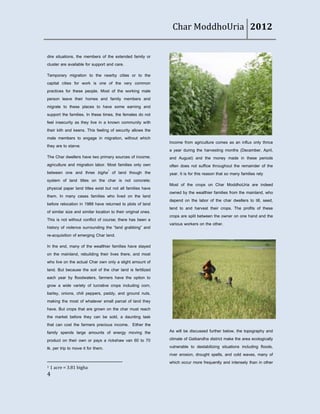
The Char dwellers have two primary sources of income;          and August) and the money made in these periods
agriculture and migration labor. Most families only own        often does not suffice throughout the remainder of the
between one and three bigha1 of land though the                year. It is for this reason that so many families rely
system of land titles on the char is not concrete;
                                                               Most of the crops on Char ModdhoUria are indeed
physical paper land titles exist but not all families have
                                                               owned by the wealthier families from the mainland, who
them. In many cases families who lived on the land
                                                               depend on the labor of the char dwellers to till, seed,
before relocation in 1988 have returned to plots of land
                                                               tend to and harvest their crops. The profits of these
of similar size and similar location to their original ones.
                                                               crops are split between the owner on one hand and the
This is not without conflict of course; there has been a
                                                               various workers on the other.
history of violence surrounding the ‚land grabbing‛ and
re-acquisition of emerging Char land.
In the end, many of the wealthier families have stayed
on the mainland, rebuilding their lives there, and most
who live on the actual Char own only a slight amount of
land. But because the soil of the char land is fertilized
each year by floodwaters, farmers have the option to
grow a wide variety of lucrative crops including corn,
barley, onions, chili peppers, paddy, and ground nuts,
making the most of whatever small parcel of land they
have. But crops that are grown on the char must reach
the market before they can be sold, a daunting task
that can cost the farmers precious income. Either the
family spends large amounts of energy moving the               As will be discussed further below, the topography and
product on their own or pays a rickshaw van 60 to 70           climate of Gaibandha district make the area ecologically
tk. per trip to move it for them.                              vulnerable to destabilizing situations including floods,
                                                               river erosion, drought spells, and cold waves, many of
                                                               which occur more frequently and intensely than in other
1   1 acre = 3.81 bigha
4
Char ModdhoUria 2012


regions of Bangladesh. Aside from this, the local                during monsoon, which damage their homestead,
economy shows little diversification and is heavily              livestock, agriculture crop, livelihood, drinking water
dependent on agriculture. In this setting, local                 availability, sanitation, and health and lowers total
employment is often very limited from September                  capabilities.
through December.                                                Flooding in this area is generally an annual
As the landless and poorest survive on agricultural              phenomenon and often a bi-annual one. Unusual
wage, their opportunities and ensuing incomes drop in            flooding, such as that seen in September and October
this period, and they become trapped in what is locally          of 2005, generated a particular crisis situation that is
called Monga, a cyclical phenomenon of poverty and               considerably worse than that of an average year. The
hunger. In years with particular negative weather                floods destroy household assets, houses as well as
conditions, the period of seasonal unemployment                  standing crops of rice and vegetables. Many of them
expands to more than four months, for example if early           and their families in these situations enter a routine of
floods in August and September destroy part of the               only one poor meal per day, which leads to a state of
recently sownrice crop.                                          chronic malnutrition and starvation.
In this context of vulnerability, seasonal food insecurity       Floods are an expected occurrence, and prior to flood
manifests itself in all three of its dimensions: availability;   season, families try to prepare as much as their funds
access and utilization. The shocks that trigger food             allow them. Kerosene, firewood, and dry foods are
insecurity are usually local natural disasters, aggravated       purchased with extra money, enough to last them up to
by the specific vulnerability that the hard-core poor            15 days. If the water does not revisit and they are left
endure in various economic, social, health, and                  without extra cash, they are forced to visit mainland
governance factors.                                              loan sharks to acquire extra capital at a crippling
                                                                 interest rate. The member of one family recounted how
                                                                 they attempt to save money for preparedness
4. Environmental Threats                                         measures, setting aside 5 or 10 taka each day. But
The Chars are, thus, home to some of the poorest and             when stomachs are rumbling it is all too easy to dig into
most vulnerable people in Bangladesh. These areas are            savings.
particularly prone to the effects of frequent climatic
shocks (floods, drought and cyclones) which increase
the precariousness of poor people’s lives by wiping out
their assets and pushing them deeper into poverty.
Generally four types of flood occur in Bangladesh; a)
Flash flood, b) River flood, c) Rain fed flood, and d)
Flood caused by cyclonic storm surges. Gaibandha
district experiences river floods and rain fed floods
almost every year. Gaibandha is among the most flood
prone areas in the low-lying country as it sits upon the         Families only leave their homes in the worst of the
intensely active Brahmaputra-Jamuna flood plain. The             floods. In the less severe floods they raise their beds
people face riverbank erosion and floodwater inundation          and wait the water out, sometimes living in the water for
                                                                 3 or 4 months straight with no retreat.
5
Char ModdhoUria 2012


Cooking during the flood times is done on portable clay       River erosion is another major threat to the security of
stoves or open fires. For transportation they resort to       char residents. But riverbank erosion cannot be
makeshift vela rafts of jute and banana trunk. The cows       predicted in the way flooding can. Char residents say
and goats that the families keep on their homestead are       that it is very common and has become an integral an
moved onto velas of their own, platforms of grass,            destructive part of their lives. They know how to
hyacinth, and banana stalk.                                   manage it, but in most of the cases they cope with it by
                                                              voluntary displacement.
                                                               The erosion of riverbank is a natural phenomenon,
                                                              occurring when a river gradually changes its course
                                                              through sedimentary plains. It is normally a slow and
                                                              localized process but can become rapid and
                                                              widespread during floods. It can swallow land,
                                                              settlements, crops, all in an instant. Though it seems
                                                              counter intuitive small landowners are actually the
                                                              hardest hit by river erosion on the chars. These small
                                                              scale farmers invest everything in their land, trying to
According to the people; every year flood causes a            make the most of a small plot and hoping for plentiful
huge damage to infrastructure (especially sanitation)         harvests. More wealthy land owners, on the contrary,
and helps spread diarrhea and other water borne               own more land in more areas, and so will not usually
diseases. Raised water levels inundates tube wells and        lose everything in the occasion there is flooding in the
erases fresh groundwater supply, leaving families only        region. There is hardly any household that has not
with the flood water to drink after boiling, wasting          been displaced in this Char. Further, there are some
precious fuel and risking serious illness. Latrines, often    people who have been displaced for more than twenty
shallow, are frequently inundated as well, adding their       times due to riverbank erosion and flooding.
contents to the floodwater. Livestock living on the
                                                              Gaibandha also suffers from heat waves during
makeshift rafts face higher mortality due to water
                                                              summer months, as well as an increasing threat of cold
exposure and reduced availability of fodder, and many
                                                              snaps in the winter. Increased evapo-transpiration
families choose to sell livestock for a less than optimal
                                                              during the heat depletes the moisture from topsoil,
price rather than risk losing the asset all together.
                                                              diminishing organic matter from top soil and dropping
On the Char ModdhoUria, many fortunate families have          the ground water level. Cold snaps in Bangladesh have
elevated their homesteads on built-up plinth to protect       claimed the lives of more than 40 people over the past
their homes and livestock from annual inundation. In          five years, with a number of these deaths occurring in
this way they can secure their assets from normal flood;      Gaibandha district. When the cold hits, straw is
however, this practice cannot protect their homestead         collected to insulate the thin walls of char homes and to
entirely from moderate or severe flooding.                    protect from the cold sand underfoot. Precious cloth is
‘If a house is burnt, it can be recovered but if a house is   also used to insulate the floor. Parental instinct leads
engulfed by river, it cannot be regained’ a local saying      parents and extended family to ensure the warmth of
goes.                                                         children first and the mortality of elderly due to cold is
                                                              far higher than that of any other demographic.

6
Char ModdhoUria 2012


5. IRW and DIPECHO on ModdhoUria
Considering the country’s vulnerability to natural
hazards, six international NGOs in Bangladesh
(ActionAid, Concern Worldwide, Concern Universal,
Islamic Relief Worldwide, Oxfam GB and Plan
Bangladesh) have forged a strategic alliance & formed
a consortium named National Alliance for Risk
Reduction Initiatives in Bangladesh (NARRI) with the
financial assistance of European Commission
Directorate General for Humanitarian Aid & Civil             The presence of SKS on Char ModdhaUria is the first
Protection (ECHO). The NARRI consortium is                   non-governmental work to take place on that specific
implementing the 6th DIPECHO Action Plan in                  char. It is making people aware of their disaster risks
Bangladesh, running from 15 March 2011 to                    and in the same time, trying to make them prepared for
14thSeptember, 2012.                                         the upcoming ones by involving people in different
SKS Foundation, with assistance from Islamic Relief          capacity building activities under the project.
Worldwide, is implementing the DIPECHO VI project in
Gaibandha district, with the aim of enhancing the
resilience of communities vulnerable to natural hazards.
The targeted areas, including Char ModdhoUria, are
very prone to different hazards like flood, river erosion,
cold waves etc. There are number of NGOs working in
the area closely with the aim of reducing vulnerability of
the local people, but these initiatives are not sufficient
for the local communities to improve their resilience and
ultimately improve their economic status. There is a
huge need to do more to complement government and
non-government efforts of increasing awareness and
knowledge on disaster preparedness among                     Effective community preparedness involves both public
communities and institutions in order to save lives and      locations, such as schools, hospitals, markets as well
enable communities to increase their resilience to           as households. Lessons in local schools on disaster
emergencies.                                                 threats and corresponding appropriate responses,
                                                             which are run and funded by DIPECHO, teach students
                                                             and employees about the processes behind
                                                             environmental hazards and how to best cope with their
                                                             initiatives. These people are bringing these new
                                                             knowledge and skill to home, putting them into practice,
                                                             and are playing a crucial role in disseminating
                                                             information.

7
Char ModdhoUria 2012


                                                            around six feet, allowing families to remain in their
                                                            homes when the waters rise. Plinth raising is a crucial
                                                            disaster resistance measure that greatly increases the
                                                            stability of families during floods. With raised plinth
                                                            levels both people and livestock remain safe during
                                                            flood and thus the community resilience to floods
                                                            becomes much higher, releasing some of the stress put
                                                            on finances by other flood resistance techniques or
                                                            migration to the mainland.
DIPECHO has organized Village Disaster Committees           The funding for a particular plinth project is more or
(VDC’s) as a step towards educating Char communities        less split between the NAARI consortium and
about threats and resilience measures. These                community input, as outlined on signs atop each plinth
committees work together to formulate village disaster      project. These interventions are also the scope of short
plans and initiate necessary actions when necessary for     term income generation for the community people as
the betterment of the community especially in regards       well and they are getting at least two hundred taka for
to disasters.                                               minimum forty days. NAARI provides wages for workers
                                                            and technical support, while the community does its
                                                            part by providing land for excavation and working a
                                                            portion of the time unpaid.


In addition to community awareness and preparedness,
DIPECHO is undertaking a number of physical
measures as well in the Char of ModdhoUria like other
target areas. The program emphasizes the aid to at risk     A single plinth project takes between 25 and 30 days to
demographics and prioritizes women, elderly, and            complete, around 15 days of manual labor to
disabled people when selecting its project beneficiaries.   excavating and constructing the plinth and the rest of
These interventions include but not limited to plinth       the time to rebuild homes and livelihoods atop the new
height raising, road repairing, bridge construction, tube   structure. Several measures are taken to ensure the
well and latrine setting, market cum flood shelter          longevity of each plinth. The outslope of each wall is
preparing etc. which will directly address the disaster     constructed as close to a 45 degree angle as possible
risk and reduce the underlying causes of disasters in       so as to reduce erosion of the slope, and various
this area.                                                  grasses are planted as an anchor that binds soil
                                                            together to make the structure stronger. Damper, more
Plinth raising means raising the land beneath clusters
                                                            fertile soil is carried from the pit to the top of the plinth,
of homes above the highest recorded flood level,
8
Char ModdhoUria 2012


then stamped to make it extremely solid. A variety of        have to suffer no more with their household assets,
tree species are planted on top to further the               children, and livestock during the flood season as they
permanence of the plinth.                                    have now the elevated ground of their own, they think.
                                                             Even, they assert that their raised homestead can be
                                                             used as shelter for the other people who have not been
                                                             covered under the project and have not that much
                                                             ability to raise their plinth by their own. And this is how,
                                                             these small scale mitigation activities are making the
                                                             entire community more confident in survival during
                                                             natural disasters.
                                                             Now people at ModdhoUria do not face the nightmare
                                                             of being flooded away. They are planning to have some
                                                             more investment in their homestead; they are planting
The labor for each plinth scheme is split between            trees on the yard, doing homestead gardening and so
workers of different families, effectively spreading the     on. They believe that their days have come back and
benefit of the added income from paid physical labor         now they can move to a collective prosperity.
and attempting to increase community ownership over
the projects.
The implementing agency is directly paying the money
to the house owner who later on distributes it to all the
workers worked for the plinth raising. For the entire
task, a well formulated guideline is being followed and
there is a monitoring framework developed in line with
the guideline. With this framework, every individual
component of this task is being monitored. There is
also a close monitoring by the community people as
well to ensure transparency and quality of the work.
Not only plinth raising, rather the poor vulnerable
people of this Char are being given a complete
package for a safe home with hygiene latrine and safe
tube well. In this regard, the local government has
come up with their support also from their own agenda
and thus extending the combined support to the
community. These people had never even though about
having these facilities of their own but now after getting
all these things they have been confident enough to
cope with the usual flood they face annually. They will


9

Char moddha uria 31 jan 2012

  • 1.
    A Disaster ResilientFuture: Mobilizing Communities and Institutions for Effective Risk Reduction A Case Study on Char ModdhoUria Brief History and Current Disaster Preparedness Efforts Islamic Relief Worldwide House No: 10, Road No: 10 Block-K, Baridhara, Dhaka-1212 Web: www.islamicrelief.com
  • 2.
    Char ModdhoUria 2012 CharModdhoUria January, 2012 Written by, Brad Kless Volunteer for Islamic Relief Worldwide-Bangladesh Quest University Canada M. Mizanur Rahman Programme Officer (Monitoring, Evaluation and Research) Islamic Relief Worldwide-Bangladesh Coordinated by, Niger Dil Nahar Programme Officer (Partnership Development and Capacity Building) Islamic Relief Worldwide-Bangladesh Advised by, Syed Shahnawaz Ali Programme Manager Islamic Relief Worldwide-Bangladesh Photo and design, Brad Kless and M. Mizanur Rahman This document is published under 6th DIPECHO Action Plan for South Asia implemented by Islamic Relief Worldwide working under the NARRI consortium, an alliance for six international NGOs on disaster risk reduction in Bangladesh. The project is implemented with the financial assistance from European Commission Humanitarian Aid and Civil Protection (ECHO) and the views expressed herein should not be taken, in any way, to reflect the official opinion of the European Commission Humanitarian Aid and Civil Protection (ECHO). The information in this document can’t be sold in any manner, but can be used or reproduced with proper acknowledgment of DG ECHO and Islamic Relief Worldwide. 1
  • 3.
    Char ModdhoUria 2012 1.Introduction Life on the watery margins of Bangladesh is a painful balance between prosperity and destruction. Farmers living in the Char ModdhoUria in the district of Gaibandha benefit from some of the country’s richest soil and produce high yields, but the concentration of rivers and tributaries in the area means the residents must cope with an equally high risk of environmental disasters. Every year the water from South Asia's great rivers is funneled down into Bangladesh from India and Tibet, agreements of goodwill, in small government-provided bearing million tons of silt. These are rampant and huts, or camping on roads. Here they resided for up to swollen and also have the power to tear the land this ten years, though the government camps offered little way and that, carving new courses every year, creating more than a place to sleep and there was a constant islands in the rivers only to destroy them in the near possibility that they would be kicked out of their homes. future. Known locally as ‘Chars’, these islands are Without assets of any sort they had no consistent evanescent, difficult to access, and form an extremely income and no opportunities to improve their dynamic environment for more than a half million livelihoods. people trying to make a living despite extreme and Char ModdhoUria appeared again from sediment hazardous conditions of frequent environmental deposited by the Brahmaputra only ten years ago, in pressures. 2001. It took 3-4 years for the Char to regain its fertility, after which families began to move back to it and begin 2. Char History once again farming the rich soil. Previously connected with the mainland, the original ModdhoUria eroded away completely after intense 3. Life on the Char monsoon-season flooding in 1988, the same flood that The homes of the char residents are simple, one room inundated two thirds of the country and claimed the structures constructed almost entirely out of jute stick. lives of over 5000 Bangladeshis. Many of the families Many families can afford to supplement their roofs with that currently live on Char ModdhoUria were residents a tarp under the jute stick; but smaller proportions have of the original land that disappeared more than two the capital to purchase sturdy tin walls or roofs. decades ago. Their ancestors have called the area Food comes from the ground though most of the people home for as long as oral history can recall, at least 500 do not have enough land to produce the grains that can years by many accounts. meet their annual family demand. The poor and When their land was permanently inundated in 1988, marginal farmers suffer the most as there is every families were forced to seek refuge on the earthen dam possibility to that they lose their crop land for river that separates the Brahmaputra from the rest of the erosion or crop due to flood water. People here invest mainland, living on the property of others in tentative 2
  • 4.
    Char ModdhoUria 2012 theirall for cultivating the lands but if it is destroyed, Transportation is a constant obstacle for char residents; their sufferings know no bounds. markets, hospitals and schools are a world away across the river or its sandy bed and the roads on the Water comes from shared tube wells and is consumed mainland are already narrow and rough. On the Char unfiltered and unboiled. The ground water level on the itself there are no real roads, only narrow paths Char sits below fifty feet and sometimes the tube wells between fields across which men push vans and produce no water at all and crops go un-irrigated. bicycles or carry heavy loads of rice and barley. For Kitchens, which often symbolize social status in five months of the year the Brahmaputra moves quickly Bangladesh, are at ground level outdoors or in small and at full capacity, making necessary trips to the external shelters where traditional stoves are built into mainland is even tougher except when people can the ground, small pits with three knobs uplifted to hold manage a boat. Owning no boat of their own, people vessels. The women burn jute stick and cow dung to wishing to cross the river must pay the fare of private heat blackened and cracked pots, cooking the typical ferry owners. daily meals of rice and vegetables with fish, eggs, or Medical facilities are obviously hard to reach, and meat enjoyed only a few times a month if at all. The doctors rarely make visit to the Char. Because there is river does contain fish, though the quantity has dropped no easily available transportation for patients to the sharply in recent years and many families cannot spare infirmaries and hospitals, the families are often forced funds for even fishing net. to attach a chair to bamboo poles and physically carry the ill person across the Char, across the river, and across the mainland almost ten kilometers to the nearest medical facility. When the patient is very sick the whole bed is sometimes carried by two people. In homestead gardens families grow beets, bottle gourds, pumpkin, radishes, and the occasional cucumber. In addition to growing their own vegetables, char dwellers sometimes keep chickens, goats or pigeons, though these are usually sold to purchase Most homes on the char are arranged into, with three to extra vegetables instead of consumed by the families upwards of twenty families to a group. Often families in that raise them. Many also keep cows as per an these communal arrangements are blood related in arrangement with owners on the mainland. They some way or another, though this is not always the receive the cows when they are young and rear them, case. There are a number of factors that make living in feeding them as well as benefitting from their milk. such clusters beneficial. When one family is struck with Then when the cow is grown enough to be sold, the illness, threatened by natural disaster, or faces other profits are split with the owner. 3
  • 5.
    Char ModdhoUria 2012 diresituations, the members of the extended family or cluster are available for support and care. Temporary migration to the nearby cities or to the capital cities for work is one of the very common practices for these people. Most of the working male person leave their homes and family members and migrate to these places to have some earning and support the families. In these times, the females do not feel insecurity as they live in a known community with their kith and keens. This feeling of security allows the male members to engage in migration, without which Income from agriculture comes as an influx only thrice they are to starve. a year during the harvesting months (December, April, The Char dwellers have two primary sources of income; and August) and the money made in these periods agriculture and migration labor. Most families only own often does not suffice throughout the remainder of the between one and three bigha1 of land though the year. It is for this reason that so many families rely system of land titles on the char is not concrete; Most of the crops on Char ModdhoUria are indeed physical paper land titles exist but not all families have owned by the wealthier families from the mainland, who them. In many cases families who lived on the land depend on the labor of the char dwellers to till, seed, before relocation in 1988 have returned to plots of land tend to and harvest their crops. The profits of these of similar size and similar location to their original ones. crops are split between the owner on one hand and the This is not without conflict of course; there has been a various workers on the other. history of violence surrounding the ‚land grabbing‛ and re-acquisition of emerging Char land. In the end, many of the wealthier families have stayed on the mainland, rebuilding their lives there, and most who live on the actual Char own only a slight amount of land. But because the soil of the char land is fertilized each year by floodwaters, farmers have the option to grow a wide variety of lucrative crops including corn, barley, onions, chili peppers, paddy, and ground nuts, making the most of whatever small parcel of land they have. But crops that are grown on the char must reach the market before they can be sold, a daunting task that can cost the farmers precious income. Either the family spends large amounts of energy moving the As will be discussed further below, the topography and product on their own or pays a rickshaw van 60 to 70 climate of Gaibandha district make the area ecologically tk. per trip to move it for them. vulnerable to destabilizing situations including floods, river erosion, drought spells, and cold waves, many of which occur more frequently and intensely than in other 1 1 acre = 3.81 bigha 4
  • 6.
    Char ModdhoUria 2012 regionsof Bangladesh. Aside from this, the local during monsoon, which damage their homestead, economy shows little diversification and is heavily livestock, agriculture crop, livelihood, drinking water dependent on agriculture. In this setting, local availability, sanitation, and health and lowers total employment is often very limited from September capabilities. through December. Flooding in this area is generally an annual As the landless and poorest survive on agricultural phenomenon and often a bi-annual one. Unusual wage, their opportunities and ensuing incomes drop in flooding, such as that seen in September and October this period, and they become trapped in what is locally of 2005, generated a particular crisis situation that is called Monga, a cyclical phenomenon of poverty and considerably worse than that of an average year. The hunger. In years with particular negative weather floods destroy household assets, houses as well as conditions, the period of seasonal unemployment standing crops of rice and vegetables. Many of them expands to more than four months, for example if early and their families in these situations enter a routine of floods in August and September destroy part of the only one poor meal per day, which leads to a state of recently sownrice crop. chronic malnutrition and starvation. In this context of vulnerability, seasonal food insecurity Floods are an expected occurrence, and prior to flood manifests itself in all three of its dimensions: availability; season, families try to prepare as much as their funds access and utilization. The shocks that trigger food allow them. Kerosene, firewood, and dry foods are insecurity are usually local natural disasters, aggravated purchased with extra money, enough to last them up to by the specific vulnerability that the hard-core poor 15 days. If the water does not revisit and they are left endure in various economic, social, health, and without extra cash, they are forced to visit mainland governance factors. loan sharks to acquire extra capital at a crippling interest rate. The member of one family recounted how they attempt to save money for preparedness 4. Environmental Threats measures, setting aside 5 or 10 taka each day. But The Chars are, thus, home to some of the poorest and when stomachs are rumbling it is all too easy to dig into most vulnerable people in Bangladesh. These areas are savings. particularly prone to the effects of frequent climatic shocks (floods, drought and cyclones) which increase the precariousness of poor people’s lives by wiping out their assets and pushing them deeper into poverty. Generally four types of flood occur in Bangladesh; a) Flash flood, b) River flood, c) Rain fed flood, and d) Flood caused by cyclonic storm surges. Gaibandha district experiences river floods and rain fed floods almost every year. Gaibandha is among the most flood prone areas in the low-lying country as it sits upon the Families only leave their homes in the worst of the intensely active Brahmaputra-Jamuna flood plain. The floods. In the less severe floods they raise their beds people face riverbank erosion and floodwater inundation and wait the water out, sometimes living in the water for 3 or 4 months straight with no retreat. 5
  • 7.
    Char ModdhoUria 2012 Cookingduring the flood times is done on portable clay River erosion is another major threat to the security of stoves or open fires. For transportation they resort to char residents. But riverbank erosion cannot be makeshift vela rafts of jute and banana trunk. The cows predicted in the way flooding can. Char residents say and goats that the families keep on their homestead are that it is very common and has become an integral an moved onto velas of their own, platforms of grass, destructive part of their lives. They know how to hyacinth, and banana stalk. manage it, but in most of the cases they cope with it by voluntary displacement. The erosion of riverbank is a natural phenomenon, occurring when a river gradually changes its course through sedimentary plains. It is normally a slow and localized process but can become rapid and widespread during floods. It can swallow land, settlements, crops, all in an instant. Though it seems counter intuitive small landowners are actually the hardest hit by river erosion on the chars. These small scale farmers invest everything in their land, trying to According to the people; every year flood causes a make the most of a small plot and hoping for plentiful huge damage to infrastructure (especially sanitation) harvests. More wealthy land owners, on the contrary, and helps spread diarrhea and other water borne own more land in more areas, and so will not usually diseases. Raised water levels inundates tube wells and lose everything in the occasion there is flooding in the erases fresh groundwater supply, leaving families only region. There is hardly any household that has not with the flood water to drink after boiling, wasting been displaced in this Char. Further, there are some precious fuel and risking serious illness. Latrines, often people who have been displaced for more than twenty shallow, are frequently inundated as well, adding their times due to riverbank erosion and flooding. contents to the floodwater. Livestock living on the Gaibandha also suffers from heat waves during makeshift rafts face higher mortality due to water summer months, as well as an increasing threat of cold exposure and reduced availability of fodder, and many snaps in the winter. Increased evapo-transpiration families choose to sell livestock for a less than optimal during the heat depletes the moisture from topsoil, price rather than risk losing the asset all together. diminishing organic matter from top soil and dropping On the Char ModdhoUria, many fortunate families have the ground water level. Cold snaps in Bangladesh have elevated their homesteads on built-up plinth to protect claimed the lives of more than 40 people over the past their homes and livestock from annual inundation. In five years, with a number of these deaths occurring in this way they can secure their assets from normal flood; Gaibandha district. When the cold hits, straw is however, this practice cannot protect their homestead collected to insulate the thin walls of char homes and to entirely from moderate or severe flooding. protect from the cold sand underfoot. Precious cloth is ‘If a house is burnt, it can be recovered but if a house is also used to insulate the floor. Parental instinct leads engulfed by river, it cannot be regained’ a local saying parents and extended family to ensure the warmth of goes. children first and the mortality of elderly due to cold is far higher than that of any other demographic. 6
  • 8.
    Char ModdhoUria 2012 5.IRW and DIPECHO on ModdhoUria Considering the country’s vulnerability to natural hazards, six international NGOs in Bangladesh (ActionAid, Concern Worldwide, Concern Universal, Islamic Relief Worldwide, Oxfam GB and Plan Bangladesh) have forged a strategic alliance & formed a consortium named National Alliance for Risk Reduction Initiatives in Bangladesh (NARRI) with the financial assistance of European Commission Directorate General for Humanitarian Aid & Civil The presence of SKS on Char ModdhaUria is the first Protection (ECHO). The NARRI consortium is non-governmental work to take place on that specific implementing the 6th DIPECHO Action Plan in char. It is making people aware of their disaster risks Bangladesh, running from 15 March 2011 to and in the same time, trying to make them prepared for 14thSeptember, 2012. the upcoming ones by involving people in different SKS Foundation, with assistance from Islamic Relief capacity building activities under the project. Worldwide, is implementing the DIPECHO VI project in Gaibandha district, with the aim of enhancing the resilience of communities vulnerable to natural hazards. The targeted areas, including Char ModdhoUria, are very prone to different hazards like flood, river erosion, cold waves etc. There are number of NGOs working in the area closely with the aim of reducing vulnerability of the local people, but these initiatives are not sufficient for the local communities to improve their resilience and ultimately improve their economic status. There is a huge need to do more to complement government and non-government efforts of increasing awareness and knowledge on disaster preparedness among Effective community preparedness involves both public communities and institutions in order to save lives and locations, such as schools, hospitals, markets as well enable communities to increase their resilience to as households. Lessons in local schools on disaster emergencies. threats and corresponding appropriate responses, which are run and funded by DIPECHO, teach students and employees about the processes behind environmental hazards and how to best cope with their initiatives. These people are bringing these new knowledge and skill to home, putting them into practice, and are playing a crucial role in disseminating information. 7
  • 9.
    Char ModdhoUria 2012 around six feet, allowing families to remain in their homes when the waters rise. Plinth raising is a crucial disaster resistance measure that greatly increases the stability of families during floods. With raised plinth levels both people and livestock remain safe during flood and thus the community resilience to floods becomes much higher, releasing some of the stress put on finances by other flood resistance techniques or migration to the mainland. DIPECHO has organized Village Disaster Committees The funding for a particular plinth project is more or (VDC’s) as a step towards educating Char communities less split between the NAARI consortium and about threats and resilience measures. These community input, as outlined on signs atop each plinth committees work together to formulate village disaster project. These interventions are also the scope of short plans and initiate necessary actions when necessary for term income generation for the community people as the betterment of the community especially in regards well and they are getting at least two hundred taka for to disasters. minimum forty days. NAARI provides wages for workers and technical support, while the community does its part by providing land for excavation and working a portion of the time unpaid. In addition to community awareness and preparedness, DIPECHO is undertaking a number of physical measures as well in the Char of ModdhoUria like other target areas. The program emphasizes the aid to at risk A single plinth project takes between 25 and 30 days to demographics and prioritizes women, elderly, and complete, around 15 days of manual labor to disabled people when selecting its project beneficiaries. excavating and constructing the plinth and the rest of These interventions include but not limited to plinth the time to rebuild homes and livelihoods atop the new height raising, road repairing, bridge construction, tube structure. Several measures are taken to ensure the well and latrine setting, market cum flood shelter longevity of each plinth. The outslope of each wall is preparing etc. which will directly address the disaster constructed as close to a 45 degree angle as possible risk and reduce the underlying causes of disasters in so as to reduce erosion of the slope, and various this area. grasses are planted as an anchor that binds soil together to make the structure stronger. Damper, more Plinth raising means raising the land beneath clusters fertile soil is carried from the pit to the top of the plinth, of homes above the highest recorded flood level, 8
  • 10.
    Char ModdhoUria 2012 thenstamped to make it extremely solid. A variety of have to suffer no more with their household assets, tree species are planted on top to further the children, and livestock during the flood season as they permanence of the plinth. have now the elevated ground of their own, they think. Even, they assert that their raised homestead can be used as shelter for the other people who have not been covered under the project and have not that much ability to raise their plinth by their own. And this is how, these small scale mitigation activities are making the entire community more confident in survival during natural disasters. Now people at ModdhoUria do not face the nightmare of being flooded away. They are planning to have some more investment in their homestead; they are planting The labor for each plinth scheme is split between trees on the yard, doing homestead gardening and so workers of different families, effectively spreading the on. They believe that their days have come back and benefit of the added income from paid physical labor now they can move to a collective prosperity. and attempting to increase community ownership over the projects. The implementing agency is directly paying the money to the house owner who later on distributes it to all the workers worked for the plinth raising. For the entire task, a well formulated guideline is being followed and there is a monitoring framework developed in line with the guideline. With this framework, every individual component of this task is being monitored. There is also a close monitoring by the community people as well to ensure transparency and quality of the work. Not only plinth raising, rather the poor vulnerable people of this Char are being given a complete package for a safe home with hygiene latrine and safe tube well. In this regard, the local government has come up with their support also from their own agenda and thus extending the combined support to the community. These people had never even though about having these facilities of their own but now after getting all these things they have been confident enough to cope with the usual flood they face annually. They will 9