Chapter 07
Promotion
Importance of Promotion
• Modern marketing calls for more than just developing a good
product, pricing it attractively, and making it available to target
customers.
• Companies must also communicate with their customers, and
what they communicate should not be left to chance.
• To communicate well, companies often hire:
• advertising agencies to develop effective ads,
• sales promotion specialists to design sales-incentive programs,
• direct-marketing specialists to develop databases and interact with
customers and prospects by mail and telephone, and
• public relations firms to develop corporate images
What is Promotion Mix??
• It is a company's total marketing communications mix which
consists of the following:
• Advertising — Any paid form of non-personal presentation and promotion
of ideas, goods or services by an identified sponsor.
• Personal selling — Oral presentation in a conversation with one or more
prospective purchasers for the purpose of making sales and building
customer relationships.
• Sales promotion — Short-term incentives to encourage the purchase or
sale of a product or service.
• Public relations — Building good relations with the company's various
publics by obtaining favorable publicity, building up a good 'corporate
image, and handling or heading off unfavorable rumors, stories and
events
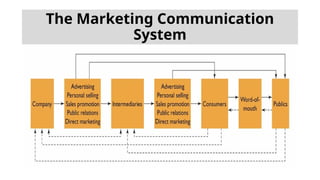
The Marketing Communication
System
Steps in Developing Effective
Communication
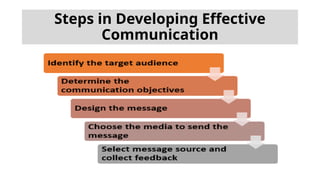
• Identifying the Target Audience
• A marketing communicator starts with a clear target audience in mind. The
audience may be potential buyers or current users, those who make the buying
decision or those who influence it.
• The target audience will heavily affect the communicator's decisions on 'what will
be said, how it will be said, when it will he said, where it will be said and who will
say it.
• Determining the Communication Objectives
• Once the target audience has been defined, the marketing communicator must
decide what response is sought. Of course, in many cases, the final response is
purchase. But purchase is the result of a long process of consumer decision
making.
• The marketing communicator needs to know where the target audience now
stands and to what state it needs to be moved. To do this, he or she must
determine whether or not the customer is ready to buy.
• Designing a Message
• Having defined the desired audience response, the communicator turns to
developing an effective message. Ideally, the message should get Attention, hold
interest, arouse Desire and obtain Action.
• In putting the message together, the marketing communicator must decide what to
say (message content) and how to say it (message structure and format).
• Selecting the Message Source
• Messages delivered by highly credible sources are more persuasive. Pharmaceutical
firms want doctors to tell about their products' benefits because doctors rank high
on expertise in their field, so they have high credibility.
• Many food companies promote to doctors, dentists and other healthcare experts to
motivate these professionals to recommend their products to patients.
Steps in Developing Effective
Communication
• Choosing Media
• Personal communication channels
• It refers to two or more people communicate directly with each other.
They might communicate face to face, over the telephone, through
the mail or even through an internet 'chat'.
• Non-personal communication channels
• It denotes the media that carry messages without personal contact or
feedback.
• They include major media, atmospheres and events. Important media
consists of print media (newspapers, magazines, direct mail);
broadcast media (radio, television); and display media (billboards,
signs, posters).
Steps in Developing Effective
Communication
• Collecting Feedback
• After sending the message, the communicator must research its
effect on the target audience.
• This involves asking the target audience members whether they
remember the message, how many times they saw it, what points
they recall, how they felt about the message, and their past and
present attitudes towards the product and company.
• The communicator would also like to measure behavior resulting
in the message - how many people bought a product, talked to
others about it or visited the store.
Steps in Developing Effective
Communication
Steps in Developing Effective
Communication
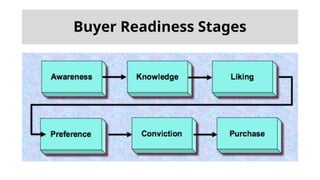
Buyer Readiness Stages

Chapter7-1.pptx Marketing chapter 7-1.000

  • 1.
  • 2.
    Importance of Promotion •Modern marketing calls for more than just developing a good product, pricing it attractively, and making it available to target customers. • Companies must also communicate with their customers, and what they communicate should not be left to chance. • To communicate well, companies often hire: • advertising agencies to develop effective ads, • sales promotion specialists to design sales-incentive programs, • direct-marketing specialists to develop databases and interact with customers and prospects by mail and telephone, and • public relations firms to develop corporate images
  • 3.
    What is PromotionMix?? • It is a company's total marketing communications mix which consists of the following: • Advertising — Any paid form of non-personal presentation and promotion of ideas, goods or services by an identified sponsor. • Personal selling — Oral presentation in a conversation with one or more prospective purchasers for the purpose of making sales and building customer relationships. • Sales promotion — Short-term incentives to encourage the purchase or sale of a product or service. • Public relations — Building good relations with the company's various publics by obtaining favorable publicity, building up a good 'corporate image, and handling or heading off unfavorable rumors, stories and events
  • 4.
  • 5.
    Steps in DevelopingEffective Communication • Identifying the Target Audience • A marketing communicator starts with a clear target audience in mind. The audience may be potential buyers or current users, those who make the buying decision or those who influence it. • The target audience will heavily affect the communicator's decisions on 'what will be said, how it will be said, when it will he said, where it will be said and who will say it. • Determining the Communication Objectives • Once the target audience has been defined, the marketing communicator must decide what response is sought. Of course, in many cases, the final response is purchase. But purchase is the result of a long process of consumer decision making. • The marketing communicator needs to know where the target audience now stands and to what state it needs to be moved. To do this, he or she must determine whether or not the customer is ready to buy.
  • 6.
    • Designing aMessage • Having defined the desired audience response, the communicator turns to developing an effective message. Ideally, the message should get Attention, hold interest, arouse Desire and obtain Action. • In putting the message together, the marketing communicator must decide what to say (message content) and how to say it (message structure and format). • Selecting the Message Source • Messages delivered by highly credible sources are more persuasive. Pharmaceutical firms want doctors to tell about their products' benefits because doctors rank high on expertise in their field, so they have high credibility. • Many food companies promote to doctors, dentists and other healthcare experts to motivate these professionals to recommend their products to patients. Steps in Developing Effective Communication
  • 7.
    • Choosing Media •Personal communication channels • It refers to two or more people communicate directly with each other. They might communicate face to face, over the telephone, through the mail or even through an internet 'chat'. • Non-personal communication channels • It denotes the media that carry messages without personal contact or feedback. • They include major media, atmospheres and events. Important media consists of print media (newspapers, magazines, direct mail); broadcast media (radio, television); and display media (billboards, signs, posters). Steps in Developing Effective Communication
  • 8.
    • Collecting Feedback •After sending the message, the communicator must research its effect on the target audience. • This involves asking the target audience members whether they remember the message, how many times they saw it, what points they recall, how they felt about the message, and their past and present attitudes towards the product and company. • The communicator would also like to measure behavior resulting in the message - how many people bought a product, talked to others about it or visited the store. Steps in Developing Effective Communication
  • 9.
    Steps in DevelopingEffective Communication
  • 10.