Chapter 2: Anatomy of the
Problem
•Recent terrorist attacks and the raise in
cyber attacks have raised concern about
the need to protect the nation’s cyber
infrastructure
•The big and most recent ones like:
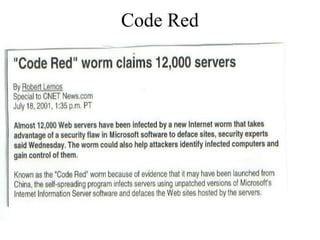
Code Red
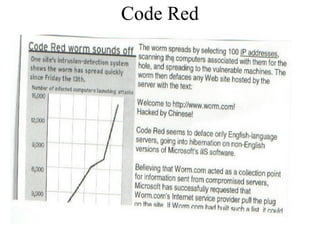
Code Red
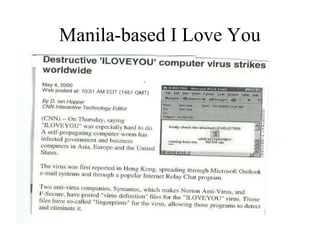
Manila-based I Love You
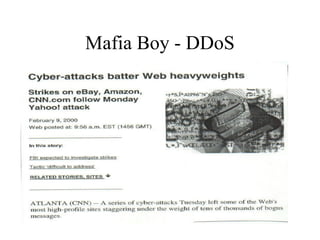
Mafia Boy - DDoS
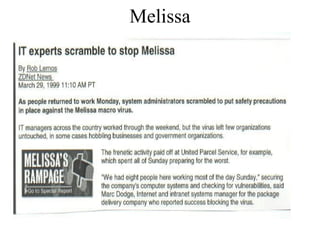
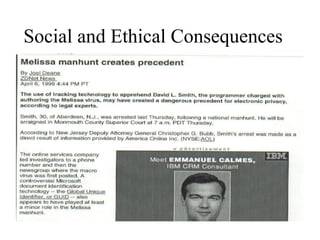
Melissa
Melissa
Daily alerts from the tech people

• Almost every day at work you are
  reminded by the people in the tech support
  office of a virus on the loose.
Will there ever be an end to these?
  • Cyberspace infrastructure and
    communication protocols are inherently
    weak
  • The average user in cyberspace has very
    limited knowledge of the computer network
    infrastructure, its weaknesses and gapping
    loopholes.
  • Society, as a whole, is increasingly
    becoming irreversibly dependent on an
    infrastructure and technology that it
    least understands.
• There are no long-term, let alone immediate
  plans and mechanism in place or planned to
  educate the public.
• There is a high degree of compliancy in a
  society that still accords a "Wiz Kid" status to
  cyberspace vandals
• The only known remedy mechanisms and solutions
  to the problem are patching loopholes after an attack
  has occurred.
• The price of this escalating problem is yet to be
  known.
• Reporting is voluntary, haphazard, and quite often
  at will.
• The nation is yet to understand the seriousness
  of cyber vandalism.
What are the causes?
• Vendetta/Revenge
       • Demonstrations at World Trade Organization (WTO) in
         Seattle, Washington, the World Bank and the
         International Monetary Fund in Washington, D.C.,
         Prague, Hungry, and Geneo Italy – against globalization.
• Joke/Hoax/Prank
• The Hacker's Ethics
       • All information should be free
•   Terrorism
•   Political and Military Espionage
•   Business ( Competition) Espionage
•   Hate (national origin, gender, and race)
•   Personal gain/Fame/Fun/Notoriety
•   Ignorance
Challenges in Tracking Cyber
Criminals
• Nearly in all countries there is no required
  reporting mechanism in government
  agencies, even the private sector, to detect
  intrusions and report such intrusions
• In the private sector, there is very little
  interest in reporting of any system related
  intrusions. This is a result of the fear of
  marketplace forces that would expose
  management’s weaknesses to the
  shareholder community and competitors.
• There is no adequate enforcement of
  existing reporting mechanisms
• The insider effect, it is reported in some
  studies that most e-attacks are generated
  and started by inside employees. This
  makes the job of detection and reporting
  very murky. It is like having an arsonist
  working in the fire department
• Many nations have no required and trained
  security agencies to fight e-attacks.
Social and Ethical Consequences
• Psychological effects – these include hate
  and joke especially on an individual.
   – may lead to individual reclusion,
   – increasing isolation, and such trends may lead to
     dangerous and costly repercussions on the
     individual, corporations and society as a whole.
• Moral decay – There is a moral imperative in all
  our actions. When human actions, whether bad or
  good, become so frequent, they create a level of
  familiarity that leads to acceptance as “normal”. This
   type of acceptance of actions formerly viewed as
  immoral and bad by society lead to moral decay.
• Loss of privacy – After an attack, there is usually an
  over reaction and a resurgence in the need for quick
  solutions to the problem that seems to have hit
  home. Many businesses are responding with patches,
  filters, ID tools, and a whole list of “solutions”.
      • profile scanners and straight email scanners like Echlon. Echlon
        is a high-tech U.S. government spying software housed in
        England. It is capable of scanning millions of emails given
        specific keywords.
      • Tracking technology to lead to virus writers.
• Trust – Along with privacy lost, is trust lost.
  Individuals once attacked, lose trust in a person,
  group, company or anything else believed to be the
  source of the attack or believed to be unable to stop
  the attack.

Chapter2

  • 1.
    Chapter 2: Anatomyof the Problem •Recent terrorist attacks and the raise in cyber attacks have raised concern about the need to protect the nation’s cyber infrastructure •The big and most recent ones like:
  • 2.
  • 3.
  • 4.
  • 6.
  • 7.
  • 8.
  • 9.
    Daily alerts fromthe tech people • Almost every day at work you are reminded by the people in the tech support office of a virus on the loose.
  • 10.
    Will there everbe an end to these? • Cyberspace infrastructure and communication protocols are inherently weak • The average user in cyberspace has very limited knowledge of the computer network infrastructure, its weaknesses and gapping loopholes. • Society, as a whole, is increasingly becoming irreversibly dependent on an infrastructure and technology that it least understands.
  • 11.
    • There areno long-term, let alone immediate plans and mechanism in place or planned to educate the public. • There is a high degree of compliancy in a society that still accords a "Wiz Kid" status to cyberspace vandals • The only known remedy mechanisms and solutions to the problem are patching loopholes after an attack has occurred. • The price of this escalating problem is yet to be known. • Reporting is voluntary, haphazard, and quite often at will. • The nation is yet to understand the seriousness of cyber vandalism.
  • 12.
    What are thecauses? • Vendetta/Revenge • Demonstrations at World Trade Organization (WTO) in Seattle, Washington, the World Bank and the International Monetary Fund in Washington, D.C., Prague, Hungry, and Geneo Italy – against globalization. • Joke/Hoax/Prank • The Hacker's Ethics • All information should be free • Terrorism • Political and Military Espionage • Business ( Competition) Espionage • Hate (national origin, gender, and race) • Personal gain/Fame/Fun/Notoriety • Ignorance
  • 13.
    Challenges in TrackingCyber Criminals • Nearly in all countries there is no required reporting mechanism in government agencies, even the private sector, to detect intrusions and report such intrusions • In the private sector, there is very little interest in reporting of any system related intrusions. This is a result of the fear of marketplace forces that would expose management’s weaknesses to the shareholder community and competitors.
  • 14.
    • There isno adequate enforcement of existing reporting mechanisms • The insider effect, it is reported in some studies that most e-attacks are generated and started by inside employees. This makes the job of detection and reporting very murky. It is like having an arsonist working in the fire department • Many nations have no required and trained security agencies to fight e-attacks.
  • 15.
    Social and EthicalConsequences
  • 16.
    • Psychological effects– these include hate and joke especially on an individual. – may lead to individual reclusion, – increasing isolation, and such trends may lead to dangerous and costly repercussions on the individual, corporations and society as a whole. • Moral decay – There is a moral imperative in all our actions. When human actions, whether bad or good, become so frequent, they create a level of familiarity that leads to acceptance as “normal”. This type of acceptance of actions formerly viewed as immoral and bad by society lead to moral decay.
  • 17.
    • Loss ofprivacy – After an attack, there is usually an over reaction and a resurgence in the need for quick solutions to the problem that seems to have hit home. Many businesses are responding with patches, filters, ID tools, and a whole list of “solutions”. • profile scanners and straight email scanners like Echlon. Echlon is a high-tech U.S. government spying software housed in England. It is capable of scanning millions of emails given specific keywords. • Tracking technology to lead to virus writers. • Trust – Along with privacy lost, is trust lost. Individuals once attacked, lose trust in a person, group, company or anything else believed to be the source of the attack or believed to be unable to stop the attack.