Chapter 1 - Meaning of
Marriage & Family
Used by permission of
THE ACADEMY OF NURSING
2355 E. 3900 S.
S.L.C., UT 84124
801-506-0064
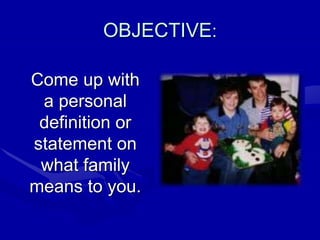
OBJECTIVE:
Come up with
a personal
definition or
statement on
what family
means to you.
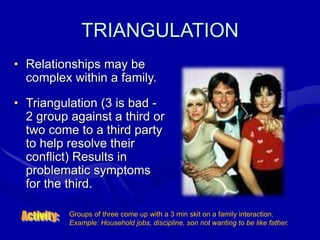
TRIANGULATION
• Relationships may be
complex within a family.
• Triangulation (3 is bad -
2 group against a third or
two come to a third party
to help resolve their
conflict) Results in
problematic symptoms
for the third.
Groups of three come up with a 3 min skit on a family interaction.
Example: Household jobs, discipline, son not wanting to be like father.
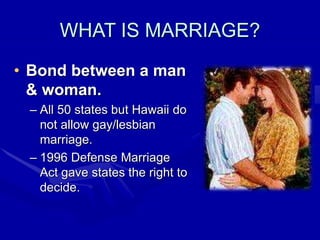
WHAT IS MARRIAGE?
• Bond between a man
& woman.
– All 50 states but Hawaii do
not allow gay/lesbian
marriage.
– 1996 Defense Marriage
Act gave states the right to
decide.
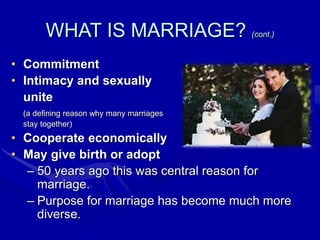
WHAT IS MARRIAGE? (cont.)
• Commitment
• Intimacy and sexually
unite
(a defining reason why many marriages
stay together)
• Cooperate economically
• May give birth or adopt
– 50 years ago this was central reason for
marriage.
– Purpose for marriage has become much more
diverse.
WHAT IS MARRIAGE? (continued)
• Book’s definition: Legal union
between a man & woman, united
sexually, cooperate economically,
and may have children.
• Benefits: Live longer, healthier,
fewer accidents.
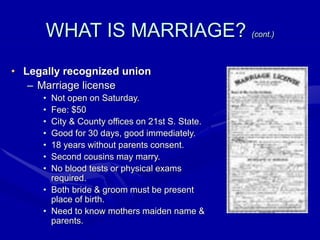
WHAT IS MARRIAGE? (cont.)
• Legally recognized union
– Marriage license
• Not open on Saturday.
• Fee: $50
• City & County offices on 21st S. State.
• Good for 30 days, good immediately.
• 18 years without parents consent.
• Second cousins may marry.
• No blood tests or physical exams
required.
• Both bride & groom must be present
place of birth.
• Need to know mothers maiden name &
parents.
CULTURE DEFINES WHAT A
MARRIAGE IS OR NOT
• Monogamy - one man, one woman. All 1st
world countries are monogamous.
• Polygamy - more than one wife or husband.
Example: Islam & Fundamental Mormons
• Bigamy – Marrying another person while still
married to someone else. It is against the law.
• Serial Monogamy or Modified Polygamy –
Succession of marriages over time. Typical of
US marriages.
MEDIA
ARE WE IMMERSED IN IT?
MEDIA
ARE WE IMMERSED IN IT?
• Everyone’s view of marriage is somewhat
distorted. No other family is exactly like your
family. But our family is not the only one we
"know."
• Popular Culture constructions or TV & movies
gives us privy to intimacies and conflicts which
are usually not acceptable public behaviors.
Discuss the PROs and CONs of TELEVISION.
CULTIVATION THEORY
• Cultivation theory: These consistent
themes, images, and stereo types that cut
across programming genres cultivate or
form world views.
– People who watch more than the average
amount of media are more likely to mistake
the media world for the real world.
• Average family has the TV on 7 hours a day.
• Average person watches 4 hours per day.
• Average person will spend 10 years of their life
watching TV.
PROS OF TV:
• Opens up the world to us.
• Communicates instantly what is
happening.
• Less prejudice, we see other cultures.
• Children learn from parents era and vice
versa.
• Families watch TV together.
• Gives more meaning to life to elderly.
• Entertaining – novelty in a box.
CONS OF TV:
• Shallow communication about wealth, races,
sex.
• We trust each other less.
• Spend less time being citizens and with families.
• Children bored with school due to razzel dazzel
of TV – shorten attention span.
• Freezes images in our mind (Sept 11).
• Speeds up time (ER, NYPD, Friends).
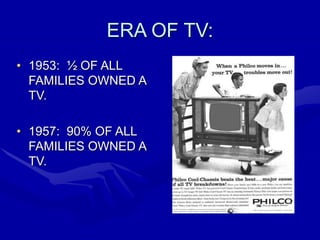
ERA OF TV:
• 1953: ½ OF ALL
FAMILIES OWNED A
TV.
• 1957: 90% OF ALL
FAMILIES OWNED A
TV.
ERA OF TV (cont.)
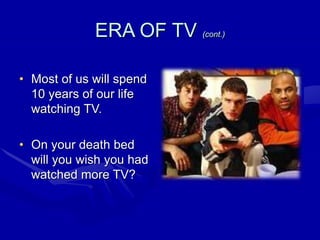
• Most of us will spend
10 years of our life
watching TV.
• On your death bed
will you wish you had
watched more TV?
ACTIVITY:
• Divide into 6 groups and each discuss one
of the following as to how it is portrayed on
TV
– Crime
– Sex
– Conflict and problems in families
– Men & Women
– Races
– Single parent families
HOW DOES MEDIA PORTRAY
AMOUNTS OF CRIME?
HOW DOES MEDIA PORTRAY
AMOUNTS OF CRIME?
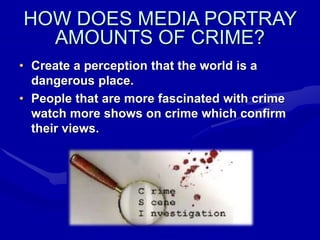
• Create a perception that the world is a
dangerous place.
• People that are more fascinated with crime
watch more shows on crime which confirm
their views.
HOW DOES MEDIA
PORTRAY SEX?
HOW DOES MEDIA
PORTRAY SEX?
• Sex acts like extramarital affairs, premarital,
rape, prostitution appears to happen 4x more
frequently than they really do.
• Physical beauty and appearances are extremely
important.
• Rarely see anything on birth control.
• Rarely see loving marital sex.
HOW DOES MEDIA PORTRAY
CONFLICT & PROBLEMS
IN FAMILIES?
HOW DOES MEDIA PORTRAY
CONFLICT & PROBLEMS
IN FAMILIES?
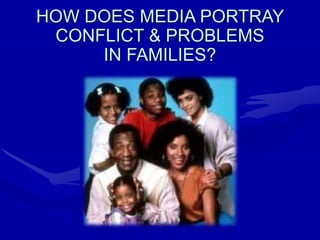
• Love will conquer all.
• 30 minutes can resolve any problem.
• Usually solved with manipulation or humor.
• Divorce is rare & a trend towards non traditional
families.
• Total omission of household chores which is a
huge source of conflict.
• Life is much less complicated than in reality.
– Rarely see divorce, unemployment, chronic illness,
death, poverty, caring for elderly.
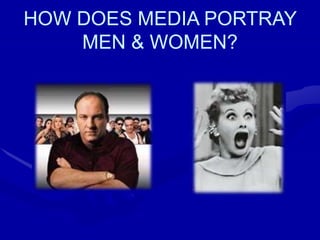
HOW DOES MEDIA PORTRAY
MEN & WOMEN?
HOW DOES MEDIA PORTRAY
MEN & WOMEN?
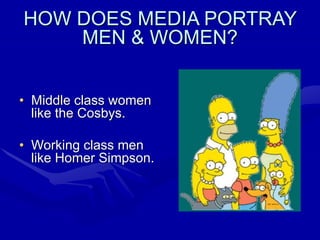
• Middle class women
like the Cosbys.
• Working class men
like Homer Simpson.
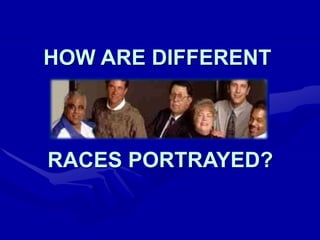
HOW ARE DIFFERENT
RACES PORTRAYED?
HOW ARE DIFFERENT
RACES PORTRAYED?
• Whites over represented.
• Blacks improving.
• Perpetuates racism.
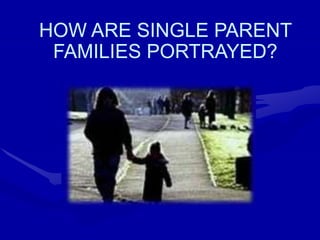
HOW ARE SINGLE PARENT
FAMILIES PORTRAYED?
HOW ARE SINGLE PARENT
FAMILIES PORTRAYED?
• Fathers head household 5x as often.
• Single women want to marry & single men
enjoy their freedom.
• The reality is single father remarry more
often than women.
• Step families have harmony or solve a
problem in a single episode.
• Affiliated kin shown as families.
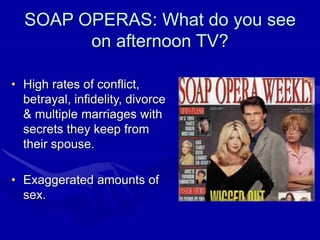
SOAP OPERAS: What do you see
on afternoon TV?
• High rates of conflict,
betrayal, infidelity, divorce
& multiple marriages with
secrets they keep from
their spouse.
• Exaggerated amounts of
sex.
TALK SHOWS:
TALK SHOWS:
• Group therapy for the masses that everyone can
afford.
• Primary purpose is to entertain or raise the
rating. Definite difference in scholarly research
whose primary purpose is to gain knowledge.
• Topics are high interest or shocking materials to
attract an audience.
WE ARE IMMERSED IN THE
MEDIA!
WHAT CAN WE DO?
• To keep from being used?
• To keep from being manipulated?
• To keep from being negatively influenced?
• To keep the media from displacing the
family, education, or religion in our lives?
ADVICE:
• Be skeptical.
• Search for biases, stereotypes, and lack of
objectivity.
• Look for moralizing. What are the underlying
values?
• Go to the original source and see how valid they
are.
• Seek additional information. The whole story
was probably not told - watered down info.
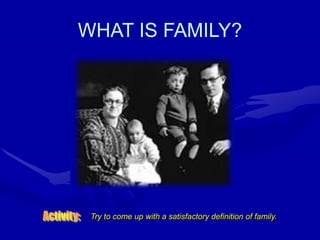
WHAT IS FAMILY?
Try to come up with a satisfactory definition of family.
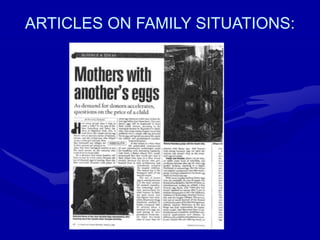
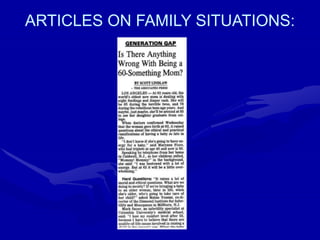
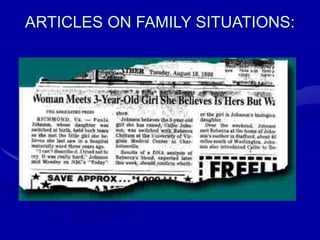
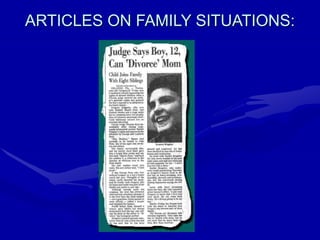
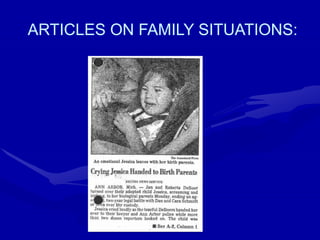
ARTICLES ON FAMILY SITUATIONS:
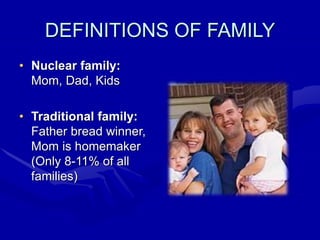
DEFINITIONS OF FAMILY
• Nuclear family:
Mom, Dad, Kids
• Traditional family:
Father bread winner,
Mom is homemaker
(Only 8-11% of all
families)
On a blank piece of paper, draw your family visually.
(Refer to page 29 Genogram)
On the other side with pictures draw what a family is -
no words.
Have a few share theirs. Some may include friends,
foster family, grandparents, step families, mother-in-law,
aunts/uncles, nephews/nieces, etc.
Family Types
• Living alone
• Cohabitation
• Couple with no children (DINK)
• Divorced adults
• Single parent families
• Step families
• Adoptive/Foster family/legal guardians
• Grandparents living with families or raising
grandchildren
• "Boomerang" families - children move back in
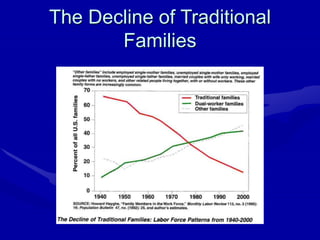
The Decline of Traditional
Families
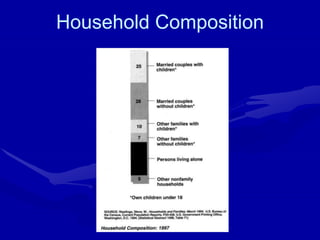
Household Composition
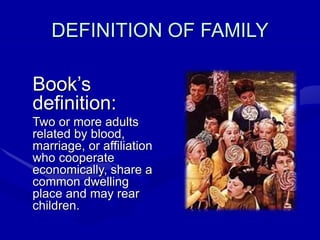
DEFINITION OF FAMILY
Book’s
definition:
Two or more adults
related by blood,
marriage, or affiliation
who cooperate
economically, share a
common dwelling
place and may rear
children.
Functions of Families
• Family ties like intimacy.
• Economic cooperation - families are consuming
and producing units.
• Reproduction and socialization.
• Only a family can produce a socialized adult.
WHAT SHOULD A CHILD LEARN
IN A FAMILY?
• Values, moral
• Culture and traditions
• Self concept
• How to solve problems/conflict resolution
• Commitment to family is first
• Each member must contribute
• Change is possible
• How to make a decision
• Communication
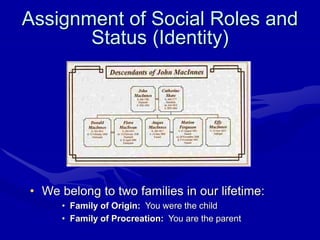
Assignment of Social Roles and
Status (Identity)
• We belong to two families in our lifetime:
• Family of Origin: You were the child
• Family of Procreation: You are the parent
WHY LIVE IN A FAMILY?
• Love and closeness
• Offer continuity in
emotional attachments,
rights, and obligations.
• Close proximity which
facilitates cooperation and
communication.
• Abiding familiarity with
others. Can know
ourselves and others well.
• Economic benefits.
IS THE AMERICAN FAMILY
DYING OR CEASING TO EXIST?
Consider this:
• Nine out of ten people continue to live in
households as family members
• Nine out of ten young adults marry.
• The majority (three out of four) of those
who divorce will remarry.
• The majority of those who marry will have
children.
CHARACTERISTICS OF STRONG
FAMILIES
• Appreciation – notice the less obvious
things, express appreciation often.
• Kindness –tends to be catching.
• Communication – listen so others will talk,
talk so others will listen.
• Time Together – plan it, don’t wait to find it,
need quantity to have quality.
CHARACTERISTICS OF STRONG
FAMILIES (cont.)
• Values and Standards – communicate them
clearly, follow them consistently.
• Strictness & Permissiveness – firm, fair, and
friendly.
• Problem Solving – look for solutions, not for
blame.
• Traditions –give a sense of identity.
• Fun & laughter – plan it, use props, bring
home jokes.
CHAPTER 1 VOCABULARY
1. Family: 2 or more adults related by blood,
marriage, or affiliation. Who cooperate
economically, may share common dwelling
place & may rear children.
2. Marriage: Legal union between a man &
woman united sexually, cooperate
economically and may have children.
3. Monogamy: 1 husband or 1 wife, sexual
exclusivity
4. Polygamy: More than one husband or wife
at the same time.
CHAPTER 1 VOCABULARY
cont’d
• 5. Serial Monogamy or Modified Polygamy:
Succession of marriages over time. Typical of US
marriages.
• 6. Cultivation Theory: Media images form view of
world.
• 7. Nuclear Family: Consists of mother, father and at
least one child. (Traditional Family)
• 8. Family of origin: Family of which one is reared as
a child.
• 9. Family of Procreation: Family one forms as a
couple.
CHAPTER 1 VOCABULARY
cont’d
• 10. Family of cohabitation: Family formed
by two people living together whether
married or unmarried, may include children
or stepchildren.
• 11. Affiliated Kin: Unrelated people who are
treated as if related.
• 12. Kinship system: Social organization of
the family, conferring rights and obligations
based on status.
• 13. Conjugal: Related by marriage
• 14. Consanguineous Relationship:
Relationship formed by common blood lines.
Chapter_1_-_Meaning_of_Marriage___Family.ppt

Chapter_1_-_Meaning_of_Marriage___Family.ppt

  • 1.
    Chapter 1 -Meaning of Marriage & Family
  • 2.
    Used by permissionof THE ACADEMY OF NURSING 2355 E. 3900 S. S.L.C., UT 84124 801-506-0064
  • 3.
    OBJECTIVE: Come up with apersonal definition or statement on what family means to you.
  • 4.
    TRIANGULATION • Relationships maybe complex within a family. • Triangulation (3 is bad - 2 group against a third or two come to a third party to help resolve their conflict) Results in problematic symptoms for the third. Groups of three come up with a 3 min skit on a family interaction. Example: Household jobs, discipline, son not wanting to be like father.
  • 5.
    WHAT IS MARRIAGE? •Bond between a man & woman. – All 50 states but Hawaii do not allow gay/lesbian marriage. – 1996 Defense Marriage Act gave states the right to decide.
  • 6.
    WHAT IS MARRIAGE?(cont.) • Commitment • Intimacy and sexually unite (a defining reason why many marriages stay together) • Cooperate economically • May give birth or adopt – 50 years ago this was central reason for marriage. – Purpose for marriage has become much more diverse.
  • 7.
    WHAT IS MARRIAGE?(continued) • Book’s definition: Legal union between a man & woman, united sexually, cooperate economically, and may have children. • Benefits: Live longer, healthier, fewer accidents.
  • 8.
    WHAT IS MARRIAGE?(cont.) • Legally recognized union – Marriage license • Not open on Saturday. • Fee: $50 • City & County offices on 21st S. State. • Good for 30 days, good immediately. • 18 years without parents consent. • Second cousins may marry. • No blood tests or physical exams required. • Both bride & groom must be present place of birth. • Need to know mothers maiden name & parents.
  • 9.
    CULTURE DEFINES WHATA MARRIAGE IS OR NOT • Monogamy - one man, one woman. All 1st world countries are monogamous. • Polygamy - more than one wife or husband. Example: Islam & Fundamental Mormons • Bigamy – Marrying another person while still married to someone else. It is against the law. • Serial Monogamy or Modified Polygamy – Succession of marriages over time. Typical of US marriages.
  • 10.
  • 11.
    MEDIA ARE WE IMMERSEDIN IT? • Everyone’s view of marriage is somewhat distorted. No other family is exactly like your family. But our family is not the only one we "know." • Popular Culture constructions or TV & movies gives us privy to intimacies and conflicts which are usually not acceptable public behaviors. Discuss the PROs and CONs of TELEVISION.
  • 12.
    CULTIVATION THEORY • Cultivationtheory: These consistent themes, images, and stereo types that cut across programming genres cultivate or form world views. – People who watch more than the average amount of media are more likely to mistake the media world for the real world. • Average family has the TV on 7 hours a day. • Average person watches 4 hours per day. • Average person will spend 10 years of their life watching TV.
  • 13.
    PROS OF TV: •Opens up the world to us. • Communicates instantly what is happening. • Less prejudice, we see other cultures. • Children learn from parents era and vice versa. • Families watch TV together. • Gives more meaning to life to elderly. • Entertaining – novelty in a box.
  • 14.
    CONS OF TV: •Shallow communication about wealth, races, sex. • We trust each other less. • Spend less time being citizens and with families. • Children bored with school due to razzel dazzel of TV – shorten attention span. • Freezes images in our mind (Sept 11). • Speeds up time (ER, NYPD, Friends).
  • 15.
    ERA OF TV: •1953: ½ OF ALL FAMILIES OWNED A TV. • 1957: 90% OF ALL FAMILIES OWNED A TV.
  • 16.
    ERA OF TV(cont.) • Most of us will spend 10 years of our life watching TV. • On your death bed will you wish you had watched more TV?
  • 17.
    ACTIVITY: • Divide into6 groups and each discuss one of the following as to how it is portrayed on TV – Crime – Sex – Conflict and problems in families – Men & Women – Races – Single parent families
  • 18.
    HOW DOES MEDIAPORTRAY AMOUNTS OF CRIME?
  • 19.
    HOW DOES MEDIAPORTRAY AMOUNTS OF CRIME? • Create a perception that the world is a dangerous place. • People that are more fascinated with crime watch more shows on crime which confirm their views.
  • 20.
  • 21.
    HOW DOES MEDIA PORTRAYSEX? • Sex acts like extramarital affairs, premarital, rape, prostitution appears to happen 4x more frequently than they really do. • Physical beauty and appearances are extremely important. • Rarely see anything on birth control. • Rarely see loving marital sex.
  • 22.
    HOW DOES MEDIAPORTRAY CONFLICT & PROBLEMS IN FAMILIES?
  • 23.
    HOW DOES MEDIAPORTRAY CONFLICT & PROBLEMS IN FAMILIES? • Love will conquer all. • 30 minutes can resolve any problem. • Usually solved with manipulation or humor. • Divorce is rare & a trend towards non traditional families. • Total omission of household chores which is a huge source of conflict. • Life is much less complicated than in reality. – Rarely see divorce, unemployment, chronic illness, death, poverty, caring for elderly.
  • 24.
    HOW DOES MEDIAPORTRAY MEN & WOMEN?
  • 25.
    HOW DOES MEDIAPORTRAY MEN & WOMEN? • Middle class women like the Cosbys. • Working class men like Homer Simpson.
  • 26.
  • 27.
    HOW ARE DIFFERENT RACESPORTRAYED? • Whites over represented. • Blacks improving. • Perpetuates racism.
  • 28.
    HOW ARE SINGLEPARENT FAMILIES PORTRAYED?
  • 29.
    HOW ARE SINGLEPARENT FAMILIES PORTRAYED? • Fathers head household 5x as often. • Single women want to marry & single men enjoy their freedom. • The reality is single father remarry more often than women. • Step families have harmony or solve a problem in a single episode. • Affiliated kin shown as families.
  • 30.
    SOAP OPERAS: Whatdo you see on afternoon TV? • High rates of conflict, betrayal, infidelity, divorce & multiple marriages with secrets they keep from their spouse. • Exaggerated amounts of sex.
  • 31.
  • 32.
    TALK SHOWS: • Grouptherapy for the masses that everyone can afford. • Primary purpose is to entertain or raise the rating. Definite difference in scholarly research whose primary purpose is to gain knowledge. • Topics are high interest or shocking materials to attract an audience.
  • 33.
    WE ARE IMMERSEDIN THE MEDIA! WHAT CAN WE DO? • To keep from being used? • To keep from being manipulated? • To keep from being negatively influenced? • To keep the media from displacing the family, education, or religion in our lives?
  • 34.
    ADVICE: • Be skeptical. •Search for biases, stereotypes, and lack of objectivity. • Look for moralizing. What are the underlying values? • Go to the original source and see how valid they are. • Seek additional information. The whole story was probably not told - watered down info.
  • 35.
    WHAT IS FAMILY? Tryto come up with a satisfactory definition of family.
  • 36.
    ARTICLES ON FAMILYSITUATIONS:
  • 37.
    ARTICLES ON FAMILYSITUATIONS:
  • 38.
    ARTICLES ON FAMILYSITUATIONS:
  • 39.
    ARTICLES ON FAMILYSITUATIONS:
  • 40.
    ARTICLES ON FAMILYSITUATIONS:
  • 41.
    DEFINITIONS OF FAMILY •Nuclear family: Mom, Dad, Kids • Traditional family: Father bread winner, Mom is homemaker (Only 8-11% of all families)
  • 42.
    On a blankpiece of paper, draw your family visually. (Refer to page 29 Genogram) On the other side with pictures draw what a family is - no words. Have a few share theirs. Some may include friends, foster family, grandparents, step families, mother-in-law, aunts/uncles, nephews/nieces, etc.
  • 43.
    Family Types • Livingalone • Cohabitation • Couple with no children (DINK) • Divorced adults • Single parent families • Step families • Adoptive/Foster family/legal guardians • Grandparents living with families or raising grandchildren • "Boomerang" families - children move back in
  • 44.
    The Decline ofTraditional Families
  • 45.
  • 46.
    DEFINITION OF FAMILY Book’s definition: Twoor more adults related by blood, marriage, or affiliation who cooperate economically, share a common dwelling place and may rear children.
  • 47.
    Functions of Families •Family ties like intimacy. • Economic cooperation - families are consuming and producing units. • Reproduction and socialization. • Only a family can produce a socialized adult.
  • 48.
    WHAT SHOULD ACHILD LEARN IN A FAMILY? • Values, moral • Culture and traditions • Self concept • How to solve problems/conflict resolution • Commitment to family is first • Each member must contribute • Change is possible • How to make a decision • Communication
  • 49.
    Assignment of SocialRoles and Status (Identity) • We belong to two families in our lifetime: • Family of Origin: You were the child • Family of Procreation: You are the parent
  • 50.
    WHY LIVE INA FAMILY? • Love and closeness • Offer continuity in emotional attachments, rights, and obligations. • Close proximity which facilitates cooperation and communication. • Abiding familiarity with others. Can know ourselves and others well. • Economic benefits.
  • 51.
    IS THE AMERICANFAMILY DYING OR CEASING TO EXIST? Consider this: • Nine out of ten people continue to live in households as family members • Nine out of ten young adults marry. • The majority (three out of four) of those who divorce will remarry. • The majority of those who marry will have children.
  • 52.
    CHARACTERISTICS OF STRONG FAMILIES •Appreciation – notice the less obvious things, express appreciation often. • Kindness –tends to be catching. • Communication – listen so others will talk, talk so others will listen. • Time Together – plan it, don’t wait to find it, need quantity to have quality.
  • 53.
    CHARACTERISTICS OF STRONG FAMILIES(cont.) • Values and Standards – communicate them clearly, follow them consistently. • Strictness & Permissiveness – firm, fair, and friendly. • Problem Solving – look for solutions, not for blame. • Traditions –give a sense of identity. • Fun & laughter – plan it, use props, bring home jokes.
  • 54.
    CHAPTER 1 VOCABULARY 1.Family: 2 or more adults related by blood, marriage, or affiliation. Who cooperate economically, may share common dwelling place & may rear children. 2. Marriage: Legal union between a man & woman united sexually, cooperate economically and may have children. 3. Monogamy: 1 husband or 1 wife, sexual exclusivity 4. Polygamy: More than one husband or wife at the same time.
  • 55.
    CHAPTER 1 VOCABULARY cont’d •5. Serial Monogamy or Modified Polygamy: Succession of marriages over time. Typical of US marriages. • 6. Cultivation Theory: Media images form view of world. • 7. Nuclear Family: Consists of mother, father and at least one child. (Traditional Family) • 8. Family of origin: Family of which one is reared as a child. • 9. Family of Procreation: Family one forms as a couple.
  • 56.
    CHAPTER 1 VOCABULARY cont’d •10. Family of cohabitation: Family formed by two people living together whether married or unmarried, may include children or stepchildren. • 11. Affiliated Kin: Unrelated people who are treated as if related. • 12. Kinship system: Social organization of the family, conferring rights and obligations based on status. • 13. Conjugal: Related by marriage • 14. Consanguineous Relationship: Relationship formed by common blood lines.