Introduction
Chapter 1
Tanenbaum & Bos, Modern Operating Systems: 4th ed., Global Edition (c) 2015 Pearson Education Limited. All rights reserved.
Components of a Modern
Computer (1)
– One or more processors
– Main memory
– Disks
– Printers
– Keyboard
– Mouse
– Display
– Network interfaces
– I/O devices
Tanenbaum & Bos, Modern Operating Systems: 4th ed., Global Edition (c) 2015 Pearson Education Limited. All rights reserved.
Components of a Modern
Computer (2)
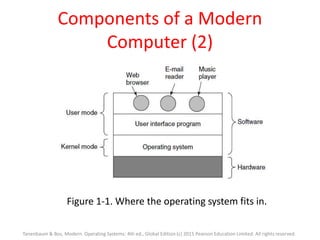
Figure 1-1. Where the operating system fits in.
Tanenbaum & Bos, Modern Operating Systems: 4th ed., Global Edition (c) 2015 Pearson Education Limited. All rights reserved.
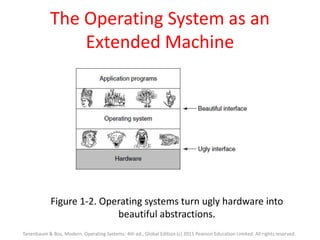
The Operating System as an
Extended Machine
Figure 1-2. Operating systems turn ugly hardware into
beautiful abstractions.
Tanenbaum & Bos, Modern Operating Systems: 4th ed., Global Edition (c) 2015 Pearson Education Limited. All rights reserved.
The Operating System as a
Resource Manager
• Top down view
– Provide abstractions to application programs
• Bottom up view
– Manage pieces of complex system
• Alternative view
– Provide orderly, controlled allocation of resources
Tanenbaum & Bos, Modern Operating Systems: 4th ed., Global Edition (c) 2015 Pearson Education Limited. All rights reserved.
History of Operating Systems
• The first generation (1945–55) vacuum tubes
• The second generation (1955–65) transistors
and batch systems
• The third generation (1965–1980) ICs and
multiprogramming
• The fourth generation (1980–present)
personal computers
• The fifth generation (1990–present) mobile
computers
Tanenbaum & Bos, Modern Operating Systems: 4th ed., Global Edition (c) 2015 Pearson Education Limited. All rights reserved.
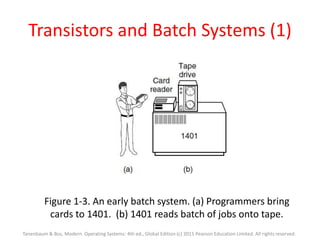
Transistors and Batch Systems (1)
Figure 1-3. An early batch system. (a) Programmers bring
cards to 1401. (b) 1401 reads batch of jobs onto tape.
Tanenbaum & Bos, Modern Operating Systems: 4th ed., Global Edition (c) 2015 Pearson Education Limited. All rights reserved.
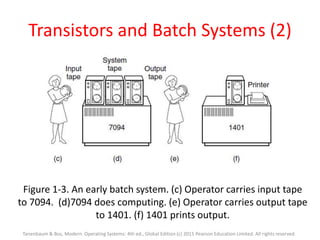
Transistors and Batch Systems (2)
Figure 1-3. An early batch system. (c) Operator carries input tape
to 7094. (d)7094 does computing. (e) Operator carries output tape
to 1401. (f) 1401 prints output.
Tanenbaum & Bos, Modern Operating Systems: 4th ed., Global Edition (c) 2015 Pearson Education Limited. All rights reserved.
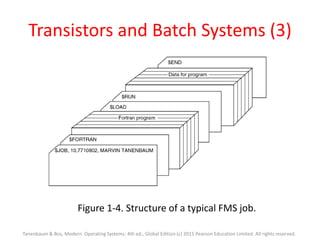
Transistors and Batch Systems (3)
Figure 1-4. Structure of a typical FMS job.
Tanenbaum & Bos, Modern Operating Systems: 4th ed., Global Edition (c) 2015 Pearson Education Limited. All rights reserved.
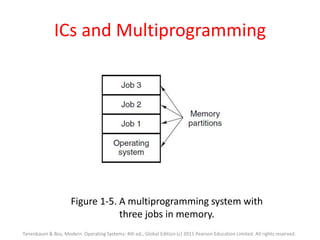
ICs and Multiprogramming
Figure 1-5. A multiprogramming system with
three jobs in memory.
Tanenbaum & Bos, Modern Operating Systems: 4th ed., Global Edition (c) 2015 Pearson Education Limited. All rights reserved.
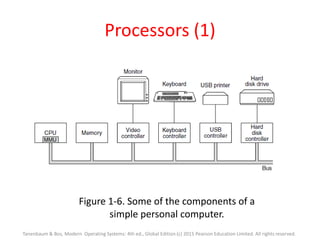
Processors (1)
Figure 1-6. Some of the components of a
simple personal computer.
Tanenbaum & Bos, Modern Operating Systems: 4th ed., Global Edition (c) 2015 Pearson Education Limited. All rights reserved.
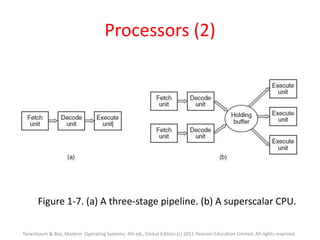
Processors (2)
Figure 1-7. (a) A three-stage pipeline. (b) A superscalar CPU.
Tanenbaum & Bos, Modern Operating Systems: 4th ed., Global Edition (c) 2015 Pearson Education Limited. All rights reserved.
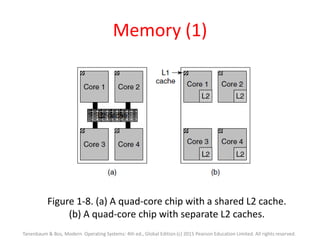
Memory (1)
Figure 1-8. (a) A quad-core chip with a shared L2 cache.
(b) A quad-core chip with separate L2 caches.
Tanenbaum & Bos, Modern Operating Systems: 4th ed., Global Edition (c) 2015 Pearson Education Limited. All rights reserved.
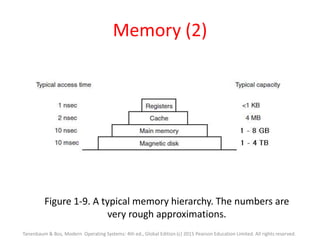
Memory (2)
Figure 1-9. A typical memory hierarchy. The numbers are
very rough approximations.
Tanenbaum & Bos, Modern Operating Systems: 4th ed., Global Edition (c) 2015 Pearson Education Limited. All rights reserved.
Memory (3)
Caching system issues:
1. When to put a new item into the cache.
2. Which cache line to put the new item in.
3. Which item to remove from the cache when
a slot is needed.
4. Where to put a newly evicted item in the
larger memory.
Tanenbaum & Bos, Modern Operating Systems: 4th ed., Global Edition (c) 2015 Pearson Education Limited. All rights reserved.
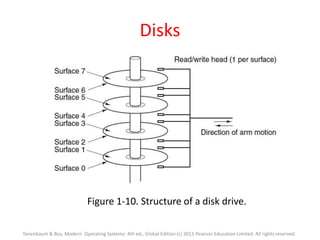
Disks
Figure 1-10. Structure of a disk drive.
Tanenbaum & Bos, Modern Operating Systems: 4th ed., Global Edition (c) 2015 Pearson Education Limited. All rights reserved.
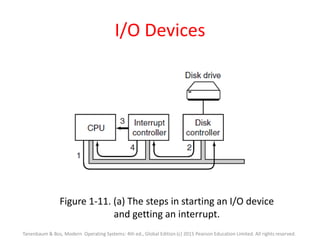
I/O Devices
Figure 1-11. (a) The steps in starting an I/O device
and getting an interrupt.
Tanenbaum & Bos, Modern Operating Systems: 4th ed., Global Edition (c) 2015 Pearson Education Limited. All rights reserved.
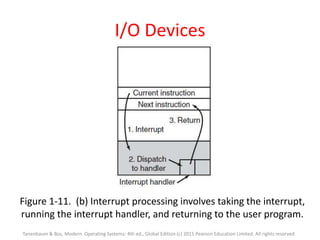
I/O Devices
Figure 1-11. (b) Interrupt processing involves taking the interrupt,
running the interrupt handler, and returning to the user program.
Tanenbaum & Bos, Modern Operating Systems: 4th ed., Global Edition (c) 2015 Pearson Education Limited. All rights reserved.
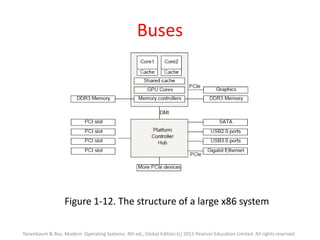
Buses
Figure 1-12. The structure of a large x86 system
Tanenbaum & Bos, Modern Operating Systems: 4th ed., Global Edition (c) 2015 Pearson Education Limited. All rights reserved.
The Operating System Zoo
• Mainframe Operating Systems
• Server Operating Systems
• Multiprocessor Operating Systems
• Personal Computer Operating Systems
• Handheld Computer Operating Systems
• Embedded Operating Systems
• Sensor Node Operating Systems
• Real-Time Operating Systems
• Smart Card Operating Systems
Tanenbaum & Bos, Modern Operating Systems: 4th ed., Global Edition (c) 2015 Pearson Education Limited. All rights reserved.
Processes (1)
• Key concept in all operating systems
• Definition: a program in execution
• Process is associated with an address space
• Also associated with set of resources
• Process can be thought of as a container
– Holds all information needed to run program
Tanenbaum & Bos, Modern Operating Systems: 4th ed., Global Edition (c) 2015 Pearson Education Limited. All rights reserved.
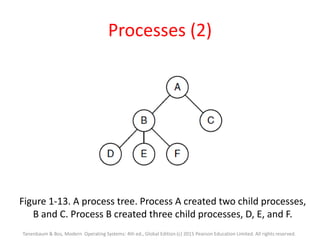
Processes (2)
Figure 1-13. A process tree. Process A created two child processes,
B and C. Process B created three child processes, D, E, and F.
Tanenbaum & Bos, Modern Operating Systems: 4th ed., Global Edition (c) 2015 Pearson Education Limited. All rights reserved.
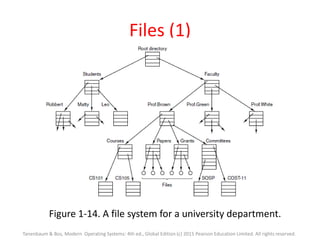
Files (1)
Figure 1-14. A file system for a university department.
Tanenbaum & Bos, Modern Operating Systems: 4th ed., Global Edition (c) 2015 Pearson Education Limited. All rights reserved.
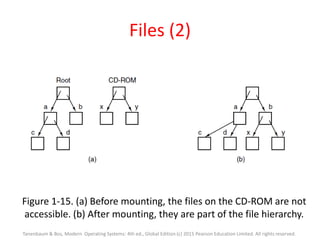
Files (2)
Figure 1-15. (a) Before mounting, the files on the CD-ROM are not
accessible. (b) After mounting, they are part of the file hierarchy.
Tanenbaum & Bos, Modern Operating Systems: 4th ed., Global Edition (c) 2015 Pearson Education Limited. All rights reserved.
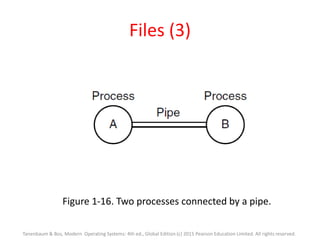
Files (3)
Figure 1-16. Two processes connected by a pipe.
Tanenbaum & Bos, Modern Operating Systems: 4th ed., Global Edition (c) 2015 Pearson Education Limited. All rights reserved.
Ontogeny Recapitulates Phylogeny
• Each new “species” of computer
– Goes through same development as “ancestors”
• Consequence of impermanence
– Text often looks at “obsolete” concepts
– Changes in technology may bring them back
• Happens with large memory, protection
hardware, disks, virtual memory
Tanenbaum & Bos, Modern Operating Systems: 4th ed., Global Edition (c) 2015 Pearson Education Limited. All rights reserved.
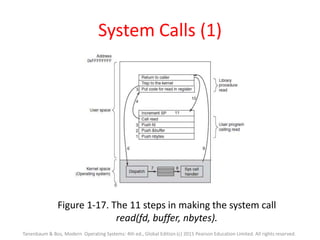
System Calls (1)
Figure 1-17. The 11 steps in making the system call
read(fd, buffer, nbytes).
Tanenbaum & Bos, Modern Operating Systems: 4th ed., Global Edition (c) 2015 Pearson Education Limited. All rights reserved.
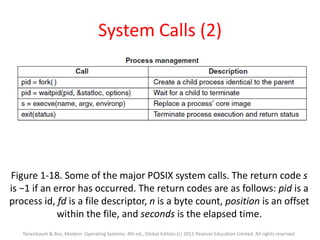
System Calls (2)
Figure 1-18. Some of the major POSIX system calls. The return code s
is −1 if an error has occurred. The return codes are as follows: pid is a
process id, fd is a file descriptor, n is a byte count, position is an offset
within the file, and seconds is the elapsed time.
Tanenbaum & Bos, Modern Operating Systems: 4th ed., Global Edition (c) 2015 Pearson Education Limited. All rights reserved.
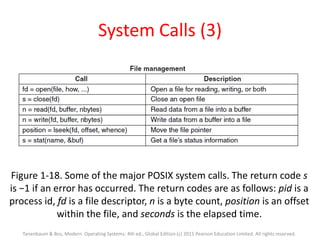
System Calls (3)
Figure 1-18. Some of the major POSIX system calls. The return code s
is −1 if an error has occurred. The return codes are as follows: pid is a
process id, fd is a file descriptor, n is a byte count, position is an offset
within the file, and seconds is the elapsed time.
Tanenbaum & Bos, Modern Operating Systems: 4th ed., Global Edition (c) 2015 Pearson Education Limited. All rights reserved.
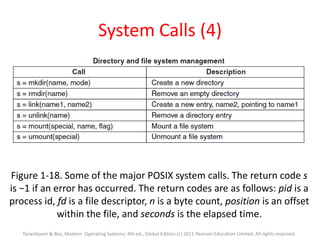
System Calls (4)
Figure 1-18. Some of the major POSIX system calls. The return code s
is −1 if an error has occurred. The return codes are as follows: pid is a
process id, fd is a file descriptor, n is a byte count, position is an offset
within the file, and seconds is the elapsed time.
Tanenbaum & Bos, Modern Operating Systems: 4th ed., Global Edition (c) 2015 Pearson Education Limited. All rights reserved.
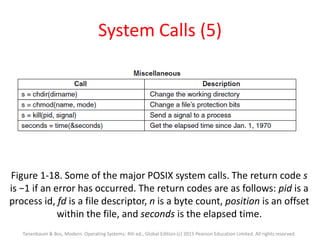
System Calls (5)
Figure 1-18. Some of the major POSIX system calls. The return code s
is −1 if an error has occurred. The return codes are as follows: pid is a
process id, fd is a file descriptor, n is a byte count, position is an offset
within the file, and seconds is the elapsed time.
Tanenbaum & Bos, Modern Operating Systems: 4th ed., Global Edition (c) 2015 Pearson Education Limited. All rights reserved.
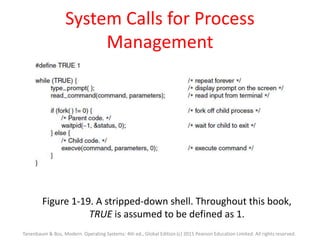
System Calls for Process
Management
Figure 1-19. A stripped-down shell. Throughout this book,
TRUE is assumed to be defined as 1.
Tanenbaum & Bos, Modern Operating Systems: 4th ed., Global Edition (c) 2015 Pearson Education Limited. All rights reserved.
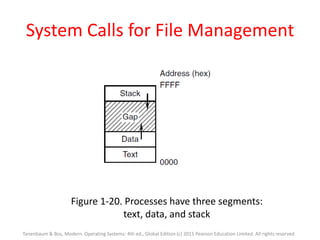
System Calls for File Management
Figure 1-20. Processes have three segments:
text, data, and stack
Tanenbaum & Bos, Modern Operating Systems: 4th ed., Global Edition (c) 2015 Pearson Education Limited. All rights reserved.
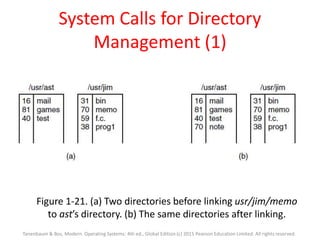
System Calls for Directory
Management (1)
Figure 1-21. (a) Two directories before linking usr/jim/memo
to ast’s directory. (b) The same directories after linking.
Tanenbaum & Bos, Modern Operating Systems: 4th ed., Global Edition (c) 2015 Pearson Education Limited. All rights reserved.
System Calls for Directory
Management (2)
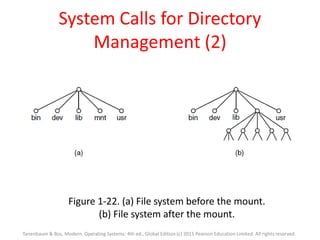
Figure 1-22. (a) File system before the mount.
(b) File system after the mount.
Tanenbaum & Bos, Modern Operating Systems: 4th ed., Global Edition (c) 2015 Pearson Education Limited. All rights reserved.
The Windows Win32 API (1)
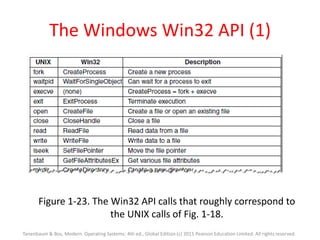
Figure 1-23. The Win32 API calls that roughly correspond to
the UNIX calls of Fig. 1-18.
Tanenbaum & Bos, Modern Operating Systems: 4th ed., Global Edition (c) 2015 Pearson Education Limited. All rights reserved.
The Windows Win32 API (2)
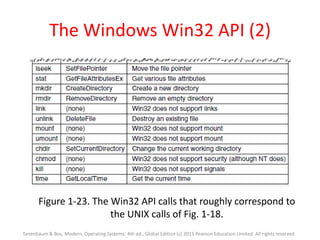
Figure 1-23. The Win32 API calls that roughly correspond to
the UNIX calls of Fig. 1-18.
Tanenbaum & Bos, Modern Operating Systems: 4th ed., Global Edition (c) 2015 Pearson Education Limited. All rights reserved.
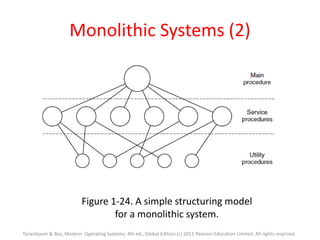
Monolithic Systems (1)
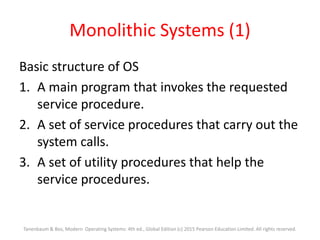
Basic structure of OS
1. A main program that invokes the requested
service procedure.
2. A set of service procedures that carry out the
system calls.
3. A set of utility procedures that help the
service procedures.
Tanenbaum & Bos, Modern Operating Systems: 4th ed., Global Edition (c) 2015 Pearson Education Limited. All rights reserved.
Monolithic Systems (2)
Figure 1-24. A simple structuring model
for a monolithic system.
Tanenbaum & Bos, Modern Operating Systems: 4th ed., Global Edition (c) 2015 Pearson Education Limited. All rights reserved.
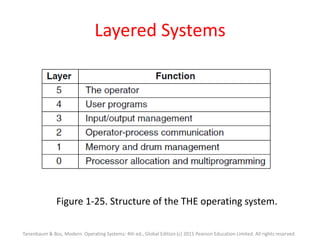
Layered Systems
Figure 1-25. Structure of the THE operating system.
Tanenbaum & Bos, Modern Operating Systems: 4th ed., Global Edition (c) 2015 Pearson Education Limited. All rights reserved.
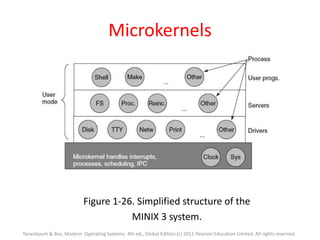
Microkernels
Figure 1-26. Simplified structure of the
MINIX 3 system.
Tanenbaum & Bos, Modern Operating Systems: 4th ed., Global Edition (c) 2015 Pearson Education Limited. All rights reserved.
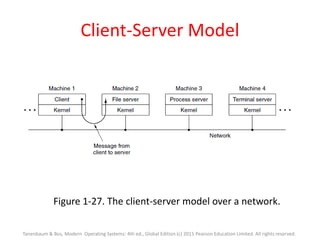
Client-Server Model
Figure 1-27. The client-server model over a network.
Tanenbaum & Bos, Modern Operating Systems: 4th ed., Global Edition (c) 2015 Pearson Education Limited. All rights reserved.
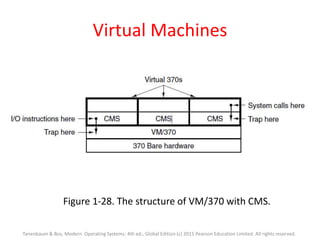
Virtual Machines
Figure 1-28. The structure of VM/370 with CMS.
Tanenbaum & Bos, Modern Operating Systems: 4th ed., Global Edition (c) 2015 Pearson Education Limited. All rights reserved.
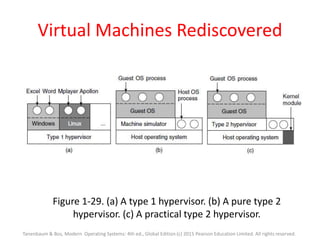
Virtual Machines Rediscovered
Figure 1-29. (a) A type 1 hypervisor. (b) A pure type 2
hypervisor. (c) A practical type 2 hypervisor.
Tanenbaum & Bos, Modern Operating Systems: 4th ed., Global Edition (c) 2015 Pearson Education Limited. All rights reserved.
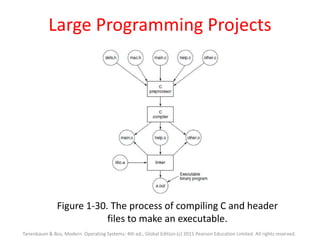
Large Programming Projects
Figure 1-30. The process of compiling C and header
files to make an executable.
Tanenbaum & Bos, Modern Operating Systems: 4th ed., Global Edition (c) 2015 Pearson Education Limited. All rights reserved.
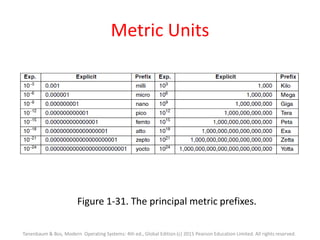
Metric Units
Figure 1-31. The principal metric prefixes.
Tanenbaum & Bos, Modern Operating Systems: 4th ed., Global Edition (c) 2015 Pearson Education Limited. All rights reserved.
End
Chapter 1
Tanenbaum & Bos, Modern Operating Systems: 4th ed., Global Edition (c) 2015 Pearson Education Limited. All rights reserved.

Chapter01-Introduction of OPERATING SYSTEM

  • 1.
    Introduction Chapter 1 Tanenbaum &Bos, Modern Operating Systems: 4th ed., Global Edition (c) 2015 Pearson Education Limited. All rights reserved.
  • 2.
    Components of aModern Computer (1) – One or more processors – Main memory – Disks – Printers – Keyboard – Mouse – Display – Network interfaces – I/O devices Tanenbaum & Bos, Modern Operating Systems: 4th ed., Global Edition (c) 2015 Pearson Education Limited. All rights reserved.
  • 3.
    Components of aModern Computer (2) Figure 1-1. Where the operating system fits in. Tanenbaum & Bos, Modern Operating Systems: 4th ed., Global Edition (c) 2015 Pearson Education Limited. All rights reserved.
  • 4.
    The Operating Systemas an Extended Machine Figure 1-2. Operating systems turn ugly hardware into beautiful abstractions. Tanenbaum & Bos, Modern Operating Systems: 4th ed., Global Edition (c) 2015 Pearson Education Limited. All rights reserved.
  • 5.
    The Operating Systemas a Resource Manager • Top down view – Provide abstractions to application programs • Bottom up view – Manage pieces of complex system • Alternative view – Provide orderly, controlled allocation of resources Tanenbaum & Bos, Modern Operating Systems: 4th ed., Global Edition (c) 2015 Pearson Education Limited. All rights reserved.
  • 6.
    History of OperatingSystems • The first generation (1945–55) vacuum tubes • The second generation (1955–65) transistors and batch systems • The third generation (1965–1980) ICs and multiprogramming • The fourth generation (1980–present) personal computers • The fifth generation (1990–present) mobile computers Tanenbaum & Bos, Modern Operating Systems: 4th ed., Global Edition (c) 2015 Pearson Education Limited. All rights reserved.
  • 7.
    Transistors and BatchSystems (1) Figure 1-3. An early batch system. (a) Programmers bring cards to 1401. (b) 1401 reads batch of jobs onto tape. Tanenbaum & Bos, Modern Operating Systems: 4th ed., Global Edition (c) 2015 Pearson Education Limited. All rights reserved.
  • 8.
    Transistors and BatchSystems (2) Figure 1-3. An early batch system. (c) Operator carries input tape to 7094. (d)7094 does computing. (e) Operator carries output tape to 1401. (f) 1401 prints output. Tanenbaum & Bos, Modern Operating Systems: 4th ed., Global Edition (c) 2015 Pearson Education Limited. All rights reserved.
  • 9.
    Transistors and BatchSystems (3) Figure 1-4. Structure of a typical FMS job. Tanenbaum & Bos, Modern Operating Systems: 4th ed., Global Edition (c) 2015 Pearson Education Limited. All rights reserved.
  • 10.
    ICs and Multiprogramming Figure1-5. A multiprogramming system with three jobs in memory. Tanenbaum & Bos, Modern Operating Systems: 4th ed., Global Edition (c) 2015 Pearson Education Limited. All rights reserved.
  • 11.
    Processors (1) Figure 1-6.Some of the components of a simple personal computer. Tanenbaum & Bos, Modern Operating Systems: 4th ed., Global Edition (c) 2015 Pearson Education Limited. All rights reserved.
  • 12.
    Processors (2) Figure 1-7.(a) A three-stage pipeline. (b) A superscalar CPU. Tanenbaum & Bos, Modern Operating Systems: 4th ed., Global Edition (c) 2015 Pearson Education Limited. All rights reserved.
  • 13.
    Memory (1) Figure 1-8.(a) A quad-core chip with a shared L2 cache. (b) A quad-core chip with separate L2 caches. Tanenbaum & Bos, Modern Operating Systems: 4th ed., Global Edition (c) 2015 Pearson Education Limited. All rights reserved.
  • 14.
    Memory (2) Figure 1-9.A typical memory hierarchy. The numbers are very rough approximations. Tanenbaum & Bos, Modern Operating Systems: 4th ed., Global Edition (c) 2015 Pearson Education Limited. All rights reserved.
  • 15.
    Memory (3) Caching systemissues: 1. When to put a new item into the cache. 2. Which cache line to put the new item in. 3. Which item to remove from the cache when a slot is needed. 4. Where to put a newly evicted item in the larger memory. Tanenbaum & Bos, Modern Operating Systems: 4th ed., Global Edition (c) 2015 Pearson Education Limited. All rights reserved.
  • 16.
    Disks Figure 1-10. Structureof a disk drive. Tanenbaum & Bos, Modern Operating Systems: 4th ed., Global Edition (c) 2015 Pearson Education Limited. All rights reserved.
  • 17.
    I/O Devices Figure 1-11.(a) The steps in starting an I/O device and getting an interrupt. Tanenbaum & Bos, Modern Operating Systems: 4th ed., Global Edition (c) 2015 Pearson Education Limited. All rights reserved.
  • 18.
    I/O Devices Figure 1-11.(b) Interrupt processing involves taking the interrupt, running the interrupt handler, and returning to the user program. Tanenbaum & Bos, Modern Operating Systems: 4th ed., Global Edition (c) 2015 Pearson Education Limited. All rights reserved.
  • 19.
    Buses Figure 1-12. Thestructure of a large x86 system Tanenbaum & Bos, Modern Operating Systems: 4th ed., Global Edition (c) 2015 Pearson Education Limited. All rights reserved.
  • 20.
    The Operating SystemZoo • Mainframe Operating Systems • Server Operating Systems • Multiprocessor Operating Systems • Personal Computer Operating Systems • Handheld Computer Operating Systems • Embedded Operating Systems • Sensor Node Operating Systems • Real-Time Operating Systems • Smart Card Operating Systems Tanenbaum & Bos, Modern Operating Systems: 4th ed., Global Edition (c) 2015 Pearson Education Limited. All rights reserved.
  • 21.
    Processes (1) • Keyconcept in all operating systems • Definition: a program in execution • Process is associated with an address space • Also associated with set of resources • Process can be thought of as a container – Holds all information needed to run program Tanenbaum & Bos, Modern Operating Systems: 4th ed., Global Edition (c) 2015 Pearson Education Limited. All rights reserved.
  • 22.
    Processes (2) Figure 1-13.A process tree. Process A created two child processes, B and C. Process B created three child processes, D, E, and F. Tanenbaum & Bos, Modern Operating Systems: 4th ed., Global Edition (c) 2015 Pearson Education Limited. All rights reserved.
  • 23.
    Files (1) Figure 1-14.A file system for a university department. Tanenbaum & Bos, Modern Operating Systems: 4th ed., Global Edition (c) 2015 Pearson Education Limited. All rights reserved.
  • 24.
    Files (2) Figure 1-15.(a) Before mounting, the files on the CD-ROM are not accessible. (b) After mounting, they are part of the file hierarchy. Tanenbaum & Bos, Modern Operating Systems: 4th ed., Global Edition (c) 2015 Pearson Education Limited. All rights reserved.
  • 25.
    Files (3) Figure 1-16.Two processes connected by a pipe. Tanenbaum & Bos, Modern Operating Systems: 4th ed., Global Edition (c) 2015 Pearson Education Limited. All rights reserved.
  • 26.
    Ontogeny Recapitulates Phylogeny •Each new “species” of computer – Goes through same development as “ancestors” • Consequence of impermanence – Text often looks at “obsolete” concepts – Changes in technology may bring them back • Happens with large memory, protection hardware, disks, virtual memory Tanenbaum & Bos, Modern Operating Systems: 4th ed., Global Edition (c) 2015 Pearson Education Limited. All rights reserved.
  • 27.
    System Calls (1) Figure1-17. The 11 steps in making the system call read(fd, buffer, nbytes). Tanenbaum & Bos, Modern Operating Systems: 4th ed., Global Edition (c) 2015 Pearson Education Limited. All rights reserved.
  • 28.
    System Calls (2) Figure1-18. Some of the major POSIX system calls. The return code s is −1 if an error has occurred. The return codes are as follows: pid is a process id, fd is a file descriptor, n is a byte count, position is an offset within the file, and seconds is the elapsed time. Tanenbaum & Bos, Modern Operating Systems: 4th ed., Global Edition (c) 2015 Pearson Education Limited. All rights reserved.
  • 29.
    System Calls (3) Figure1-18. Some of the major POSIX system calls. The return code s is −1 if an error has occurred. The return codes are as follows: pid is a process id, fd is a file descriptor, n is a byte count, position is an offset within the file, and seconds is the elapsed time. Tanenbaum & Bos, Modern Operating Systems: 4th ed., Global Edition (c) 2015 Pearson Education Limited. All rights reserved.
  • 30.
    System Calls (4) Figure1-18. Some of the major POSIX system calls. The return code s is −1 if an error has occurred. The return codes are as follows: pid is a process id, fd is a file descriptor, n is a byte count, position is an offset within the file, and seconds is the elapsed time. Tanenbaum & Bos, Modern Operating Systems: 4th ed., Global Edition (c) 2015 Pearson Education Limited. All rights reserved.
  • 31.
    System Calls (5) Figure1-18. Some of the major POSIX system calls. The return code s is −1 if an error has occurred. The return codes are as follows: pid is a process id, fd is a file descriptor, n is a byte count, position is an offset within the file, and seconds is the elapsed time. Tanenbaum & Bos, Modern Operating Systems: 4th ed., Global Edition (c) 2015 Pearson Education Limited. All rights reserved.
  • 32.
    System Calls forProcess Management Figure 1-19. A stripped-down shell. Throughout this book, TRUE is assumed to be defined as 1. Tanenbaum & Bos, Modern Operating Systems: 4th ed., Global Edition (c) 2015 Pearson Education Limited. All rights reserved.
  • 33.
    System Calls forFile Management Figure 1-20. Processes have three segments: text, data, and stack Tanenbaum & Bos, Modern Operating Systems: 4th ed., Global Edition (c) 2015 Pearson Education Limited. All rights reserved.
  • 34.
    System Calls forDirectory Management (1) Figure 1-21. (a) Two directories before linking usr/jim/memo to ast’s directory. (b) The same directories after linking. Tanenbaum & Bos, Modern Operating Systems: 4th ed., Global Edition (c) 2015 Pearson Education Limited. All rights reserved.
  • 35.
    System Calls forDirectory Management (2) Figure 1-22. (a) File system before the mount. (b) File system after the mount. Tanenbaum & Bos, Modern Operating Systems: 4th ed., Global Edition (c) 2015 Pearson Education Limited. All rights reserved.
  • 36.
    The Windows Win32API (1) Figure 1-23. The Win32 API calls that roughly correspond to the UNIX calls of Fig. 1-18. Tanenbaum & Bos, Modern Operating Systems: 4th ed., Global Edition (c) 2015 Pearson Education Limited. All rights reserved.
  • 37.
    The Windows Win32API (2) Figure 1-23. The Win32 API calls that roughly correspond to the UNIX calls of Fig. 1-18. Tanenbaum & Bos, Modern Operating Systems: 4th ed., Global Edition (c) 2015 Pearson Education Limited. All rights reserved.
  • 38.
    Monolithic Systems (1) Basicstructure of OS 1. A main program that invokes the requested service procedure. 2. A set of service procedures that carry out the system calls. 3. A set of utility procedures that help the service procedures. Tanenbaum & Bos, Modern Operating Systems: 4th ed., Global Edition (c) 2015 Pearson Education Limited. All rights reserved.
  • 39.
    Monolithic Systems (2) Figure1-24. A simple structuring model for a monolithic system. Tanenbaum & Bos, Modern Operating Systems: 4th ed., Global Edition (c) 2015 Pearson Education Limited. All rights reserved.
  • 40.
    Layered Systems Figure 1-25.Structure of the THE operating system. Tanenbaum & Bos, Modern Operating Systems: 4th ed., Global Edition (c) 2015 Pearson Education Limited. All rights reserved.
  • 41.
    Microkernels Figure 1-26. Simplifiedstructure of the MINIX 3 system. Tanenbaum & Bos, Modern Operating Systems: 4th ed., Global Edition (c) 2015 Pearson Education Limited. All rights reserved.
  • 42.
    Client-Server Model Figure 1-27.The client-server model over a network. Tanenbaum & Bos, Modern Operating Systems: 4th ed., Global Edition (c) 2015 Pearson Education Limited. All rights reserved.
  • 43.
    Virtual Machines Figure 1-28.The structure of VM/370 with CMS. Tanenbaum & Bos, Modern Operating Systems: 4th ed., Global Edition (c) 2015 Pearson Education Limited. All rights reserved.
  • 44.
    Virtual Machines Rediscovered Figure1-29. (a) A type 1 hypervisor. (b) A pure type 2 hypervisor. (c) A practical type 2 hypervisor. Tanenbaum & Bos, Modern Operating Systems: 4th ed., Global Edition (c) 2015 Pearson Education Limited. All rights reserved.
  • 45.
    Large Programming Projects Figure1-30. The process of compiling C and header files to make an executable. Tanenbaum & Bos, Modern Operating Systems: 4th ed., Global Edition (c) 2015 Pearson Education Limited. All rights reserved.
  • 46.
    Metric Units Figure 1-31.The principal metric prefixes. Tanenbaum & Bos, Modern Operating Systems: 4th ed., Global Edition (c) 2015 Pearson Education Limited. All rights reserved.
  • 47.
    End Chapter 1 Tanenbaum &Bos, Modern Operating Systems: 4th ed., Global Edition (c) 2015 Pearson Education Limited. All rights reserved.