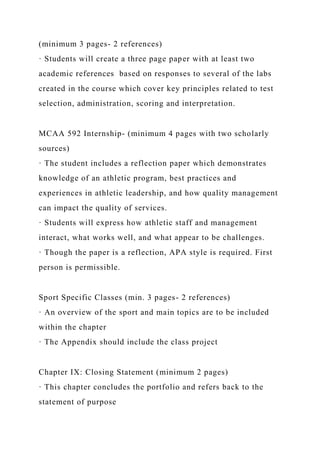
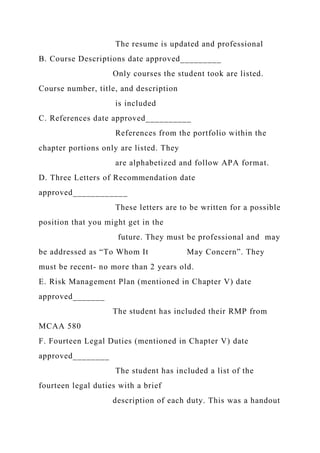
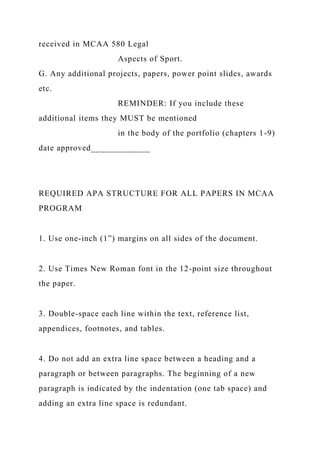
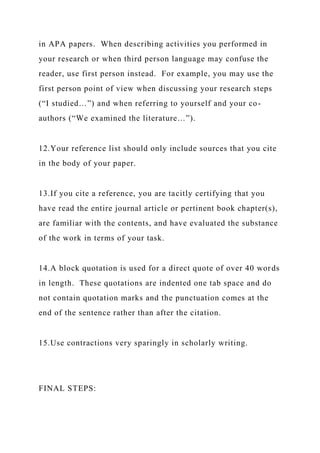
CHAPTER VI: PROGRAM DEVELOPMENT CHECKLIST for
AN ATHLETIC DIRECTOR
Format Requirements:
1. Times New Roman – 12 pt font
2. Double spaced
3. Margins: 1” right, left, top and bottom
4. Two-line heading (in bold) on first page of text
5. APA citation & reference format (if applicable)
6. THIRD PERSON – no “I” “me” “my” “we” “you” “your”
“our” etc.
7. NO bold, italics, underline in text
8. Subheadings must be bold and flush left
Chapter VI Program Development:
A. Must be 15-25 pages in length
B. The following topics and subheadings may be included
CHAPTER VI PROGRAM DEVELOPMENT MUST DESCRIBE
THE FUNCTIONS AND ROLE OF THE ATHLETIC
DEPARTMENT AND THE ATHLETIC DIRECTOR
THE FOLLOWING HEADINGS AND SUBHEADINGS MAY
BE INCLUDED:
Introduction
Give an overview of what this chapter will include.
Organization of the office
Create a work-flow chart of the ideal office ( This could be an
appendix item)
What will the layout of the office be that promotes ideal
working conditions? Will there be conference rooms/ white
boards/ video monitors
Communication
Identify the Mission of the Athletic Department – Where will
this be displayed or published?
What type of culture do you want your Athletic Department to
have?
What interpersonal skills and leadership style are most
effective?
How will you use social media, phone, texting, video tools,
apps, websites to effectively communicate?
Leadership
What leadership skills does an effective administrator need and
how would those be implemented?
Staffing: Hiring of coaches, athletic trainers, support personnel,
etc.
Best practices for hiring
Include what skill set for each staff member that an AD should
consider for each staff position
What will the Administrative Assistant roles and
responsibilities be?
What core values do you want your staff to possess?
How will you address personal problems/issues?
Department meetings: frequency, purpose, etc.
What are the benefits to meeting as a department?
What policies and procedures are important to address and
revisit throughout the year?
Describe the type of meetings- formal/informal
Include a sample of what an agenda might look like for a
meeting (appendix item)
What other type of meetings might the AD need to attend and
report back to the staff about?
Parent Engagement
What are the benefits of parent inclusion?
How can you create an atmosphere for positive parent
engagement?
Will there be parent volunteers for games/concession stands?
What will the standards be for parent conduct?
How can you encourage parents of the community to bond and
support the athletic programs? How can you create parent
advocates for various athletic programs?
Will any end of season events be planned for closure and to
honor athletes and how will parents be involved?
Discipline and Codes of Behavior
What discipline and codes of behavior will be set for student
athletes, staff and parents?
What standards of behavior will be in place?
How will this be modeled?
What formal disciplinary actions are there? How will they be
implemented?
What documentation might be needed? Will there be a code of
conduct agreement form? (This could be an appendix item)
Scheduling of Athletic Facilities
Determine what facilities are available
How to address overbooking issues
Determining what teams need what facilities during various
times of the year
Will a master calendar be used and if so how will it be
implemented? (Create a master calendar as a sample- This could
be an appendix item)
Game Day Preparations
Before the game
Topics may include: facility check for hazards, physicals on file
for athletes, eligibility records checked, equipment check,
media coverage, officials are scheduled, snack bar coverage,
security, ticket takers, National Anthem, announcers,
scoreboard condition, PA system, bleachers, water coolers,
athletic trainer, physician on duty, buses
After the game
Topics may include: Field, bleacher clean up, close facility
bathrooms, locker rooms, concessions, store equipment,
Deposit game receipts and ticket money
Create a checklist to use to keep track of duties(this could be
included in the appendix)
Coach Evaluations
Discuss the value and purpose of evaluations. What goal setting
might be included? When will evaluations be given? Discuss
some of the evaluations to consider:
Head Coach Evaluation
Assistant Coach Evaluation
Coach Self Evaluation
Athlete Evaluation of Coach
Administrator Evaluation of Coach
Maintenance of Athletic Fields, Courts, Weight Room
Safety Concerns/ Inspections/ Cleaning Routines
Budget and Funding
Booster Clubs
Types of fundraising and best practices for holding a
fundraising event
Understanding funds available to operate programs
Identify sources of revenue and expenses
Purchase approval process
Representation at Conference, District, State; Memberships &
Professional Participation
Include state and national associations that are recommended to
join, benefits to members, educational opportunities provided,
importance of networking and career development
Relationships with school administrators and faculty
How to encourage school/faculty involvement with athletic
programs
How to demonstrate support toward faculty members and the
importance of academics for athletes
Create a console application using Visual Studio in C#
Language.
• Name the
Solution
and Project Program06.
• Output appropriate communication messages to the user.
• Output appropriate results. In other words, all requirements
should be
output and identified by number.
Requirements (remember to identify the requirements by
number):
1. Output a header in the console: “This is Program06”
2. Create a structure named Phone with the following members:
a. Phone Number
b. Manufacturer
c. Model
d. Operating System
e. Diagonal Screen Size
f. Constructor to set data above
3. Ask the user how many phones to enter and configure
appropriately.
4. Create a class named Account with the following members:
g. Inherits IAccountUpdate interface
h. Phone Number(s)
i. Customer Name
j. Address
k. Credit Card Number
l. Constructor(s) as appropriate
5. Create an interface named IAccountUpdate with the
following members:
m. Balance Owed
n. Minutes Used
o. Cost Per Minute
p. CalculateCharge()
q. AdjustMinutes() – increase or decrease
6. Using Phone, Account, and IAccountUpdate, create an
application for a mobile phone company that minimally supports
functionality listed. For instance: creating accounts, adding
phones, calculating charges, and adjusting minutes.
7. Output a thank you message: “Thank you for running
Program06.”
Not meeting all requirements = No ‘’0” points for the
assignment.
Flowchart
Include a flowchart of your program.
Construct your flowchart using draw.io. Use appropriate
symbols. Use vertical/horizontal connections (NOT
slanted/angled connections).
Export your flowchart to the SVG format (File | Export as... |
SVG)
Submit the SVG file with your assignment
MCAA 595
CULMINATING PROJECT
CHAPTER VI:
PROGRAM DEVELOPMENT
*
PURPOSEDescribe an exemplary program or departmentDetail
all areasPrepare a document that could be used in an
interviewStart from scratch15-25 pagesTake the best of what
you are doingImprove what could be better
*
GoalsShowcase Your ExperienceInclude New Knowledge and
SkillsDemonstrate Your Ability to Organize and LeadPrepare
for an Interview
FORMAT REQUIREMENTSTimes New Roman; 12 ptDouble
spacedMargins:1” top, bottom, left, right; Paragraph indented:
.5”Page numbers upper right hand2-line heading on first page of
text in bold Subheadings: flush with left margin; bold NO bold,
italics, underline, caps in the text of the paperParagraphs: AT
LEAST 3 sentencesTHIRD PERSON – OMIT: you, I, me, my,
our, us, weCitations in APA format
DO NOT………DO…DO NOT….copy a school handbookDO
NOT…use the name of a school or programDO…use a school as
a modelDO…be detailed and descriptiveDO…add subheadings
as needed
CONTENT REQUIREMENTS
Coaching (use checklist)OrganizationCommunicationCoaching
behaviorsGrowth & well being of athletesTeam
practiceCoaching staffCharacter development of
athletesFundraising & boostersBuilding relationshipsCollege
recruiting (for college coaches)
CONTENT REQUIREMENTS
Athletic Director (use checklist)StaffingSchedulingDepartment
meetingsAthletic facilitiesDiscipline & codes of
behaviorCoaches: hiring, evaluation, etc.Budget &
fundraising/boostersCommunication: parents, athletes, donors,
principal, facultyRepresentation in conference/league, etc.
Program Development MUST:Discuss all subheadings and
topics on the checklistBe 15-25 pages in lengthInclude TWO (2)
direct quotes (minimum!) with APA citations (author, year,
page).with the text of a subheading of your choice
OPPORTUNITY!!
Use this opportunity to showcase your knowledge, experience,
expertise and newly acquired concepts or skills.
*
*
Chapter VI
Program Development
A successful athletic program is more than a record of wins and
losses. A truly successful
program is founded in an athlete-centered philosophy, employs
cooperative coaching practices,
and strives for the complete positive development of its student-
athletes in addition to
competitive success. In order for a football program to
accomplish these goals, it must be
organized, efficiently use team practice time, promote positive
coaching behaviors, and provide
opportunities for players to grow physically, emotionally,
psychologically, socially, and
spiritually. A successful program must also invest in its
coaching staff, acknowledge
opportunities for player development, utilize booster and
various fund-raising opportunities,
continuously work on building relationships within the
community, and have an ethical
recruiting process.
Organization
The organization of an entire football program begins with the
organizational and
communication skills of the head coach. It is vital that a head
coach establish and communicate a
defined schedule and clear expectations for his athletes, their
parents, and his coaches. This can
be accomplished through a variety of methods. A coach must
demonstrate organized
expectations for his players and communicate it with all
stakeholders. One way that this can be
accomplished is through the distribution of a player handbook.
This handbook should outline
several aspects of the program including a mission statement
expressing a commitment to the
physical, academic, social, character, and psychological
development of all student-athletes. This
handbook illustrates organized expectations for player behavior
both on and off the field, during
both practice and game situations, and communication
information. The practice procedures
illustrated in this handbook include punctuality, absences,
practice attire, attitude and effort,
holiday practice scheduling, locker room behavior, and
“coachability.” Game day procedures
include pre-game routines and behaviors, bus conduct, bench
and sideline conduct, treatment of
officials, substitutions, playing time, and team support. This
handbook also includes information
regarding how both players and parents should deal with
conflict and problems, a coaching
directory which includes responsibilities, email addresses and
phone numbers, and instruction for
how to best contact coaches regarding questions or concerns.
This handbook is communicated in
written and verbal form, and both players and parents are to
sign a waiver recognizing that they
have received and understand the expressed standards and
expectations of the football program.
Another way that a head coach can demonstrate and
communicate clear organization is
through a master calendar. A coach must provide parents,
players, and coaches with an organized
master calendar that outlines important dates and times. This
should be a year-long calendar that
outlines events important to player training, booster functions,
and competition dates. This
calendar is also beneficial in assisting families in scheduling
appointments and vacations that do
not conflict with practice. Practice dates must account for the
off-season, pre-season, and in-
season, include start and end times, and the location in which
training will take place. For
example, the calendar should express whether the players will
be in the weight room, on the
field, or in the classroom at certain times. Additionally, this
calendar should include important
academic dates such as finals week, national holidays, “dead
periods”, booster meetings, and
fundraising dates. Finally, this calendar should outline the in-
season competitive schedule
including the location and start time of games. This in-season
game schedule should also be
made available as a separate document for parents and
stakeholders such as school personnel in
the form of a handout, poster, or magnet. Both the player
handbook and master calendar should
also be posted on the team website and available for
stakeholders to access at all times.
In addition to the player handbook, master calendar, and in-
season schedule, a head coach
must communicate other organizational factors to his coaches.
A head coach must clearly
express the practices and expectations for assistant coaches in
the form of a coaching manual and
communicate this during staff meetings. This manual should
include the information provided to
parents and players as well as offensive, defensive, special unit
philosophies and playbooks, and
conditioning and strength training philosophies and practices.
Additionally, the coach’s manual
must express policies regarding coach to coach relations, coach
to player relations, expected staff
attributes and behaviors, player personnel templates,
installation templates, and a field equipment
inventory. A final and integral part of the coach’s manual is a
clearly organized assignment chart
for each individual coach so that each coach is aware of his
responsibilities during practice,
games, and on the weekend. This chart provides each coach with
a clear understanding of his
major coaching responsibilities, his assignments in respect to
game analysis, scouting reports,
weekly preparation, his location and responsibilities during a
game, as well as any other
supplementary duties.
It is vital that a head coach thoroughly organize coaching
responsibilities and clearly
communicate with his staff during the off-season in order to
account for the many different
factors essential to a successful football program and minimize
future conflict, dissatisfied staff
members, or unfulfilled tasks. Through these charts, all
responsibilities of a successful coaching
staff must be accounted for and each coach must know his part
in achieving the collective goal of
having a successful program. This is an extensive process that
requires much planning and
organization due to the numerous factors that must be accounted
for. Coaching assignment charts
must include individual coaching assignments on offense,
defense, and special units, strength
and conditioning training, weekly checklists, practice planning,
film breakdown, opponent
tendency charts and scouting reports, and game configurations
and assignments. Coaching
assignment charts must also include all collateral
responsibilities such as locker room
supervision, updating statistics or goal charts, generating
position tests and tip/reminder sheets,
overseeing weekly academic grade checks or team council
meetings, facilitating school, district
and community outreach, and coordinating team meals,
banquets, fundraisers, and tradition
development. Thorough organization and clear communication
to players, parents, and coaches
is vital to program development. Efficient and effective daily
practices also require extensive
organization and planning.
Team Practice
Team practice sessions must be well planned, organized, and
detailed, regardless of
whether they are designed for technical improvement, tactical
awareness, conditioning, or
strength training. Although there are differences between
practices that occur on different days of
the week, all efficient football practices must have an organized
structure. Efficient football
practices begin with early outs which are followed by four
quarters of practice. The first quarter
of practice consists of a functional and dynamic warm up and
team installation period. The
second quarter consists of individual fundamentals and group
combo periods. After halftime
corrections and water, the third quarter begins which
emphasizes combo run and pass periods,
and the fourth quarter includes team run/pass emphasis and
special units. Team conditioning,
strength training, and classroom strategy sessions occur after
the on-field practice session.
Before the official practice begins, players and coaches
participate in “early outs.” During
this 15 minute period kickers, holders, snappers and returners
practice their individual skills
while all other players meet with their position coach. During
this period coaches may lead their
players through technical drills designed to improve areas of
weakness, discuss and re-teach
tactical strategies and awareness needed to correct previous
mistakes, or pre-teach concepts that
are scheduled for installation during practice that day.
The first quarter of practice begins with a functional and
dynamic warm up routine. This
15 minute routine consists of 22 movements that progress from
slow to fast and are designed to
dynamically prepare the body for the future demands of practice
by developing functional
flexibility, activating the nervous system, enhancing balance
and control, and incorporating
running mechanics, acceleration, change of direction, and
reaction time. The first quarter of
practice finishes with a 15 minutes team period. During this
session previous instruction is
reviewed and any new concepts are installed in no more than 5-
7 minutes of verbal instruction.
Following this period of verbal instruction, fundamental team
drills are executed. These drills
consist of defensive pursuit, tackling, and turnover drills, and
offensive perfect play execution,
screen periods, and 2-minute drills. Different fundamental team
drills are executed on each day.
The second quarter of practice begins with individual position
fundamental work. During this 15
minute session, each position works to improve at the multiple
individual technical and tactical
skills specific to their position. In the same way that practice is
designed in a whole-part-whole
(team-individual-group-team) format, the teaching of
fundamentals is best done in a whole-part-
whole format as well.
Due to the multiple parts of each technical skill a football
player must master, the
progressive part method is the best way to teach as it combines
a few aspects of the skill at a time
allowing the player to master each specific part, and ultimately
progress toward complete skill
mastery based on the pacing determined by the coach and the
speed at which he learns. Although
explanation and demonstrations are important to the learning
process, the athlete must be given
ample opportunity to physically improve in his execution of the
skill. Additionally, the best way
to teach technical skills is through the “games approach” as
opposed to the traditional approach
where athletes execute the skill in situations unrelated to game
situations. Through the games
approach, athletes develop the ability to determine and execute
movements based off of game
simulated keys and reads. This “tactical awareness” and the
ability to “read the play” not only
assists the player in mastering the technical skill, but also
develops tactical awareness and
motivates the athlete to continue working to improve as he can
see a how the skill directly
translates to competitive situations (Martens, 2007, p. 174-175).
Following individual position work is followed by group combo
sessions. During group
combo sessions, certain individual positions group with other
positions to once again apply the
progressive part method. Once individual position players have
been introduced to and practice
their specific skills, they group up with other position groups to
begin putting the whole
defensive or offensive unit together. Typical group
combinations during this period are defensive
linemen with linebackers, defensive safeties with cornerbacks,
offensive linemen with running
backs, and offensive wide receivers, tight ends, and
quarterbacks. During this period, groups
work on movement and execution in conjunction with one
another for both run and pass offense
and defense. At the end of this period the team has a water
break and individual players meet
with their position coach for a brief correction period based on
what transpired in practice thus
far. After the 10 minute water and correction period, the
progressive part method is completed as
the third quarter begins with complete offensive and defensive
units competing and executing
against one another.
The third quarter is a period designed for the competitive
application of techniques and
skills that have previously been practiced in individual and
group settings. The first 15 minutes
of this quarter consists of 9 on 7 drill which is between the
offensive and defensive fronts, and 1
on 1 passing drills between the defensive backs and wide
receivers and quarterbacks. A 9 on 7
drill is a run emphasis drill where the offense executes running
plays and the defense attempts to
stop the run through the use of defensive fronts and stunts. This
first 1 on 1 drill is a passing
emphasis drill where the wide receivers run routes and the
defensive backs attempt to intercept
or cause an incompletion through either man on man or zone
technique. After this 15 minute
period, practice progresses to a second series of competitive
drills.
The second set of competitive drills consists of 7 on 7 drill
between the offensive skill
players an defensive linebackers and secondary, and 1 on 1 pass
rush drills between the offensive
and defensive linemen. 7 on 7 drill is a pass emphasis drill
where the offense executes passing
plays and the defense attempts to stop the run through the use of
defensive coverages. This
second 1 on 1 drill is a pass rush drill where defensive linemen
attempt to successfully pass rush
past an offensive lineman and achieve the goal of getting to the
quarterback. 9 on 7 and 7 on 7
drills are run at the “no-huddle” game tempo that our offense
executes making this a period that
requires extreme focus under duress and serves as conditioning
periods as well. Both 1 on 1
drills are run at a high tempo, but more time is allowed for
instructional purposes if needed.
Additionally, each of these periods are filmed and made
available online for coach and players to
study and evaluate at home and during post-practice classroom
sessions.
The fourth quarter of practice finalizes the whole-part-whole
and progressive part method
as complete offensive and defensive units execute their
techniques in a competitive team drill.
This 15 minute team period has an emphasis on both run and
pass, and is executed with a certain
game scenario in mind. Through practicing the team session
with a situational context, the games
approach is applied to this period as well. Players are given a
game situation such as the
offensive is ahead by 3 points with 5 minutes left, or behind by
6 points with 4 minutes left.
Offensive and defensive plays that are appropriate for the
situation are scripted before practice
and thus players are executing appropriate techniques in calls
that are applicable to true game
situations that they have previously worked to improve on
during individual and combo periods.
The fourth quarter of practice finishes with a 15 minute period
of team conditioning combined
with special team practice. During this period, a different
special unit is practiced each day while
member of the team who are not on that special unit condition
together separately from the drill.
A typical on-field practice plan is as follows:
2:30-2:45 Early Outs
2:45-3:00 Team Dynamic Stretch
3:00-3:15 Team Offense/Defense Install and Execution
3:15-3:30 Individual Position Training
3:30-3:45 Offensive/Defensive Group Combo Training
3:45-3:55 Water and Halftime Corrections
3:55-4:10 9 on 7 / 1 on 1 passing routes
4:10-4:25 7 on 7 / 1 on 1 pass rush
4:25-4:40 Team Offense/Defense
4:40-4:55 Special Units / Conditioning
4:55-5:00 Team and Position Meetings
During the in-season there is frequent instruction that occurs in
a classroom rather than
on the field. On Monday, the team meets with the coaching staff
to address game performance
from the previous week and view and assess the game film.
During this meeting players are
provided evaluation sheets that assess their performance, and
coaches offer instruction and
criticism to assist in the further development of athletes. On
Tuesday, players meet with coaches
in the classroom after practice to receive weekly scouting
reports, game plan instruction, and
begin watching film of the opponent. Players will continue to
meet with coaches after practice on
Wednesday and Thursday to discuss the game plan and watch
film of their opponent. On Friday,
there is a special units meeting before practice, and a whole
team meeting to discuss the game
day itinerary immediately following practice. Coaches can also
provide players with off-field
instruction through playlists and tutorials regarding weekly
opponents and game plans that are
published online through coaching programs such as Hudl.
Conditioning and strength training practices are conducted in
systematic, periodized and
year-long programs that vary between the off-season and in-
season. During the off-season
players participate in a speed and agility development program
that takes place 4 times per week.
On Monday and Thursday players do speed training Speed
training designed to develop
acceleration, plyometric power, resisted movement, core
strength and stability. On Tuesday and
Friday they do agility training designed to promote multi-
dimensional speed and agility through
drills that improve footwork, quickness, change of direction,
balance, reaction time, as well as
core strength and explosiveness.
During the off-season players also participate in a strength
training program that takes
place during a four day per week split routine. On Mondays and
Thursdays players strength train
for functional power and explosiveness through Olympic lifting
while on Tuesday and Friday
they develop structural strength through basic, complementary
and specialty exercises. Speed,
agility, and strength training programs are each 8 weeks in
length and are followed a testing
week in which program effectiveness and athlete improvement
are assessed.
During the in-season, conditioning is done during practice
through competitive group
drills and team conditioning sessions. In-season conditioning
emphasizes team unity and positive
peer pressure. In-season conditioning emphasizes game speed
endurance and the development of
a strong team dynamic. Positive team conditioning “is a proven
method for bringing teams
together in a sincere, believable way. It also is a method to turn
what some coaches consider to
be the ‘worst,’ …part of practice (conditioning) into one of the
best” (Brown, 2003, p. 102).
Strength training during the in-season is done through a
maintenance program consisting of a 45
minute workout conducted Monday through Thursday before
practice.
The importance of flexibility and nutrition are reinforced the
entire year. Functional and
dynamic warm-up routines are done before on-field and weight
room practices during both off-
season and in-season as are post practice/work out flexibility
and mobility routines. Proper
nutrition and hydration are also reinforced throughout the year.
Athletes are instructed in proper
nutrition and encouraged to employ a balanced diet consisting
of the “six separate types of
nutrients [needed] in order to function properly: carbohydrates,
fats, proteins, vitamins, minerals,
and water” (Arthur & Bailey, 1998, p. 240). Athletes are taught
when and what to eat throughout
the year, the importance of proper hydration, and the dangers of
supplement use.
Coaching Behaviors
It is vital that a coach is able to capture and maintain the
attention of his athletes. This is
not only important to their learning and execution, but also to
minimizing behavioral issues and
keeping players motivated. As “[a]ttentiveness is one of the
most important requirements of a
good learning environment” (Brown, 2003, p. 18) it is important
that a coach take specific
measures to ensure that the focus of his team is on what it
should be. A coaching behavior that
can improve attentiveness is to structure practice and drills that
create the most active
participation by the athletes and avoid too much informative,
direct instruction and standing
around. A coach can create a more effective learning
environment by designing drills with the
“games approach.” Competitive simulation and opportunities for
athletes to develop tactical
awareness and decision-making skills are increased through the
“games approach.” The “games
approach” also helps keep players from becoming “impatient
during what… [can seem] to be
endless instruction and drills and very little playing of the
game” (Martens, 2004, p. 168).
Another behavior that can assist a coach in gaining and
maintaining the attention of his
team is related to the pacing of his instruction. If a coach
teaches too slowly, he risks losing the
attention and motivation of his faster learners, however if he
teaches too quickly it may be
difficult for some athletes to keep up. Therefore coaching
behaviors must account for both fast
and “slower” learners. A coach should pace his instruction and
“teach to the level of [his] fastest
learners” in order to assist the “more advanced players stay
focused and motivated” (Brown,
2003, p. 19). By teaching to the fastest learner during practice,
the coach can protect the dignity
of the athletes who require more assistance and still provide
them additional coaching to help
them master the skills.
In order to teach to the fastest learners during practice and
while also protecting the
dignity and ensuring the learning of all players a coach can
provide additional improvement
opportunities through extra practice time before or after
practice. Re-teaching or providing
additional practice time during the “early out” period prior to
the start of practice sessions is one
way in which coaches can provide additional instruction of this
type. By using time outside of
the scheduled practice to work with athletes who need more
help, a coach can give them a higher
frequency of practice opportunities without compromising their
dignity or the speed of
instruction needed to accommodate the faster learning athletes
during the actual practice periods.
Coaches can also foster attentiveness and focus in his players
by varying the physical intensity,
competitive nature, and time duration of drills. Coaches can
encourage attentiveness in athletes
by making “every drill as competitive as possible”, teaching
skills clearly and correctly when
they are first introduces, and minimizing the amount of
transition time in between drills (Brown,
2003, p. 18).
Coaches must also be flexible during practice and consider the
extent to which goals are
being accomplished. Although practice plans are thoroughly
organized and detailed, a coach
must always consider the actual learning and improvement that
occurs during practice as the
determining factor in pacing instruction. Due to the strict time
limits and performance
expectations coaches must face, it is easy for them to get caught
up with all that they must teach,
practice, and master. However, when coaches lose flexibility
and become overly focused on the
“to do” list, they can often have a poor perception of the true
status of their team. Consequently,
it is imperative that a coaching staff meets regularly to discuss
learning outcomes, practice
efficiency and effectiveness, and determine modifications and
interventions that will enhance the
improvement and performance of both the team and individual
athletes. Through the
coordination of organized planning and flexibility, a coach can
do much to ensure the attention
and focus of his athletes, adjust appropriately in various
circumstances, and promote the growth
and well-being of each player on his team.
Growth and Well-Being of Athletes
The overall growth and well-being of the athletes on a team
must be of the highest
importance to a coach. A coach must consider the physical,
emotional, psychological, social,
spiritual, and academic development and well-being of each
individual athlete. It is important
that a coach teaches his athletes the importance of having
positive and healthy priorities.
A coach must ensure that the athletes on his team are provided
a safe physical
environment in which to practice and compete and that they are
instructed in how to develop a
healthy lifestyle. A coach must take precautions to ensure that
the practice facility does not
present a danger to his athletes and that he proactive in
providing his coach staff with adequate
training in respect to caring for athletic injuries. The head
coach and athletic director must also
ensure that there is an adult present that is certificated and
qualified to care for any injuries that
may occur during practice. A coach must also be proactive in
teaching his athletes about the
dangers of substance abuse. A coach must take time to instruct
his players about the dangers of
alcohol, tobacco, drug, and supplement use. In addition to
instructing players about these
dangers, a coach must also abstain from such substances as a
part of the behavioral expectations
of the team and take every precaution to ensure that the entire
coaching staff promotes and
models proper behavior in this area.
A coach must establish and clearly communicate the behavioral
expectations for player
behavior in athletic, academic, and social settings. Establishing
proper behavioral expectations is
vital to the emotional, psychological, social and spiritual
development and well-being of all
athletes. In addition to establishing expected behaviors, a coach
must also clearly communicate
the consequences that will incur if any players violate
communicated expectation. Both
expectations and consequences must be clearly communicated at
the start of the first off-season
training period to both players and parents and should be done
in both written and verbal form.
This can be accomplished through player handbooks, letters,
website postings, and meetings. The
expectations and consequences for behaviors should be
developed in a cooperative manner with
both players and coaches.
A coach should utilize a “unity council” or captain’s meeting to
develop the expected
behaviors of the team. Through an accountability group made up
of representatives from each
sub-group within the team, players are empowered through their
“voice”, clear understanding of
behavioral expectations that they consider fair and equitable,
support disciplinary policies that
are designed from the bottom-up and unity is developed
between both players and coaches
through a sense of a common mission. Through team designed
behavioral expectations that
emphasize the importance of proper behavior in all situations
and clear disciplinary strategies
that have been communicated prior to any infraction, a coach
can consistently and fairly promote
the overall development of each student-athlete on his team.
It is important that a coach help foster the academic
development of his athletes by
expecting the same serious and enthusiastic attitude in the
classroom that they display on the
field. Players should be encouraged to strive for the best grade
they can achieve in each course.
A coach can assist the pursuit of academic excellence through
the use of weekly grade checks,
and facilitating the collective support for his players through
constant communication with
teacher, counselors, players and parents. A coach can also
provide additional tutoring
opportunities for athletes who are struggling in academic
classes and utilize the stronger
academic students on the team as tutors. A coach should also
make every effort possible to
provide special recognition for not only physical achievement
and improvement, but also
academic success as well.
Coaching Staff
A head football coach must do everything possible to surround
himself with qualified,
capable, caring, and enthusiastic coaches. It is important that
the coaching experience is a
positive and rewarding one for both the coaches themselves and
the athletes they coach. In order
for this to be achieved, there are certain characteristics that all
coaches in the program should
have and that each understands his role and responsibilities
within the program. It is important
that a head coach facilitate consistent staff meetings in order to
ensure that all coaches are “on
the same page” regarding practice and game procedures,
assessment of success, team personnel,
as well as coaching behaviors and opportunities.
A head coach should strive to employ coaches who are
intrinsically motivated to succeed
as an organization and individuals. To assist in this effort, the
head coach must provide his
assistant coaches with opportunities to raise their level of
expertise within their sport. Coaches
should be afforded opportunities to attended professional
development clinics, coaching
conferences and seminars, enroll in coaching education courses
such as the MCAA at Concordia,
and travel as a staff to visit, interview and observe successful
and respected football programs
that use similar systems. It is important that the head coach
consistently presents his coaching
staff with opportunities to become better coaches and teachers.
A head coach must strive to ensure that his assistant coaches
practice a cooperative style
as it greatly assists in the teaching and learning process. The
cooperative coaching style is also
beneficial in developing a positive team culture, improving on-
field performance, and enabling
athletes “to make decisions…cope with pressure, adapt to
changing situations, keep contests in
perspective, exhibit discipline and maintain concentration”
while on the field without their coach
(Martens, 2004, p. 34). Through a cooperative coaching style,
coaches avoid the dictatorship
type of leadership and coaching that typically accompanies a
command style. This produces a
more positive approach to coaching, stronger player-coach
relationships, and a better team
culture.
Additionally, a cooperative style coach primarily uses positive
reinforcement during
instruction and behavior modification. This is possible due to
the fact that behavioral guidelines
have been developed collaboratively with the players, team
“buy in” have been facilitated
through unity council” or captain’s meetings in which players
have a forum in which they can
express questions or concerns, and behavioral expectations and
applicable consequences are
communicated well in advance. As a result, a coach can use
positive reinforcement when
providing both instruction and behavior correction to his
athletes. Positive feedback assists in
reinforcing proper actions and behaviors as well as serving as
motivation for athletes. Positive
reinforcement is not only the most effective way for coaches to
provide instruction and modify
player behavior, but it also motivates players and teams to
continue working to improve through
encouragement and allows them to see how they are progressing
toward their goals. Coaches
must take steps to actively motivate the individuals and groups
on the team.
In addition to using positive reinforcement, coaches can also
motivate the ego oriented
athlete through performance grading and testing, and the task-
oriented players through the
promotion of the belief that all individuals can improve and
succeed, and in the importance of
maximum effort at all time. Teams and players can also be
motivated through speakers, videos,
and handouts. A handout that is an effective motivator during
game weeks is a tip and reminder
sheet that outlines the most important parts of our game plan
and helpful opponent tendencies on
one side, while the other side has motivational quotes that are
discussed and applied to the
upcoming game. The commitment, effort, and work ethic
demonstrated by the coaching staff can
also serve as a strong motivator to the team and individual
players.
It is important that a head coach clearly define the assistant
coach’s roles in respect to
developing strategic game plans, and analyzing opponent
strengths, weaknesses and tendencies.
Analysis of opponents in the sport of football must be thorough,
extensive, detailed and data
based. A head coach should assign coaching assignments based
on the desire and experience of
the individual coach as well the challenges and needs of the
team. A head coach must establish a
weekly game planning and strategy meetings that include post-
game evaluation and analysis of
the next opponent’s strengths, weaknesses, and tendencies. The
data collected and assessed by
the staff should be based on extensive film study and data
reports run through coaching software
such as hudl or coach designed templates and tables. Game
planning sessions must address
pregame checklists, weekly installation scheduling, and game
plans that are specific for the
offense, defense, and special units. Additionally, the head coach
must ensure that his staff
positively and efficiently installs and supports the game plan
strategies on the field, strive to
become better teachers who utilize a cooperative approach,
multiple strategies and resources, and
attend and participate in all staff meetings.
Team and player motivation is stronger when the coaching staff
is efficient, effective,
thorough and dependable. Coaches must follow through on the
commitments made to the team,
work diligently to effectively analyze opponents, and
communicate assessments, game plans, and
other instructional practices to the team in a clearly and timely
manner. Behaviors such as these
demonstrated by a coaching staff not only provide a team with
stronger motivation and sound
tactical game plans, but also model proper behavior to the team
assisting in the positive
emotional, psychological, social, and spiritual development of
each player.
It is imperative that a head coach and his staff model proper
behaviors at all times. A
great coach understands that he must be in control of his
emotions and that his players are
learning how to behave through his actions. Although there may
be disagreements or “animated”
discussions in coaching meetings, the entire staff must refrain
from arguments and other
unprofessional behaviors when in the presence of players.
Coaches must consistently practice
positive coaching techniques and avoid negativity directed
toward players, the use of profanity,
and an overused sarcastic tone. All coaches must demonstrate
behaviors that assist in the
development of the entire student-athlete. Often coaches
become preoccupied with the physical
development of athletes and, unfortunately, disregard the other
important development aspects
associated with sport. Coaches must behave in ways that
promote the physical, academic,
behavioral and social achievement of the players on the team.
Coaches must behave in ways that
ensure the physical, emotional, and psychological safety of the
players on the team. Additionally,
coaches must behave in ways that demonstrate to the team that
they care about them as
individual people as opposed to merely caring about them as
athletes. Finally, by modeling
proper behavior coaches can provide the most positive influence
and strongest foundation in the
character education and character development of the athletes
on the team.
Character Development
Modeling proper behavior, strong character, and ethical
decision making from a
conscientious coaching staff is one of the most important
behaviors to demonstrate to players
acceptable and appropriate behaviors. Players must understand
what an athlete with “good
character” looks like. A person of good character understands
what is right and what is wrong
and makes decisions that are consistent with these beliefs. A
person of good character does not
try to convince themselves that there is a “grey” area when it
comes to ethical decision making.
They make the ethical decision and display strong character
regardless of the circumstances.
For athletes to develop strong character themselves, it is not
only important that they see
it demonstrated by their coaches, but that they truly understand
the aspects of good character.
Therefore, character education is another thing that must be
done by the coaching staff in order
to teach strong character and behavior expectations. General
George S. Patton once said, “[t]he
fixed determination to have acquired the warrior soul, to either
conquer or perish with honor, is
the secret to victory.”
A 10-week character education unit titled “Acquiring the
Warrior Soul: Ten Essential
Elements for Developing the Attitude of a Champion” is taught
to the team beginning during
Spring football and continuing through the Summer. The first
step in teaching good character is
to identify the principles of character. The principles of
character addressed in “Acquiring the
Warrior Soul” are: character, desire, goals, dedication, courage,
work ethic, perseverance,
teamwork and unity, unselfishness and sacrifice, honesty and
loyalty. The second step of
teaching character is to provide the team with instruction
regarding each principle. This
instruction happens with each lesson in the character education
unit. Each lesson consists of
various quotes pertaining to a specific character trait and a
discussion prompt.
During a team meeting once a week, the coaches will lead a
team discussion about the
specific character trait of that week, how it applies to football
and life outside of sports, and the
importance of having strong character. Each character principle
is covered once during the off-
season in order to build a strong foundational understanding.
The third step in teaching character
is giving players with opportunities to practice the principles of
character. Once the team has
been instructed in these principles, they should be encouraged
to begin applying them to their
personal lives and interaction within the team.
The head coach should infuse practice plans and team activities
with routines that
promote and allow for application of character principles.
Additionally, coaches should privately
and publicly recognize and reward good character both publicly
and privately. Coaches should
recognize and reward good character demonstrated by both
individuals and the team. Individual
character traits should also be revisited during the regular
season as needed on an individual and
team basis. The importance of these character principles must
be consistently made evident in
the form of posters located in the locker room and team room,
handouts available for players to
take home, weekly themes, and through guest speakers and
character awards. Through a
commitment to character education and clearly established and
communicated player guidelines
and expectations, athletes will have a strong understanding of
the behaviors that are acceptable
as well as those that are not. A head coach must make several
considerations when he is faced
with a situation in which a player has broken an established
team rule or policy, or displayed
poor ethical behavior.
A head coach must determine what type of actions must be
confronted and which actions
are acceptable. When the coach establishes, distributes,
communicates and teaches players and
parents about the standards of behavior and procedural
expectations of the program, he must
follow through on the expressed consequences when a violation
occurs. Failure to do so creates
inconsistencies within the program and the behavioral standards
of the program lose integrity.
Brown (2003) states that in shaping player behavior, “the
overriding truth is that by not
confronting a behavior that is inappropriate, the coach is
sending a message of acceptance” (p.
69).
When confronting unacceptable behavior a coach must make
certain considerations and
model certain behaviors. The first consideration a coach must
make is whether the violation was
a mistake resulting from a lack of knowledge or ability, or if it
was misbehavior because the
individual was knowledgeable and capable and chose to
willfully misbehave. Mistakes and
misbehaviors should be dealt with differently, however in both
situations the coach should
employ positive discipline. Through the use of positive
discipline, a coach can use mistakes as
opportunities to learn and grow as opposed to merely punish. It
is an important aspect of
correcting player behavior as the use of positive discipline
expresses “an attitude toward
coaching players that is constructive, not destructive. It helps
you provide enough guidance to
direct and teach without directing so much that you stifle
players’ growth and motivation”
(Jordan, Greenwell, Geist, Pastore, and Mahony, 2004, p. 144).
When confronting players,
coaches must be sure that they do so in a way that does not
humiliate or demean the athlete. It is
imperative that the coach express that his displeasure is with the
choice that was made and not
with the individual person. When confronting inappropriate
behaviors coaches must protect the
player’s dignity and enforce the consequences that have
previously been established for the
violation. By doing so, the coach remains consistent, avoids
bias, and illustrates that the
punishment is not a personal attack but rather the enforcement
of rules that apply to all members
of the team.
There are times in which an athlete may need to be removed
from practice, a game, or the
team. When an athlete clearly and willfully defies established
rules and practices, his actions
should be confronted and the player should be given the
opportunity to correct his behavior.
These behaviors may violate policies established in the player
handbook or be unethical as they
break behavioral expectations developed through character
education. The initial correction by
the coach should occur immediately following the violation to
ensure that the athlete understands
what the mistake or misbehavior was. If the player continues to
disregard the rules and
corrections of the coach he may need to be dismissed from that
activity.
Often removing a player from a drill in practice or from a series
in a game will be enough
for him to self-correct at this point. However, if the behavior
continues he may need to be
removed from the practice or game environment in order to not
distract or negatively affect the
rest of the team. When removing a player from a drill, practice
or game it is imperative that the
coach protects the dignity of the athlete as he does during initial
correction. In these situations it
is important that the coach holds a meeting with the player and
his parents as soon as possible.
At this meeting the poor behaviors of the athlete should be
discussed, the established behavior
expectations and violation consequences should be reviewed,
and an action plan to assist the
player in improving behaviors should be outlined.
The positive influences that a coach and participation in sport
can have on an individual
can only occur if the athlete is on the team. Therefore, athletes
should only be removed from a
team as a last resort, and if his misbehaviors are having a
dramatically negative affect on the
team. If one recognizes that the primary purpose of coach is to
assist players in becoming “better
human beings, then you should only cut a player when you
conclude that the cost to the team of
the player’s misdeeds is greater than the potential help you can
give the player” (Martens, 2004,
p. 150). Otherwise, all efforts should be made to keep the player
involved in the program, and an
intensified focus should be made to assist the athlete in
developing the ability to demonstrate
good decision-making skills and strong character.
There are some behavior however, that a coach cannot
compromise. Willful misbehaviors
that undermine the established policies and values of the
program cannot be tolerated. Players
should be given every opportunity to correct their behavior, but
if it becomes damaging to the
entire team or compromises the safety or welfare of other player
as coach cannot compromise the
philosophies of the entire program for one player. This can
prove to be a difficult decision if the
player in question is a great athlete, but the coach must place
the overall well-being of the team
before the athletic talents of an individual. A coach can never
compromise his values or the
welfare of other team members by accepting the poor behaviors
and unethical decisions of a
great athlete who refuses to correct his behaviors. A coach must
maintain that the emotional,
social, psychological, and spiritual development and well-being
of the team is more important
than an individual player with outstanding talent. This is a
characteristic of great team.
All great teams have coaches who teach, promote, and
encourage the overall “buy in” and
success of all team members. Brown states that players on great
teams “understand, accept, and
embrace their roles, and maintain a positive attitude” (2003, p.
98). Coaches of great teams are
able to coordinate many players and coaches, all with different
personalities, and convince them
to place their individual desires behind the ideal of working
together in the pursuit of a common
goal. When a head coach can accomplish this difficult task, he
can mold many different people
into a single unit. This is the ultimate job of a great head coach,
and one that can make all the
difference in competitive success and the development of his
athletes. Former New York Yankee
great and current L.A. Dodger manager Don Mattingly once
said:
Team sports are really difficult things…at one point in my
career…something wonderful
happened…I learned I could impact my team by caring first and
foremost about the
team’s success and not my own…I become less lazy, less
sensitive to negative
comments. When I gave up me, I became more. I became a
captain, a leader, a better
person, and I came to understand that life is a team game…and
you know what…I’ve
found most people are not team players. They do not realize that
life is the only game in
town. Someone should tell them. It has made all the difference
in the world to me.
Great teams are epitomized by their ability to make this
realization as a collective group and
develop into a single unit without regard for who gets the credit
or is on top of the statistical
chart. Great teams that illustrate this concept display a team-
first attitude, understand and accept
individual roles, maintain a positive attitude, and persevere
through adversity remaining loyal to
one another in all circumstances.
Fundraising and Boosters
During this era of lower state funding for education, it is
vitally important that athletic
programs make efforts to raise funding for their own program.
This is one of the major
expectations for a booster club as it is an effective, active, and
helpful role that parents can be
encouraged to take in the athletic program. Additional fund
raising by a booster club or program
can assist in the ability to hire additional qualified coaches and
provide educational and training
opportunities for the coaching staff. Additional fund raising can
also assist in refurbishing and
purchasing training equipment, maintaining safe practice
facilities, help cover the costs of player
recognition awards and banquets, as well as the many other
costs that a program can incur.
Fundraising for athletic programs can be done in various ways
including golf tournaments, silent
auctions, raffles, casino nights, and Christmas tree sales.
Participation in the booster club is a positive way that parents
can be encouraged to be
involved as active stake holders in the athletic program with a
clear understanding of their role
and expectations. Booster clubs can also assist in the
management of other areas of the program
such as organizing and hosting team functions and managing the
budget. It is important that a
head coach encourage parents to participate in booster clubs due
to the fundraising and
organizational efforts the can provide, and the positive
participation it affords parents through a
constructive role, and specific area in which they can focus
their support.
Building Relationships
It is important that the head coach incorporate community
outreach and service learning
as part of the developmental education that sports provide. A
head coach can promote the
importance of building relationships by involving the team in
service oriented activities. The
head coach should build relationships between his program and
other organizations through an
“adopt a cause” effort. Relationships can be built through
community and service outreach
wherein the players and coaches select an organization to
support. The program can then show
support through service fund-raising specifically for the
organization, as well as volunteering
team time and effort to it.
It is also important for the coach to build relationships with the
parents of players on the
team through clearly established roles and communication
expectations. A coach must keep
parents informed regarding how their son will be treated in the
program, how playing time is
determined and what guidance and support the program will
provide their son. Communication
processes must be clearly established between parents and
coaches. Parents must understand the
appropriate times, places, and methods to initiate
communication.
Parents should be made aware of certain topics that will not be
discussed. For example, a
coach should never discuss an athlete with a booster club
member other than the player’s parent
or guardian. Parents must also understand that communication
with coaches must focus on their
role as boosters and not on competitive strategies, playing time,
or practice planning. Coaches
should also make efforts to make positive communications to
parents. A head coach should try to
make contact with as many parents as possible to express
something positive about their son at
least once during the off-season and whenever possible during
the competitive season.
Head coaches can also facilitate the support and participation of
assistant coaches in this
effort. A head coach must take precautions to ensure that
parents understand that their role in the
athletic program is to support the team, their son or daughter,
and the entire program, while the
coach’s role is to coach, and the player’s role is to play.
Coaches can communicate these roles
and expectations through handouts, letters, and parent
informational meetings.
College Coaches
As a collegiate football coach at the community college level,
it is important to have a
clear philosophy regarding recruiting and understanding of the
recruiting process. A head coach
of a community college should maintain the philosophy of
recruiting the local player. It is illegal
for coaches at the community college level to initiate contact
with out of state players. The
athlete must make contact with the head coach first and should
have a natural reason to come to
the school. Some junior colleges have many players in
apartments and do not follow the
appropriate recruiting protocol. An ethical recruiting philosophy
at this level will follow the rules
and procedures for recruiting, rather than break or bend the
rules in the attempt to obtain better
athletes.
The recruiting process should begin with the coach seeing the
player perform in
competition either live or online. The next step in the process is
to rank the player in respect to
his ability to compete at the community college level. An
effective way to rank recruits is to
label them as “red” if they will be a starter and potential four-
years prospect, “yellow” if they
may take year or two to progress into a starter or their four-year
ability is questionable, or
“green” if they are someone who is predicted to be unable to
start at the collegiate level. When
players are ranked as “red” then the head coach should make
contact and attempt to set up a
meeting with the player. If the athlete is on time for the
meeting, seems like a good fit with the
program, and the parents are supportive of the student-athlete
attending the school then they
should remain “red” as the recruiting process continues. If an
athlete who is initially ranked as a
“red” player doesn’t show up for the meeting, won’t return
phone calls or text messages, or if
something is odd at the meeting then he may drop to “yellow”
depending on the issue. If
problems persist, then the coach may choose to stop recruiting
that specific athlete.
Common examples of actions that could cause an athlete who is
initially ranked as a
“red” recruit to be dropped to “yellow” or cease to be recruited
entirely could be leaving
headphones on during a meeting, checking a phone numerous
times during a meeting, not
showing up for the meeting at all, or lying to the coach.
Although a coach’s tolerance for such
behavior may vary slightly from player to player dependent on
his performance ability, a coach
must not compromise his philosophy or values in the
recruitment of an individual player or he
may jeopardize the integrity of his entire program. There are
many collegiate programs that will
compromise integrity, ethics, and values in an effort to recruit
the best athletes. A sound
recruiting philosophy for a community college should be
designed to help the local athlete and
the few others who have relatives living nearby, be founded in
ethical standards, and remain
consistent to its philosophy regardless of the practices of other
schools. Ethical practices and
philosophical integrity must be exhibited, not only in such
recruiting efforts, but in every aspect
of a successful organization if it is to remain consistent to its
vision of developing the complete
student-athlete in the pursuit of competitive success.
Chapter VI
Program Development
A successful athletic program is more than a record of wins and
losses. A truly successful
program is founded in an athlete-centered philosophy, employs
cooperative coaching practices,
and strives for the complete positive development of its student-
athletes in addition to
competitive success. In order for a football program to
accomplish these goals, it must be
organized, efficiently use team practice time, promote positive
coaching behaviors, and provide
opportunities for players to grow physically, emotionally,
psychologically, socially, and
spiritually. A successful program must also invest in its
coaching staff, acknowledge
opportunities for player development, utilize booster and
various fund-raising opportunities,
continuously work on building relationships within the
community, and have an ethical
recruiting process.
Organization
The organization of an entire football program begins with the
organizational and
communication skills of the head coach. It is vital that a head
coach establish and communicate a
defined schedule and clear expectations for his athletes, their
parents, and his coaches. This can
be accomplished through a variety of methods. A coach must
demonstrate organized
expectations for his players and communicate it with all
stakeholders. One way that this can be
accomplished is through the distribution of a player handbook.
This handbook should outline
several aspects of the program including a mission statement
expressing a commitment to the
physical, academic, social, character, and psychological
development of all student-athletes. This
handbook illustrates organized expectations for player behavior
both on and off the field, during
both practice and game situations, and communication
information. The practice procedures
illustrated in this handbook include punctuality, absences,
practice attire, attitude and effort,
holiday practice scheduling, locker room behavior, and
“coachability.” Game day procedures
include pre-game routines and behaviors, bus conduct, bench
and sideline conduct, treatment of
officials, substitutions, playing time, and team support. This
handbook also includes information
regarding how both players and parents should deal with
conflict and problems, a coaching
directory which includes responsibilities, email addresses and
phone numbers, and instruction for
how to best contact coaches regarding questions or concerns.
This handbook is communicated in
written and verbal form, and both players and parents are to
sign a waiver recognizing that they
have received and understand the expressed standards and
expectations of the football program.
Another way that a head coach can demonstrate and
communicate clear organization is
through a master calendar. A coach must provide parents,
players, and coaches with an organized
master calendar that outlines important dates and times. This
should be a year-long calendar that
outlines events important to player training, booster functions,
and competition dates. This
calendar is also beneficial in assisting families in scheduling
appointments and vacations that do
not conflict with practice. Practice dates must account for the
off-season, pre-season, and in-
season, include start and end times, and the location in which
training will take place. For
example, the calendar should express whether the players will
be in the weight room, on the
field, or in the classroom at certain times. Additionally, this
calendar should include important
academic dates such as finals week, national holidays, “dead
periods”, booster meetings, and
fundraising dates. Finally, this calendar should outline the in-
season competitive schedule
including the location and start time of games. This in-season
game schedule should also be
made available as a separate document for parents and
stakeholders such as school personnel in
the form of a handout, poster, or magnet. Both the player
handbook and master calendar should
also be posted on the team website and available for
stakeholders to access at all times.
In addition to the player handbook, master calendar, and in-
season schedule, a head coach
must communicate other organizational factors to his coaches.
A head coach must clearly
express the practices and expectations for assistant coaches in
the form of a coaching manual and
communicate this during staff meetings. This manual should
include the information provided to
parents and players as well as offensive, defensive, special unit
philosophies and playbooks, and
conditioning and strength training philosophies and practices.
Additionally, the coach’s manual
must express policies regarding coach to coach relations, coach
to player relations, expected staff
attributes and behaviors, player personnel templates,
installation templates, and a field equipment
inventory. A final and integral part of the coach’s manual is a
clearly organized assignment chart
for each individual coach so that each coach is aware of his
responsibilities during practice,
games, and on the weekend. This chart provides each coach with
a clear understanding of his
major coaching responsibilities, his assignments in respect to
game analysis, scouting reports,
weekly preparation, his location and responsibilities during a
game, as well as any other
supplementary duties.
It is vital that a head coach thoroughly organize coaching
responsibilities and clearly
communicate with his staff during the off-season in order to
account for the many different
factors essential to a successful football program and minimize
future conflict, dissatisfied staff
members, or unfulfilled tasks. Through these charts, all
responsibilities of a successful coaching
staff must be accounted for and each coach must know his part
in achieving the collective goal of
having a successful program. This is an extensive process that
requires much planning and
organization due to the numerous factors that must be accounted
for. Coaching assignment charts
must include individual coaching assignments on offense,
defense, and special units, strength
and conditioning training, weekly checklists, practice planning,
film breakdown, opponent
tendency charts and scouting reports, and game configurations
and assignments. Coaching
assignment charts must also include all collateral
responsibilities such as locker room
supervision, updating statistics or goal charts, generating
position tests and tip/reminder sheets,
overseeing weekly academic grade checks or team council
meetings, facilitating school, district
and community outreach, and coordinating team meals,
banquets, fundraisers, and tradition
development. Thorough organization and clear communication
to players, parents, and coaches
is vital to program development. Efficient and effective daily
practices also require extensive
organization and planning.
Team Practice
Team practice sessions must be well planned, organized, and
detailed, regardless of
whether they are designed for technical improvement, tactical
awareness, conditioning, or
strength training. Although there are differences between
practices that occur on different days of
the week, all efficient football practices must have an organized
structure. Efficient football
practices begin with early outs which are followed by four
quarters of practice. The first quarter
of practice consists of a functional and dynamic warm up and
team installation period. The
second quarter consists of individual fundamentals and group
combo periods. After halftime
corrections and water, the third quarter begins which
emphasizes combo run and pass periods,
and the fourth quarter includes team run/pass emphasis and
special units. Team conditioning,
strength training, and classroom strategy sessions occur after
the on-field practice session.
Before the official practice begins, players and coaches
participate in “early outs.” During
this 15 minute period kickers, holders, snappers and returners
practice their individual skills
while all other players meet with their position coach. During
this period coaches may lead their
players through technical drills designed to improve areas of
weakness, discuss and re-teach
tactical strategies and awareness needed to correct previous
mistakes, or pre-teach concepts that
are scheduled for installation during practice that day.
The first quarter of practice begins with a functional and
dynamic warm up routine. This
15 minute routine consists of 22 movements that progress from
slow to fast and are designed to
dynamically prepare the body for the future demands of practice
by developing functional
flexibility, activating the nervous system, enhancing balance
and control, and incorporating
running mechanics, acceleration, change of direction, and
reaction time. The first quarter of
practice finishes with a 15 minutes team period. During this
session previous instruction is
reviewed and any new concepts are installed in no more than 5-
7 minutes of verbal instruction.
Following this period of verbal instruction, fundamental team
drills are executed. These drills
consist of defensive pursuit, tackling, and turnover drills, and
offensive perfect play execution,
screen periods, and 2-minute drills. Different fundamental team
drills are executed on each day.
The second quarter of practice begins with individual position
fundamental work. During this 15
minute session, each position works to improve at the multiple
individual technical and tactical
skills specific to their position. In the same way that practice is
designed in a whole-part-whole
(team-individual-group-team) format, the teaching of
fundamentals is best done in a whole-part-
whole format as well.
Due to the multiple parts of each technical skill a football
player must master, the
progressive part method is the best way to teach as it combines
a few aspects of the skill at a time
allowing the player to master each specific part, and ultimately
progress toward complete skill
mastery based on the pacing determined by the coach and the
speed at which he learns. Although
explanation and demonstrations are important to the learning
process, the athlete must be given
ample opportunity to physically improve in his execution of the
skill. Additionally, the best way
to teach technical skills is through the “games approach” as
opposed to the traditional approach
where athletes execute the skill in situations unrelated to game
situations. Through the games
approach, athletes develop the ability to determine and execute
movements based off of game
simulated keys and reads. This “tactical awareness” and the
ability to “read the play” not only
assists the player in mastering the technical skill, but also
develops tactical awareness and
motivates the athlete to continue working to improve as he can
see a how the skill directly
translates to competitive situations (Martens, 2007, p. 174-175).
Following individual position work is followed by group combo
sessions. During group
combo sessions, certain individual positions group with other
positions to once again apply the
progressive part method. Once individual position players have
been introduced to and practice
their specific skills, they group up with other position groups to
begin putting the whole
defensive or offensive unit together. Typical group
combinations during this period are defensive
linemen with linebackers, defensive safeties with cornerbacks,
offensive linemen with running
backs, and offensive wide receivers, tight ends, and
quarterbacks. During this period, groups
work on movement and execution in conjunction with one
another for both run and pass offense
and defense. At the end of this period the team has a water
break and individual players meet
with their position coach for a brief correction period based on
what transpired in practice thus
far. After the 10 minute water and correction period, the
progressive part method is completed as
the third quarter begins with complete offensive and defensive
units competing and executing
against one another.
The third quarter is a period designed for the competitive
application of techniques and
skills that have previously been practiced in individual and
group settings. The first 15 minutes
of this quarter consists of 9 on 7 drill which is between the
offensive and defensive fronts, and 1
on 1 passing drills between the defensive backs and wide
receivers and quarterbacks. A 9 on 7
drill is a run emphasis drill where the offense executes running
plays and the defense attempts to
stop the run through the use of defensive fronts and stunts. This
first 1 on 1 drill is a passing
emphasis drill where the wide receivers run routes and the
defensive backs attempt to intercept
or cause an incompletion through either man on man or zone
technique. After this 15 minute
period, practice progresses to a second series of competitive
drills.
The second set of competitive drills consists of 7 on 7 drill
between the offensive skill
players an defensive linebackers and secondary, and 1 on 1 pass
rush drills between the offensive
and defensive linemen. 7 on 7 drill is a pass emphasis drill
where the offense executes passing
plays and the defense attempts to stop the run through the use of
defensive coverages. This
second 1 on 1 drill is a pass rush drill where defensive linemen
attempt to successfully pass rush
past an offensive lineman and achieve the goal of getting to the
quarterback. 9 on 7 and 7 on 7
drills are run at the “no-huddle” game tempo that our offense
executes making this a period that
requires extreme focus under duress and serves as conditioning
periods as well. Both 1 on 1
drills are run at a high tempo, but more time is allowed for
instructional purposes if needed.
Additionally, each of these periods are filmed and made
available online for coach and players to
study and evaluate at home and during post-practice classroom
sessions.
The fourth quarter of practice finalizes the whole-part-whole
and progressive part method
as complete offensive and defensive units execute their
techniques in a competitive team drill.
This 15 minute team period has an emphasis on both run and
pass, and is executed with a certain
game scenario in mind. Through practicing the team session
with a situational context, the games
approach is applied to this period as well. Players are given a
game situation such as the
offensive is ahead by 3 points with 5 minutes left, or behind by
6 points with 4 minutes left.
Offensive and defensive plays that are appropriate for the
situation are scripted before practice
and thus players are executing appropriate techniques in calls
that are applicable to true game
situations that they have previously worked to improve on
during individual and combo periods.
The fourth quarter of practice finishes with a 15 minute period
of team conditioning combined
with special team practice. During this period, a different
special unit is practiced each day while
member of the team who are not on that special unit condition
together separately from the drill.
A typical on-field practice plan is as follows:
2:30-2:45 Early Outs
2:45-3:00 Team Dynamic Stretch
3:00-3:15 Team Offense/Defense Install and Execution
3:15-3:30 Individual Position Training
3:30-3:45 Offensive/Defensive Group Combo Training
3:45-3:55 Water and Halftime Corrections
3:55-4:10 9 on 7 / 1 on 1 passing routes
4:10-4:25 7 on 7 / 1 on 1 pass rush
4:25-4:40 Team Offense/Defense
4:40-4:55 Special Units / Conditioning
4:55-5:00 Team and Position Meetings
During the in-season there is frequent instruction that occurs in
a classroom rather than
on the field. On Monday, the team meets with the coaching staff
to address game performance
from the previous week and view and assess the game film.
During this meeting players are
provided evaluation sheets that assess their performance, and
coaches offer instruction and
criticism to assist in the further development of athletes. On
Tuesday, players meet with coaches
in the classroom after practice to receive weekly scouting
reports, game plan instruction, and
begin watching film of the opponent. Players will continue to
meet with coaches after practice on
Wednesday and Thursday to discuss the game plan and watch
film of their opponent. On Friday,
there is a special units meeting before practice, and a whole
team meeting to discuss the game
day itinerary immediately following practice. Coaches can also
provide players with off-field
instruction through playlists and tutorials regarding weekly
opponents and game plans that are
published online through coaching programs such as Hudl.
Conditioning and strength training practices are conducted in
systematic, periodized and
year-long programs that vary between the off-season and in-
season. During the off-season
players participate in a speed and agility development program
that takes place 4 times per week.
On Monday and Thursday players do speed training Speed
training designed to develop
acceleration, plyometric power, resisted movement, core
strength and stability. On Tuesday and
Friday they do agility training designed to promote multi-
dimensional speed and agility through
drills that improve footwork, quickness, change of direction,
balance, reaction time, as well as
core strength and explosiveness.
During the off-season players also participate in a strength
training program that takes
place during a four day per week split routine. On Mondays and
Thursdays players strength train
for functional power and explosiveness through Olympic lifting
while on Tuesday and Friday
they develop structural strength through basic, complementary
and specialty exercises. Speed,
agility, and strength training programs are each 8 weeks in
length and are followed a testing
week in which program effectiveness and athlete improvement
are assessed.
During the in-season, conditioning is done during practice
through competitive group
drills and team conditioning sessions. In-season conditioning
emphasizes team unity and positive
peer pressure. In-season conditioning emphasizes game speed
endurance and the development of
a strong team dynamic. Positive team conditioning “is a proven
method for bringing teams
together in a sincere, believable way. It also is a method to turn
what some coaches consider to
be the ‘worst,’ …part of practice (conditioning) into one of the
best” (Brown, 2003, p. 102).
Strength training during the in-season is done through a
maintenance program consisting of a 45
minute workout conducted Monday through Thursday before
practice.
The importance of flexibility and nutrition are reinforced the
entire year. Functional and
dynamic warm-up routines are done before on-field and weight
room practices during both off-
season and in-season as are post practice/work out flexibility
and mobility routines. Proper
nutrition and hydration are also reinforced throughout the year.
Athletes are instructed in proper
nutrition and encouraged to employ a balanced diet consisting
of the “six separate types of
nutrients [needed] in order to function properly: carbohydrates,
fats, proteins, vitamins, minerals,
and water” (Arthur & Bailey, 1998, p. 240). Athletes are taught
when and what to eat throughout
the year, the importance of proper hydration, and the dangers of
supplement use.
Coaching Behaviors
It is vital that a coach is able to capture and maintain the
attention of his athletes. This is
not only important to their learning and execution, but also to
minimizing behavioral issues and
keeping players motivated. As “[a]ttentiveness is one of the
most important requirements of a
good learning environment” (Brown, 2003, p. 18) it is important
that a coach take specific
measures to ensure that the focus of his team is on what it
should be. A coaching behavior that
can improve attentiveness is to structure practice and drills that
create the most active
participation by the athletes and avoid too much informative,
direct instruction and standing
around. A coach can create a more effective learning
environment by designing drills with the
“games approach.” Competitive simulation and opportunities for
athletes to develop tactical
awareness and decision-making skills are increased through the
“games approach.” The “games
approach” also helps keep players from becoming “impatient
during what… [can seem] to be
endless instruction and drills and very little playing of the
game” (Martens, 2004, p. 168).
Another behavior that can assist a coach in gaining and
maintaining the attention of his
team is related to the pacing of his instruction. If a coach
teaches too slowly, he risks losing the
attention and motivation of his faster learners, however if he
teaches too quickly it may be
difficult for some athletes to keep up. Therefore coaching
behaviors must account for both fast
and “slower” learners. A coach should pace his instruction and
“teach to the level of [his] fastest
learners” in order to assist the “more advanced players stay
focused and motivated” (Brown,
2003, p. 19). By teaching to the fastest learner during practice,
the coach can protect the dignity
of the athletes who require more assistance and still provide
them additional coaching to help
them master the skills.
In order to teach to the fastest learners during practice and
while also protecting the
dignity and ensuring the learning of all players a coach can
provide additional improvement
opportunities through extra practice time before or after
practice. Re-teaching or providing
additional practice time during the “early out” period prior to
the start of practice sessions is one
way in which coaches can provide additional instruction of this
type. By using time outside of
the scheduled practice to work with athletes who need more
help, a coach can give them a higher
frequency of practice opportunities without compromising their
dignity or the speed of
instruction needed to accommodate the faster learning athletes
during the actual practice periods.
Coaches can also foster attentiveness and focus in his players
by varying the physical intensity,
competitive nature, and time duration of drills. Coaches can
encourage attentiveness in athletes
by making “every drill as competitive as possible”, teaching
skills clearly and correctly when
they are first introduces, and minimizing the amount of
transition time in between drills (Brown,
2003, p. 18).
Coaches must also be flexible during practice and consider the
extent to which goals are
being accomplished. Although practice plans are thoroughly
organized and detailed, a coach
must always consider the actual learning and improvement that
occurs during practice as the
determining factor in pacing instruction. Due to the strict time
limits and performance
expectations coaches must face, it is easy for them to get caught
up with all that they must teach,
practice, and master. However, when coaches lose flexibility
and become overly focused on the
“to do” list, they can often have a poor perception of the true
status of their team. Consequently,
it is imperative that a coaching staff meets regularly to discuss
learning outcomes, practice
efficiency and effectiveness, and determine modifications and
interventions that will enhance the
improvement and performance of both the team and individual
athletes. Through the
coordination of organized planning and flexibility, a coach can
do much to ensure the attention
and focus of his athletes, adjust appropriately in various
circumstances, and promote the growth
and well-being of each player on his team.
Growth and Well-Being of Athletes
The overall growth and well-being of the athletes on a team
must be of the highest
importance to a coach. A coach must consider the physical,
emotional, psychological, social,
spiritual, and academic development and well-being of each
individual athlete. It is important
that a coach teaches his athletes the importance of having
positive and healthy priorities.
A coach must ensure that the athletes on his team are provided
a safe physical
environment in which to practice and compete and that they are
instructed in how to develop a
healthy lifestyle. A coach must take precautions to ensure that
the practice facility does not
present a danger to his athletes and that he proactive in
providing his coach staff with adequate
training in respect to caring for athletic injuries. The head
coach and athletic director must also
ensure that there is an adult present that is certificated and
qualified to care for any injuries that
may occur during practice. A coach must also be proactive in
teaching his athletes about the
dangers of substance abuse. A coach must take time to instruct
his players about the dangers of
alcohol, tobacco, drug, and supplement use. In addition to
instructing players about these
dangers, a coach must also abstain from such substances as a
part of the behavioral expectations
of the team and take every precaution to ensure that the entire
coaching staff promotes and
models proper behavior in this area.
A coach must establish and clearly communicate the behavioral
expectations for player
behavior in athletic, academic, and social settings. Establishing
proper behavioral expectations is
vital to the emotional, psychological, social and spiritual
development and well-being of all
athletes. In addition to establishing expected behaviors, a coach
must also clearly communicate
the consequences that will incur if any players violate
communicated expectation. Both
expectations and consequences must be clearly communicated at
the start of the first off-season
training period to both players and parents and should be done
in both written and verbal form.
This can be accomplished through player handbooks, letters,
website postings, and meetings. The
expectations and consequences for behaviors should be
developed in a cooperative manner with
both players and coaches.
A coach should utilize a “unity council” or captain’s meeting to
develop the expected
behaviors of the team. Through an accountability group made up
of representatives from each
sub-group within the team, players are empowered through their
“voice”, clear understanding of
behavioral expectations that they consider fair and equitable,
support disciplinary policies that
are designed from the bottom-up and unity is developed
between both players and coaches
through a sense of a common mission. Through team designed
behavioral expectations that
emphasize the importance of proper behavior in all situations
and clear disciplinary strategies
that have been communicated prior to any infraction, a coach
can consistently and fairly promote
the overall development of each student-athlete on his team.
It is important that a coach help foster the academic
development of his athletes by
expecting the same serious and enthusiastic attitude in the
classroom that they display on the
field. Players should be encouraged to strive for the best grade
they can achieve in each course.
A coach can assist the pursuit of academic excellence through
the use of weekly grade checks,
and facilitating the collective support for his players through
constant communication with
teacher, counselors, players and parents. A coach can also
provide additional tutoring
opportunities for athletes who are struggling in academic
classes and utilize the stronger
academic students on the team as tutors. A coach should also
make every effort possible to
provide special recognition for not only physical achievement
and improvement, but also
academic success as well.
Coaching Staff
A head football coach must do everything possible to surround
himself with qualified,
capable, caring, and enthusiastic coaches. It is important that
the coaching experience is a
positive and rewarding one for both the coaches themselves and
the athletes they coach. In order
for this to be achieved, there are certain characteristics that all
coaches in the program should
have and that each understands his role and responsibilities
within the program. It is important
that a head coach facilitate consistent staff meetings in order to
ensure that all coaches are “on
the same page” regarding practice and game procedures,
assessment of success, team personnel,
as well as coaching behaviors and opportunities.
A head coach should strive to employ coaches who are
intrinsically motivated to succeed
as an organization and individuals. To assist in this effort, the
head coach must provide his
assistant coaches with opportunities to raise their level of
expertise within their sport. Coaches
should be afforded opportunities to attended professional
development clinics, coaching
conferences and seminars, enroll in coaching education courses
such as the MCAA at Concordia,
and travel as a staff to visit, interview and observe successful
and respected football programs
that use similar systems. It is important that the head coach
consistently presents his coaching
staff with opportunities to become better coaches and teachers.
A head coach must strive to ensure that his assistant coaches
practice a cooperative style
as it greatly assists in the teaching and learning process. The
cooperative coaching style is also
beneficial in developing a positive team culture, improving on-
field performance, and enabling
athletes “to make decisions…cope with pressure, adapt to
changing situations, keep contests in
perspective, exhibit discipline and maintain concentration”
while on the field without their coach
(Martens, 2004, p. 34). Through a cooperative coaching style,
coaches avoid the dictatorship
type of leadership and coaching that typically accompanies a
command style. This produces a
more positive approach to coaching, stronger player-coach
relationships, and a better team
culture.
Additionally, a cooperative style coach primarily uses positive
reinforcement during
instruction and behavior modification. This is possible due to
the fact that behavioral guidelines
have been developed collaboratively with the players, team
“buy in” have been facilitated
through unity council” or captain’s meetings in which players
have a forum in which they can
express questions or concerns, and behavioral expectations and
applicable consequences are
communicated well in advance. As a result, a coach can use
positive reinforcement when
providing both instruction and behavior correction to his
athletes. Positive feedback assists in
reinforcing proper actions and behaviors as well as serving as
motivation for athletes. Positive
reinforcement is not only the most effective way for coaches to
provide instruction and modify
player behavior, but it also motivates players and teams to
continue working to improve through
encouragement and allows them to see how they are progressing
toward their goals. Coaches
must take steps to actively motivate the individuals and groups
on the team.
In addition to using positive reinforcement, coaches can also
motivate the ego oriented
athlete through performance grading and testing, and the task-
oriented players through the
promotion of the belief that all individuals can improve and
succeed, and in the importance of
maximum effort at all time. Teams and players can also be
motivated through speakers, videos,
and handouts. A handout that is an effective motivator during
game weeks is a tip and reminder
sheet that outlines the most important parts of our game plan
and helpful opponent tendencies on
one side, while the other side has motivational quotes that are
discussed and applied to the
upcoming game. The commitment, effort, and work ethic
demonstrated by the coaching staff can
also serve as a strong motivator to the team and individual
players.
It is important that a head coach clearly define the assistant
coach’s roles in respect to
developing strategic game plans, and analyzing opponent
strengths, weaknesses and tendencies.
Analysis of opponents in the sport of football must be thorough,
extensive, detailed and data
based. A head coach should assign coaching assignments based
on the desire and experience of
the individual coach as well the challenges and needs of the
team. A head coach must establish a
weekly game planning and strategy meetings that include post-
game evaluation and analysis of
the next opponent’s strengths, weaknesses, and tendencies. The
data collected and assessed by
the staff should be based on extensive film study and data
reports run through coaching software
such as hudl or coach designed templates and tables. Game
planning sessions must address
pregame checklists, weekly installation scheduling, and game
plans that are specific for the
offense, defense, and special units. Additionally, the head coach
must ensure that his staff
positively and efficiently installs and supports the game plan
strategies on the field, strive to
become better teachers who utilize a cooperative approach,
multiple strategies and resources, and
attend and participate in all staff meetings.
Team and player motivation is stronger when the coaching staff
is efficient, effective,
thorough and dependable. Coaches must follow through on the
commitments made to the team,
work diligently to effectively analyze opponents, and
communicate assessments, game plans, and
other instructional practices to the team in a clearly and timely
manner. Behaviors such as these
demonstrated by a coaching staff not only provide a team with
stronger motivation and sound
tactical game plans, but also model proper behavior to the team
assisting in the positive
emotional, psychological, social, and spiritual development of
each player.
It is imperative that a head coach and his staff model proper
behaviors at all times. A
great coach understands that he must be in control of his
emotions and that his players are
learning how to behave through his actions. Although there may
be disagreements or “animated”
discussions in coaching meetings, the entire staff must refrain
from arguments and other
unprofessional behaviors when in the presence of players.
Coaches must consistently practice
positive coaching techniques and avoid negativity directed
toward players, the use of profanity,
and an overused sarcastic tone. All coaches must demonstrate
behaviors that assist in the
development of the entire student-athlete. Often coaches
become preoccupied with the physical
development of athletes and, unfortunately, disregard the other
important development aspects
associated with sport. Coaches must behave in ways that
promote the physical, academic,
behavioral and social achievement of the players on the team.
Coaches must behave in ways that
ensure the physical, emotional, and psychological safety of the
players on the team. Additionally,
coaches must behave in ways that demonstrate to the team that
they care about them as
individual people as opposed to merely caring about them as
athletes. Finally, by modeling
proper behavior coaches can provide the most positive influence
and strongest foundation in the
character education and character development of the athletes
on the team.
Character Development
Modeling proper behavior, strong character, and ethical
decision making from a
conscientious coaching staff is one of the most important
behaviors to demonstrate to players
acceptable and appropriate behaviors. Players must understand
what an athlete with “good
character” looks like. A person of good character understands
what is right and what is wrong
and makes decisions that are consistent with these beliefs. A
person of good character does not
try to convince themselves that there is a “grey” area when it
comes to ethical decision making.
They make the ethical decision and display strong character
regardless of the circumstances.
For athletes to develop strong character themselves, it is not
only important that they see
it demonstrated by their coaches, but that they truly understand
the aspects of good character.
Therefore, character education is another thing that must be
done by the coaching staff in order
to teach strong character and behavior expectations. General
George S. Patton once said, “[t]he
fixed determination to have acquired the warrior soul, to either
conquer or perish with honor, is
the secret to victory.”
A 10-week character education unit titled “Acquiring the
Warrior Soul: Ten Essential
Elements for Developing the Attitude of a Champion” is taught
to the team beginning during
Spring football and continuing through the Summer. The first
step in teaching good character is
to identify the principles of character. The principles of
character addressed in “Acquiring the
Warrior Soul” are: character, desire, goals, dedication, courage,
work ethic, perseverance,
teamwork and unity, unselfishness and sacrifice, honesty and
loyalty. The second step of
teaching character is to provide the team with instruction
regarding each principle. This
instruction happens with each lesson in the character education
unit. Each lesson consists of
various quotes pertaining to a specific character trait and a
discussion prompt.
During a team meeting once a week, the coaches will lead a
team discussion about the
specific character trait of that week, how it applies to football
and life outside of sports, and the
importance of having strong character. Each character principle
is covered once during the off-
season in order to build a strong foundational understanding.
The third step in teaching character
is giving players with opportunities to practice the principles of
character. Once the team has
been instructed in these principles, they should be encouraged
to begin applying them to their
personal lives and interaction within the team.
The head coach should infuse practice plans and team activities
with routines that
promote and allow for application of character principles.
Additionally, coaches should privately
and publicly recognize and reward good character both publicly
and privately. Coaches should
recognize and reward good character demonstrated by both
individuals and the team. Individual
character traits should also be revisited during the regular
season as needed on an individual and
team basis. The importance of these character principles must
be consistently made evident in
the form of posters located in the locker room and team room,
handouts available for players to
take home, weekly themes, and through guest speakers and
character awards. Through a
commitment to character education and clearly established and
communicated player guidelines
and expectations, athletes will have a strong understanding of
the behaviors that are acceptable
as well as those that are not. A head coach must make several
considerations when he is faced
with a situation in which a player has broken an established
team rule or policy, or displayed
poor ethical behavior.
A head coach must determine what type of actions must be
confronted and which actions
are acceptable. When the coach establishes, distributes,
communicates and teaches players and
parents about the standards of behavior and procedural
expectations of the program, he must
follow through on the expressed consequences when a violation
occurs. Failure to do so creates
inconsistencies within the program and the behavioral standards
of the program lose integrity.
Brown (2003) states that in shaping player behavior, “the
overriding truth is that by not
confronting a behavior that is inappropriate, the coach is
sending a message of acceptance” (p.
69).
When confronting unacceptable behavior a coach must make
certain considerations and
model certain behaviors. The first consideration a coach must
make is whether the violation was
a mistake resulting from a lack of knowledge or ability, or if it
was misbehavior because the
individual was knowledgeable and capable and chose to
willfully misbehave. Mistakes and
misbehaviors should be dealt with differently, however in both
situations the coach should
employ positive discipline. Through the use of positive
discipline, a coach can use mistakes as
opportunities to learn and grow as opposed to merely punish. It
is an important aspect of
correcting player behavior as the use of positive discipline
expresses “an attitude toward
coaching players that is constructive, not destructive. It helps
you provide enough guidance to
direct and teach without directing so much that you stifle
players’ growth and motivation”
(Jordan, Greenwell, Geist, Pastore, and Mahony, 2004, p. 144).
When confronting players,
coaches must be sure that they do so in a way that does not
humiliate or demean the athlete. It is
imperative that the coach express that his displeasure is with the
choice that was made and not
with the individual person. When confronting inappropriate
behaviors coaches must protect the
player’s dignity and enforce the consequences that have
previously been established for the
violation. By doing so, the coach remains consistent, avoids
bias, and illustrates that the
punishment is not a personal attack but rather the enforcement
of rules that apply to all members
of the team.
There are times in which an athlete may need to be removed
from practice, a game, or the
team. When an athlete clearly and willfully defies established
rules and practices, his actions
should be confronted and the player should be given the
opportunity to correct his behavior.
These behaviors may violate policies established in the player
handbook or be unethical as they
break behavioral expectations developed through character
education. The initial correction by
the coach should occur immediately following the violation to
ensure that the athlete understands
what the mistake or misbehavior was. If the player continues to
disregard the rules and
corrections of the coach he may need to be dismissed from that
activity.
Often removing a player from a drill in practice or from a series
in a game will be enough
for him to self-correct at this point. However, if the behavior
continues he may need to be
removed from the practice or game environment in order to not
distract or negatively affect the
rest of the team. When removing a player from a drill, practice
or game it is imperative that the
coach protects the dignity of the athlete as he does during initial
correction. In these situations it
is important that the coach holds a meeting with the player and
his parents as soon as possible.
At this meeting the poor behaviors of the athlete should be
discussed, the established behavior
expectations and violation consequences should be reviewed,
and an action plan to assist the
player in improving behaviors should be outlined.
The positive influences that a coach and participation in sport
can have on an individual
can only occur if the athlete is on the team. Therefore, athletes
should only be removed from a
team as a last resort, and if his misbehaviors are having a
dramatically negative affect on the
team. If one recognizes that the primary purpose of coach is to
assist players in becoming “better
human beings, then you should only cut a player when you
conclude that the cost to the team of
the player’s misdeeds is greater than the potential help you can
give the player” (Martens, 2004,
p. 150). Otherwise, all efforts should be made to keep the player
involved in the program, and an
intensified focus should be made to assist the athlete in
developing the ability to demonstrate
good decision-making skills and strong character.
There are some behavior however, that a coach cannot
compromise. Willful misbehaviors
that undermine the established policies and values of the
program cannot be tolerated. Players
should be given every opportunity to correct their behavior, but
if it becomes damaging to the
entire team or compromises the safety or welfare of other player
as coach cannot compromise the
philosophies of the entire program for one player. This can
prove to be a difficult decision if the
player in question is a great athlete, but the coach must place
the overall well-being of the team
before the athletic talents of an individual. A coach can never
compromise his values or the
welfare of other team members by accepting the poor behaviors
and unethical decisions of a
great athlete who refuses to correct his behaviors. A coach must
maintain that the emotional,
social, psychological, and spiritual development and well-being
of the team is more important
than an individual player with outstanding talent. This is a
characteristic of great team.
All great teams have coaches who teach, promote, and
encourage the overall “buy in” and
success of all team members. Brown states that players on great
teams “understand, accept, and
embrace their roles, and maintain a positive attitude” (2003, p.
98). Coaches of great teams are
able to coordinate many players and coaches, all with different
personalities, and convince them
to place their individual desires behind the ideal of working
together in the pursuit of a common
goal. When a head coach can accomplish this difficult task, he
can mold many different people
into a single unit. This is the ultimate job of a great head coach,
and one that can make all the
difference in competitive success and the development of his
athletes. Former New York Yankee
great and current L.A. Dodger manager Don Mattingly once
said:
Team sports are really difficult things…at one point in my
career…something wonderful
happened…I learned I could impact my team by caring first and
foremost about the
team’s success and not my own…I become less lazy, less
sensitive to negative
comments. When I gave up me, I became more. I became a
captain, a leader, a better
person, and I came to understand that life is a team game…and
you know what…I’ve
found most people are not team players. They do not realize that
life is the only game in
town. Someone should tell them. It has made all the difference
in the world to me.
Great teams are epitomized by their ability to make this
realization as a collective group and
develop into a single unit without regard for who gets the credit
or is on top of the statistical
chart. Great teams that illustrate this concept display a team-
first attitude, understand and accept
individual roles, maintain a positive attitude, and persevere
through adversity remaining loyal to
one another in all circumstances.
Fundraising and Boosters
During this era of lower state funding for education, it is
vitally important that athletic
programs make efforts to raise funding for their own program.
This is one of the major
expectations for a booster club as it is an effective, active, and
helpful role that parents can be
encouraged to take in the athletic program. Additional fund
raising by a booster club or program
can assist in the ability to hire additional qualified coaches and
provide educational and training
opportunities for the coaching staff. Additional fund raising can
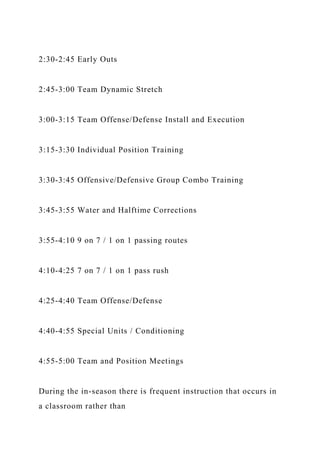
also assist in refurbishing and
purchasing training equipment, maintaining safe practice
facilities, help cover the costs of player
recognition awards and banquets, as well as the many other
costs that a program can incur.
Fundraising for athletic programs can be done in various ways
including golf tournaments, silent
auctions, raffles, casino nights, and Christmas tree sales.
Participation in the booster club is a positive way that parents
can be encouraged to be
involved as active stake holders in the athletic program with a
clear understanding of their role
and expectations. Booster clubs can also assist in the
management of other areas of the program
such as organizing and hosting team functions and managing the
budget. It is important that a
head coach encourage parents to participate in booster clubs due
to the fundraising and
organizational efforts the can provide, and the positive
participation it affords parents through a
constructive role, and specific area in which they can focus
their support.
Building Relationships
It is important that the head coach incorporate community
outreach and service learning
as part of the developmental education that sports provide. A
head coach can promote the
importance of building relationships by involving the team in
service oriented activities. The
head coach should build relationships between his program and
other organizations through an
“adopt a cause” effort. Relationships can be built through
community and service outreach
wherein the players and coaches select an organization to
support. The program can then show
support through service fund-raising specifically for the
organization, as well as volunteering
team time and effort to it.
It is also important for the coach to build relationships with the
parents of players on the
team through clearly established roles and communication
expectations. A coach must keep
parents informed regarding how their son will be treated in the
program, how playing time is
determined and what guidance and support the program will
provide their son. Communication
processes must be clearly established between parents and
coaches. Parents must understand the
appropriate times, places, and methods to initiate
communication.
Parents should be made aware of certain topics that will not be
discussed. For example, a
coach should never discuss an athlete with a booster club
member other than the player’s parent
or guardian. Parents must also understand that communication
with coaches must focus on their
role as boosters and not on competitive strategies, playing time,
or practice planning. Coaches
should also make efforts to make positive communications to
parents. A head coach should try to
make contact with as many parents as possible to express
something positive about their son at
least once during the off-season and whenever possible during
the competitive season.
Head coaches can also facilitate the support and participation of
assistant coaches in this
effort. A head coach must take precautions to ensure that
parents understand that their role in the
athletic program is to support the team, their son or daughter,
and the entire program, while the
coach’s role is to coach, and the player’s role is to play.
Coaches can communicate these roles
and expectations through handouts, letters, and parent
informational meetings.
College Coaches
As a collegiate football coach at the community college level,
it is important to have a
clear philosophy regarding recruiting and understanding of the
recruiting process. A head coach
of a community college should maintain the philosophy of
recruiting the local player. It is illegal
for coaches at the community college level to initiate contact
with out of state players. The
athlete must make contact with the head coach first and should
have a natural reason to come to
the school. Some junior colleges have many players in
apartments and do not follow the
appropriate recruiting protocol. An ethical recruiting philosophy
at this level will follow the rules
and procedures for recruiting, rather than break or bend the
rules in the attempt to obtain better
athletes.
The recruiting process should begin with the coach seeing the
player perform in
competition either live or online. The next step in the process is
to rank the player in respect to
his ability to compete at the community college level. An
effective way to rank recruits is to
label them as “red” if they will be a starter and potential four-
years prospect, “yellow” if they
may take year or two to progress into a starter or their four-year
ability is questionable, or
“green” if they are someone who is predicted to be unable to
start at the collegiate level. When
players are ranked as “red” then the head coach should make
contact and attempt to set up a
meeting with the player. If the athlete is on time for the
meeting, seems like a good fit with the
program, and the parents are supportive of the student-athlete
attending the school then they
should remain “red” as the recruiting process continues. If an
athlete who is initially ranked as a
“red” player doesn’t show up for the meeting, won’t return
phone calls or text messages, or if
something is odd at the meeting then he may drop to “yellow”
depending on the issue. If
problems persist, then the coach may choose to stop recruiting
that specific athlete.
Common examples of actions that could cause an athlete who is
initially ranked as a
“red” recruit to be dropped to “yellow” or cease to be recruited
entirely could be leaving
headphones on during a meeting, checking a phone numerous
times during a meeting, not
showing up for the meeting at all, or lying to the coach.
Although a coach’s tolerance for such
behavior may vary slightly from player to player dependent on
his performance ability, a coach
must not compromise his philosophy or values in the
recruitment of an individual player or he
may jeopardize the integrity of his entire program. There are
many collegiate programs that will
compromise integrity, ethics, and values in an effort to recruit
the best athletes. A sound
recruiting philosophy for a community college should be
designed to help the local athlete and
the few others who have relatives living nearby, be founded in
ethical standards, and remain
consistent to its philosophy regardless of the practices of other
schools. Ethical practices and
philosophical integrity must be exhibited, not only in such
recruiting efforts, but in every aspect
of a successful organization if it is to remain consistent to its
vision of developing the complete
student-athlete in the pursuit of competitive success.
CHAPTER VI: PROGRAM DEVELOPMENT CHECKLIST for
COACHES
Format Requirements:
1. Times New Roman – 12 pt font
2. Double spaced
3. Margins: 1” right, left, top and bottom
4. Two-line heading (in bold) on first page of text
5. Citations in APA format
6. THIRD PERSON – no “I” “me” “my” “we” “you” “your”
“our” etc.
7. NO bold, italics, underline in text
8. Subheadings must be bold and flush left
THIS CHAPTER IS A DESCRIPTION OF AN EXEMPLARY
SPORT PROGRAM
Chapter VI Program Development:
A. Must be 15-25 pages in length
B. The following topics and subheadings may be included
Introduction
Organization
This section should include organizational factors such as:
Communication to athletes, parents, coaches
Playbooks, master schedules, posting schedules
Important dates, master checklists and expectations for players,
coaches, parents
Organizational chart for reporting responsibilities for coaches,
trainers and support staff
Team Practice
This section should include:
List the drills used in practices; duration of drills; rotation of
drills
Verbal instruction vs. time spent on the drill or technique
Variations and rotations of drills & practices
Efficient use of practice time
Small group vs. large/whole group practice and instruction
Instruction in classroom/off field or court
Conditioning drills: frequency & rationale for conditioning
In season and off out-of-season nutrition; flexibility; strength
conditioning
Coaching behaviors
Methods/strategies to get, hold, the focus/attention of the
athletes (i.e. voice or whistle)
Teaching fast vs. slow learners
Provide for the dignity of players who require more
help/coaching
Flexibility during practice/adjustments to practice plan
Unacceptable coaching behaviors
Growth and Well-Being of Athletes
Ensure the care and prevention of athletic injuries
Demonstrate/model appropriate behavior regarding sound
chemical health
Expectations for players during the season; in the classroom;
school; community; off-season
Strategies to change inappropriate attitudes and behaviors; how
and when
Procedures to insure athletes are students first, achieving the
best grades
Coaching Staff
Methods to raise the level of expertise within coaching staff
Meetings: frequency, purpose, topics, etc.
Behaviors on game day; before and after the game
Explain positive coaching vs. demanding behaviors
Positive reinforcement for learning & player behaviors
Identifying the opposing team’s strengths, weaknesses and
tendencies
Keys for individual and team motivation
Character Development
Describe what athletes with “good character” look like
Blueprint for behavior that demonstrates behavior expectations
for athletes
How to: correct (confront) a behavior; remove a player from
practice; dismiss player from the game; remove a player from
the team
Explain what will you compromise and what you will never
compromise
Methods to reinforce good character traits: posters, speakers,
awards, themes
Qualities of a great team
Strategies to mold the team into a single unit
Fundraising and Boosters
Fundraisers for program/team
Describe the organization/expectations of a booster club
Building Relationships
Team involvement in the community & service learning
Role of parents in athletics & methods to communicate
expectations
Recruiting Practices (this is for college coaches only!)
Identifying high school or transfer athletes that would be a good
fit for the institution
Describe recruitment process
CHAPTER VI: PROGRAM DEVELOPMENT CHECKLIST for
AN ATHLETIC DIRECTOR
Format Requirements:
1. Times New Roman – 12 pt font
2. Double spaced
3. Margins: 1” right, left, top and bottom
4. Two-line heading (in bold) on first page of text
5. APA citation & reference format (if applicable)
6. THIRD PERSON – no “I” “me” “my” “we” “you” “your”
“our” etc.
7. NO bold, italics, underline in text
8. Subheadings must be bold and flush left
Chapter VI Program Development:
A. Must be 15-25 pages in length
B. The following topics and subheadings may be included
CHAPTER VI PROGRAM DEVELOPMENT MUST DESCRIBE
THE FUNCTIONS AND ROLE OF THE ATHLETIC
DEPARTMENT AND THE ATHLETIC DIRECTOR
THE FOLLOWING HEADINGS AND SUBHEADINGS MAY
BE INCLUDED:
Introduction
Give an overview of what this chapter will include.
Organization of the office
Create a work-flow chart of the ideal office ( This could be an
appendix item)
What will the layout of the office be that promotes ideal
working conditions? Will there be conference rooms/ white
boards/ video monitors
Communication
Identify the Mission of the Athletic Department – Where will
this be displayed or published?
What type of culture do you want your Athletic Department to
have?
What interpersonal skills and leadership style are most
effective?
How will you use social media, phone, texting, video tools,
apps, websites to effectively communicate?
Leadership
What leadership skills does an effective administrator need and
how would those be implemented?
Staffing: Hiring of coaches, athletic trainers, support personnel,
etc.
Best practices for hiring
Include what skill set for each staff member that an AD should
consider for each staff position
What will the Administrative Assistant roles and
responsibilities be?
What core values do you want your staff to possess?
How will you address personal problems/issues?
Department meetings: frequency, purpose, etc.
What are the benefits to meeting as a department?
What policies and procedures are important to address and
revisit throughout the year?
Describe the type of meetings- formal/informal
Include a sample of what an agenda might look like for a
meeting (appendix item)
What other type of meetings might the AD need to attend and
report back to the staff about?
Parent Engagement
What are the benefits of parent inclusion?
How can you create an atmosphere for positive parent
engagement?
Will there be parent volunteers for games/concession stands?
What will the standards be for parent conduct?
How can you encourage parents of the community to bond and
support the athletic programs? How can you create parent
advocates for various athletic programs?
Will any end of season events be planned for closure and to
honor athletes and how will parents be involved?
Discipline and Codes of Behavior
What discipline and codes of behavior will be set for student
athletes, staff and parents?
What standards of behavior will be in place?
How will this be modeled?
What formal disciplinary actions are there? How will they be
implemented?
What documentation might be needed? Will there be a code of
conduct agreement form? (This could be an appendix item)
Scheduling of Athletic Facilities
Determine what facilities are available
How to address overbooking issues
Determining what teams need what facilities during various
times of the year
Will a master calendar be used and if so how will it be
implemented? (Create a master calendar as a sample- This could
be an appendix item)
Game Day Preparations
Before the game
Topics may include: facility check for hazards, physicals on file
for athletes, eligibility records checked, equipment check,
media coverage, officials are scheduled, snack bar coverage,
security, ticket takers, National Anthem, announcers,
scoreboard condition, PA system, bleachers, water coolers,
athletic trainer, physician on duty, buses
After the game
Topics may include: Field, bleacher clean up, close facility
bathrooms, locker rooms, concessions, store equipment,
Deposit game receipts and ticket money
Create a checklist to use to keep track of duties(this could be
included in the appendix)
Coach Evaluations
Discuss the value and purpose of evaluations. What goal setting
might be included? When will evaluations be given? Discuss
some of the evaluations to consider:
Head Coach Evaluation
Assistant Coach Evaluation
Coach Self Evaluation
Athlete Evaluation of Coach
Administrator Evaluation of Coach
Maintenance of Athletic Fields, Courts, Weight Room
Safety Concerns/ Inspections/ Cleaning Routines
Budget and Funding
Booster Clubs
Types of fundraising and best practices for holding a
fundraising event
Understanding funds available to operate programs
Identify sources of revenue and expenses
Purchase approval process
Representation at Conference, District, State; Memberships &
Professional Participation
Include state and national associations that are recommended to
join, benefits to members, educational opportunities provided,
importance of networking and career development
Relationships with school administrators and faculty
How to encourage school/faculty involvement with athletic
programs
How to demonstrate support toward faculty members and the
importance of academics for athletes
1
2
Insert Title of Portfolio Here
Presented in Partial Fulfillment of Requirements
For the Degree of
Master of Arts in Coaching and Athletics Administration
In
The School of Professional Studies
by
Insert Your Name
Concordia University-Irvine
________________
Graduate Advisor
________
Approval Date
Table of Contents
Chapter
Page Number
Acknowledgements
PREFACE
I. Statement of Purpose
#
II. Philosophy of Coaching Athletics
#
III. Research Methods and Analysis
#
IV. Ethics and Sportsmanship
#
V. Legal Aspects and Considerations
#
VI. Program Development
#
VII. Elective
#
VIII. Elective
#
IX. Closing Statement
#
Appendices
A. Current Resume
B. Course Descriptions
C. References
D. Three Recent Letters of Recommendation
E. Risk Management Plan
F. Fourteen Legal Duties
G. Any additional documents, projects, etc.
Acknowledgements
Chapter I
Statement of Purpose
(Level 1 heading)
Centered, Boldface, Upper and Lowercase Heading
Subheading Title (Level 2 heading)
Subheadings begin with capital letters for each part of the title
of the subheading.
They are boldface and flush left.
Additional subheadings.(Level 3 headings)
Any additional subheadings are indented, they are in boldface,
only the first letter
is capitalized and the headings ends with a period.
Appendix A
Resume
This is the format for your Appendix headings. Below the
heading is the title of the Appendix and below the title is the
content.
1
MASTER OF ARTS IN COACHING AND ATHLETICS
ADMINISTRATION
MCAA 595 – Professional Portfolio Assessment
This form is submitted with your final e-file of your portfolio .
You are responsible for keeping track of approval dates from
your advisor.
Name of Student_____________________ Name of
Advisor__________________________
Editor
The editor will be responsible for correcting typos, spelling
errors, run on sentences, grammar errors and checking for APA
format.
· The student has selected an editor and provided the advisor the
editor’s contact information (name email and phone #)
· The student has sent an email to their editor and provided their
editor the document Culminating Project Guide Format and
APA.
· The student first submitted chapters to the editor before the
portfolio advisor reviewed
date approved_______________________
Title page format
· Follows sample posted in Blackboard
date approved_______________
Table of Contents (Follows the sample in the Sample Portfolio
Format)
· The student has included a minimum of nine chapters
· The required Appendices are listed in the following order and
labeled
A. Resume
B. Course Descriptions
C. References
D. Three Letters of Recommendation
E. Risk Management Plan
F. Fourteen Legal Duties
· The page numbers on the table of contents match the page
numbers of the document
date approved________________
Acknowledgments
· This is listed on the Table of Contents as the PREFACE and is
placed after the Table of Contents but before Chapter I.
· This is a minimum of one page which includes who you would
like to thank during your experience in the MCAA program that
has supported you and who has impacted you during your
coursework. This may include but is not limited to your family,
friends, other students, your athletes, coaches, administrators,
co-workers, instructors
date
approved_______________
CHAPTERS I-IX
Chapter I: Statement of Purpose Criteria (minimum 2 pages)
· This statement announces the purpose, scope and direction of
the portfolio
· The specific focus serves as the portfolio’s title. The title
“Professional Portfolio” will not be acceptable. There must be a
specific title. For example, “Building a Successful High School
Football Team”
· The purpose of the portfolio is explained and the student has
identified what he or she wants conveyed to the reader. This
will most likely include who you are and what you are going to
demonstrate in this portfolio.
· There is a clear purpose statement (thesis sentence) that
demonstrates what the statement of purpose will be at the
conclusion of this chapter.
· The student may also include a brief summary of what each
chapter will cover.
date approved________________
Chapter II : Philosophy of Coaching (minimum 4 pages- 2
references)
The student describes his or her personal coaching and
leadership philosophy that will guide their work as a coach of a
team or as an athletic director of their school’s athletic
program. The following must be included and described in
detail:
· Mission Statement for the student’s team or program
· Vision Statement for the student’s team or program
· Core Values that the student strives to infuse in their team or
program that will make their leadership distinctive
· The student’s leadership style is included which describes his
or her coaching of: command, submissive, cooperative,
transformational, transactional.
· The philosophy is supported by a minimum of two references
· The philosophy demonstrates growth over the course of the
MCAA program.
date approved________________
Chapter III: Research Methods and Analysis (minimum 5 pages-
2 references)
· This chapter will begin with why you decided to include this
research in your portfolio and an introduction to research will
be given. Your final project from MCAA 550 will be included.
Formatting must match other chapters of the portfolio. Chapter
heading is bold and centered and subheadings are bold flush
left. Use the following format for Chapter III.
Chapter III
Research Methods and Analysis
Introduction
Statement of the Problem
Review of the literature
Methodology
Terms and assumptions.
Population and sample.
Research design.
Data collection.
Instruments.
Reliability and validity of the instruments.
Reliability and validity of the methodology.
Data analysis.
Anticipated Findings
Implications for the Profession
date approved__________________________
Chapter IV: Ethics and Sportsmanship Criteria (minimum 9
pages- 2 references)
NOTE* Requirements for students enrolled in MCAA 530
Ethics and Sport prior to Fall 2016
The following are included:
· An introduction which describes the current status of ethics in
sport and the relationship between ethics and how it relates to
your current job or career, how you feel it is important
· A protocol is included which demonstrates what the student
does when an ethical situation arises. The student may reflect
on his or her morals or beliefs, questions he or she may ask
when placed in the situation and how they will best handle it.
· The ethical dilemma analysis from MCAA 530 must be
included within the chapter.
date approved_____________________
Chapter IV: Ethics and Sportsmanship Criteria (minimum 4
pages - 2 references)
NOTE* Requirements for students enrolled in MCAA 530
Ethics and Sport Fall 2016 to present
The following are included:
· An introduction which describes the role of Christian virtues
and civic responsibilities for the coach, athletic administrator
and leader in athletics.
· A definition, explanation and example of 3-4 of the Christian
virtues or civic responsibilities following the subheading for
each.
· An application of each virtue/responsibility to coaching or
athletic administration.
date approved_____________________
Chapter V: Legal Aspects and Considerations (minimum 3
pages- 2 references)
· An introduction is included which discusses legal aspects and
sport and why it is important to know as a coach or athletic
administrator who is working with athletes, parents or school
districts
· A description is included of what a risk management plan is.
· At least 2 legal duties of a coach or athletic administrator are
further clarified. These duties are explained and a description is
included of how they relate to risk management and specifically
to the student’s role as a coach/administrator as well as the
main objective of the portfolio
· The student refers the reader to the 14 Legal Duties in
Appendix F within the chapter. (All fourteen legal duties are
listed and explained in the Appendix)
· The student refers the reader to the risk management plan in
the Appendix
(This student includes the actual RMP from
MCAA 580 in his or her Appendix)
date approved______________________
Chapter VI: Program Development-(minimum 15 pages- 2
references)
· See Chapter VI Program Development tab in Blackboard for
detailed requirements, instructional video and sample papers.
· The student followed either the coaching or athletic director
Program Development Checklist.
· Students may use the Personal Management Model Project
from MCAA 510 in the Appendix to expound on behavioral
expectations, communication, community and parent interaction
and development of the athlete within the program.
date
approved______________________
Chapters VII and VIII are based on elective courses taken in the
program as a chapter topic. If the student took any sport
specific classes, only one sport specific course may be included.
Please see below for elective course content. These chapters
require a minimum of 3 pages and 2 references.
Chapter VII Approval Date:__________________
Chapter VIII Approval Date: _________________
MCAA 520 Psychology of Coaching-(minimum 3 pages- 2
references)
· The student describes how the principles of psychology are
applied in a coaching environment
· The student may include any or all of the following: principles
of motivation, confidence building, competitive anxiety,
communication skills, group processes, emotional growth,
techniques for creating effective teams, building positive
cohesion, relaxation techniques, the use of imagery,
concentration and control strategies
· The student will include their Final Mental Training Program
in the Appendix and refer to it within the chapter.
MCAA 540 Sport Technologies-(minimum 3 pages- 2
references)
· The student describes how technology has changed over the
years and how this affects him or her as a coach or
administrator.
· Technology skill strength is included which demonstrates how
the student applies those skills to his or her individual sport.
For example, the student my include a link to an instructional
youtube video.
· The student may include any or all of the following: the role
of video analysis in his or her career, electronic methods for
scouting, preparing his or her team, how communication is
conducted electronically to players/family/fans/administration,
the use of Social media and what those implications may be
MCAA 560 Leadership and Administration-(minimum 3 pages-
2 references)
· The student will include any or all of the following topics:
Principles of leadership, organization and management of sport
programs, leadership strengths skills and techniques, ways of
communicating with staff, scheduling and program reviews
· The final project is in the Appendix and the student has
summarized and referred to the project within the chapter
MCAA 561 Athletic Finance: -(minimum 3 pages- 2 references)
· The student included what finance is and why it is important
to be able to manage a budget, fundraising and boosters.
· Strategic plans are included that explain how the student
would balance the budget and take care of the programs
finances.
· The student describes how to market his or her program
· The student determines when purchases are made
· The student will include their Budget Analysis Project in the
Appendix and refer to it within the chapter.
MCAA 562 Facility Planning and Event Management-(minimum
3 pages- 2 references)
· Details of how to develop a new sport facility will be
included, how to renovate an existing facility as well as how to
manage sport venues specifically for your sport.
· The student put their Comprehensive Facility Plan Project in
the Appendix and referred to it within the chapter.
MCAA 563 Intercollegiate Athletics in America(minimum 3
pages- 2 references)
· Demonstrate in this chapter how athletic administrators take
the next step to leadership excellence. Discuss the seven key
areas of administration and include how administrators
implement various leadership skills into their departments.
Discuss branding and what key aspects support an athletic
program.
· The student put their Professional Development Plan in the
Appendix and referred to it within the chapter.
MCAA 570 Sport Medicine and Performance-(minimum 3
pages- 2 references)
· The student includes an introduction to their injury to
rehabilitation research paper and how it relates to the student’s
portfolio as well as why this piece was chosen to include in the
portfolio.
· The injury to rehabilitation research paper may be used within
the chapter however complete sentences must be used. Outlines
and lists are not acceptable for chapter content and proper APA
formatting must be used.
MCAA 573 ATS for Coaching Basketball minimum 3 pages- 2
references)
· The student will include the Basketball Program and Offensive
and Defensive Systems Paper which covers specifically three
areas
· Developing a Basketball Program
· Offensive Principals/System
· Defensive Principals/System
MCAA 574 ATS for Coaching Football (updates as of Su 18/ Fa
18)
· The final week 11 project will be comprised of a power point
presentation and a three-four page (minimum) summary paper
with at least two direct quotes. The paper may be used as a
chapter in MCAA 595 for the Culminating Project/Portfolio.
The power point will be included in the appendices of the
portfolio.
MCAA 585 Strength, Speed and Conditioning-(minimum 3
pages- 2 references)
· The student included the best methods to implement for
successful training in his or her sport.
· The student included his or her training principles that need to
be followed in his or her sport and program as well as the
different types of training for strength. Topics may include:
what type of training the student believes in, Periodization
method? Olympic Lifting? Resistance Training? Defining and
developing the role of plyometric and sprint training and the
role of nutrition.
· The entire year long strength and conditioning project is
inserted in the Appendix.
A summary of the project may be included
within the chapter.
MCAA 582 Women and Sports- (minimum 5 page paper with
two references)
· Students will use the final paper from the course on a topic of
their choice. This topic must have been approved by the 582
instructor.
MCAA 586 Advanced Strength, Speed and Conditioning-
(minimum 3 pages- 2 references)
· Students will create a three page paper with at least two
academic references based on responses to several of the labs
created in the course which cover key principles related to test
selection, administration, scoring and interpretation.
MCAA 592 Internship- (minimum 4 pages with two scholarly
sources)
· The student includes a reflection paper which demonstrates
knowledge of an athletic program, best practices and
experiences in athletic leadership, and how quality management
can impact the quality of services.
· Students will express how athletic staff and management
interact, what works well, and what appear to be challenges.
· Though the paper is a reflection, APA style is required. First
person is permissible.
Sport Specific Classes (min. 3 pages- 2 references)
· An overview of the sport and main topics are to be included
within the chapter
· The Appendix should include the class project
Chapter IX: Closing Statement (minimum 2 pages)
· This chapter concludes the portfolio and refers back to the
statement of purpose
· The student included their overall experience in the MCAA
program and how this portfolio will be utilized in the future
· The student may include any other concluding remarks about
the curriculum and experience during the MCAA program. Have
any changes occurred or new discoveries made about themselves
personally and as a coach? Have any challenges or joys over the
course of their studies?
Student participation responsibilities:
· By week three the student has submitted a minimum of the
title page, table of contents,acknowledgements and Chapter I.
· The student has kept in weekly communication with the
portfolio advisor throughout the term and has completed the 2
minimum phone conferences.
· The student has notified the advisor when assignments will be
turned in late.
Content for Chapters 1-9
· The student has followed all min. page number requirements
per chapter
· Third person APA writing is required with the exception of the
Acknowledgments, Chapters I and II and Chapter IX. First
person is permissible in other chapters but to a limited degree.
The student used third person APA writing except in the above
mentioned sections. Other chapters used first person to a limited
degree.
· Each chapter relates and refers back to the main focus that is
stated in the Statement of Purpose
· Each chapter has an introductory sentence which relates back
to the previous chapter
· Each chapter has a concluding sentence which concludes the
current chapter
· Anything additional which the student decides to include
which is listed in the appendices such as a project, paper, power
point slide is referred to in the body of the chapters
· The format for each chapter is professionally written.
Complete sentences are included. Lists, outlines etc. are not
included in the chapter portion of the portfolio only in the
appendices.
· Chapters II- VIII contain a minimum of two sources/references
per chapter.
Content for Appendices
Each Appendix is labeled with a capital letter at the top of the
Appendix page
The following appendices are included
A. Resume date approved_________
The resume is updated and professional
B. Course Descriptions date approved_________
Only courses the student took are listed.
Course number, title, and description
is included
C. References date approved__________
References from the portfolio within the
chapter portions only are listed. They
are alphabetized and follow APA format.
D. Three Letters of Recommendation date
approved____________
These letters are to be written for a possible
position that you might get in the
future. They must be professional and may
be addressed as “To Whom It May Concern”. They
must be recent- no more than 2 years old.
E. Risk Management Plan (mentioned in Chapter V) date
approved_______
The student has included their RMP from
MCAA 580
F. Fourteen Legal Duties (mentioned in Chapter V) date
approved________
The student has included a list of the
fourteen legal duties with a brief
description of each duty. This was a handout
received in MCAA 580 Legal
Aspects of Sport.
G. Any additional projects, papers, power point slides, awards
etc.
REMINDER: If you include these
additional items they MUST be mentioned
in the body of the portfolio (chapters 1-9)
date approved_____________
REQUIRED APA STRUCTURE FOR ALL PAPERS IN MCAA
PROGRAM
1. Use one-inch (1”) margins on all sides of the document.
2. Use Times New Roman font in the 12-point size throughout
the paper.
3. Double-space each line within the text, reference list,
appendices, footnotes, and tables.
4. Do not add an extra line space between a heading and a
paragraph or between paragraphs. The beginning of a new
paragraph is indicated by the indentation (one tab space) and
adding an extra line space is redundant.
5. Level one headings are centered and bolded. Level two
headings are placed at the left margin and bolded.
6.Pagination should be 1 inch from the edge of the page on the
right and approximately 0.5 inches from the top. (Use the
header feature in Microsoft Word to set the page number).
7.Do not use a “running head” on any paper.
8. Use two (2) spaces after all punctuation at the end of a
sentence.
9. Use numerals to express numbers 10 and above, and words
for numbers nine and below.
10. Abstracts are not needed on any papers.
11.Most formal writing uses the third person point of view to
make ideas sound less subjective and remove direct reference to
the writer. For example, "Researchers first need to determine
participants" (third person) conveys a more formal, objective
tone than "You first need to determine participants" (second
person) and "I first needed to determine participants" (first
person). However, third person may not always be appropriate
in APA papers. When describing activities you performed in
your research or when third person language may confuse the
reader, use first person instead. For example, you may use the
first person point of view when discussing your research steps
(“I studied…”) and when referring to yourself and your co-
authors (“We examined the literature…”).
12.Your reference list should only include sources that you cite
in the body of your paper.
13.If you cite a reference, you are tacitly certifying that you
have read the entire journal article or pertinent book chapter(s),
are familiar with the contents, and have evaluated the substance
of the work in terms of your task.
14.A block quotation is used for a direct quote of over 40 words
in length. These quotations are indented one tab space and do
not contain quotation marks and the punctuation comes at the
end of the sentence rather than after the citation.
15.Use contractions very sparingly in scholarly writing.
FINAL STEPS:
· If both the Instructor and Portfolio Advisor approve the final
file, the student is responsible for submitting the final file and
signed cover page to blackboard
· The final approved file must also be submitted to MCAA
Administrative Assistant Emily Lathrop [email protected] to
archive in the MCAA department to meet graduation
requirements
· The student is responsible for submitting the Professional
Portfolio Assessment Form to Blackboard once the final file has
met all criteria.
05/08/18
CHAPTER VI: PROGRAM DEVELOPMENT CHECKLIST for
COACHES
Format Requirements:
1. Times New Roman – 12 pt font
2. Double spaced
3. Margins: 1” right, left, top and bottom
4. Two-line heading (in bold) on first page of text
5. Citations in APA format
6. THIRD PERSON – no “I” “me” “my” “we” “you” “your”
“our” etc.
7. NO bold, italics, underline in text
8. Subheadings must be bold and flush left
THIS CHAPTER IS A DESCRIPTION OF AN EXEMPLARY
SPORT PROGRAM
Chapter VI Program Development:
A. Must be 15-25 pages in length
B. The following topics and subheadings may be included
Introduction
Organization
This section should include organizational factors such as:
Communication to athletes, parents, coaches
Playbooks, master schedules, posting schedules
Important dates, master checklists and expectations for players,
coaches, parents
Organizational chart for reporting responsibilities for coaches,
trainers and support staff
Team Practice
This section should include:
List the drills used in practices; duration of drills; rotation of
drills
Verbal instruction vs. time spent on the drill or technique
Variations and rotations of drills & practices
Efficient use of practice time
Small group vs. large/whole group practice and instruction
Instruction in classroom/off field or court
Conditioning drills: frequency & rationale for conditioning
In season and off out-of-season nutrition; flexibility; strength
conditioning
Coaching behaviors
Methods/strategies to get, hold, the focus/attention of the
athletes (i.e. voice or whistle)
Teaching fast vs. slow learners
Provide for the dignity of players who require more
help/coaching
Flexibility during practice/adjustments to practice plan
Unacceptable coaching behaviors
Growth and Well-Being of Athletes
Ensure the care and prevention of athletic injuries
Demonstrate/model appropriate behavior regarding sound
chemical health
Expectations for players during the season; in the classroom;
school; community; off-season
Strategies to change inappropriate attitudes and behaviors; how
and when
Procedures to insure athletes are students first, achieving the
best grades
Coaching Staff
Methods to raise the level of expertise within coaching staff
Meetings: frequency, purpose, topics, etc.
Behaviors on game day; before and after the game
Explain positive coaching vs. demanding behaviors
Positive reinforcement for learning & player behaviors
Identifying the opposing team’s strengths, weaknesses and
tendencies
Keys for individual and team motivation
Character Development
Describe what athletes with “good character” look like
Blueprint for behavior that demonstrates behavior expectations
for athletes
How to: correct (confront) a behavior; remove a player from
practice; dismiss player from the game; remove a player from
the team
Explain what will you compromise and what you will never
compromise
Methods to reinforce good character traits: posters, speakers,
awards, themes
Qualities of a great team
Strategies to mold the team into a single unit
Fundraising and Boosters
Fundraisers for program/team
Describe the organization/expectations of a booster club
Building Relationships
Team involvement in the community & service learning
Role of parents in athletics & methods to communicate
expectations
Recruiting Practices (this is for college coaches only!)
Identifying high school or transfer athletes that would be a good
fit for the institution
Describe recruitment process
CHAPTER VI: PROGRAM DEVELOPMENT CHECKLIST for
AN ATHLETIC DIRECTOR
Format Requirements:
1. Times New Roman – 12 pt font
2. Double spaced
3. Margins: 1” right, left, top and bottom
4. Two-line heading (in bold) on first page of text
5. APA citation & reference format (if applicable)
6. THIRD PERSON – no “I” “me” “my” “we” “you” “your”
“our” etc.
7. NO bold, italics, underline in text
8. Subheadings must be bold and flush left
Chapter VI Program Development:
A. Must be 15-25 pages in length
B. The following topics and subheadings may be included
CHAPTER VI PROGRAM DEVELOPMENT MUST DESCRIBE
THE FUNCTIONS AND ROLE OF THE ATHLETIC
DEPARTMENT AND THE ATHLETIC DIRECTOR
THE FOLLOWING HEADINGS AND SUBHEADINGS MAY
BE INCLUDED:
Introduction
Give an overview of what this chapter will include.
Organization of the office
Create a work-flow chart of the ideal office ( This could be an
appendix item)
What will the layout of the office be that promotes ideal
working conditions? Will there be conference rooms/ white
boards/ video monitors
Communication
Identify the Mission of the Athletic Department – Where will
this be displayed or published?
What type of culture do you want your Athletic Department to
have?
What interpersonal skills and leadership style are most
effective?
How will you use social media, phone, texting, video tools,
apps, websites to effectively communicate?
Leadership
What leadership skills does an effective administrator need and
how would those be implemented?
Staffing: Hiring of coaches, athletic trainers, support personnel,
etc.
Best practices for hiring
Include what skill set for each staff member that an AD should
consider for each staff position
What will the Administrative Assistant roles and
responsibilities be?
What core values do you want your staff to possess?
How will you address personal problems/issues?
Department meetings: frequency, purpose, etc.
What are the benefits to meeting as a department?
What policies and procedures are important to address and
revisit throughout the year?
Describe the type of meetings- formal/informal
Include a sample of what an agenda might look like for a
meeting (appendix item)
What other type of meetings might the AD need to attend and
report back to the staff about?
Parent Engagement
What are the benefits of parent inclusion?
How can you create an atmosphere for positive parent
engagement?
Will there be parent volunteers for games/concession stands?
What will the standards be for parent conduct?
How can you encourage parents of the community to bond and
support the athletic programs? How can you create parent
advocates for various athletic programs?
Will any end of season events be planned for closure and to
honor athletes and how will parents be involved?
Discipline and Codes of Behavior
What discipline and codes of behavior will be set for student
athletes, staff and parents?
What standards of behavior will be in place?
How will this be modeled?
What formal disciplinary actions are there? How will they be
implemented?
What documentation might be needed? Will there be a code of
conduct agreement form? (This could be an appendix item)
Scheduling of Athletic Facilities
Determine what facilities are available
How to address overbooking issues
Determining what teams need what facilities during various
times of the year
Will a master calendar be used and if so how will it be
implemented? (Create a master calendar as a sample- This could
be an appendix item)
Game Day Preparations
Before the game
Topics may include: facility check for hazards, physicals on file
for athletes, eligibility records checked, equipment check,
media coverage, officials are scheduled, snack bar coverage,
security, ticket takers, National Anthem, announcers,
scoreboard condition, PA system, bleachers, water coolers,
athletic trainer, physician on duty, buses
After the game
Topics may include: Field, bleacher clean up, close facility
bathrooms, locker rooms, concessions, store equipment,
Deposit game receipts and ticket money
Create a checklist to use to keep track of duties(this could be
included in the appendix)
Coach Evaluations
Discuss the value and purpose of evaluations. What goal setting
might be included? When will evaluations be given? Discuss
some of the evaluations to consider:
Head Coach Evaluation
Assistant Coach Evaluation
Coach Self Evaluation
Athlete Evaluation of Coach
Administrator Evaluation of Coach
Maintenance of Athletic Fields, Courts, Weight Room
Safety Concerns/ Inspections/ Cleaning Routines
Budget and Funding
Booster Clubs
Types of fundraising and best practices for holding a
fundraising event
Understanding funds available to operate programs
Identify sources of revenue and expenses
Purchase approval process
Representation at Conference, District, State; Memberships &
Professional Participation
Include state and national associations that are recommended to
join, benefits to members, educational opportunities provided,
importance of networking and career development
Relationships with school administrators and faculty
How to encourage school/faculty involvement with athletic
programs
How to demonstrate support toward faculty members and the
importance of academics for athletes
1
2
Insert Title of Portfolio Here
Presented in Partial Fulfillment of Requirements
For the Degree of
Master of Arts in Coaching and Athletics Administration
In
The School of Professional Studies
by
Insert Your Name
Concordia University-Irvine
________________
Graduate Advisor
________
Approval Date
Table of Contents
Chapter
Page Number
Acknowledgements
PREFACE
I. Statement of Purpose
#
II. Philosophy of Coaching Athletics
#
III. Research Methods and Analysis
#
IV. Ethics and Sportsmanship
#
V. Legal Aspects and Considerations
#
VI. Program Development
#
VII. Elective
#
VIII. Elective
#
IX. Closing Statement
#
Appendices
A. Current Resume
B. Course Descriptions
C. References
D. Three Recent Letters of Recommendation
E. Risk Management Plan
F. Fourteen Legal Duties
G. Any additional documents, projects, etc.
Acknowledgements
Chapter I
Statement of Purpose
(Level 1 heading)
Centered, Boldface, Upper and Lowercase Heading
Subheading Title (Level 2 heading)
Subheadings begin with capital letters for each part of the title
of the subheading.
They are boldface and flush left.
Additional subheadings.(Level 3 headings)
Any additional subheadings are indented, they are in boldface,
only the first letter
is capitalized and the headings ends with a period.
Appendix A
Resume
This is the format for your Appendix headings. Below the
heading is the title of the Appendix and below the title is the
content.
1
MASTER OF ARTS IN COACHING AND ATHLETICS
ADMINISTRATION
MCAA 595 – Professional Portfolio Assessment
This form is submitted with your final e-file of your portfolio .
You are responsible for keeping track of approval dates from
your advisor.
Name of Student_____________________ Name of
Advisor__________________________
Editor
The editor will be responsible for correcting typos, spelling
errors, run on sentences, grammar errors and checking for APA
format.
· The student has selected an editor and provided the advisor the
editor’s contact information (name email and phone #)
· The student has sent an email to their editor and provided their
editor the document Culminating Project Guide Format and
APA.
· The student first submitted chapters to the editor before the
portfolio advisor reviewed
date approved_______________________
Title page format
· Follows sample posted in Blackboard
date approved_______________
Table of Contents (Follows the sample in the Sample Portfolio
Format)
· The student has included a minimum of nine chapters
· The required Appendices are listed in the following order and
labeled
A. Resume
B. Course Descriptions
C. References
D. Three Letters of Recommendation
E. Risk Management Plan
F. Fourteen Legal Duties
· The page numbers on the table of contents match the page
numbers of the document
date approved________________
Acknowledgments
· This is listed on the Table of Contents as the PREFACE and is
placed after the Table of Contents but before Chapter I.
· This is a minimum of one page which includes who you would
like to thank during your experience in the MCAA program that
has supported you and who has impacted you during your
coursework. This may include but is not limited to your family,
friends, other students, your athletes, coaches, administrators,
co-workers, instructors
date
approved_______________
CHAPTERS I-IX
Chapter I: Statement of Purpose Criteria (minimum 2 pages)
· This statement announces the purpose, scope and direction of
the portfolio
· The specific focus serves as the portfolio’s title. The title
“Professional Portfolio” will not be acceptable. There must be a
specific title. For example, “Building a Successful High School
Football Team”
· The purpose of the portfolio is explained and the student has
identified what he or she wants conveyed to the reader. This
will most likely include who you are and what you are going to
demonstrate in this portfolio.
· There is a clear purpose statement (thesis sentence) that
demonstrates what the statement of purpose will be at the
conclusion of this chapter.
· The student may also include a brief summary of what each
chapter will cover.
date approved________________
Chapter II : Philosophy of Coaching (minimum 4 pages- 2
references)
The student describes his or her personal coaching and
leadership philosophy that will guide their work as a coach of a
team or as an athletic director of their school’s athletic
program. The following must be included and described in
detail:
· Mission Statement for the student’s team or program
· Vision Statement for the student’s team or program
· Core Values that the student strives to infuse in their team or
program that will make their leadership distinctive
· The student’s leadership style is included which describes his
or her coaching of: command, submissive, cooperative,
transformational, transactional.
· The philosophy is supported by a minimum of two references
· The philosophy demonstrates growth over the course of the
MCAA program.
date approved________________
Chapter III: Research Methods and Analysis (minimum 5 pages-
2 references)
· This chapter will begin with why you decided to include this
research in your portfolio and an introduction to research will
be given. Your final project from MCAA 550 will be included.
Formatting must match other chapters of the portfolio. Chapter
heading is bold and centered and subheadings are bold flush
left. Use the following format for Chapter III.
Chapter III
Research Methods and Analysis
Introduction
Statement of the Problem
Review of the literature
Methodology
Terms and assumptions.
Population and sample.
Research design.
Data collection.
Instruments.
Reliability and validity of the instruments.
Reliability and validity of the methodology.
Data analysis.
Anticipated Findings
Implications for the Profession
date approved__________________________
Chapter IV: Ethics and Sportsmanship Criteria (minimum 9
pages- 2 references)
NOTE* Requirements for students enrolled in MCAA 530
Ethics and Sport prior to Fall 2016
The following are included:
· An introduction which describes the current status of ethics in
sport and the relationship between ethics and how it relates to
your current job or career, how you feel it is important
· A protocol is included which demonstrates what the student
does when an ethical situation arises. The student may reflect
on his or her morals or beliefs, questions he or she may ask
when placed in the situation and how they will best handle it.
· The ethical dilemma analysis from MCAA 530 must be
included within the chapter.
date approved_____________________
Chapter IV: Ethics and Sportsmanship Criteria (minimum 4
pages - 2 references)
NOTE* Requirements for students enrolled in MCAA 530
Ethics and Sport Fall 2016 to present
The following are included:
· An introduction which describes the role of Christian virtues
and civic responsibilities for the coach, athletic administrator
and leader in athletics.
· A definition, explanation and example of 3-4 of the Christian
virtues or civic responsibilities following the subheading for
each.
· An application of each virtue/responsibility to coaching or
athletic administration.
date approved_____________________
Chapter V: Legal Aspects and Considerations (minimum 3
pages- 2 references)
· An introduction is included which discusses legal aspects and
sport and why it is important to know as a coach or athletic
administrator who is working with athletes, parents or school
districts
· A description is included of what a risk management plan is.
· At least 2 legal duties of a coach or athletic administrator are
further clarified. These duties are explained and a description is
included of how they relate to risk management and specifically
to the student’s role as a coach/administrator as well as the
main objective of the portfolio
· The student refers the reader to the 14 Legal Duties in
Appendix F within the chapter. (All fourteen legal duties are
listed and explained in the Appendix)
· The student refers the reader to the risk management plan in
the Appendix
(This student includes the actual RMP from
MCAA 580 in his or her Appendix)
date approved______________________
Chapter VI: Program Development-(minimum 15 pages- 2
references)
· See Chapter VI Program Development tab in Blackboard for
detailed requirements, instructional video and sample papers.
· The student followed either the coaching or athletic director
Program Development Checklist.
· Students may use the Personal Management Model Project
from MCAA 510 in the Appendix to expound on behavioral
expectations, communication, community and parent interaction
and development of the athlete within the program.
date
approved______________________
Chapters VII and VIII are based on elective courses taken in the
program as a chapter topic. If the student took any sport
specific classes, only one sport specific course may be included.
Please see below for elective course content. These chapters
require a minimum of 3 pages and 2 references.
Chapter VII Approval Date:__________________
Chapter VIII Approval Date: _________________
MCAA 520 Psychology of Coaching-(minimum 3 pages- 2
references)
· The student describes how the principles of psychology are
applied in a coaching environment
· The student may include any or all of the following: principles
of motivation, confidence building, competitive anxiety,
communication skills, group processes, emotional growth,
techniques for creating effective teams, building positive
cohesion, relaxation techniques, the use of imagery,
concentration and control strategies
· The student will include their Final Mental Training Program
in the Appendix and refer to it within the chapter.
MCAA 540 Sport Technologies-(minimum 3 pages- 2
references)
· The student describes how technology has changed over the
years and how this affects him or her as a coach or
administrator.
· Technology skill strength is included which demonstrates how
the student applies those skills to his or her individual sport.
For example, the student my include a link to an instructional
youtube video.
· The student may include any or all of the following: the role
of video analysis in his or her career, electronic methods for
scouting, preparing his or her team, how communication is
conducted electronically to players/family/fans/administration,
the use of Social media and what those implications may be
MCAA 560 Leadership and Administration-(minimum 3 pages-
2 references)
· The student will include any or all of the following topics:
Principles of leadership, organization and management of sport
programs, leadership strengths skills and techniques, ways of
communicating with staff, scheduling and program reviews
· The final project is in the Appendix and the student has
summarized and referred to the project within the chapter
MCAA 561 Athletic Finance: -(minimum 3 pages- 2 references)
· The student included what finance is and why it is important
to be able to manage a budget, fundraising and boosters.
· Strategic plans are included that explain how the student
would balance the budget and take care of the programs
finances.
· The student describes how to market his or her program
· The student determines when purchases are made
· The student will include their Budget Analysis Project in the
Appendix and refer to it within the chapter.
MCAA 562 Facility Planning and Event Management-(minimum
3 pages- 2 references)
· Details of how to develop a new sport facility will be
included, how to renovate an existing facility as well as how to
manage sport venues specifically for your sport.
· The student put their Comprehensive Facility Plan Project in
the Appendix and referred to it within the chapter.
MCAA 563 Intercollegiate Athletics in America(minimum 3
pages- 2 references)
· Demonstrate in this chapter how athletic administrators take
the next step to leadership excellence. Discuss the seven key
areas of administration and include how administrators
implement various leadership skills into their departments.
Discuss branding and what key aspects support an athletic
program.
· The student put their Professional Development Plan in the
Appendix and referred to it within the chapter.
MCAA 570 Sport Medicine and Performance-(minimum 3
pages- 2 references)
· The student includes an introduction to their injury to
rehabilitation research paper and how it relates to the student’s
portfolio as well as why this piece was chosen to include in the
portfolio.
· The injury to rehabilitation research paper may be used within
the chapter however complete sentences must be used. Outlines
and lists are not acceptable for chapter content and proper APA
formatting must be used.
MCAA 573 ATS for Coaching Basketball minimum 3 pages- 2
references)
· The student will include the Basketball Program and Offensive
and Defensive Systems Paper which covers specifically three
areas
· Developing a Basketball Program
· Offensive Principals/System
· Defensive Principals/System
MCAA 574 ATS for Coaching Football (updates as of Su 18/ Fa
18)
· The final week 11 project will be comprised of a power point
presentation and a three-four page (minimum) summary paper
with at least two direct quotes. The paper may be used as a
chapter in MCAA 595 for the Culminating Project/Portfolio.
The power point will be included in the appendices of the
portfolio.
MCAA 585 Strength, Speed and Conditioning-(minimum 3
pages- 2 references)
· The student included the best methods to implement for
successful training in his or her sport.
· The student included his or her training principles that need to
be followed in his or her sport and program as well as the
different types of training for strength. Topics may include:
what type of training the student believes in, Periodization
method? Olympic Lifting? Resistance Training? Defining and
developing the role of plyometric and sprint training and the
role of nutrition.
· The entire year long strength and conditioning project is
inserted in the Appendix.
A summary of the project may be included
within the chapter.
MCAA 582 Women and Sports- (minimum 5 page paper with
two references)
· Students will use the final paper from the course on a topic of
their choice. This topic must have been approved by the 582
instructor.
MCAA 586 Advanced Strength, Speed and Conditioning-
(minimum 3 pages- 2 references)
· Students will create a three page paper with at least two
academic references based on responses to several of the labs
created in the course which cover key principles related to test
selection, administration, scoring and interpretation.
MCAA 592 Internship- (minimum 4 pages with two scholarly
sources)
· The student includes a reflection paper which demonstrates
knowledge of an athletic program, best practices and
experiences in athletic leadership, and how quality management
can impact the quality of services.
· Students will express how athletic staff and management
interact, what works well, and what appear to be challenges.
· Though the paper is a reflection, APA style is required. First
person is permissible.
Sport Specific Classes (min. 3 pages- 2 references)
· An overview of the sport and main topics are to be included
within the chapter
· The Appendix should include the class project
Chapter IX: Closing Statement (minimum 2 pages)
· This chapter concludes the portfolio and refers back to the
statement of purpose
· The student included their overall experience in the MCAA
program and how this portfolio will be utilized in the future
· The student may include any other concluding remarks about
the curriculum and experience during the MCAA program. Have
any changes occurred or new discoveries made about themselves
personally and as a coach? Have any challenges or joys over the
course of their studies?
Student participation responsibilities:
· By week three the student has submitted a minimum of the
title page, table of contents,acknowledgements and Chapter I.
· The student has kept in weekly communication with the
portfolio advisor throughout the term and has completed the 2
minimum phone conferences.
· The student has notified the advisor when assignments will be
turned in late.
Content for Chapters 1-9
· The student has followed all min. page number requirements
per chapter
· Third person APA writing is required with the exception of the
Acknowledgments, Chapters I and II and Chapter IX. First
person is permissible in other chapters but to a limited degree.
The student used third person APA writing except in the above
mentioned sections. Other chapters used first person to a limited
degree.
· Each chapter relates and refers back to the main focus that is
stated in the Statement of Purpose
· Each chapter has an introductory sentence which relates back
to the previous chapter
· Each chapter has a concluding sentence which concludes the
current chapter
· Anything additional which the student decides to include
which is listed in the appendices such as a project, paper, power
point slide is referred to in the body of the chapters
· The format for each chapter is professionally written.
Complete sentences are included. Lists, outlines etc. are not
included in the chapter portion of the portfolio only in the
appendices.
· Chapters II- VIII contain a minimum of two sources/references
per chapter.
Content for Appendices
Each Appendix is labeled with a capital letter at the top of the
Appendix page
The following appendices are included
A. Resume date approved_________
The resume is updated and professional
B. Course Descriptions date approved_________
Only courses the student took are listed.
Course number, title, and description
is included
C. References date approved__________
References from the portfolio within the
chapter portions only are listed. They
are alphabetized and follow APA format.
D. Three Letters of Recommendation date
approved____________
These letters are to be written for a possible
position that you might get in the
future. They must be professional and may
be addressed as “To Whom It May Concern”. They
must be recent- no more than 2 years old.
E. Risk Management Plan (mentioned in Chapter V) date
approved_______
The student has included their RMP from
MCAA 580
F. Fourteen Legal Duties (mentioned in Chapter V) date
approved________
The student has included a list of the
fourteen legal duties with a brief
description of each duty. This was a handout
received in MCAA 580 Legal
Aspects of Sport.
G. Any additional projects, papers, power point slides, awards
etc.
REMINDER: If you include these
additional items they MUST be mentioned
in the body of the portfolio (chapters 1-9)
date approved_____________
REQUIRED APA STRUCTURE FOR ALL PAPERS IN MCAA
PROGRAM
1. Use one-inch (1”) margins on all sides of the document.
2. Use Times New Roman font in the 12-point size throughout
the paper.
3. Double-space each line within the text, reference list,
appendices, footnotes, and tables.
4. Do not add an extra line space between a heading and a
paragraph or between paragraphs. The beginning of a new
paragraph is indicated by the indentation (one tab space) and
adding an extra line space is redundant.
5. Level one headings are centered and bolded. Level two
headings are placed at the left margin and bolded.
6.Pagination should be 1 inch from the edge of the page on the
right and approximately 0.5 inches from the top. (Use the
header feature in Microsoft Word to set the page number).
7.Do not use a “running head” on any paper.
8. Use two (2) spaces after all punctuation at the end of a
sentence.
9. Use numerals to express numbers 10 and above, and words
for numbers nine and below.
10. Abstracts are not needed on any papers.
11.Most formal writing uses the third person point of view to
make ideas sound less subjective and remove direct reference to
the writer. For example, "Researchers first need to determine
participants" (third person) conveys a more formal, objective
tone than "You first need to determine participants" (second
person) and "I first needed to determine participants" (first
person). However, third person may not always be appropriate
in APA papers. When describing activities you performed in
your research or when third person language may confuse the
reader, use first person instead. For example, you may use the
first person point of view when discussing your research steps
(“I studied…”) and when referring to yourself and your co-
authors (“We examined the literature…”).
12.Your reference list should only include sources that you cite
in the body of your paper.
13.If you cite a reference, you are tacitly certifying that you
have read the entire journal article or pertinent book chapter(s),
are familiar with the contents, and have evaluated the substance
of the work in terms of your task.
14.A block quotation is used for a direct quote of over 40 words
in length. These quotations are indented one tab space and do
not contain quotation marks and the punctuation comes at the
end of the sentence rather than after the citation.
15.Use contractions very sparingly in scholarly writing.
FINAL STEPS:
· If both the Instructor and Portfolio Advisor approve the final
file, the student is responsible for submitting the final file and
signed cover page to blackboard
· The final approved file must also be submitted to MCAA
Administrative Assistant Emily Lathrop [email protected] to
archive in the MCAA department to meet graduation
requirements
· The student is responsible for submitting the Professional
Portfolio Assessment Form to Blackboard once the final file has
met all criteria.
05/08/18
CHAPTER VI PROGRAM DEVELOPMENT CHECKLIST for AN ATHLETIC DIRECTOR.docx

CHAPTER VI PROGRAM DEVELOPMENT CHECKLIST for AN ATHLETIC DIRECTOR.docx

  • 1.
    CHAPTER VI: PROGRAMDEVELOPMENT CHECKLIST for AN ATHLETIC DIRECTOR Format Requirements: 1. Times New Roman – 12 pt font 2. Double spaced 3. Margins: 1” right, left, top and bottom 4. Two-line heading (in bold) on first page of text
  • 2.
    5. APA citation& reference format (if applicable) 6. THIRD PERSON – no “I” “me” “my” “we” “you” “your” “our” etc. 7. NO bold, italics, underline in text 8. Subheadings must be bold and flush left Chapter VI Program Development: A. Must be 15-25 pages in length B. The following topics and subheadings may be included CHAPTER VI PROGRAM DEVELOPMENT MUST DESCRIBE THE FUNCTIONS AND ROLE OF THE ATHLETIC DEPARTMENT AND THE ATHLETIC DIRECTOR
  • 3.
    THE FOLLOWING HEADINGSAND SUBHEADINGS MAY BE INCLUDED: Introduction Give an overview of what this chapter will include. Organization of the office Create a work-flow chart of the ideal office ( This could be an appendix item) What will the layout of the office be that promotes ideal working conditions? Will there be conference rooms/ white boards/ video monitors Communication Identify the Mission of the Athletic Department – Where will this be displayed or published? What type of culture do you want your Athletic Department to have? What interpersonal skills and leadership style are most effective? How will you use social media, phone, texting, video tools, apps, websites to effectively communicate? Leadership What leadership skills does an effective administrator need and how would those be implemented? Staffing: Hiring of coaches, athletic trainers, support personnel, etc. Best practices for hiring Include what skill set for each staff member that an AD should consider for each staff position What will the Administrative Assistant roles and
  • 4.
    responsibilities be? What corevalues do you want your staff to possess? How will you address personal problems/issues? Department meetings: frequency, purpose, etc. What are the benefits to meeting as a department? What policies and procedures are important to address and revisit throughout the year? Describe the type of meetings- formal/informal Include a sample of what an agenda might look like for a meeting (appendix item) What other type of meetings might the AD need to attend and report back to the staff about? Parent Engagement What are the benefits of parent inclusion? How can you create an atmosphere for positive parent engagement? Will there be parent volunteers for games/concession stands? What will the standards be for parent conduct? How can you encourage parents of the community to bond and support the athletic programs? How can you create parent advocates for various athletic programs? Will any end of season events be planned for closure and to honor athletes and how will parents be involved? Discipline and Codes of Behavior What discipline and codes of behavior will be set for student athletes, staff and parents? What standards of behavior will be in place?
  • 5.
    How will thisbe modeled? What formal disciplinary actions are there? How will they be implemented? What documentation might be needed? Will there be a code of conduct agreement form? (This could be an appendix item) Scheduling of Athletic Facilities Determine what facilities are available How to address overbooking issues Determining what teams need what facilities during various times of the year Will a master calendar be used and if so how will it be implemented? (Create a master calendar as a sample- This could be an appendix item) Game Day Preparations Before the game Topics may include: facility check for hazards, physicals on file for athletes, eligibility records checked, equipment check, media coverage, officials are scheduled, snack bar coverage, security, ticket takers, National Anthem, announcers, scoreboard condition, PA system, bleachers, water coolers, athletic trainer, physician on duty, buses
  • 6.
    After the game Topicsmay include: Field, bleacher clean up, close facility bathrooms, locker rooms, concessions, store equipment, Deposit game receipts and ticket money Create a checklist to use to keep track of duties(this could be included in the appendix) Coach Evaluations Discuss the value and purpose of evaluations. What goal setting might be included? When will evaluations be given? Discuss some of the evaluations to consider: Head Coach Evaluation Assistant Coach Evaluation Coach Self Evaluation Athlete Evaluation of Coach Administrator Evaluation of Coach Maintenance of Athletic Fields, Courts, Weight Room Safety Concerns/ Inspections/ Cleaning Routines Budget and Funding
  • 7.
    Booster Clubs Types offundraising and best practices for holding a fundraising event Understanding funds available to operate programs Identify sources of revenue and expenses Purchase approval process Representation at Conference, District, State; Memberships & Professional Participation Include state and national associations that are recommended to join, benefits to members, educational opportunities provided, importance of networking and career development Relationships with school administrators and faculty How to encourage school/faculty involvement with athletic programs How to demonstrate support toward faculty members and the importance of academics for athletes Create a console application using Visual Studio in C# Language. • Name the Solution
  • 8.
    and Project Program06. •Output appropriate communication messages to the user. • Output appropriate results. In other words, all requirements should be output and identified by number. Requirements (remember to identify the requirements by number): 1. Output a header in the console: “This is Program06” 2. Create a structure named Phone with the following members: a. Phone Number b. Manufacturer c. Model d. Operating System e. Diagonal Screen Size f. Constructor to set data above 3. Ask the user how many phones to enter and configure appropriately. 4. Create a class named Account with the following members: g. Inherits IAccountUpdate interface h. Phone Number(s) i. Customer Name j. Address k. Credit Card Number l. Constructor(s) as appropriate 5. Create an interface named IAccountUpdate with the
  • 9.
    following members: m. BalanceOwed n. Minutes Used o. Cost Per Minute p. CalculateCharge() q. AdjustMinutes() – increase or decrease 6. Using Phone, Account, and IAccountUpdate, create an application for a mobile phone company that minimally supports functionality listed. For instance: creating accounts, adding phones, calculating charges, and adjusting minutes. 7. Output a thank you message: “Thank you for running Program06.” Not meeting all requirements = No ‘’0” points for the assignment. Flowchart Include a flowchart of your program. Construct your flowchart using draw.io. Use appropriate symbols. Use vertical/horizontal connections (NOT slanted/angled connections). Export your flowchart to the SVG format (File | Export as... | SVG) Submit the SVG file with your assignment
  • 10.
    MCAA 595 CULMINATING PROJECT CHAPTERVI: PROGRAM DEVELOPMENT * PURPOSEDescribe an exemplary program or departmentDetail all areasPrepare a document that could be used in an interviewStart from scratch15-25 pagesTake the best of what you are doingImprove what could be better *
  • 11.
    GoalsShowcase Your ExperienceIncludeNew Knowledge and SkillsDemonstrate Your Ability to Organize and LeadPrepare for an Interview FORMAT REQUIREMENTSTimes New Roman; 12 ptDouble spacedMargins:1” top, bottom, left, right; Paragraph indented: .5”Page numbers upper right hand2-line heading on first page of text in bold Subheadings: flush with left margin; bold NO bold, italics, underline, caps in the text of the paperParagraphs: AT LEAST 3 sentencesTHIRD PERSON – OMIT: you, I, me, my, our, us, weCitations in APA format DO NOT………DO…DO NOT….copy a school handbookDO NOT…use the name of a school or programDO…use a school as a modelDO…be detailed and descriptiveDO…add subheadings as needed
  • 12.
    CONTENT REQUIREMENTS Coaching (usechecklist)OrganizationCommunicationCoaching behaviorsGrowth & well being of athletesTeam practiceCoaching staffCharacter development of athletesFundraising & boostersBuilding relationshipsCollege recruiting (for college coaches) CONTENT REQUIREMENTS Athletic Director (use checklist)StaffingSchedulingDepartment meetingsAthletic facilitiesDiscipline & codes of behaviorCoaches: hiring, evaluation, etc.Budget & fundraising/boostersCommunication: parents, athletes, donors, principal, facultyRepresentation in conference/league, etc. Program Development MUST:Discuss all subheadings and topics on the checklistBe 15-25 pages in lengthInclude TWO (2)
  • 13.
    direct quotes (minimum!)with APA citations (author, year, page).with the text of a subheading of your choice OPPORTUNITY!! Use this opportunity to showcase your knowledge, experience, expertise and newly acquired concepts or skills. * * Chapter VI Program Development A successful athletic program is more than a record of wins and losses. A truly successful program is founded in an athlete-centered philosophy, employs
  • 14.
    cooperative coaching practices, andstrives for the complete positive development of its student- athletes in addition to competitive success. In order for a football program to accomplish these goals, it must be organized, efficiently use team practice time, promote positive coaching behaviors, and provide opportunities for players to grow physically, emotionally, psychologically, socially, and spiritually. A successful program must also invest in its coaching staff, acknowledge opportunities for player development, utilize booster and various fund-raising opportunities, continuously work on building relationships within the community, and have an ethical recruiting process.
  • 15.
    Organization The organization ofan entire football program begins with the organizational and communication skills of the head coach. It is vital that a head coach establish and communicate a defined schedule and clear expectations for his athletes, their parents, and his coaches. This can be accomplished through a variety of methods. A coach must demonstrate organized expectations for his players and communicate it with all stakeholders. One way that this can be accomplished is through the distribution of a player handbook. This handbook should outline several aspects of the program including a mission statement expressing a commitment to the physical, academic, social, character, and psychological development of all student-athletes. This
  • 16.
    handbook illustrates organizedexpectations for player behavior both on and off the field, during both practice and game situations, and communication information. The practice procedures illustrated in this handbook include punctuality, absences, practice attire, attitude and effort, holiday practice scheduling, locker room behavior, and “coachability.” Game day procedures include pre-game routines and behaviors, bus conduct, bench and sideline conduct, treatment of officials, substitutions, playing time, and team support. This handbook also includes information regarding how both players and parents should deal with conflict and problems, a coaching directory which includes responsibilities, email addresses and
  • 17.
    phone numbers, andinstruction for how to best contact coaches regarding questions or concerns. This handbook is communicated in written and verbal form, and both players and parents are to sign a waiver recognizing that they have received and understand the expressed standards and expectations of the football program. Another way that a head coach can demonstrate and communicate clear organization is through a master calendar. A coach must provide parents, players, and coaches with an organized master calendar that outlines important dates and times. This should be a year-long calendar that outlines events important to player training, booster functions, and competition dates. This calendar is also beneficial in assisting families in scheduling appointments and vacations that do
  • 18.
    not conflict withpractice. Practice dates must account for the off-season, pre-season, and in- season, include start and end times, and the location in which training will take place. For example, the calendar should express whether the players will be in the weight room, on the field, or in the classroom at certain times. Additionally, this calendar should include important academic dates such as finals week, national holidays, “dead periods”, booster meetings, and fundraising dates. Finally, this calendar should outline the in- season competitive schedule including the location and start time of games. This in-season game schedule should also be made available as a separate document for parents and stakeholders such as school personnel in
  • 19.
    the form ofa handout, poster, or magnet. Both the player handbook and master calendar should also be posted on the team website and available for stakeholders to access at all times. In addition to the player handbook, master calendar, and in- season schedule, a head coach must communicate other organizational factors to his coaches. A head coach must clearly express the practices and expectations for assistant coaches in the form of a coaching manual and communicate this during staff meetings. This manual should include the information provided to parents and players as well as offensive, defensive, special unit philosophies and playbooks, and conditioning and strength training philosophies and practices. Additionally, the coach’s manual
  • 20.
    must express policiesregarding coach to coach relations, coach to player relations, expected staff attributes and behaviors, player personnel templates, installation templates, and a field equipment inventory. A final and integral part of the coach’s manual is a clearly organized assignment chart for each individual coach so that each coach is aware of his responsibilities during practice, games, and on the weekend. This chart provides each coach with a clear understanding of his major coaching responsibilities, his assignments in respect to game analysis, scouting reports, weekly preparation, his location and responsibilities during a game, as well as any other supplementary duties. It is vital that a head coach thoroughly organize coaching
  • 21.
    responsibilities and clearly communicatewith his staff during the off-season in order to account for the many different factors essential to a successful football program and minimize future conflict, dissatisfied staff members, or unfulfilled tasks. Through these charts, all responsibilities of a successful coaching staff must be accounted for and each coach must know his part in achieving the collective goal of having a successful program. This is an extensive process that requires much planning and organization due to the numerous factors that must be accounted for. Coaching assignment charts must include individual coaching assignments on offense, defense, and special units, strength and conditioning training, weekly checklists, practice planning, film breakdown, opponent
  • 22.
    tendency charts andscouting reports, and game configurations and assignments. Coaching assignment charts must also include all collateral responsibilities such as locker room supervision, updating statistics or goal charts, generating position tests and tip/reminder sheets, overseeing weekly academic grade checks or team council meetings, facilitating school, district and community outreach, and coordinating team meals, banquets, fundraisers, and tradition development. Thorough organization and clear communication to players, parents, and coaches is vital to program development. Efficient and effective daily practices also require extensive organization and planning.
  • 23.
    Team Practice Team practicesessions must be well planned, organized, and detailed, regardless of whether they are designed for technical improvement, tactical awareness, conditioning, or strength training. Although there are differences between practices that occur on different days of the week, all efficient football practices must have an organized structure. Efficient football practices begin with early outs which are followed by four quarters of practice. The first quarter of practice consists of a functional and dynamic warm up and team installation period. The second quarter consists of individual fundamentals and group combo periods. After halftime corrections and water, the third quarter begins which
  • 24.
    emphasizes combo runand pass periods, and the fourth quarter includes team run/pass emphasis and special units. Team conditioning, strength training, and classroom strategy sessions occur after the on-field practice session. Before the official practice begins, players and coaches participate in “early outs.” During this 15 minute period kickers, holders, snappers and returners practice their individual skills while all other players meet with their position coach. During this period coaches may lead their players through technical drills designed to improve areas of weakness, discuss and re-teach tactical strategies and awareness needed to correct previous mistakes, or pre-teach concepts that
  • 25.
    are scheduled forinstallation during practice that day. The first quarter of practice begins with a functional and dynamic warm up routine. This 15 minute routine consists of 22 movements that progress from slow to fast and are designed to dynamically prepare the body for the future demands of practice by developing functional flexibility, activating the nervous system, enhancing balance and control, and incorporating running mechanics, acceleration, change of direction, and reaction time. The first quarter of practice finishes with a 15 minutes team period. During this session previous instruction is reviewed and any new concepts are installed in no more than 5- 7 minutes of verbal instruction. Following this period of verbal instruction, fundamental team drills are executed. These drills
  • 26.
    consist of defensivepursuit, tackling, and turnover drills, and offensive perfect play execution, screen periods, and 2-minute drills. Different fundamental team drills are executed on each day. The second quarter of practice begins with individual position fundamental work. During this 15 minute session, each position works to improve at the multiple individual technical and tactical skills specific to their position. In the same way that practice is designed in a whole-part-whole (team-individual-group-team) format, the teaching of fundamentals is best done in a whole-part- whole format as well. Due to the multiple parts of each technical skill a football player must master, the progressive part method is the best way to teach as it combines
  • 27.
    a few aspectsof the skill at a time allowing the player to master each specific part, and ultimately progress toward complete skill mastery based on the pacing determined by the coach and the speed at which he learns. Although explanation and demonstrations are important to the learning process, the athlete must be given ample opportunity to physically improve in his execution of the skill. Additionally, the best way to teach technical skills is through the “games approach” as opposed to the traditional approach where athletes execute the skill in situations unrelated to game situations. Through the games approach, athletes develop the ability to determine and execute movements based off of game
  • 28.
    simulated keys andreads. This “tactical awareness” and the ability to “read the play” not only assists the player in mastering the technical skill, but also develops tactical awareness and motivates the athlete to continue working to improve as he can see a how the skill directly translates to competitive situations (Martens, 2007, p. 174-175). Following individual position work is followed by group combo sessions. During group combo sessions, certain individual positions group with other positions to once again apply the progressive part method. Once individual position players have been introduced to and practice their specific skills, they group up with other position groups to begin putting the whole defensive or offensive unit together. Typical group combinations during this period are defensive
  • 29.
    linemen with linebackers,defensive safeties with cornerbacks, offensive linemen with running backs, and offensive wide receivers, tight ends, and quarterbacks. During this period, groups work on movement and execution in conjunction with one another for both run and pass offense and defense. At the end of this period the team has a water break and individual players meet with their position coach for a brief correction period based on what transpired in practice thus far. After the 10 minute water and correction period, the progressive part method is completed as the third quarter begins with complete offensive and defensive units competing and executing against one another. The third quarter is a period designed for the competitive
  • 30.
    application of techniquesand skills that have previously been practiced in individual and group settings. The first 15 minutes of this quarter consists of 9 on 7 drill which is between the offensive and defensive fronts, and 1 on 1 passing drills between the defensive backs and wide receivers and quarterbacks. A 9 on 7 drill is a run emphasis drill where the offense executes running plays and the defense attempts to stop the run through the use of defensive fronts and stunts. This first 1 on 1 drill is a passing emphasis drill where the wide receivers run routes and the defensive backs attempt to intercept or cause an incompletion through either man on man or zone technique. After this 15 minute
  • 31.
    period, practice progressesto a second series of competitive drills. The second set of competitive drills consists of 7 on 7 drill between the offensive skill players an defensive linebackers and secondary, and 1 on 1 pass rush drills between the offensive and defensive linemen. 7 on 7 drill is a pass emphasis drill where the offense executes passing plays and the defense attempts to stop the run through the use of defensive coverages. This second 1 on 1 drill is a pass rush drill where defensive linemen attempt to successfully pass rush past an offensive lineman and achieve the goal of getting to the quarterback. 9 on 7 and 7 on 7 drills are run at the “no-huddle” game tempo that our offense executes making this a period that requires extreme focus under duress and serves as conditioning
  • 32.
    periods as well.Both 1 on 1 drills are run at a high tempo, but more time is allowed for instructional purposes if needed. Additionally, each of these periods are filmed and made available online for coach and players to study and evaluate at home and during post-practice classroom sessions. The fourth quarter of practice finalizes the whole-part-whole and progressive part method as complete offensive and defensive units execute their techniques in a competitive team drill. This 15 minute team period has an emphasis on both run and pass, and is executed with a certain game scenario in mind. Through practicing the team session with a situational context, the games approach is applied to this period as well. Players are given a game situation such as the
  • 33.
    offensive is aheadby 3 points with 5 minutes left, or behind by 6 points with 4 minutes left. Offensive and defensive plays that are appropriate for the situation are scripted before practice and thus players are executing appropriate techniques in calls that are applicable to true game situations that they have previously worked to improve on during individual and combo periods. The fourth quarter of practice finishes with a 15 minute period of team conditioning combined with special team practice. During this period, a different special unit is practiced each day while member of the team who are not on that special unit condition together separately from the drill. A typical on-field practice plan is as follows:
  • 34.
    2:30-2:45 Early Outs 2:45-3:00Team Dynamic Stretch 3:00-3:15 Team Offense/Defense Install and Execution 3:15-3:30 Individual Position Training 3:30-3:45 Offensive/Defensive Group Combo Training 3:45-3:55 Water and Halftime Corrections 3:55-4:10 9 on 7 / 1 on 1 passing routes 4:10-4:25 7 on 7 / 1 on 1 pass rush 4:25-4:40 Team Offense/Defense 4:40-4:55 Special Units / Conditioning 4:55-5:00 Team and Position Meetings During the in-season there is frequent instruction that occurs in a classroom rather than
  • 35.
    on the field.On Monday, the team meets with the coaching staff to address game performance from the previous week and view and assess the game film. During this meeting players are provided evaluation sheets that assess their performance, and coaches offer instruction and criticism to assist in the further development of athletes. On Tuesday, players meet with coaches in the classroom after practice to receive weekly scouting reports, game plan instruction, and begin watching film of the opponent. Players will continue to meet with coaches after practice on Wednesday and Thursday to discuss the game plan and watch film of their opponent. On Friday, there is a special units meeting before practice, and a whole
  • 36.
    team meeting todiscuss the game day itinerary immediately following practice. Coaches can also provide players with off-field instruction through playlists and tutorials regarding weekly opponents and game plans that are published online through coaching programs such as Hudl. Conditioning and strength training practices are conducted in systematic, periodized and year-long programs that vary between the off-season and in- season. During the off-season players participate in a speed and agility development program that takes place 4 times per week. On Monday and Thursday players do speed training Speed training designed to develop acceleration, plyometric power, resisted movement, core strength and stability. On Tuesday and
  • 37.
    Friday they doagility training designed to promote multi- dimensional speed and agility through drills that improve footwork, quickness, change of direction, balance, reaction time, as well as core strength and explosiveness. During the off-season players also participate in a strength training program that takes place during a four day per week split routine. On Mondays and Thursdays players strength train for functional power and explosiveness through Olympic lifting while on Tuesday and Friday they develop structural strength through basic, complementary and specialty exercises. Speed, agility, and strength training programs are each 8 weeks in length and are followed a testing week in which program effectiveness and athlete improvement are assessed.
  • 38.
    During the in-season,conditioning is done during practice through competitive group drills and team conditioning sessions. In-season conditioning emphasizes team unity and positive peer pressure. In-season conditioning emphasizes game speed endurance and the development of a strong team dynamic. Positive team conditioning “is a proven method for bringing teams together in a sincere, believable way. It also is a method to turn what some coaches consider to be the ‘worst,’ …part of practice (conditioning) into one of the best” (Brown, 2003, p. 102). Strength training during the in-season is done through a maintenance program consisting of a 45 minute workout conducted Monday through Thursday before
  • 39.
    practice. The importance offlexibility and nutrition are reinforced the entire year. Functional and dynamic warm-up routines are done before on-field and weight room practices during both off- season and in-season as are post practice/work out flexibility and mobility routines. Proper nutrition and hydration are also reinforced throughout the year. Athletes are instructed in proper nutrition and encouraged to employ a balanced diet consisting of the “six separate types of nutrients [needed] in order to function properly: carbohydrates, fats, proteins, vitamins, minerals, and water” (Arthur & Bailey, 1998, p. 240). Athletes are taught when and what to eat throughout the year, the importance of proper hydration, and the dangers of supplement use.
  • 40.
    Coaching Behaviors It isvital that a coach is able to capture and maintain the attention of his athletes. This is not only important to their learning and execution, but also to minimizing behavioral issues and keeping players motivated. As “[a]ttentiveness is one of the most important requirements of a good learning environment” (Brown, 2003, p. 18) it is important that a coach take specific measures to ensure that the focus of his team is on what it should be. A coaching behavior that can improve attentiveness is to structure practice and drills that create the most active participation by the athletes and avoid too much informative, direct instruction and standing around. A coach can create a more effective learning
  • 41.
    environment by designingdrills with the “games approach.” Competitive simulation and opportunities for athletes to develop tactical awareness and decision-making skills are increased through the “games approach.” The “games approach” also helps keep players from becoming “impatient during what… [can seem] to be endless instruction and drills and very little playing of the game” (Martens, 2004, p. 168). Another behavior that can assist a coach in gaining and maintaining the attention of his team is related to the pacing of his instruction. If a coach teaches too slowly, he risks losing the attention and motivation of his faster learners, however if he teaches too quickly it may be
  • 42.
    difficult for someathletes to keep up. Therefore coaching behaviors must account for both fast and “slower” learners. A coach should pace his instruction and “teach to the level of [his] fastest learners” in order to assist the “more advanced players stay focused and motivated” (Brown, 2003, p. 19). By teaching to the fastest learner during practice, the coach can protect the dignity of the athletes who require more assistance and still provide them additional coaching to help them master the skills. In order to teach to the fastest learners during practice and while also protecting the dignity and ensuring the learning of all players a coach can provide additional improvement opportunities through extra practice time before or after practice. Re-teaching or providing
  • 43.
    additional practice timeduring the “early out” period prior to the start of practice sessions is one way in which coaches can provide additional instruction of this type. By using time outside of the scheduled practice to work with athletes who need more help, a coach can give them a higher frequency of practice opportunities without compromising their dignity or the speed of instruction needed to accommodate the faster learning athletes during the actual practice periods. Coaches can also foster attentiveness and focus in his players by varying the physical intensity, competitive nature, and time duration of drills. Coaches can encourage attentiveness in athletes by making “every drill as competitive as possible”, teaching
  • 44.
    skills clearly andcorrectly when they are first introduces, and minimizing the amount of transition time in between drills (Brown, 2003, p. 18). Coaches must also be flexible during practice and consider the extent to which goals are being accomplished. Although practice plans are thoroughly organized and detailed, a coach must always consider the actual learning and improvement that occurs during practice as the determining factor in pacing instruction. Due to the strict time limits and performance expectations coaches must face, it is easy for them to get caught up with all that they must teach, practice, and master. However, when coaches lose flexibility and become overly focused on the
  • 45.
    “to do” list,they can often have a poor perception of the true status of their team. Consequently, it is imperative that a coaching staff meets regularly to discuss learning outcomes, practice efficiency and effectiveness, and determine modifications and interventions that will enhance the improvement and performance of both the team and individual athletes. Through the coordination of organized planning and flexibility, a coach can do much to ensure the attention and focus of his athletes, adjust appropriately in various circumstances, and promote the growth and well-being of each player on his team. Growth and Well-Being of Athletes The overall growth and well-being of the athletes on a team must be of the highest
  • 46.
    importance to acoach. A coach must consider the physical, emotional, psychological, social, spiritual, and academic development and well-being of each individual athlete. It is important that a coach teaches his athletes the importance of having positive and healthy priorities. A coach must ensure that the athletes on his team are provided a safe physical environment in which to practice and compete and that they are instructed in how to develop a healthy lifestyle. A coach must take precautions to ensure that the practice facility does not present a danger to his athletes and that he proactive in providing his coach staff with adequate training in respect to caring for athletic injuries. The head coach and athletic director must also
  • 47.
    ensure that thereis an adult present that is certificated and qualified to care for any injuries that may occur during practice. A coach must also be proactive in teaching his athletes about the dangers of substance abuse. A coach must take time to instruct his players about the dangers of alcohol, tobacco, drug, and supplement use. In addition to instructing players about these dangers, a coach must also abstain from such substances as a part of the behavioral expectations of the team and take every precaution to ensure that the entire coaching staff promotes and models proper behavior in this area. A coach must establish and clearly communicate the behavioral expectations for player behavior in athletic, academic, and social settings. Establishing
  • 48.
    proper behavioral expectationsis vital to the emotional, psychological, social and spiritual development and well-being of all athletes. In addition to establishing expected behaviors, a coach must also clearly communicate the consequences that will incur if any players violate communicated expectation. Both expectations and consequences must be clearly communicated at the start of the first off-season training period to both players and parents and should be done in both written and verbal form. This can be accomplished through player handbooks, letters, website postings, and meetings. The expectations and consequences for behaviors should be developed in a cooperative manner with both players and coaches.
  • 49.
    A coach shouldutilize a “unity council” or captain’s meeting to develop the expected behaviors of the team. Through an accountability group made up of representatives from each sub-group within the team, players are empowered through their “voice”, clear understanding of behavioral expectations that they consider fair and equitable, support disciplinary policies that are designed from the bottom-up and unity is developed between both players and coaches through a sense of a common mission. Through team designed behavioral expectations that emphasize the importance of proper behavior in all situations and clear disciplinary strategies that have been communicated prior to any infraction, a coach can consistently and fairly promote
  • 50.
    the overall developmentof each student-athlete on his team. It is important that a coach help foster the academic development of his athletes by expecting the same serious and enthusiastic attitude in the classroom that they display on the field. Players should be encouraged to strive for the best grade they can achieve in each course. A coach can assist the pursuit of academic excellence through the use of weekly grade checks, and facilitating the collective support for his players through constant communication with teacher, counselors, players and parents. A coach can also provide additional tutoring opportunities for athletes who are struggling in academic classes and utilize the stronger academic students on the team as tutors. A coach should also
  • 51.
    make every effortpossible to provide special recognition for not only physical achievement and improvement, but also academic success as well. Coaching Staff A head football coach must do everything possible to surround himself with qualified, capable, caring, and enthusiastic coaches. It is important that the coaching experience is a positive and rewarding one for both the coaches themselves and the athletes they coach. In order for this to be achieved, there are certain characteristics that all coaches in the program should have and that each understands his role and responsibilities within the program. It is important that a head coach facilitate consistent staff meetings in order to
  • 52.
    ensure that allcoaches are “on the same page” regarding practice and game procedures, assessment of success, team personnel, as well as coaching behaviors and opportunities. A head coach should strive to employ coaches who are intrinsically motivated to succeed as an organization and individuals. To assist in this effort, the head coach must provide his assistant coaches with opportunities to raise their level of expertise within their sport. Coaches should be afforded opportunities to attended professional development clinics, coaching conferences and seminars, enroll in coaching education courses such as the MCAA at Concordia, and travel as a staff to visit, interview and observe successful
  • 53.
    and respected footballprograms that use similar systems. It is important that the head coach consistently presents his coaching staff with opportunities to become better coaches and teachers. A head coach must strive to ensure that his assistant coaches practice a cooperative style as it greatly assists in the teaching and learning process. The cooperative coaching style is also beneficial in developing a positive team culture, improving on- field performance, and enabling athletes “to make decisions…cope with pressure, adapt to changing situations, keep contests in perspective, exhibit discipline and maintain concentration” while on the field without their coach (Martens, 2004, p. 34). Through a cooperative coaching style, coaches avoid the dictatorship
  • 54.
    type of leadershipand coaching that typically accompanies a command style. This produces a more positive approach to coaching, stronger player-coach relationships, and a better team culture. Additionally, a cooperative style coach primarily uses positive reinforcement during instruction and behavior modification. This is possible due to the fact that behavioral guidelines have been developed collaboratively with the players, team “buy in” have been facilitated through unity council” or captain’s meetings in which players have a forum in which they can express questions or concerns, and behavioral expectations and applicable consequences are
  • 55.
    communicated well inadvance. As a result, a coach can use positive reinforcement when providing both instruction and behavior correction to his athletes. Positive feedback assists in reinforcing proper actions and behaviors as well as serving as motivation for athletes. Positive reinforcement is not only the most effective way for coaches to provide instruction and modify player behavior, but it also motivates players and teams to continue working to improve through encouragement and allows them to see how they are progressing toward their goals. Coaches must take steps to actively motivate the individuals and groups on the team. In addition to using positive reinforcement, coaches can also motivate the ego oriented athlete through performance grading and testing, and the task-
  • 56.
    oriented players throughthe promotion of the belief that all individuals can improve and succeed, and in the importance of maximum effort at all time. Teams and players can also be motivated through speakers, videos, and handouts. A handout that is an effective motivator during game weeks is a tip and reminder sheet that outlines the most important parts of our game plan and helpful opponent tendencies on one side, while the other side has motivational quotes that are discussed and applied to the upcoming game. The commitment, effort, and work ethic demonstrated by the coaching staff can also serve as a strong motivator to the team and individual players. It is important that a head coach clearly define the assistant coach’s roles in respect to
  • 57.
    developing strategic gameplans, and analyzing opponent strengths, weaknesses and tendencies. Analysis of opponents in the sport of football must be thorough, extensive, detailed and data based. A head coach should assign coaching assignments based on the desire and experience of the individual coach as well the challenges and needs of the team. A head coach must establish a weekly game planning and strategy meetings that include post- game evaluation and analysis of the next opponent’s strengths, weaknesses, and tendencies. The data collected and assessed by the staff should be based on extensive film study and data reports run through coaching software such as hudl or coach designed templates and tables. Game
  • 58.
    planning sessions mustaddress pregame checklists, weekly installation scheduling, and game plans that are specific for the offense, defense, and special units. Additionally, the head coach must ensure that his staff positively and efficiently installs and supports the game plan strategies on the field, strive to become better teachers who utilize a cooperative approach, multiple strategies and resources, and attend and participate in all staff meetings. Team and player motivation is stronger when the coaching staff is efficient, effective, thorough and dependable. Coaches must follow through on the commitments made to the team, work diligently to effectively analyze opponents, and communicate assessments, game plans, and
  • 59.
    other instructional practicesto the team in a clearly and timely manner. Behaviors such as these demonstrated by a coaching staff not only provide a team with stronger motivation and sound tactical game plans, but also model proper behavior to the team assisting in the positive emotional, psychological, social, and spiritual development of each player. It is imperative that a head coach and his staff model proper behaviors at all times. A great coach understands that he must be in control of his emotions and that his players are learning how to behave through his actions. Although there may be disagreements or “animated” discussions in coaching meetings, the entire staff must refrain from arguments and other unprofessional behaviors when in the presence of players.
  • 60.
    Coaches must consistentlypractice positive coaching techniques and avoid negativity directed toward players, the use of profanity, and an overused sarcastic tone. All coaches must demonstrate behaviors that assist in the development of the entire student-athlete. Often coaches become preoccupied with the physical development of athletes and, unfortunately, disregard the other important development aspects associated with sport. Coaches must behave in ways that promote the physical, academic, behavioral and social achievement of the players on the team. Coaches must behave in ways that ensure the physical, emotional, and psychological safety of the players on the team. Additionally,
  • 61.
    coaches must behavein ways that demonstrate to the team that they care about them as individual people as opposed to merely caring about them as athletes. Finally, by modeling proper behavior coaches can provide the most positive influence and strongest foundation in the character education and character development of the athletes on the team. Character Development Modeling proper behavior, strong character, and ethical decision making from a conscientious coaching staff is one of the most important behaviors to demonstrate to players acceptable and appropriate behaviors. Players must understand what an athlete with “good character” looks like. A person of good character understands what is right and what is wrong
  • 62.
    and makes decisionsthat are consistent with these beliefs. A person of good character does not try to convince themselves that there is a “grey” area when it comes to ethical decision making. They make the ethical decision and display strong character regardless of the circumstances. For athletes to develop strong character themselves, it is not only important that they see it demonstrated by their coaches, but that they truly understand the aspects of good character. Therefore, character education is another thing that must be done by the coaching staff in order to teach strong character and behavior expectations. General George S. Patton once said, “[t]he fixed determination to have acquired the warrior soul, to either conquer or perish with honor, is
  • 63.
    the secret tovictory.” A 10-week character education unit titled “Acquiring the Warrior Soul: Ten Essential Elements for Developing the Attitude of a Champion” is taught to the team beginning during Spring football and continuing through the Summer. The first step in teaching good character is to identify the principles of character. The principles of character addressed in “Acquiring the Warrior Soul” are: character, desire, goals, dedication, courage, work ethic, perseverance, teamwork and unity, unselfishness and sacrifice, honesty and loyalty. The second step of teaching character is to provide the team with instruction regarding each principle. This
  • 64.
    instruction happens witheach lesson in the character education unit. Each lesson consists of various quotes pertaining to a specific character trait and a discussion prompt. During a team meeting once a week, the coaches will lead a team discussion about the specific character trait of that week, how it applies to football and life outside of sports, and the importance of having strong character. Each character principle is covered once during the off- season in order to build a strong foundational understanding. The third step in teaching character is giving players with opportunities to practice the principles of character. Once the team has been instructed in these principles, they should be encouraged to begin applying them to their personal lives and interaction within the team.
  • 65.
    The head coachshould infuse practice plans and team activities with routines that promote and allow for application of character principles. Additionally, coaches should privately and publicly recognize and reward good character both publicly and privately. Coaches should recognize and reward good character demonstrated by both individuals and the team. Individual character traits should also be revisited during the regular season as needed on an individual and team basis. The importance of these character principles must be consistently made evident in the form of posters located in the locker room and team room, handouts available for players to take home, weekly themes, and through guest speakers and character awards. Through a
  • 66.
    commitment to charactereducation and clearly established and communicated player guidelines and expectations, athletes will have a strong understanding of the behaviors that are acceptable as well as those that are not. A head coach must make several considerations when he is faced with a situation in which a player has broken an established team rule or policy, or displayed poor ethical behavior. A head coach must determine what type of actions must be confronted and which actions are acceptable. When the coach establishes, distributes, communicates and teaches players and parents about the standards of behavior and procedural expectations of the program, he must
  • 67.
    follow through onthe expressed consequences when a violation occurs. Failure to do so creates inconsistencies within the program and the behavioral standards of the program lose integrity. Brown (2003) states that in shaping player behavior, “the overriding truth is that by not confronting a behavior that is inappropriate, the coach is sending a message of acceptance” (p. 69). When confronting unacceptable behavior a coach must make certain considerations and model certain behaviors. The first consideration a coach must make is whether the violation was a mistake resulting from a lack of knowledge or ability, or if it was misbehavior because the individual was knowledgeable and capable and chose to willfully misbehave. Mistakes and
  • 68.
    misbehaviors should bedealt with differently, however in both situations the coach should employ positive discipline. Through the use of positive discipline, a coach can use mistakes as opportunities to learn and grow as opposed to merely punish. It is an important aspect of correcting player behavior as the use of positive discipline expresses “an attitude toward coaching players that is constructive, not destructive. It helps you provide enough guidance to direct and teach without directing so much that you stifle players’ growth and motivation” (Jordan, Greenwell, Geist, Pastore, and Mahony, 2004, p. 144). When confronting players, coaches must be sure that they do so in a way that does not
  • 69.
    humiliate or demeanthe athlete. It is imperative that the coach express that his displeasure is with the choice that was made and not with the individual person. When confronting inappropriate behaviors coaches must protect the player’s dignity and enforce the consequences that have previously been established for the violation. By doing so, the coach remains consistent, avoids bias, and illustrates that the punishment is not a personal attack but rather the enforcement of rules that apply to all members of the team. There are times in which an athlete may need to be removed from practice, a game, or the team. When an athlete clearly and willfully defies established rules and practices, his actions
  • 70.
    should be confrontedand the player should be given the opportunity to correct his behavior. These behaviors may violate policies established in the player handbook or be unethical as they break behavioral expectations developed through character education. The initial correction by the coach should occur immediately following the violation to ensure that the athlete understands what the mistake or misbehavior was. If the player continues to disregard the rules and corrections of the coach he may need to be dismissed from that activity. Often removing a player from a drill in practice or from a series in a game will be enough for him to self-correct at this point. However, if the behavior continues he may need to be removed from the practice or game environment in order to not
  • 71.
    distract or negativelyaffect the rest of the team. When removing a player from a drill, practice or game it is imperative that the coach protects the dignity of the athlete as he does during initial correction. In these situations it is important that the coach holds a meeting with the player and his parents as soon as possible. At this meeting the poor behaviors of the athlete should be discussed, the established behavior expectations and violation consequences should be reviewed, and an action plan to assist the player in improving behaviors should be outlined. The positive influences that a coach and participation in sport can have on an individual can only occur if the athlete is on the team. Therefore, athletes
  • 72.
    should only beremoved from a team as a last resort, and if his misbehaviors are having a dramatically negative affect on the team. If one recognizes that the primary purpose of coach is to assist players in becoming “better human beings, then you should only cut a player when you conclude that the cost to the team of the player’s misdeeds is greater than the potential help you can give the player” (Martens, 2004, p. 150). Otherwise, all efforts should be made to keep the player involved in the program, and an intensified focus should be made to assist the athlete in developing the ability to demonstrate good decision-making skills and strong character. There are some behavior however, that a coach cannot compromise. Willful misbehaviors
  • 73.
    that undermine theestablished policies and values of the program cannot be tolerated. Players should be given every opportunity to correct their behavior, but if it becomes damaging to the entire team or compromises the safety or welfare of other player as coach cannot compromise the philosophies of the entire program for one player. This can prove to be a difficult decision if the player in question is a great athlete, but the coach must place the overall well-being of the team before the athletic talents of an individual. A coach can never compromise his values or the welfare of other team members by accepting the poor behaviors and unethical decisions of a great athlete who refuses to correct his behaviors. A coach must maintain that the emotional, social, psychological, and spiritual development and well-being
  • 74.
    of the teamis more important than an individual player with outstanding talent. This is a characteristic of great team. All great teams have coaches who teach, promote, and encourage the overall “buy in” and success of all team members. Brown states that players on great teams “understand, accept, and embrace their roles, and maintain a positive attitude” (2003, p. 98). Coaches of great teams are able to coordinate many players and coaches, all with different personalities, and convince them to place their individual desires behind the ideal of working together in the pursuit of a common goal. When a head coach can accomplish this difficult task, he can mold many different people
  • 75.
    into a singleunit. This is the ultimate job of a great head coach, and one that can make all the difference in competitive success and the development of his athletes. Former New York Yankee great and current L.A. Dodger manager Don Mattingly once said: Team sports are really difficult things…at one point in my career…something wonderful happened…I learned I could impact my team by caring first and foremost about the team’s success and not my own…I become less lazy, less sensitive to negative comments. When I gave up me, I became more. I became a captain, a leader, a better person, and I came to understand that life is a team game…and you know what…I’ve found most people are not team players. They do not realize that
  • 76.
    life is theonly game in town. Someone should tell them. It has made all the difference in the world to me. Great teams are epitomized by their ability to make this realization as a collective group and develop into a single unit without regard for who gets the credit or is on top of the statistical chart. Great teams that illustrate this concept display a team- first attitude, understand and accept individual roles, maintain a positive attitude, and persevere through adversity remaining loyal to one another in all circumstances. Fundraising and Boosters During this era of lower state funding for education, it is vitally important that athletic programs make efforts to raise funding for their own program.
  • 77.
    This is oneof the major expectations for a booster club as it is an effective, active, and helpful role that parents can be encouraged to take in the athletic program. Additional fund raising by a booster club or program can assist in the ability to hire additional qualified coaches and provide educational and training opportunities for the coaching staff. Additional fund raising can also assist in refurbishing and purchasing training equipment, maintaining safe practice facilities, help cover the costs of player recognition awards and banquets, as well as the many other costs that a program can incur. Fundraising for athletic programs can be done in various ways including golf tournaments, silent
  • 78.
    auctions, raffles, casinonights, and Christmas tree sales. Participation in the booster club is a positive way that parents can be encouraged to be involved as active stake holders in the athletic program with a clear understanding of their role and expectations. Booster clubs can also assist in the management of other areas of the program such as organizing and hosting team functions and managing the budget. It is important that a head coach encourage parents to participate in booster clubs due to the fundraising and organizational efforts the can provide, and the positive participation it affords parents through a constructive role, and specific area in which they can focus their support. Building Relationships
  • 79.
    It is importantthat the head coach incorporate community outreach and service learning as part of the developmental education that sports provide. A head coach can promote the importance of building relationships by involving the team in service oriented activities. The head coach should build relationships between his program and other organizations through an “adopt a cause” effort. Relationships can be built through community and service outreach wherein the players and coaches select an organization to support. The program can then show support through service fund-raising specifically for the organization, as well as volunteering team time and effort to it.
  • 80.
    It is alsoimportant for the coach to build relationships with the parents of players on the team through clearly established roles and communication expectations. A coach must keep parents informed regarding how their son will be treated in the program, how playing time is determined and what guidance and support the program will provide their son. Communication processes must be clearly established between parents and coaches. Parents must understand the appropriate times, places, and methods to initiate communication. Parents should be made aware of certain topics that will not be discussed. For example, a coach should never discuss an athlete with a booster club member other than the player’s parent or guardian. Parents must also understand that communication
  • 81.
    with coaches mustfocus on their role as boosters and not on competitive strategies, playing time, or practice planning. Coaches should also make efforts to make positive communications to parents. A head coach should try to make contact with as many parents as possible to express something positive about their son at least once during the off-season and whenever possible during the competitive season. Head coaches can also facilitate the support and participation of assistant coaches in this effort. A head coach must take precautions to ensure that parents understand that their role in the athletic program is to support the team, their son or daughter, and the entire program, while the coach’s role is to coach, and the player’s role is to play. Coaches can communicate these roles
  • 82.
    and expectations throughhandouts, letters, and parent informational meetings. College Coaches As a collegiate football coach at the community college level, it is important to have a clear philosophy regarding recruiting and understanding of the recruiting process. A head coach of a community college should maintain the philosophy of recruiting the local player. It is illegal for coaches at the community college level to initiate contact with out of state players. The athlete must make contact with the head coach first and should have a natural reason to come to the school. Some junior colleges have many players in apartments and do not follow the
  • 83.
    appropriate recruiting protocol.An ethical recruiting philosophy at this level will follow the rules and procedures for recruiting, rather than break or bend the rules in the attempt to obtain better athletes. The recruiting process should begin with the coach seeing the player perform in competition either live or online. The next step in the process is to rank the player in respect to his ability to compete at the community college level. An effective way to rank recruits is to label them as “red” if they will be a starter and potential four- years prospect, “yellow” if they may take year or two to progress into a starter or their four-year ability is questionable, or “green” if they are someone who is predicted to be unable to
  • 84.
    start at thecollegiate level. When players are ranked as “red” then the head coach should make contact and attempt to set up a meeting with the player. If the athlete is on time for the meeting, seems like a good fit with the program, and the parents are supportive of the student-athlete attending the school then they should remain “red” as the recruiting process continues. If an athlete who is initially ranked as a “red” player doesn’t show up for the meeting, won’t return phone calls or text messages, or if something is odd at the meeting then he may drop to “yellow” depending on the issue. If problems persist, then the coach may choose to stop recruiting that specific athlete. Common examples of actions that could cause an athlete who is initially ranked as a
  • 85.
    “red” recruit tobe dropped to “yellow” or cease to be recruited entirely could be leaving headphones on during a meeting, checking a phone numerous times during a meeting, not showing up for the meeting at all, or lying to the coach. Although a coach’s tolerance for such behavior may vary slightly from player to player dependent on his performance ability, a coach must not compromise his philosophy or values in the recruitment of an individual player or he may jeopardize the integrity of his entire program. There are many collegiate programs that will compromise integrity, ethics, and values in an effort to recruit the best athletes. A sound recruiting philosophy for a community college should be
  • 86.
    designed to helpthe local athlete and the few others who have relatives living nearby, be founded in ethical standards, and remain consistent to its philosophy regardless of the practices of other schools. Ethical practices and philosophical integrity must be exhibited, not only in such recruiting efforts, but in every aspect of a successful organization if it is to remain consistent to its vision of developing the complete student-athlete in the pursuit of competitive success.
  • 87.
    Chapter VI Program Development Asuccessful athletic program is more than a record of wins and losses. A truly successful program is founded in an athlete-centered philosophy, employs cooperative coaching practices, and strives for the complete positive development of its student- athletes in addition to competitive success. In order for a football program to accomplish these goals, it must be organized, efficiently use team practice time, promote positive coaching behaviors, and provide opportunities for players to grow physically, emotionally, psychologically, socially, and
  • 88.
    spiritually. A successfulprogram must also invest in its coaching staff, acknowledge opportunities for player development, utilize booster and various fund-raising opportunities, continuously work on building relationships within the community, and have an ethical recruiting process. Organization The organization of an entire football program begins with the organizational and communication skills of the head coach. It is vital that a head coach establish and communicate a defined schedule and clear expectations for his athletes, their parents, and his coaches. This can be accomplished through a variety of methods. A coach must demonstrate organized
  • 89.
    expectations for hisplayers and communicate it with all stakeholders. One way that this can be accomplished is through the distribution of a player handbook. This handbook should outline several aspects of the program including a mission statement expressing a commitment to the physical, academic, social, character, and psychological development of all student-athletes. This handbook illustrates organized expectations for player behavior both on and off the field, during both practice and game situations, and communication information. The practice procedures illustrated in this handbook include punctuality, absences, practice attire, attitude and effort, holiday practice scheduling, locker room behavior, and
  • 90.
    “coachability.” Game dayprocedures include pre-game routines and behaviors, bus conduct, bench and sideline conduct, treatment of officials, substitutions, playing time, and team support. This handbook also includes information regarding how both players and parents should deal with conflict and problems, a coaching directory which includes responsibilities, email addresses and phone numbers, and instruction for how to best contact coaches regarding questions or concerns. This handbook is communicated in written and verbal form, and both players and parents are to sign a waiver recognizing that they have received and understand the expressed standards and expectations of the football program. Another way that a head coach can demonstrate and communicate clear organization is
  • 91.
    through a mastercalendar. A coach must provide parents, players, and coaches with an organized master calendar that outlines important dates and times. This should be a year-long calendar that outlines events important to player training, booster functions, and competition dates. This calendar is also beneficial in assisting families in scheduling appointments and vacations that do not conflict with practice. Practice dates must account for the off-season, pre-season, and in- season, include start and end times, and the location in which training will take place. For example, the calendar should express whether the players will be in the weight room, on the field, or in the classroom at certain times. Additionally, this calendar should include important
  • 92.
    academic dates suchas finals week, national holidays, “dead periods”, booster meetings, and fundraising dates. Finally, this calendar should outline the in- season competitive schedule including the location and start time of games. This in-season game schedule should also be made available as a separate document for parents and stakeholders such as school personnel in the form of a handout, poster, or magnet. Both the player handbook and master calendar should also be posted on the team website and available for stakeholders to access at all times. In addition to the player handbook, master calendar, and in- season schedule, a head coach must communicate other organizational factors to his coaches. A head coach must clearly
  • 93.
    express the practicesand expectations for assistant coaches in the form of a coaching manual and communicate this during staff meetings. This manual should include the information provided to parents and players as well as offensive, defensive, special unit philosophies and playbooks, and conditioning and strength training philosophies and practices. Additionally, the coach’s manual must express policies regarding coach to coach relations, coach to player relations, expected staff attributes and behaviors, player personnel templates, installation templates, and a field equipment inventory. A final and integral part of the coach’s manual is a clearly organized assignment chart for each individual coach so that each coach is aware of his responsibilities during practice,
  • 94.
    games, and onthe weekend. This chart provides each coach with a clear understanding of his major coaching responsibilities, his assignments in respect to game analysis, scouting reports, weekly preparation, his location and responsibilities during a game, as well as any other supplementary duties. It is vital that a head coach thoroughly organize coaching responsibilities and clearly communicate with his staff during the off-season in order to account for the many different factors essential to a successful football program and minimize future conflict, dissatisfied staff members, or unfulfilled tasks. Through these charts, all responsibilities of a successful coaching staff must be accounted for and each coach must know his part in achieving the collective goal of
  • 95.
    having a successfulprogram. This is an extensive process that requires much planning and organization due to the numerous factors that must be accounted for. Coaching assignment charts must include individual coaching assignments on offense, defense, and special units, strength and conditioning training, weekly checklists, practice planning, film breakdown, opponent tendency charts and scouting reports, and game configurations and assignments. Coaching assignment charts must also include all collateral responsibilities such as locker room supervision, updating statistics or goal charts, generating position tests and tip/reminder sheets, overseeing weekly academic grade checks or team council
  • 96.
    meetings, facilitating school,district and community outreach, and coordinating team meals, banquets, fundraisers, and tradition development. Thorough organization and clear communication to players, parents, and coaches is vital to program development. Efficient and effective daily practices also require extensive organization and planning. Team Practice Team practice sessions must be well planned, organized, and detailed, regardless of whether they are designed for technical improvement, tactical awareness, conditioning, or strength training. Although there are differences between practices that occur on different days of the week, all efficient football practices must have an organized
  • 97.
    structure. Efficient football practicesbegin with early outs which are followed by four quarters of practice. The first quarter of practice consists of a functional and dynamic warm up and team installation period. The second quarter consists of individual fundamentals and group combo periods. After halftime corrections and water, the third quarter begins which emphasizes combo run and pass periods, and the fourth quarter includes team run/pass emphasis and special units. Team conditioning, strength training, and classroom strategy sessions occur after the on-field practice session. Before the official practice begins, players and coaches participate in “early outs.” During this 15 minute period kickers, holders, snappers and returners practice their individual skills
  • 98.
    while all otherplayers meet with their position coach. During this period coaches may lead their players through technical drills designed to improve areas of weakness, discuss and re-teach tactical strategies and awareness needed to correct previous mistakes, or pre-teach concepts that are scheduled for installation during practice that day. The first quarter of practice begins with a functional and dynamic warm up routine. This 15 minute routine consists of 22 movements that progress from slow to fast and are designed to dynamically prepare the body for the future demands of practice by developing functional flexibility, activating the nervous system, enhancing balance and control, and incorporating
  • 99.
    running mechanics, acceleration,change of direction, and reaction time. The first quarter of practice finishes with a 15 minutes team period. During this session previous instruction is reviewed and any new concepts are installed in no more than 5- 7 minutes of verbal instruction. Following this period of verbal instruction, fundamental team drills are executed. These drills consist of defensive pursuit, tackling, and turnover drills, and offensive perfect play execution, screen periods, and 2-minute drills. Different fundamental team drills are executed on each day. The second quarter of practice begins with individual position fundamental work. During this 15 minute session, each position works to improve at the multiple individual technical and tactical
  • 100.
    skills specific totheir position. In the same way that practice is designed in a whole-part-whole (team-individual-group-team) format, the teaching of fundamentals is best done in a whole-part- whole format as well. Due to the multiple parts of each technical skill a football player must master, the progressive part method is the best way to teach as it combines a few aspects of the skill at a time allowing the player to master each specific part, and ultimately progress toward complete skill mastery based on the pacing determined by the coach and the speed at which he learns. Although explanation and demonstrations are important to the learning process, the athlete must be given ample opportunity to physically improve in his execution of the skill. Additionally, the best way
  • 101.
    to teach technicalskills is through the “games approach” as opposed to the traditional approach where athletes execute the skill in situations unrelated to game situations. Through the games approach, athletes develop the ability to determine and execute movements based off of game simulated keys and reads. This “tactical awareness” and the ability to “read the play” not only assists the player in mastering the technical skill, but also develops tactical awareness and motivates the athlete to continue working to improve as he can see a how the skill directly translates to competitive situations (Martens, 2007, p. 174-175). Following individual position work is followed by group combo sessions. During group
  • 102.
    combo sessions, certainindividual positions group with other positions to once again apply the progressive part method. Once individual position players have been introduced to and practice their specific skills, they group up with other position groups to begin putting the whole defensive or offensive unit together. Typical group combinations during this period are defensive linemen with linebackers, defensive safeties with cornerbacks, offensive linemen with running backs, and offensive wide receivers, tight ends, and quarterbacks. During this period, groups work on movement and execution in conjunction with one another for both run and pass offense and defense. At the end of this period the team has a water break and individual players meet
  • 103.
    with their positioncoach for a brief correction period based on what transpired in practice thus far. After the 10 minute water and correction period, the progressive part method is completed as the third quarter begins with complete offensive and defensive units competing and executing against one another. The third quarter is a period designed for the competitive application of techniques and skills that have previously been practiced in individual and group settings. The first 15 minutes of this quarter consists of 9 on 7 drill which is between the offensive and defensive fronts, and 1 on 1 passing drills between the defensive backs and wide receivers and quarterbacks. A 9 on 7
  • 104.
    drill is arun emphasis drill where the offense executes running plays and the defense attempts to stop the run through the use of defensive fronts and stunts. This first 1 on 1 drill is a passing emphasis drill where the wide receivers run routes and the defensive backs attempt to intercept or cause an incompletion through either man on man or zone technique. After this 15 minute period, practice progresses to a second series of competitive drills. The second set of competitive drills consists of 7 on 7 drill between the offensive skill players an defensive linebackers and secondary, and 1 on 1 pass rush drills between the offensive and defensive linemen. 7 on 7 drill is a pass emphasis drill where the offense executes passing plays and the defense attempts to stop the run through the use of
  • 105.
    defensive coverages. This second1 on 1 drill is a pass rush drill where defensive linemen attempt to successfully pass rush past an offensive lineman and achieve the goal of getting to the quarterback. 9 on 7 and 7 on 7 drills are run at the “no-huddle” game tempo that our offense executes making this a period that requires extreme focus under duress and serves as conditioning periods as well. Both 1 on 1 drills are run at a high tempo, but more time is allowed for instructional purposes if needed. Additionally, each of these periods are filmed and made available online for coach and players to study and evaluate at home and during post-practice classroom sessions. The fourth quarter of practice finalizes the whole-part-whole and progressive part method
  • 106.
    as complete offensiveand defensive units execute their techniques in a competitive team drill. This 15 minute team period has an emphasis on both run and pass, and is executed with a certain game scenario in mind. Through practicing the team session with a situational context, the games approach is applied to this period as well. Players are given a game situation such as the offensive is ahead by 3 points with 5 minutes left, or behind by 6 points with 4 minutes left. Offensive and defensive plays that are appropriate for the situation are scripted before practice and thus players are executing appropriate techniques in calls that are applicable to true game situations that they have previously worked to improve on
  • 107.
    during individual andcombo periods. The fourth quarter of practice finishes with a 15 minute period of team conditioning combined with special team practice. During this period, a different special unit is practiced each day while member of the team who are not on that special unit condition together separately from the drill. A typical on-field practice plan is as follows: 2:30-2:45 Early Outs 2:45-3:00 Team Dynamic Stretch 3:00-3:15 Team Offense/Defense Install and Execution 3:15-3:30 Individual Position Training 3:30-3:45 Offensive/Defensive Group Combo Training 3:45-3:55 Water and Halftime Corrections
  • 108.
    3:55-4:10 9 on7 / 1 on 1 passing routes 4:10-4:25 7 on 7 / 1 on 1 pass rush 4:25-4:40 Team Offense/Defense 4:40-4:55 Special Units / Conditioning 4:55-5:00 Team and Position Meetings During the in-season there is frequent instruction that occurs in a classroom rather than on the field. On Monday, the team meets with the coaching staff to address game performance from the previous week and view and assess the game film. During this meeting players are provided evaluation sheets that assess their performance, and coaches offer instruction and criticism to assist in the further development of athletes. On Tuesday, players meet with coaches
  • 109.
    in the classroomafter practice to receive weekly scouting reports, game plan instruction, and begin watching film of the opponent. Players will continue to meet with coaches after practice on Wednesday and Thursday to discuss the game plan and watch film of their opponent. On Friday, there is a special units meeting before practice, and a whole team meeting to discuss the game day itinerary immediately following practice. Coaches can also provide players with off-field instruction through playlists and tutorials regarding weekly opponents and game plans that are published online through coaching programs such as Hudl. Conditioning and strength training practices are conducted in systematic, periodized and
  • 110.
    year-long programs thatvary between the off-season and in- season. During the off-season players participate in a speed and agility development program that takes place 4 times per week. On Monday and Thursday players do speed training Speed training designed to develop acceleration, plyometric power, resisted movement, core strength and stability. On Tuesday and Friday they do agility training designed to promote multi- dimensional speed and agility through drills that improve footwork, quickness, change of direction, balance, reaction time, as well as core strength and explosiveness. During the off-season players also participate in a strength training program that takes place during a four day per week split routine. On Mondays and Thursdays players strength train
  • 111.
    for functional powerand explosiveness through Olympic lifting while on Tuesday and Friday they develop structural strength through basic, complementary and specialty exercises. Speed, agility, and strength training programs are each 8 weeks in length and are followed a testing week in which program effectiveness and athlete improvement are assessed. During the in-season, conditioning is done during practice through competitive group drills and team conditioning sessions. In-season conditioning emphasizes team unity and positive peer pressure. In-season conditioning emphasizes game speed endurance and the development of a strong team dynamic. Positive team conditioning “is a proven
  • 112.
    method for bringingteams together in a sincere, believable way. It also is a method to turn what some coaches consider to be the ‘worst,’ …part of practice (conditioning) into one of the best” (Brown, 2003, p. 102). Strength training during the in-season is done through a maintenance program consisting of a 45 minute workout conducted Monday through Thursday before practice. The importance of flexibility and nutrition are reinforced the entire year. Functional and dynamic warm-up routines are done before on-field and weight room practices during both off- season and in-season as are post practice/work out flexibility and mobility routines. Proper nutrition and hydration are also reinforced throughout the year. Athletes are instructed in proper
  • 113.
    nutrition and encouragedto employ a balanced diet consisting of the “six separate types of nutrients [needed] in order to function properly: carbohydrates, fats, proteins, vitamins, minerals, and water” (Arthur & Bailey, 1998, p. 240). Athletes are taught when and what to eat throughout the year, the importance of proper hydration, and the dangers of supplement use. Coaching Behaviors It is vital that a coach is able to capture and maintain the attention of his athletes. This is not only important to their learning and execution, but also to minimizing behavioral issues and keeping players motivated. As “[a]ttentiveness is one of the most important requirements of a good learning environment” (Brown, 2003, p. 18) it is important
  • 114.
    that a coachtake specific measures to ensure that the focus of his team is on what it should be. A coaching behavior that can improve attentiveness is to structure practice and drills that create the most active participation by the athletes and avoid too much informative, direct instruction and standing around. A coach can create a more effective learning environment by designing drills with the “games approach.” Competitive simulation and opportunities for athletes to develop tactical awareness and decision-making skills are increased through the “games approach.” The “games approach” also helps keep players from becoming “impatient during what… [can seem] to be
  • 115.
    endless instruction anddrills and very little playing of the game” (Martens, 2004, p. 168). Another behavior that can assist a coach in gaining and maintaining the attention of his team is related to the pacing of his instruction. If a coach teaches too slowly, he risks losing the attention and motivation of his faster learners, however if he teaches too quickly it may be difficult for some athletes to keep up. Therefore coaching behaviors must account for both fast and “slower” learners. A coach should pace his instruction and “teach to the level of [his] fastest learners” in order to assist the “more advanced players stay focused and motivated” (Brown, 2003, p. 19). By teaching to the fastest learner during practice, the coach can protect the dignity of the athletes who require more assistance and still provide
  • 116.
    them additional coachingto help them master the skills. In order to teach to the fastest learners during practice and while also protecting the dignity and ensuring the learning of all players a coach can provide additional improvement opportunities through extra practice time before or after practice. Re-teaching or providing additional practice time during the “early out” period prior to the start of practice sessions is one way in which coaches can provide additional instruction of this type. By using time outside of the scheduled practice to work with athletes who need more help, a coach can give them a higher frequency of practice opportunities without compromising their dignity or the speed of
  • 117.
    instruction needed toaccommodate the faster learning athletes during the actual practice periods. Coaches can also foster attentiveness and focus in his players by varying the physical intensity, competitive nature, and time duration of drills. Coaches can encourage attentiveness in athletes by making “every drill as competitive as possible”, teaching skills clearly and correctly when they are first introduces, and minimizing the amount of transition time in between drills (Brown, 2003, p. 18). Coaches must also be flexible during practice and consider the extent to which goals are being accomplished. Although practice plans are thoroughly organized and detailed, a coach
  • 118.
    must always considerthe actual learning and improvement that occurs during practice as the determining factor in pacing instruction. Due to the strict time limits and performance expectations coaches must face, it is easy for them to get caught up with all that they must teach, practice, and master. However, when coaches lose flexibility and become overly focused on the “to do” list, they can often have a poor perception of the true status of their team. Consequently, it is imperative that a coaching staff meets regularly to discuss learning outcomes, practice efficiency and effectiveness, and determine modifications and interventions that will enhance the improvement and performance of both the team and individual athletes. Through the coordination of organized planning and flexibility, a coach can
  • 119.
    do much toensure the attention and focus of his athletes, adjust appropriately in various circumstances, and promote the growth and well-being of each player on his team. Growth and Well-Being of Athletes The overall growth and well-being of the athletes on a team must be of the highest importance to a coach. A coach must consider the physical, emotional, psychological, social, spiritual, and academic development and well-being of each individual athlete. It is important that a coach teaches his athletes the importance of having positive and healthy priorities. A coach must ensure that the athletes on his team are provided a safe physical environment in which to practice and compete and that they are
  • 120.
    instructed in howto develop a healthy lifestyle. A coach must take precautions to ensure that the practice facility does not present a danger to his athletes and that he proactive in providing his coach staff with adequate training in respect to caring for athletic injuries. The head coach and athletic director must also ensure that there is an adult present that is certificated and qualified to care for any injuries that may occur during practice. A coach must also be proactive in teaching his athletes about the dangers of substance abuse. A coach must take time to instruct his players about the dangers of alcohol, tobacco, drug, and supplement use. In addition to instructing players about these
  • 121.
    dangers, a coachmust also abstain from such substances as a part of the behavioral expectations of the team and take every precaution to ensure that the entire coaching staff promotes and models proper behavior in this area. A coach must establish and clearly communicate the behavioral expectations for player behavior in athletic, academic, and social settings. Establishing proper behavioral expectations is vital to the emotional, psychological, social and spiritual development and well-being of all athletes. In addition to establishing expected behaviors, a coach must also clearly communicate the consequences that will incur if any players violate communicated expectation. Both expectations and consequences must be clearly communicated at the start of the first off-season
  • 122.
    training period toboth players and parents and should be done in both written and verbal form. This can be accomplished through player handbooks, letters, website postings, and meetings. The expectations and consequences for behaviors should be developed in a cooperative manner with both players and coaches. A coach should utilize a “unity council” or captain’s meeting to develop the expected behaviors of the team. Through an accountability group made up of representatives from each sub-group within the team, players are empowered through their “voice”, clear understanding of behavioral expectations that they consider fair and equitable, support disciplinary policies that
  • 123.
    are designed fromthe bottom-up and unity is developed between both players and coaches through a sense of a common mission. Through team designed behavioral expectations that emphasize the importance of proper behavior in all situations and clear disciplinary strategies that have been communicated prior to any infraction, a coach can consistently and fairly promote the overall development of each student-athlete on his team. It is important that a coach help foster the academic development of his athletes by expecting the same serious and enthusiastic attitude in the classroom that they display on the field. Players should be encouraged to strive for the best grade they can achieve in each course. A coach can assist the pursuit of academic excellence through
  • 124.
    the use ofweekly grade checks, and facilitating the collective support for his players through constant communication with teacher, counselors, players and parents. A coach can also provide additional tutoring opportunities for athletes who are struggling in academic classes and utilize the stronger academic students on the team as tutors. A coach should also make every effort possible to provide special recognition for not only physical achievement and improvement, but also academic success as well. Coaching Staff A head football coach must do everything possible to surround himself with qualified, capable, caring, and enthusiastic coaches. It is important that
  • 125.
    the coaching experienceis a positive and rewarding one for both the coaches themselves and the athletes they coach. In order for this to be achieved, there are certain characteristics that all coaches in the program should have and that each understands his role and responsibilities within the program. It is important that a head coach facilitate consistent staff meetings in order to ensure that all coaches are “on the same page” regarding practice and game procedures, assessment of success, team personnel, as well as coaching behaviors and opportunities. A head coach should strive to employ coaches who are intrinsically motivated to succeed as an organization and individuals. To assist in this effort, the
  • 126.
    head coach mustprovide his assistant coaches with opportunities to raise their level of expertise within their sport. Coaches should be afforded opportunities to attended professional development clinics, coaching conferences and seminars, enroll in coaching education courses such as the MCAA at Concordia, and travel as a staff to visit, interview and observe successful and respected football programs that use similar systems. It is important that the head coach consistently presents his coaching staff with opportunities to become better coaches and teachers. A head coach must strive to ensure that his assistant coaches practice a cooperative style as it greatly assists in the teaching and learning process. The cooperative coaching style is also
  • 127.
    beneficial in developinga positive team culture, improving on- field performance, and enabling athletes “to make decisions…cope with pressure, adapt to changing situations, keep contests in perspective, exhibit discipline and maintain concentration” while on the field without their coach (Martens, 2004, p. 34). Through a cooperative coaching style, coaches avoid the dictatorship type of leadership and coaching that typically accompanies a command style. This produces a more positive approach to coaching, stronger player-coach relationships, and a better team culture. Additionally, a cooperative style coach primarily uses positive reinforcement during instruction and behavior modification. This is possible due to the fact that behavioral guidelines
  • 128.
    have been developedcollaboratively with the players, team “buy in” have been facilitated through unity council” or captain’s meetings in which players have a forum in which they can express questions or concerns, and behavioral expectations and applicable consequences are communicated well in advance. As a result, a coach can use positive reinforcement when providing both instruction and behavior correction to his athletes. Positive feedback assists in reinforcing proper actions and behaviors as well as serving as motivation for athletes. Positive reinforcement is not only the most effective way for coaches to provide instruction and modify player behavior, but it also motivates players and teams to
  • 129.
    continue working toimprove through encouragement and allows them to see how they are progressing toward their goals. Coaches must take steps to actively motivate the individuals and groups on the team. In addition to using positive reinforcement, coaches can also motivate the ego oriented athlete through performance grading and testing, and the task- oriented players through the promotion of the belief that all individuals can improve and succeed, and in the importance of maximum effort at all time. Teams and players can also be motivated through speakers, videos, and handouts. A handout that is an effective motivator during game weeks is a tip and reminder sheet that outlines the most important parts of our game plan and helpful opponent tendencies on
  • 130.
    one side, whilethe other side has motivational quotes that are discussed and applied to the upcoming game. The commitment, effort, and work ethic demonstrated by the coaching staff can also serve as a strong motivator to the team and individual players. It is important that a head coach clearly define the assistant coach’s roles in respect to developing strategic game plans, and analyzing opponent strengths, weaknesses and tendencies. Analysis of opponents in the sport of football must be thorough, extensive, detailed and data based. A head coach should assign coaching assignments based on the desire and experience of the individual coach as well the challenges and needs of the team. A head coach must establish a
  • 131.
    weekly game planningand strategy meetings that include post- game evaluation and analysis of the next opponent’s strengths, weaknesses, and tendencies. The data collected and assessed by the staff should be based on extensive film study and data reports run through coaching software such as hudl or coach designed templates and tables. Game planning sessions must address pregame checklists, weekly installation scheduling, and game plans that are specific for the offense, defense, and special units. Additionally, the head coach must ensure that his staff positively and efficiently installs and supports the game plan strategies on the field, strive to become better teachers who utilize a cooperative approach, multiple strategies and resources, and
  • 132.
    attend and participatein all staff meetings. Team and player motivation is stronger when the coaching staff is efficient, effective, thorough and dependable. Coaches must follow through on the commitments made to the team, work diligently to effectively analyze opponents, and communicate assessments, game plans, and other instructional practices to the team in a clearly and timely manner. Behaviors such as these demonstrated by a coaching staff not only provide a team with stronger motivation and sound tactical game plans, but also model proper behavior to the team assisting in the positive emotional, psychological, social, and spiritual development of each player. It is imperative that a head coach and his staff model proper
  • 133.
    behaviors at alltimes. A great coach understands that he must be in control of his emotions and that his players are learning how to behave through his actions. Although there may be disagreements or “animated” discussions in coaching meetings, the entire staff must refrain from arguments and other unprofessional behaviors when in the presence of players. Coaches must consistently practice positive coaching techniques and avoid negativity directed toward players, the use of profanity, and an overused sarcastic tone. All coaches must demonstrate behaviors that assist in the development of the entire student-athlete. Often coaches become preoccupied with the physical
  • 134.
    development of athletesand, unfortunately, disregard the other important development aspects associated with sport. Coaches must behave in ways that promote the physical, academic, behavioral and social achievement of the players on the team. Coaches must behave in ways that ensure the physical, emotional, and psychological safety of the players on the team. Additionally, coaches must behave in ways that demonstrate to the team that they care about them as individual people as opposed to merely caring about them as athletes. Finally, by modeling proper behavior coaches can provide the most positive influence and strongest foundation in the character education and character development of the athletes on the team. Character Development
  • 135.
    Modeling proper behavior,strong character, and ethical decision making from a conscientious coaching staff is one of the most important behaviors to demonstrate to players acceptable and appropriate behaviors. Players must understand what an athlete with “good character” looks like. A person of good character understands what is right and what is wrong and makes decisions that are consistent with these beliefs. A person of good character does not try to convince themselves that there is a “grey” area when it comes to ethical decision making. They make the ethical decision and display strong character regardless of the circumstances. For athletes to develop strong character themselves, it is not only important that they see
  • 136.
    it demonstrated bytheir coaches, but that they truly understand the aspects of good character. Therefore, character education is another thing that must be done by the coaching staff in order to teach strong character and behavior expectations. General George S. Patton once said, “[t]he fixed determination to have acquired the warrior soul, to either conquer or perish with honor, is the secret to victory.” A 10-week character education unit titled “Acquiring the Warrior Soul: Ten Essential Elements for Developing the Attitude of a Champion” is taught to the team beginning during Spring football and continuing through the Summer. The first step in teaching good character is
  • 137.
    to identify theprinciples of character. The principles of character addressed in “Acquiring the Warrior Soul” are: character, desire, goals, dedication, courage, work ethic, perseverance, teamwork and unity, unselfishness and sacrifice, honesty and loyalty. The second step of teaching character is to provide the team with instruction regarding each principle. This instruction happens with each lesson in the character education unit. Each lesson consists of various quotes pertaining to a specific character trait and a discussion prompt. During a team meeting once a week, the coaches will lead a team discussion about the specific character trait of that week, how it applies to football and life outside of sports, and the importance of having strong character. Each character principle
  • 138.
    is covered onceduring the off- season in order to build a strong foundational understanding. The third step in teaching character is giving players with opportunities to practice the principles of character. Once the team has been instructed in these principles, they should be encouraged to begin applying them to their personal lives and interaction within the team. The head coach should infuse practice plans and team activities with routines that promote and allow for application of character principles. Additionally, coaches should privately and publicly recognize and reward good character both publicly and privately. Coaches should recognize and reward good character demonstrated by both individuals and the team. Individual
  • 139.
    character traits shouldalso be revisited during the regular season as needed on an individual and team basis. The importance of these character principles must be consistently made evident in the form of posters located in the locker room and team room, handouts available for players to take home, weekly themes, and through guest speakers and character awards. Through a commitment to character education and clearly established and communicated player guidelines and expectations, athletes will have a strong understanding of the behaviors that are acceptable as well as those that are not. A head coach must make several considerations when he is faced with a situation in which a player has broken an established team rule or policy, or displayed
  • 140.
    poor ethical behavior. Ahead coach must determine what type of actions must be confronted and which actions are acceptable. When the coach establishes, distributes, communicates and teaches players and parents about the standards of behavior and procedural expectations of the program, he must follow through on the expressed consequences when a violation occurs. Failure to do so creates inconsistencies within the program and the behavioral standards of the program lose integrity. Brown (2003) states that in shaping player behavior, “the overriding truth is that by not confronting a behavior that is inappropriate, the coach is sending a message of acceptance” (p. 69).
  • 141.
    When confronting unacceptablebehavior a coach must make certain considerations and model certain behaviors. The first consideration a coach must make is whether the violation was a mistake resulting from a lack of knowledge or ability, or if it was misbehavior because the individual was knowledgeable and capable and chose to willfully misbehave. Mistakes and misbehaviors should be dealt with differently, however in both situations the coach should employ positive discipline. Through the use of positive discipline, a coach can use mistakes as opportunities to learn and grow as opposed to merely punish. It is an important aspect of correcting player behavior as the use of positive discipline expresses “an attitude toward
  • 142.
    coaching players thatis constructive, not destructive. It helps you provide enough guidance to direct and teach without directing so much that you stifle players’ growth and motivation” (Jordan, Greenwell, Geist, Pastore, and Mahony, 2004, p. 144). When confronting players, coaches must be sure that they do so in a way that does not humiliate or demean the athlete. It is imperative that the coach express that his displeasure is with the choice that was made and not with the individual person. When confronting inappropriate behaviors coaches must protect the player’s dignity and enforce the consequences that have previously been established for the violation. By doing so, the coach remains consistent, avoids bias, and illustrates that the
  • 143.
    punishment is nota personal attack but rather the enforcement of rules that apply to all members of the team. There are times in which an athlete may need to be removed from practice, a game, or the team. When an athlete clearly and willfully defies established rules and practices, his actions should be confronted and the player should be given the opportunity to correct his behavior. These behaviors may violate policies established in the player handbook or be unethical as they break behavioral expectations developed through character education. The initial correction by the coach should occur immediately following the violation to ensure that the athlete understands what the mistake or misbehavior was. If the player continues to
  • 144.
    disregard the rulesand corrections of the coach he may need to be dismissed from that activity. Often removing a player from a drill in practice or from a series in a game will be enough for him to self-correct at this point. However, if the behavior continues he may need to be removed from the practice or game environment in order to not distract or negatively affect the rest of the team. When removing a player from a drill, practice or game it is imperative that the coach protects the dignity of the athlete as he does during initial correction. In these situations it is important that the coach holds a meeting with the player and his parents as soon as possible. At this meeting the poor behaviors of the athlete should be discussed, the established behavior
  • 145.
    expectations and violationconsequences should be reviewed, and an action plan to assist the player in improving behaviors should be outlined. The positive influences that a coach and participation in sport can have on an individual can only occur if the athlete is on the team. Therefore, athletes should only be removed from a team as a last resort, and if his misbehaviors are having a dramatically negative affect on the team. If one recognizes that the primary purpose of coach is to assist players in becoming “better human beings, then you should only cut a player when you conclude that the cost to the team of the player’s misdeeds is greater than the potential help you can give the player” (Martens, 2004,
  • 146.
    p. 150). Otherwise,all efforts should be made to keep the player involved in the program, and an intensified focus should be made to assist the athlete in developing the ability to demonstrate good decision-making skills and strong character. There are some behavior however, that a coach cannot compromise. Willful misbehaviors that undermine the established policies and values of the program cannot be tolerated. Players should be given every opportunity to correct their behavior, but if it becomes damaging to the entire team or compromises the safety or welfare of other player as coach cannot compromise the philosophies of the entire program for one player. This can prove to be a difficult decision if the player in question is a great athlete, but the coach must place
  • 147.
    the overall well-beingof the team before the athletic talents of an individual. A coach can never compromise his values or the welfare of other team members by accepting the poor behaviors and unethical decisions of a great athlete who refuses to correct his behaviors. A coach must maintain that the emotional, social, psychological, and spiritual development and well-being of the team is more important than an individual player with outstanding talent. This is a characteristic of great team. All great teams have coaches who teach, promote, and encourage the overall “buy in” and success of all team members. Brown states that players on great teams “understand, accept, and
  • 148.
    embrace their roles,and maintain a positive attitude” (2003, p. 98). Coaches of great teams are able to coordinate many players and coaches, all with different personalities, and convince them to place their individual desires behind the ideal of working together in the pursuit of a common goal. When a head coach can accomplish this difficult task, he can mold many different people into a single unit. This is the ultimate job of a great head coach, and one that can make all the difference in competitive success and the development of his athletes. Former New York Yankee great and current L.A. Dodger manager Don Mattingly once said: Team sports are really difficult things…at one point in my career…something wonderful happened…I learned I could impact my team by caring first and
  • 149.
    foremost about the team’ssuccess and not my own…I become less lazy, less sensitive to negative comments. When I gave up me, I became more. I became a captain, a leader, a better person, and I came to understand that life is a team game…and you know what…I’ve found most people are not team players. They do not realize that life is the only game in town. Someone should tell them. It has made all the difference in the world to me. Great teams are epitomized by their ability to make this realization as a collective group and develop into a single unit without regard for who gets the credit or is on top of the statistical chart. Great teams that illustrate this concept display a team- first attitude, understand and accept
  • 150.
    individual roles, maintaina positive attitude, and persevere through adversity remaining loyal to one another in all circumstances. Fundraising and Boosters During this era of lower state funding for education, it is vitally important that athletic programs make efforts to raise funding for their own program. This is one of the major expectations for a booster club as it is an effective, active, and helpful role that parents can be encouraged to take in the athletic program. Additional fund raising by a booster club or program can assist in the ability to hire additional qualified coaches and provide educational and training
  • 151.
    opportunities for thecoaching staff. Additional fund raising can also assist in refurbishing and purchasing training equipment, maintaining safe practice facilities, help cover the costs of player recognition awards and banquets, as well as the many other costs that a program can incur. Fundraising for athletic programs can be done in various ways including golf tournaments, silent auctions, raffles, casino nights, and Christmas tree sales. Participation in the booster club is a positive way that parents can be encouraged to be involved as active stake holders in the athletic program with a clear understanding of their role and expectations. Booster clubs can also assist in the management of other areas of the program such as organizing and hosting team functions and managing the budget. It is important that a
  • 152.
    head coach encourageparents to participate in booster clubs due to the fundraising and organizational efforts the can provide, and the positive participation it affords parents through a constructive role, and specific area in which they can focus their support. Building Relationships It is important that the head coach incorporate community outreach and service learning as part of the developmental education that sports provide. A head coach can promote the importance of building relationships by involving the team in service oriented activities. The head coach should build relationships between his program and other organizations through an “adopt a cause” effort. Relationships can be built through
  • 153.
    community and serviceoutreach wherein the players and coaches select an organization to support. The program can then show support through service fund-raising specifically for the organization, as well as volunteering team time and effort to it. It is also important for the coach to build relationships with the parents of players on the team through clearly established roles and communication expectations. A coach must keep parents informed regarding how their son will be treated in the program, how playing time is determined and what guidance and support the program will provide their son. Communication processes must be clearly established between parents and
  • 154.
    coaches. Parents mustunderstand the appropriate times, places, and methods to initiate communication. Parents should be made aware of certain topics that will not be discussed. For example, a coach should never discuss an athlete with a booster club member other than the player’s parent or guardian. Parents must also understand that communication with coaches must focus on their role as boosters and not on competitive strategies, playing time, or practice planning. Coaches should also make efforts to make positive communications to parents. A head coach should try to make contact with as many parents as possible to express something positive about their son at least once during the off-season and whenever possible during the competitive season.
  • 155.
    Head coaches canalso facilitate the support and participation of assistant coaches in this effort. A head coach must take precautions to ensure that parents understand that their role in the athletic program is to support the team, their son or daughter, and the entire program, while the coach’s role is to coach, and the player’s role is to play. Coaches can communicate these roles and expectations through handouts, letters, and parent informational meetings. College Coaches As a collegiate football coach at the community college level, it is important to have a clear philosophy regarding recruiting and understanding of the recruiting process. A head coach of a community college should maintain the philosophy of
  • 156.
    recruiting the localplayer. It is illegal for coaches at the community college level to initiate contact with out of state players. The athlete must make contact with the head coach first and should have a natural reason to come to the school. Some junior colleges have many players in apartments and do not follow the appropriate recruiting protocol. An ethical recruiting philosophy at this level will follow the rules and procedures for recruiting, rather than break or bend the rules in the attempt to obtain better athletes. The recruiting process should begin with the coach seeing the player perform in competition either live or online. The next step in the process is
  • 157.
    to rank theplayer in respect to his ability to compete at the community college level. An effective way to rank recruits is to label them as “red” if they will be a starter and potential four- years prospect, “yellow” if they may take year or two to progress into a starter or their four-year ability is questionable, or “green” if they are someone who is predicted to be unable to start at the collegiate level. When players are ranked as “red” then the head coach should make contact and attempt to set up a meeting with the player. If the athlete is on time for the meeting, seems like a good fit with the program, and the parents are supportive of the student-athlete attending the school then they should remain “red” as the recruiting process continues. If an athlete who is initially ranked as a
  • 158.
    “red” player doesn’tshow up for the meeting, won’t return phone calls or text messages, or if something is odd at the meeting then he may drop to “yellow” depending on the issue. If problems persist, then the coach may choose to stop recruiting that specific athlete. Common examples of actions that could cause an athlete who is initially ranked as a “red” recruit to be dropped to “yellow” or cease to be recruited entirely could be leaving headphones on during a meeting, checking a phone numerous times during a meeting, not showing up for the meeting at all, or lying to the coach. Although a coach’s tolerance for such behavior may vary slightly from player to player dependent on
  • 159.
    his performance ability,a coach must not compromise his philosophy or values in the recruitment of an individual player or he may jeopardize the integrity of his entire program. There are many collegiate programs that will compromise integrity, ethics, and values in an effort to recruit the best athletes. A sound recruiting philosophy for a community college should be designed to help the local athlete and the few others who have relatives living nearby, be founded in ethical standards, and remain consistent to its philosophy regardless of the practices of other schools. Ethical practices and philosophical integrity must be exhibited, not only in such recruiting efforts, but in every aspect of a successful organization if it is to remain consistent to its vision of developing the complete
  • 160.
    student-athlete in thepursuit of competitive success. CHAPTER VI: PROGRAM DEVELOPMENT CHECKLIST for COACHES Format Requirements: 1. Times New Roman – 12 pt font
  • 161.
    2. Double spaced 3.Margins: 1” right, left, top and bottom 4. Two-line heading (in bold) on first page of text
  • 162.
    5. Citations inAPA format 6. THIRD PERSON – no “I” “me” “my” “we” “you” “your” “our” etc. 7. NO bold, italics, underline in text 8. Subheadings must be bold and flush left THIS CHAPTER IS A DESCRIPTION OF AN EXEMPLARY SPORT PROGRAM Chapter VI Program Development:
  • 163.
    A. Must be15-25 pages in length B. The following topics and subheadings may be included Introduction Organization This section should include organizational factors such as: Communication to athletes, parents, coaches Playbooks, master schedules, posting schedules Important dates, master checklists and expectations for players, coaches, parents Organizational chart for reporting responsibilities for coaches, trainers and support staff Team Practice This section should include: List the drills used in practices; duration of drills; rotation of drills Verbal instruction vs. time spent on the drill or technique
  • 164.
    Variations and rotationsof drills & practices Efficient use of practice time Small group vs. large/whole group practice and instruction Instruction in classroom/off field or court Conditioning drills: frequency & rationale for conditioning In season and off out-of-season nutrition; flexibility; strength conditioning Coaching behaviors Methods/strategies to get, hold, the focus/attention of the athletes (i.e. voice or whistle) Teaching fast vs. slow learners Provide for the dignity of players who require more help/coaching
  • 165.
    Flexibility during practice/adjustmentsto practice plan Unacceptable coaching behaviors Growth and Well-Being of Athletes Ensure the care and prevention of athletic injuries Demonstrate/model appropriate behavior regarding sound chemical health Expectations for players during the season; in the classroom; school; community; off-season Strategies to change inappropriate attitudes and behaviors; how and when Procedures to insure athletes are students first, achieving the best grades Coaching Staff Methods to raise the level of expertise within coaching staff Meetings: frequency, purpose, topics, etc. Behaviors on game day; before and after the game
  • 166.
    Explain positive coachingvs. demanding behaviors Positive reinforcement for learning & player behaviors Identifying the opposing team’s strengths, weaknesses and tendencies Keys for individual and team motivation Character Development Describe what athletes with “good character” look like Blueprint for behavior that demonstrates behavior expectations for athletes How to: correct (confront) a behavior; remove a player from practice; dismiss player from the game; remove a player from the team Explain what will you compromise and what you will never compromise Methods to reinforce good character traits: posters, speakers, awards, themes
  • 167.
    Qualities of agreat team Strategies to mold the team into a single unit Fundraising and Boosters Fundraisers for program/team Describe the organization/expectations of a booster club Building Relationships Team involvement in the community & service learning Role of parents in athletics & methods to communicate expectations Recruiting Practices (this is for college coaches only!) Identifying high school or transfer athletes that would be a good fit for the institution Describe recruitment process CHAPTER VI: PROGRAM DEVELOPMENT CHECKLIST for AN ATHLETIC DIRECTOR Format Requirements: 1. Times New Roman – 12 pt font
  • 168.
    2. Double spaced 3.Margins: 1” right, left, top and bottom
  • 169.
    4. Two-line heading(in bold) on first page of text 5. APA citation & reference format (if applicable) 6. THIRD PERSON – no “I” “me” “my” “we” “you” “your” “our” etc. 7. NO bold, italics, underline in text
  • 170.
    8. Subheadings mustbe bold and flush left Chapter VI Program Development: A. Must be 15-25 pages in length B. The following topics and subheadings may be included CHAPTER VI PROGRAM DEVELOPMENT MUST DESCRIBE THE FUNCTIONS AND ROLE OF THE ATHLETIC DEPARTMENT AND THE ATHLETIC DIRECTOR THE FOLLOWING HEADINGS AND SUBHEADINGS MAY BE INCLUDED: Introduction Give an overview of what this chapter will include. Organization of the office
  • 171.
    Create a work-flowchart of the ideal office ( This could be an appendix item) What will the layout of the office be that promotes ideal working conditions? Will there be conference rooms/ white boards/ video monitors Communication Identify the Mission of the Athletic Department – Where will this be displayed or published? What type of culture do you want your Athletic Department to have? What interpersonal skills and leadership style are most effective? How will you use social media, phone, texting, video tools, apps, websites to effectively communicate? Leadership What leadership skills does an effective administrator need and how would those be implemented? Staffing: Hiring of coaches, athletic trainers, support personnel, etc. Best practices for hiring
  • 172.
    Include what skillset for each staff member that an AD should consider for each staff position What will the Administrative Assistant roles and responsibilities be? What core values do you want your staff to possess? How will you address personal problems/issues? Department meetings: frequency, purpose, etc. What are the benefits to meeting as a department? What policies and procedures are important to address and revisit throughout the year? Describe the type of meetings- formal/informal Include a sample of what an agenda might look like for a meeting (appendix item) What other type of meetings might the AD need to attend and report back to the staff about? Parent Engagement
  • 173.
    What are thebenefits of parent inclusion? How can you create an atmosphere for positive parent engagement? Will there be parent volunteers for games/concession stands? What will the standards be for parent conduct? How can you encourage parents of the community to bond and support the athletic programs? How can you create parent advocates for various athletic programs? Will any end of season events be planned for closure and to honor athletes and how will parents be involved? Discipline and Codes of Behavior What discipline and codes of behavior will be set for student athletes, staff and parents? What standards of behavior will be in place? How will this be modeled? What formal disciplinary actions are there? How will they be implemented? What documentation might be needed? Will there be a code of conduct agreement form? (This could be an appendix item) Scheduling of Athletic Facilities
  • 174.
    Determine what facilitiesare available How to address overbooking issues Determining what teams need what facilities during various times of the year Will a master calendar be used and if so how will it be implemented? (Create a master calendar as a sample- This could be an appendix item) Game Day Preparations Before the game Topics may include: facility check for hazards, physicals on file for athletes, eligibility records checked, equipment check, media coverage, officials are scheduled, snack bar coverage, security, ticket takers, National Anthem, announcers, scoreboard condition, PA system, bleachers, water coolers, athletic trainer, physician on duty, buses
  • 175.
    After the game Topicsmay include: Field, bleacher clean up, close facility bathrooms, locker rooms, concessions, store equipment, Deposit game receipts and ticket money Create a checklist to use to keep track of duties(this could be included in the appendix) Coach Evaluations Discuss the value and purpose of evaluations. What goal setting might be included? When will evaluations be given? Discuss some of the evaluations to consider: Head Coach Evaluation Assistant Coach Evaluation Coach Self Evaluation
  • 176.
    Athlete Evaluation ofCoach Administrator Evaluation of Coach Maintenance of Athletic Fields, Courts, Weight Room Safety Concerns/ Inspections/ Cleaning Routines Budget and Funding Booster Clubs Types of fundraising and best practices for holding a fundraising event Understanding funds available to operate programs Identify sources of revenue and expenses Purchase approval process
  • 177.
    Representation at Conference,District, State; Memberships & Professional Participation Include state and national associations that are recommended to join, benefits to members, educational opportunities provided, importance of networking and career development Relationships with school administrators and faculty How to encourage school/faculty involvement with athletic programs How to demonstrate support toward faculty members and the importance of academics for athletes 1 2 Insert Title of Portfolio Here Presented in Partial Fulfillment of Requirements For the Degree of Master of Arts in Coaching and Athletics Administration In The School of Professional Studies
  • 178.
    by Insert Your Name ConcordiaUniversity-Irvine ________________ Graduate Advisor ________ Approval Date Table of Contents Chapter Page Number Acknowledgements
  • 179.
    PREFACE I. Statement ofPurpose # II. Philosophy of Coaching Athletics # III. Research Methods and Analysis
  • 180.
    # IV. Ethics andSportsmanship # V. Legal Aspects and Considerations # VI. Program Development
  • 181.
  • 182.
    # Appendices A. Current Resume B.Course Descriptions C. References D. Three Recent Letters of Recommendation E. Risk Management Plan F. Fourteen Legal Duties G. Any additional documents, projects, etc. Acknowledgements Chapter I Statement of Purpose
  • 183.
    (Level 1 heading) Centered,Boldface, Upper and Lowercase Heading Subheading Title (Level 2 heading) Subheadings begin with capital letters for each part of the title of the subheading. They are boldface and flush left. Additional subheadings.(Level 3 headings) Any additional subheadings are indented, they are in boldface, only the first letter is capitalized and the headings ends with a period. Appendix A Resume This is the format for your Appendix headings. Below the heading is the title of the Appendix and below the title is the content.
  • 184.
    1 MASTER OF ARTSIN COACHING AND ATHLETICS ADMINISTRATION MCAA 595 – Professional Portfolio Assessment This form is submitted with your final e-file of your portfolio . You are responsible for keeping track of approval dates from your advisor. Name of Student_____________________ Name of Advisor__________________________ Editor The editor will be responsible for correcting typos, spelling errors, run on sentences, grammar errors and checking for APA format. · The student has selected an editor and provided the advisor the editor’s contact information (name email and phone #) · The student has sent an email to their editor and provided their editor the document Culminating Project Guide Format and APA. · The student first submitted chapters to the editor before the portfolio advisor reviewed date approved_______________________
  • 185.
    Title page format ·Follows sample posted in Blackboard date approved_______________ Table of Contents (Follows the sample in the Sample Portfolio Format) · The student has included a minimum of nine chapters · The required Appendices are listed in the following order and labeled A. Resume B. Course Descriptions C. References D. Three Letters of Recommendation E. Risk Management Plan F. Fourteen Legal Duties · The page numbers on the table of contents match the page numbers of the document date approved________________ Acknowledgments · This is listed on the Table of Contents as the PREFACE and is placed after the Table of Contents but before Chapter I. · This is a minimum of one page which includes who you would like to thank during your experience in the MCAA program that has supported you and who has impacted you during your coursework. This may include but is not limited to your family,
  • 186.
    friends, other students,your athletes, coaches, administrators, co-workers, instructors date approved_______________ CHAPTERS I-IX Chapter I: Statement of Purpose Criteria (minimum 2 pages) · This statement announces the purpose, scope and direction of the portfolio · The specific focus serves as the portfolio’s title. The title “Professional Portfolio” will not be acceptable. There must be a specific title. For example, “Building a Successful High School Football Team” · The purpose of the portfolio is explained and the student has identified what he or she wants conveyed to the reader. This will most likely include who you are and what you are going to demonstrate in this portfolio. · There is a clear purpose statement (thesis sentence) that demonstrates what the statement of purpose will be at the conclusion of this chapter. · The student may also include a brief summary of what each chapter will cover.
  • 187.
    date approved________________ Chapter II: Philosophy of Coaching (minimum 4 pages- 2 references) The student describes his or her personal coaching and leadership philosophy that will guide their work as a coach of a team or as an athletic director of their school’s athletic program. The following must be included and described in detail: · Mission Statement for the student’s team or program · Vision Statement for the student’s team or program · Core Values that the student strives to infuse in their team or program that will make their leadership distinctive · The student’s leadership style is included which describes his or her coaching of: command, submissive, cooperative, transformational, transactional. · The philosophy is supported by a minimum of two references · The philosophy demonstrates growth over the course of the MCAA program. date approved________________ Chapter III: Research Methods and Analysis (minimum 5 pages- 2 references) · This chapter will begin with why you decided to include this research in your portfolio and an introduction to research will
  • 188.
    be given. Yourfinal project from MCAA 550 will be included. Formatting must match other chapters of the portfolio. Chapter heading is bold and centered and subheadings are bold flush left. Use the following format for Chapter III. Chapter III Research Methods and Analysis Introduction Statement of the Problem Review of the literature Methodology Terms and assumptions. Population and sample. Research design. Data collection. Instruments. Reliability and validity of the instruments. Reliability and validity of the methodology. Data analysis.
  • 189.
    Anticipated Findings Implications forthe Profession date approved__________________________ Chapter IV: Ethics and Sportsmanship Criteria (minimum 9 pages- 2 references) NOTE* Requirements for students enrolled in MCAA 530 Ethics and Sport prior to Fall 2016 The following are included: · An introduction which describes the current status of ethics in sport and the relationship between ethics and how it relates to your current job or career, how you feel it is important · A protocol is included which demonstrates what the student does when an ethical situation arises. The student may reflect on his or her morals or beliefs, questions he or she may ask when placed in the situation and how they will best handle it. · The ethical dilemma analysis from MCAA 530 must be included within the chapter. date approved_____________________ Chapter IV: Ethics and Sportsmanship Criteria (minimum 4 pages - 2 references) NOTE* Requirements for students enrolled in MCAA 530 Ethics and Sport Fall 2016 to present
  • 190.
    The following areincluded: · An introduction which describes the role of Christian virtues and civic responsibilities for the coach, athletic administrator and leader in athletics. · A definition, explanation and example of 3-4 of the Christian virtues or civic responsibilities following the subheading for each. · An application of each virtue/responsibility to coaching or athletic administration. date approved_____________________ Chapter V: Legal Aspects and Considerations (minimum 3 pages- 2 references) · An introduction is included which discusses legal aspects and sport and why it is important to know as a coach or athletic administrator who is working with athletes, parents or school districts · A description is included of what a risk management plan is. · At least 2 legal duties of a coach or athletic administrator are further clarified. These duties are explained and a description is included of how they relate to risk management and specifically to the student’s role as a coach/administrator as well as the main objective of the portfolio · The student refers the reader to the 14 Legal Duties in Appendix F within the chapter. (All fourteen legal duties are
  • 191.
    listed and explainedin the Appendix) · The student refers the reader to the risk management plan in the Appendix (This student includes the actual RMP from MCAA 580 in his or her Appendix) date approved______________________ Chapter VI: Program Development-(minimum 15 pages- 2 references) · See Chapter VI Program Development tab in Blackboard for detailed requirements, instructional video and sample papers. · The student followed either the coaching or athletic director Program Development Checklist. · Students may use the Personal Management Model Project from MCAA 510 in the Appendix to expound on behavioral expectations, communication, community and parent interaction and development of the athlete within the program. date approved______________________ Chapters VII and VIII are based on elective courses taken in the program as a chapter topic. If the student took any sport specific classes, only one sport specific course may be included. Please see below for elective course content. These chapters require a minimum of 3 pages and 2 references.
  • 192.
    Chapter VII ApprovalDate:__________________ Chapter VIII Approval Date: _________________ MCAA 520 Psychology of Coaching-(minimum 3 pages- 2 references) · The student describes how the principles of psychology are applied in a coaching environment · The student may include any or all of the following: principles of motivation, confidence building, competitive anxiety, communication skills, group processes, emotional growth, techniques for creating effective teams, building positive cohesion, relaxation techniques, the use of imagery, concentration and control strategies · The student will include their Final Mental Training Program in the Appendix and refer to it within the chapter. MCAA 540 Sport Technologies-(minimum 3 pages- 2 references) · The student describes how technology has changed over the years and how this affects him or her as a coach or administrator. · Technology skill strength is included which demonstrates how the student applies those skills to his or her individual sport.
  • 193.
    For example, thestudent my include a link to an instructional youtube video. · The student may include any or all of the following: the role of video analysis in his or her career, electronic methods for scouting, preparing his or her team, how communication is conducted electronically to players/family/fans/administration, the use of Social media and what those implications may be MCAA 560 Leadership and Administration-(minimum 3 pages- 2 references) · The student will include any or all of the following topics: Principles of leadership, organization and management of sport programs, leadership strengths skills and techniques, ways of communicating with staff, scheduling and program reviews · The final project is in the Appendix and the student has summarized and referred to the project within the chapter MCAA 561 Athletic Finance: -(minimum 3 pages- 2 references) · The student included what finance is and why it is important to be able to manage a budget, fundraising and boosters. · Strategic plans are included that explain how the student would balance the budget and take care of the programs finances. · The student describes how to market his or her program · The student determines when purchases are made
  • 194.
    · The studentwill include their Budget Analysis Project in the Appendix and refer to it within the chapter. MCAA 562 Facility Planning and Event Management-(minimum 3 pages- 2 references) · Details of how to develop a new sport facility will be included, how to renovate an existing facility as well as how to manage sport venues specifically for your sport. · The student put their Comprehensive Facility Plan Project in the Appendix and referred to it within the chapter. MCAA 563 Intercollegiate Athletics in America(minimum 3 pages- 2 references) · Demonstrate in this chapter how athletic administrators take the next step to leadership excellence. Discuss the seven key areas of administration and include how administrators implement various leadership skills into their departments. Discuss branding and what key aspects support an athletic program. · The student put their Professional Development Plan in the Appendix and referred to it within the chapter. MCAA 570 Sport Medicine and Performance-(minimum 3 pages- 2 references) · The student includes an introduction to their injury to
  • 195.
    rehabilitation research paperand how it relates to the student’s portfolio as well as why this piece was chosen to include in the portfolio. · The injury to rehabilitation research paper may be used within the chapter however complete sentences must be used. Outlines and lists are not acceptable for chapter content and proper APA formatting must be used. MCAA 573 ATS for Coaching Basketball minimum 3 pages- 2 references) · The student will include the Basketball Program and Offensive and Defensive Systems Paper which covers specifically three areas · Developing a Basketball Program · Offensive Principals/System · Defensive Principals/System MCAA 574 ATS for Coaching Football (updates as of Su 18/ Fa 18) · The final week 11 project will be comprised of a power point presentation and a three-four page (minimum) summary paper with at least two direct quotes. The paper may be used as a chapter in MCAA 595 for the Culminating Project/Portfolio. The power point will be included in the appendices of the portfolio.
  • 196.
    MCAA 585 Strength,Speed and Conditioning-(minimum 3 pages- 2 references) · The student included the best methods to implement for successful training in his or her sport. · The student included his or her training principles that need to be followed in his or her sport and program as well as the different types of training for strength. Topics may include: what type of training the student believes in, Periodization method? Olympic Lifting? Resistance Training? Defining and developing the role of plyometric and sprint training and the role of nutrition. · The entire year long strength and conditioning project is inserted in the Appendix. A summary of the project may be included within the chapter. MCAA 582 Women and Sports- (minimum 5 page paper with two references) · Students will use the final paper from the course on a topic of their choice. This topic must have been approved by the 582 instructor. MCAA 586 Advanced Strength, Speed and Conditioning-
  • 197.
    (minimum 3 pages-2 references) · Students will create a three page paper with at least two academic references based on responses to several of the labs created in the course which cover key principles related to test selection, administration, scoring and interpretation. MCAA 592 Internship- (minimum 4 pages with two scholarly sources) · The student includes a reflection paper which demonstrates knowledge of an athletic program, best practices and experiences in athletic leadership, and how quality management can impact the quality of services. · Students will express how athletic staff and management interact, what works well, and what appear to be challenges. · Though the paper is a reflection, APA style is required. First person is permissible. Sport Specific Classes (min. 3 pages- 2 references) · An overview of the sport and main topics are to be included within the chapter · The Appendix should include the class project Chapter IX: Closing Statement (minimum 2 pages) · This chapter concludes the portfolio and refers back to the statement of purpose
  • 198.
    · The studentincluded their overall experience in the MCAA program and how this portfolio will be utilized in the future · The student may include any other concluding remarks about the curriculum and experience during the MCAA program. Have any changes occurred or new discoveries made about themselves personally and as a coach? Have any challenges or joys over the course of their studies? Student participation responsibilities: · By week three the student has submitted a minimum of the title page, table of contents,acknowledgements and Chapter I. · The student has kept in weekly communication with the portfolio advisor throughout the term and has completed the 2 minimum phone conferences. · The student has notified the advisor when assignments will be turned in late. Content for Chapters 1-9 · The student has followed all min. page number requirements per chapter · Third person APA writing is required with the exception of the Acknowledgments, Chapters I and II and Chapter IX. First
  • 199.
    person is permissiblein other chapters but to a limited degree. The student used third person APA writing except in the above mentioned sections. Other chapters used first person to a limited degree. · Each chapter relates and refers back to the main focus that is stated in the Statement of Purpose · Each chapter has an introductory sentence which relates back to the previous chapter · Each chapter has a concluding sentence which concludes the current chapter · Anything additional which the student decides to include which is listed in the appendices such as a project, paper, power point slide is referred to in the body of the chapters · The format for each chapter is professionally written. Complete sentences are included. Lists, outlines etc. are not included in the chapter portion of the portfolio only in the appendices. · Chapters II- VIII contain a minimum of two sources/references per chapter. Content for Appendices Each Appendix is labeled with a capital letter at the top of the Appendix page The following appendices are included A. Resume date approved_________
  • 200.
    The resume isupdated and professional B. Course Descriptions date approved_________ Only courses the student took are listed. Course number, title, and description is included C. References date approved__________ References from the portfolio within the chapter portions only are listed. They are alphabetized and follow APA format. D. Three Letters of Recommendation date approved____________ These letters are to be written for a possible position that you might get in the future. They must be professional and may be addressed as “To Whom It May Concern”. They must be recent- no more than 2 years old. E. Risk Management Plan (mentioned in Chapter V) date approved_______ The student has included their RMP from MCAA 580 F. Fourteen Legal Duties (mentioned in Chapter V) date approved________ The student has included a list of the fourteen legal duties with a brief description of each duty. This was a handout
  • 201.
    received in MCAA580 Legal Aspects of Sport. G. Any additional projects, papers, power point slides, awards etc. REMINDER: If you include these additional items they MUST be mentioned in the body of the portfolio (chapters 1-9) date approved_____________ REQUIRED APA STRUCTURE FOR ALL PAPERS IN MCAA PROGRAM 1. Use one-inch (1”) margins on all sides of the document. 2. Use Times New Roman font in the 12-point size throughout the paper. 3. Double-space each line within the text, reference list, appendices, footnotes, and tables. 4. Do not add an extra line space between a heading and a paragraph or between paragraphs. The beginning of a new paragraph is indicated by the indentation (one tab space) and adding an extra line space is redundant.
  • 202.
    5. Level oneheadings are centered and bolded. Level two headings are placed at the left margin and bolded. 6.Pagination should be 1 inch from the edge of the page on the right and approximately 0.5 inches from the top. (Use the header feature in Microsoft Word to set the page number). 7.Do not use a “running head” on any paper. 8. Use two (2) spaces after all punctuation at the end of a sentence. 9. Use numerals to express numbers 10 and above, and words for numbers nine and below. 10. Abstracts are not needed on any papers. 11.Most formal writing uses the third person point of view to make ideas sound less subjective and remove direct reference to the writer. For example, "Researchers first need to determine participants" (third person) conveys a more formal, objective tone than "You first need to determine participants" (second person) and "I first needed to determine participants" (first person). However, third person may not always be appropriate
  • 203.
    in APA papers.When describing activities you performed in your research or when third person language may confuse the reader, use first person instead. For example, you may use the first person point of view when discussing your research steps (“I studied…”) and when referring to yourself and your co- authors (“We examined the literature…”). 12.Your reference list should only include sources that you cite in the body of your paper. 13.If you cite a reference, you are tacitly certifying that you have read the entire journal article or pertinent book chapter(s), are familiar with the contents, and have evaluated the substance of the work in terms of your task. 14.A block quotation is used for a direct quote of over 40 words in length. These quotations are indented one tab space and do not contain quotation marks and the punctuation comes at the end of the sentence rather than after the citation. 15.Use contractions very sparingly in scholarly writing. FINAL STEPS:
  • 204.
    · If boththe Instructor and Portfolio Advisor approve the final file, the student is responsible for submitting the final file and signed cover page to blackboard · The final approved file must also be submitted to MCAA Administrative Assistant Emily Lathrop [email protected] to archive in the MCAA department to meet graduation requirements · The student is responsible for submitting the Professional Portfolio Assessment Form to Blackboard once the final file has met all criteria. 05/08/18 CHAPTER VI: PROGRAM DEVELOPMENT CHECKLIST for COACHES Format Requirements: 1. Times New Roman – 12 pt font
  • 205.
    2. Double spaced 3.Margins: 1” right, left, top and bottom 4. Two-line heading (in bold) on first page of text
  • 206.
    5. Citations inAPA format 6. THIRD PERSON – no “I” “me” “my” “we” “you” “your” “our” etc. 7. NO bold, italics, underline in text 8. Subheadings must be bold and flush left
  • 207.
    THIS CHAPTER ISA DESCRIPTION OF AN EXEMPLARY SPORT PROGRAM Chapter VI Program Development: A. Must be 15-25 pages in length B. The following topics and subheadings may be included Introduction Organization This section should include organizational factors such as: Communication to athletes, parents, coaches Playbooks, master schedules, posting schedules Important dates, master checklists and expectations for players, coaches, parents Organizational chart for reporting responsibilities for coaches, trainers and support staff Team Practice This section should include: List the drills used in practices; duration of drills; rotation of
  • 208.
    drills Verbal instruction vs.time spent on the drill or technique Variations and rotations of drills & practices Efficient use of practice time Small group vs. large/whole group practice and instruction Instruction in classroom/off field or court Conditioning drills: frequency & rationale for conditioning In season and off out-of-season nutrition; flexibility; strength conditioning Coaching behaviors Methods/strategies to get, hold, the focus/attention of the athletes (i.e. voice or whistle) Teaching fast vs. slow learners
  • 209.
    Provide for thedignity of players who require more help/coaching Flexibility during practice/adjustments to practice plan Unacceptable coaching behaviors Growth and Well-Being of Athletes Ensure the care and prevention of athletic injuries Demonstrate/model appropriate behavior regarding sound chemical health Expectations for players during the season; in the classroom; school; community; off-season Strategies to change inappropriate attitudes and behaviors; how and when Procedures to insure athletes are students first, achieving the best grades Coaching Staff
  • 210.
    Methods to raisethe level of expertise within coaching staff Meetings: frequency, purpose, topics, etc. Behaviors on game day; before and after the game Explain positive coaching vs. demanding behaviors Positive reinforcement for learning & player behaviors Identifying the opposing team’s strengths, weaknesses and tendencies Keys for individual and team motivation Character Development Describe what athletes with “good character” look like Blueprint for behavior that demonstrates behavior expectations for athletes How to: correct (confront) a behavior; remove a player from practice; dismiss player from the game; remove a player from the team Explain what will you compromise and what you will never compromise
  • 211.
    Methods to reinforcegood character traits: posters, speakers, awards, themes Qualities of a great team Strategies to mold the team into a single unit Fundraising and Boosters Fundraisers for program/team Describe the organization/expectations of a booster club Building Relationships Team involvement in the community & service learning Role of parents in athletics & methods to communicate expectations Recruiting Practices (this is for college coaches only!) Identifying high school or transfer athletes that would be a good fit for the institution Describe recruitment process CHAPTER VI: PROGRAM DEVELOPMENT CHECKLIST for
  • 212.
    AN ATHLETIC DIRECTOR FormatRequirements: 1. Times New Roman – 12 pt font 2. Double spaced 3. Margins: 1” right, left, top and bottom
  • 213.
    4. Two-line heading(in bold) on first page of text 5. APA citation & reference format (if applicable) 6. THIRD PERSON – no “I” “me” “my” “we” “you” “your” “our” etc. 7. NO bold, italics, underline in text
  • 214.
    8. Subheadings mustbe bold and flush left Chapter VI Program Development: A. Must be 15-25 pages in length B. The following topics and subheadings may be included CHAPTER VI PROGRAM DEVELOPMENT MUST DESCRIBE THE FUNCTIONS AND ROLE OF THE ATHLETIC DEPARTMENT AND THE ATHLETIC DIRECTOR THE FOLLOWING HEADINGS AND SUBHEADINGS MAY BE INCLUDED: Introduction
  • 215.
    Give an overviewof what this chapter will include. Organization of the office Create a work-flow chart of the ideal office ( This could be an appendix item) What will the layout of the office be that promotes ideal working conditions? Will there be conference rooms/ white boards/ video monitors Communication Identify the Mission of the Athletic Department – Where will this be displayed or published? What type of culture do you want your Athletic Department to have? What interpersonal skills and leadership style are most effective? How will you use social media, phone, texting, video tools, apps, websites to effectively communicate? Leadership What leadership skills does an effective administrator need and how would those be implemented? Staffing: Hiring of coaches, athletic trainers, support personnel,
  • 216.
    etc. Best practices forhiring Include what skill set for each staff member that an AD should consider for each staff position What will the Administrative Assistant roles and responsibilities be? What core values do you want your staff to possess? How will you address personal problems/issues? Department meetings: frequency, purpose, etc. What are the benefits to meeting as a department? What policies and procedures are important to address and revisit throughout the year? Describe the type of meetings- formal/informal Include a sample of what an agenda might look like for a meeting (appendix item)
  • 217.
    What other typeof meetings might the AD need to attend and report back to the staff about? Parent Engagement What are the benefits of parent inclusion? How can you create an atmosphere for positive parent engagement? Will there be parent volunteers for games/concession stands? What will the standards be for parent conduct? How can you encourage parents of the community to bond and support the athletic programs? How can you create parent advocates for various athletic programs? Will any end of season events be planned for closure and to honor athletes and how will parents be involved? Discipline and Codes of Behavior What discipline and codes of behavior will be set for student athletes, staff and parents? What standards of behavior will be in place? How will this be modeled? What formal disciplinary actions are there? How will they be implemented?
  • 218.
    What documentation mightbe needed? Will there be a code of conduct agreement form? (This could be an appendix item) Scheduling of Athletic Facilities Determine what facilities are available How to address overbooking issues Determining what teams need what facilities during various times of the year Will a master calendar be used and if so how will it be implemented? (Create a master calendar as a sample- This could be an appendix item) Game Day Preparations Before the game Topics may include: facility check for hazards, physicals on file for athletes, eligibility records checked, equipment check, media coverage, officials are scheduled, snack bar coverage,
  • 219.
    security, ticket takers,National Anthem, announcers, scoreboard condition, PA system, bleachers, water coolers, athletic trainer, physician on duty, buses After the game Topics may include: Field, bleacher clean up, close facility bathrooms, locker rooms, concessions, store equipment, Deposit game receipts and ticket money Create a checklist to use to keep track of duties(this could be included in the appendix) Coach Evaluations Discuss the value and purpose of evaluations. What goal setting might be included? When will evaluations be given? Discuss some of the evaluations to consider: Head Coach Evaluation Assistant Coach Evaluation
  • 220.
    Coach Self Evaluation AthleteEvaluation of Coach Administrator Evaluation of Coach Maintenance of Athletic Fields, Courts, Weight Room Safety Concerns/ Inspections/ Cleaning Routines Budget and Funding Booster Clubs Types of fundraising and best practices for holding a fundraising event Understanding funds available to operate programs Identify sources of revenue and expenses
  • 221.
    Purchase approval process Representationat Conference, District, State; Memberships & Professional Participation Include state and national associations that are recommended to join, benefits to members, educational opportunities provided, importance of networking and career development Relationships with school administrators and faculty How to encourage school/faculty involvement with athletic programs How to demonstrate support toward faculty members and the importance of academics for athletes 1 2 Insert Title of Portfolio Here Presented in Partial Fulfillment of Requirements For the Degree of
  • 222.
    Master of Artsin Coaching and Athletics Administration In The School of Professional Studies by Insert Your Name Concordia University-Irvine ________________ Graduate Advisor ________ Approval Date Table of Contents Chapter Page Number
  • 223.
    Acknowledgements PREFACE I. Statement ofPurpose # II. Philosophy of Coaching Athletics
  • 224.
    # III. Research Methodsand Analysis # IV. Ethics and Sportsmanship # V. Legal Aspects and Considerations # VI. Program Development
  • 225.
  • 226.
    # IX. Closing Statement # Appendices A.Current Resume B. Course Descriptions C. References D. Three Recent Letters of Recommendation E. Risk Management Plan F. Fourteen Legal Duties
  • 227.
    G. Any additionaldocuments, projects, etc. Acknowledgements Chapter I Statement of Purpose (Level 1 heading) Centered, Boldface, Upper and Lowercase Heading Subheading Title (Level 2 heading) Subheadings begin with capital letters for each part of the title of the subheading. They are boldface and flush left. Additional subheadings.(Level 3 headings) Any additional subheadings are indented, they are in boldface, only the first letter is capitalized and the headings ends with a period. Appendix A Resume This is the format for your Appendix headings. Below the
  • 228.
    heading is thetitle of the Appendix and below the title is the content. 1 MASTER OF ARTS IN COACHING AND ATHLETICS ADMINISTRATION MCAA 595 – Professional Portfolio Assessment This form is submitted with your final e-file of your portfolio . You are responsible for keeping track of approval dates from your advisor. Name of Student_____________________ Name of Advisor__________________________ Editor The editor will be responsible for correcting typos, spelling errors, run on sentences, grammar errors and checking for APA format. · The student has selected an editor and provided the advisor the editor’s contact information (name email and phone #) · The student has sent an email to their editor and provided their editor the document Culminating Project Guide Format and
  • 229.
    APA. · The studentfirst submitted chapters to the editor before the portfolio advisor reviewed date approved_______________________ Title page format · Follows sample posted in Blackboard date approved_______________ Table of Contents (Follows the sample in the Sample Portfolio Format) · The student has included a minimum of nine chapters · The required Appendices are listed in the following order and labeled A. Resume B. Course Descriptions C. References D. Three Letters of Recommendation E. Risk Management Plan F. Fourteen Legal Duties · The page numbers on the table of contents match the page numbers of the document date approved________________ Acknowledgments · This is listed on the Table of Contents as the PREFACE and is
  • 230.
    placed after theTable of Contents but before Chapter I. · This is a minimum of one page which includes who you would like to thank during your experience in the MCAA program that has supported you and who has impacted you during your coursework. This may include but is not limited to your family, friends, other students, your athletes, coaches, administrators, co-workers, instructors date approved_______________ CHAPTERS I-IX Chapter I: Statement of Purpose Criteria (minimum 2 pages) · This statement announces the purpose, scope and direction of the portfolio · The specific focus serves as the portfolio’s title. The title “Professional Portfolio” will not be acceptable. There must be a specific title. For example, “Building a Successful High School Football Team” · The purpose of the portfolio is explained and the student has identified what he or she wants conveyed to the reader. This will most likely include who you are and what you are going to demonstrate in this portfolio.
  • 231.
    · There isa clear purpose statement (thesis sentence) that demonstrates what the statement of purpose will be at the conclusion of this chapter. · The student may also include a brief summary of what each chapter will cover. date approved________________ Chapter II : Philosophy of Coaching (minimum 4 pages- 2 references) The student describes his or her personal coaching and leadership philosophy that will guide their work as a coach of a team or as an athletic director of their school’s athletic program. The following must be included and described in detail: · Mission Statement for the student’s team or program · Vision Statement for the student’s team or program · Core Values that the student strives to infuse in their team or program that will make their leadership distinctive · The student’s leadership style is included which describes his or her coaching of: command, submissive, cooperative, transformational, transactional. · The philosophy is supported by a minimum of two references · The philosophy demonstrates growth over the course of the MCAA program. date approved________________
  • 232.
    Chapter III: ResearchMethods and Analysis (minimum 5 pages- 2 references) · This chapter will begin with why you decided to include this research in your portfolio and an introduction to research will be given. Your final project from MCAA 550 will be included. Formatting must match other chapters of the portfolio. Chapter heading is bold and centered and subheadings are bold flush left. Use the following format for Chapter III. Chapter III Research Methods and Analysis Introduction Statement of the Problem Review of the literature Methodology Terms and assumptions. Population and sample. Research design. Data collection.
  • 233.
    Instruments. Reliability and validityof the instruments. Reliability and validity of the methodology. Data analysis. Anticipated Findings Implications for the Profession date approved__________________________ Chapter IV: Ethics and Sportsmanship Criteria (minimum 9 pages- 2 references) NOTE* Requirements for students enrolled in MCAA 530 Ethics and Sport prior to Fall 2016 The following are included: · An introduction which describes the current status of ethics in sport and the relationship between ethics and how it relates to your current job or career, how you feel it is important · A protocol is included which demonstrates what the student does when an ethical situation arises. The student may reflect on his or her morals or beliefs, questions he or she may ask when placed in the situation and how they will best handle it. · The ethical dilemma analysis from MCAA 530 must be included within the chapter. date approved_____________________
  • 234.
    Chapter IV: Ethicsand Sportsmanship Criteria (minimum 4 pages - 2 references) NOTE* Requirements for students enrolled in MCAA 530 Ethics and Sport Fall 2016 to present The following are included: · An introduction which describes the role of Christian virtues and civic responsibilities for the coach, athletic administrator and leader in athletics. · A definition, explanation and example of 3-4 of the Christian virtues or civic responsibilities following the subheading for each. · An application of each virtue/responsibility to coaching or athletic administration. date approved_____________________ Chapter V: Legal Aspects and Considerations (minimum 3 pages- 2 references) · An introduction is included which discusses legal aspects and sport and why it is important to know as a coach or athletic administrator who is working with athletes, parents or school districts · A description is included of what a risk management plan is. · At least 2 legal duties of a coach or athletic administrator are further clarified. These duties are explained and a description is
  • 235.
    included of howthey relate to risk management and specifically to the student’s role as a coach/administrator as well as the main objective of the portfolio · The student refers the reader to the 14 Legal Duties in Appendix F within the chapter. (All fourteen legal duties are listed and explained in the Appendix) · The student refers the reader to the risk management plan in the Appendix (This student includes the actual RMP from MCAA 580 in his or her Appendix) date approved______________________ Chapter VI: Program Development-(minimum 15 pages- 2 references) · See Chapter VI Program Development tab in Blackboard for detailed requirements, instructional video and sample papers. · The student followed either the coaching or athletic director Program Development Checklist. · Students may use the Personal Management Model Project from MCAA 510 in the Appendix to expound on behavioral expectations, communication, community and parent interaction and development of the athlete within the program. date approved______________________
  • 236.
    Chapters VII andVIII are based on elective courses taken in the program as a chapter topic. If the student took any sport specific classes, only one sport specific course may be included. Please see below for elective course content. These chapters require a minimum of 3 pages and 2 references. Chapter VII Approval Date:__________________ Chapter VIII Approval Date: _________________ MCAA 520 Psychology of Coaching-(minimum 3 pages- 2 references) · The student describes how the principles of psychology are applied in a coaching environment · The student may include any or all of the following: principles of motivation, confidence building, competitive anxiety, communication skills, group processes, emotional growth, techniques for creating effective teams, building positive cohesion, relaxation techniques, the use of imagery, concentration and control strategies · The student will include their Final Mental Training Program in the Appendix and refer to it within the chapter. MCAA 540 Sport Technologies-(minimum 3 pages- 2 references)
  • 237.
    · The studentdescribes how technology has changed over the years and how this affects him or her as a coach or administrator. · Technology skill strength is included which demonstrates how the student applies those skills to his or her individual sport. For example, the student my include a link to an instructional youtube video. · The student may include any or all of the following: the role of video analysis in his or her career, electronic methods for scouting, preparing his or her team, how communication is conducted electronically to players/family/fans/administration, the use of Social media and what those implications may be MCAA 560 Leadership and Administration-(minimum 3 pages- 2 references) · The student will include any or all of the following topics: Principles of leadership, organization and management of sport programs, leadership strengths skills and techniques, ways of communicating with staff, scheduling and program reviews · The final project is in the Appendix and the student has summarized and referred to the project within the chapter MCAA 561 Athletic Finance: -(minimum 3 pages- 2 references) · The student included what finance is and why it is important to be able to manage a budget, fundraising and boosters.
  • 238.
    · Strategic plansare included that explain how the student would balance the budget and take care of the programs finances. · The student describes how to market his or her program · The student determines when purchases are made · The student will include their Budget Analysis Project in the Appendix and refer to it within the chapter. MCAA 562 Facility Planning and Event Management-(minimum 3 pages- 2 references) · Details of how to develop a new sport facility will be included, how to renovate an existing facility as well as how to manage sport venues specifically for your sport. · The student put their Comprehensive Facility Plan Project in the Appendix and referred to it within the chapter. MCAA 563 Intercollegiate Athletics in America(minimum 3 pages- 2 references) · Demonstrate in this chapter how athletic administrators take the next step to leadership excellence. Discuss the seven key areas of administration and include how administrators implement various leadership skills into their departments. Discuss branding and what key aspects support an athletic program. · The student put their Professional Development Plan in the
  • 239.
    Appendix and referredto it within the chapter. MCAA 570 Sport Medicine and Performance-(minimum 3 pages- 2 references) · The student includes an introduction to their injury to rehabilitation research paper and how it relates to the student’s portfolio as well as why this piece was chosen to include in the portfolio. · The injury to rehabilitation research paper may be used within the chapter however complete sentences must be used. Outlines and lists are not acceptable for chapter content and proper APA formatting must be used. MCAA 573 ATS for Coaching Basketball minimum 3 pages- 2 references) · The student will include the Basketball Program and Offensive and Defensive Systems Paper which covers specifically three areas · Developing a Basketball Program · Offensive Principals/System · Defensive Principals/System MCAA 574 ATS for Coaching Football (updates as of Su 18/ Fa 18) · The final week 11 project will be comprised of a power point
  • 240.
    presentation and athree-four page (minimum) summary paper with at least two direct quotes. The paper may be used as a chapter in MCAA 595 for the Culminating Project/Portfolio. The power point will be included in the appendices of the portfolio. MCAA 585 Strength, Speed and Conditioning-(minimum 3 pages- 2 references) · The student included the best methods to implement for successful training in his or her sport. · The student included his or her training principles that need to be followed in his or her sport and program as well as the different types of training for strength. Topics may include: what type of training the student believes in, Periodization method? Olympic Lifting? Resistance Training? Defining and developing the role of plyometric and sprint training and the role of nutrition. · The entire year long strength and conditioning project is inserted in the Appendix. A summary of the project may be included within the chapter. MCAA 582 Women and Sports- (minimum 5 page paper with two references)
  • 241.
    · Students willuse the final paper from the course on a topic of their choice. This topic must have been approved by the 582 instructor. MCAA 586 Advanced Strength, Speed and Conditioning- (minimum 3 pages- 2 references) · Students will create a three page paper with at least two academic references based on responses to several of the labs created in the course which cover key principles related to test selection, administration, scoring and interpretation. MCAA 592 Internship- (minimum 4 pages with two scholarly sources) · The student includes a reflection paper which demonstrates knowledge of an athletic program, best practices and experiences in athletic leadership, and how quality management can impact the quality of services. · Students will express how athletic staff and management interact, what works well, and what appear to be challenges. · Though the paper is a reflection, APA style is required. First person is permissible. Sport Specific Classes (min. 3 pages- 2 references) · An overview of the sport and main topics are to be included within the chapter
  • 242.
    · The Appendixshould include the class project Chapter IX: Closing Statement (minimum 2 pages) · This chapter concludes the portfolio and refers back to the statement of purpose · The student included their overall experience in the MCAA program and how this portfolio will be utilized in the future · The student may include any other concluding remarks about the curriculum and experience during the MCAA program. Have any changes occurred or new discoveries made about themselves personally and as a coach? Have any challenges or joys over the course of their studies? Student participation responsibilities: · By week three the student has submitted a minimum of the title page, table of contents,acknowledgements and Chapter I. · The student has kept in weekly communication with the portfolio advisor throughout the term and has completed the 2 minimum phone conferences. · The student has notified the advisor when assignments will be turned in late.
  • 243.
    Content for Chapters1-9 · The student has followed all min. page number requirements per chapter · Third person APA writing is required with the exception of the Acknowledgments, Chapters I and II and Chapter IX. First person is permissible in other chapters but to a limited degree. The student used third person APA writing except in the above mentioned sections. Other chapters used first person to a limited degree. · Each chapter relates and refers back to the main focus that is stated in the Statement of Purpose · Each chapter has an introductory sentence which relates back to the previous chapter · Each chapter has a concluding sentence which concludes the current chapter · Anything additional which the student decides to include which is listed in the appendices such as a project, paper, power point slide is referred to in the body of the chapters · The format for each chapter is professionally written. Complete sentences are included. Lists, outlines etc. are not included in the chapter portion of the portfolio only in the appendices. · Chapters II- VIII contain a minimum of two sources/references per chapter.
  • 244.
    Content for Appendices EachAppendix is labeled with a capital letter at the top of the Appendix page The following appendices are included A. Resume date approved_________ The resume is updated and professional B. Course Descriptions date approved_________ Only courses the student took are listed. Course number, title, and description is included C. References date approved__________ References from the portfolio within the chapter portions only are listed. They are alphabetized and follow APA format. D. Three Letters of Recommendation date approved____________ These letters are to be written for a possible position that you might get in the future. They must be professional and may be addressed as “To Whom It May Concern”. They must be recent- no more than 2 years old. E. Risk Management Plan (mentioned in Chapter V) date approved_______ The student has included their RMP from MCAA 580
  • 245.
    F. Fourteen LegalDuties (mentioned in Chapter V) date approved________ The student has included a list of the fourteen legal duties with a brief description of each duty. This was a handout received in MCAA 580 Legal Aspects of Sport. G. Any additional projects, papers, power point slides, awards etc. REMINDER: If you include these additional items they MUST be mentioned in the body of the portfolio (chapters 1-9) date approved_____________ REQUIRED APA STRUCTURE FOR ALL PAPERS IN MCAA PROGRAM 1. Use one-inch (1”) margins on all sides of the document. 2. Use Times New Roman font in the 12-point size throughout the paper. 3. Double-space each line within the text, reference list, appendices, footnotes, and tables.
  • 246.
    4. Do notadd an extra line space between a heading and a paragraph or between paragraphs. The beginning of a new paragraph is indicated by the indentation (one tab space) and adding an extra line space is redundant. 5. Level one headings are centered and bolded. Level two headings are placed at the left margin and bolded. 6.Pagination should be 1 inch from the edge of the page on the right and approximately 0.5 inches from the top. (Use the header feature in Microsoft Word to set the page number). 7.Do not use a “running head” on any paper. 8. Use two (2) spaces after all punctuation at the end of a sentence. 9. Use numerals to express numbers 10 and above, and words for numbers nine and below. 10. Abstracts are not needed on any papers. 11.Most formal writing uses the third person point of view to make ideas sound less subjective and remove direct reference to
  • 247.
    the writer. Forexample, "Researchers first need to determine participants" (third person) conveys a more formal, objective tone than "You first need to determine participants" (second person) and "I first needed to determine participants" (first person). However, third person may not always be appropriate in APA papers. When describing activities you performed in your research or when third person language may confuse the reader, use first person instead. For example, you may use the first person point of view when discussing your research steps (“I studied…”) and when referring to yourself and your co- authors (“We examined the literature…”). 12.Your reference list should only include sources that you cite in the body of your paper. 13.If you cite a reference, you are tacitly certifying that you have read the entire journal article or pertinent book chapter(s), are familiar with the contents, and have evaluated the substance of the work in terms of your task. 14.A block quotation is used for a direct quote of over 40 words in length. These quotations are indented one tab space and do not contain quotation marks and the punctuation comes at the end of the sentence rather than after the citation.
  • 248.
    15.Use contractions verysparingly in scholarly writing. FINAL STEPS: · If both the Instructor and Portfolio Advisor approve the final file, the student is responsible for submitting the final file and signed cover page to blackboard · The final approved file must also be submitted to MCAA Administrative Assistant Emily Lathrop [email protected] to archive in the MCAA department to meet graduation requirements · The student is responsible for submitting the Professional Portfolio Assessment Form to Blackboard once the final file has met all criteria. 05/08/18