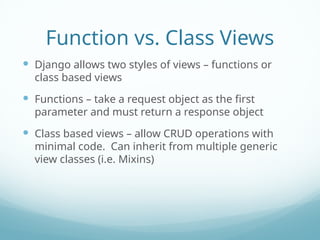
Function vs. ClassViews
Django allows two styles of views – functions or
class based views
Functions – take a request object as the first
parameter and must return a response object
Class based views – allow CRUD operations with
minimal code. Can inherit from multiple generic
view classes (i.e. Mixins)
3.
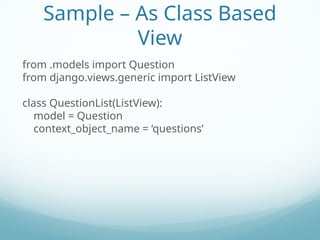
Sample – AsClass Based
View
from .models import Question
from django.views.generic import ListView
class QuestionList(ListView):
model = Question
context_object_name = ‘questions’
4.
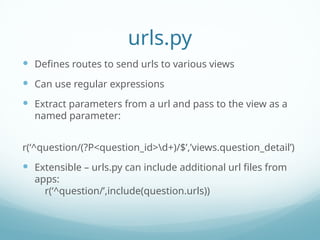
urls.py
Defines routesto send urls to various views
Can use regular expressions
Extract parameters from a url and pass to the view as a
named parameter:
r(‘^question/(?P<question_id>d+)/$’,’views.question_detail’)
Extensible – urls.py can include additional url files from
apps:
r(‘^question/’,include(question.urls))
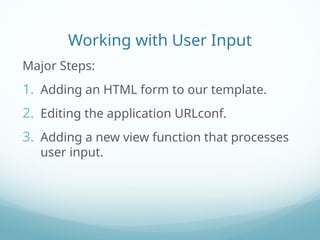
Working with UserInput
Major Steps:
1. Adding an HTML form to our template.
2. Editing the application URLconf.
3. Adding a new view function that processes
user input.
7.
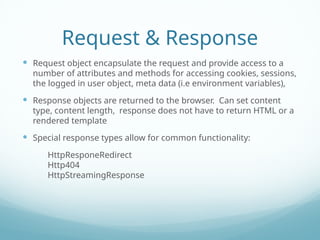
Request & Response
Request object encapsulate the request and provide access to a
number of attributes and methods for accessing cookies, sessions,
the logged in user object, meta data (i.e environment variables),
Response objects are returned to the browser. Can set content
type, content length, response does not have to return HTML or a
rendered template
Special response types allow for common functionality:
HttpResponeRedirect
Http404
HttpStreamingResponse
8.
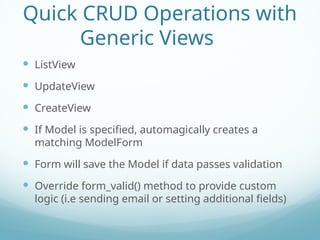
Quick CRUD Operationswith
Generic Views
ListView
UpdateView
CreateView
If Model is specified, automagically creates a
matching ModelForm
Form will save the Model if data passes validation
Override form_valid() method to provide custom
logic (i.e sending email or setting additional fields)
9.
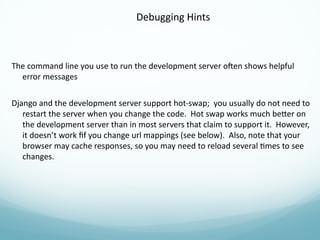
Debugging Hints
The commandline you use to run the development server often shows helpful
error messages
Django and the development server support hot-swap; you usually do not need to
restart the server when you change the code. Hot swap works much better on
the development server than in most servers that claim to support it. However,
it doesn’t work fif you change url mappings (see below). Also, note that your
browser may cache responses, so you may need to reload several times to see
changes.
10.
Django Extras
CRSFMiddleware – enabled by default. Include template
tag in all forms:
{%csrf_token%}
Authentication
Caching
Sessions
Messages
Email
Logging
11.
Cross-Site Request Forgery
Djangocomes with a data-preserving feature
that disallows POSTs which are not secure
against cross-site request forgery (CSRF)
attacks.
You can read more about CSRF at the following
website:
https://docs.djangoproject.com/en/dev/ref/
contrib/csrf/
12.
Cross-Site Request Forgery
Forour simple application, two fixes:
1. Add a CSFR token ({% csrf_token %} to forms
that POST back to your site
2. Send the request context instance to the token
via the template.





![CHAPTER_4_DJANGO_FORMS[1] [Read-Only].pptx](https://cdn.slidesharecdn.com/ss_thumbnails/chapter4djangoforms1read-only-250214215440-2556e5be-thumbnail.jpg?width=640&height=640&fit=bounds)


