THE GUIDE TO APA STYLE: 7TH EDITION
NATIONAL TAIWAN NORMAL UNIVERSITY
INTERNATIONAL HUMAN RESOURCE DEVELOPMENT
CHAPTER ONE
ELEMENTS & FORMAT
2021-2022
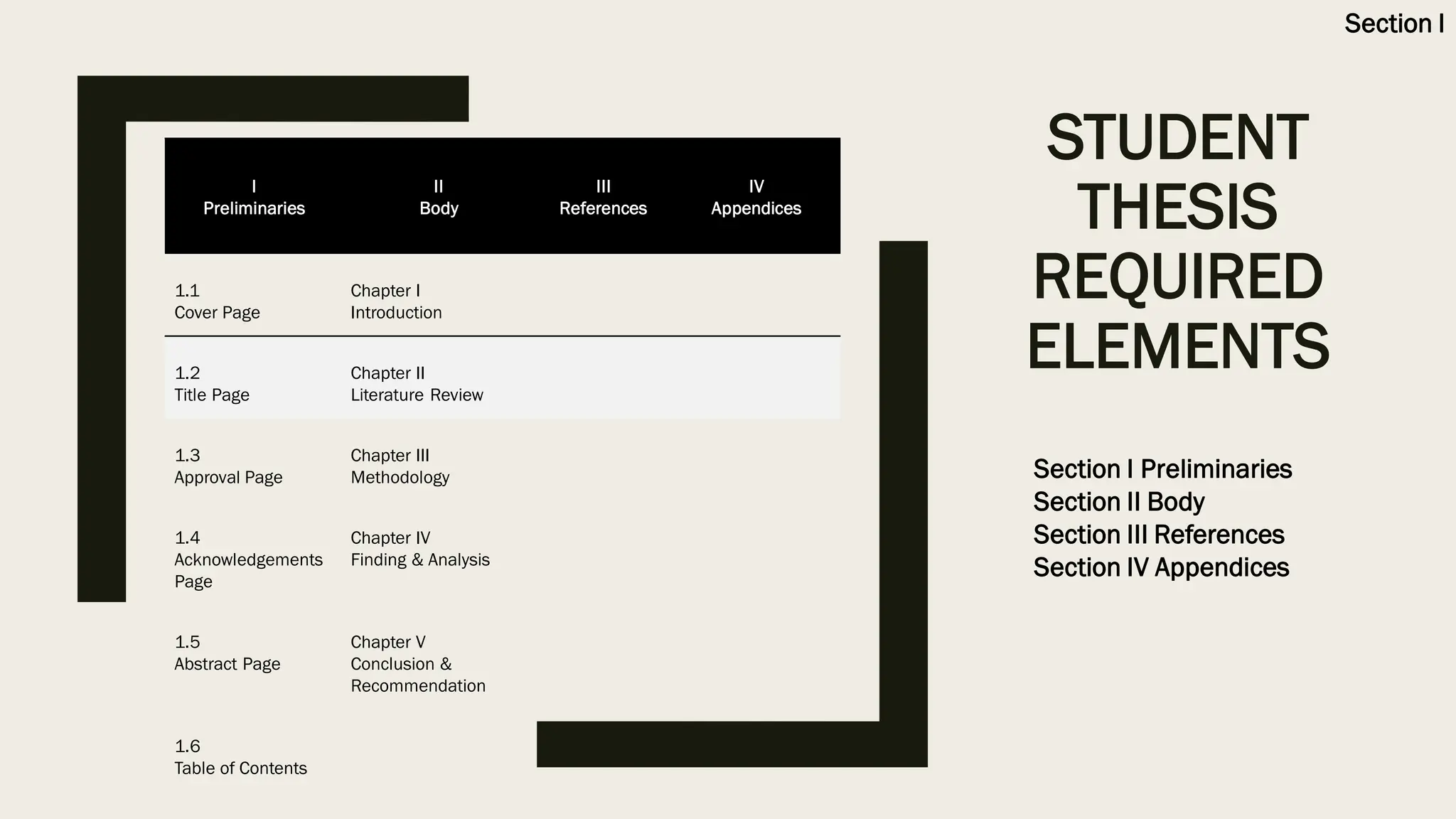
STUDENT
THESIS
REQUIRED
ELEMENTS
I
Preliminaries
II
Body
III
References
IV
Appendices
1.1
Cover Page
Chapter I
Introduction
1.2
Title Page
Chapter II
Literature Review
1.3
Approval Page
Chapter III
Methodology
1.4
Acknowledgements
Page
Chapter IV
Finding & Analysis
1.5
Abstract Page
Chapter V
Conclusion &
Recommendation
1.6
Table of Contents
Section I Preliminaries
Section II Body
Section III References
Section IV Appendices
Section I
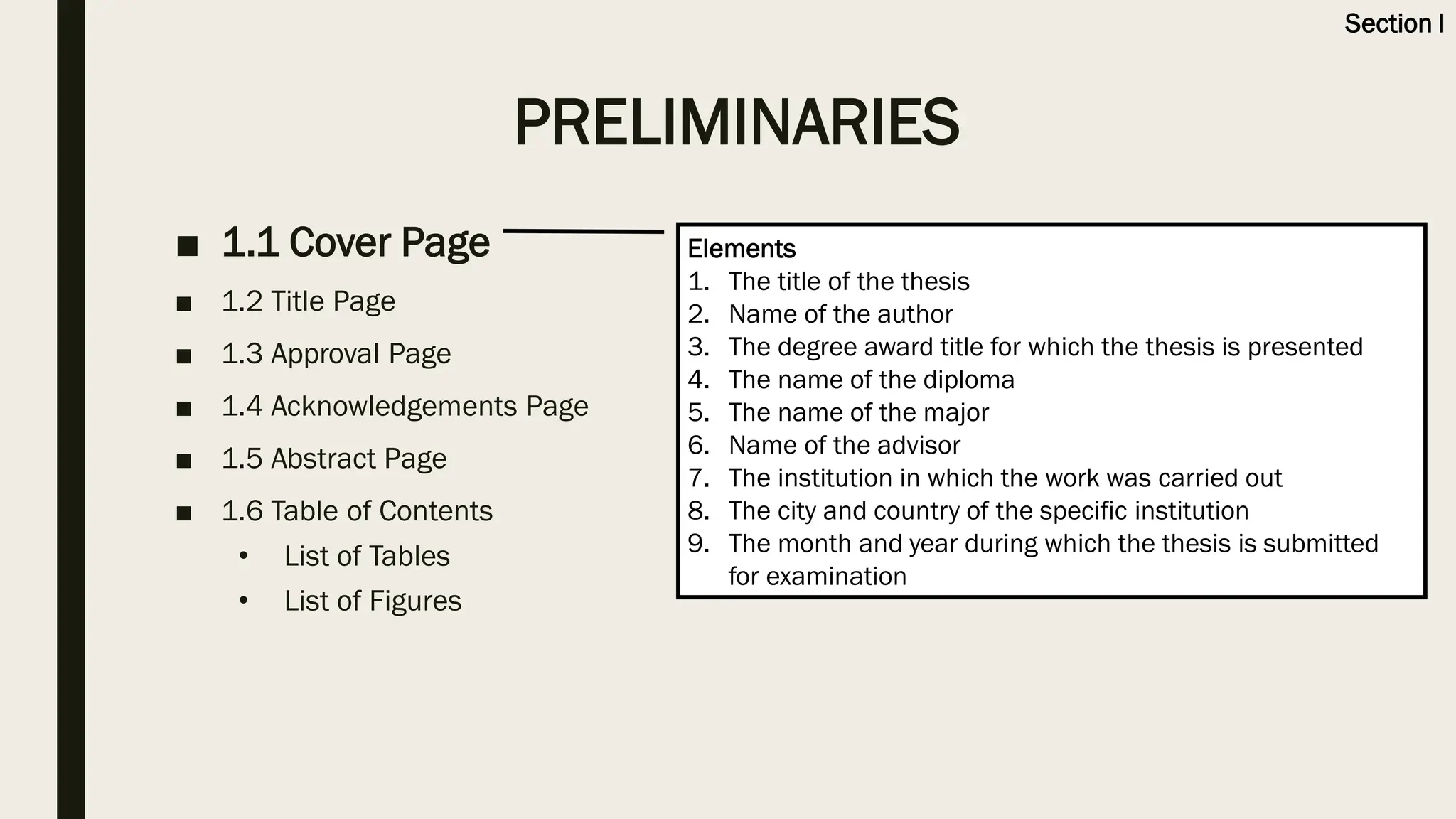
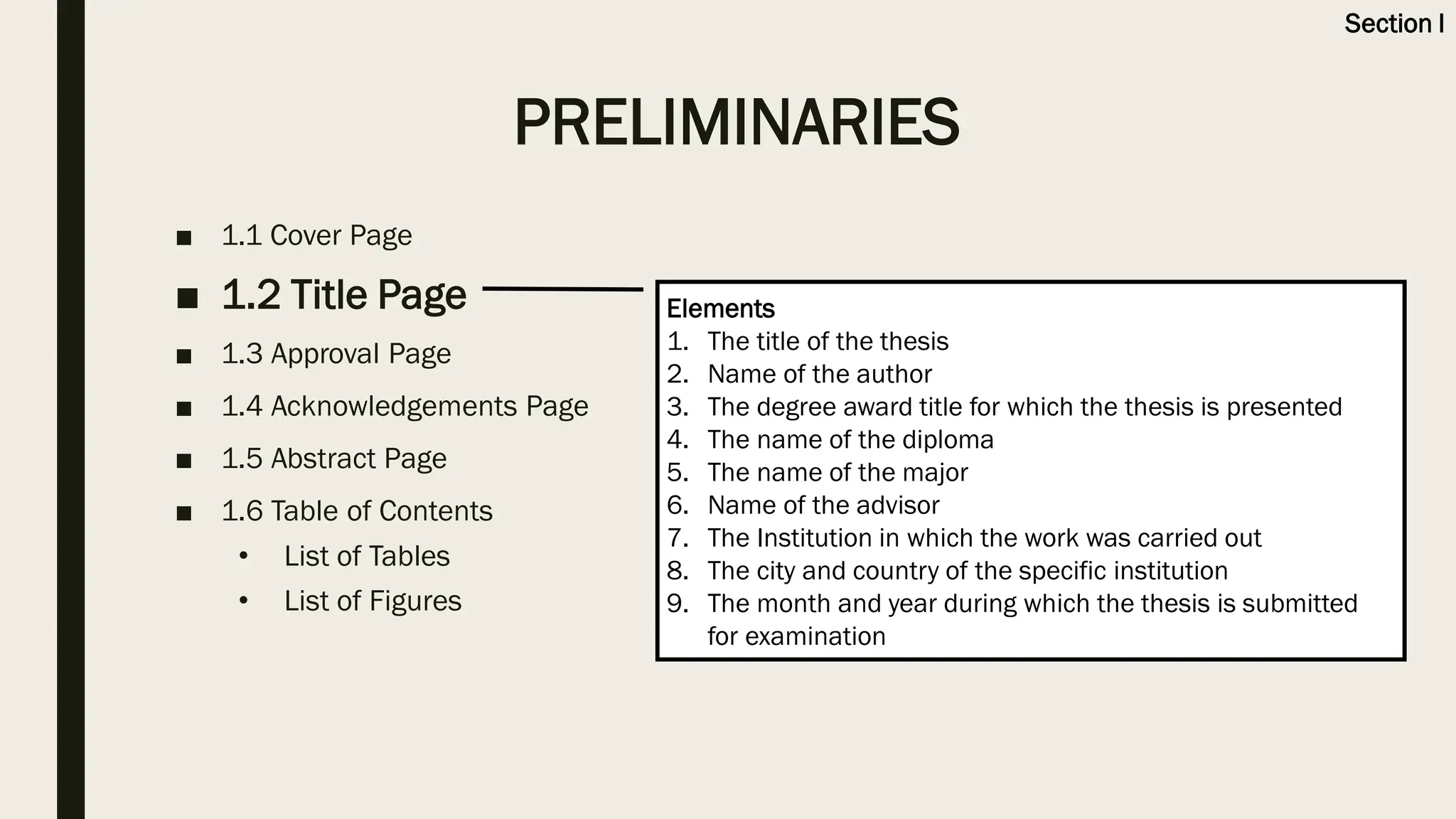
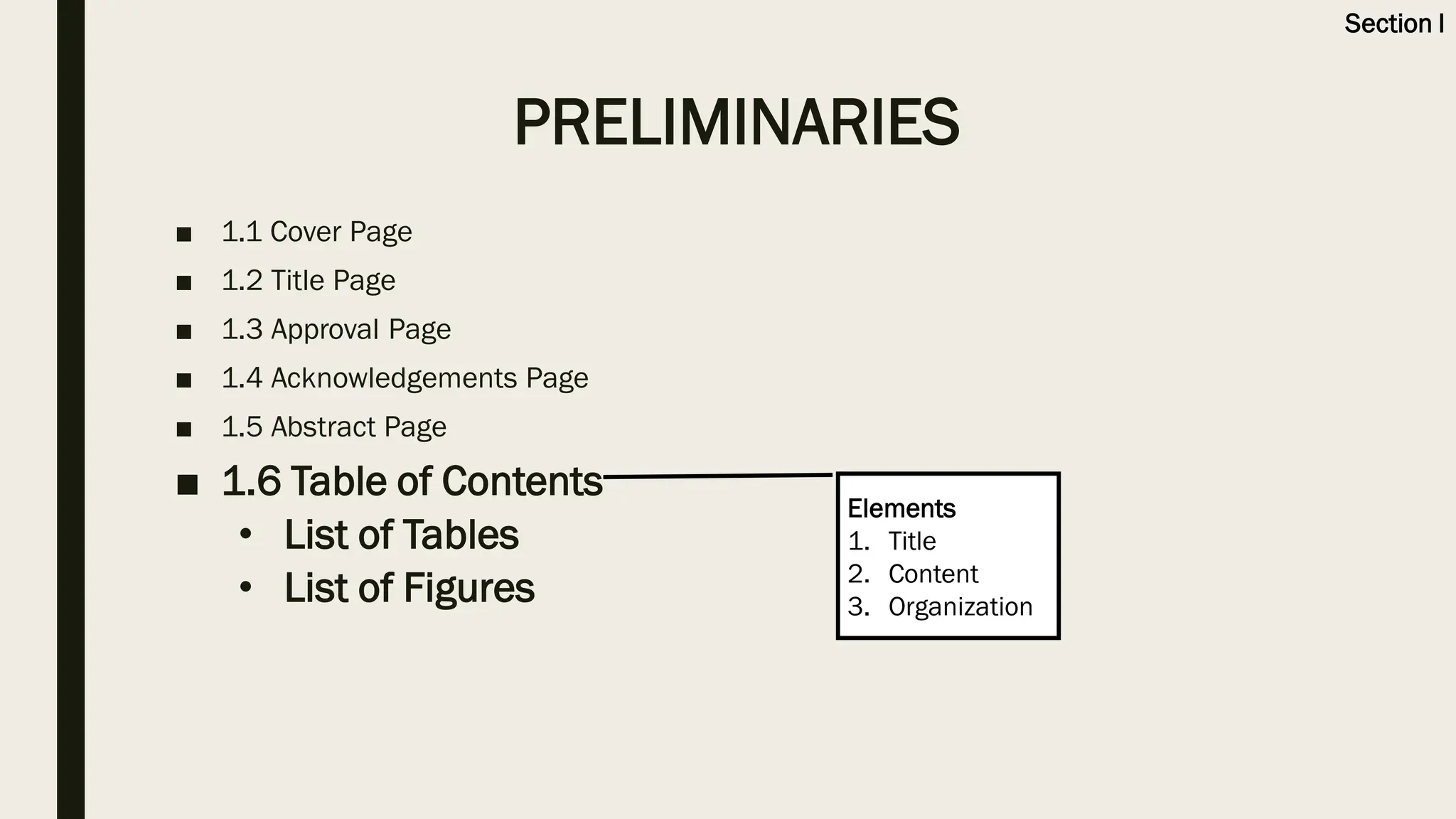
PRELIMINARIES
■ 1.1 Cover Page
■ 1.2 Title Page
■ 1.3 Approval Page
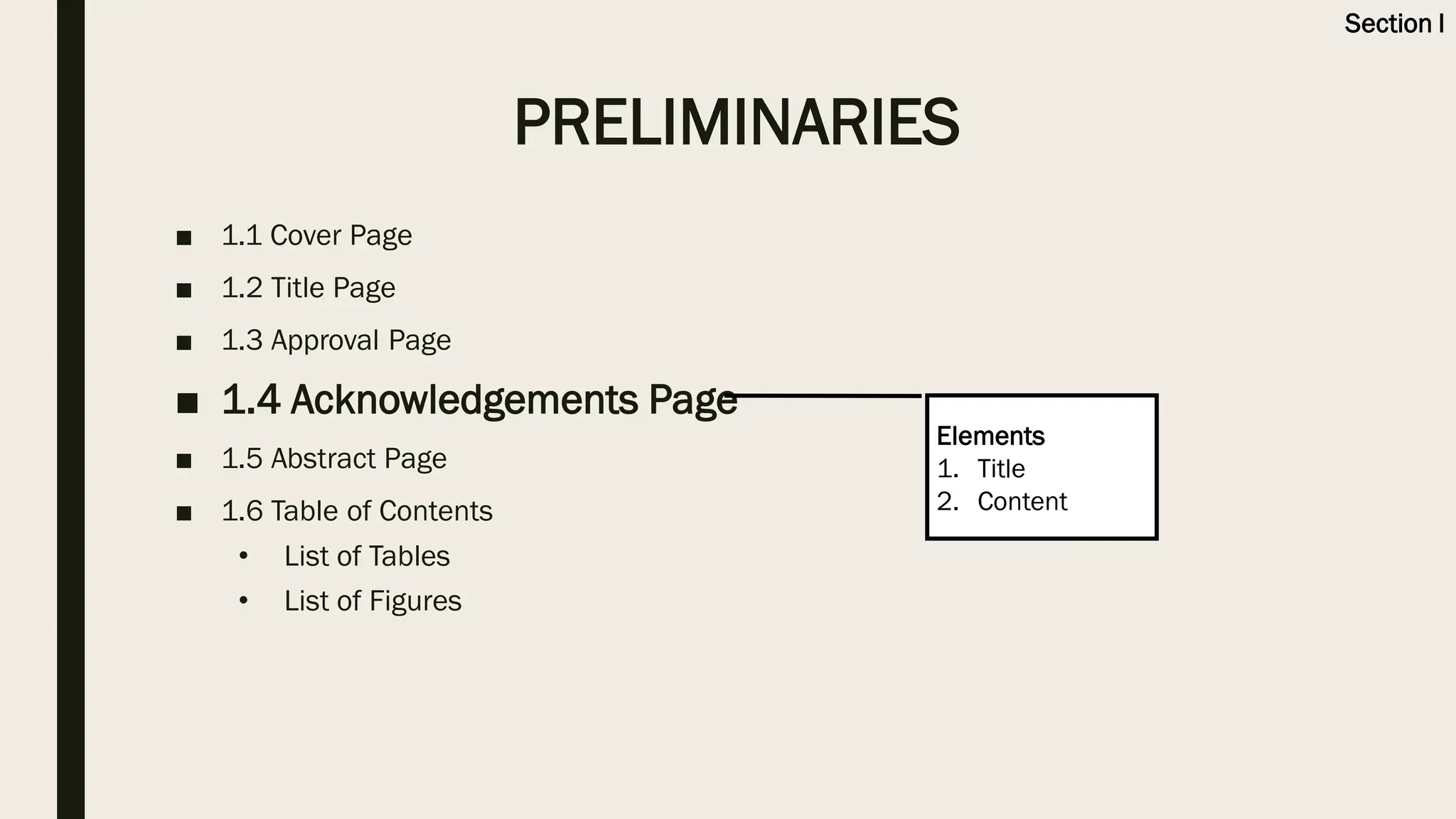
■ 1.4 Acknowledgements Page
■ 1.5 Abstract Page
■ 1.6 Table of Contents
• List of Tables
• List of Figures
Elements
1. The title of the thesis
2. Name of the author
3. The degree award title for which the thesis is presented
4. The name of the diploma
5. The name of the major
6. Name of the advisor
7. The institution in which the work was carried out
8. The city and country of the specific institution
9. The month and year during which the thesis is submitted
for examination
Section I
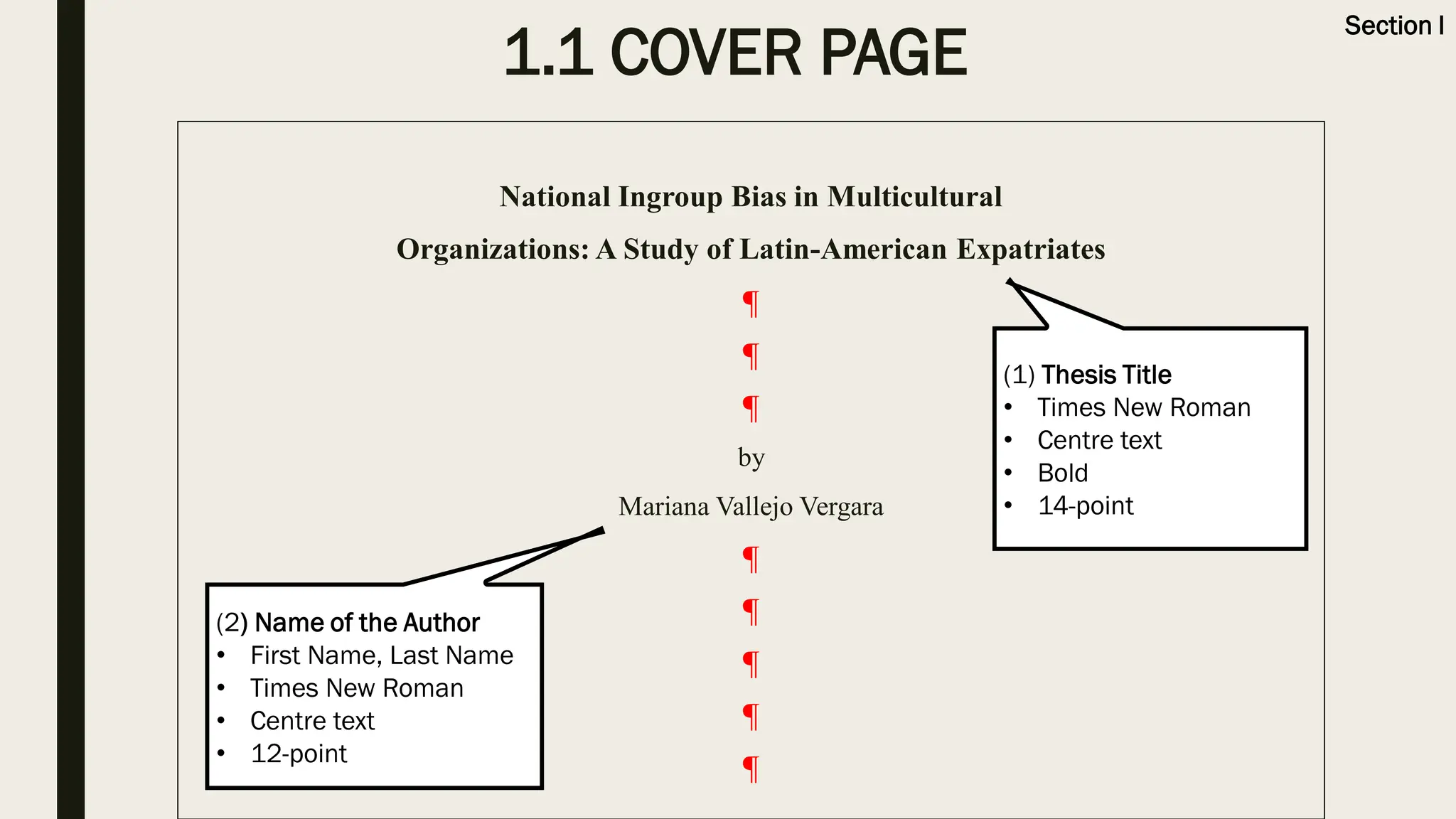
1.1 COVER PAGE
National Ingroup Bias in Multicultural
Organizations: A Study of Latin-American Expatriates


by
Mariana Vallejo Vergara


(1) Thesis Title
• Times New Roman
• Centre text
• Bold
• 14-point
(2) Name of the Author
• First Name, Last Name
• Times New Roman
• Centre text
• 12-point
Section I
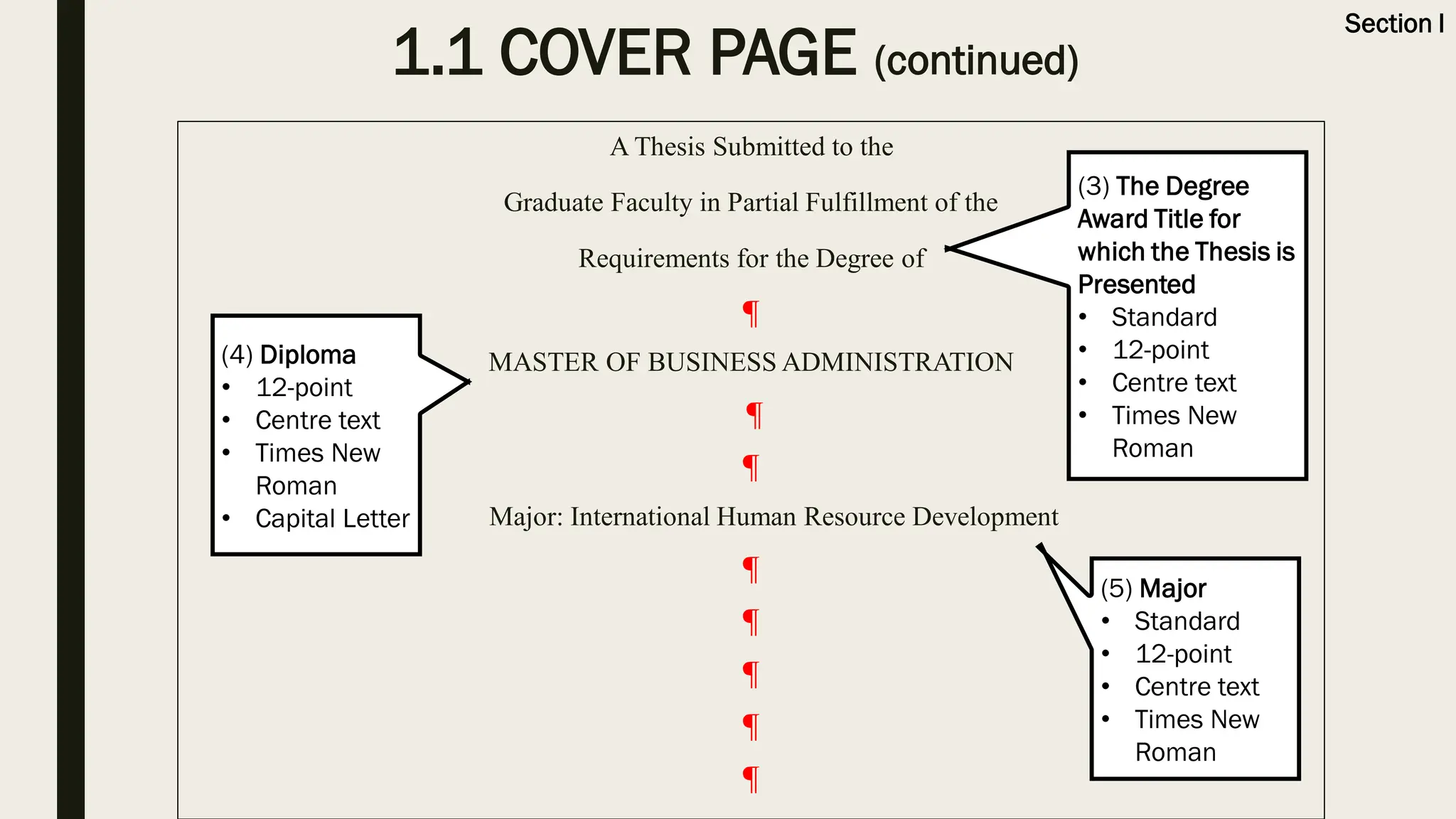
1.1 COVER PAGE (continued)
A Thesis Submitted to the
Graduate Faculty in Partial Fulfillment of the
Requirements for the Degree of

MASTER OF BUSINESS ADMINISTRATION


Major: International Human Resource Development


(3) The Degree
Award Title for
which the Thesis is
Presented
• Standard
• 12-point
• Centre text
• Times New
Roman
(4) Diploma
• 12-point
• Centre text
• Times New
Roman
• Capital Letter
(5) Major
• Standard
• 12-point
• Centre text
• Times New
Roman
Section I
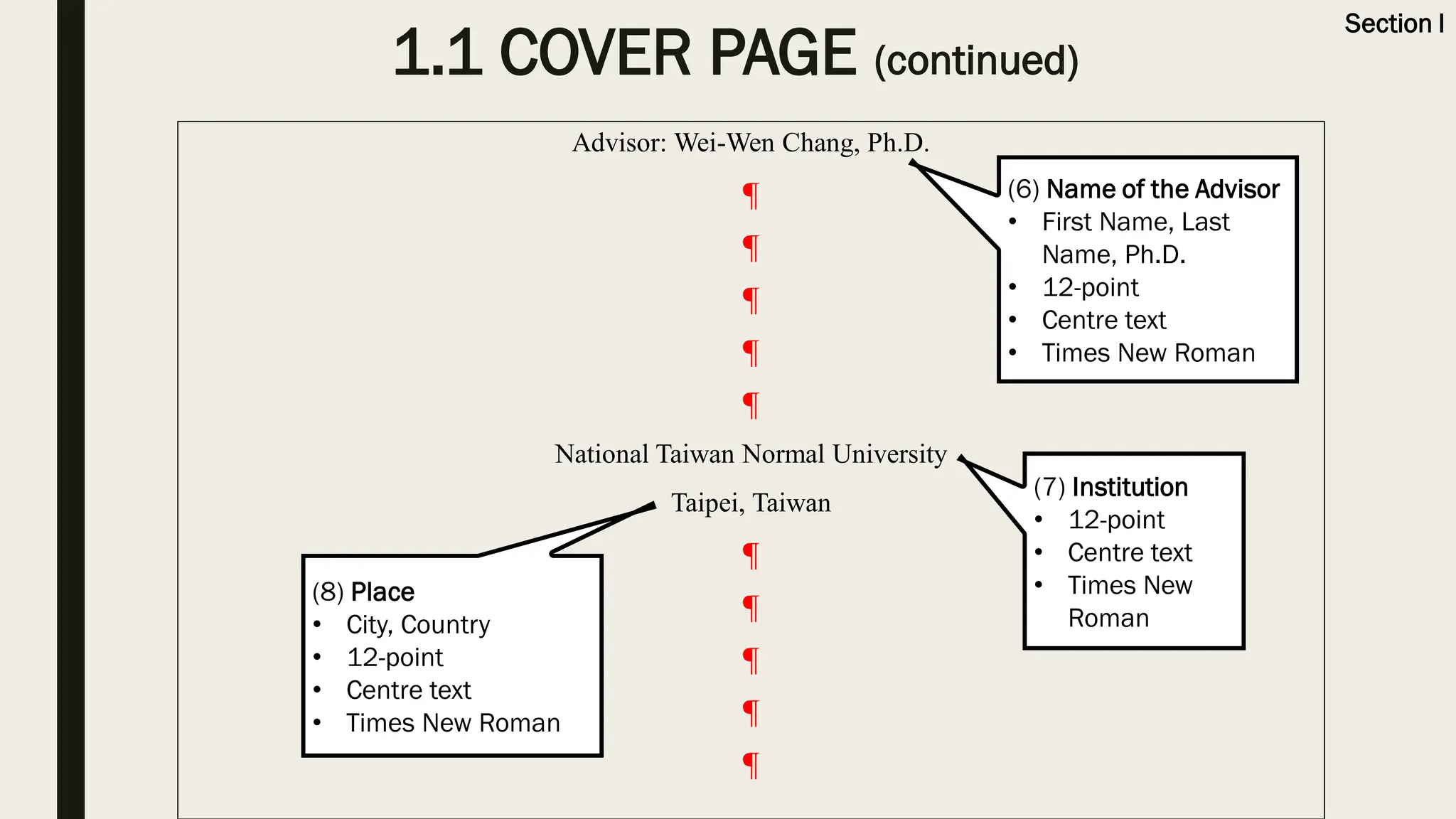
Advisor: Wei-Wen Chang, Ph.D.


National Taiwan Normal University
Taipei, Taiwan


(6) Name of the Advisor
• First Name, Last
Name, Ph.D.
• 12-point
• Centre text
• Times New Roman
(7) Institution
• 12-point
• Centre text
• Times New
Roman
(8) Place
• City, Country
• 12-point
• Centre text
• Times New Roman
1.1 COVER PAGE (continued)
Section I
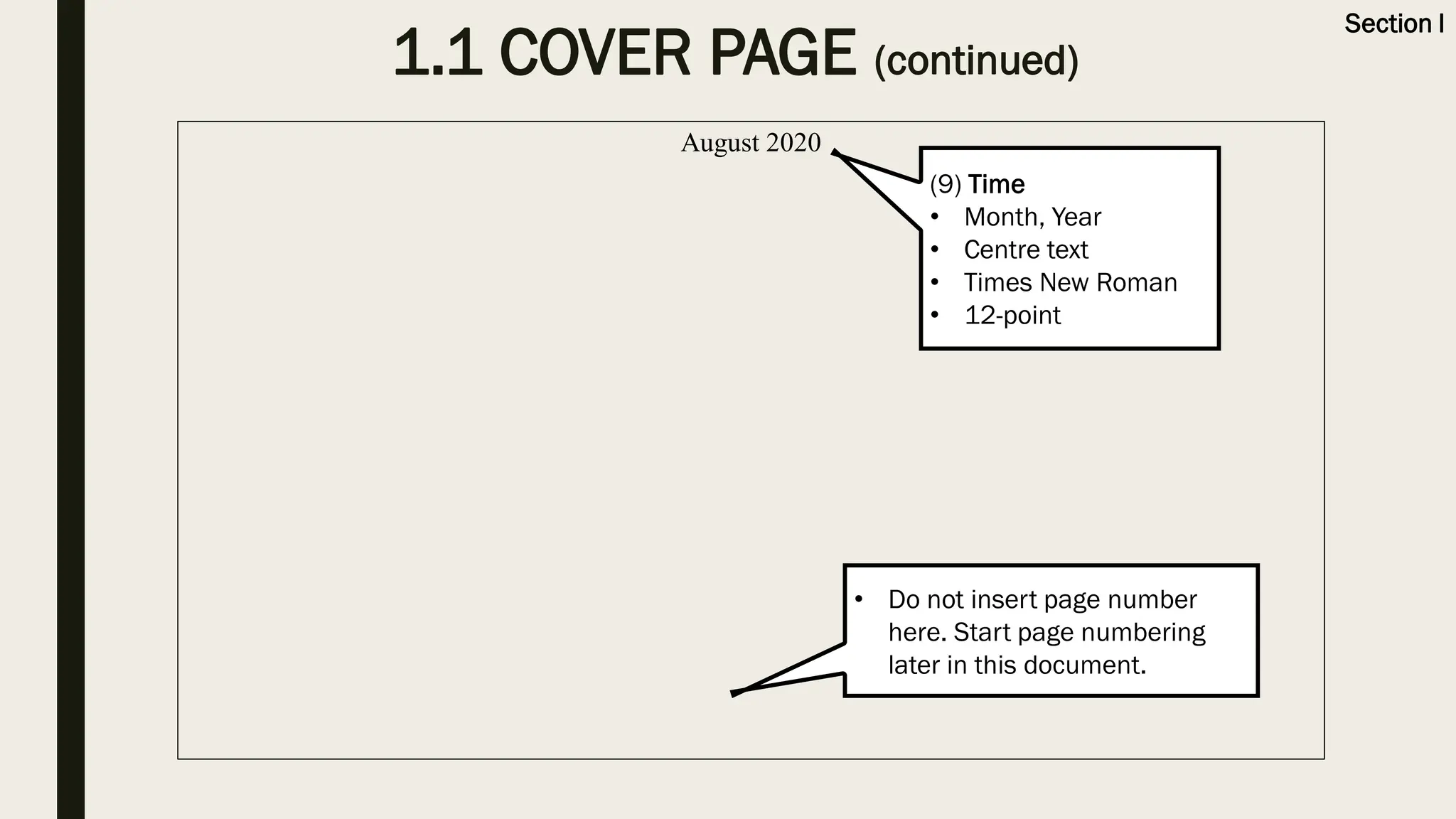
August 2020
• Do not insert page number
here. Start page numbering
later in this document.
(9) Time
• Month, Year
• Centre text
• Times New Roman
• 12-point
1.1 COVER PAGE (continued)
Section I
1.1
COVER PAGE
EXAMPLE
IHRD
Section I
■ 1.1 Cover Page
■ 1.2 Title Page
■ 1.3 Approval Page
■ 1.4 Acknowledgements Page
■ 1.5 Abstract Page
■ 1.6 Table of Contents
• List of Tables
• List of Figures
Elements
1. The title of the thesis
2. Name of the author
3. The degree award title for which the thesis is presented
4. The name of the diploma
5. The name of the major
6. Name of the advisor
7. The Institution in which the work was carried out
8. The city and country of the specific institution
9. The month and year during which the thesis is submitted
for examination
PRELIMINARIES
Section I
1.2 TITLE PAGE
■ This is the first page of your thesis and should succinctly summarize your work
though the page number does not appear on this page.
■ You may use the Cover Page as your Title Page.
Section I
1.2
TITLE PAGE
EXAMPLE
IHRD
Section I
■ 1.1 Cover Page
■ 1.2 Title Page
■ 1.3 Approval Page
■ 1.4 Acknowledgements Page
■ 1.5 Abstract Page
■ 1.6 Table of Contents
• List of Tables
• List of Figures
Elements
1. The title of the thesis
2. Name of the author
3. The degree award title for which the thesis is
presented
4. The name of the diploma
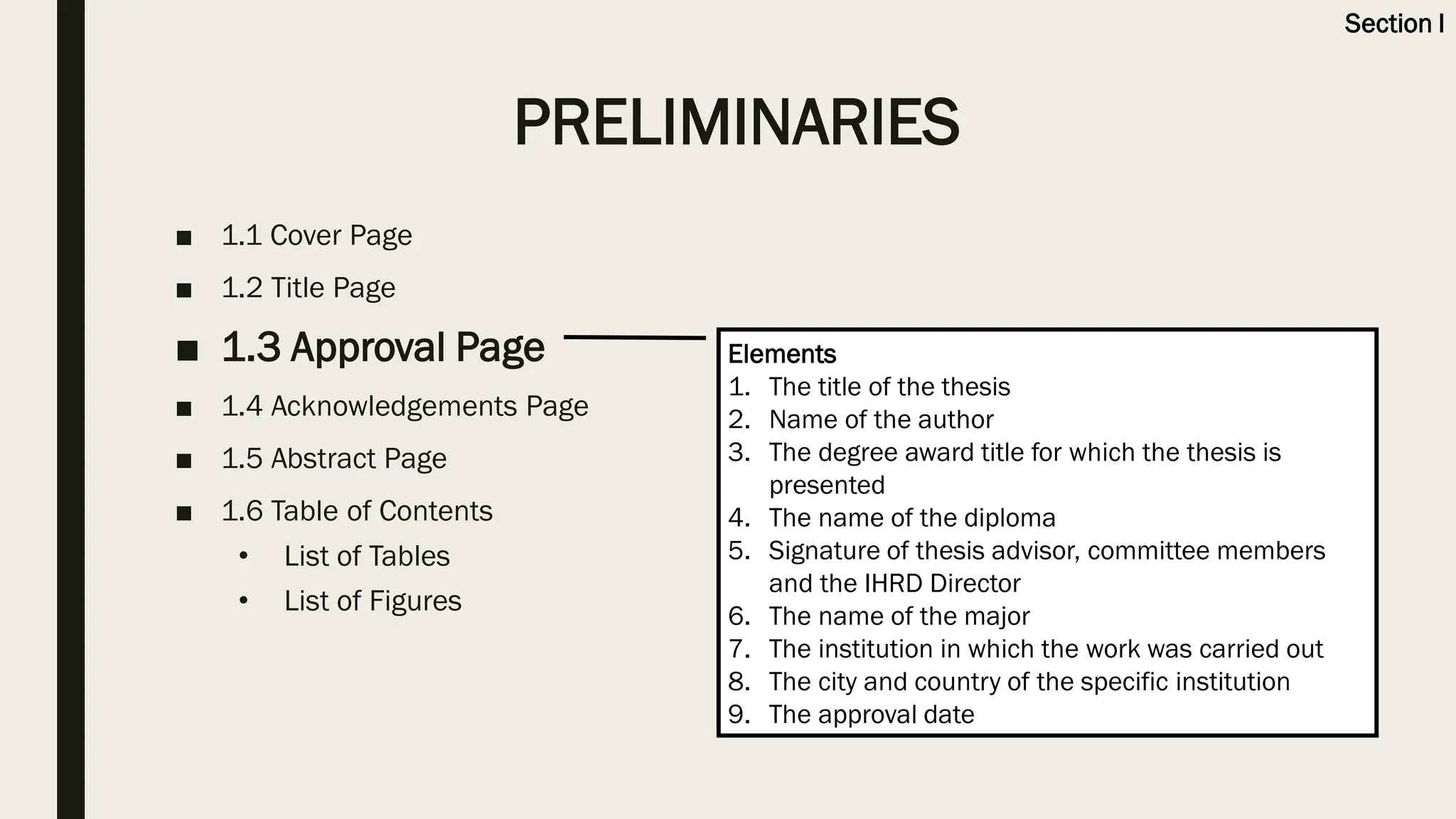
5. Signature of thesis advisor, committee members
and the IHRD Director
6. The name of the major
7. The institution in which the work was carried out
8. The city and country of the specific institution
9. The approval date
PRELIMINARIES
Section I
1.3 APPROVAL PAGE (continued)

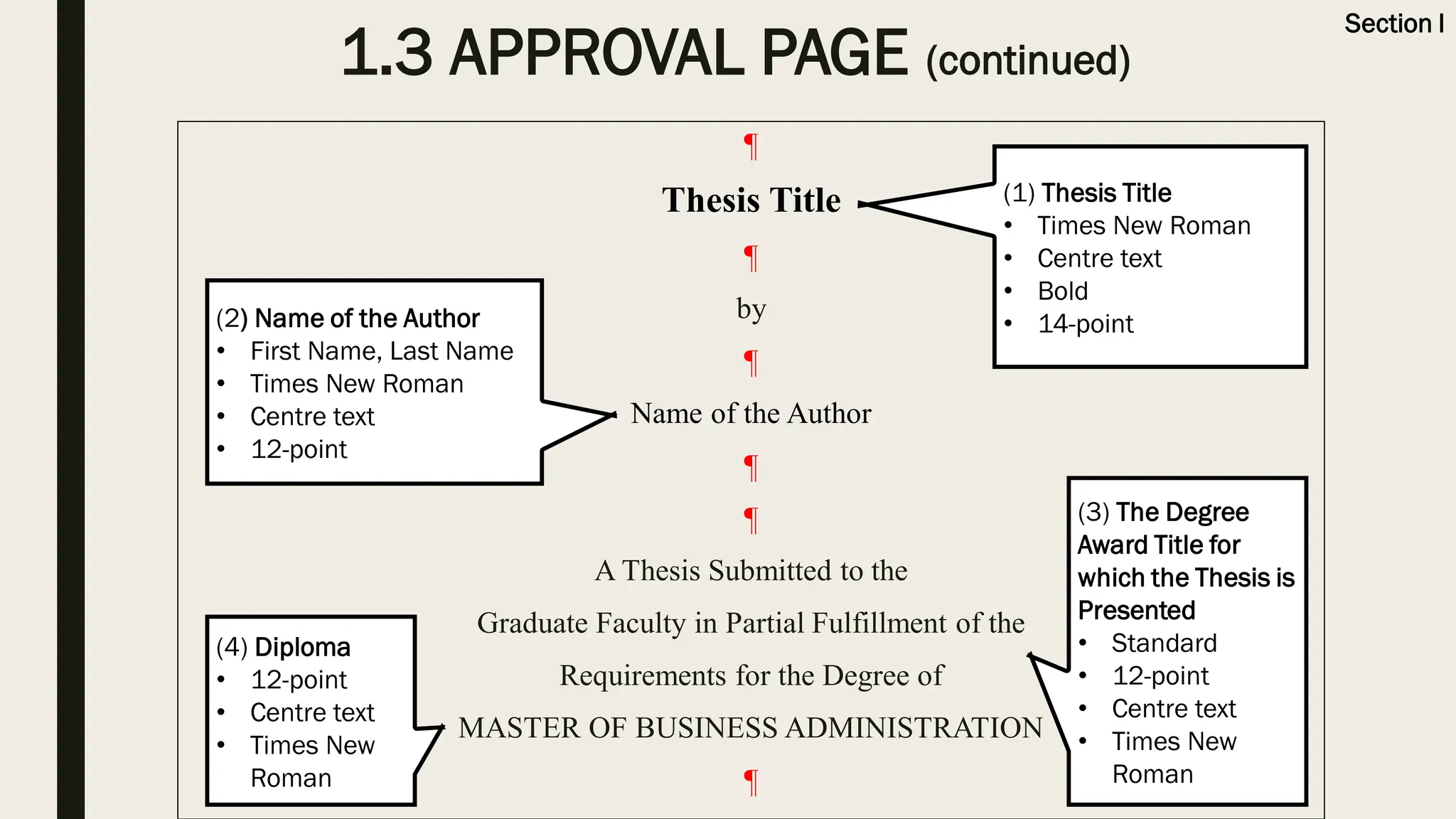
Thesis Title

by

Name of the Author


A Thesis Submitted to the
Graduate Faculty in Partial Fulfillment of the
Requirements for the Degree of
MASTER OF BUSINESS ADMINISTRATION

(1) Thesis Title
• Times New Roman
• Centre text
• Bold
• 14-point
Section I
(2) Name of the Author
• First Name, Last Name
• Times New Roman
• Centre text
• 12-point
(3) The Degree
Award Title for
which the Thesis is
Presented
• Standard
• 12-point
• Centre text
• Times New
Roman
(4) Diploma
• 12-point
• Centre text
• Times New
Roman
1.3 APPROVAL PAGE (continued)

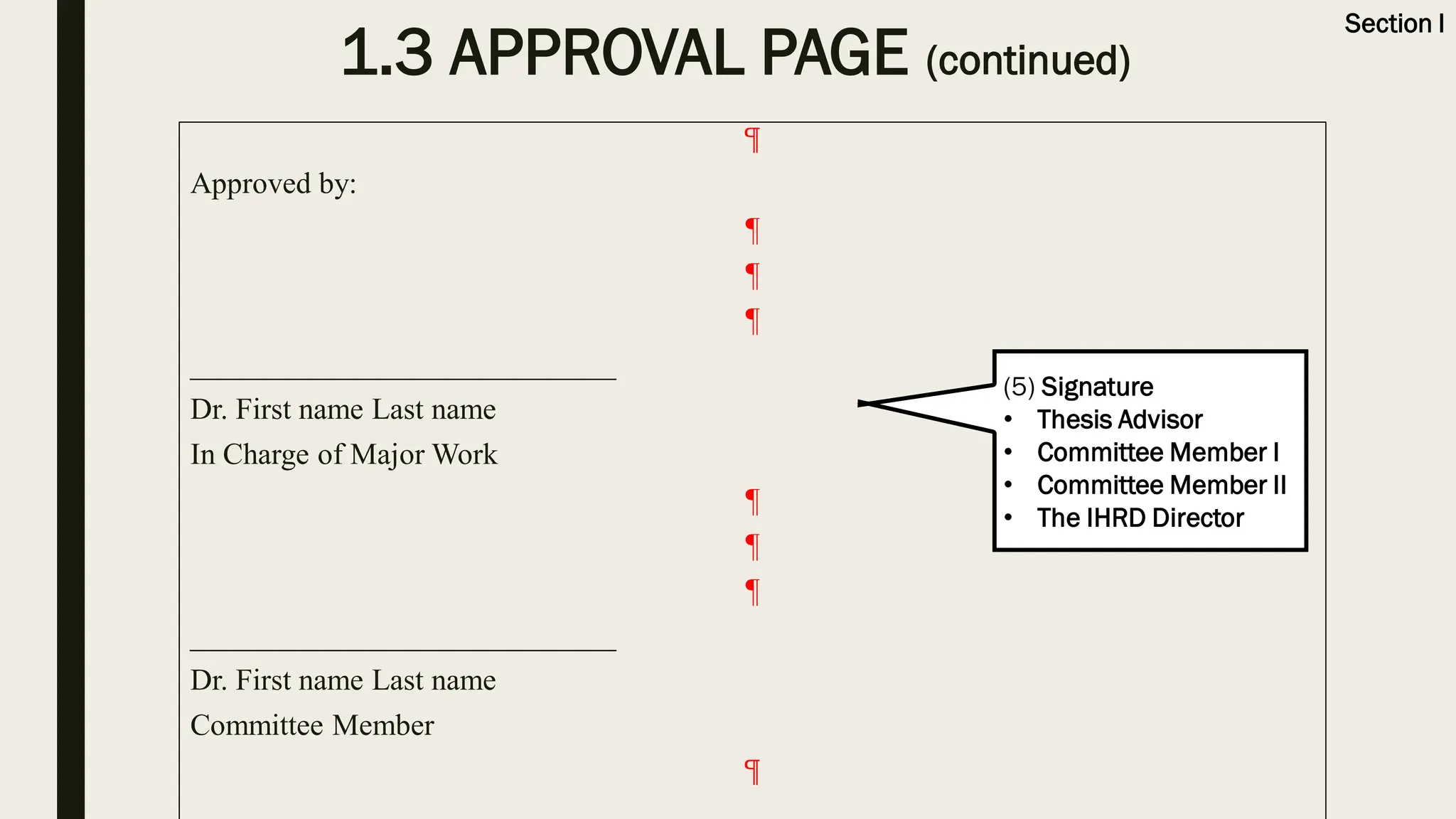
Approved by:


____________________________
Dr. First name Last name
In Charge of Major Work


____________________________
Dr. First name Last name
Committee Member

(5) Signature
• Thesis Advisor
• Committee Member I
• Committee Member II
• The IHRD Director
Section I
1.3 APPROVAL PAGE (continued)

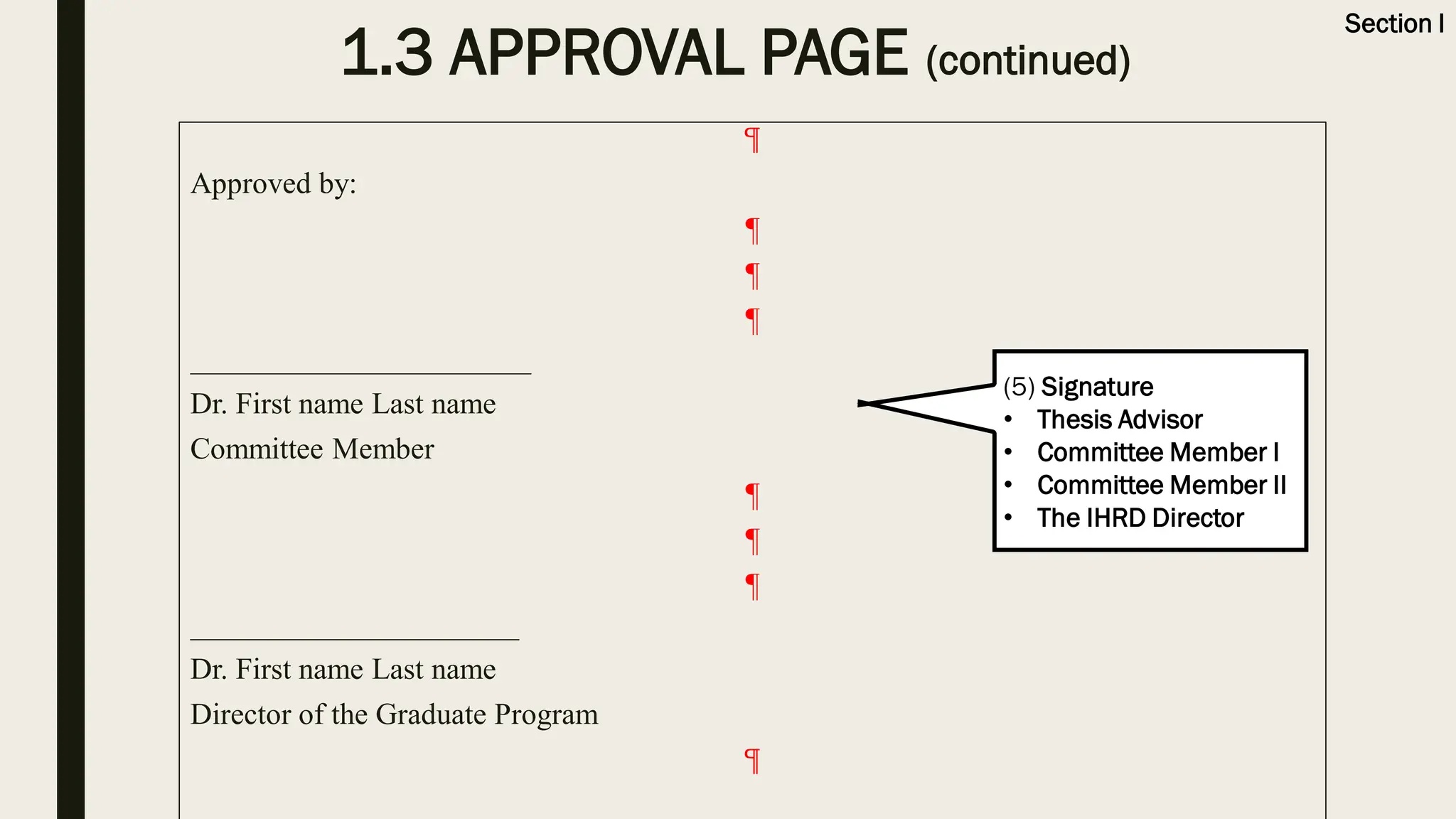
Approved by:


____________________________
Dr. First name Last name
Committee Member


___________________________
Dr. First name Last name
Director of the Graduate Program

Section I
(5) Signature
• Thesis Advisor
• Committee Member I
• Committee Member II
• The IHRD Director
1.3 APPROVAL PAGE (continued)


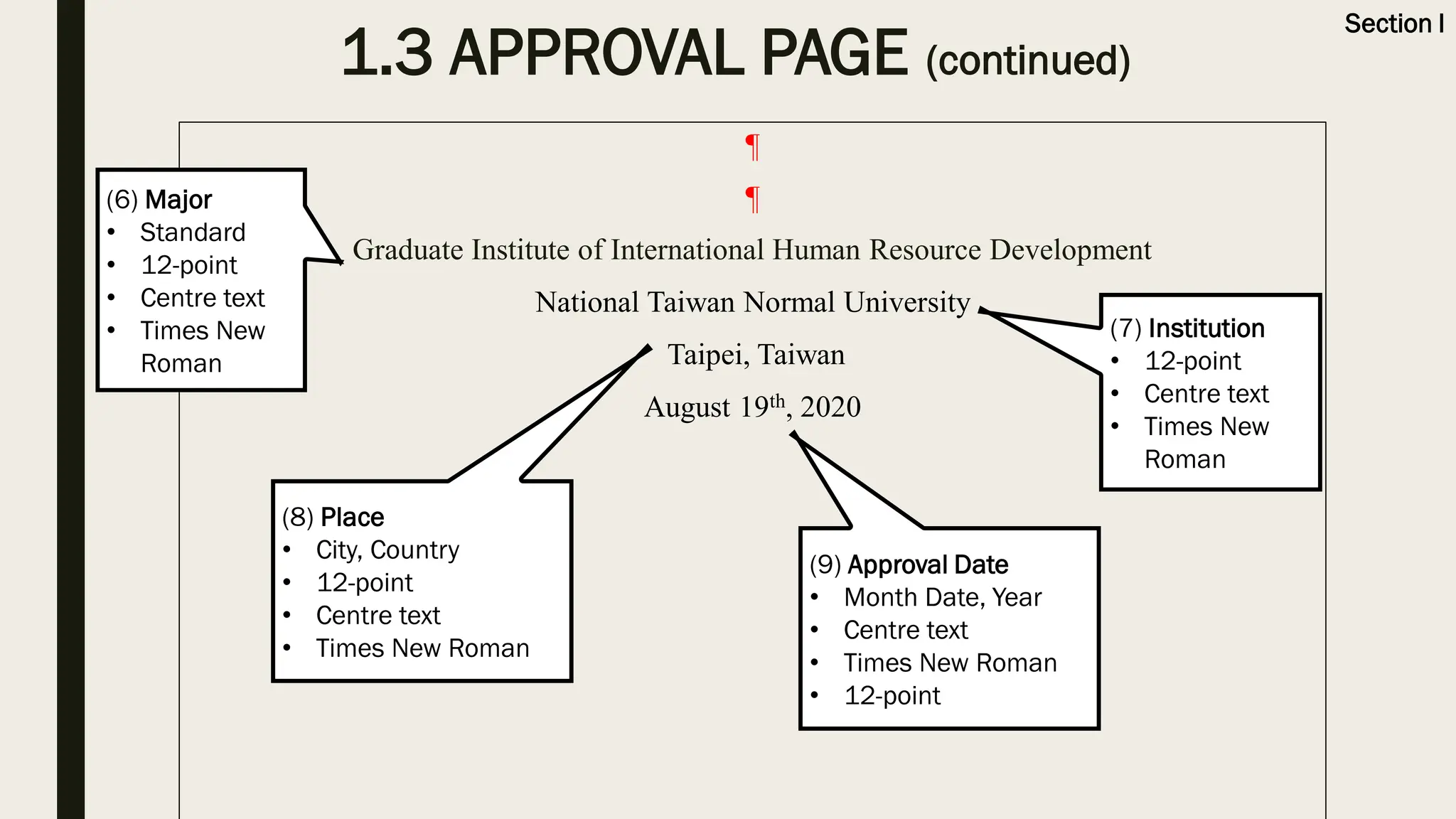
Graduate Institute of International Human Resource Development
National Taiwan Normal University
Taipei, Taiwan
August 19th, 2020
Section I
(7) Institution
• 12-point
• Centre text
• Times New
Roman
(6) Major
• Standard
• 12-point
• Centre text
• Times New
Roman
(8) Place
• City, Country
• 12-point
• Centre text
• Times New Roman
(9) Approval Date
• Month Date, Year
• Centre text
• Times New Roman
• 12-point
1.3
APPROVAL PAGE
EXAMPLE
Section I
IHRD
■ 1.1 Cover Page
■ 1.2 Title Page
■ 1.3 Approval Page
■ 1.4 Acknowledgements Page
■ 1.5 Abstract Page
■ 1.6 Table of Contents
• List of Tables
• List of Figures
Elements
1. Title
2. Content
PRELIMINARIES
Section I
1.4 ACKNOWLEDGEMENTS PAGE
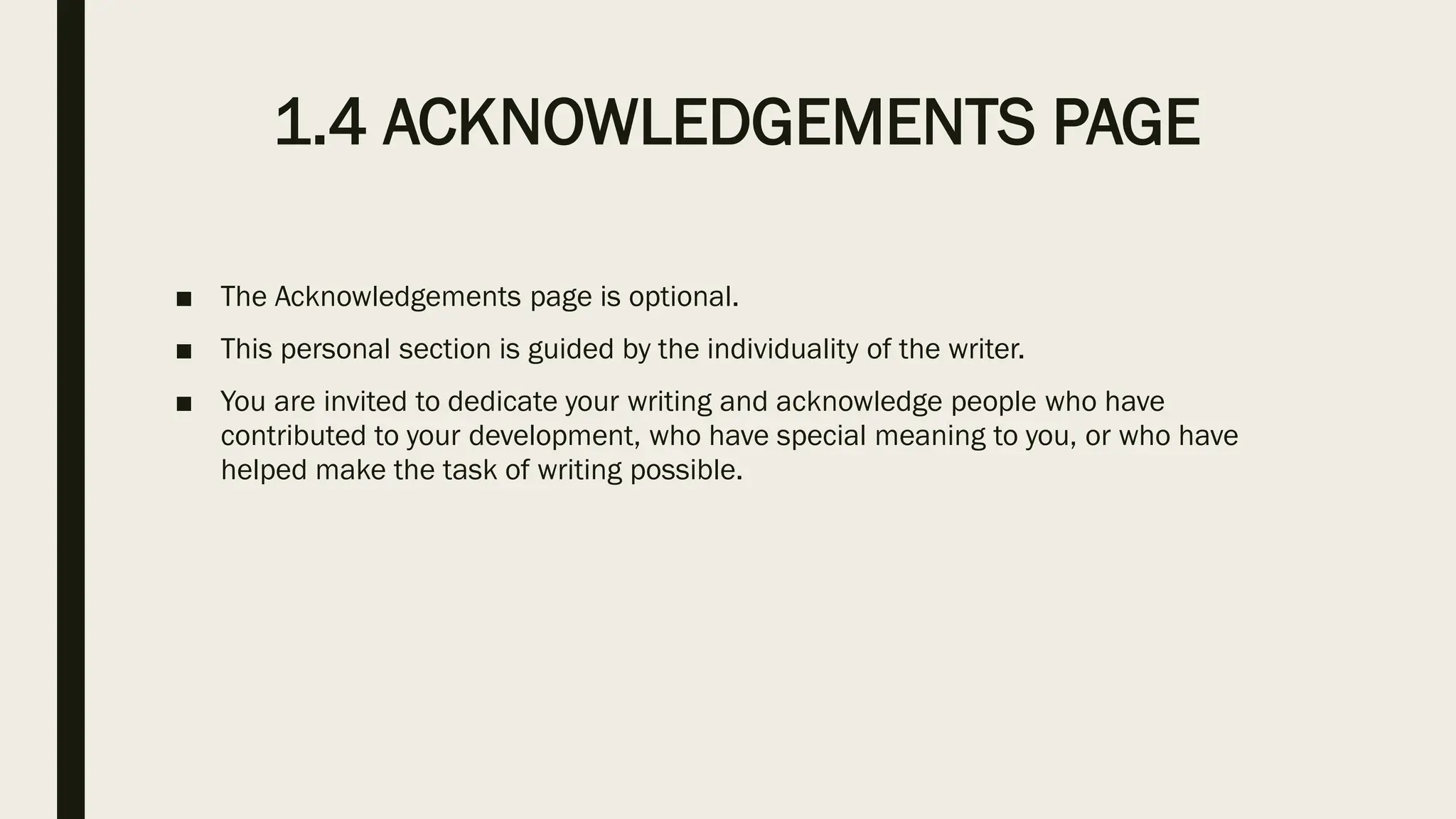
■ The Acknowledgements page is optional.
■ This personal section is guided by the individuality of the writer.
■ You are invited to dedicate your writing and acknowledge people who have
contributed to your development, who have special meaning to you, or who have
helped make the task of writing possible.
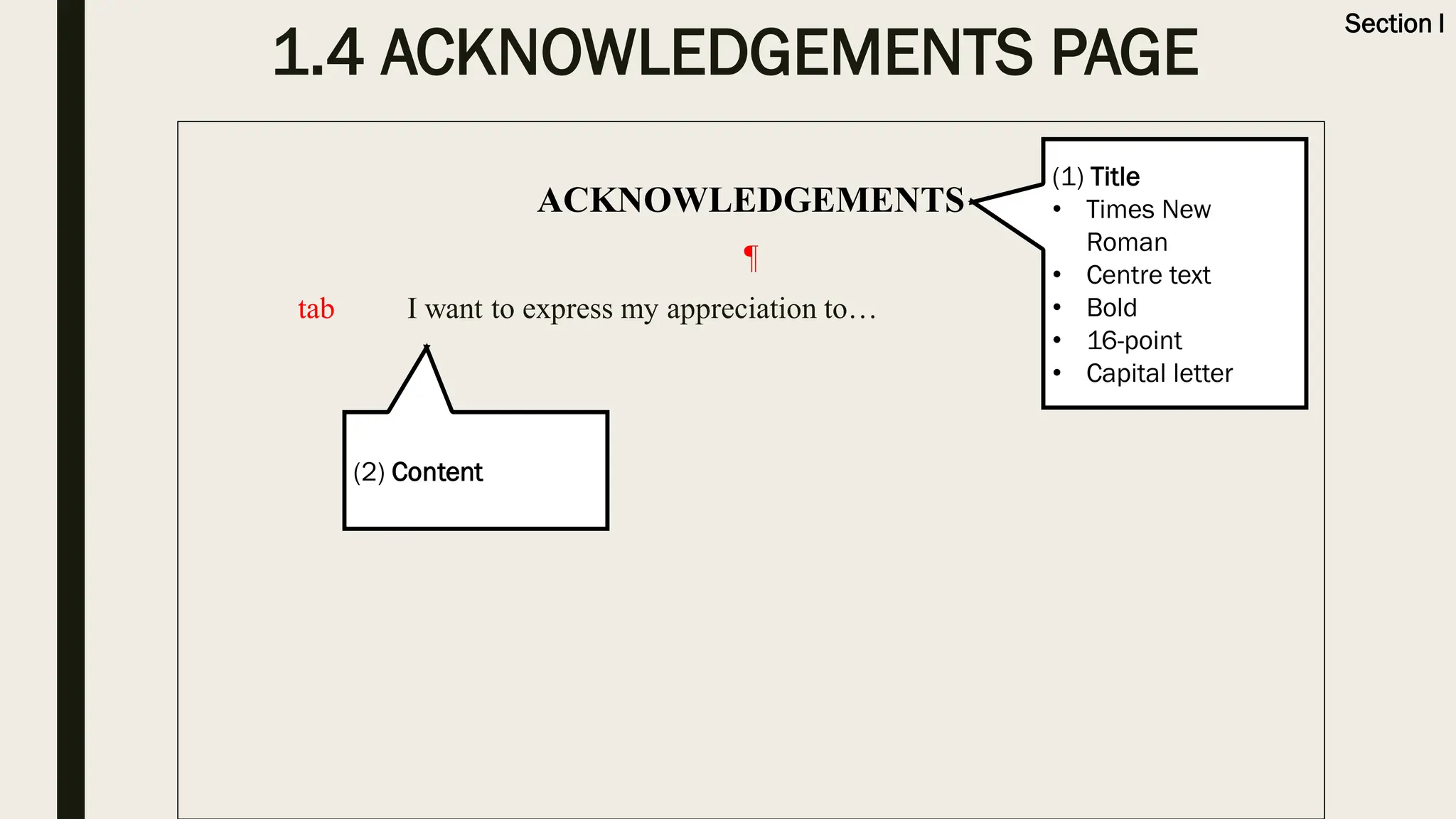
1.4 ACKNOWLEDGEMENTS PAGE
ACKNOWLEDGEMENTS

tab I want to express my appreciation to…
(1) Title
• Times New
Roman
• Centre text
• Bold
• 16-point
• Capital letter
Section I
(2) Content
1.4
ACKNOWLEDGEMENTS PAGE
EXAMPLE
Section I
IHRD
■ 1.1 Cover Page
■ 1.2 Title Page
■ 1.3 Approval Page
■ 1.4 Acknowledgements Page
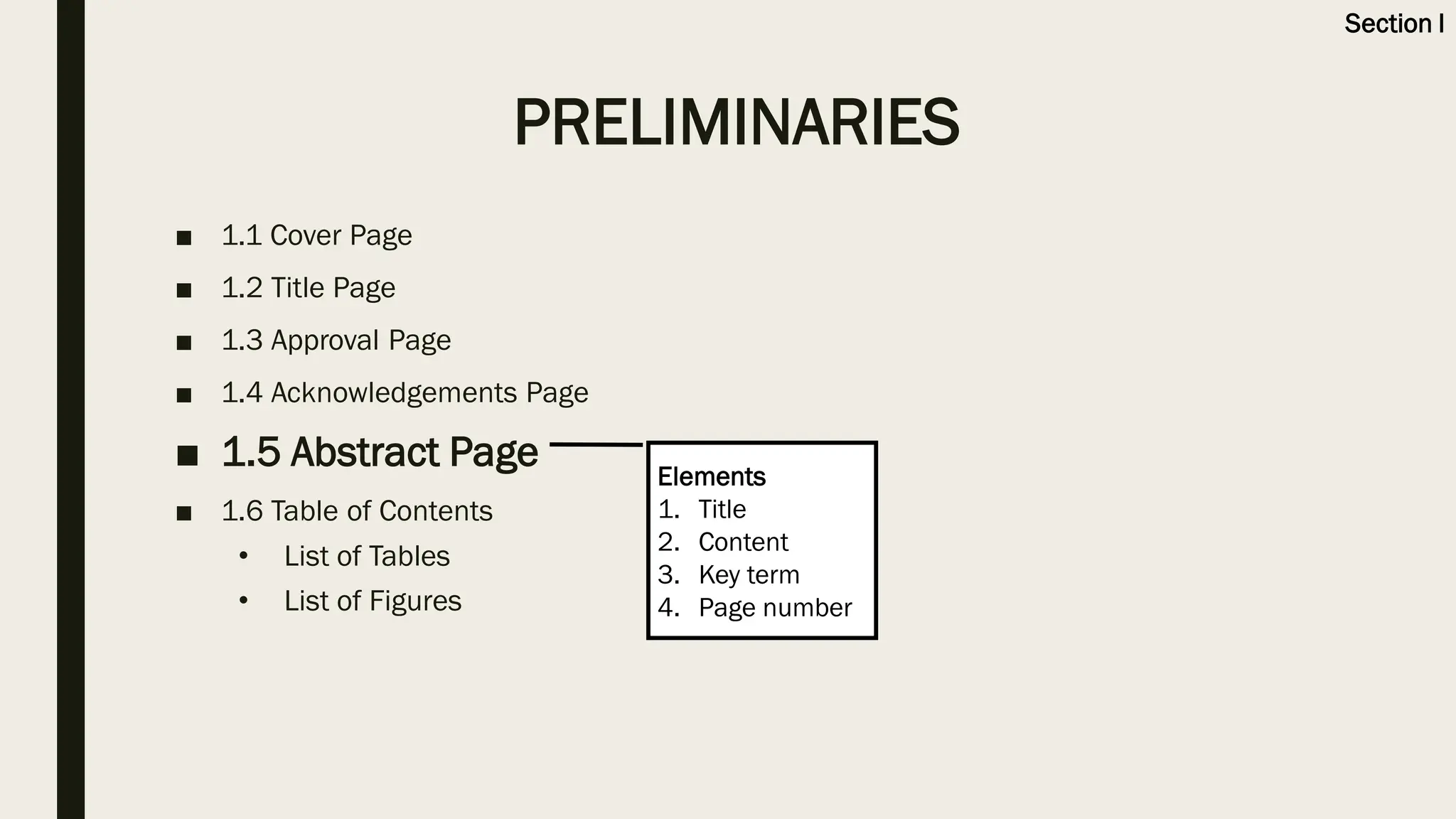
■ 1.5 Abstract Page
■ 1.6 Table of Contents
• List of Tables
• List of Figures
Elements
1. Title
2. Content
3. Key term
4. Page number
PRELIMINARIES
Section I
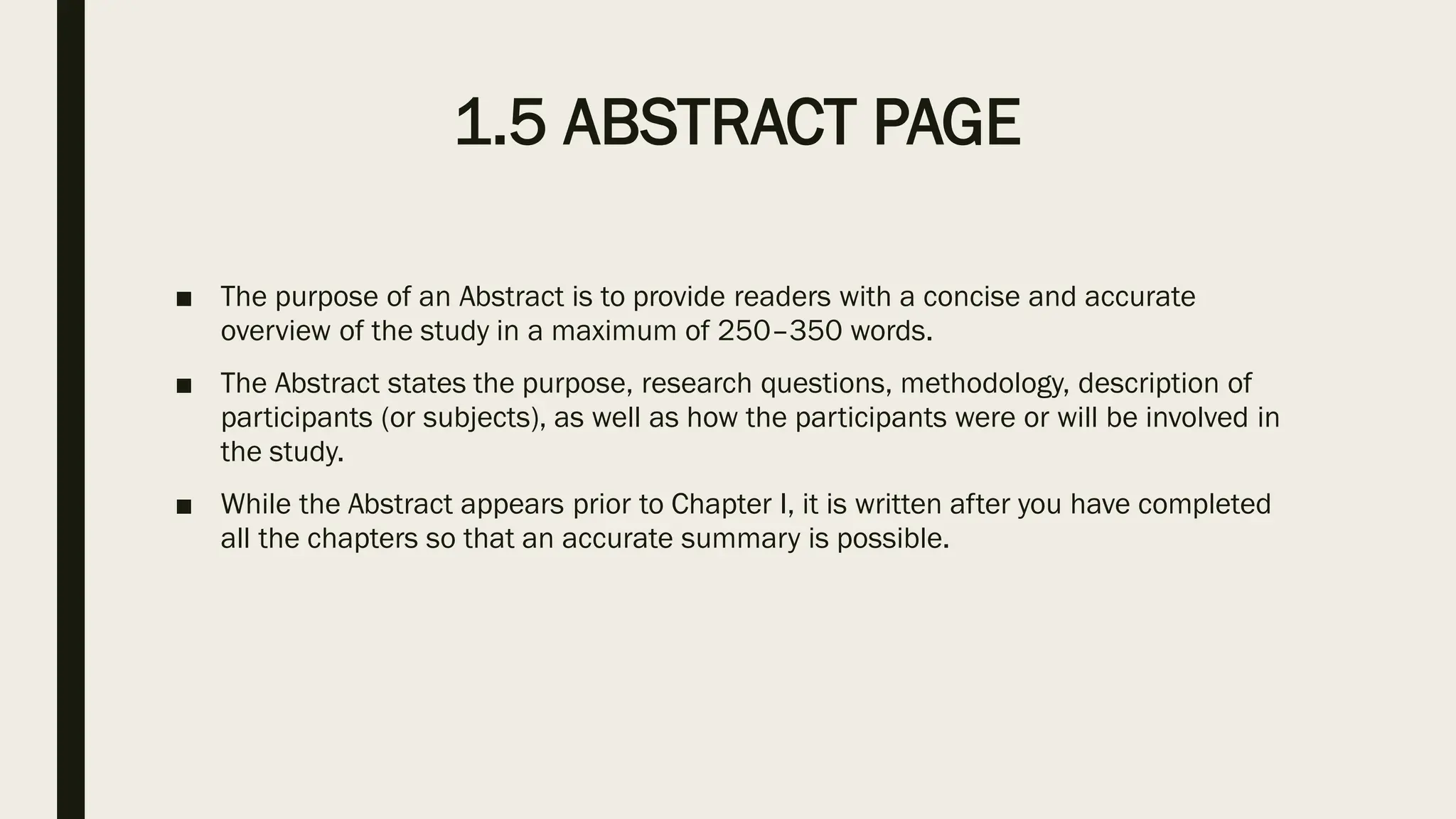
1.5 ABSTRACT PAGE
■ The purpose of an Abstract is to provide readers with a concise and accurate
overview of the study in a maximum of 250–350 words.
■ The Abstract states the purpose, research questions, methodology, description of
participants (or subjects), as well as how the participants were or will be involved in
the study.
■ While the Abstract appears prior to Chapter I, it is written after you have completed
all the chapters so that an accurate summary is possible.
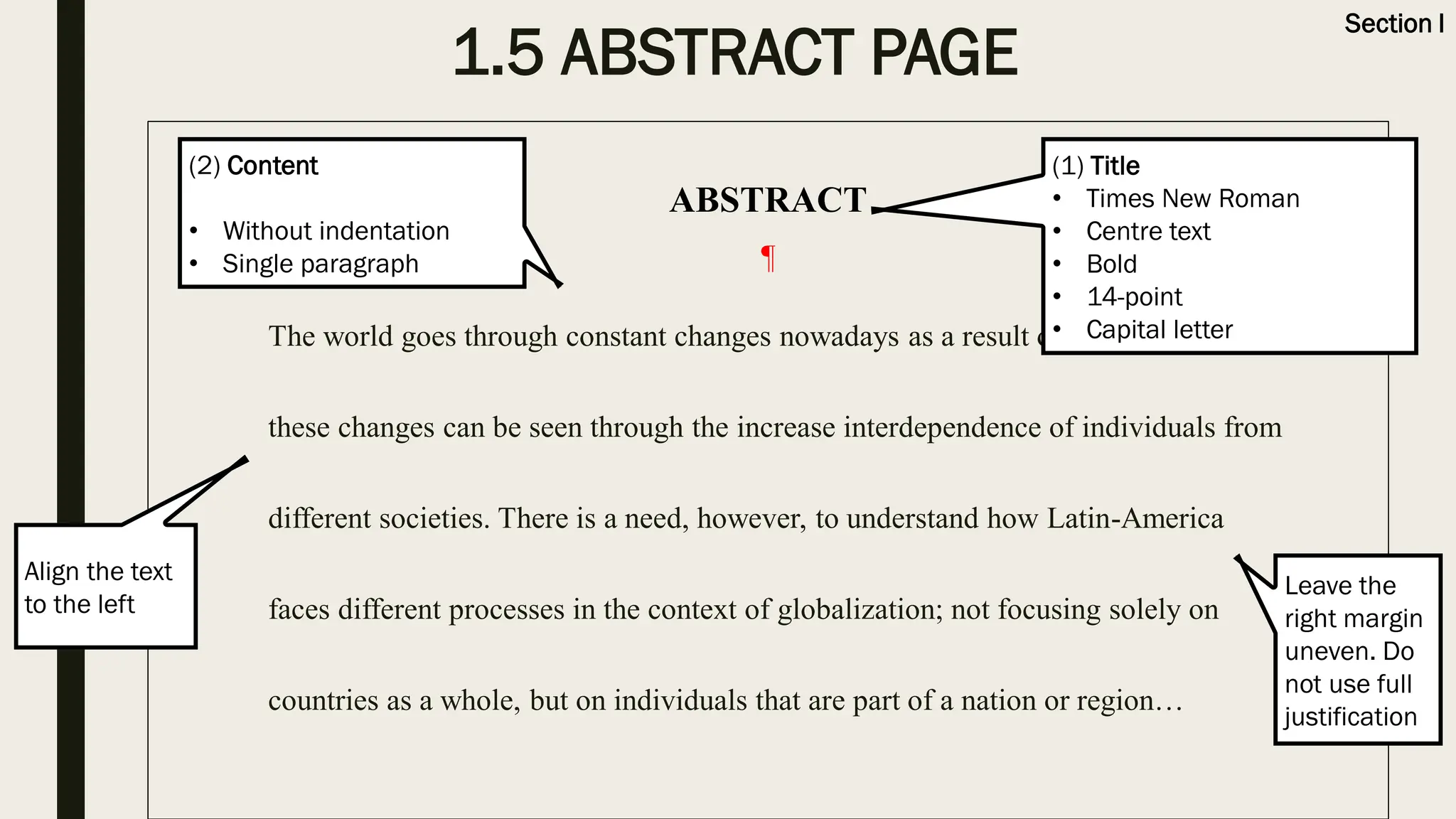
1.5 ABSTRACT PAGE
ABSTRACT

The world goes through constant changes nowadays as a result of globalization,
these changes can be seen through the increase interdependence of individuals from
different societies. There is a need, however, to understand how Latin-America
faces different processes in the context of globalization; not focusing solely on
countries as a whole, but on individuals that are part of a nation or region…
(1) Title
• Times New Roman
• Centre text
• Bold
• 14-point
• Capital letter
Section I
(2) Content
• Without indentation
• Single paragraph
Leave the
right margin
uneven. Do
not use full
justification
Align the text
to the left
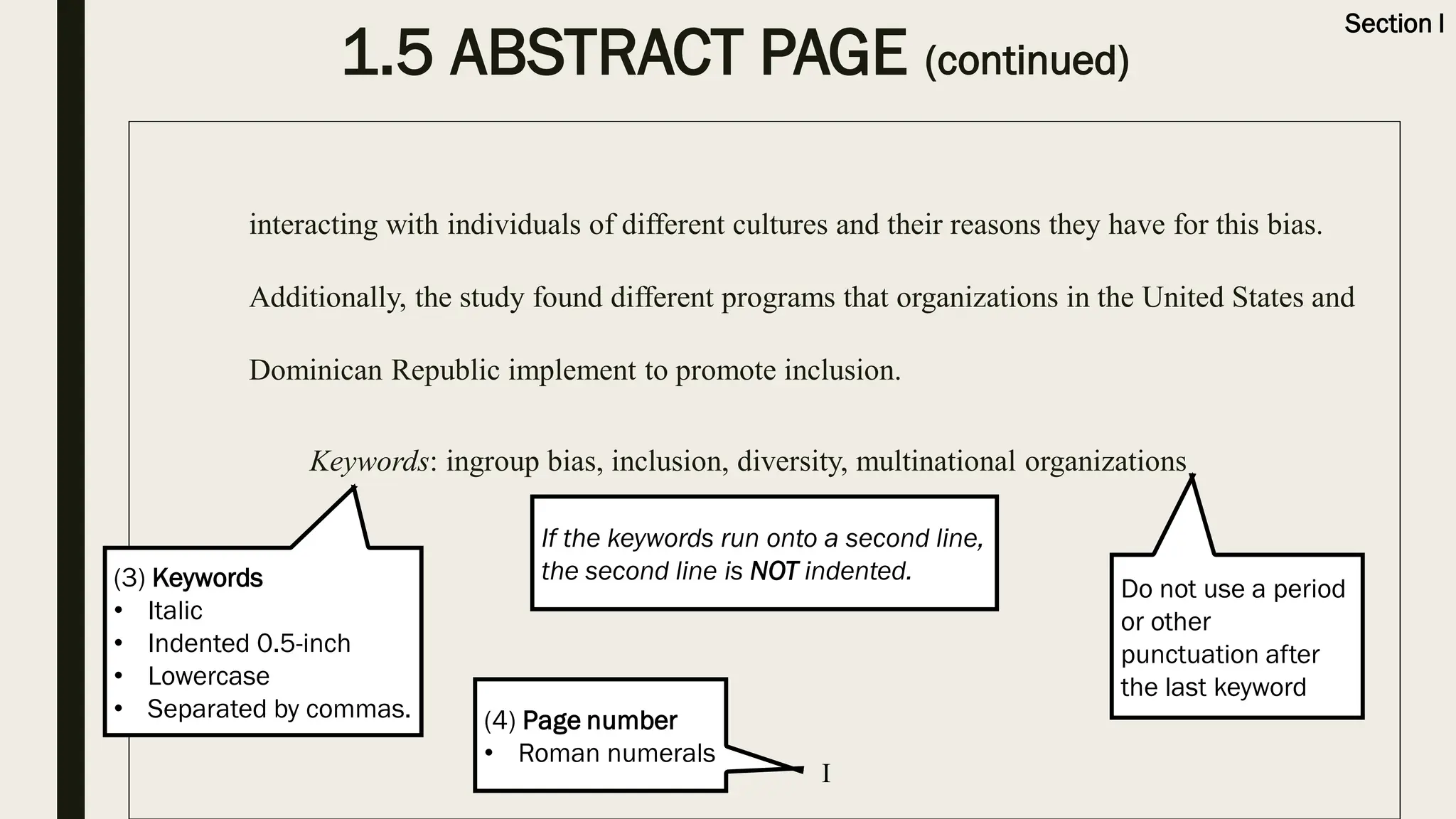
1.5 ABSTRACT PAGE (continued)
interacting with individuals of different cultures and their reasons they have for this bias.
Additionally, the study found different programs that organizations in the United States and
Dominican Republic implement to promote inclusion.
Keywords: ingroup bias, inclusion, diversity, multinational organizations
Section I
If the keywords run onto a second line,
the second line is NOT indented.
Do not use a period
or other
punctuation after
the last keyword
(3) Keywords
• Italic
• Indented 0.5-inch
• Lowercase
• Separated by commas.
I
(4) Page number
• Roman numerals
1.5
ABSTRACT PAGE
EXAMPLE
Section I
IHRD
expatriates
■ 1.1 Cover Page
■ 1.2 Title Page
■ 1.3 Approval Page
■ 1.4 Acknowledgements Page
■ 1.5 Abstract Page
■ 1.6 Table of Contents
• List of Tables
• List of Figures
Elements
1. Title
2. Content
3. Organization
PRELIMINARIES
Section I
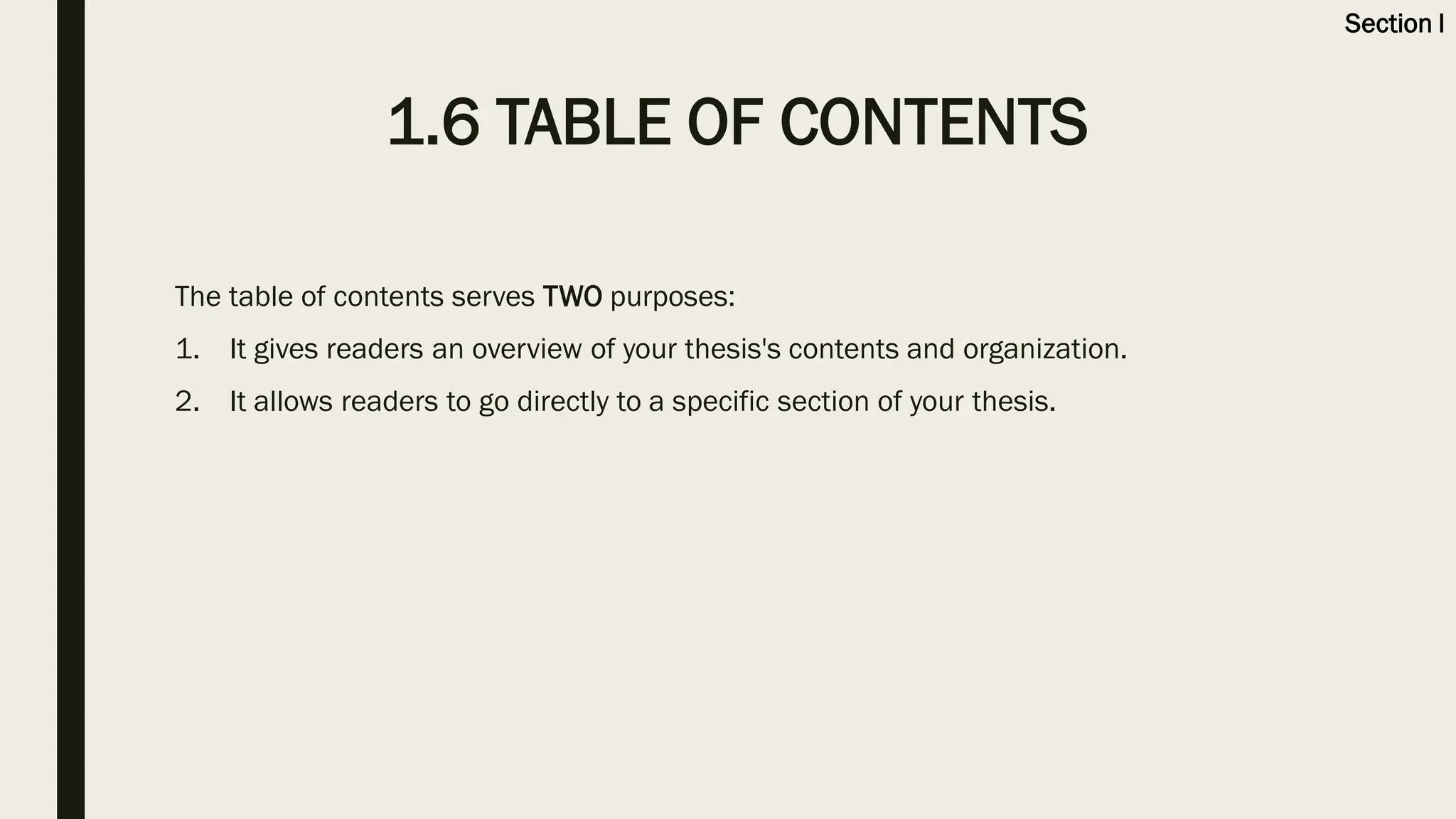
1.6 TABLE OF CONTENTS
The table of contents serves TWO purposes:
1. It gives readers an overview of your thesis's contents and organization.
2. It allows readers to go directly to a specific section of your thesis.
Section I
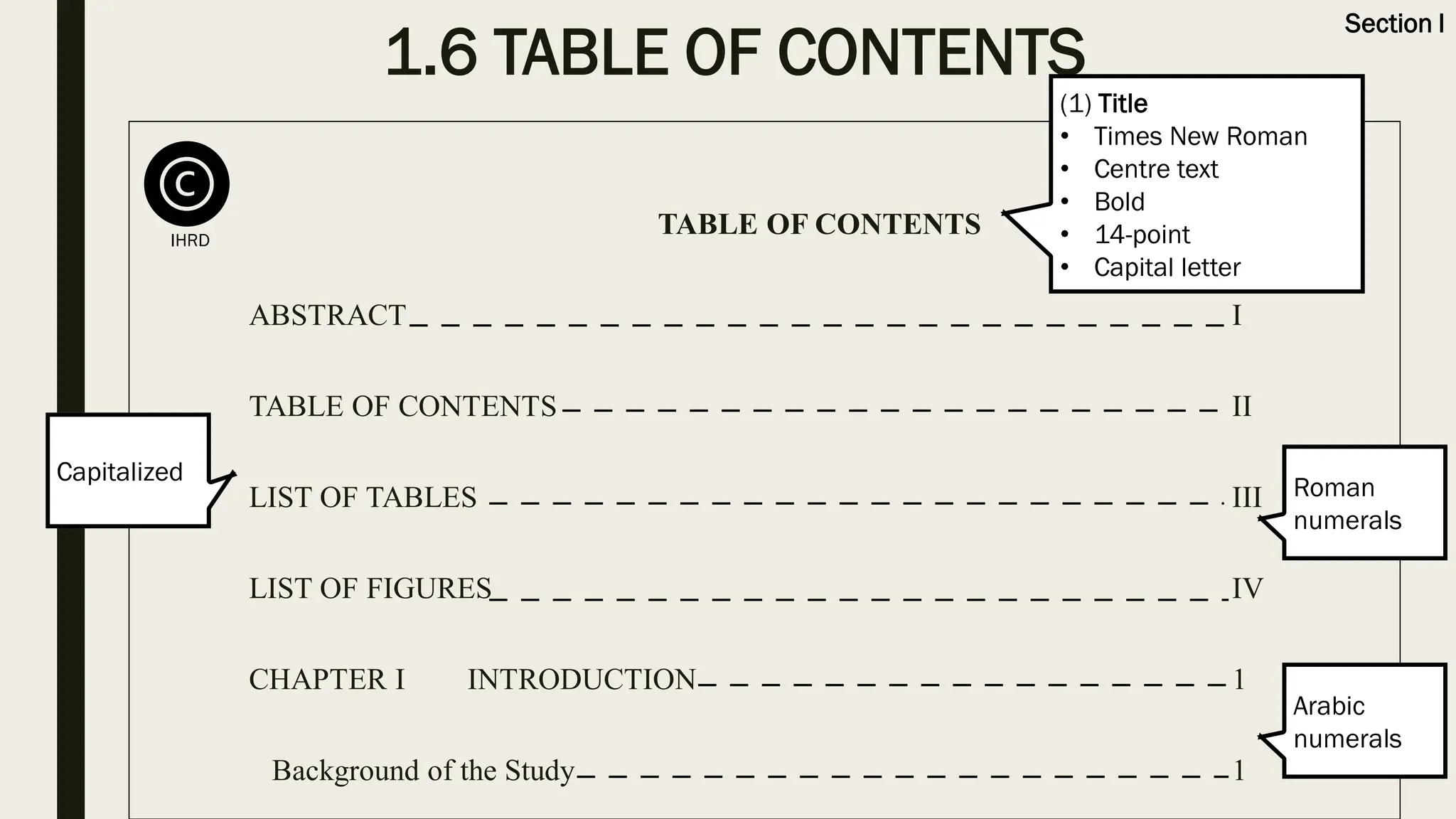
1.6 TABLE OF CONTENTS
Section I
TABLE OF CONTENTS
ABSTRACT I
TABLE OF CONTENTS II
LIST OF TABLES III
LIST OF FIGURES IV
CHAPTER I INTRODUCTION 1
Background of the Study 1
IHRD
(1) Title
• Times New Roman
• Centre text
• Bold
• 14-point
• Capital letter
Roman
numerals
Arabic
numerals
Capitalized
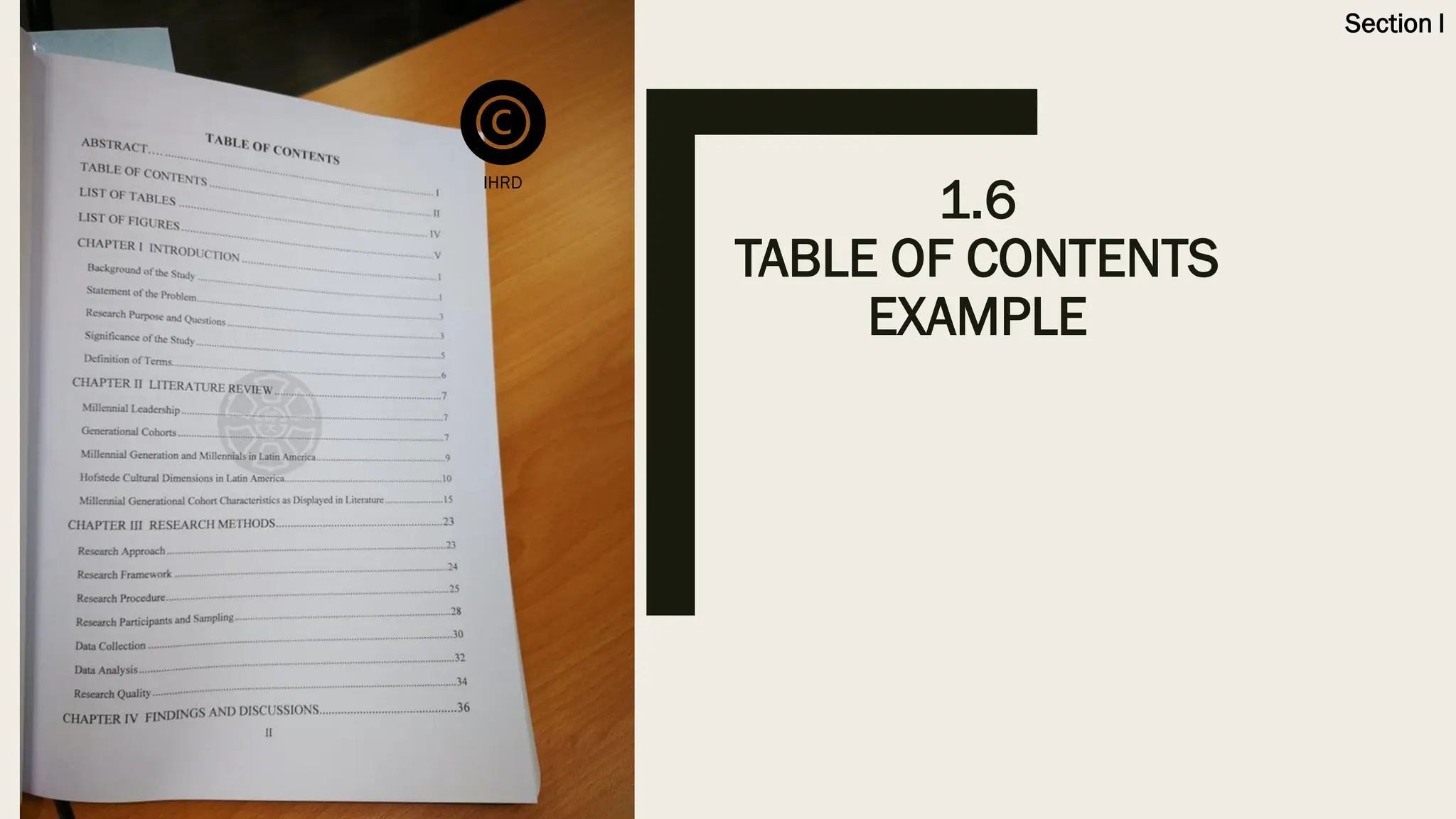
1.6
TABLE OF CONTENTS
EXAMPLE
Section I
IHRD
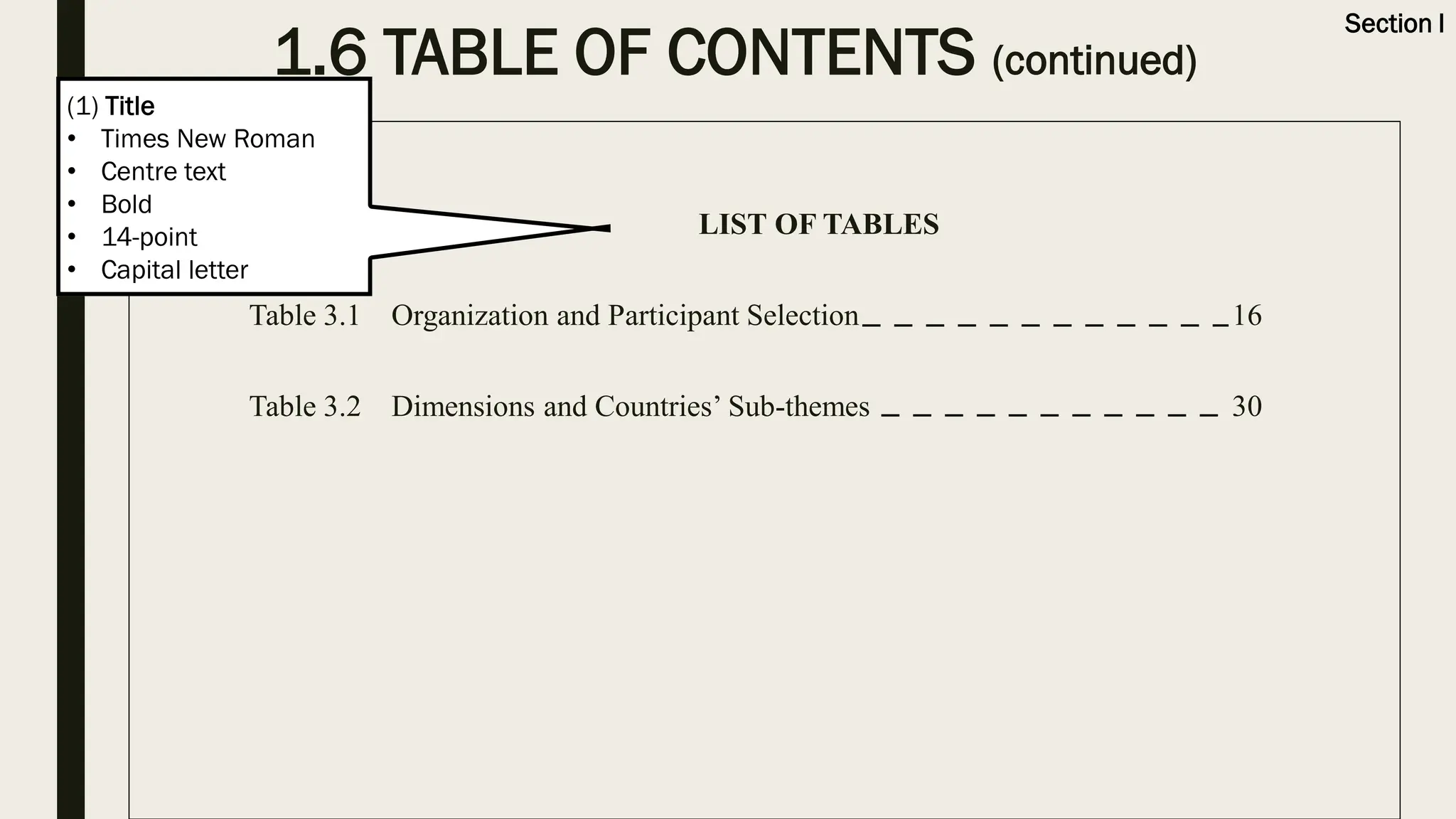
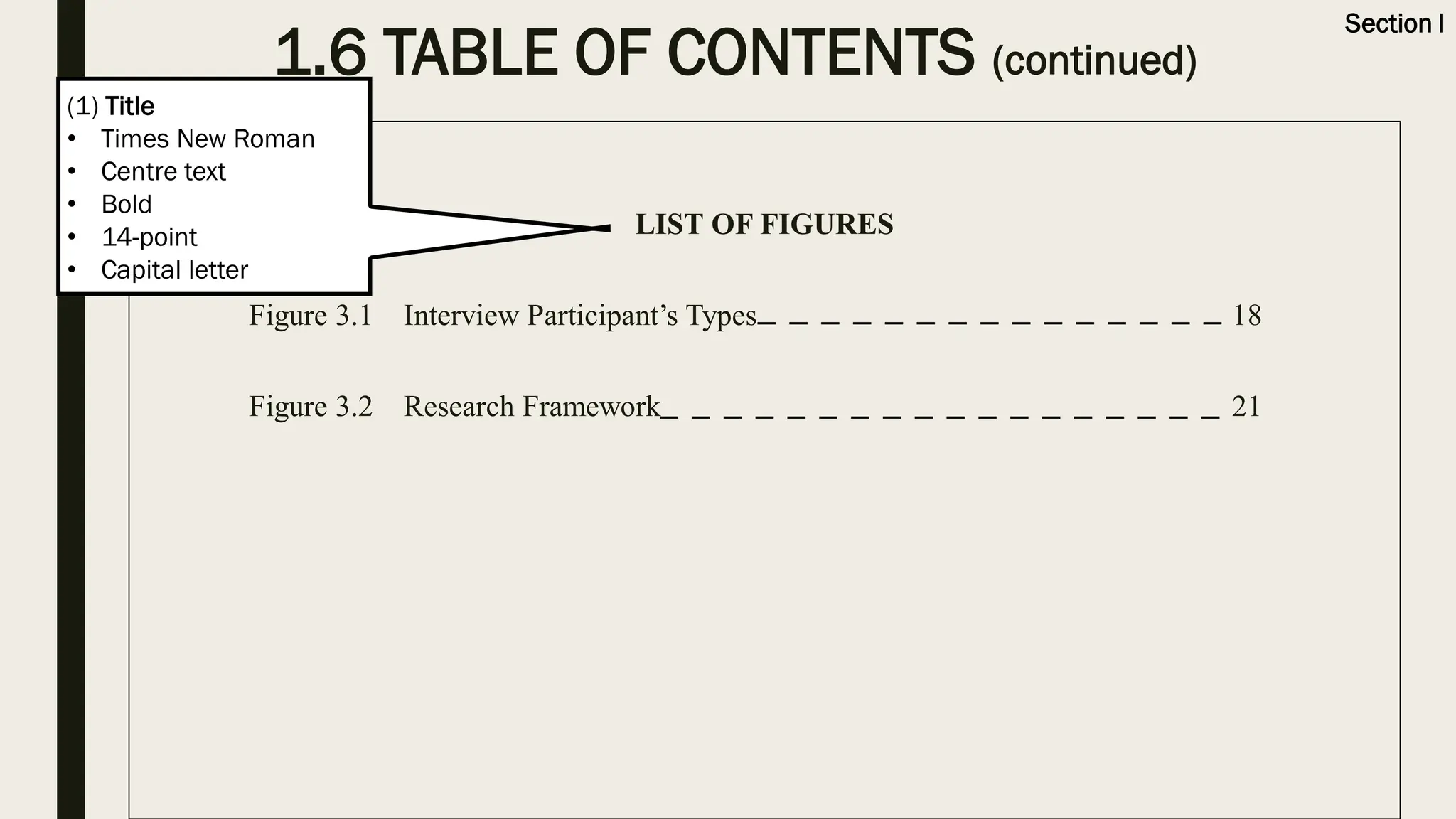
1.6 TABLE OF CONTENTS (continued)
Section I
LIST OF TABLES
Table 3.1 Organization and Participant Selection 16
Table 3.2 Dimensions and Countries’ Sub-themes 30
(1) Title
• Times New Roman
• Centre text
• Bold
• 14-point
• Capital letter
1.6
LIST OF TABLES
EXAMPLE
Section I
IHRD
1.6 TABLE OF CONTENTS (continued)
Section I
LIST OF FIGURES
Figure 3.1 Interview Participant’s Types 18
Figure 3.2 Research Framework 21
(1) Title
• Times New Roman
• Centre text
• Bold
• 14-point
• Capital letter
1.6
LIST OF FIGURES
EXAMPLE
Section I
IHRD
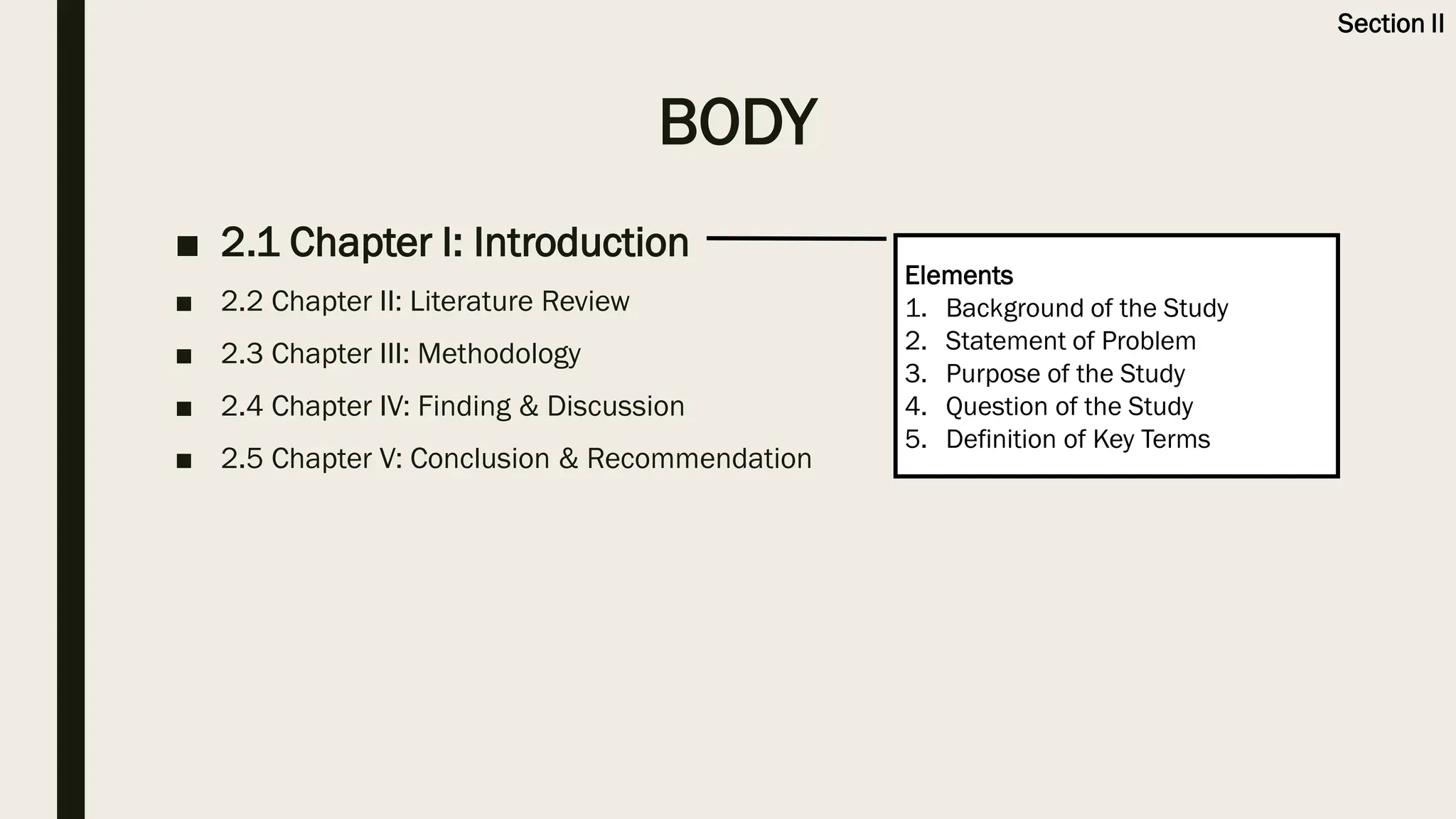
BODY
■ 2.1 Chapter I: Introduction
■ 2.2 Chapter II: Literature Review
■ 2.3 Chapter III: Methodology
■ 2.4 Chapter IV: Finding & Discussion
■ 2.5 Chapter V: Conclusion & Recommendation
Elements
1. Background of the Study
2. Statement of Problem
3. Purpose of the Study
4. Question of the Study
5. Definition of Key Terms
Section II
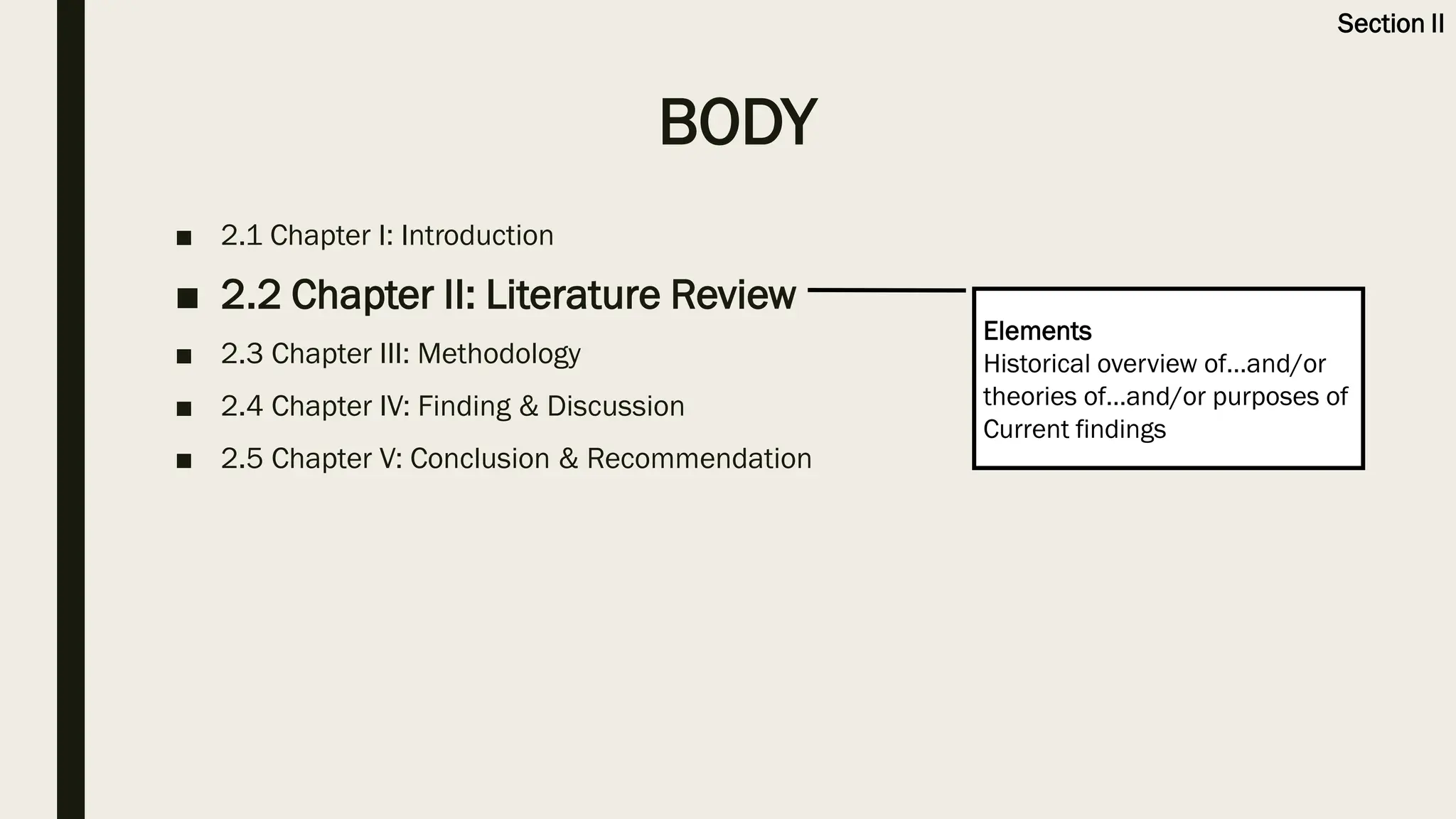
BODY
■ 2.1 Chapter I: Introduction
■ 2.2 Chapter II: Literature Review
■ 2.3 Chapter III: Methodology
■ 2.4 Chapter IV: Finding & Discussion
■ 2.5 Chapter V: Conclusion & Recommendation
Elements
Historical overview of…and/or
theories of…and/or purposes of
Current findings
Section II
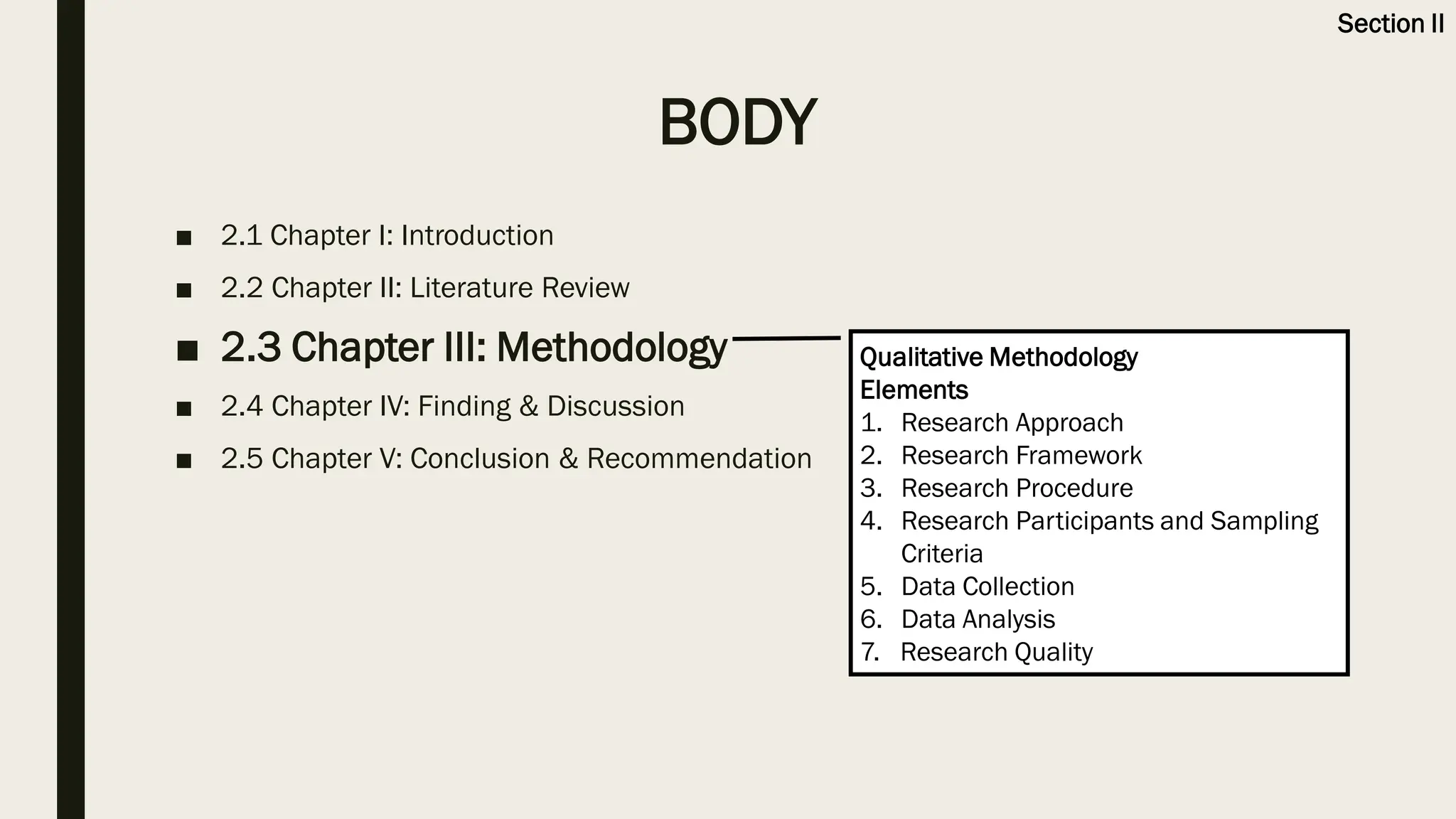
BODY
■ 2.1 Chapter I: Introduction
■ 2.2 Chapter II: Literature Review
■ 2.3 Chapter III: Methodology
■ 2.4 Chapter IV: Finding & Discussion
■ 2.5 Chapter V: Conclusion & Recommendation
Qualitative Methodology
Elements
1. Research Approach
2. Research Framework
3. Research Procedure
4. Research Participants and Sampling
Criteria
5. Data Collection
6. Data Analysis
7. Research Quality
Section II
BODY
■ 2.1 Chapter I: Introduction
■ 2.2 Chapter II: Literature Review
■ 2.3 Chapter III: Methodology
■ 2.4 Chapter IV: Finding & Discussion
■ 2.5 Chapter V: Conclusion & Recommendation
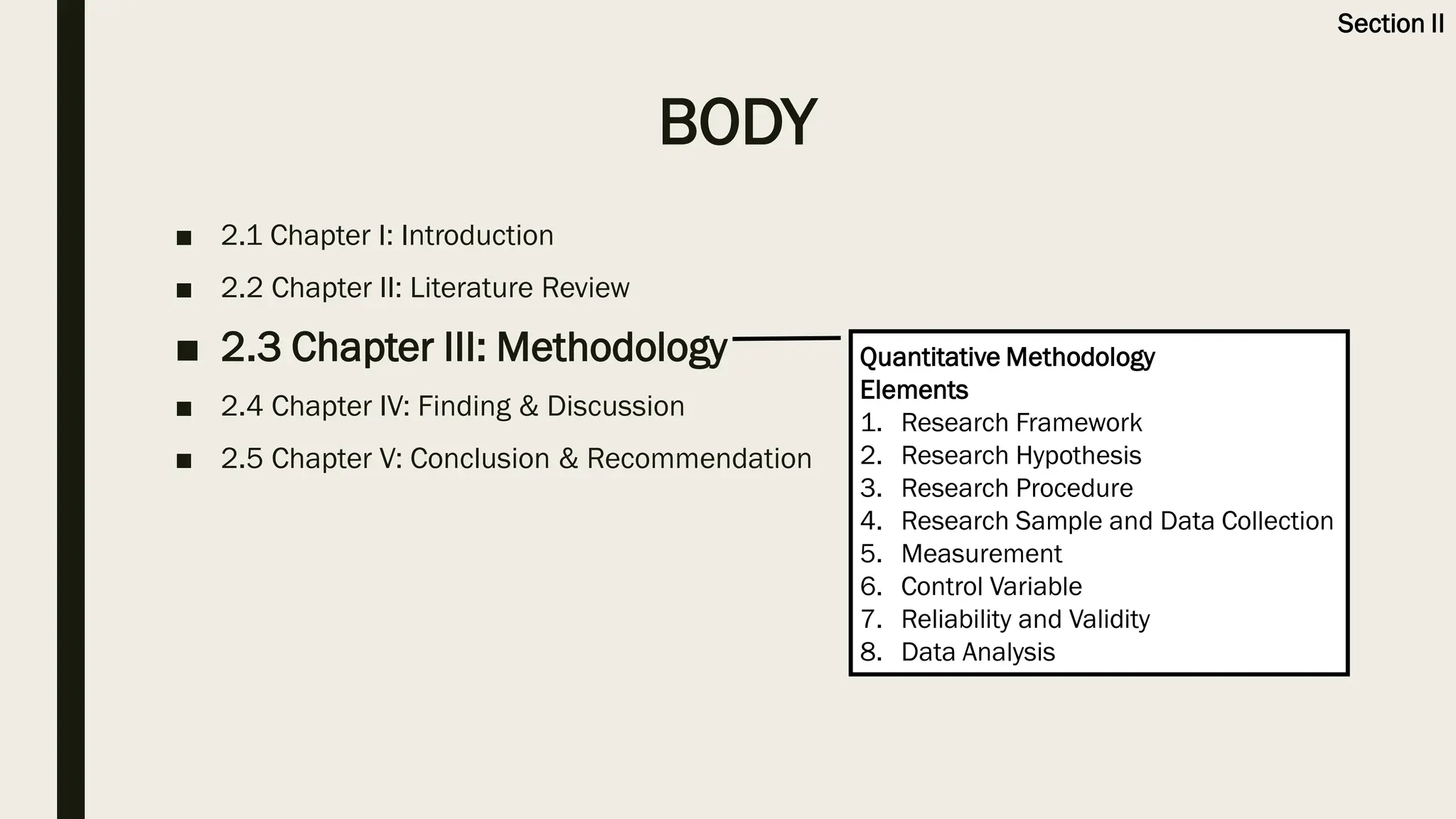
Quantitative Methodology
Elements
1. Research Framework
2. Research Hypothesis
3. Research Procedure
4. Research Sample and Data Collection
5. Measurement
6. Control Variable
7. Reliability and Validity
8. Data Analysis
Section II
BODY
■ 2.1 Chapter I: Introduction
■ 2.2 Chapter II: Literature Review
■ 2.3 Chapter III: Methodology
■ 2.4 Chapter IV: Finding & Discussion
■ 2.5 Chapter V: Conclusion & Recommendation
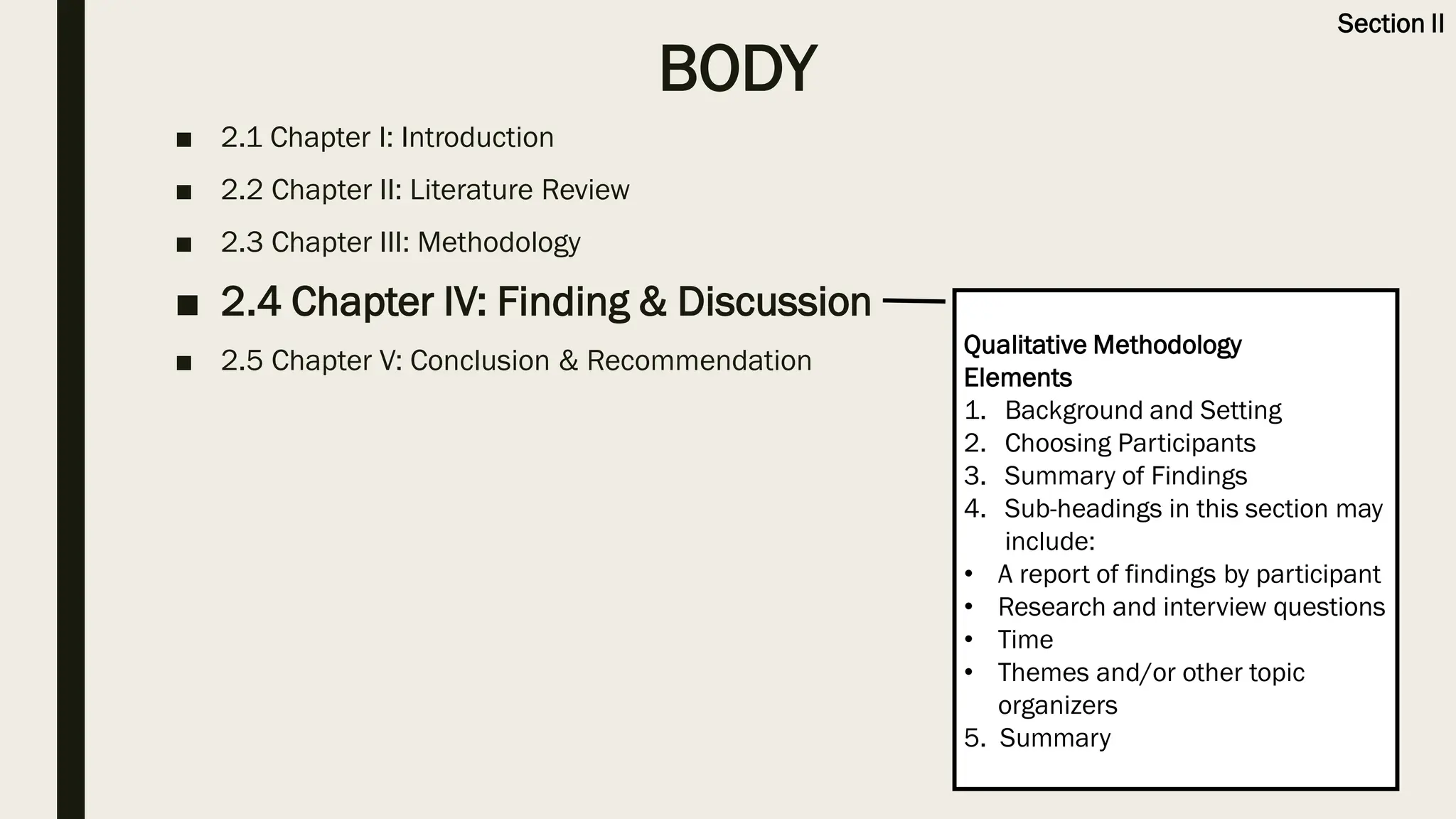
Qualitative Methodology
Elements
1. Background and Setting
2. Choosing Participants
3. Summary of Findings
4. Sub-headings in this section may
include:
• A report of findings by participant
• Research and interview questions
• Time
• Themes and/or other topic
organizers
5. Summary
Section II
BODY
■ 2.1 Chapter I: Introduction
■ 2.2 Chapter II: Literature Review
■ 2.3 Chapter III: Methodology
■ 2.4 Chapter IV: Finding & Discussion
■ 2.5 Chapter V: Conclusion & Recommendation
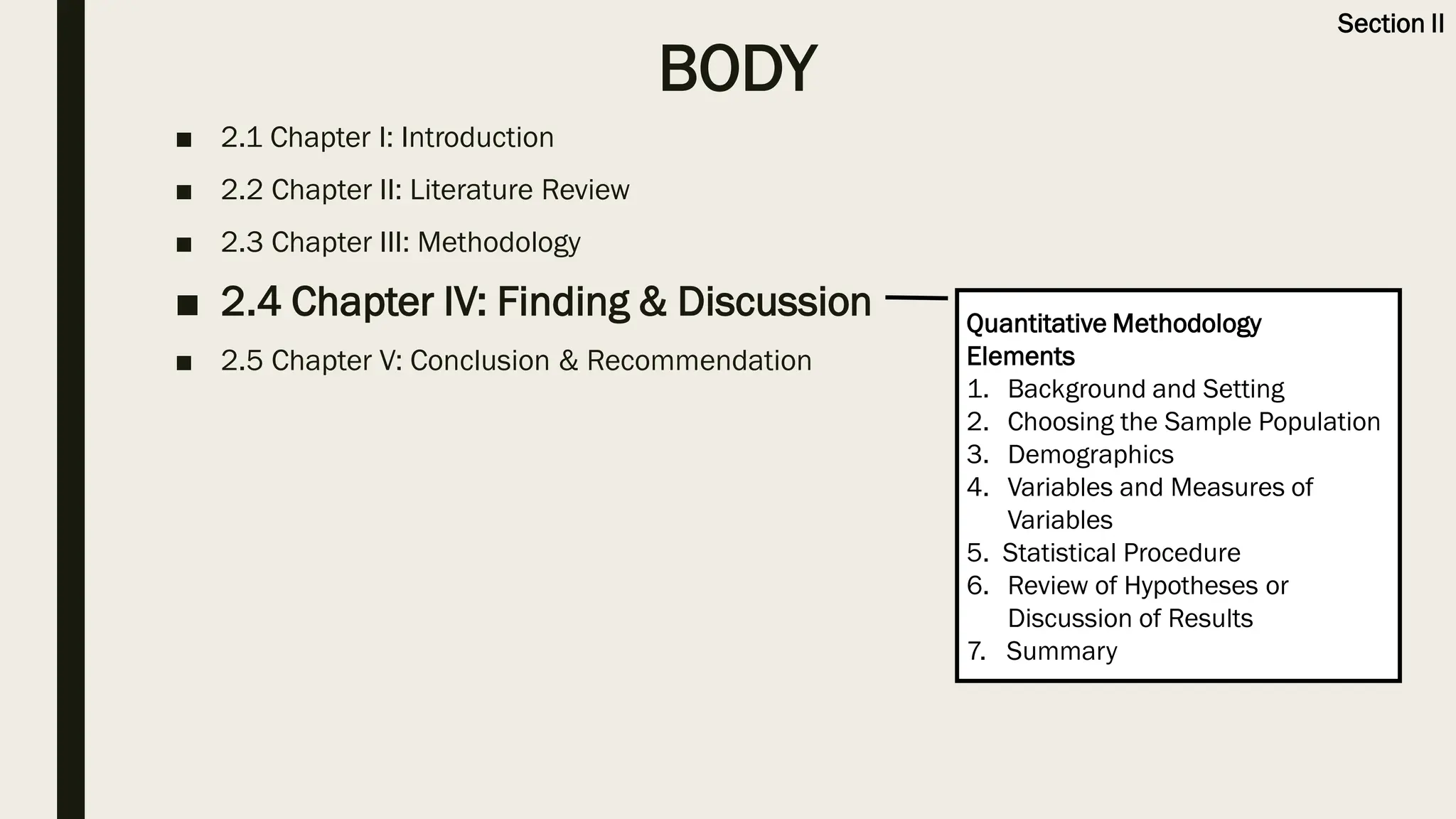
Quantitative Methodology
Elements
1. Background and Setting
2. Choosing the Sample Population
3. Demographics
4. Variables and Measures of
Variables
5. Statistical Procedure
6. Review of Hypotheses or
Discussion of Results
7. Summary
Section II
BODY
■ 2.1 Chapter I: Introduction
■ 2.2 Chapter II: Literature Review
■ 2.3 Chapter III: Methodology
■ 2.4 Chapter IV: Finding & Discussion
■ 2.5 Chapter V: Conclusion & Recommendation
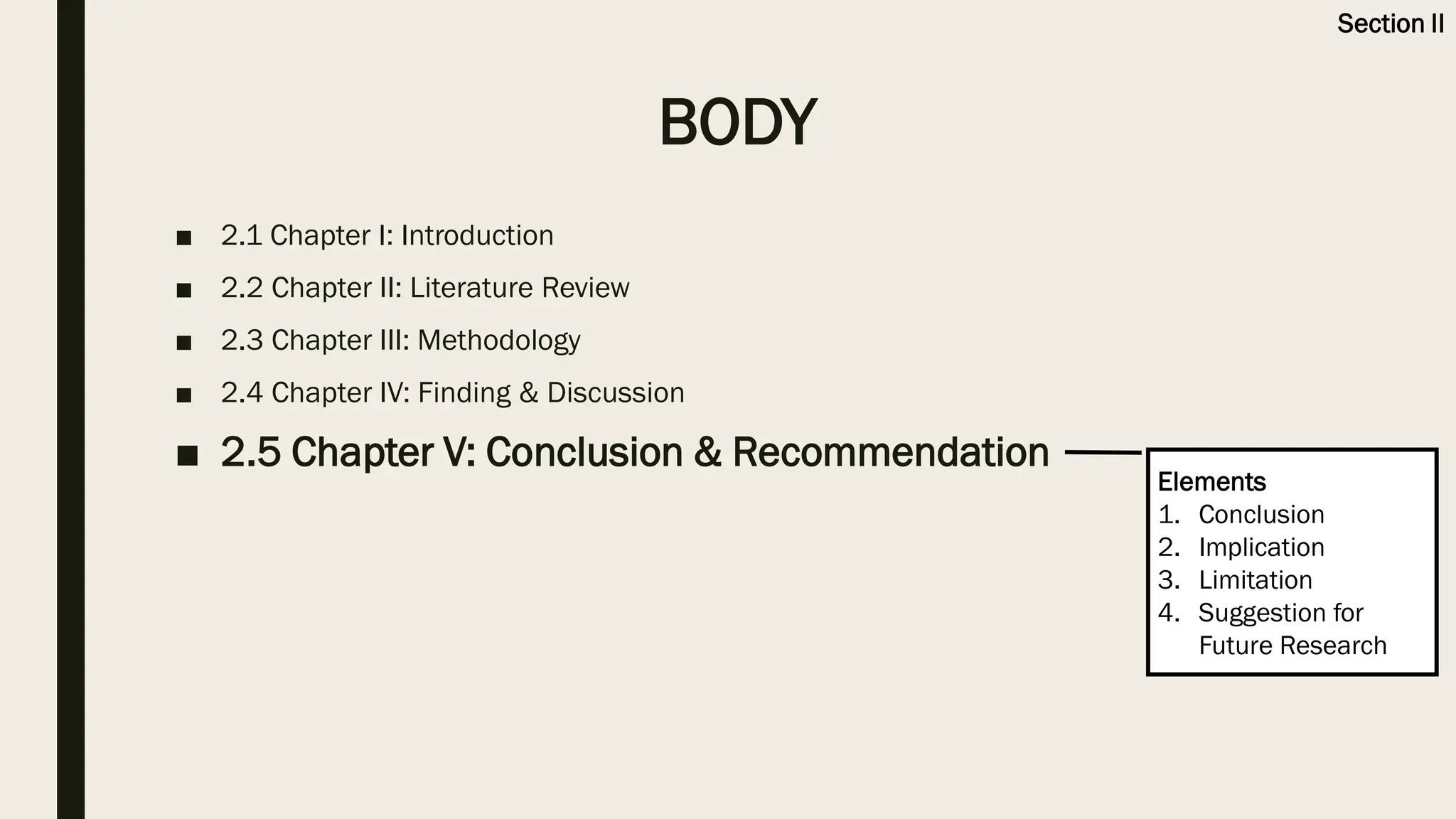
Elements
1. Conclusion
2. Implication
3. Limitation
4. Suggestion for
Future Research
Section II
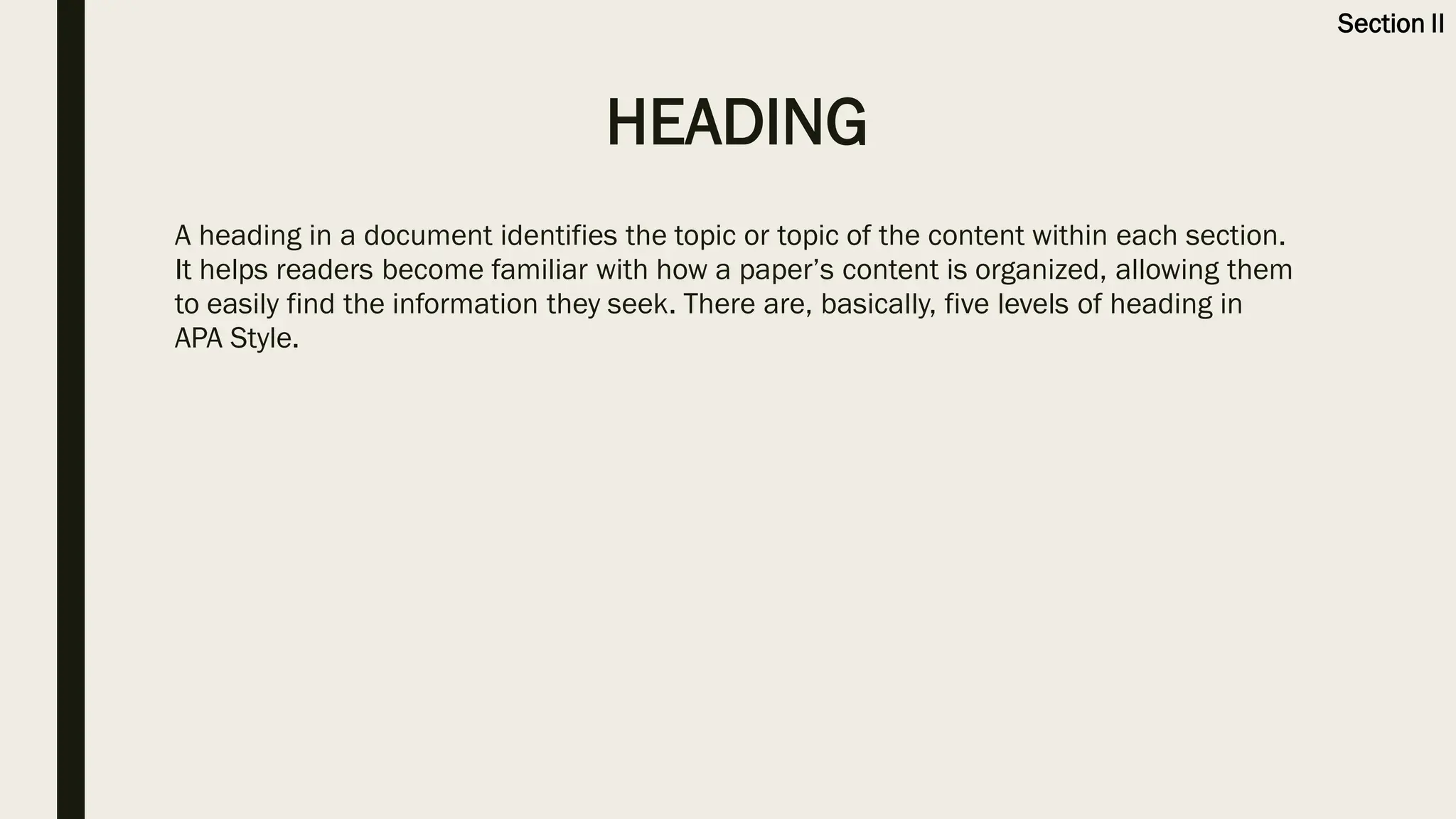
HEADING
A heading in a document identifies the topic or topic of the content within each section.
It helps readers become familiar with how a paper’s content is organized, allowing them
to easily find the information they seek. There are, basically, five levels of heading in
APA Style.
Section II
HEADING
Section II
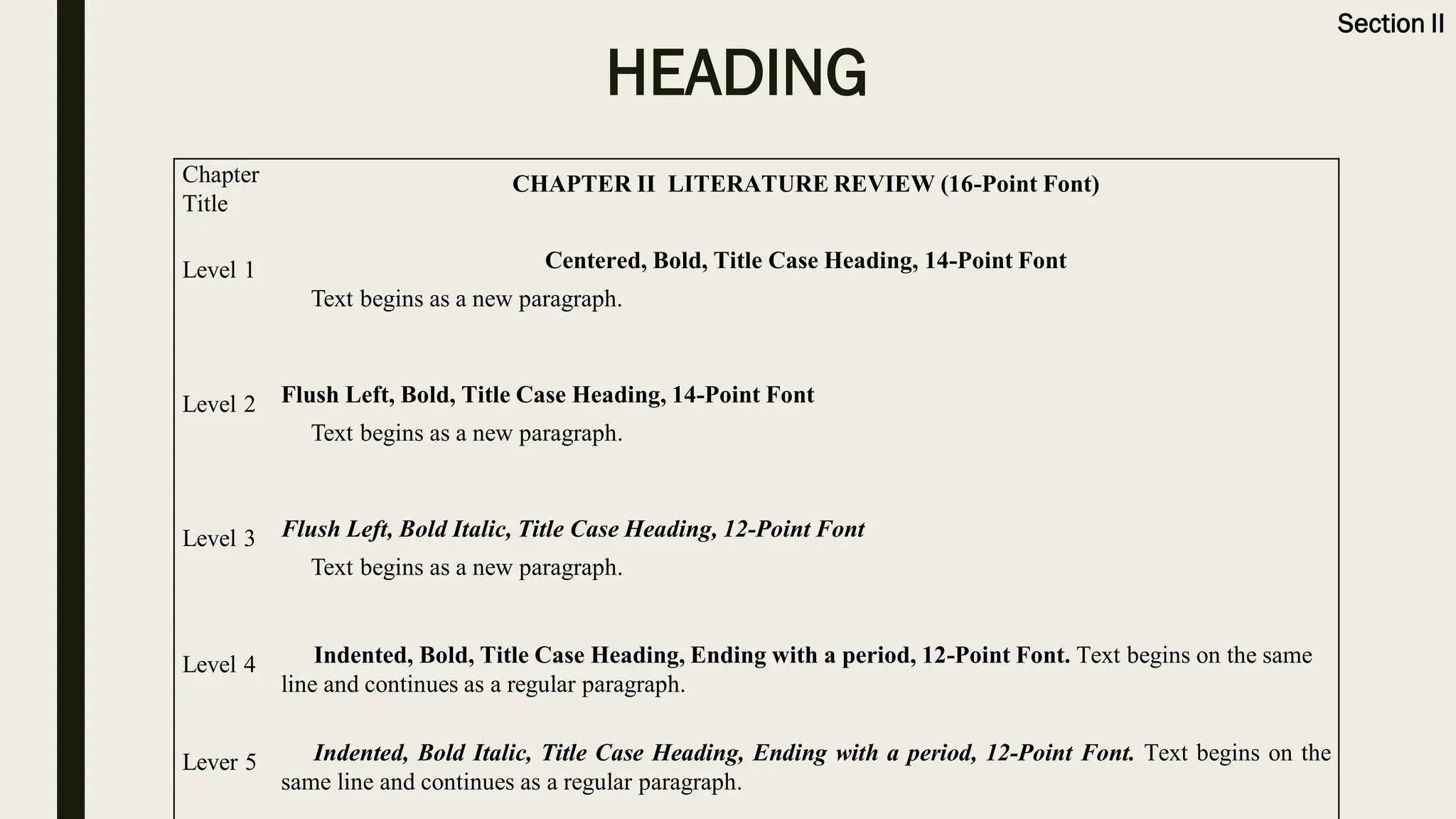
Chapter
Title
CHAPTER II LITERATURE REVIEW (16-Point Font)
Level 1 Centered, Bold, Title Case Heading, 14-Point Font
Text begins as a new paragraph.
Level 2 Flush Left, Bold, Title Case Heading, 14-Point Font
Text begins as a new paragraph.
Level 3 Flush Left, Bold Italic, Title Case Heading, 12-Point Font
Text begins as a new paragraph.
Level 4 Indented, Bold, Title Case Heading, Ending with a period, 12-Point Font. Text begins on the same
line and continues as a regular paragraph.
Lever 5 Indented, Bold Italic, Title Case Heading, Ending with a period, 12-Point Font. Text begins on the
same line and continues as a regular paragraph.
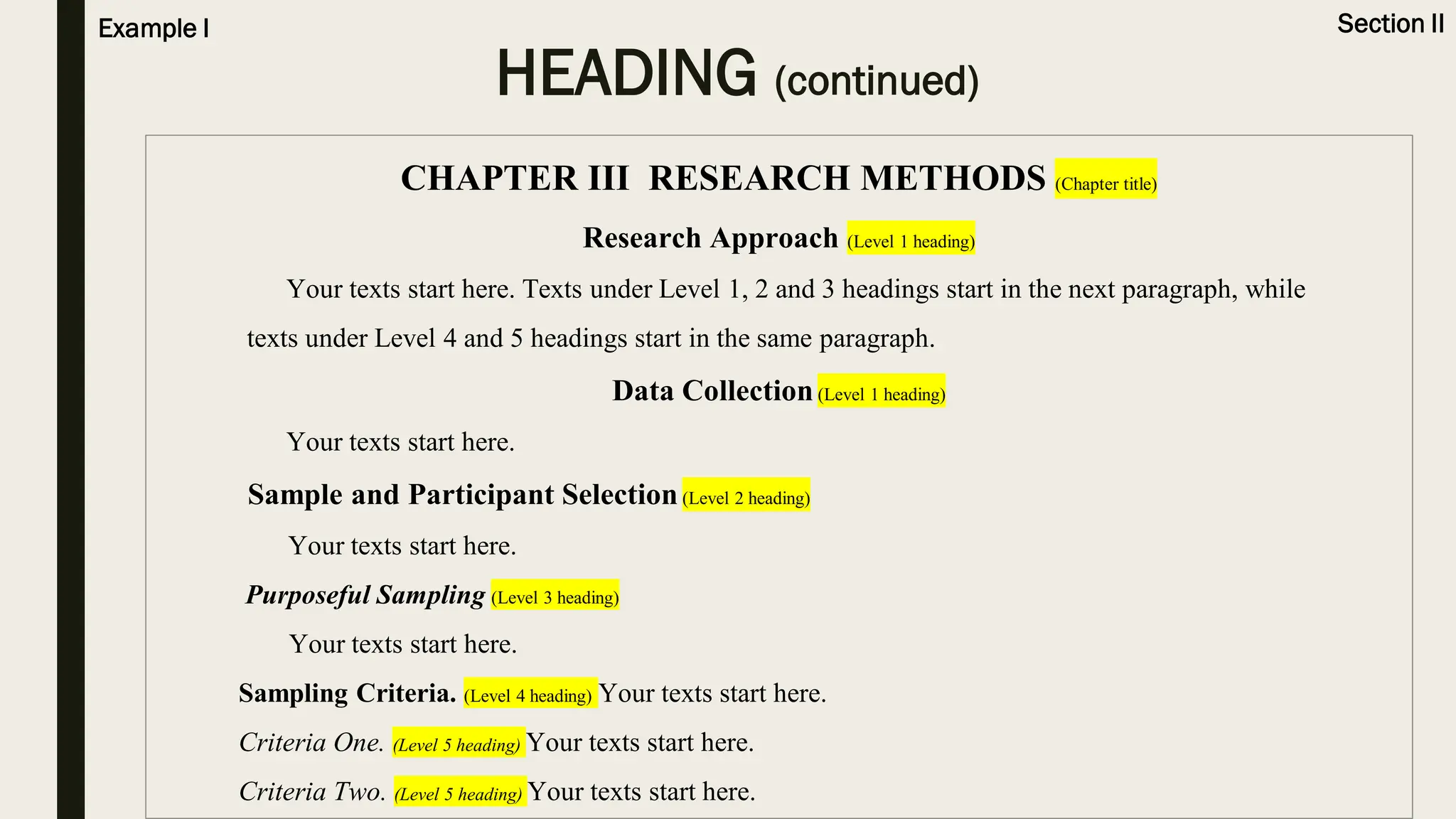
HEADING (continued)
Section II
CHAPTER III RESEARCH METHODS (Chapter title)
Research Approach (Level 1 heading)
Your texts start here. Texts under Level 1, 2 and 3 headings start in the next paragraph, while
texts under Level 4 and 5 headings start in the same paragraph.
Data Collection(Level 1 heading)
Your texts start here.
Sample and Participant Selection(Level 2 heading)
Your texts start here.
Purposeful Sampling (Level 3 heading)
Your texts start here.
Sampling Criteria. (Level 4 heading) Your texts start here.
Criteria One. (Level 5 heading) Your texts start here.
Criteria Two. (Level 5 heading) Your texts start here.
Example I
HEADING (continued)
Section II
Example II
Startup Ecosystem (Level 1 heading)
Novel technology tends to emanate from new ventures, especially startup. Thiel
(2014) debates that startups “question received ideas and rethink business from scratch” (p. 11).
Startups are not merely the key players in highly competitive markets, but also challenge and
disrupt the conventional industries, revitalize the entrepreneurial community through introducing
new products, services or business models that greatly facilitate their ability to provide promising
solutions to the existing problem (OECD, 2016). [paragraph continues]
Culture (Level 2 heading)
Located at the heart of the Asia Pacific region puts Taiwan at a considerable advantage
to travel both domestically and internationally. According to Jan (2019), Taiwan is widely
recognized for its advanced manufacturing and robotics. [paragraph continues]
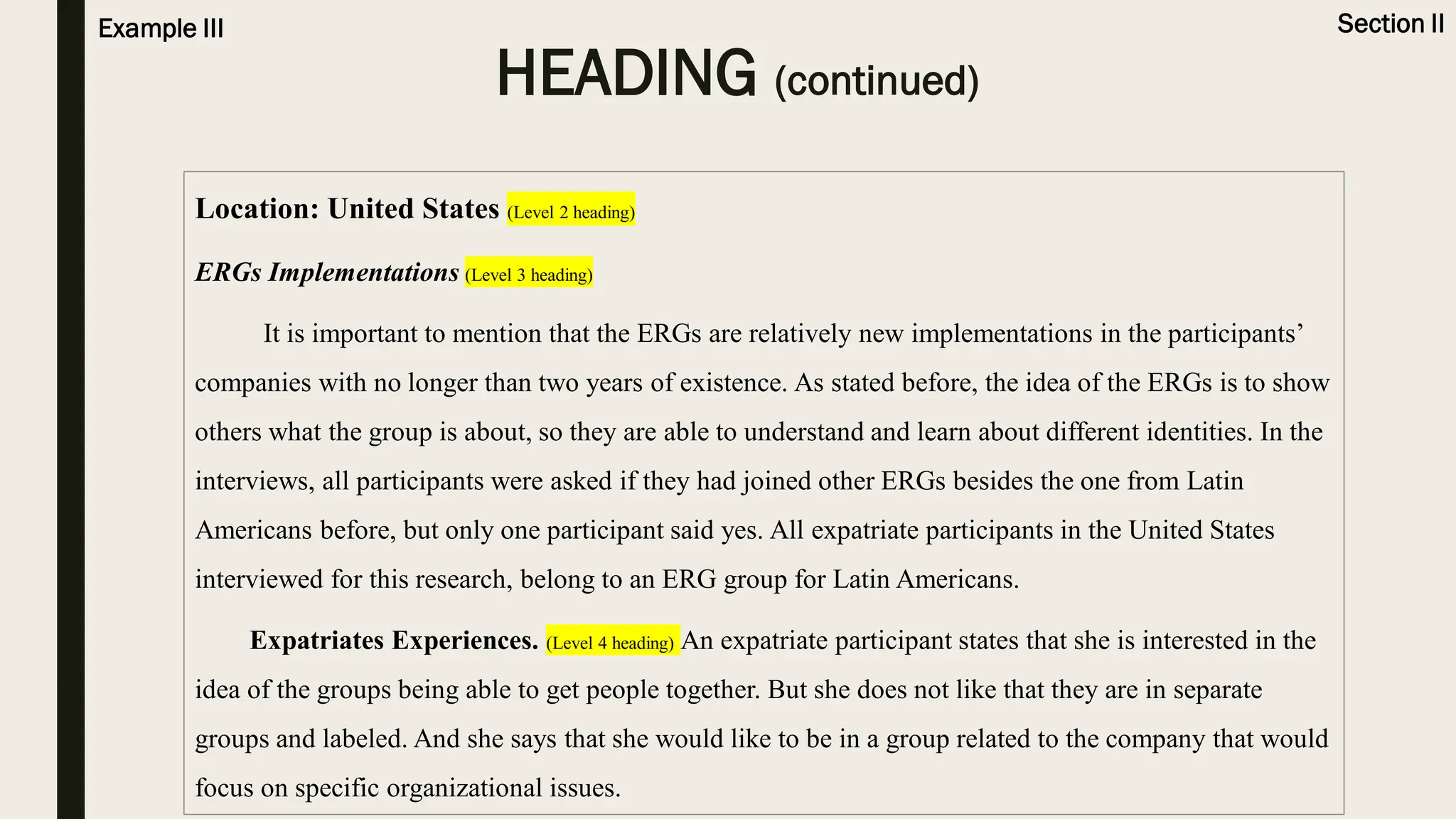
HEADING (continued)
Section II
Example III
Location: United States (Level 2 heading)
ERGs Implementations (Level 3 heading)
It is important to mention that the ERGs are relatively new implementations in the participants’
companies with no longer than two years of existence. As stated before, the idea of the ERGs is to show
others what the group is about, so they are able to understand and learn about different identities. In the
interviews, all participants were asked if they had joined other ERGs besides the one from Latin
Americans before, but only one participant said yes. All expatriate participants in the United States
interviewed for this research, belong to an ERG group for Latin Americans.
Expatriates Experiences. (Level 4 heading) An expatriate participant states that she is interested in the
idea of the groups being able to get people together. But she does not like that they are in separate
groups and labeled. And she says that she would like to be in a group related to the company that would
focus on specific organizational issues.
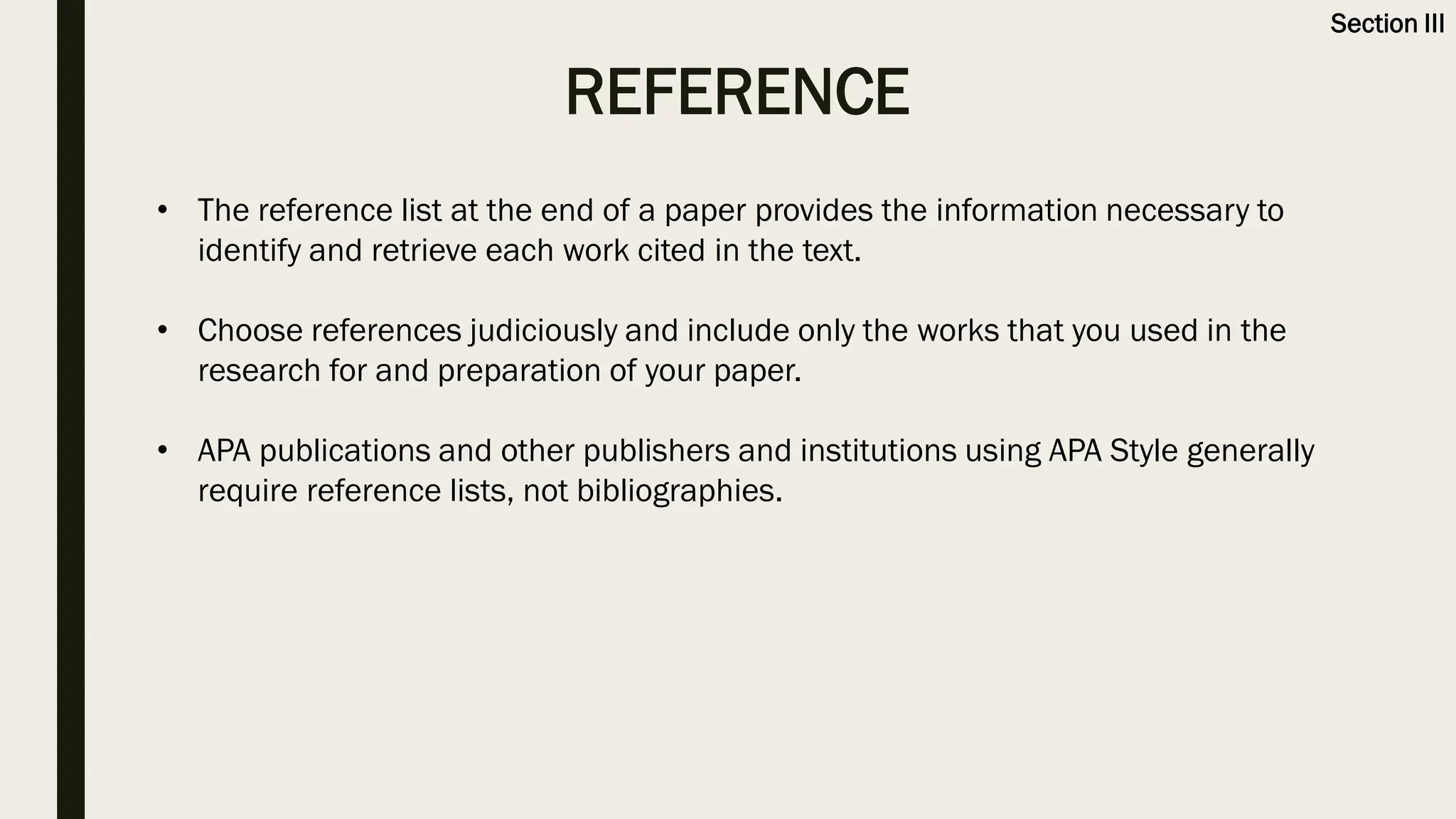
REFERENCE
Section III
• The reference list at the end of a paper provides the information necessary to
identify and retrieve each work cited in the text.
• Choose references judiciously and include only the works that you used in the
research for and preparation of your paper.
• APA publications and other publishers and institutions using APA Style generally
require reference lists, not bibliographies.
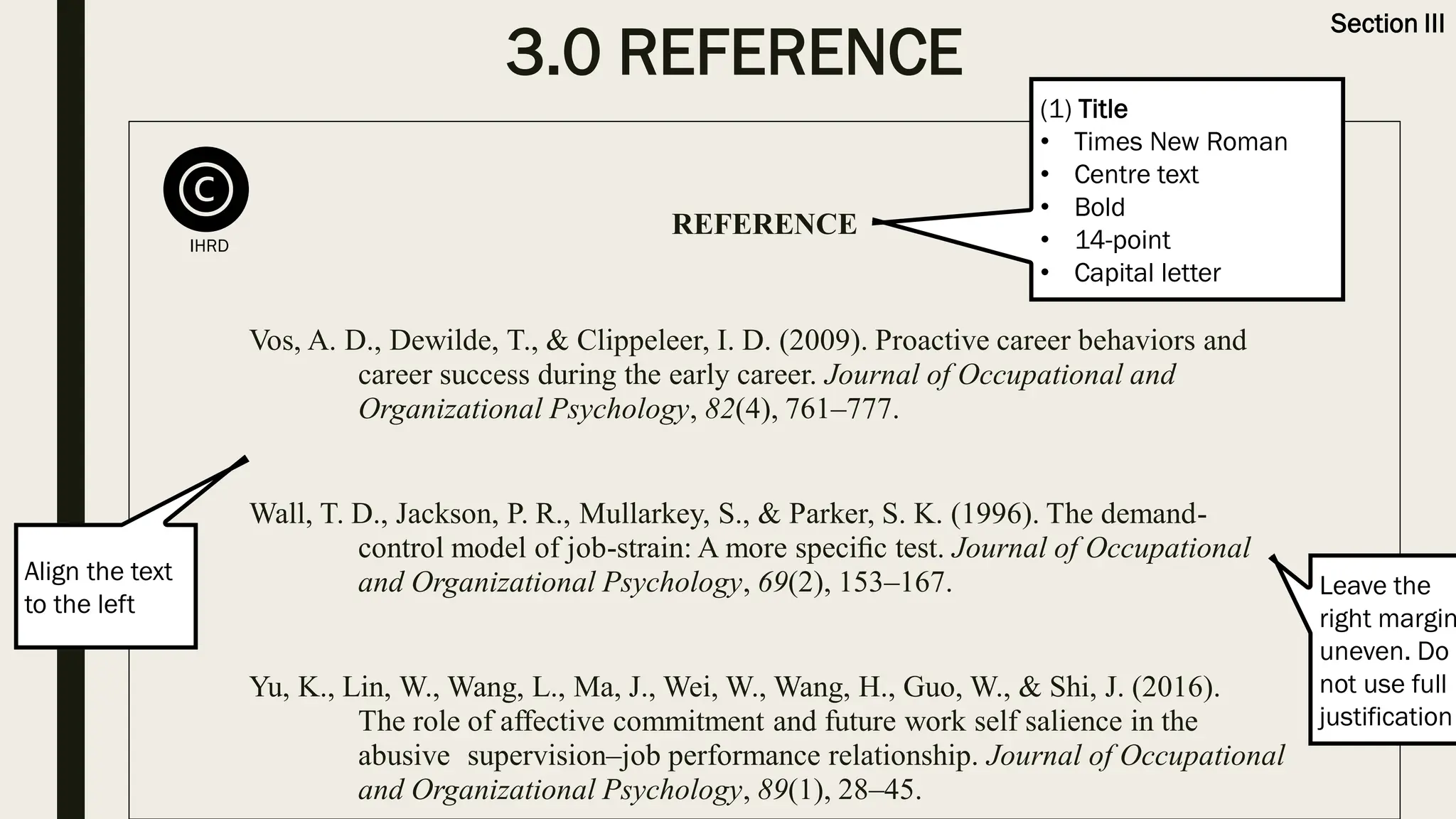
3.0 REFERENCE
Section III
REFERENCE
Vos, A. D., Dewilde, T., & Clippeleer, I. D. (2009). Proactive career behaviors and
career success during the early career. Journal of Occupational and
Organizational Psychology, 82(4), 761–777.
Wall, T. D., Jackson, P. R., Mullarkey, S., & Parker, S. K. (1996). The demand-
control model of job-strain: A more specific test. Journal of Occupational
and Organizational Psychology, 69(2), 153–167.
Yu, K., Lin, W., Wang, L., Ma, J., Wei, W., Wang, H., Guo, W., & Shi, J. (2016).
The role of affective commitment and future work self salience in the
abusive supervision–job performance relationship. Journal of Occupational
and Organizational Psychology, 89(1), 28–45.
(1) Title
• Times New Roman
• Centre text
• Bold
• 14-point
• Capital letter
Align the text
to the left
Leave the
right margin
uneven. Do
not use full
justification
IHRD
APPENDICES
Section IV
Appendices contain material that is too detailed to include in the main report,
such as long mathematical derivations or calculations, detailed technical
drawings, or tables of raw data.
4.0 APPENDICES
Section IV
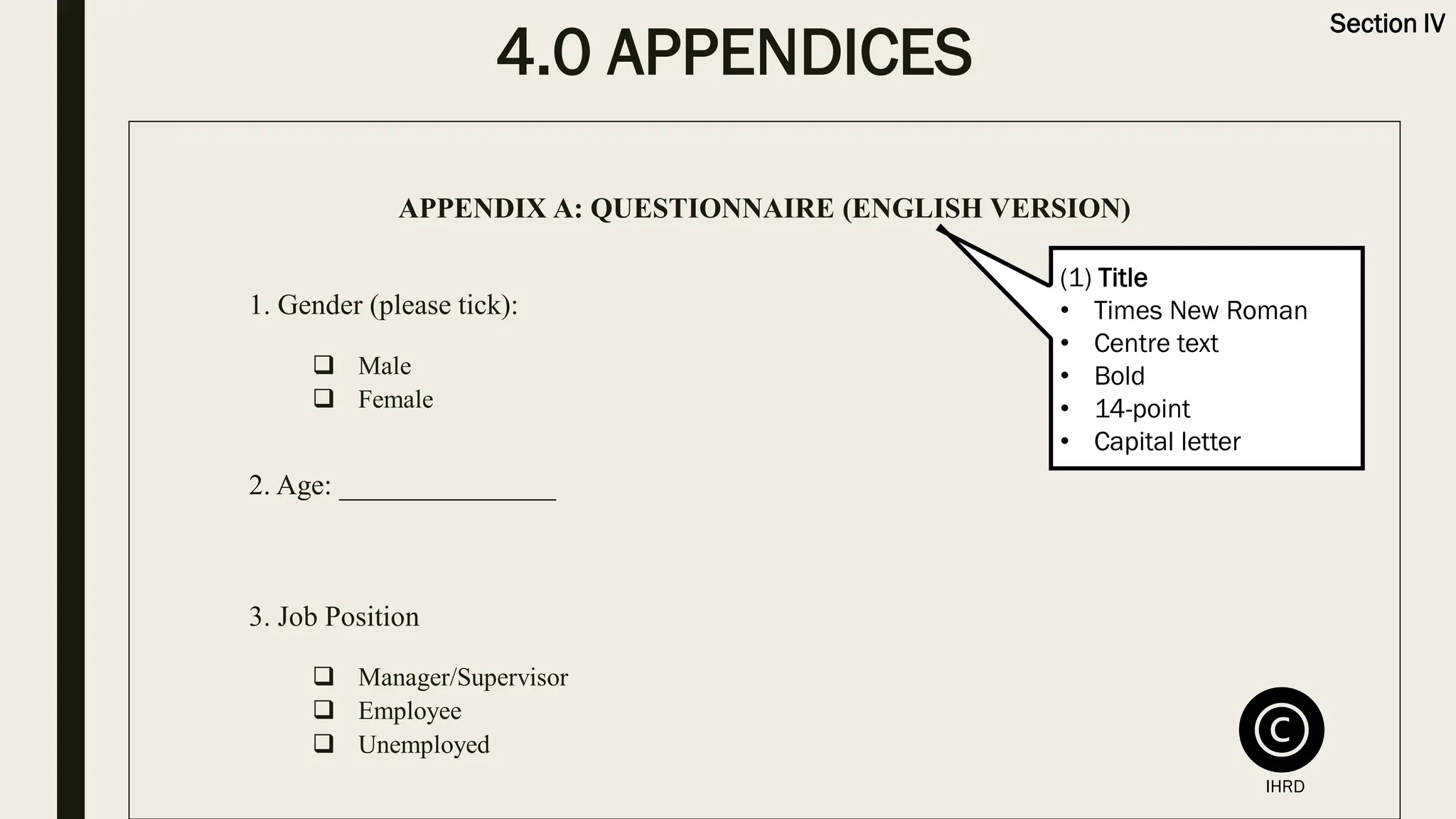
APPENDIX A: QUESTIONNAIRE (ENGLISH VERSION)
1. Gender (please tick):
❑ Male
❑ Female
2. Age: _______________
3. Job Position
❑ Manager/Supervisor
❑ Employee
❑ Unemployed
(1) Title
• Times New Roman
• Centre text
• Bold
• 14-point
• Capital letter
IHRD
4.0 APPENDICES
Section IV
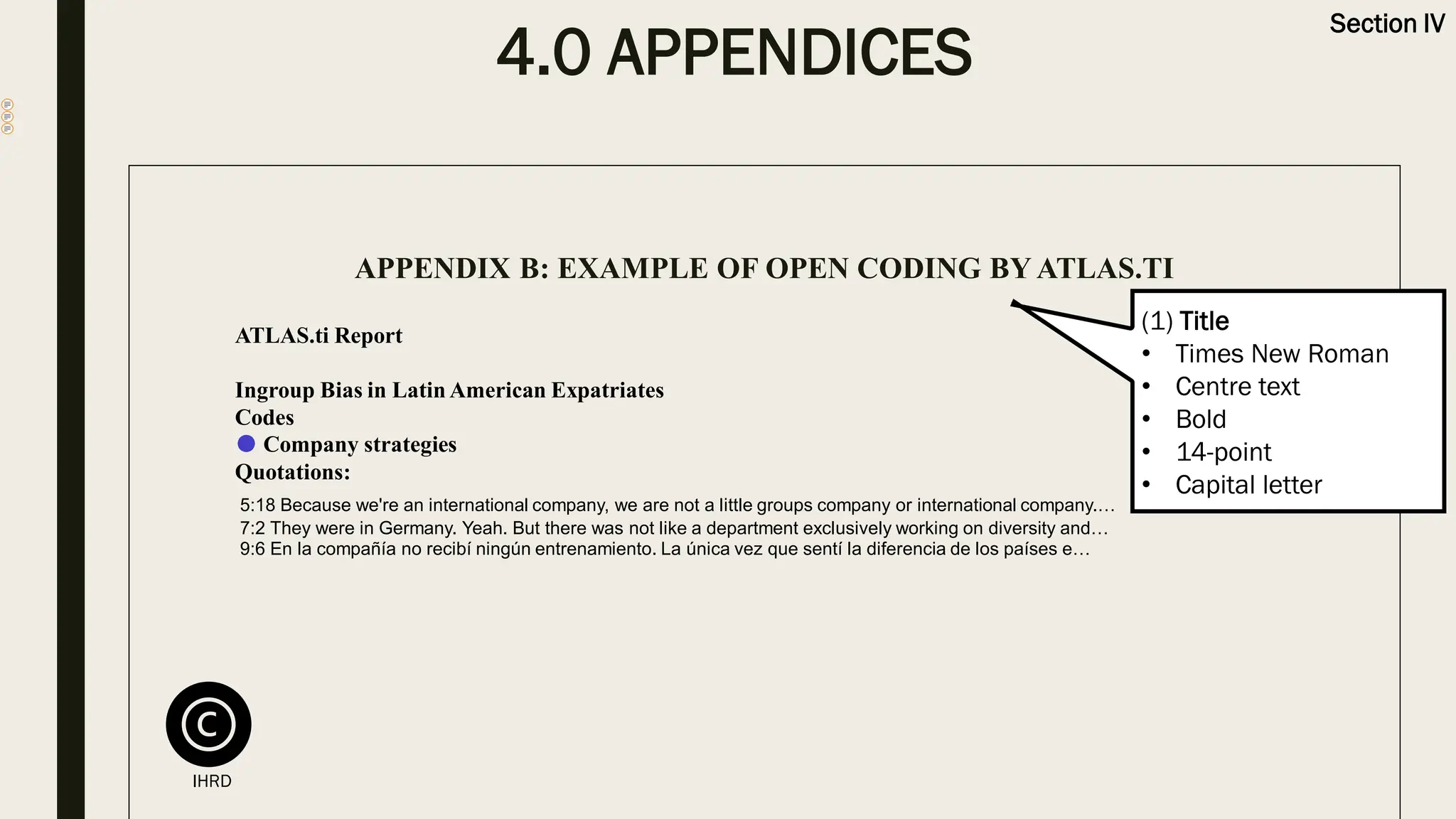
APPENDIX B: EXAMPLE OF OPEN CODING BY ATLAS.TI
ATLAS.ti Report
Ingroup Bias in Latin American Expatriates
Codes
● Company strategies
Quotations:
5:18 Because we're an international company, we are not a little groups company or international company.…
7:2 They were in Germany. Yeah. But there was not like a department exclusively working on diversity and…
9:6 En la compañía no recibí ningún entrenamiento. La única vez que sentí la diferencia de los países e…
(1) Title
• Times New Roman
• Centre text
• Bold
• 14-point
• Capital letter
IHRD

Chapter-I-Elements APA Style-_-Format.pdf

  • 1.
    THE GUIDE TOAPA STYLE: 7TH EDITION NATIONAL TAIWAN NORMAL UNIVERSITY INTERNATIONAL HUMAN RESOURCE DEVELOPMENT CHAPTER ONE ELEMENTS & FORMAT 2021-2022
  • 2.
    STUDENT THESIS REQUIRED ELEMENTS I Preliminaries II Body III References IV Appendices 1.1 Cover Page Chapter I Introduction 1.2 TitlePage Chapter II Literature Review 1.3 Approval Page Chapter III Methodology 1.4 Acknowledgements Page Chapter IV Finding & Analysis 1.5 Abstract Page Chapter V Conclusion & Recommendation 1.6 Table of Contents Section I Preliminaries Section II Body Section III References Section IV Appendices Section I
  • 3.
    PRELIMINARIES ■ 1.1 CoverPage ■ 1.2 Title Page ■ 1.3 Approval Page ■ 1.4 Acknowledgements Page ■ 1.5 Abstract Page ■ 1.6 Table of Contents • List of Tables • List of Figures Elements 1. The title of the thesis 2. Name of the author 3. The degree award title for which the thesis is presented 4. The name of the diploma 5. The name of the major 6. Name of the advisor 7. The institution in which the work was carried out 8. The city and country of the specific institution 9. The month and year during which the thesis is submitted for examination Section I
  • 4.
    1.1 COVER PAGE NationalIngroup Bias in Multicultural Organizations: A Study of Latin-American Expatriates ¶ ¶ ¶ by Mariana Vallejo Vergara ¶ ¶ ¶ ¶ ¶ (1) Thesis Title • Times New Roman • Centre text • Bold • 14-point (2) Name of the Author • First Name, Last Name • Times New Roman • Centre text • 12-point Section I
  • 5.
    1.1 COVER PAGE(continued) A Thesis Submitted to the Graduate Faculty in Partial Fulfillment of the Requirements for the Degree of ¶ MASTER OF BUSINESS ADMINISTRATION ¶ ¶ Major: International Human Resource Development ¶ ¶ ¶ ¶ ¶ (3) The Degree Award Title for which the Thesis is Presented • Standard • 12-point • Centre text • Times New Roman (4) Diploma • 12-point • Centre text • Times New Roman • Capital Letter (5) Major • Standard • 12-point • Centre text • Times New Roman Section I
  • 6.
    Advisor: Wei-Wen Chang,Ph.D. ¶ ¶ ¶ ¶ ¶ National Taiwan Normal University Taipei, Taiwan ¶ ¶ ¶ ¶ ¶ (6) Name of the Advisor • First Name, Last Name, Ph.D. • 12-point • Centre text • Times New Roman (7) Institution • 12-point • Centre text • Times New Roman (8) Place • City, Country • 12-point • Centre text • Times New Roman 1.1 COVER PAGE (continued) Section I
  • 7.
    August 2020 • Donot insert page number here. Start page numbering later in this document. (9) Time • Month, Year • Centre text • Times New Roman • 12-point 1.1 COVER PAGE (continued) Section I
  • 8.
  • 9.
    ■ 1.1 CoverPage ■ 1.2 Title Page ■ 1.3 Approval Page ■ 1.4 Acknowledgements Page ■ 1.5 Abstract Page ■ 1.6 Table of Contents • List of Tables • List of Figures Elements 1. The title of the thesis 2. Name of the author 3. The degree award title for which the thesis is presented 4. The name of the diploma 5. The name of the major 6. Name of the advisor 7. The Institution in which the work was carried out 8. The city and country of the specific institution 9. The month and year during which the thesis is submitted for examination PRELIMINARIES Section I
  • 10.
    1.2 TITLE PAGE ■This is the first page of your thesis and should succinctly summarize your work though the page number does not appear on this page. ■ You may use the Cover Page as your Title Page. Section I
  • 11.
  • 12.
    ■ 1.1 CoverPage ■ 1.2 Title Page ■ 1.3 Approval Page ■ 1.4 Acknowledgements Page ■ 1.5 Abstract Page ■ 1.6 Table of Contents • List of Tables • List of Figures Elements 1. The title of the thesis 2. Name of the author 3. The degree award title for which the thesis is presented 4. The name of the diploma 5. Signature of thesis advisor, committee members and the IHRD Director 6. The name of the major 7. The institution in which the work was carried out 8. The city and country of the specific institution 9. The approval date PRELIMINARIES Section I
  • 13.
    1.3 APPROVAL PAGE(continued) ¶ Thesis Title ¶ by ¶ Name of the Author ¶ ¶ A Thesis Submitted to the Graduate Faculty in Partial Fulfillment of the Requirements for the Degree of MASTER OF BUSINESS ADMINISTRATION ¶ (1) Thesis Title • Times New Roman • Centre text • Bold • 14-point Section I (2) Name of the Author • First Name, Last Name • Times New Roman • Centre text • 12-point (3) The Degree Award Title for which the Thesis is Presented • Standard • 12-point • Centre text • Times New Roman (4) Diploma • 12-point • Centre text • Times New Roman
  • 14.
    1.3 APPROVAL PAGE(continued) ¶ Approved by: ¶ ¶ ¶ ____________________________ Dr. First name Last name In Charge of Major Work ¶ ¶ ¶ ____________________________ Dr. First name Last name Committee Member ¶ (5) Signature • Thesis Advisor • Committee Member I • Committee Member II • The IHRD Director Section I
  • 15.
    1.3 APPROVAL PAGE(continued) ¶ Approved by: ¶ ¶ ¶ ____________________________ Dr. First name Last name Committee Member ¶ ¶ ¶ ___________________________ Dr. First name Last name Director of the Graduate Program ¶ Section I (5) Signature • Thesis Advisor • Committee Member I • Committee Member II • The IHRD Director
  • 16.
    1.3 APPROVAL PAGE(continued) ¶ ¶ Graduate Institute of International Human Resource Development National Taiwan Normal University Taipei, Taiwan August 19th, 2020 Section I (7) Institution • 12-point • Centre text • Times New Roman (6) Major • Standard • 12-point • Centre text • Times New Roman (8) Place • City, Country • 12-point • Centre text • Times New Roman (9) Approval Date • Month Date, Year • Centre text • Times New Roman • 12-point
  • 17.
  • 18.
    ■ 1.1 CoverPage ■ 1.2 Title Page ■ 1.3 Approval Page ■ 1.4 Acknowledgements Page ■ 1.5 Abstract Page ■ 1.6 Table of Contents • List of Tables • List of Figures Elements 1. Title 2. Content PRELIMINARIES Section I
  • 19.
    1.4 ACKNOWLEDGEMENTS PAGE ■The Acknowledgements page is optional. ■ This personal section is guided by the individuality of the writer. ■ You are invited to dedicate your writing and acknowledge people who have contributed to your development, who have special meaning to you, or who have helped make the task of writing possible.
  • 20.
    1.4 ACKNOWLEDGEMENTS PAGE ACKNOWLEDGEMENTS ¶ tabI want to express my appreciation to… (1) Title • Times New Roman • Centre text • Bold • 16-point • Capital letter Section I (2) Content
  • 21.
  • 22.
    ■ 1.1 CoverPage ■ 1.2 Title Page ■ 1.3 Approval Page ■ 1.4 Acknowledgements Page ■ 1.5 Abstract Page ■ 1.6 Table of Contents • List of Tables • List of Figures Elements 1. Title 2. Content 3. Key term 4. Page number PRELIMINARIES Section I
  • 23.
    1.5 ABSTRACT PAGE ■The purpose of an Abstract is to provide readers with a concise and accurate overview of the study in a maximum of 250–350 words. ■ The Abstract states the purpose, research questions, methodology, description of participants (or subjects), as well as how the participants were or will be involved in the study. ■ While the Abstract appears prior to Chapter I, it is written after you have completed all the chapters so that an accurate summary is possible.
  • 24.
    1.5 ABSTRACT PAGE ABSTRACT ¶ Theworld goes through constant changes nowadays as a result of globalization, these changes can be seen through the increase interdependence of individuals from different societies. There is a need, however, to understand how Latin-America faces different processes in the context of globalization; not focusing solely on countries as a whole, but on individuals that are part of a nation or region… (1) Title • Times New Roman • Centre text • Bold • 14-point • Capital letter Section I (2) Content • Without indentation • Single paragraph Leave the right margin uneven. Do not use full justification Align the text to the left
  • 25.
    1.5 ABSTRACT PAGE(continued) interacting with individuals of different cultures and their reasons they have for this bias. Additionally, the study found different programs that organizations in the United States and Dominican Republic implement to promote inclusion. Keywords: ingroup bias, inclusion, diversity, multinational organizations Section I If the keywords run onto a second line, the second line is NOT indented. Do not use a period or other punctuation after the last keyword (3) Keywords • Italic • Indented 0.5-inch • Lowercase • Separated by commas. I (4) Page number • Roman numerals
  • 26.
  • 27.
    ■ 1.1 CoverPage ■ 1.2 Title Page ■ 1.3 Approval Page ■ 1.4 Acknowledgements Page ■ 1.5 Abstract Page ■ 1.6 Table of Contents • List of Tables • List of Figures Elements 1. Title 2. Content 3. Organization PRELIMINARIES Section I
  • 28.
    1.6 TABLE OFCONTENTS The table of contents serves TWO purposes: 1. It gives readers an overview of your thesis's contents and organization. 2. It allows readers to go directly to a specific section of your thesis. Section I
  • 29.
    1.6 TABLE OFCONTENTS Section I TABLE OF CONTENTS ABSTRACT I TABLE OF CONTENTS II LIST OF TABLES III LIST OF FIGURES IV CHAPTER I INTRODUCTION 1 Background of the Study 1 IHRD (1) Title • Times New Roman • Centre text • Bold • 14-point • Capital letter Roman numerals Arabic numerals Capitalized
  • 30.
  • 31.
    1.6 TABLE OFCONTENTS (continued) Section I LIST OF TABLES Table 3.1 Organization and Participant Selection 16 Table 3.2 Dimensions and Countries’ Sub-themes 30 (1) Title • Times New Roman • Centre text • Bold • 14-point • Capital letter
  • 32.
  • 33.
    1.6 TABLE OFCONTENTS (continued) Section I LIST OF FIGURES Figure 3.1 Interview Participant’s Types 18 Figure 3.2 Research Framework 21 (1) Title • Times New Roman • Centre text • Bold • 14-point • Capital letter
  • 34.
  • 35.
    BODY ■ 2.1 ChapterI: Introduction ■ 2.2 Chapter II: Literature Review ■ 2.3 Chapter III: Methodology ■ 2.4 Chapter IV: Finding & Discussion ■ 2.5 Chapter V: Conclusion & Recommendation Elements 1. Background of the Study 2. Statement of Problem 3. Purpose of the Study 4. Question of the Study 5. Definition of Key Terms Section II
  • 36.
    BODY ■ 2.1 ChapterI: Introduction ■ 2.2 Chapter II: Literature Review ■ 2.3 Chapter III: Methodology ■ 2.4 Chapter IV: Finding & Discussion ■ 2.5 Chapter V: Conclusion & Recommendation Elements Historical overview of…and/or theories of…and/or purposes of Current findings Section II
  • 37.
    BODY ■ 2.1 ChapterI: Introduction ■ 2.2 Chapter II: Literature Review ■ 2.3 Chapter III: Methodology ■ 2.4 Chapter IV: Finding & Discussion ■ 2.5 Chapter V: Conclusion & Recommendation Qualitative Methodology Elements 1. Research Approach 2. Research Framework 3. Research Procedure 4. Research Participants and Sampling Criteria 5. Data Collection 6. Data Analysis 7. Research Quality Section II
  • 38.
    BODY ■ 2.1 ChapterI: Introduction ■ 2.2 Chapter II: Literature Review ■ 2.3 Chapter III: Methodology ■ 2.4 Chapter IV: Finding & Discussion ■ 2.5 Chapter V: Conclusion & Recommendation Quantitative Methodology Elements 1. Research Framework 2. Research Hypothesis 3. Research Procedure 4. Research Sample and Data Collection 5. Measurement 6. Control Variable 7. Reliability and Validity 8. Data Analysis Section II
  • 39.
    BODY ■ 2.1 ChapterI: Introduction ■ 2.2 Chapter II: Literature Review ■ 2.3 Chapter III: Methodology ■ 2.4 Chapter IV: Finding & Discussion ■ 2.5 Chapter V: Conclusion & Recommendation Qualitative Methodology Elements 1. Background and Setting 2. Choosing Participants 3. Summary of Findings 4. Sub-headings in this section may include: • A report of findings by participant • Research and interview questions • Time • Themes and/or other topic organizers 5. Summary Section II
  • 40.
    BODY ■ 2.1 ChapterI: Introduction ■ 2.2 Chapter II: Literature Review ■ 2.3 Chapter III: Methodology ■ 2.4 Chapter IV: Finding & Discussion ■ 2.5 Chapter V: Conclusion & Recommendation Quantitative Methodology Elements 1. Background and Setting 2. Choosing the Sample Population 3. Demographics 4. Variables and Measures of Variables 5. Statistical Procedure 6. Review of Hypotheses or Discussion of Results 7. Summary Section II
  • 41.
    BODY ■ 2.1 ChapterI: Introduction ■ 2.2 Chapter II: Literature Review ■ 2.3 Chapter III: Methodology ■ 2.4 Chapter IV: Finding & Discussion ■ 2.5 Chapter V: Conclusion & Recommendation Elements 1. Conclusion 2. Implication 3. Limitation 4. Suggestion for Future Research Section II
  • 42.
    HEADING A heading ina document identifies the topic or topic of the content within each section. It helps readers become familiar with how a paper’s content is organized, allowing them to easily find the information they seek. There are, basically, five levels of heading in APA Style. Section II
  • 43.
    HEADING Section II Chapter Title CHAPTER IILITERATURE REVIEW (16-Point Font) Level 1 Centered, Bold, Title Case Heading, 14-Point Font Text begins as a new paragraph. Level 2 Flush Left, Bold, Title Case Heading, 14-Point Font Text begins as a new paragraph. Level 3 Flush Left, Bold Italic, Title Case Heading, 12-Point Font Text begins as a new paragraph. Level 4 Indented, Bold, Title Case Heading, Ending with a period, 12-Point Font. Text begins on the same line and continues as a regular paragraph. Lever 5 Indented, Bold Italic, Title Case Heading, Ending with a period, 12-Point Font. Text begins on the same line and continues as a regular paragraph.
  • 44.
    HEADING (continued) Section II CHAPTERIII RESEARCH METHODS (Chapter title) Research Approach (Level 1 heading) Your texts start here. Texts under Level 1, 2 and 3 headings start in the next paragraph, while texts under Level 4 and 5 headings start in the same paragraph. Data Collection(Level 1 heading) Your texts start here. Sample and Participant Selection(Level 2 heading) Your texts start here. Purposeful Sampling (Level 3 heading) Your texts start here. Sampling Criteria. (Level 4 heading) Your texts start here. Criteria One. (Level 5 heading) Your texts start here. Criteria Two. (Level 5 heading) Your texts start here. Example I
  • 45.
    HEADING (continued) Section II ExampleII Startup Ecosystem (Level 1 heading) Novel technology tends to emanate from new ventures, especially startup. Thiel (2014) debates that startups “question received ideas and rethink business from scratch” (p. 11). Startups are not merely the key players in highly competitive markets, but also challenge and disrupt the conventional industries, revitalize the entrepreneurial community through introducing new products, services or business models that greatly facilitate their ability to provide promising solutions to the existing problem (OECD, 2016). [paragraph continues] Culture (Level 2 heading) Located at the heart of the Asia Pacific region puts Taiwan at a considerable advantage to travel both domestically and internationally. According to Jan (2019), Taiwan is widely recognized for its advanced manufacturing and robotics. [paragraph continues]
  • 46.
    HEADING (continued) Section II ExampleIII Location: United States (Level 2 heading) ERGs Implementations (Level 3 heading) It is important to mention that the ERGs are relatively new implementations in the participants’ companies with no longer than two years of existence. As stated before, the idea of the ERGs is to show others what the group is about, so they are able to understand and learn about different identities. In the interviews, all participants were asked if they had joined other ERGs besides the one from Latin Americans before, but only one participant said yes. All expatriate participants in the United States interviewed for this research, belong to an ERG group for Latin Americans. Expatriates Experiences. (Level 4 heading) An expatriate participant states that she is interested in the idea of the groups being able to get people together. But she does not like that they are in separate groups and labeled. And she says that she would like to be in a group related to the company that would focus on specific organizational issues.
  • 47.
    REFERENCE Section III • Thereference list at the end of a paper provides the information necessary to identify and retrieve each work cited in the text. • Choose references judiciously and include only the works that you used in the research for and preparation of your paper. • APA publications and other publishers and institutions using APA Style generally require reference lists, not bibliographies.
  • 48.
    3.0 REFERENCE Section III REFERENCE Vos,A. D., Dewilde, T., & Clippeleer, I. D. (2009). Proactive career behaviors and career success during the early career. Journal of Occupational and Organizational Psychology, 82(4), 761–777. Wall, T. D., Jackson, P. R., Mullarkey, S., & Parker, S. K. (1996). The demand- control model of job-strain: A more specific test. Journal of Occupational and Organizational Psychology, 69(2), 153–167. Yu, K., Lin, W., Wang, L., Ma, J., Wei, W., Wang, H., Guo, W., & Shi, J. (2016). The role of affective commitment and future work self salience in the abusive supervision–job performance relationship. Journal of Occupational and Organizational Psychology, 89(1), 28–45. (1) Title • Times New Roman • Centre text • Bold • 14-point • Capital letter Align the text to the left Leave the right margin uneven. Do not use full justification IHRD
  • 49.
    APPENDICES Section IV Appendices containmaterial that is too detailed to include in the main report, such as long mathematical derivations or calculations, detailed technical drawings, or tables of raw data.
  • 50.
    4.0 APPENDICES Section IV APPENDIXA: QUESTIONNAIRE (ENGLISH VERSION) 1. Gender (please tick): ❑ Male ❑ Female 2. Age: _______________ 3. Job Position ❑ Manager/Supervisor ❑ Employee ❑ Unemployed (1) Title • Times New Roman • Centre text • Bold • 14-point • Capital letter IHRD
  • 51.
    4.0 APPENDICES Section IV APPENDIXB: EXAMPLE OF OPEN CODING BY ATLAS.TI ATLAS.ti Report Ingroup Bias in Latin American Expatriates Codes ● Company strategies Quotations: 5:18 Because we're an international company, we are not a little groups company or international company.… 7:2 They were in Germany. Yeah. But there was not like a department exclusively working on diversity and… 9:6 En la compañía no recibí ningún entrenamiento. La única vez que sentí la diferencia de los países e… (1) Title • Times New Roman • Centre text • Bold • 14-point • Capital letter IHRD