Feasibility Analysis
• Feasibility analysis is the process of determining if a business idea is
viable. If a business idea falls short on one or more of the four
components of feasibility analysis, it should be dropped or rethought.
Many entrepreneurs make the mistake of identifying a business idea
and then jumping directly to developing a business model to describe
and gain support for the idea. This sequence often omits or provides
little time for the important step of testing the feasibility of a business
idea.
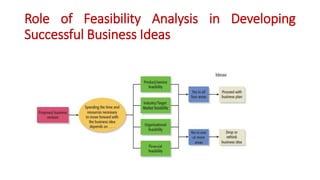
Role of Feasibility Analysis in Developing
Successful Business Ideas
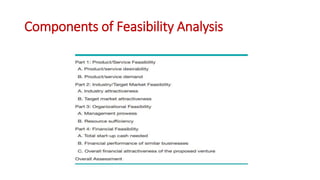
Components of Feasibility Analysis
Product/Service Feasibility
• Product and Service Desirability
Does it make sense? Is it reasonable? Is it something real customers
will buy? Does it take advantage of an environmental trend, solve a
problem, or fill a gap in the marketplace? Is this a good time to
introduce the product or service to the market? Are there any fatal
flaws in the product or service’s basic design or concept?
Product/Service Feasibility
• Product and Service Demand
The second component of product/service feasibility analysis is to
determine if there is demand for the product or service. Three
commonly utilized methods for doing this include (1) talking face-to-
face with potential customers, (2) utilizing online tools, such as Google
Adwords and landing pages, to assess demand, and (3) library, Internet,
and gumshoe research.
Industry/Target Market Feasibility
• Industry/target market feasibility is an assessment of the overall appeal
of the industry and the target market for the product or service being
proposed. There is a distinct difference between a firm’s industry and
its target market; having a clear understanding of this difference is
important. An industry is a group of firms producing a similar
product or service, such as computers, children’s toys, airplanes,
or social networks. A firm’s target market is the limited portion of
the industry that it goes after or to which it wants to appeal. Most
firms, and certainly entrepreneurial start-ups, typically do not try to
service an entire industry.
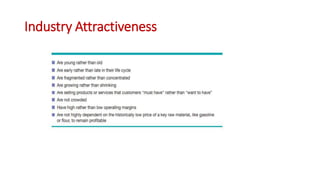
Industry Attractiveness
Organizational Feasibility Analysis
• Organizational feasibility analysis is conducted to
determine whether a proposed business has sufficient
management expertise, organizational competence, and
resources to successfully launch. There are two primary
issues to consider in this area: management prowess and
resource sufficiency.
Management Prowess
A proposed business should evaluate the prowess, or ability,
of its initial management team, whether it is a sole
entrepreneur or a larger group. Two of the most important
factors in this area are the passion that the solo entrepreneur
or the management team has for the business idea and the
extent to which the management team or solo entrepreneur
understands the markets in which the firm will participate.
There are no practical substitutes for strengths in these areas.
Resource Sufficiency
•The second area of organizational feasibility
analysis is to determine whether the proposed
venture has or is capable of obtaining sufficient
resources to move forward. The focus in
organizational feasibility analysis is on
nonfinancial resources. The objective is to identify
the most important nonfinancial resources and
assess their availability.
Financial Feasibility Analysis
• Financial feasibility analysis is the final component of a
comprehensive feasibility analysis. For feasibility analysis, a
preliminary financial assessment is usually sufficient; indeed,
additional rigor at this point is typically not required because the
specifics of the business will inevitably evolve, making it impractical
to spend a lot of time early on preparing detailed financial forecasts.
The most important issues to consider at this stage are total start-up
cash needed, financial performance of similar businesses, and the
overall financial attractiveness of the proposed venture.
Total Start-Up Cash Needed
• This first issue refers to the total cash needed to
prepare the business to make its first sale. An
actual budget should be prepared that lists all the
anticipated capital purchases and operating
expenses needed to get the business up and
running. After determining a total figure, an
explanation of where the money will come from
should be provided.
Financial Performance of Similar Businesses
• The second component of financial feasibility
analysis is estimating a proposed start-up’s
potential financial performance by comparing it
to similar, already established businesses.
Obviously, this effort will result in approximate
rather than exact numbers.
Overall Financial Attractiveness of the
proposed venture
• A number of other factors are associated with
evaluating the financial attractiveness of a proposed
venture. These evaluations are based primarily on a
new venture’s projected sales and rate of return (or
profitability), as just discussed. At the feasibility
analysis stage, the projected return is a judgment
call.
Feasibility Analysis for Entrepreneurshio.pptx

Feasibility Analysis for Entrepreneurshio.pptx

  • 1.
  • 2.
    Feasibility Analysis • Feasibilityanalysis is the process of determining if a business idea is viable. If a business idea falls short on one or more of the four components of feasibility analysis, it should be dropped or rethought. Many entrepreneurs make the mistake of identifying a business idea and then jumping directly to developing a business model to describe and gain support for the idea. This sequence often omits or provides little time for the important step of testing the feasibility of a business idea.
  • 3.
    Role of FeasibilityAnalysis in Developing Successful Business Ideas
  • 4.
  • 5.
    Product/Service Feasibility • Productand Service Desirability Does it make sense? Is it reasonable? Is it something real customers will buy? Does it take advantage of an environmental trend, solve a problem, or fill a gap in the marketplace? Is this a good time to introduce the product or service to the market? Are there any fatal flaws in the product or service’s basic design or concept?
  • 6.
    Product/Service Feasibility • Productand Service Demand The second component of product/service feasibility analysis is to determine if there is demand for the product or service. Three commonly utilized methods for doing this include (1) talking face-to- face with potential customers, (2) utilizing online tools, such as Google Adwords and landing pages, to assess demand, and (3) library, Internet, and gumshoe research.
  • 7.
    Industry/Target Market Feasibility •Industry/target market feasibility is an assessment of the overall appeal of the industry and the target market for the product or service being proposed. There is a distinct difference between a firm’s industry and its target market; having a clear understanding of this difference is important. An industry is a group of firms producing a similar product or service, such as computers, children’s toys, airplanes, or social networks. A firm’s target market is the limited portion of the industry that it goes after or to which it wants to appeal. Most firms, and certainly entrepreneurial start-ups, typically do not try to service an entire industry.
  • 8.
  • 9.
    Organizational Feasibility Analysis •Organizational feasibility analysis is conducted to determine whether a proposed business has sufficient management expertise, organizational competence, and resources to successfully launch. There are two primary issues to consider in this area: management prowess and resource sufficiency.
  • 10.
    Management Prowess A proposedbusiness should evaluate the prowess, or ability, of its initial management team, whether it is a sole entrepreneur or a larger group. Two of the most important factors in this area are the passion that the solo entrepreneur or the management team has for the business idea and the extent to which the management team or solo entrepreneur understands the markets in which the firm will participate. There are no practical substitutes for strengths in these areas.
  • 11.
    Resource Sufficiency •The secondarea of organizational feasibility analysis is to determine whether the proposed venture has or is capable of obtaining sufficient resources to move forward. The focus in organizational feasibility analysis is on nonfinancial resources. The objective is to identify the most important nonfinancial resources and assess their availability.
  • 12.
    Financial Feasibility Analysis •Financial feasibility analysis is the final component of a comprehensive feasibility analysis. For feasibility analysis, a preliminary financial assessment is usually sufficient; indeed, additional rigor at this point is typically not required because the specifics of the business will inevitably evolve, making it impractical to spend a lot of time early on preparing detailed financial forecasts. The most important issues to consider at this stage are total start-up cash needed, financial performance of similar businesses, and the overall financial attractiveness of the proposed venture.
  • 13.
    Total Start-Up CashNeeded • This first issue refers to the total cash needed to prepare the business to make its first sale. An actual budget should be prepared that lists all the anticipated capital purchases and operating expenses needed to get the business up and running. After determining a total figure, an explanation of where the money will come from should be provided.
  • 14.
    Financial Performance ofSimilar Businesses • The second component of financial feasibility analysis is estimating a proposed start-up’s potential financial performance by comparing it to similar, already established businesses. Obviously, this effort will result in approximate rather than exact numbers.
  • 15.
    Overall Financial Attractivenessof the proposed venture • A number of other factors are associated with evaluating the financial attractiveness of a proposed venture. These evaluations are based primarily on a new venture’s projected sales and rate of return (or profitability), as just discussed. At the feasibility analysis stage, the projected return is a judgment call.