Let’s celebrate!
You will learn:
2
1
2
Relative Clause of Time
For Describing Festival And Celebration
1
4
4
Do you celebrate these festivals above or similar holidays in your hometown?
What other special days do you have?
What’s your favorite festival?
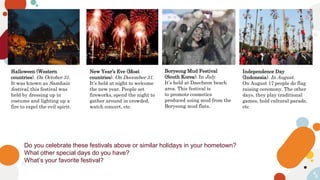
Boryeong Mud Festival
(South Korea). In July.
It’s held at Daecheon beach
area. This festival is
to promote cosmetics
produced using mud from the
Boryeong mud flats.
Halloween (Western
countries). On October 31.
It was known as Samhain
festival, this festival was
held by dressing up in
costume and lighting up a
fire to expel the evil spirit.
New Year’s Eve (Most
countries). On December 31.
It’s held at night to welcome
the new year. People set
fireworks, spend the night to
gather around in crowded,
watch concert, etc.
Independence Day
(Indonesia). In August.
On August 17 people do flag
raising ceremony. The other
days, they play traditional
games, hold cultural parade,
etc
5
PERSPECTIVES Special days
5
GRAMMAR FOCUS
6
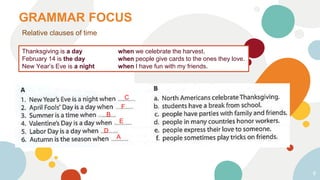
Relative clauses of time
Thanksgiving is a day when we celebrate the harvest.
February 14 is the day when people give cards to the ones they love.
New Year’s Eve is a night when I have fun with my friends.
C
F
B
E
D
A
7
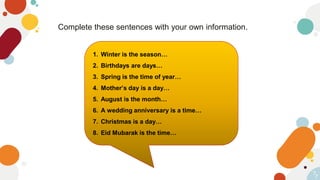
Complete these sentences with your own information.
7
1. Winter is the season…
2. Birthdays are days…
3. Spring is the time of year…
4. Mother’s day is a day…
5. August is the month…
6. A wedding anniversary is a time…
7. Christmas is a day…
8. Eid Mubarak is the time…
8
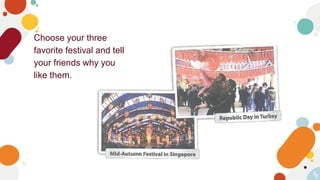
Choose your three
favorite festival and tell
your friends why you
like them.
8
2
Adverbial Clauses of Time
For telling special occasions
10
CONVERSATION
Wedding day
10
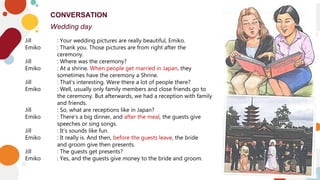
Jill : Your wedding pictures are really beautiful, Emiko.
Emiko : Thank you. Those pictures are from right after the
ceremony.
Jill : Where was the ceremony?
Emiko : At a shrine. When people get married in Japan, they
sometimes have the ceremony a Shrine.
Jill : That’s interesting. Were there a lot of people there?
Emiko : Well, usually only family members and close friends go to
the ceremony. But afterwards, we had a reception with family
and friends.
Jill : So, what are receptions like in Japan?
Emiko : There’s a big dinner, and after the meal, the guests give
speeches or sing songs.
Jill : It’s sounds like fun.
Emiko : It really is. And then, before the guests leave, the bride
and groom give then presents.
Jill : The guests get presents?
Emiko : Yes, and the guests give money to the bride and groom.
GRAMMAR FOCUS
11
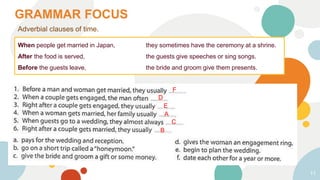
Adverbial clauses of time.
When people get married in Japan, they sometimes have the ceremony at a shrine.
After the food is served, the guests give speeches or sing songs.
Before the guests leave, the bride and groom give them presents.
F
D
E
A
C
B
12
Speak up
challenge!
Tell about interesting custom from your
hometown.
13
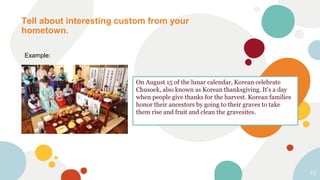
Example:
On August 15 of the lunar calendar, Korean celebrate
Chusoek, also known as Korean thanksgiving. It’s a day
when people give thanks for the harvest. Korean families
honor their ancestors by going to their graves to take
them rise and fruit and clean the gravesites.
14
Thanks!
What do we learn today?

Chapter 8 js2.pptx

  • 1.
  • 2.
  • 3.
    Relative Clause ofTime For Describing Festival And Celebration 1
  • 4.
    4 4 Do you celebratethese festivals above or similar holidays in your hometown? What other special days do you have? What’s your favorite festival? Boryeong Mud Festival (South Korea). In July. It’s held at Daecheon beach area. This festival is to promote cosmetics produced using mud from the Boryeong mud flats. Halloween (Western countries). On October 31. It was known as Samhain festival, this festival was held by dressing up in costume and lighting up a fire to expel the evil spirit. New Year’s Eve (Most countries). On December 31. It’s held at night to welcome the new year. People set fireworks, spend the night to gather around in crowded, watch concert, etc. Independence Day (Indonesia). In August. On August 17 people do flag raising ceremony. The other days, they play traditional games, hold cultural parade, etc
  • 5.
  • 6.
    GRAMMAR FOCUS 6 Relative clausesof time Thanksgiving is a day when we celebrate the harvest. February 14 is the day when people give cards to the ones they love. New Year’s Eve is a night when I have fun with my friends. C F B E D A
  • 7.
    7 Complete these sentenceswith your own information. 7 1. Winter is the season… 2. Birthdays are days… 3. Spring is the time of year… 4. Mother’s day is a day… 5. August is the month… 6. A wedding anniversary is a time… 7. Christmas is a day… 8. Eid Mubarak is the time…
  • 8.
    8 Choose your three favoritefestival and tell your friends why you like them. 8
  • 9.
    2 Adverbial Clauses ofTime For telling special occasions
  • 10.
    10 CONVERSATION Wedding day 10 Jill :Your wedding pictures are really beautiful, Emiko. Emiko : Thank you. Those pictures are from right after the ceremony. Jill : Where was the ceremony? Emiko : At a shrine. When people get married in Japan, they sometimes have the ceremony a Shrine. Jill : That’s interesting. Were there a lot of people there? Emiko : Well, usually only family members and close friends go to the ceremony. But afterwards, we had a reception with family and friends. Jill : So, what are receptions like in Japan? Emiko : There’s a big dinner, and after the meal, the guests give speeches or sing songs. Jill : It’s sounds like fun. Emiko : It really is. And then, before the guests leave, the bride and groom give then presents. Jill : The guests get presents? Emiko : Yes, and the guests give money to the bride and groom.
  • 11.
    GRAMMAR FOCUS 11 Adverbial clausesof time. When people get married in Japan, they sometimes have the ceremony at a shrine. After the food is served, the guests give speeches or sing songs. Before the guests leave, the bride and groom give them presents. F D E A C B
  • 12.
  • 13.
    Tell about interestingcustom from your hometown. 13 Example: On August 15 of the lunar calendar, Korean celebrate Chusoek, also known as Korean thanksgiving. It’s a day when people give thanks for the harvest. Korean families honor their ancestors by going to their graves to take them rise and fruit and clean the gravesites.
  • 14.