Chapter Six
Corporate Social Responsibility
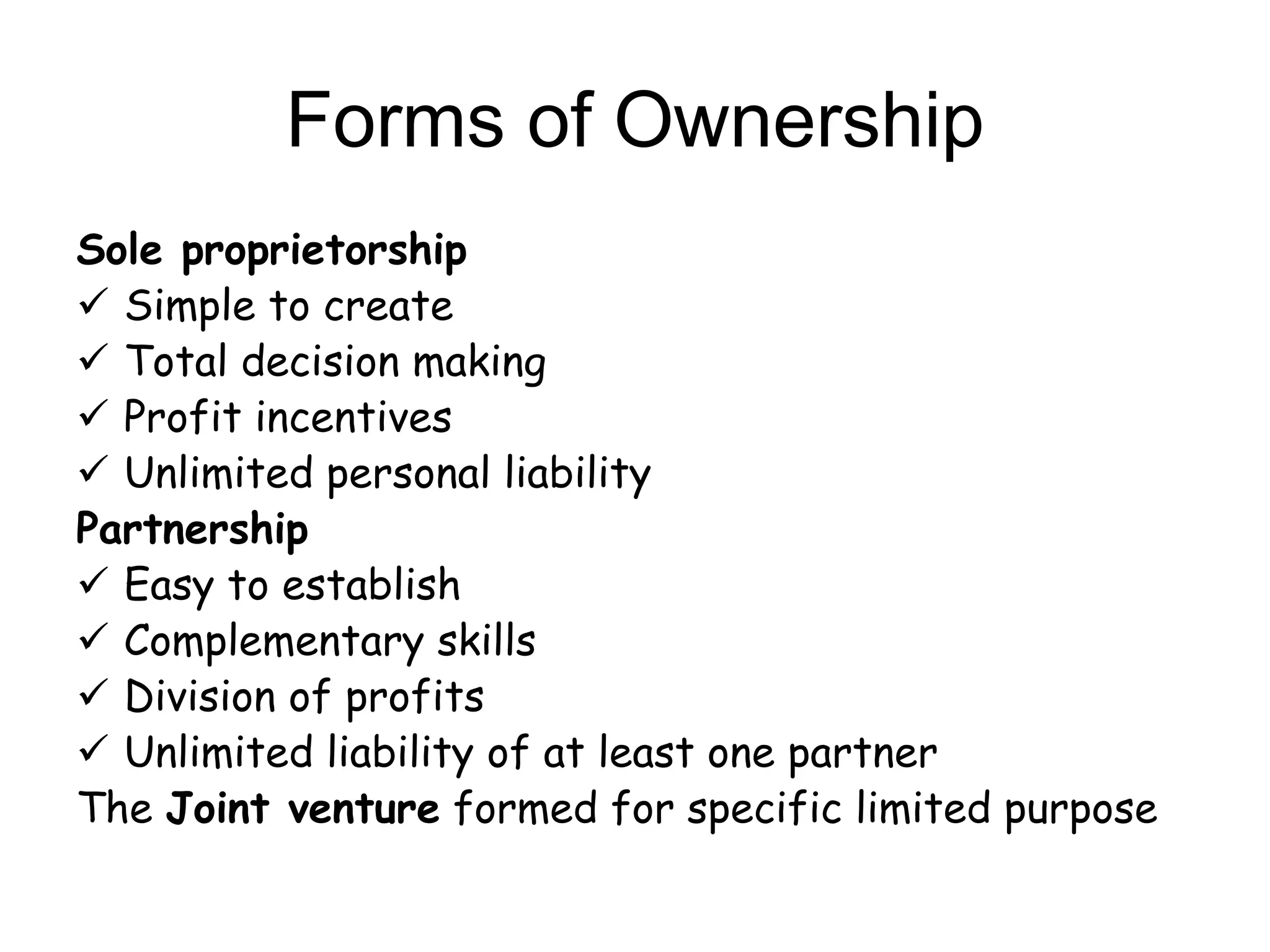
Forms of Ownership
Sole proprietorship
 Simple to create
 Total decision making
 Profit incentives
 Unlimited personal liability
Partnership
 Easy to establish
 Complementary skills
 Division of profits
 Unlimited liability of at least one partner
The Joint venture formed for specific limited purpose
What is a corporation?
• The corporation is by far the dominant
form of business entity in the modern
global economy.
• Although not all businesses (such as sole
traders) are corporations, and many
corporations (such as charities and
universities) are not-for- profit business.
Cont..
• Legally, corporations are typically
regarded as independent from those who
work in them, manage them, invest them,
or receive products or services from them.
Corporations are separate entities in their
own right.
Cont..
• The corporation itself usually owns all assets like
factories , offices ,computers ,machines,
and other assets.
• They could not, for instance, try to remove
a computer or a desk and take it home,
because the corporation owns that
computers or desk, not the shareholder,
Cont..
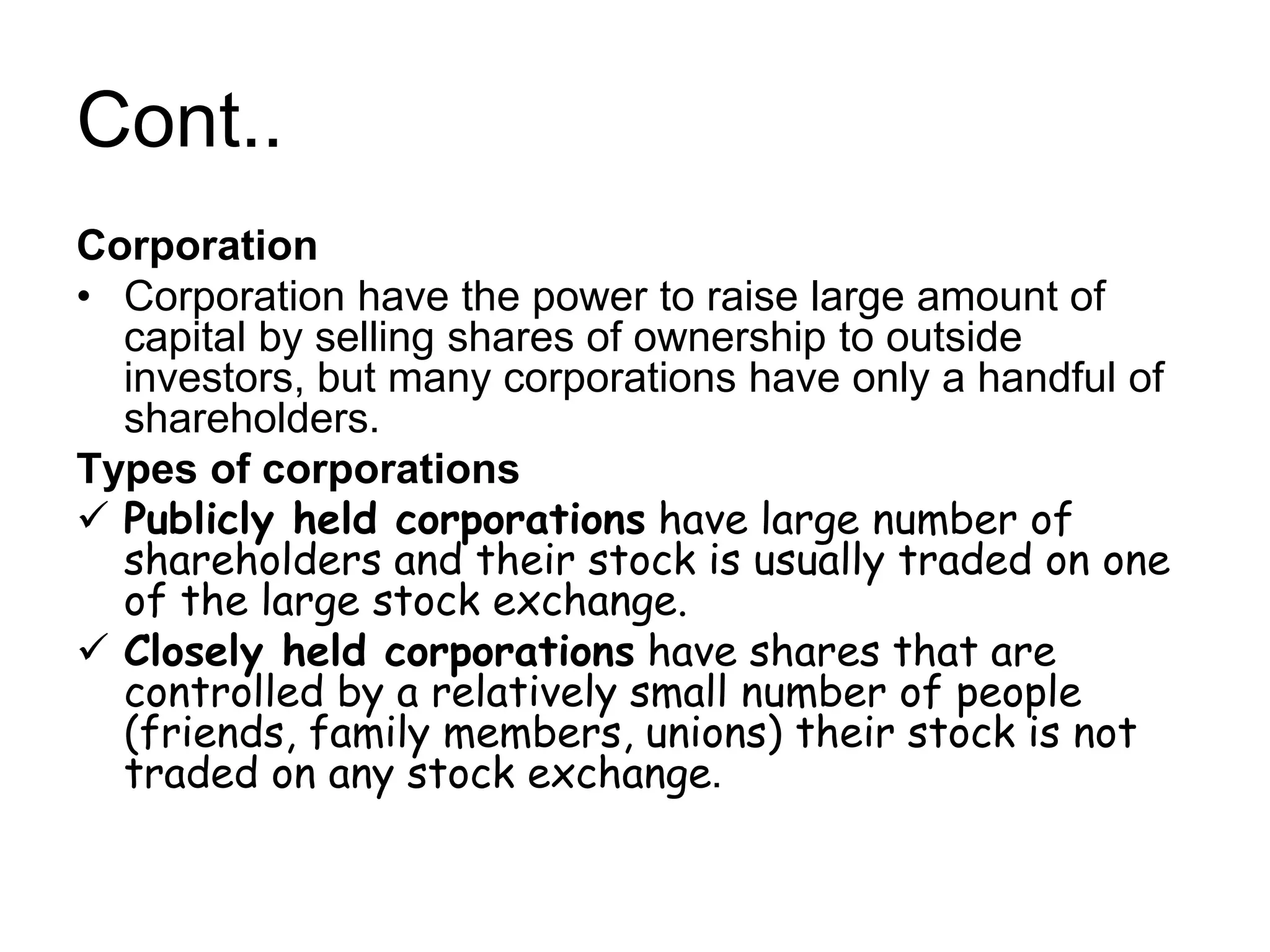
Corporation
• Corporation have the power to raise large amount of
capital by selling shares of ownership to outside
investors, but many corporations have only a handful of
shareholders.
Types of corporations
 Publicly held corporations have large number of
shareholders and their stock is usually traded on one
of the large stock exchange.
 Closely held corporations have shares that are
controlled by a relatively small number of people
(friends, family members, unions) their stock is not
traded on any stock exchange.
Cont..
Corporation have :
• Limited liability of shareholders
• Ability to attract capital (pool of capital)
• Ability to transfer ownerships
• Ability to continue indefinitely
Cont..
The implications of this situation are extremely significant
for our understanding of the responsibilities of
corporation:
 Corporations are typically regarded as “artificial
person” in the ayes of the law” . That is, they have
certain rights and responsibilities in society, just as an
individual citizen might.
 Corporations are notionally “owned” by shareholders, but
exist independently of them.
 The corporation holds its own assets and shareholders
are not responsible for the debts or damages caused by
the corporation (they have limited liability).
Cont.
Managers and directors have a “fiduciary”
responsibility to protect the investment of
shareholders. This means that senior
management is expected to hold
shareholders” investment in trust and to
act in their best interests.
Can a corporation have social responsibilities?
• The Nobel-prize winning economist Milton
Friedman published an article that has
since become a classic text questioning
the alleged social role of corporations.
• He vigorously protested against the notion
of social responsibilities for corporations.
He based his argument on three main
premises:
Cont..
1) Only human beings have a moral responsibility for
their action. His first substantial point was that
corporations are not human beings and therefore cannot
assume true moral responsibility for their actions. Since
corporations are set up by individual human beings, it is
those human beings who are then individually
responsible for the actions of the corporation.
2) Its managers’ responsibility to act solely in the
interests of shareholders. The only responsibility of
the managers of the corporations is to make profit,
because it is for this task that the firm has been set up
and the managers have been employed .
Cont.
3. Social issues and problems are the
proper province of the state rather than
corporate managers. Friedman’s third
main point was that managers should not,
and cannot decide what is in society’s best
interests. This is the job of government.
Corporate managers are not trained to set
and achieve social goals.
Can a corporation be morally
responsible for its actions?
• Is a corporation just a collection of
individuals who work together under the
same roof, or is the corporation not only a
legal entity in its own right, but also a
moral one?
• Can a corporation actually assume moral
responsibility for the right and wrong of its
action?
Cont..
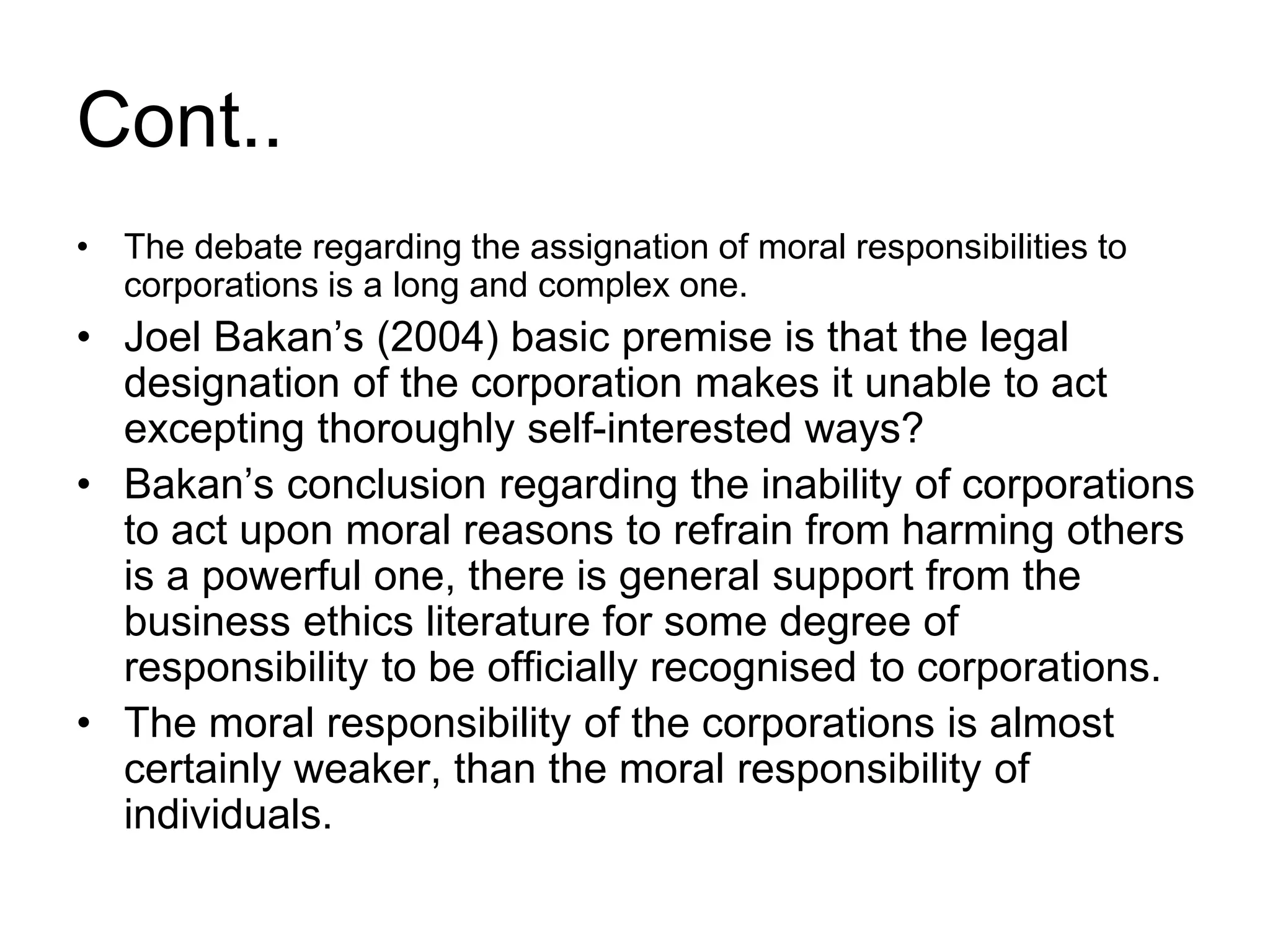
• The debate regarding the assignation of moral responsibilities to
corporations is a long and complex one.
• Joel Bakan’s (2004) basic premise is that the legal
designation of the corporation makes it unable to act
excepting thoroughly self-interested ways?
• Bakan’s conclusion regarding the inability of corporations
to act upon moral reasons to refrain from harming others
is a powerful one, there is general support from the
business ethics literature for some degree of
responsibility to be officially recognised to corporations.
• The moral responsibility of the corporations is almost
certainly weaker, than the moral responsibility of
individuals.
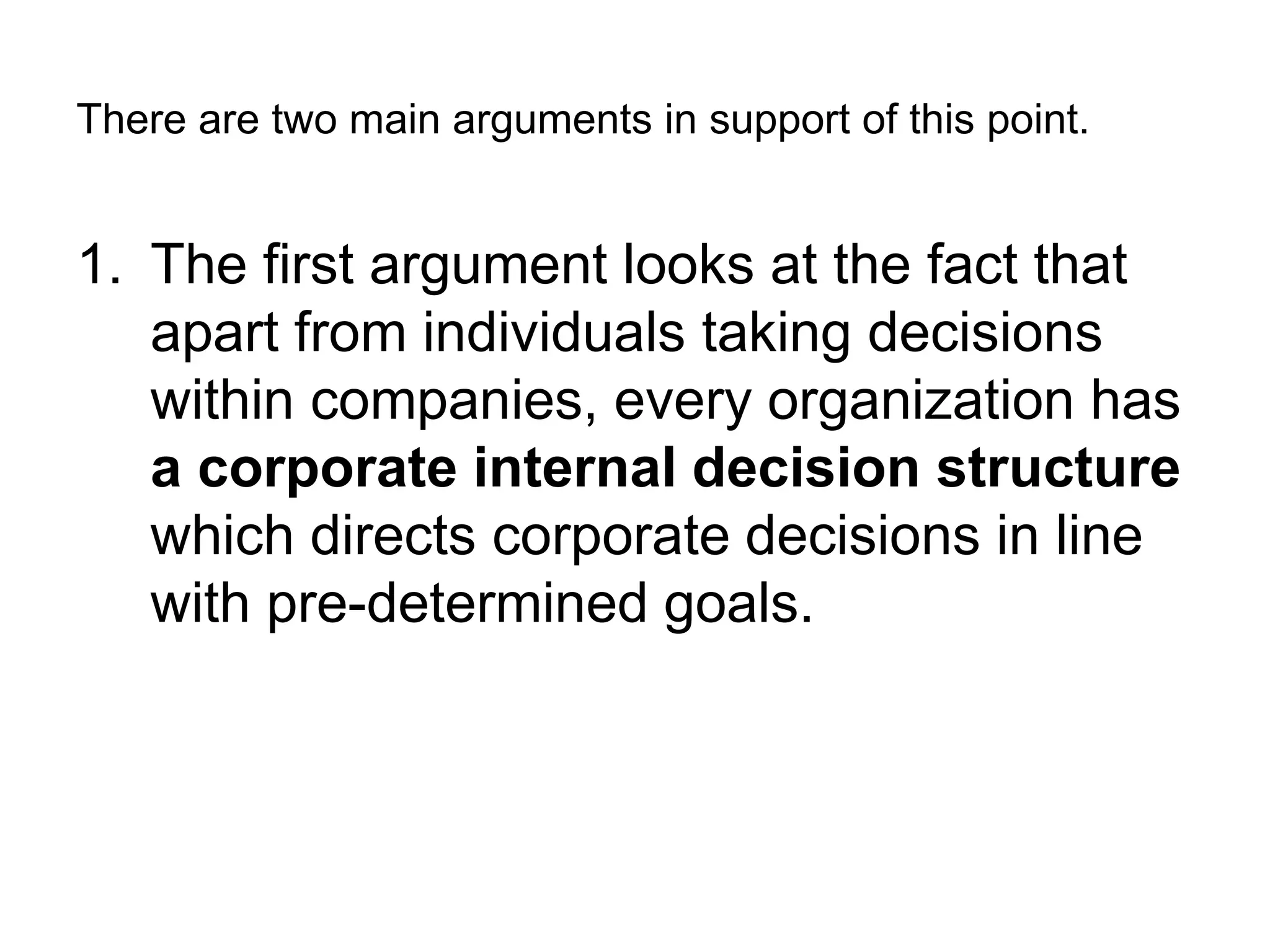
There are two main arguments in support of this point.
1. The first argument looks at the fact that
apart from individuals taking decisions
within companies, every organization has
a corporate internal decision structure
which directs corporate decisions in line
with pre-determined goals.
Cont..
2. A second argument supporting the moral
dimension of corporate responsibility is the fact
that all companies not only have an organized
corporate internal decision structure, but
furthermore manifest a set of beliefs and values
that set out what is generally regarded as right
or wrong in the corporation –namely, the
organizational culture.
• These values and beliefs are widely believed to
be a strong influence on the individual’s ethical
decision –making and behaviour.
What does mean corporate
social responsibility?
• Corporate Social responsibility can be defined
as:
 A concept whereby companies integrate social
and environmental concerns in their business
operations and in their interaction with their
stakeholders on a voluntary.
 It also concerns with the continuing
commitment by business to behave ethically
and contribute to economic development while
improving the quality of life of the workforce
and their families as well as of the local
community and society at large.
Cont..
• CSR respects Cultural differences and
finds the business opportunities in building
the Skills of employees, the Community
and the Government. Social responsibility
becomes an integral part of the wealth
creation process, which if managed
properly should enhance the
competitiveness of business and maximize
the value of wealth creation to society.
Why do corporations have social responsibilities?
 Corporations perceived as being socially
responsible might be rewarded with extra
and/ or more satisfied customers, whilst
perceived irresponsibility may result in
boycotts or other undesirable consumer
actions.
 Similarly, employees might be attracted to
work for, and even be more committed to,
corporations perceived as being socially
responsible.
Cont.
 Voluntarily committing to social action and
programmes may forestall legislation and
ensure greater corporate independence from
government.
 Making a positive contribution to society
might be regarded as a long-term investment
in a safer, better- and more equitable
community, which subsequently benefits the
corporation by creating an improved and
stable context in which to do business.
What is the nature of corporate
social responsibility?
• Corporate social responsibility encompasses the
economic, legal, ethical, and philanthropic
expectations placed on organizations by society at a
given point in time.
1. Economic responsibility: companies have
shareholders who demand a reasonable return on
their investments, they have employees who want
safe and fairly paid jobs, and they have customers
who demand good quality products at a fair price,
etc.This is by definition the reason why businesses
are set up in society and so the first responsibility
of business is to be a properly functioning economic
unit and to stay in business.
Cont..
2.Legal responsibility: the legal responsibility
of corporations demand that business abide
by the law and ‘play by the rules of the game’ .
For example the US software gain Microsoft
has faced a long running antitrust case in
Europe for abusing its monopolistic position to
disadvantage competitors, resulting in tough
settlements against the company.
Cont..
3. Ethical responsibility:
These responsibilities oblige corporations to
do what is right, just, and fair even when they
are not compelled to do so by the legal
framework.
4. Philanthropic responsibility
The Greek word ‘philanthropy’ means literally
‘the love of the human’.it is to improve the
quality of life of employees, local
communities, and ultimately society in general
Corporate social responsiveness
• Four philosophies or strategies of social responsiveness
have been widely cited. These are:
 Reaction – the corporation denies any responsibility
for social issues, for example by claiming that they
are the responsibility of government, or by arguing
that the corporation is not to blame.
 Defense- the corporation admits responsibility but
fights it, doing the very least that seems to be
required. Hence, the corporation may adopt an
approach based mainly on superficial public relations
rather positive action
Cont..
Accommodation- the corporation
accepts responsibility and does what is
demanded of it by relevant groups.
Proaction- the corporation seeks to go
beyond industry norms and anticipates
future expectations by doing more than
is expected.
Impact of CSR on Business and Society
• CSR practices makes enterprises to play
an important role in preventing and
combating corruption and bribery.
• CSR helps business companies in
managing their risk, their intangible assets,
their internal processes, and their relations
with internal and external stakeholders.
Cont..
• CSR could be desirable to apply in the following areas of the
company’s daily activities: fields
• Codes of conduct are innovative and
important instruments for the
promotion of fundamental human, labour
and environmental rights, and anti-
corruption practices especially in
countries where public authorities fail
to enforce minimum standards.
Cont..
• Labels
Information regarding the uses,
contents date of manufactured and
expired date, weight of the products
etc should be accurate and accessible to
be useful to consumers.
Labels should be respecting
international obligations and applicable
competition rules.
Cont..
• Management Standard:
CSR management systems like total
quality management systems could allow
enterprises to have a clear picture of
their social and environmental impacts
help them to target the significant ones
and manage them well.
END
Thanks

chapter 6.ppt

  • 1.
  • 2.
    Forms of Ownership Soleproprietorship  Simple to create  Total decision making  Profit incentives  Unlimited personal liability Partnership  Easy to establish  Complementary skills  Division of profits  Unlimited liability of at least one partner The Joint venture formed for specific limited purpose
  • 3.
    What is acorporation? • The corporation is by far the dominant form of business entity in the modern global economy. • Although not all businesses (such as sole traders) are corporations, and many corporations (such as charities and universities) are not-for- profit business.
  • 4.
    Cont.. • Legally, corporationsare typically regarded as independent from those who work in them, manage them, invest them, or receive products or services from them. Corporations are separate entities in their own right.
  • 5.
    Cont.. • The corporationitself usually owns all assets like factories , offices ,computers ,machines, and other assets. • They could not, for instance, try to remove a computer or a desk and take it home, because the corporation owns that computers or desk, not the shareholder,
  • 6.
    Cont.. Corporation • Corporation havethe power to raise large amount of capital by selling shares of ownership to outside investors, but many corporations have only a handful of shareholders. Types of corporations  Publicly held corporations have large number of shareholders and their stock is usually traded on one of the large stock exchange.  Closely held corporations have shares that are controlled by a relatively small number of people (friends, family members, unions) their stock is not traded on any stock exchange.
  • 7.
    Cont.. Corporation have : •Limited liability of shareholders • Ability to attract capital (pool of capital) • Ability to transfer ownerships • Ability to continue indefinitely
  • 8.
    Cont.. The implications ofthis situation are extremely significant for our understanding of the responsibilities of corporation:  Corporations are typically regarded as “artificial person” in the ayes of the law” . That is, they have certain rights and responsibilities in society, just as an individual citizen might.  Corporations are notionally “owned” by shareholders, but exist independently of them.  The corporation holds its own assets and shareholders are not responsible for the debts or damages caused by the corporation (they have limited liability).
  • 9.
    Cont. Managers and directorshave a “fiduciary” responsibility to protect the investment of shareholders. This means that senior management is expected to hold shareholders” investment in trust and to act in their best interests.
  • 10.
    Can a corporationhave social responsibilities? • The Nobel-prize winning economist Milton Friedman published an article that has since become a classic text questioning the alleged social role of corporations. • He vigorously protested against the notion of social responsibilities for corporations. He based his argument on three main premises:
  • 11.
    Cont.. 1) Only humanbeings have a moral responsibility for their action. His first substantial point was that corporations are not human beings and therefore cannot assume true moral responsibility for their actions. Since corporations are set up by individual human beings, it is those human beings who are then individually responsible for the actions of the corporation. 2) Its managers’ responsibility to act solely in the interests of shareholders. The only responsibility of the managers of the corporations is to make profit, because it is for this task that the firm has been set up and the managers have been employed .
  • 12.
    Cont. 3. Social issuesand problems are the proper province of the state rather than corporate managers. Friedman’s third main point was that managers should not, and cannot decide what is in society’s best interests. This is the job of government. Corporate managers are not trained to set and achieve social goals.
  • 13.
    Can a corporationbe morally responsible for its actions? • Is a corporation just a collection of individuals who work together under the same roof, or is the corporation not only a legal entity in its own right, but also a moral one? • Can a corporation actually assume moral responsibility for the right and wrong of its action?
  • 14.
    Cont.. • The debateregarding the assignation of moral responsibilities to corporations is a long and complex one. • Joel Bakan’s (2004) basic premise is that the legal designation of the corporation makes it unable to act excepting thoroughly self-interested ways? • Bakan’s conclusion regarding the inability of corporations to act upon moral reasons to refrain from harming others is a powerful one, there is general support from the business ethics literature for some degree of responsibility to be officially recognised to corporations. • The moral responsibility of the corporations is almost certainly weaker, than the moral responsibility of individuals.
  • 15.
    There are twomain arguments in support of this point. 1. The first argument looks at the fact that apart from individuals taking decisions within companies, every organization has a corporate internal decision structure which directs corporate decisions in line with pre-determined goals.
  • 16.
    Cont.. 2. A secondargument supporting the moral dimension of corporate responsibility is the fact that all companies not only have an organized corporate internal decision structure, but furthermore manifest a set of beliefs and values that set out what is generally regarded as right or wrong in the corporation –namely, the organizational culture. • These values and beliefs are widely believed to be a strong influence on the individual’s ethical decision –making and behaviour.
  • 17.
    What does meancorporate social responsibility? • Corporate Social responsibility can be defined as:  A concept whereby companies integrate social and environmental concerns in their business operations and in their interaction with their stakeholders on a voluntary.  It also concerns with the continuing commitment by business to behave ethically and contribute to economic development while improving the quality of life of the workforce and their families as well as of the local community and society at large.
  • 18.
    Cont.. • CSR respectsCultural differences and finds the business opportunities in building the Skills of employees, the Community and the Government. Social responsibility becomes an integral part of the wealth creation process, which if managed properly should enhance the competitiveness of business and maximize the value of wealth creation to society.
  • 19.
    Why do corporationshave social responsibilities?  Corporations perceived as being socially responsible might be rewarded with extra and/ or more satisfied customers, whilst perceived irresponsibility may result in boycotts or other undesirable consumer actions.  Similarly, employees might be attracted to work for, and even be more committed to, corporations perceived as being socially responsible.
  • 20.
    Cont.  Voluntarily committingto social action and programmes may forestall legislation and ensure greater corporate independence from government.  Making a positive contribution to society might be regarded as a long-term investment in a safer, better- and more equitable community, which subsequently benefits the corporation by creating an improved and stable context in which to do business.
  • 21.
    What is thenature of corporate social responsibility? • Corporate social responsibility encompasses the economic, legal, ethical, and philanthropic expectations placed on organizations by society at a given point in time. 1. Economic responsibility: companies have shareholders who demand a reasonable return on their investments, they have employees who want safe and fairly paid jobs, and they have customers who demand good quality products at a fair price, etc.This is by definition the reason why businesses are set up in society and so the first responsibility of business is to be a properly functioning economic unit and to stay in business.
  • 22.
    Cont.. 2.Legal responsibility: thelegal responsibility of corporations demand that business abide by the law and ‘play by the rules of the game’ . For example the US software gain Microsoft has faced a long running antitrust case in Europe for abusing its monopolistic position to disadvantage competitors, resulting in tough settlements against the company.
  • 23.
    Cont.. 3. Ethical responsibility: Theseresponsibilities oblige corporations to do what is right, just, and fair even when they are not compelled to do so by the legal framework. 4. Philanthropic responsibility The Greek word ‘philanthropy’ means literally ‘the love of the human’.it is to improve the quality of life of employees, local communities, and ultimately society in general
  • 24.
    Corporate social responsiveness •Four philosophies or strategies of social responsiveness have been widely cited. These are:  Reaction – the corporation denies any responsibility for social issues, for example by claiming that they are the responsibility of government, or by arguing that the corporation is not to blame.  Defense- the corporation admits responsibility but fights it, doing the very least that seems to be required. Hence, the corporation may adopt an approach based mainly on superficial public relations rather positive action
  • 25.
    Cont.. Accommodation- the corporation acceptsresponsibility and does what is demanded of it by relevant groups. Proaction- the corporation seeks to go beyond industry norms and anticipates future expectations by doing more than is expected.
  • 26.
    Impact of CSRon Business and Society • CSR practices makes enterprises to play an important role in preventing and combating corruption and bribery. • CSR helps business companies in managing their risk, their intangible assets, their internal processes, and their relations with internal and external stakeholders.
  • 27.
    Cont.. • CSR couldbe desirable to apply in the following areas of the company’s daily activities: fields • Codes of conduct are innovative and important instruments for the promotion of fundamental human, labour and environmental rights, and anti- corruption practices especially in countries where public authorities fail to enforce minimum standards.
  • 28.
    Cont.. • Labels Information regardingthe uses, contents date of manufactured and expired date, weight of the products etc should be accurate and accessible to be useful to consumers. Labels should be respecting international obligations and applicable competition rules.
  • 29.
    Cont.. • Management Standard: CSRmanagement systems like total quality management systems could allow enterprises to have a clear picture of their social and environmental impacts help them to target the significant ones and manage them well.
  • 30.