ninth edition
STEPHEN P. ROBBINS
PowerPoint Presentation by Charlie Cook
The University of West Alabama
MARY COULTER
© 2007 Prentice Hall, Inc.
All rights reserved.
Organizational Culture
and Environment:
The Constraints
Chapter
3
© 2007 Prentice Hall, Inc. All rights reserved. 3–2
The Manager: Omnipotent or Symbolic?
• Omnipotent View of Management
Managers are directly responsible for an
organization’s success or failure.
The quality of the organization is determined by the
quality of its managers.
Managers are held accountable
for an organization’s performance
yet it is difficult to attribute
good or poor performance
directly to their influence
on the organization.
© 2007 Prentice Hall, Inc. All rights reserved. 3–3
The Manager: Omnipotent or Symbolic?
• Symbolic View of Management
Much of an organization’s success or failure is due to
external forces outside of managers’ control.
The ability of managers to affect outcomes is
influenced and constrained by external factors.
 The economy, customers, governmental policies,
competitors, industry conditions,
technology, and the actions of
previous managers
Managers symbolize control and
influence through their action.
© 2007 Prentice Hall, Inc. All rights reserved. 3–4
Exhibit 3–1 Parameters of Managerial Discretion
© 2007 Prentice Hall, Inc. All rights reserved. 3–5
The Organization’s Culture
• Organizational Culture
A system of shared meanings and common beliefs
held by organizational members that determines, in a
large degree, how they act towards each other.
“The way we do things around here.”
 Values, symbols, rituals, myths, and practices
Implications:
 Culture is a perception.
 Culture is shared.
 Culture is descriptive.
© 2007 Prentice Hall, Inc. All rights reserved. 3–6
How Employees Learn Culture
• Stories
 Narratives of significant events or actions of people that convey
the spirit of the organization
• Rituals
 Repetitive sequences of activities that express and reinforce the
values of the organization
• Material Symbols
 Physical assets distinguishing the organization
• Language
 Acronyms and jargon of terms, phrases, and word meanings
specific to an organization
© 2007 Prentice Hall, Inc. All rights reserved. 3–7
Defining the External Environment
• External Environment
Those factors and forces outside the organization that
affect the organization’s performance.
• Components of the External Environment
Specific environment: external forces that have a
direct and immediate impact on the organization.
General environment: broad economic, socio-
cultural, political/legal, demographic, technological,
and global conditions that may affect the organization.
© 2007 Prentice Hall, Inc. All rights reserved. 3–8
Exhibit 3–9 The External Environment
© 2007 Prentice Hall, Inc. All rights reserved. 3–9
How the Environment Affects Managers
• Environmental Uncertainty
The extent to which managers have knowledge of
and are able to predict change their organization’s
external environment is affected by:
 Complexity of the environment: the number of components
in an organization’s external environment.
 Degree of change in environmental components: how
dynamic or stable the external environment is.
© 2007 Prentice Hall, Inc. All rights reserved. 3–10
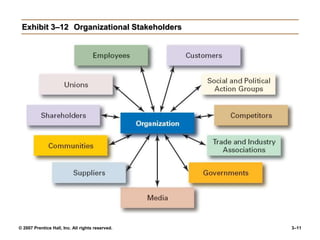
Stakeholder Relationships
• Stakeholders
Any constituencies in the organization’s environment
that are affected by the organization’s decisions and
actions
• Why Manage Stakeholder Relationships?
It can lead to improved organizational performance.
It’s the “right” thing to do given the interdependence
of the organization and its external stakeholders.
© 2007 Prentice Hall, Inc. All rights reserved. 3–11
Exhibit 3–12 Organizational Stakeholders

Chapter 03.pptx

  • 1.
    ninth edition STEPHEN P.ROBBINS PowerPoint Presentation by Charlie Cook The University of West Alabama MARY COULTER © 2007 Prentice Hall, Inc. All rights reserved. Organizational Culture and Environment: The Constraints Chapter 3
  • 2.
    © 2007 PrenticeHall, Inc. All rights reserved. 3–2 The Manager: Omnipotent or Symbolic? • Omnipotent View of Management Managers are directly responsible for an organization’s success or failure. The quality of the organization is determined by the quality of its managers. Managers are held accountable for an organization’s performance yet it is difficult to attribute good or poor performance directly to their influence on the organization.
  • 3.
    © 2007 PrenticeHall, Inc. All rights reserved. 3–3 The Manager: Omnipotent or Symbolic? • Symbolic View of Management Much of an organization’s success or failure is due to external forces outside of managers’ control. The ability of managers to affect outcomes is influenced and constrained by external factors.  The economy, customers, governmental policies, competitors, industry conditions, technology, and the actions of previous managers Managers symbolize control and influence through their action.
  • 4.
    © 2007 PrenticeHall, Inc. All rights reserved. 3–4 Exhibit 3–1 Parameters of Managerial Discretion
  • 5.
    © 2007 PrenticeHall, Inc. All rights reserved. 3–5 The Organization’s Culture • Organizational Culture A system of shared meanings and common beliefs held by organizational members that determines, in a large degree, how they act towards each other. “The way we do things around here.”  Values, symbols, rituals, myths, and practices Implications:  Culture is a perception.  Culture is shared.  Culture is descriptive.
  • 6.
    © 2007 PrenticeHall, Inc. All rights reserved. 3–6 How Employees Learn Culture • Stories  Narratives of significant events or actions of people that convey the spirit of the organization • Rituals  Repetitive sequences of activities that express and reinforce the values of the organization • Material Symbols  Physical assets distinguishing the organization • Language  Acronyms and jargon of terms, phrases, and word meanings specific to an organization
  • 7.
    © 2007 PrenticeHall, Inc. All rights reserved. 3–7 Defining the External Environment • External Environment Those factors and forces outside the organization that affect the organization’s performance. • Components of the External Environment Specific environment: external forces that have a direct and immediate impact on the organization. General environment: broad economic, socio- cultural, political/legal, demographic, technological, and global conditions that may affect the organization.
  • 8.
    © 2007 PrenticeHall, Inc. All rights reserved. 3–8 Exhibit 3–9 The External Environment
  • 9.
    © 2007 PrenticeHall, Inc. All rights reserved. 3–9 How the Environment Affects Managers • Environmental Uncertainty The extent to which managers have knowledge of and are able to predict change their organization’s external environment is affected by:  Complexity of the environment: the number of components in an organization’s external environment.  Degree of change in environmental components: how dynamic or stable the external environment is.
  • 10.
    © 2007 PrenticeHall, Inc. All rights reserved. 3–10 Stakeholder Relationships • Stakeholders Any constituencies in the organization’s environment that are affected by the organization’s decisions and actions • Why Manage Stakeholder Relationships? It can lead to improved organizational performance. It’s the “right” thing to do given the interdependence of the organization and its external stakeholders.
  • 11.
    © 2007 PrenticeHall, Inc. All rights reserved. 3–11 Exhibit 3–12 Organizational Stakeholders